

Last Updated: 06/22/2026
The wrong rewards card can quietly cost you 20,000 to 50,000 points a year. The right one depends less on the “best” headline offer and more on where your money actually goes. The best credit cards for points and miles in 2026 are not one-size-fits-all. A dining-heavy household, a frequent flyer, a renter, and a small-business owner should not all use the same setup.
The practical answer: start with transferable points, then match the card to your spending pattern.
Chase Ultimate Rewards, American Express Membership Rewards, Capital One miles, Citi ThankYou points, and Bilt points each connect to airline and hotel partners. Those points transfer partners can unlock values above 2.0 cents per point through sweet spots like World of Hyatt, Air Canada Aeroplan, Avianca LifeMiles, Air France-KLM Flying Blue, and select premium cabin awards.
But there are tradeoffs.
Award availability can be tight. Dynamic pricing can erase value. Fuel surcharges can make a “cheap” award expensive. Transfer bonuses help, but only when award space exists. This practical guide ranks the top cards by spending style, not by hype.
Key Takeaways
- Best overall for most travelers: Chase Sapphire Preferred® because of its low fee, strong travel protections, Hyatt access, and simple Chase points strategy.
- Best for dining and groceries: American Express® Gold Card if you can use its credits and stay within category caps.
- Best everyday earner: Capital One Venture X Rewards Credit Card because 2X Capital One miles on most purchases is easy to use.
- Best premium card: The Platinum Card® from American Express only if you actually use the lounge access and statement credits.
- Best trifecta strategy: Build around your highest spend bucket first, then add no-annual-fee or business cards to increase earning without adding unnecessary fees.
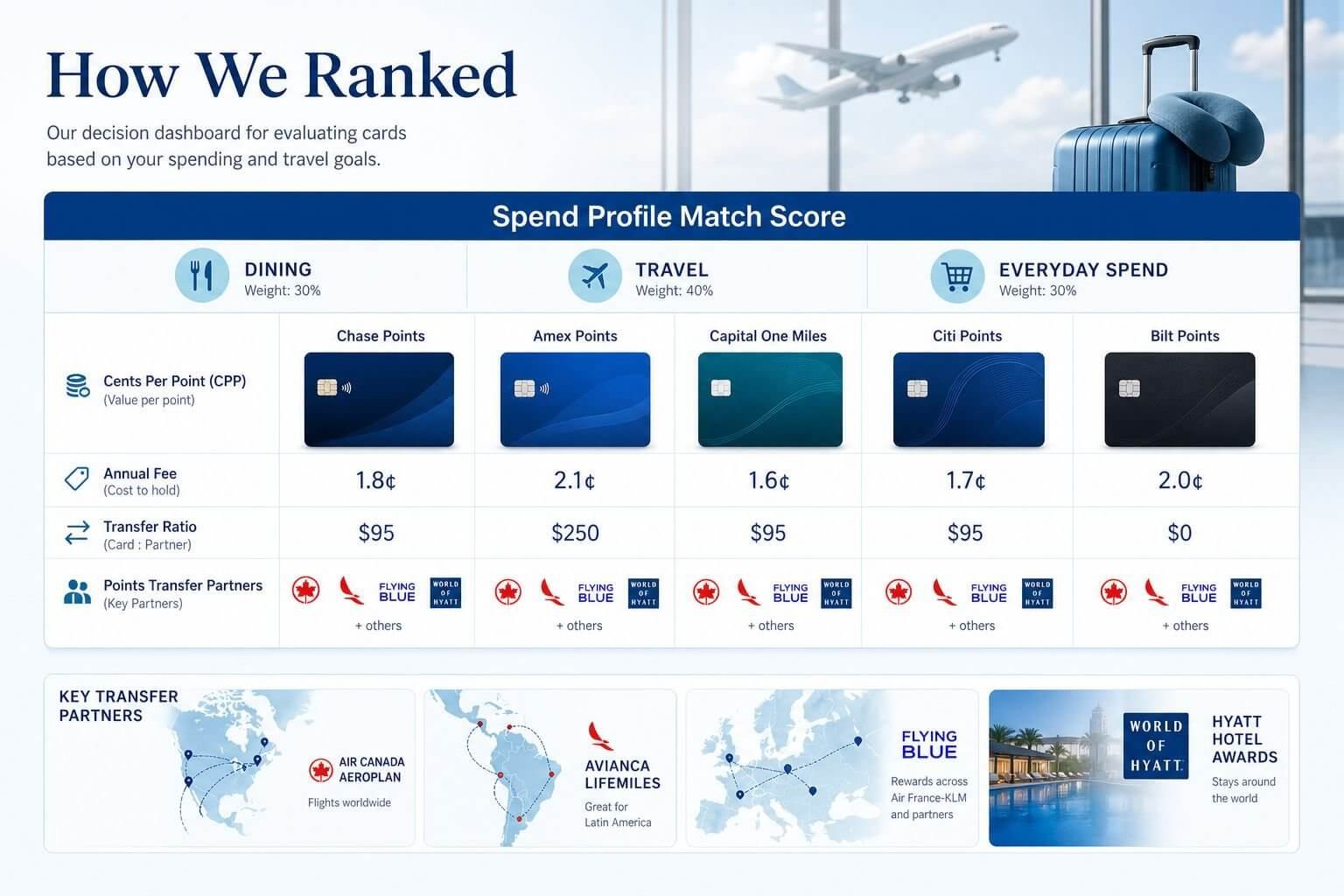
How We Ranked: Earning Rates, Transfer Partners, Real-World Value
A good points card is not just a high welcome bonus. It needs to earn well after the bonus, transfer to useful partners, and fit your booking strategy.
For this 2026 ranking, the main factors were:
You may be interested
Earning rates by category
- Dining
- Groceries
- Travel
- Everyday spend
- Business spend
Transferable points value
- Chase points
- Amex points
- Capital One miles
- Citi points
- Bilt points
Partner quality
- Airline alliance partners
- Hotel partners
- Transfer ratios
- Sweet spots
- Transfer bonuses
Real-world booking value
- Award availability
- Surcharges and fees
- Fuel surcharges
- Dynamic pricing
- Devaluation risk
Application rules
- Chase 5/24
- Amex once-per-lifetime language
- Citi 8/65/95 timing rules
- Business card eligibility



For a deeper comparison of currencies, see our complete guide to the best transferable points programs.
2026 Card Snapshot
Welcome offers change often. The offers below reflect commonly seen public or elevated offers around publication, but always verify the issuer page before applying.
| Card | Annual Fee | Common 2026 Welcome Offer | Currency | Key Earning Rates |
|---|---|---|---|---|
| Chase Sapphire Preferred® | $95 | 75,000 Chase points after required spend | Chase Ultimate Rewards | 3X dining, 2X travel, 3X select streaming, 3X online grocery, 1X other |
| Chase Sapphire Reserve® | $795 | Varies by offer | Chase Ultimate Rewards | 4X flights/hotels booked direct, 3X dining, elevated Chase Travel portal earn |
| Amex Gold | $325 | Often 60,000+ Amex points after required spend | Amex Membership Rewards | 4X restaurants, 4X U.S. supermarkets, 3X flights, 1X other |
| Amex Platinum | $895 | Often 80,000+ Amex points after required spend | Amex Membership Rewards | 5X flights, 5X prepaid hotels via Amex Travel, 1X other |
| Capital One Venture X | $395 | Often 75,000 Capital One miles after required spend | Capital One Miles | 2X everywhere, 5X flights via portal, 10X hotels/rental cars via portal |
| Citi Strata Premier℠ | $95 | Often 60,000 Citi points after required spend | Citi ThankYou Rewards | 3X restaurants, supermarkets, gas/EV, air travel, hotels |
| Ink Business Preferred® | $95 | Often 90,000 Chase points after required spend | Chase Ultimate Rewards | 3X select business categories up to annual cap |
Spend Profile Match Score
Use this simple profile:
- $5,000 dining
- $4,000 travel
- $20,000 everyday spend
- $29,000 total annual card spend
Assumed transferable point values:
- Chase points: 1.8 CPP
- Amex points: 1.7 CPP
- Capital One miles: 1.6 CPP
- Citi points: 1.5 CPP
If you want to adjust the math, use our cents per point calculator guide.
| Card | Estimated Points Earned | Gross Travel Value | Net After Annual Fee* | Best Fit |
|---|---|---|---|---|
| Chase Sapphire Preferred | ~45,900 | ~$826 | ~$731 | Most travelers |
| Chase Sapphire Reserve | ~51,000 | ~$918 | ~$423 after $795 fee, before credits beyond travel credit | Heavy travelers |
| Amex Gold | ~44,000 | ~$748 | ~$423 before credits | Dining and grocery spenders |
| Capital One Venture X | ~58,000 | ~$928 | Strong if $300 credit + 10K anniversary miles are used | Everyday spend |
| Citi Strata Premier | ~47,000 | ~$705 | ~$610 | Balanced gas, grocery, dining |
| Amex Platinum | ~45,000 if travel-heavy | ~$765 | Weak unless credits are used | Lounge and benefits users |
*Net figures are simplified. Credits, portal bookings, retention offers, and transfer bonuses can change the result.
Important 2026 Transfer Bonus Context
Transfer bonuses can improve redemption value, but they should not drive applications by themselves.
Recent 2026 examples included:
- Chase to Marriott Bonvoy: 65% bonus
- Chase to Flying Blue: 20% bonus
- Citi to Leading Hotels of the World: 25% bonus
- Amex to JetBlue TrueBlue: 10% bonus
- Capital One to Qantas Frequent Flyer: 20% bonus
These can be useful, but only if the award price is fair. A 20% bonus does not fix bad dynamic pricing or poor award availability.
Rule of thumb: Do not transfer points until you have found award space and confirmed the taxes, fees, and routing rules.
Best Overall: The Card That Wins for Most Travelers
The Chase Sapphire Preferred® is the best overall pick for most U.S.-based points and miles users in 2026.
It is not the most premium card. It does not have the biggest lounge package. But it gives most travelers the best balance of annual fee, travel protections, transfer partners, and booking flexibility.
Why It Wins
Best for:
- Travelers under Chase 5/24
- People who want a low annual fee
- Hyatt users
- Beginners building a Chase points base
- Travelers who value trip delay and rental car protections
Not for:
- Heavy lounge users
- People who want 2X everywhere
- Amex-heavy users who prefer ANA, Cathay Pacific, or other Membership Rewards partners
- Anyone over Chase 5/24 who cannot get approved

Why Chase Points Are So Useful
Chase points are valuable because the program has a tight partner list and one standout hotel partner: World of Hyatt.
Hyatt remains one of the clearest best use of points options, even after the 2026 World of Hyatt devaluation. Award charts still help create outsized value, but devaluation risk is real. Always compare the cash price, points price, taxes, and cancellation terms.
Example:
- Cash hotel price: $420
- Hyatt award price: 20,000 points
- Taxes and fees on award: often low
- Value: 2.1 CPP
That is better than most portal redemptions, but it depends on award space and the specific hotel category.
Chase also transfers to partner airlines such as Air Canada Aeroplan, United MileagePlus, Southwest Rapid Rewards, British Airways Avios, Virgin Atlantic Flying Club, and Air France-KLM Flying Blue. For route planning, our airline alliance guide can help you compare options across Star Alliance, Oneworld, and SkyTeam.
Booking Walkthrough: Chase Points to Europe
Assume you want a business class deal from New York to Paris.
- Search Flying Blue for JFK-CDG and EWR-CDG.
- Check nearby dates because dynamic pricing changes daily.
- Compare Air France/KLM pricing against Aeroplan and Virgin Atlantic.
- Watch for a Chase transfer bonus to Flying Blue.
- Transfer only after award space appears.
- Book quickly because premium cabin awards can disappear.
Example math:
- Cash price: $3,200
- Award price: 50,000 miles
- Taxes and fees: $220
- Net value: about 5.96 CPP
That looks strong, but it is not guaranteed. Flying Blue pricing is dynamic, and surcharges and fees can be meaningful.
Best for Dining and Grocery Earners
The American Express® Gold Card is the strongest pick for dining and grocery-heavy households.
It earns:
- 4X at restaurants up to the annual cap
- 4X at U.S. supermarkets up to the annual cap
- 3X on flights booked directly with airlines or Amex Travel
- 1X on most other purchases
Important cap note: Amex Gold has separate caps. The restaurant cap is higher than the U.S. supermarket cap. Do not assume all 4X categories have the same limit.
Best Credit Cards for Points and Miles If Food Spend Is Your Main Category
Amex Gold can beat Chase Sapphire Preferred on raw earning if your spending is concentrated in dining and groceries.
Example annual spend:
- Dining: $12,000
- U.S. supermarkets: $10,000
- Other: $7,000
Estimated Amex points:
- Dining: 48,000
- Supermarkets: 40,000
- Other: 7,000
- Total: 95,000 Amex points
At 1.7 CPP, that is about $1,615 in travel value before the annual fee and credits.
Where Amex Points Shine
Amex Membership Rewards has a wide list of airline partners. Strong uses often include:
- ANA Mileage Club for round-trip premium cabin awards
- Air Canada Aeroplan for Star Alliance partner airlines
- Avianca LifeMiles for lower-surcharge Star Alliance awards
- Air France-KLM Flying Blue for Europe
- British Airways, Iberia, and Qatar Avios for Oneworld options
For premium cabin awards, Amex points can be excellent. But the best redemptions often need flexibility, award search tools, and patience. If you are planning Japan business class, compare partner options in our guide to the best points for Japan business class.
Main Tradeoffs
Amex Gold is not ideal for everyone.
Watch for:
- High annual fee
- Credits that may not fit your normal habits
- Limited Amex acceptance at some merchants
- Once-per-lifetime welcome bonus restrictions
- Transfer delays with certain partners
- Fuel surcharges on some airline programs
If you only spend modestly on food, Chase Sapphire Preferred or Citi Strata Premier may be simpler.
Best for Travel Spend (Flights, Hotels, Rideshare)
The best card for travel spend depends on whether you want direct-booking flexibility or portal earning.
Best Direct Travel Earner: Chase Sapphire Reserve®
The refreshed Chase Sapphire Reserve is best for frequent travelers who book paid flights and hotels directly.
It can earn strong rewards on:
- Flights booked direct
- Hotels booked direct
- Dining
- Chase Travel portal bookings
The issue is the annual fee. At $795, the card needs real use. The easy $300 travel credit helps, but it does not make the card automatically worth it.
Best for:
- Frequent travelers
- People who value travel protections
- Travelers who use lounges and partner benefits
- Users who can redeem Chase points well
Not for:
- Casual travelers
- People who dislike coupon-style credits
- Anyone who mostly books basic economy cash fares
- Users who will redeem through poor-value options
For a broader premium card break-even view, see our guide: Are Premium Travel Cards Worth It in 2026?.
Best Mid-Tier Travel Card: Citi Strata Premier℠
Citi Strata Premier is easy to overlook, but it earns well across common travel and lifestyle categories.
It earns 3X on:
- Air travel
- Hotels
- Restaurants
- Supermarkets
- Gas stations and EV charging
That makes it one of the best travel rewards credit cards 2026 users should compare if they want a $95 annual fee and broad 3X categories.
Citi points transfer to useful airline partners, including Turkish Airlines Miles&Smiles, Avianca LifeMiles, Flying Blue, Virgin Atlantic, and others. The downside: Citi has no Hyatt-like hotel partner for simple high-value stays.
Rideshare and Portal Warning
Portal earning can be useful, but do not chase multipliers blindly.
Before booking through any portal, compare:
- Cash price direct
- Portal price
- Hotel elite benefits
- Cancellation rules
- Trip insurance coverage
- Whether the booking earns hotel points
For hotels, booking direct often matters. For flights, booking direct can make schedule changes and cancellations easier.
Best for Everyday Earners Who Don’t Want Categories
The Capital One Venture X Rewards Credit Card is the best pick for users who want simple, everyday earnings without tracking categories.
It earns 2X Capital One miles on most purchases, which is powerful because it applies everywhere.
Why Venture X Works
The card has a $395 annual fee, but the value stack is simple if you use it correctly:
- $300 annual Capital One Travel credit
- 10,000 anniversary miles
- Lounge access
- 2X everyday earning
- Transferable Capital One miles
For a full breakdown of the fee math, read our Venture X benefits guide.
Best Use of Capital One Miles
Capital One miles transfer to many airline partners. Strong options include:
- Air Canada Aeroplan
- Avianca LifeMiles
- Turkish Airlines Miles&Smiles
- Air France-KLM Flying Blue
- British Airways Avios
- Qantas Frequent Flyer
Recent 2026 transfer bonuses, such as Capital One to Qantas, can improve value for Australia-bound awards. But Qantas pricing and partner availability can be uneven, so always compare options before transferring.
For a full partner breakdown, use our Capital One miles transfer partners guide.
Example: Everyday Spend Math
Assume:
- $30,000 annual non-bonus spend
- Venture X earns 2X
- Total: 60,000 Capital One miles
- Value at 1.6 CPP: $960
That is strong for simple earning. The tradeoff is that Capital One has fewer easy hotel sweet spots than Chase.
Best Premium Card If You Use the Lounge and Credit Stack
The Amex Platinum is the best premium card only if you use the lounge access and credits at close to face value.
This card is not a strong everyday earner. It is a benefits card.
Best for Luxury Travel Benefits
Amex Platinum can make sense if you use:
- Centurion Lounges
- Priority Pass lounges
- Delta Sky Club access when eligible
- Fine Hotels + Resorts
- Airline fee credits
- Digital, entertainment, rideshare, or lifestyle credits
- 5X flights booked direct or through Amex Travel
The problem is opportunity cost. If a credit makes you spend money you would not otherwise spend, it is not worth face value.
Best Credit Cards for Points and Miles: Premium Card Decision Framework
Use this test:
- Will you use airport lounges at least 6 to 10 times per year?
- Will you book enough paid flights to benefit from 5X earning?
- Can you use statement credits without changing your habits?
- Do you value Amex transfer partners for premium cabin awards?
- Are you comfortable with Amex once-per-lifetime bonus rules?
If the answer is no to most of these, Amex Gold, Chase Sapphire Preferred, or Venture X may be better.
Main Risks
Premium cards have more moving parts.
Common pitfalls include:
- Overvaluing credits
- Forgetting enrollment requirements
- Booking through portals when direct booking is better
- Transferring Amex points before confirming award space
- Paying high fuel surcharges for first class redemptions
If lounge access is the main goal, compare the real cost after credits. If earning points is the main goal, Amex Platinum is usually not the first card to get.
Best Business Card for Self-Employed and Side-Hustlers
The Ink Business Preferred® Credit Card is the best business card for many award travelers with side-hustle or self-employed spend.
It earns Chase Ultimate Rewards and has a $95 annual fee.
Strong Business Categories
Ink Business Preferred earns 3X on the first $150,000 in combined annual spending in categories such as:
- Travel
- Shipping
- Internet, cable, and phone services
- Advertising on select social media and search engines
That can be a major points engine for consultants, online sellers, freelancers, and small-business owners.
Why It Pairs Well With Chase Sapphire Cards
Ink Business Preferred already allows transfers to Chase points transfer partners. If you also hold Chase Sapphire Preferred or Reserve, you can pool Chase points across cards and households, subject to Chase rules.
That creates a simple business-plus-personal setup:
- Ink Business Preferred for business categories
- Chase Sapphire Preferred for dining and travel
- Freedom Unlimited or Freedom Flex for no-annual-fee earning
For more business-card options, see our best business credit cards for award travel guide.
Application Rule Notes
Business cards have additional rules.
Watch for:
- Chase 5/24 status
- Business documentation
- Accurate revenue reporting
- Welcome bonus clawback risk
- Category cap limits
Do not apply for business cards unless you can honestly support the business purpose and spending requirement.
Pairing Cards: Building a 2026 Trifecta Around Your Spend
A credit card trifecta strategy means using multiple cards in the same rewards ecosystem to cover more spending categories.
The goal is simple: maximize points without adding wasteful annual fees.
Best Chase Trifecta
Good for most travelers.
| Card | Role |
|---|---|
| Chase Sapphire Preferred | Transfers, travel protections, dining |
| Freedom Unlimited | Everyday earning |
| Freedom Flex | Rotating 5X categories |
| Ink Business Preferred | Business spend, optional |
Best for:
- Hyatt redemptions
- Balanced travel
- Families
- Users under 5/24
Not for:
- Heavy grocery spenders
- Users who need lots of lounge access
- People over 5/24
Best Amex Trifecta
Good for high food spend and premium cabin awards.
| Card | Role |
|---|---|
| Amex Gold | Dining and groceries |
| Amex Platinum | Flights and premium benefits |
| Blue Business Plus | Everyday 2X business spend |
Best for:
- Dining-heavy households
- ANA, Aeroplan, Flying Blue, and LifeMiles users
- Premium cabin awards
Not for:
- People who cannot use credits
- Users who want simple cash-like redemptions
- Travelers sensitive to surcharges and fees
Best Capital One Setup
Good for simple earning.
| Card | Role |
|---|---|
| Venture X | 2X everyday, lounge access, travel credit |
| Savor or SavorOne | Dining, groceries, entertainment cash back that may pair well depending on product rules |
Best for:
- Everyday spend
- Simple earning
- Users who do not want many cards
Not for:
- Hyatt-focused travelers
- Users who avoid portals completely
- People who want the deepest U.S. airline partner list
Best Citi Setup
Good for broad 3X earning.
| Card | Role |
|---|---|
| Citi Strata Premier | Travel, gas, groceries, dining |
| Citi Double Cash | Everyday earning |
| Citi Custom Cash | One high monthly category |
Best for:
- Gas and grocery spenders
- Flexible airline redemptions
- Low-fee strategy
Not for:
- Hyatt loyalists
- Travelers who need premium protections
- Users who rely heavily on domestic airline partners
Step-by-Step Guide: Pick Your Setup
Use this decision framework:
Under Chase 5/24?
- Start with Chase Sapphire Preferred if you want Hyatt or a simple first ecosystem.
Spend over $15,000 per year on dining and groceries?
- Compare Amex Gold against Chase and Citi.
Have lots of non-bonus spend?
- Capital One Venture X or Blue Business Plus may matter more than category cards.
Need lounges?
- Compare Venture X, Amex Platinum, and Chase Sapphire Reserve.
Book premium cabin awards?
- Prioritize transfer partners over portal value.
Book hotels with points?
- Chase and Bilt are stronger because of Hyatt.
Do you rent?
- Bilt can be valuable because it earns Bilt points on rent without the usual card fee, subject to rules.
Common Pitfalls to Avoid
- Transferring points before finding award space
- Ignoring fuel surcharges
- Overvaluing hotel points after devaluations
- Using the wrong card for a bonus category
- Opening premium cards only for lounge access
- Forgetting annual fee review dates
- Chasing transfer bonuses with no booking plan
- Booking married segments without understanding restrictions
- Skipping positioning flights when they unlock better award space
Award search tools can save time here. If you are comparing premium cabin awards, start with our best award search tools guide.
Conclusion
The best credit cards for points and miles in 2026 depend on your spending style and your redemption plan.
For most travelers, Chase Sapphire Preferred is the best first move because it has a low annual fee, strong Chase points value, Hyatt access, and useful airline partners. If dining and groceries dominate your budget, Amex Gold can earn faster. If you want simple everyday earning, Capital One Venture X is hard to beat. If you want premium lounge benefits, compare Amex Platinum and Chase Sapphire Reserve carefully before paying the fee.
The right next step:
- Add up your last 12 months of dining, grocery, travel, and everyday spend.
- Pick one transferable points ecosystem first.
- Check application rules before applying.
- Build a two- or three-card setup only if the extra card clearly improves earning.
- Before transferring points, confirm award availability, taxes, fees, and cancellation rules.
Points are most valuable when they stay flexible until the moment you book. That is the core rule for avoiding mistakes and getting real redemption value in 2026.


Content on Award Travel Hub is independently created by Award Travel Hub Editorial Desk and, where noted, reviewed by Award Travel Hub Review Desk. Some pages may contain affiliate links, but compensation does not determine our coverage, opinions, or methodology.