

Last updated: June 15, 2026
Quick Answer
For most U.S. families flying 3–5 people to Japan in 2026–2027, Aeroplan is the best starting point because it pools points across up to 8 family members, transfers from Amex, Chase, Capital One, and Bilt, and books ANA and United seats on Star Alliance. Use ANA Mileage Club only when you have a single account holder, flexible dates, and want lower mileage rates round-trip. Use JAL Mileage Bank (or partners like Alaska/American) when JAL is the only carrier with 3–5 seats open. Watch out: JAL and ANA roughly doubled fuel surcharges to North America starting May 1, 2026, adding roughly $700+ per round-trip on partner award tickets.
Key Takeaways
- Aeroplan wins on flexibility: family pooling for up to 8 members, no residency restriction, and four major transfer partners feeding the account.
- ANA Mileage Club has the lowest sticker price for round-trip business class to Japan, but the family account service excludes Japan residents only and has stricter rules.
- JAL Mileage Bank isn’t an Aeroplan partner; book JAL through Alaska, American AAdvantage, or British Airways Avios instead.
- Fuel surcharges roughly doubled on JAL/ANA flights to North America as of May 1, 2026—budget $300–$370 one-way on partner awards.
- Search for 3–5 award seats together is the real bottleneck, not points balance. Use multi-program tools and check 355 days out for ANA, 11 months for Aeroplan/AC.
- Have a pivot plan: if you can’t find 4 business seats, mix cabins, split the family across two flights, or switch to United/Air Canada metal.
- Build points across two cards in two ecosystems (e.g., Chase + Amex) so you have flexibility to transfer to whichever program has space.
Why family awards to Japan are uniquely hard in 2026
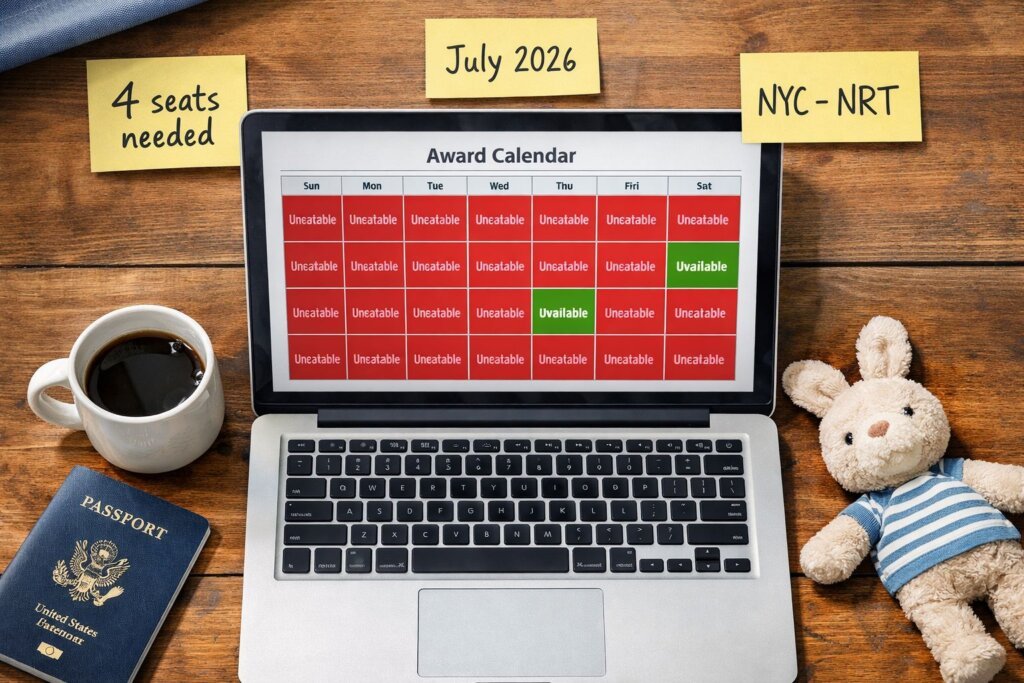
Three or four award seats in the same cabin on the same flight is the actual challenge—not the points balance. Japan is one of the highest-demand long-haul destinations from North America, and award space gets thinner during summer school holidays (June–August), spring break (late March), and cherry blossom season (late March to mid-April).
Two new pressures in 2026 make this harder:
- Fuel surcharges nearly doubled on JAL and ANA flights to North America starting May 1, 2026, jumping from around $190 to roughly $365 one-way per ticket. For a family of four flying round-trip, that’s an extra ~$1,400 in cash on top of your award.
- ANA’s system integration runs from May 19 through late June 2026, which may temporarily affect availability checks and award booking on ANA.co.jp.
- Aeroplan shifted toward revenue-based earning for Air Canada flights in 2026, but partner award redemptions on ANA and United still follow the published distance-based chart.
The good news: with a structured workflow, families can still lock in 3–5 seats together if they start early and stay flexible.
Aeroplan vs ANA vs JAL: strengths and weaknesses for families
Here’s the quick comparison families actually need:
| Feature | Aeroplan | ANA Mileage Club | JAL Mileage Bank |
|---|---|---|---|
| Transfers from | Amex, Chase, Capital One, Bilt, Marriott | Amex, Marriott | Marriott only (no major bank partners) |
| Family pooling | Up to 8 members, broad relationship rules | 2–8 members, non-Japan residents only | Up to 9 members, non-Japan residents only |
| Round-trip required? | No (one-ways priced same) | Yes (round-trip only for partner awards) | No |
| Stopover allowed? | Yes, 5,000 points extra | Limited | Limited |
| Fuel surcharges to U.S.? | Yes, on ANA flights | Yes (own metal) | Yes |
| Business class NYC–Tokyo (typical) | 75K–87.5K one-way | ~75K–85K round-trip (low season) | ~85K–100K round-trip (own metal) |
| Economy NYC–Tokyo (typical) | 50K–55K one-way | 40K–55K round-trip | 50K–65K round-trip |
| Best for | Most U.S. families pooling bank points | Aspirational round-trip with flexible dates | Backup when only JAL has 4 seats |
| Not for | Anyone allergic to YQ surcharges | Last-minute or one-way trips | Building from transferable points |
Aeroplan: the default starting point
Most U.S. families should start here. You can transfer points from four major bank programs and pool everything in one account through Aeroplan’s family sharing, with no residency restriction. Aeroplan also charges only 5,000 points for a stopover—useful for splitting a Tokyo + Osaka itinerary.
The catch: Aeroplan passes ANA’s fuel surcharges through to award tickets. After the May 2026 hike, expect $300–$370 per person one-way in YQ on ANA-operated segments. United-operated flights via Aeroplan don’t carry YQ, so prioritize UA metal where possible.
ANA Mileage Club: the round-trip sweet spot
ANA’s own award chart is one of the better deals out there—roughly 75,000–85,000 miles round-trip in business class from North America in low season, plus surcharges and taxes. The drawbacks: round-trip only, partner bookings can’t be done online for some carriers, and the family account service has strict rules. Amex Membership Rewards transfers 1:1, but transfers can take 1–3 days.
JAL Mileage Bank: usually accessed through partners
JAL is in oneworld, not Star Alliance, so Aeroplan can’t book it. If JAL is the only carrier showing 4 seats, use:
- Alaska Mileage Plan (transfers from Bilt; check our Atmos Rewards sweet spots guide)
- American AAdvantage (limited transfer partners; see AAdvantage 2026 changes)
- British Airways Avios (Amex, Chase, Capital One transfer in)
You may be interested



JAL Mileage Bank itself is hard to fund from U.S. bank points outside of Marriott transfers.

Step-by-step workflow: how to book family award flights to Japan with points
Follow this order. Skipping steps is the #1 reason people burn points without seats.
Step 1: Lock dates and cabin before transferring anything
Decide on:
- Travel window (specific 7–10 day range, not just “summer”)
- Cabin (economy, premium economy, business)
- Origin flexibility (NYC vs. EWR vs. JFK; any West Coast positioning option)
- Destination flexibility (HND, NRT, KIX, NGO)
Wider flexibility = dramatically better odds for 4 seats.
Step 2: Search the backbone tools first
Before touching points, confirm seats actually exist. Use:
- Aeroplan’s own search at aircanada.com (shows ANA, United, EVA, Lufthansa, etc.)
- United.com for United/ANA partner space (you’ll see a superset of Star Alliance availability)
- ANA’s website for ANA-operated flights, opens 355 days out at 9 AM JST
- Alaska.com for JAL availability
- A paid tool like seats.aero, AwardTool, or Daily Drop Pro to scan multiple programs at once
Our beginner award search tools guide walks through these in detail.
Set alerts for 4+ seats. Manual refreshing is a waste of time.
Step 3: Decide which program to use
Use this decision rule:
Choose Aeroplan if you need flexibility, want to pool points from multiple bank programs, or are open to mixing carriers. Choose ANA if you’re booking round-trip on ANA metal in low season and want the lowest mileage cost. Choose JAL/partners if JAL is the only carrier showing 4 seats together.
Step 4: Transfer points strategically
Don’t transfer until you have a confirmed seat hold or are ready to book within 1 hour.
Transfer speeds:
- Amex → Aeroplan: instant
- Chase → Aeroplan: instant
- Capital One → Aeroplan: instant
- Bilt → Aeroplan: instant
- Amex → ANA: 1–3 days (highest devaluation risk—wait until ready)
- Marriott → JAL: ~24 hours (3:1 ratio plus 5K bonus per 60K transferred)
Watch for transfer bonuses—Chase and Amex periodically run 20–30% Aeroplan bonuses, which can save 60K+ points across a family of four.
Step 5: Book and confirm
Book all passengers on the same record where possible. Some programs require splitting bookings into pairs (Aeroplan’s online tool may struggle with 5+ passengers—call if needed). Save your confirmation, e-ticket numbers, and double-check seat assignments using airline seat selection tools.

Example itineraries and real-world CPP for families
Family A: Economy-heavy, 4 passengers, NYC → Tokyo, October 2026 (shoulder)
- Route: JFK → NRT on ANA, return NRT → JFK on United
- Program: Aeroplan
- Cost per person: 55,000 points + ~$420 in taxes/YQ (ANA leg)
- Total: 220,000 Aeroplan points + ~$1,680 in fees
- Cash equivalent: roughly $1,650 per person economy = $6,600
- CPP: ($6,600 − $1,680) ÷ 220,000 = 2.24 cents per point
Solid use of points. The ANA leg’s surcharges hurt but the math still works.
Family B: Business class aspirational, 3 passengers (2 adults + 1 teen), LAX → Osaka, April 2027
- Route: LAX → HND on ANA business, HND → KIX domestic, return KIX → LAX on ANA business
- Program: Aeroplan with stopover
- Cost per person: 80,000 + 5,000 stopover = 85,000 points + ~$700 in taxes/YQ
- Total: 255,000 Aeroplan points + ~$2,100
- Cash equivalent: ~$5,800 per person business = $17,400
- CPP: ($17,400 − $2,100) ÷ 255,000 = 6.0 cents per point
Excellent redemption, but only if you can find 3 ANA business seats on your dates—often the hardest part.
When to pivot programs (or cabins) to avoid dead ends
If you’ve searched for 2–3 weeks and haven’t found 4 seats together, pivot:
- Mix cabins: 2 business + 2 premium economy on the same flight is often easier than 4 business
- Split flights: 2 family members on the morning departure, 2 on the evening (only with older kids)
- Add a positioning flight: fly to SFO, LAX, or YVR first to access more outbound options. Read our positioning flight guide for the buffer math
- Switch alliance: if Star Alliance is dry, check oneworld via Alaska for JAL or American for JAL/Cathay
- Adjust dates: shifting by 3–5 days often opens space, especially mid-week
- Drop a leg: book the outbound on points, return on cash if cash prices are reasonable
The real common pitfall: families speculatively transfer 400K Amex points to ANA, then can’t find seats and are stuck. Always confirm space first.
Best cards and transfer partners to build toward a Japan trip
The most flexible path is two cards in two ecosystems. Recommended stack for a family of four:
- Chase Sapphire Preferred or Reserve → transfers to Aeroplan, United, Hyatt
- Amex Gold or Platinum → transfers to Aeroplan, ANA, Avios
- Capital One Venture X → transfers to Aeroplan, Avios, Virgin
- Bilt Mastercard → transfers to Aeroplan, Alaska (for JAL), Avios
For details on which cards to prioritize, see our transferable points programs guide and the premium cards break-even analysis.
Rough points target for a family of four:
- 4× economy round-trip via Aeroplan: ~440,000 points + $1,700
- 4× business round-trip via Aeroplan: ~700,000 points + $2,800
Spread across two parents with two cards each, that’s a 12–18 month earning project including sign-up bonuses. Consider two-player mode strategy for couples.
Timeline planning for Japan trips in 2026 and 2027
- 12+ months out: choose dates, open cards, start meeting sign-up bonuses
- 355 days out: ANA opens its own award space at 9 AM JST (8 PM ET previous day)
- 11 months out: Aeroplan and Air Canada award space opens
- 6–9 months out: best window to find 3–5 seats together; set alerts
- 3 months out: most remaining business class space gets booked or absorbed; pivot to economy or alternate dates if dry
- 30 days out: ANA close-in availability often improves on ANA-operated flights, but not always to 4 seats
- 14 days out: Aeroplan close-in window; sometimes new seats appear
Read our broader when to book award flights guide for sweet-spot timing.
Frequently asked questions
How many miles do I need for a family of 4 to Japan in business class? Plan for roughly 600,000–700,000 Aeroplan points round-trip plus $2,500–$3,000 in surcharges and taxes after the May 2026 YQ hike. ANA Mileage Club is cheaper at ~340,000 miles total round-trip for four in low season, but harder to fund and book.
Can I find 4 award seats together on the same flight to Japan? Sometimes, but rarely on the day you first look. Set alerts, search 9–11 months out, stay flexible on dates and airports, and be willing to mix cabins or split flights.
Is Aeroplan or ANA cheaper for Japan Business Class? ANA’s own chart is cheaper per mile, but Aeroplan is more flexible (one-ways, stopovers, more transfer partners, family pooling). For most U.S. families, Aeroplan is more practical even at higher mileage cost.
Why are Japan award fees so high in 2026? JAL and ANA roughly doubled fuel surcharges on North America routes effective May 1, 2026. Award tickets booked through partners (including Aeroplan) pass these through. United-operated flights don’t carry YQ.
Can I book JAL with Aeroplan miles? No. JAL is in oneworld; Aeroplan is Star Alliance. Use Alaska Mileage Plan, American AAdvantage, or British Airways Avios instead.
Should I transfer points before finding award space? No. Confirm space first, then transfer. Transfers to Aeroplan from Amex/Chase/Cap One/Bilt are instant. ANA transfers take 1–3 days, so only transfer when ready to book.
Does Aeroplan family sharing actually work for non-Canadians? Yes. Up to 8 members can pool points with no residency restriction, covering spouses, children, siblings, in-laws, parents, and grandparents.
What if my family has 5 people? Aeroplan and ANA both support up to 8 family members in their pooling programs. JAL allows up to 9. For booking, you may need to split into two reservations of 2–3 passengers each.
Conclusion: your next steps
For most U.S. families targeting Japan in 2026–2027, the workflow is:
- Set your dates and cabin this week.
- Open or confirm two transferable points ecosystems (Chase + Amex is the default).
- Set up award search alerts for 4+ seats in your target window.
- Default to Aeroplan for the booking, with ANA and JAL/Alaska as backups.
- Don’t transfer points until you’ve found confirmed space.
- Budget for the new fuel surcharges—an extra $700+ per round-trip ticket on ANA/JAL metal.
The families who succeed at this aren’t the ones with the most points. They’re the ones who start 9–12 months early, stay flexible on dates and airports, and have a clear pivot plan. Pick your dates, set your alerts, and start building the points balance now.




Content on Award Travel Hub is independently created by Award Travel Hub Editorial Desk and, where noted, reviewed by Award Travel Hub Review Desk. Some pages may contain affiliate links, but compensation does not determine our coverage, opinions, or methodology.