

Last updated: June 14, 2026
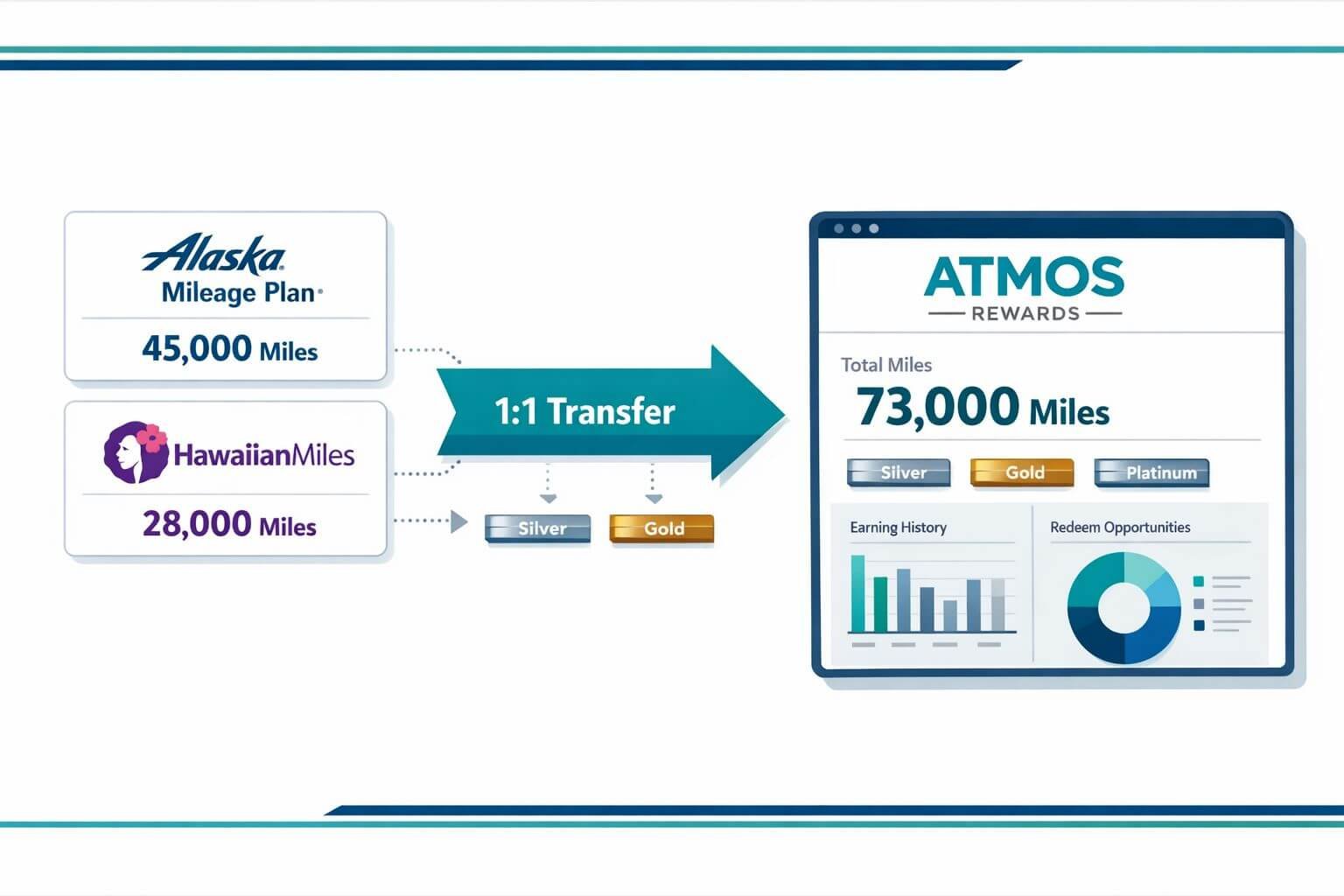
Quick Answer: When Alaska Airlines and Hawaiian Airlines combined their loyalty programs into Atmos Rewards, existing Mileage Plan and HawaiianMiles balances were transferred at a 1:1 rate — meaning every mile you had carries over at full value. Your elite status was mapped to the closest Atmos tier, and your miles do not expire as long as your account stays active. Nothing was lost in the transfer; the main job now is learning how the new program works and where your best redemption opportunities are.
Key Takeaways
- Miles transferred 1:1. Every Alaska Mileage Plan mile and every HawaiianMile converted directly to one Atmos Rewards mile — no rounding down, no conversion penalty.
- Elite status was preserved. Existing status levels (MVP, MVP Gold, MVP Gold 75K on Alaska; Pualani Silver, Gold, Platinum on Hawaiian) were mapped to the corresponding Atmos tier.
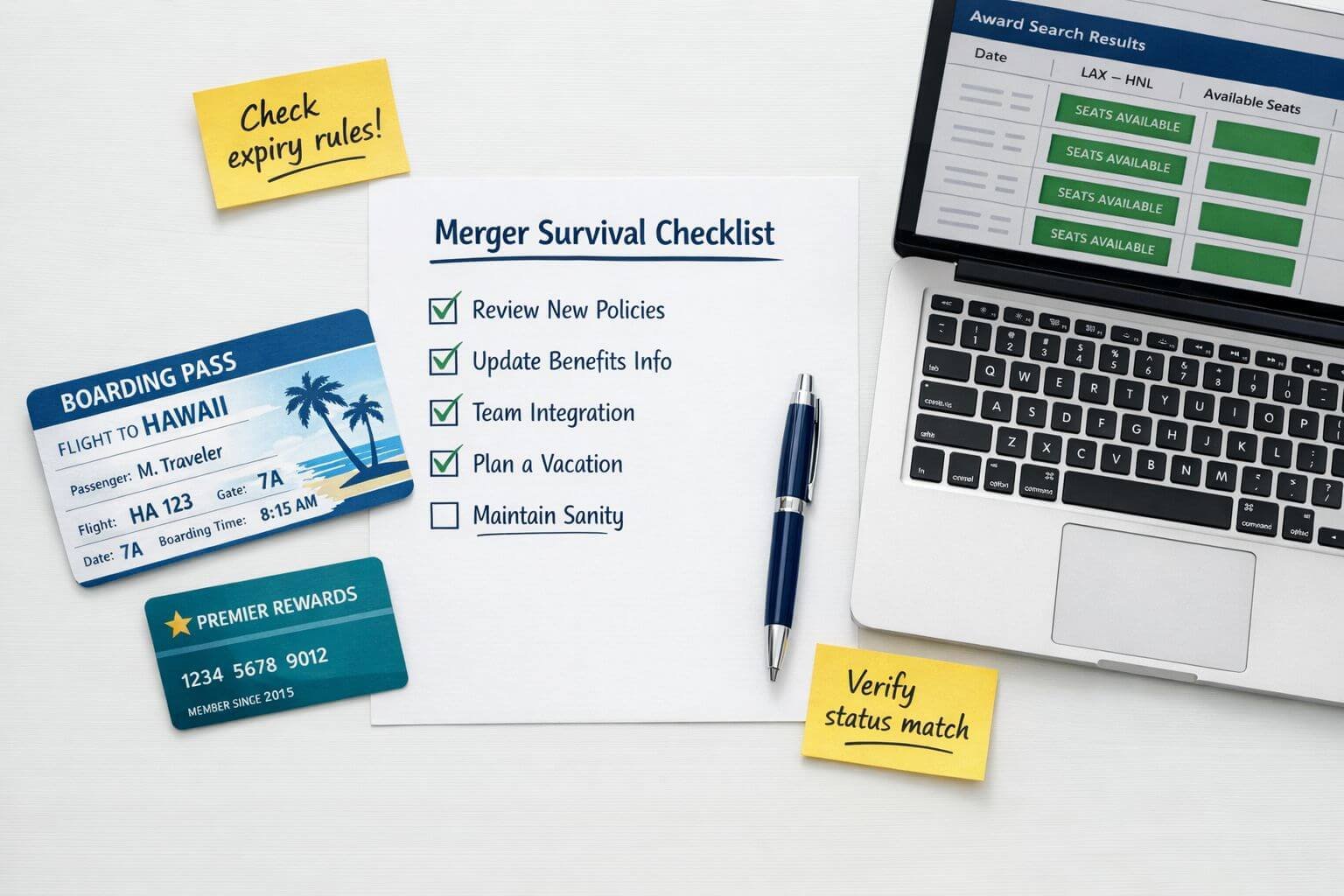
- Miles don’t expire — with a catch. Atmos miles have no set expiration date, but accounts with no qualifying activity for 24 consecutive months may be locked and require reactivation.
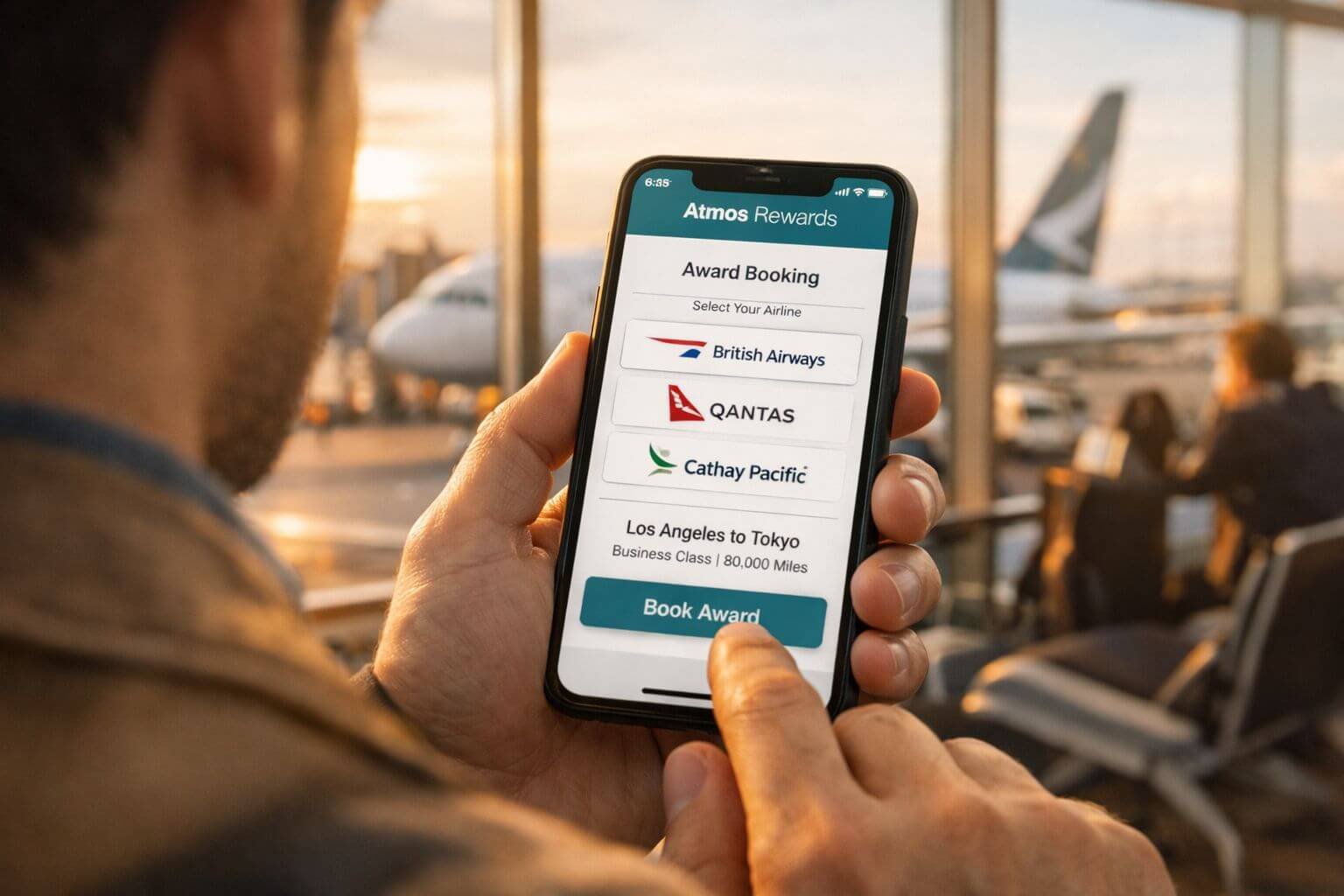
- Hawaiian joined Oneworld on April 22, 2026. This means Atmos members can now earn and redeem on 16 alliance airlines, including British Airways, Qantas, and Cathay Pacific.
- The unified app launched April 22, 2026. Former Hawaiian app users can now manage bookings, change or cancel flights, and book award travel through a single Atmos-integrated platform.
- New hotel perks rolled out in 2026. Atmos Silver members get 15%+ discounts at 10,000+ hotels; higher tiers receive 20%+ discounts plus room upgrades through partnerships with Alaska and Hawaiian Vacations.
- Devaluation risk is real but not immediate. Aviation analysts have noted that merged programs often adjust redemption rates over time. Locking in high-value redemptions sooner rather than later is a reasonable precaution.
- Transferable points (Amex, Chase, Capital One, Citi, Bilt) are not yet direct Atmos transfer partners. Check the current Atmos Rewards transfer partner list for the latest updates on which programs feed into Atmos.
Why Airline Loyalty Programs Merge — and What It Usually Means for Members
When two airlines merge, their loyalty programs almost always follow. Running two separate programs is expensive, creates confusion for customers, and prevents the combined airline from offering a unified earning and redemption network. The consolidation into one program is typically completed within 12–24 months of the airlines’ operational merger.
For members, a loyalty program merger generally means three things:
- Your balance transfers — usually at a fixed conversion rate (often 1:1, though not always).
- Your status maps — the new program assigns you to the closest equivalent tier.
- The rules change — earning rates, redemption values, partner lists, and expiration policies all shift to the new program’s terms.
The Alaska-Hawaiian merger into Atmos Rewards followed this pattern closely. But the specifics matter — and that’s where many members get confused.
Why the Alaska-Hawaiian merger into Atmos is a useful case study
Alaska Mileage Plan had a strong reputation for the value of partner awards, particularly through oneworld partners. HawaiianMiles was a smaller, more regionally focused program. Combining them created a larger currency pool, which aviation economists note gives airlines more leverage to adjust redemption economics over time — even if the initial transfer is generous.
Aviation analyst Gary Leff has pointed out that Alaska faced a genuine tension here: maintaining generous redemption rates while absorbing Hawaiian’s larger member base, or protecting the program’s financial health by adjusting values. Understanding this dynamic helps you make smarter decisions about when to redeem versus when to accumulate.
For a broader look at how Atmos compares to other programs right now, see the Best Airline Loyalty Program 2026: Atmos vs United comparison.
Case Study: Alaska and Hawaiian Miles Becoming Atmos Rewards — What Happened to Your Balance
The short version: your miles are there, they transferred at 1:1, and your account is now an Atmos Rewards account. Here are three before-and-after examples showing what this looks like in practice.
Example 1: Occasional Alaska flyer with mid-tier status
- Before: 45,000 Mileage Plan miles, MVP Gold status (earned through 50,000 EQMs in a prior year)
- After: 45,000 Atmos Rewards miles, mapped to Atmos Gold tier (the equivalent mid-tier)
- What it means for a trip: A round-trip economy award from Seattle to Honolulu that previously cost ~25,000 Mileage Plan miles now prices similarly in Atmos — but check current award pricing, as rates may have shifted post-merger.
Example 2: Frequent Hawaiian flyer with top-tier status
- Before: 120,000 HawaiianMiles, Pualani Platinum status
- After: 120,000 Atmos Rewards miles, mapped to Atmos Platinum tier
- What it means: This member gains significant new value — Pualani Platinum had limited partner redemption options, but Atmos Platinum now unlocks oneworld partner awards, including business class on Qantas or British Airways. A one-way business class award from Los Angeles to Sydney on Qantas, for example, can be a compelling use of a large Atmos balance.
Example 3: Infrequent flyer with a small balance and no status
- Before: 8,500 HawaiianMiles, no status, last flight was 18 months ago
- After: 8,500 Atmos Rewards miles, no status
- What it means: The miles are safe for now, but this member should add activity to their account within the next 6 months to avoid the 24-month inactivity lock. Even a small hotel booking or partner purchase through Atmos counts as qualifying activity. See the full guide on whether airline miles expire and how to extend them for specific tactics.
Decision rule: If your balance is under 10,000 miles and you have no near-term travel plans, prioritize keeping the account active over worrying about redemption strategy. One small purchase through the Atmos shopping portal or a partner hotel stay resets your activity clock.
How Miles and Status Typically Transfer in Any Airline Merger
The mechanics are fairly consistent across mergers, but the details vary enough that you should always verify your specific situation. Here’s the standard framework — using Atmos as the reference example.
Balance transfers: what to expect
| Scenario | Typical outcome | Atmos example |
|---|---|---|
| Same-currency merger | 1:1 transfer | Alaska miles → Atmos miles at 1:1 |
| Cross-currency merger | Fixed conversion rate (e.g., 1.5:1 or 0.8:1) | Not applicable here |
| Pending award bookings | Usually honored or refunded | Existing awards were honored |
| Pending qualifying miles | Credited to new account | Flights in progress credited to Atmos |
Status mapping: how tiers align
Status mapping is rarely perfect because two programs almost never have identical tier structures. The new program typically assigns you to the tier whose benefits most closely match what you had.
You may be interested



Common mistake: Assuming your status automatically renews under the new program’s rules. In most mergers, including Atmos, your mapped status is valid through the end of the current calendar year or a defined transition period — after which you must re-qualify under the new program’s earnings requirements.
For members who want to maintain or build status without relying solely on flights, the Alaska Atmos Rewards Guide: Earn Status Without Flying covers the full range of non-flight qualification paths now available.
New program terms: what changes
- Earning rates may differ on codeshare and partner flights
- Redemption pricing may shift, especially for partner awards
- Expiration policy applies under the new program’s rules from the merger date
- Transfer partners (credit card programs that send points to the airline) may change
How to Find and Secure Your New Atmos Account After the Merger
If you had an Alaska Mileage Plan or HawaiianMiles account, your Atmos Rewards account was created automatically. You do not need to re-enroll. Here’s how to confirm everything is in order.
Step-by-step: Verify your Atmos account
- Go to atmosrewards.com (or the Atmos app, which unified on April 22, 2026) and attempt to log in using your existing Alaska or Hawaiian credentials.
- Check your balance. Confirm the total matches your expected combined miles (Alaska balance + Hawaiian balance if you had both).
- Verify your status tier. Navigate to the membership section and confirm your tier matches what you expected based on the mapping above.
- Update your contact information. Merger transitions sometimes create duplicate accounts or outdated email addresses — this is the most common reason members miss important program communications.
- Add a qualifying activity if your last flight was more than 12 months ago. Don’t wait until month 23 to realize your account is at risk.
What to do if your balance looks wrong
- Wait 30 days from the merger date before escalating — some balances took time to fully migrate.
- Contact Atmos member services with documentation: your old account number, a screenshot of your previous balance, and any relevant flight records.
- Keep records. Screenshot your old Alaska and Hawaiian balances before and after the merger if you haven’t already. This is your evidence if a discrepancy arises.
Edge case: Members who had both an Alaska Mileage Plan account and a HawaiianMiles account under different email addresses may have received two separate Atmos accounts. Contact member services to request a merge — you generally cannot combine balances on your own through the app.
Planning Your First Redemption in the New Atmos Program
The best first redemption in Atmos is one that uses a sweet spot you already understand — a Hawaii route, a West Coast domestic award, or a oneworld partner flight if your balance is large enough. Don’t let the new program’s unfamiliarity push you into a low-value redemption just to “use” your miles.
Where Atmos miles tend to deliver strong value
- Hawaii routes: Both Alaska and Hawaiian had competitive Hawaii award pricing. Atmos has maintained these as core routes, and they remain among the more accessible redemptions for members with 20,000–35,000 miles.
- Oneworld partner business class: Hawaiian’s addition to oneworld on April 22, 2026, opened up partner award space on Qantas, British Airways, Cathay Pacific, and others. For members with 60,000+ miles, a one-way business class award to Asia or Australia is now a realistic target.
- West Coast domestic routes: Short-haul domestic awards on Alaska or Hawaiian remain efficient uses of smaller balances.
How to calculate whether a redemption is worth it
Use the cents-per-point (CPP) framework: divide the ticket’s cash price by the number of miles required, then multiply by 100.
Formula: (Cash price ÷ Miles required) × 100 = CPP
Example: A round-trip economy ticket from Seattle to Maui costs $480 in cash. An award costs 30,000 Atmos miles. That’s ($480 ÷ 30,000) × 100 = 1.6 CPP.
As a general benchmark, Atmos miles are worth approximately 1.4–1.8 cents each on domestic and Hawaii routes, and potentially 1.8–2.2 cents on well-priced international partner awards. For a deeper explanation of this math, the 2026 Guide to Cents-Per-Point walks through the full framework.
A note on award availability and dynamic pricing
Atmos, like most modern programs, uses a mix of fixed and dynamic award pricing. Partner award space (oneworld airlines) is subject to availability released by the partner carrier, which means you may need to search across award search tools to find open seats.
Common mistake: Searching only on the Atmos website for partner awards. Some partner availability shows up more reliably on the partner airline’s own site or through third-party tools. Always cross-reference before concluding that space doesn’t exist.
Common Mistakes to Avoid When Airline Programs Combine
The period immediately after a merger is when members make the most costly errors — either by panicking and redeeming at poor value, or by ignoring their account entirely and losing access.
Mistake 1: Redeeming impulsively out of fear
The most common reaction to a merger announcement is anxiety about devaluation — and the impulse to “cash out” immediately. This often leads to low-CPP redemptions on flights you didn’t really want. Unless there’s a specific devaluation announcement with a hard date, a measured approach serves most members better.
Mistake 2: Ignoring account activity requirements
The 24-month inactivity rule catches occasional flyers off guard. If you haven’t flown in over a year, check your last qualifying activity date now. A small purchase through the Atmos shopping portal or a partner hotel stay counts — you don’t need to fly.
Mistake 3: Assuming status benefits are identical
Mapped status is not always identical to the status you held before. Review the Atmos benefit guide for your tier and note any differences — particularly around upgrade priority, lounge access, and companion fare eligibility.
Mistake 4: Not checking transferable points options
If you hold Amex points, Chase points, Capital One miles, Citi points, or Bilt points, check whether any of those programs have added Atmos as a transfer partner. Transfer partners for airline programs change after mergers, and a new transfer relationship could give you a way to top up your Atmos balance for a specific redemption. The Best Transferable Points Programs 2026 guide covers current transfer partner lists across all major programs.
Mistake 5: Overlooking the oneworld expansion
Many former HawaiianMiles members don’t realize that Hawaiian’s oneworld membership — effective April 22, 2026 — is a genuinely significant upgrade to what their miles can do. Before assuming your balance is only useful for Hawaii flights, check what’s available on British Airways, Qantas, or Cathay Pacific. The Airline Alliances 2026 guide explains how oneworld partner awards work and which carriers tend to release the most availability.
What the Broader Merger Trend Means for Your Points Strategy
Airline mergers are accelerating, not slowing down. In 2026, consolidation discussions involving other major carriers have intensified, driven by fuel price pressure and the precedent set by the Alaska-Hawaiian combination. Delta’s CEO has pointed to high oil prices as a historical driver of consolidation waves, citing the 2008 merger period as a direct parallel.
For points holders, this creates a recurring strategic question: how much should you concentrate miles in a single airline program versus diversifying across transferable points currencies?
The practical answer for most members: hold the bulk of your flexible earning capacity in transferable points programs (Amex, Chase, Capital One, Citi, Bilt), and treat airline miles as a redemption currency rather than a long-term savings vehicle. Transferable points give you the flexibility to route to whichever airline program offers the best value at the time of booking — including programs that emerge from future mergers.
Aviation revenue management experts have also flagged that merged programs, once they achieve scale, tend to implement changes that were previously difficult to justify to smaller member bases — including dynamic pricing, reduced partner award availability, and adjusted earning rates on non-core routes. This isn’t a reason to panic; it’s a reason to stay informed and redeem miles strategically rather than stockpile them indefinitely.
For members who want to go further with Atmos optimization — including status earning through credit card spend and partner activity — the Alaska Atmos Rewards Guide 2026 covers advanced tactics in detail.
Frequently Asked Questions
Q: Did my Alaska Mileage Plan miles disappear after the merger? No. All Mileage Plan balances transferred to Atmos Rewards at a 1:1 rate. Log in to your Atmos account using your Alaska credentials to confirm your balance.
Q: Did my HawaiianMiles transfer to Atmos? Yes. HawaiianMiles was transferred to Atmos Rewards at a 1:1 ratio. If your balance doesn’t match, contact Atmos member services with documentation of your previous balance.
Q: What happened to my Alaska MVP Gold or Pualani Platinum status? Your status was mapped to the closest Atmos tier. Mid-tier statuses (MVP Gold, Pualani Gold) generally mapped to Atmos Gold; top-tier statuses (MVP Gold 75K, Pualani Platinum) mapped to Atmos Platinum. Confirm your current tier in the Atmos app.
Q: Do Atmos miles expire? Atmos miles have no fixed expiration date, but accounts with no qualifying activity for 24 consecutive months may be locked. Qualifying activity includes flights, hotel stays, shopping portal purchases, and partner transactions.
Q: Can I now book Qantas or British Airways awards with my Atmos miles? Yes. Hawaiian’s addition to the oneworld alliance on April 22, 2026, means Atmos members can redeem miles on all 16 oneworld member airlines, including Qantas, British Airways, Cathay Pacific, and others — subject to partner award availability.
Q: I had both an Alaska and a Hawaiian account. Were they automatically combined? Not always. If both accounts were under the same email address and member profile, they were likely merged. If they were under different email addresses, you may have two separate Atmos accounts and will need to contact member services to consolidate them.
Q: Is Atmos a transfer partner for Amex, Chase, or Capital One? Transfer partner relationships can change after mergers. Check the current Atmos transfer partner page for the latest list of which transferable points programs can send miles to Atmos.
Q: Should I redeem my Atmos miles quickly before a devaluation? Not necessarily. There’s no announced devaluation as of this writing. That said, if you have a specific high-value redemption in mind — particularly a oneworld business class award — booking it sooner rather than later is a reasonable approach, since partner award availability and pricing can shift without advance notice.
Q: What’s the best use of a small Atmos balance (under 15,000 miles)? For balances under 15,000 miles, focus on keeping the account active and topping up the balance through partner activity, shopping portal purchases, or a credit card that earns Atmos miles. A Hawaii one-way economy award typically starts around 12,500–15,000 miles and represents solid value at that level.
Q: How do I search for Atmos partner award availability? Start on the Atmos website or app, then cross-reference on the partner airline’s own site. Third-party award search tools can also surface availability that doesn’t appear directly on Atmos. See the Best Award Search Tools for Beginners in 2026 for a current tool comparison.
Q: What if I’m new to points and miles entirely? The Atmos merger is a good entry point, but the broader world of transferable points — Amex, Chase, Capital One, Citi, Bilt — offers significantly more flexibility. The Best Transferable Points Programs 2026 guide is a strong starting point for building a more diversified strategy.
Conclusion: Your Miles Are Safe — Now Make Them Work
The Alaska Hawaiian Atmos merger, for all the anxiety it generated among occasional flyers, was one of the cleaner loyalty program consolidations in recent memory. Miles transferred at 1:1, status was preserved, and the program actually expanded in value through Hawaiian’s oneworld membership.
The practical next steps depend on where you are:
- If you haven’t logged into your Atmos account yet: Do that first. Confirm your balance, verify your status tier, and update your contact information.
- If your last qualifying activity was more than 12 months ago: Add a small partner transaction now to protect your balance from the 24-month inactivity lock.
- If you have 30,000+ miles and a Hawaii or international trip in mind: Start searching award availability now. Use the CPP framework to confirm the redemption is worth it before booking.
- If you’re thinking about long-term strategy: Consider whether concentrating miles in a single airline program still makes sense, or whether shifting future earning toward transferable points (Amex, Chase, Capital One, Citi, Bilt) gives you more flexibility against future program changes.
Mergers will keep happening. The members who navigate them well aren’t the ones who panic — they’re the ones who understand the mechanics, stay informed, and redeem with a clear value target in mind.
Related Reading:
- Alaska Atmos Rewards Guide 2026: Earn Status Without Flying
- Best Airline Loyalty Program 2026: Atmos vs United
- Do Airline Miles Expire? 2026 Rules + Extension Guide
- Best Transferable Points Programs 2026
- 2026 Guide to Cents-Per-Point


Content on Award Travel Hub is independently created by Award Travel Hub Editorial Desk and, where noted, reviewed by Award Travel Hub Review Desk. Some pages may contain affiliate links, but compensation does not determine our coverage, opinions, or methodology.