Last updated: May 6, 2026
Quick Answer
The best approach to award search tools 2026 is not to pick a single winner. It is stacking tools by job: use Seats.aero for broad saver-space discovery and alerts, PointsYeah for fast filtering and date work, AwardFares for mixed-cabin and certain program checks, and Point.me when transfer guidance or booking help matters most. Awayz is the outlier because it is strongest for hotel planning and trip-level calendar views, not as a primary flight search engine.
Key Takeaways
- No single award search platform covers every airline, every partner airline, and every edge case in 2026.
- Seats.aero is best for expert-level saver hunting, route discovery, and alerts, but it has a steeper learning curve.
- Point.me is the most beginner-friendly option for real-time search, transfer partner guidance, and concierge-style support.
- PointsYeah offers strong speed, flexible filters, and its Travel Radar calendar is useful for scanning a full year.
- AwardFares remains useful for mixed-cabin searches and some oneworld use cases, including Finnair Plus integration.
- Awayz is best treated as a hotel-first companion tool, with limited usefulness for flights in 2026.
- A practical two-tool stack is often enough: Seats.aero + PointsYeah for most intermediate travelers.
- A full stack can cost roughly $200 to $300 per year, depending on paid tiers, which is usually easy to justify if it helps land even one strong premium cabin award.
- Transferable points users should not transfer Amex points, Chase points, Capital One miles, Citi points, or Bilt points until partner availability is verified across at least two sources.
- Common mistake: relying on one tool’s result without confirming program rules, married segments, surcharges and fees, and actual bookability.
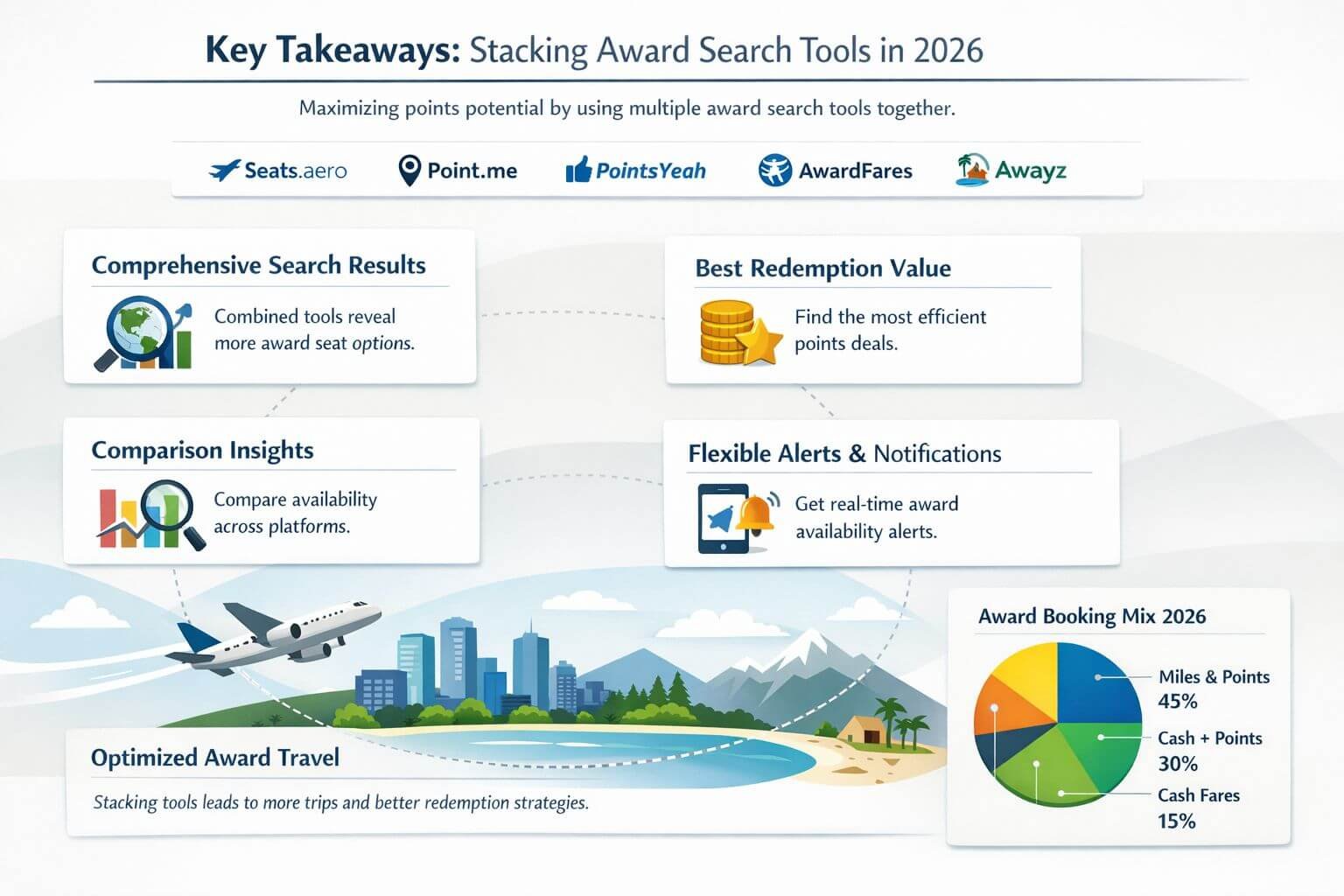
Which award search tools 2026 options are actually best at different jobs?
The right answer depends on the job. For most intermediate travelers, Seats.aero is best for discovery, PointsYeah is best for narrowing and filtering, Point.me is best for booking guidance, AwardFares is best for some mixed-cabin and niche validation, and Awayz is best for hotel planning.
Fast recommendation framework
Choose Seats.aero if:
- flexible dates are acceptable
- the goal is premium cabin awards
- alerts matter more than polished visuals
- routes across many programs need scanning quickly
Choose Point.me if:
- transfer partner guidance is needed
- a cleaner interface is preferred
- concierge support is valuable
- the search starts from bank points, not a specific airline program
Choose PointsYeah if:
- fast filters matter
- date windows and advanced search controls are important
- a balance between usability and power is preferred
- free-tier testing is desired before paying
Choose AwardFares if:
- mixed-cabin itineraries matter
- oneworld or Avios-style comparisons are part of the booking strategy
- an extra validation layer is wanted before transfer
You may be interested



Choose Awayz if:
- hotel redemptions are a major part of the trip
- trip planning is mobile-first
- the traveler wants one tool for hotel calendars plus limited flight support
Rule of thumb: if the trip starts with “Where can points take me?” begin with Seats.aero. If the trip starts with “I need a bookable option on these dates,” begin with PointsYeah or Point.me.
For a deeper look at search workflows, see Best Ways to Find Partner Award Space Fast (2026 Guide) and Best Award Travel Tools and Alerts to Set Up for 2026 Bookings.
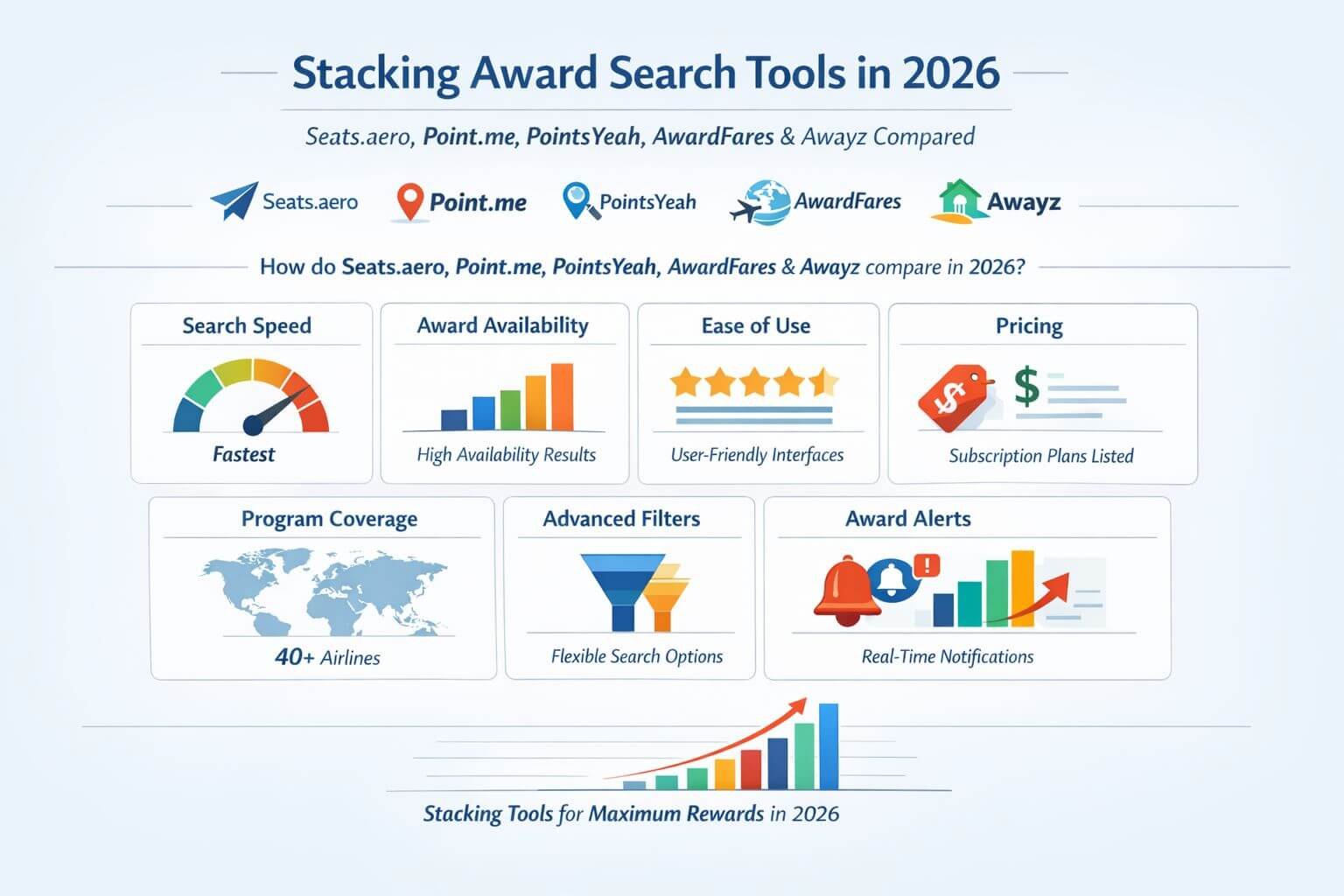
How do Seats.aero, Point.me, PointsYeah, AwardFares, and Awayz compare in 2026?
The clearest way to compare award search tools 2026 is by coverage, alerts, filters, mixed-cabin support, and booking help. Seats.aero and Point.me sit at opposite ends of the spectrum: power versus guidance.
2026 feature matrix
| Tool | Best use | Approx. pricing direction* | Alerts | Real-time / live-style search | Mixed cabins | Mobile feel | Concierge/help | Beginner-friendly | Expert power |
|---|---|---|---|---|---|---|---|---|---|
| Seats.aero | Saver discovery, alerts, route scanning | Low monthly Pro | Strong | Strong on supported programs | Limited | Fair | No | 2/5 | 5/5 |
| Point.me | Booking guidance, transfer logic | Higher annual pricing | Available | Strong | Moderate | Good | Yes | 5/5 | 3/5 |
| PointsYeah | Filters, calendars, quick search | Mid annual pricing | Good | Strong | Moderate | Good | No | 4/5 | 4/5 |
| AwardFares | Mixed awards, niche validation | Low monthly pricing | Good | Good | Strong | Fair | No | 3/5 | 4/5 |
| Awayz | Hotels, trip planning, limited flights | Low monthly pricing | Moderate | Limited for flights | Limited | Strong | No | 4/5 | 2/5 |
*Pricing changes often. Check current billing pages before subscribing. Public writeups and reviews confirm relative pricing positions, but tiers and promos can change.
What stands out in 2026
- Seats.aero is widely viewed as the strongest discovery engine for flexible travelers chasing premium cabin awards.
- Point.me emphasizes real-time search across many airlines and programs, plus points portfolio tracking and fare alerts.
- PointsYeah improved its search experience and offers Travel Radar, a 365-day calendar-style view that helps with date flexibility.
- AwardFares added useful breadth through Finnair Plus integration, which matters for Avios-based oneworld searches.
- Awayz remains more compelling for hotel users than for flight-first award travelers.
Common mistake
A common mistake is treating “program coverage” as the same thing as “reliable booking coverage.” A tool may display an award, but that does not guarantee the partner can ticket it cleanly. Married segments, phantom space, and stale availability still matter.
What is the best stacking strategy for award search tools 2026?
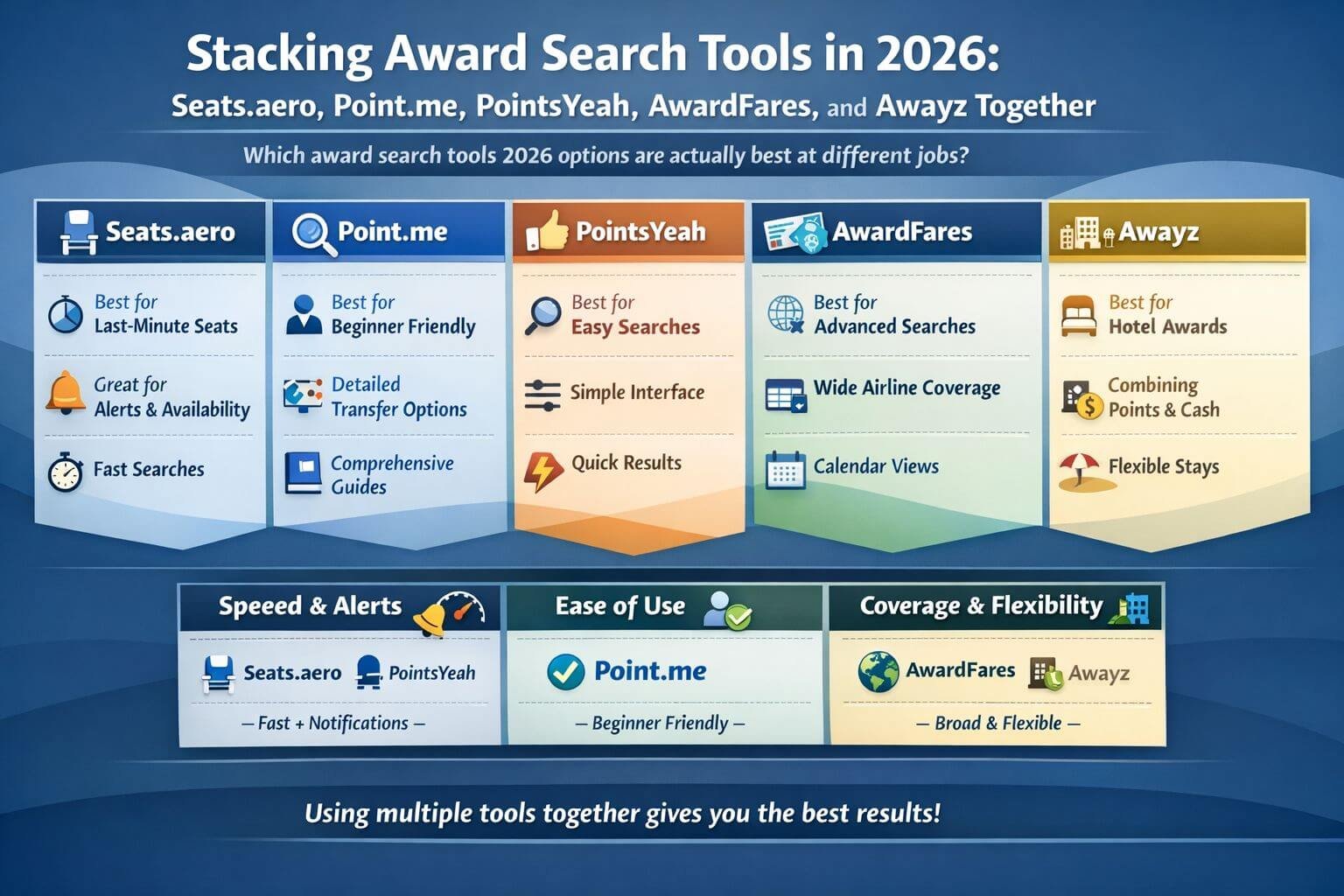
The best stacking strategy in award search tools 2026 is a sequence, not a bundle. Start with broad discovery, then validate with filters, then confirm transfer logic and final bookability before moving transferable points.
The best three-tool stack for most readers
1. Seats.aero for discovery
- scan regions and routes fast
- set saver alerts
- look for premium cabin awards and unusual sweet spots
- ideal for flexible outbound searches like U.S. to Europe or U.S. to Asia
2. PointsYeah for refinement
- narrow by dates, cabins, route preferences, and practical options
- use calendar-style tools to find better departure windows
- confirm whether the opportunity really fits travel plans
3. AwardFares or Point.me for final validation
- use AwardFares if mixed cabin, Avios, or niche search behavior matters
- use Point.me if transfer partner advice, booking walkthroughs, or concierge support matters more
Recommended stacks by traveler type
1) The practical intermediate stack
Seats.aero + PointsYeah
Best for:
- travelers who know airline alliances and points transfer partners
- flexible premium cabin searches
- people who want strong coverage without paying for everything
Not for:
- travelers who want handholding during booking
- hotel-heavy travelers
2) The book-it-for-me stack
Seats.aero + Point.me
Best for:
- travelers with large Amex points or Chase points balances
- people who discover space on Seats.aero but want guided next steps
- travelers worried about transfer mistakes
Not for:
- those who want the lowest annual cost
3) The full coverage stack
Seats.aero + PointsYeah + AwardFares + Point.me Use Awayz as an optional add-on for hotel-heavy trips.
Best for:
- frequent redeemers
- travelers booking premium cabin awards several times per year
- people comparing alliance partners, stopovers, and mixed-cabin pricing
Real-world workflow example
A traveler wants business class deals from New York to Paris.
- Seats.aero finds likely saver space across Flying Blue, Aeroplan, and Virgin Atlantic partners.
- PointsYeah narrows results to a 5-day window around the preferred departure.
- AwardFares checks whether a mixed-cabin outbound or alternate oneworld routing opens better value.
- Point.me confirms which points transfer partners work best and whether surcharges and fees are reasonable.
- Only then should Amex points, Chase points, Capital One miles, Citi points, or Bilt points move.
That same logic works for long-haul routes like SFO-HND or ORD-DOH, where married segments and inconsistent partner visibility are common.
For timing and transfer logic, pair this guide with When to Book Award Flights in 2026: Timing Guide and Transfer Bonus Strategy: When to Transfer Points in 2026.
How much should you pay for award search tools in 2026?
Most intermediate travelers should aim to spend as little as possible until a tool clearly saves time or unlocks bookable award availability. In practice, a one-tool setup can be around $100 to $150 per year, while a serious stack often lands around $200 to $300 annually depending on billing choices and promotions.
Practical budget tiers
Budget setup
- One paid tool
- Best choice: PointsYeah or Seats.aero
- Good for 1 to 2 major trips per year
Balanced setup
- Two paid tools
- Best choice: Seats.aero + PointsYeah
- Good for travelers with flexible points and multiple transfer partners
Power-user setup
- Three to four tools
- Best choice: Seats.aero + PointsYeah + Point.me, then add AwardFares when niche coverage matters
- Good for premium cabin awards, family travel, or complex routing
ROI example
Assume a traveler spends $240 per year on stacked tools. If one business class redemption saves even 60,000 points versus a weaker option, the subscription cost is usually recovered many times over. The exact cents per point (CPP) depends on what cash fare and points price are being compared, but the search-time savings alone can justify the spend for frequent users.
For redemption math, use our 2026 Guide to Cents-Per-Point and Award Travel Calculators.
Common mistake
Paying for too many tools before building a search process. The better order is:
- know your likely programs
- know your route patterns
- then buy the smallest stack that covers those needs
Which programs and trip types benefit most from stacking tools?
Stacking matters most when the route is competitive, the cabin is premium, or the booking depends on partner airlines. It matters less for simple domestic economy awards with dynamic pricing.
Best fits for stacking
Strong candidates
- long-haul business class awards
- first class redemptions where space appears briefly
- alliance partner bookings
- routes where transfer bonuses can change value
- itineraries involving positioning flights
- trips with stopovers or mixed cabins
Less compelling
- fixed-date domestic bookings using one airline program
- straightforward hotel bookings with no flight complexity
- dynamic pricing programs where partner awards are rare
Program-level notes
- Star Alliance: stacking is useful because inventory may appear differently across Aeroplan, LifeMiles, and other partner programs. See the Star Alliance Award Booking Guide 2026.
- Oneworld: AwardFares and Finnair Plus integration can help surface Avios-related opportunities.
- Flying Blue and other SkyTeam-style searches: PointsYeah and Point.me are useful when comparing cash-like dynamic pricing versus traditional partner space.
- Hotels: Awayz is most relevant when hotel search and trip-date flexibility are the main problem.
Edge case
A tool can miss a route because of how it handles married segments, where two flight segments must be booked together to access the award. In those cases, direct airline program checks still matter.
When is Point.me worth it, and when is it not?
Point.me is worth it when transfer guidance and booking support prevent costly mistakes. Point.me is less compelling if the traveler already knows how to search partner programs manually and mainly needs raw discovery speed.
Best for
- travelers moving transferable points for the first time
- people comparing multiple bank currencies
- travelers who value concierge help
- those who want a clearer interface than Seats.aero
Not for
- experts who only want broad route discovery
- bargain hunters trying to keep annual tool costs low
- users who already know program rules and transfer pathways
Decision rule
If the biggest fear is “transferring to the wrong program,” Point.me is often worth it. If the biggest problem is “finding the award before someone else does,” Seats.aero or PointsYeah usually matters more.
What are the biggest mistakes people make with award search tools?
The biggest mistake is assuming search output equals booking reality. Award search tools are filters and discovery engines, not guarantees.
Common pitfalls
- transferring points before the final seat is confirmed
- ignoring fuel surcharges and fees
- not checking cancellation rules before booking
- trusting one source for complex itineraries
- forgetting positioning flights in total trip cost
- overvaluing a flashy “deal” without doing travel rewards math
Quick checklist before transfer
- Confirm the award in at least one primary tool and, if possible, one secondary source.
- Check taxes, surcharges, and cabin mix.
- Verify cancellation and change rules.
- Confirm transfer times from the bank program.
- Consider devaluation risk if space is not ready to book now.
Related reading: Secrets to Booking Award Flights with Flexible Points, How to Book Business Class with Points: 2026 Guide, and Award Ticket Cancellation Fees Guide 2026.
What should most readers actually do next?
Most readers do not need all five tools. A simple, practical path works better.
Recommended path by scenario
If you take 1 big trip per year
- start with PointsYeah or Point.me
- add Seats.aero only if dates are flexible and premium cabin awards are the goal
If you chase business class deals often
- start with Seats.aero
- add PointsYeah next
- use Point.me only when transfer guidance is valuable
If you book hotels and flights together
- use Seats.aero or PointsYeah for flights
- add Awayz only if hotel award calendars are part of the trip planning problem
If you already know partner programs well
- Seats.aero + AwardFares is a strong expert combo
- add PointsYeah if filtering speed matters more than niche depth
FAQ
What is the best single award search tool in 2026?
There is no universal best tool. Seats.aero is strongest for discovery, while Point.me is strongest for guided booking help.
Is Seats.aero worth paying for in 2026?
Seats.aero is usually worth paying for if flexible dates, alerts, and premium cabin saver searches are central to your booking strategy.
Is Point.me worth it in 2026 for intermediate travelers?
Point.me is worth it for intermediate travelers who want transfer guidance, a cleaner interface, and optional concierge support.
Is PointsYeah better than Seats.aero?
PointsYeah is better for many users who want fast filters and date tools. Seats.aero is better for broad saver-space discovery and alert-driven hunting.
Does AwardFares still matter in 2026?
AwardFares still matters for mixed-cabin searches, some niche validation, and Avios-related oneworld use cases, especially after Finnair Plus integration.
Is Awayz a real competitor for flight searches?
Awayz is not the strongest flight-first choice. Awayz is more useful as a hotel-focused planning tool with limited flight utility.
Should transferable points be moved before checking multiple tools?
No. Transferable points should usually stay flexible until availability, taxes, routing, and program rules are verified.
Do stacked tools really improve results?
Yes, stacked tools improve results because they reduce blind spots. Different tools surface different partner inventory, filters, and edge cases.
Conclusion
The best award search tools 2026 strategy is not loyalty to one platform. It is building a simple stack based on how you search.
For most intermediate travelers, the best starting point is:
- Seats.aero for discovery and alerts
- PointsYeah for date filtering and practical search refinement
- Point.me when transfer guidance or booking support matters
- AwardFares as a niche validator for mixed cabins and some oneworld searches
- Awayz only if hotels are a major part of the trip
That stack keeps transferable points flexible longer, reduces missed award availability, and cuts down on costly transfer mistakes. Start small, add tools only when a clear gap appears, and always verify before moving points.
Related reading
- Award Travel Predictions for 2026: What Matters Most for Points Strategy Now
- Award search tools showdown: PointsYeah vs Seats.aero vs Roame
- Best Use of 100,000 Points: Transfer Partner Value 2026


Content on Award Travel Hub is independently created by Award Travel Hub Editorial Desk and, where noted, reviewed by Award Travel Hub Review Desk. Some pages may contain affiliate links, but compensation does not determine our coverage, opinions, or methodology.