
Last updated: August 17, 2026
Quick Answer: The Bilt Palladium card is a $495 Annual Fee premium travel card that earns 2x Bilt points on all eligible everyday purchases, offers fee-free rent and mortgage payments, and includes $600 in annual statement credits plus lounge access. It makes sense for renters or homeowners who combine high housing costs with meaningful everyday spend and want to funnel everything into a single transferable points ecosystem. Lower spenders will struggle to justify the fee.
Key Takeaways
The Bilt Palladium card carries a $495 annual fee and earns a flat 2x Bilt points per dollar on all eligible non-housing purchases.
The card removed the previous 100,000-point cap on housing earnings, making it significantly more valuable for high-rent or high-mortgage payers.
Bilt’s dual-currency system means cardholders choose between earning traditional transferable Bilt points or 4% Bilt Cash on everyday spend — understanding this tradeoff is essential.
The welcome offer includes 50,000 Bilt points, Gold status, and $300 Bilt Cash after $4,000 in non-housing spend within the first three months.
Bilt points transfer to over 15 airline and hotel partners, including United, Hyatt, Air Canada Aeroplan, and American Airlines — making them among the most flexible transferable points available.
The Palladium includes $600 in annual credits (structured across multiple categories), lounge access, and a $200 annual Bilt Cash deposit, which offset a meaningful portion of the fee.
You may be interested
The standard no-fee Bilt Mastercard remains the better choice for anyone not spending enough to recover the $495 annual fee through credits and elevated earnings.
Bilt Rent Day promotions — typically held on the first of each month — offer transfer bonuses that can significantly increase the value of accumulated points.




What the Bilt Palladium Card Is and How It Works
The Bilt Palladium card is the flagship product in Bilt’s 2026 card lineup, sitting above the no-fee Bilt Blue and the mid-tier $95 Bilt Obsidian. Announced in January 2026 and activated for cardholders starting February 6–7, 2026, it represents Bilt’s push into premium travel card territory — competing directly with cards like the Amex Platinum and Chase Sapphire Reserve.
At its core, the card works like most premium travel cards: pay an annual fee, earn elevated points on spending, and use those points to book travel through transfer partners. What sets it apart is the housing-earning angle. Bilt built its entire program around the idea that rent — typically a cardholder’s largest monthly expense — should generate rewards. The Palladium extends that to mortgage payments as well.
Bilt introduced a dual-currency system with the 2026 card launches. Cardholders earn either:
Traditional Bilt points — transferable to airline and hotel partners, ideal for premium cabin award redemptions.
Bilt Cash — a cash-equivalent currency that earns at 4% back on all non-housing purchases under the Flexible Bilt Cash option.
The choice between these two earning modes is the most important decision Palladium holders make. Bilt Cash can also be used to unlock housing points, which is a separate mechanism worth understanding before committing to a strategy. For most points-focused travelers, the transferable Bilt points path will deliver more value per dollar spent — but the Bilt Cash option exists for those who prefer simplicity.
For a deeper look at Bilt’s full transfer partner roster and how the program fits into a broader award travel strategy, see the Bilt Transfer Partners Guide.
Bilt Palladium Card Earning Rates and Everyday Categories
The Palladium earns a flat 2x Bilt points per dollar on all eligible everyday purchases. There are no rotating categories, no caps on everyday spend earnings, and no need to track bonus categories.
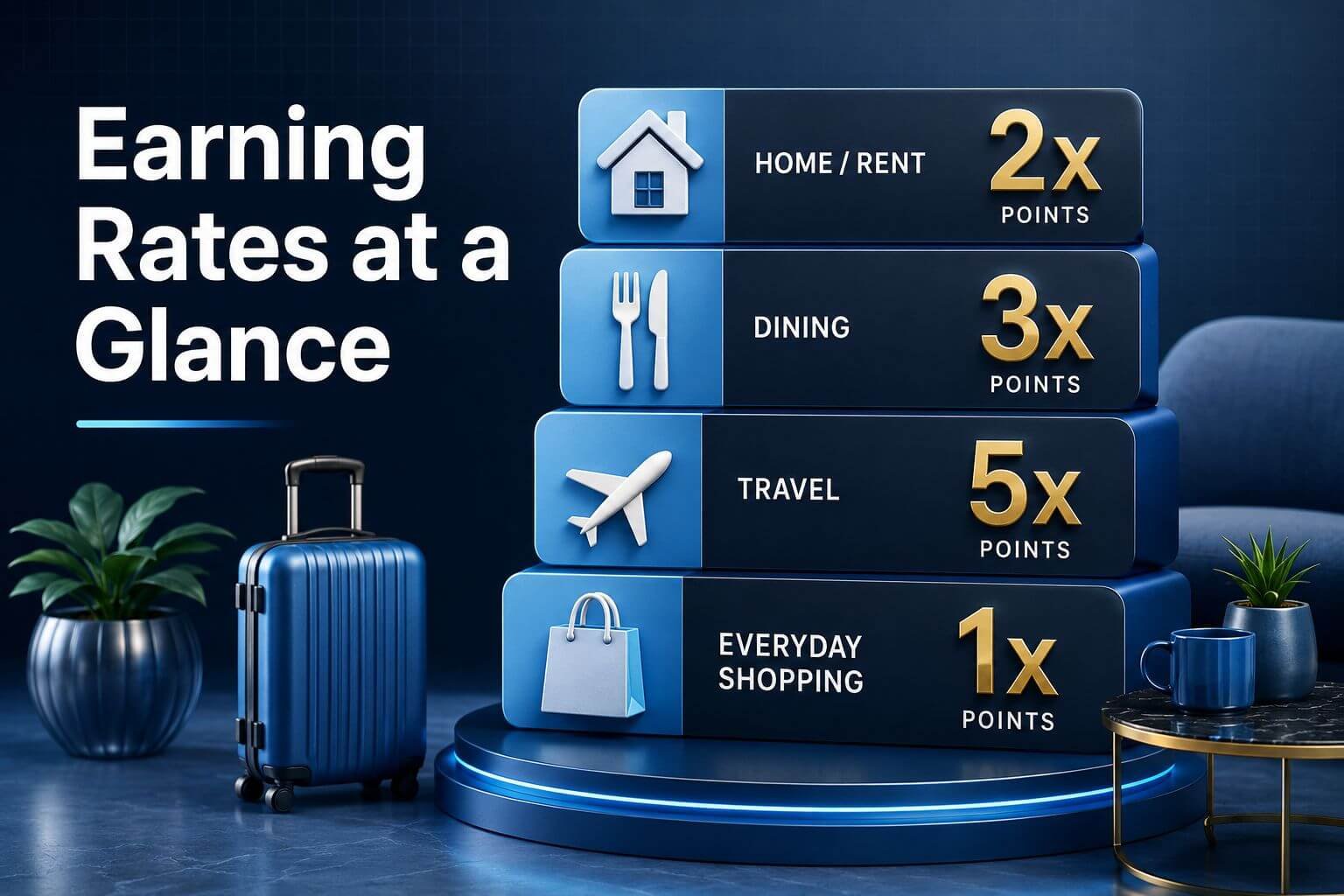
Here’s how the earning structure breaks down:
Spending CategoryEarning RateRent payments (via Bilt)Tiered housing rate (see below)Mortgage payments (via Bilt)Tiered housing rate (see below)All other eligible purchases2x Bilt points per dollarFlexible Bilt Cash option4% Bilt Cash on non-housing spend
The housing earning structure under “Option 1” (tiered) is separate from the flat 2x everyday rate. Bilt removed the previous 100,000-point annual cap on housing earnings with the 2026 card launch — a meaningful change for anyone paying $2,500 or more per month in rent or mortgage.
The Rakuten angle: The Palladium also benefits from a partnership with Rakuten that allows cardholders to convert Rakuten cash back into Bilt points at a rate of $10 in cash back equaling 1,000 Bilt points. For heavy online shoppers already using Rakuten, this is an efficient way to stack earnings on top of the card’s base rate.
Common mistake: Many new Palladium holders default to the Bilt Cash option without realizing they’re giving up transferable points. Unless the plan is to use Bilt Cash specifically to unlock housing points or cover statement credits, the transferable points path typically delivers more value — especially for anyone targeting premium cabin redemptions at 1.5 cents per point (CPP) or better.
How Rent Payments Work on the Bilt Palladium Card
The Bilt Palladium card processes rent and mortgage payments through the Bilt app without charging a transaction fee. This is the card’s foundational differentiator — most credit cards either don’t allow rent payments or charge a 2–3% processing fee that eliminates any reward value.
With the Palladium, the process works as follows:
Add the rental property or mortgage servicer in the Bilt app.
Schedule the payment through Bilt’s platform.
Bilt processes the payment and posts the housing points according to the tiered earning structure.
The removal of the 100,000-point annual housing cap is significant. Under the old structure, a renter paying $3,000 per month ($36,000 annually) would hit the cap and stop earning points on housing mid-year. Under the 2026 structure, that same renter earns housing points on the full $36,000, which changes the math considerably for high-cost-of-living markets.
One constraint to note: Bilt points still require at least five transactions per statement period to earn points on rent. This rule applies across all Bilt cards. Making fewer than five purchases in a billing cycle means housing payments do not earn points that month — a detail that catches some cardholders off guard.
For renters who are also exploring alternatives to the Bilt ecosystem, Rove Miles vs Bilt Rewards 2026 offers a direct comparison of the two no-fee-adjacent programs for housing spenders.
Bilt Rewards Transfer Partners and Redemption Value
Bilt points are transferable to over 15 airline and hotel programs, generally at a 1:1 ratio. This is what makes them genuinely valuable rather than just a cash-back alternative.
Key transfer partners include:
Airlines: United MileagePlus, American AAdvantage, Air Canada Aeroplan, Alaska Airlines Mileage Plan, Air France/KLM Flying Blue, Emirates Skywards, and others.
Hotels: World of Hyatt, IHG One Rewards, and others.
The 1:1 transfer ratio to World of Hyatt is one of the most valuable in the transferable points space. Hyatt points can be worth 1.5–2.0 CPP or more on premium property redemptions, which means Bilt points transferred to Hyatt can realistically deliver 1.5x–2x the value of a cash-back equivalent.
Bilt Rent Day: On the first of each month, Bilt runs Rent Day promotions that often include transfer bonuses to specific partners. These bonuses — sometimes 25–125% on transfers to a single partner — can dramatically increase the effective value of accumulated points. For example, a 100% transfer bonus to an airline partner effectively doubles the miles received per Bilt point transferred. Timing large transfers around these promotions is one of the highest-leverage moves available to Palladium holders.
Recent Rent Day examples include a TAP Air Portugal 125% transfer bonus in June 2026 and an Avios bonus in May 2026. These promotions are time-limited and partner-specific, so monitoring them is worthwhile for anyone accumulating a significant Bilt balance.
For context on how Bilt’s transfer partners compare to other programs, the Chase Transfer Partners Guide and Amex Transfer Partners Guide are useful reference points.
Bilt Palladium Card Annual Fee, Benefits, and Credits
The Palladium carries a $495 annual fee. The card offsets this through a combination of statement credits and travel benefits
Net fee after credits: If all $600 in credits are fully used, the effective annual cost drops to negative territory on paper. In practice, credits are only valuable if they align with spending the cardholder would make anyway. Credits tied to specific merchants, booking portals, or categories that don’t match actual spending patterns don’t reduce the card’s real cost.
The lounge access benefit is meaningful for frequent travelers but adds no value for those who rarely fly. Similarly, Gold status in the Bilt program provides perks within the Bilt ecosystem but doesn’t directly translate to airline or hotel elite status.
The welcome offer math: 50,000 Bilt points at a conservative 1.5 CPP equals $750 in travel value. Combined with the $300 Bilt Cash and Gold status, the first-year value proposition is strong — the question is whether year two and beyond justify the ongoing fee.
Bilt Palladium Card vs the Standard Bilt Mastercard
The no-fee Bilt Mastercard (now the Bilt Blue under the 2026 lineup) remains a strong card for renters who want to earn points on housing without paying an annual fee. The comparison between the two comes down to spending volume and benefit utilization.
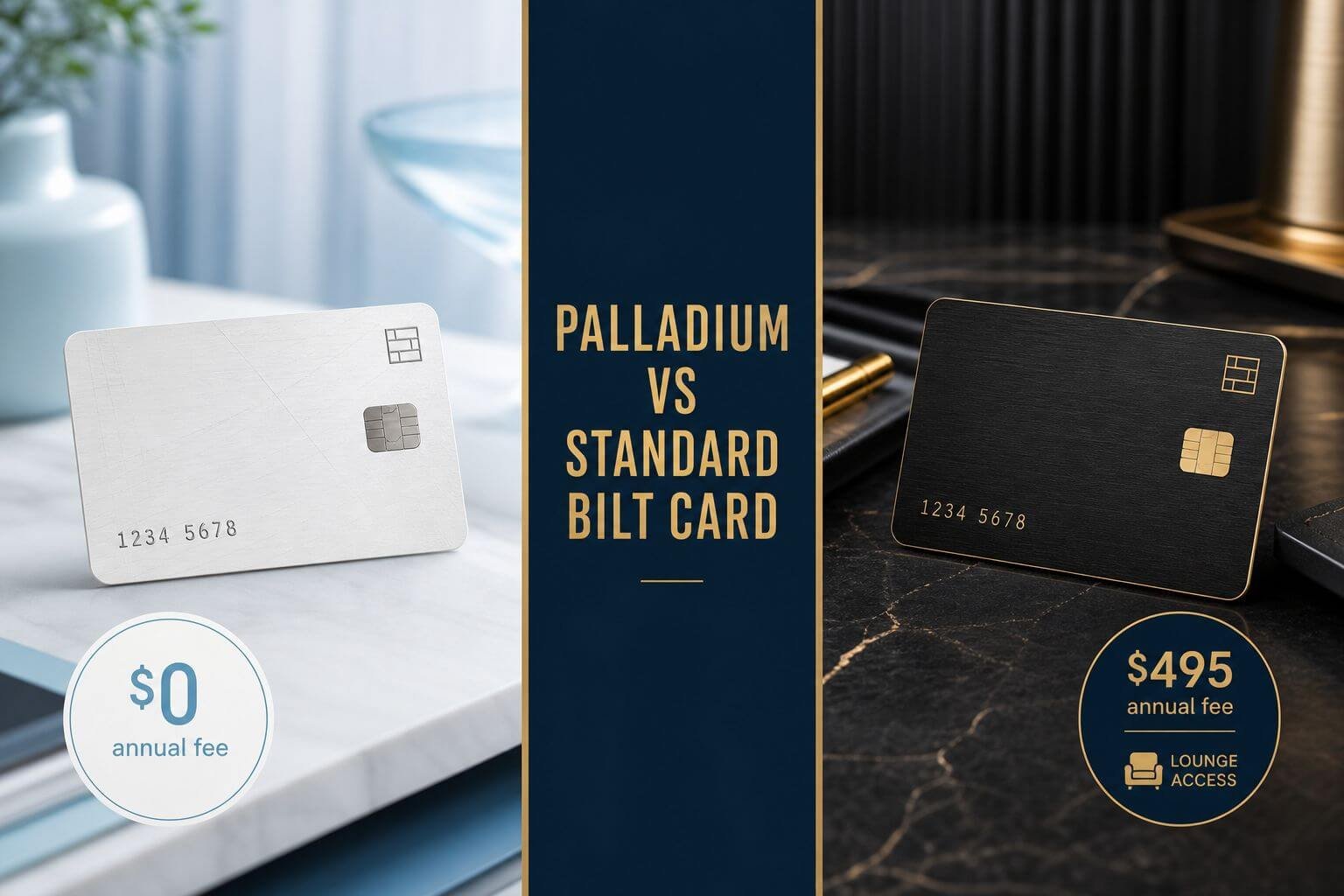
The 2x vs 1x differential on everyday spend is the core financial argument for the Palladium. At $2,000 per month in non-housing spend ($24,000 annually), the Palladium earns 48,000 Bilt points versus 24,000 for the Blue — a difference of 24,000 points. At 1.5 CPP, that’s $360 in additional value. Combined with $600 in credits (assuming full utilization), the Palladium generates roughly $960 in incremental value over the Blue before accounting for the $495 fee — a net gain of approximately $465 per year at that spend level.
At $1,000 per month in everyday spend, the math tightens considerably. The incremental earn advantage drops to $180 in travel value, and the $600 in credits need to be fully utilized to make the fee worthwhile.
Decision rule: If total non-housing monthly spend is below $1,500 and credit utilization is partial, the standard Bilt card likely wins on value. Above $2,500 in monthly non-housing spend with consistent credit use, the Palladium is the stronger card.
For those evaluating whether a premium card fee is worth it more broadly, the Chase Sapphire Preferred 2026 Review offers a useful benchmark at the $95 fee tier.
Bilt Palladium Card Sign-Up Bonus and How to Get It
The Palladium’s welcome offer requires $4,000 in non-housing spend within the first three months to earn 50,000 Bilt points, Gold status, and $300 Bilt Cash.
At $4,000 over 90 days, that’s approximately $1,333 per month in non-housing spend — achievable for most households but worth confirming before applying. Housing payments do not count toward the welcome offer threshold, which is an important distinction.
Timing consideration: Applying for the Palladium during a period of naturally elevated spending (moving costs, travel bookings, large purchases) makes hitting the threshold easier without forcing artificial spend. Manufactured spending to hit a welcome bonus threshold carries its own risks — see common mistakes when using travel credit cards for context on why this approach often backfires.
The 50,000-point bonus alone, transferred to World of Hyatt, could cover multiple nights at a mid-tier Hyatt property or a single night at a top-tier resort — a strong first-year return on the application.
Bilt Palladium Card Approval Requirements and Credit Score
The Bilt Palladium is a premium card and targets applicants with strong credit profiles. While Bilt has not published an official minimum credit score, the card is generally positioned for applicants with scores of 720 or higher (FICO 8 or equivalent).
Additional factors that influence approval:
Existing credit card history and account age
Income relative to existing credit limits
Recent hard inquiries (multiple applications in a short window reduce approval odds)
For those concerned about the impact of a new application on their credit profile, The Impact of Credit Inquiries on Your Score explains how hard pulls affect scores and how long the impact typically lasts.
Who Should Get the Bilt Palladium Card — and Who Shouldn’t
The Palladium is a commitment card. It works best for a specific profile and delivers poor value outside of it.
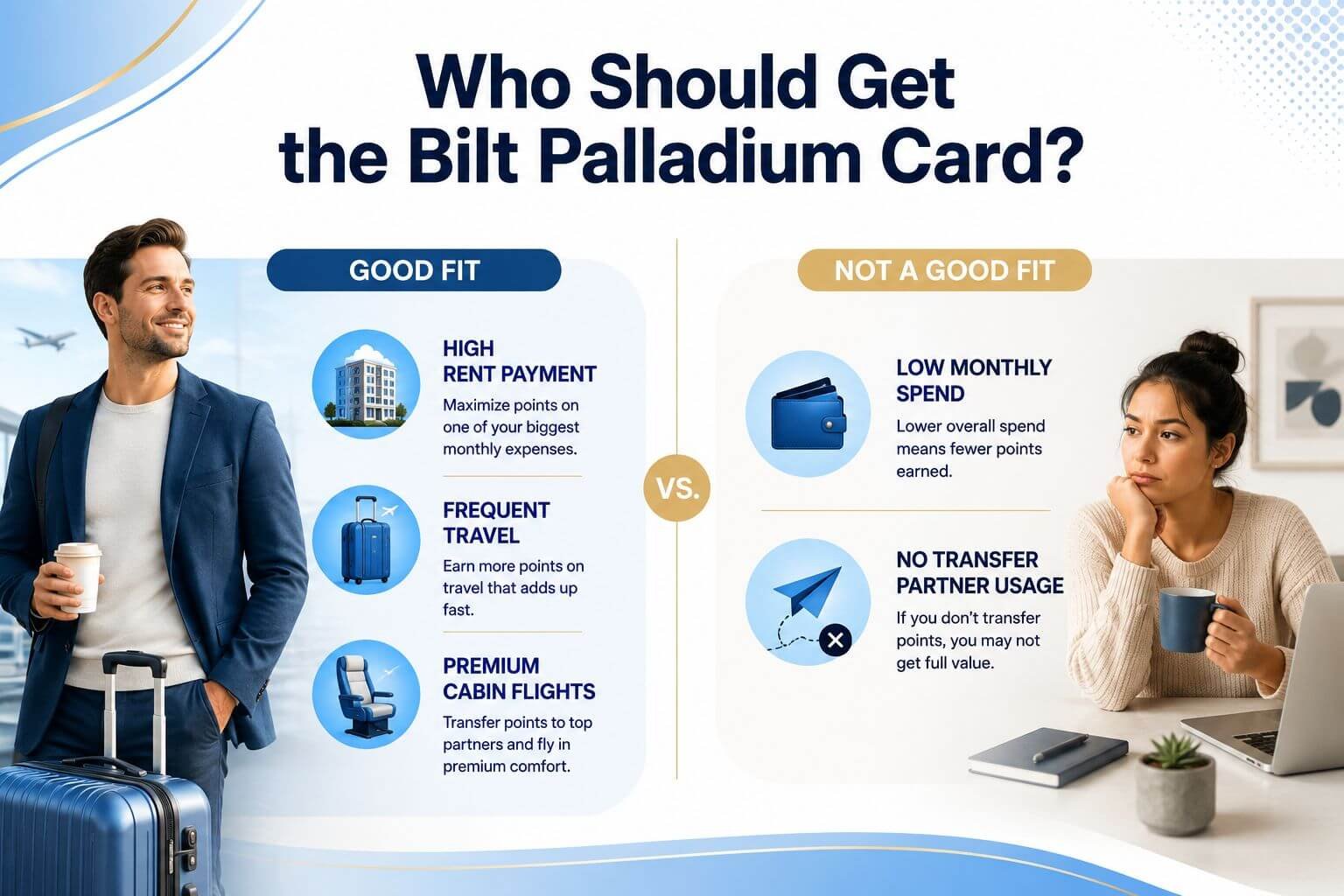
Strong fit for the Palladium:
Renters or homeowners paying $2,000 or more per month in housing costs who want to earn points on those payments without fees.
Cardholders with $2,000 or more per month in non-housing everyday spend who will consistently earn at the 2x rate.
Travelers who actively use Bilt’s transfer partners — particularly World of Hyatt, United, or Aeroplan — for premium cabin or high-value hotel redemptions.
Those who will realistically use all or most of the $600 in annual credits.
Cardholders who monitor Bilt Rent Day promotions and time transfers to capture transfer bonuses.
Not a strong fit:
Renters with low monthly housing costs (under $1,500) where the no-fee Bilt Blue captures most of the same housing-earn value.
Cardholders who prefer cash back over transferable points — the 4% Bilt Cash option on the no-fee card already provides that.
Travelers who don’t use Bilt’s transfer partners and would redeem points at low values (under 1 CPP).
Anyone who won’t consistently hit five transactions per billing cycle, which is required to earn housing points.
Those already holding a strong premium card (Amex Platinum, Chase Sapphire Reserve) who would be adding the Palladium purely for the rent-earning feature without using its other benefits.
Common Complaints and Limitations to Know
No card is without tradeoffs. The most consistent friction points reported by Palladium holders:
Complexity of the dual-currency system. Choosing between Bilt points and Bilt Cash earning modes, and understanding how Bilt Cash unlocks housing points, requires more active management than most premium cards demand.
Credits require utilization discipline. The $600 in credits is only valuable if cardholders actively use the specific categories and merchants covered. Unused credits don’t roll over.
Housing payments still require the five-transaction rule. Missing this in any given month means losing housing point earnings for that period — a recurring frustration for light spenders.
Transfer delays. Like most bank-to-airline transfers, Bilt transfers are not always instant. Transferring points to meet a specific award availability window carries execution risk, particularly for time-sensitive bookings.
$495 fee is non-trivial. At this price point, the card competes with the Amex Platinum and Chase Sapphire Reserve. Cardholders should run the math honestly rather than assuming the credits automatically justify the fee.
Can You Use Bilt Palladium Points for Flights and Hotels?
Yes — and this is where the card’s value is most clearly realized. Bilt points transfer to airline and hotel programs at a 1:1 ratio, enabling the same types of premium redemptions available through Amex, Chase, or Capital One points.
Practical examples of how Bilt points can be used:
World of Hyatt: Transfer 25,000 Bilt points for a night at a Category 5 Hyatt property (cash rate often $300–$500+), delivering 1.2–2.0 CPP.
United MileagePlus: Transfer 70,000–80,000 Bilt points for a business class award on a Star Alliance partner from the U.S. to Europe, depending on routing and availability.
Air Canada Aeroplan: One of the most flexible programs for international business class awards, with no fuel surcharges on most partners and strong award availability.
Flying Blue (Air France/KLM): Monthly Promo Rewards sales offer discounted award pricing on select routes — Bilt points transferred during a Rent Day bonus can stretch significantly further here.
The key constraint is award availability. Transferable points only deliver strong value when award space exists at saver-level pricing. Transferring points speculatively without confirmed award space is a common and costly mistake. Always verify availability before initiating a transfer.
For strategies on finding and booking premium cabin awards with transferable points, the Bilt Transfer Partners Guide covers each partner’s sweet spots and booking process in detail.
Foreign Transaction Fees and Travel Benefits
The Bilt Palladium card has no foreign transaction fees, making it a viable card for international spending. This is standard for premium travel cards but worth confirming for any card used abroad.
Additional travel benefits include:
Trip delay and cancellation protection
Purchase protection
Lounge access (specific network details subject to Bilt’s current terms)
No foreign transaction fees on international purchases
The lounge access benefit is one of the more tangible differentiators between the Palladium and the no-fee Bilt Blue. For cardholders who fly frequently enough to use lounge access regularly, this benefit alone can justify a meaningful portion of the annual fee gap.
How to Maximize Bilt Palladium Card Rewards
Getting full value from the Palladium requires a deliberate approach, not just passive card use.
Practical maximization checklist:
Confirm the earning mode (Bilt points vs Bilt Cash) aligns with the primary goal — transferable points for travel redemptions, or Bilt Cash for housing point unlocking.
Set up rent or mortgage payments through the Bilt app before the first billing cycle closes.
Ensure at least five non-housing transactions post each billing cycle to qualify for housing point earnings.
Monitor Bilt Rent Day promotions on the first of each month and time large transfers to coincide with partner bonuses.
Use the Rakuten partnership to convert online shopping cash back into additional Bilt points.
Activate and use all annual credits within their respective benefit periods — unused credits represent a real cost.
Transfer points to partners only when confirmed award space is available at target pricing.
Avoid transferring points to programs where dynamic pricing has eroded saver-level award availability.
The combination of flat 2x earning on everyday spend, uncapped housing points, and periodic Rent Day transfer bonuses means a typical household with $2,500/month in non-housing spend and $2,500/month in rent could realistically accumulate 85,000–90,000 Bilt points annually — consistent with independent estimates of roughly 88,000–89,000 points per year under similar spending assumptions.
Frequently Asked Questions
What is the Bilt Palladium card’s annual fee?
The Bilt Palladium card carries a $495 annual fee. The card includes $600 in annual statement credits and a $200 Bilt Cash deposit, which can offset a significant portion of the fee for cardholders who fully utilize these benefits.
Does the Bilt Palladium card charge a fee for rent payments?
No. Rent and mortgage payments processed through the Bilt app are fee-free on all Bilt cards, including the Palladium. This is the program’s core differentiator from general-purpose travel cards.
What is the minimum credit score needed for the Bilt Palladium card?
Bilt has not published an official minimum. Based on the card’s positioning as a premium product, applicants with FICO scores of 720 or above are generally considered competitive candidates. Approval also depends on income, existing debt, and recent credit inquiries.
Can Bilt Palladium points be transferred to airline and hotel programs?
Yes. Bilt points transfer to over 15 airline and hotel partners at a 1:1 ratio, including United MileagePlus, World of Hyatt, Air Canada Aeroplan, American AAdvantage, and Air France/KLM Flying Blue, among others.
How does the Bilt Palladium compare to the no-fee Bilt Blue card?
The Palladium earns 2x points on everyday spend versus 1x on the Blue, includes $600 in annual credits, lounge access, and a stronger welcome offer. The Blue is the better choice for cardholders whose spending volume doesn’t generate enough incremental earn to offset the $495 fee difference.
What is Bilt Rent Day and how does it affect Palladium value?
Bilt Rent Day occurs on the first of each month and typically features transfer bonuses to one or more airline or hotel partners. These bonuses — sometimes exceeding 100% — can double or more the miles or points received per Bilt point transferred. Timing transfers to Rent Day promotions is one of the most effective ways to increase the effective value of Bilt points.
Is the Bilt Palladium card worth it if I don’t pay rent?
The card still earns 2x on everyday spend and includes travel benefits and credits, but the housing-earning advantage disappears. At that point, the Palladium competes directly with the Amex Platinum and Chase Sapphire Reserve on general travel card merits — and those cards may offer stronger airline or hotel-specific benefits depending on the cardholder’s travel patterns.
Does the Bilt Palladium card have foreign transaction fees?
No. The Palladium has no foreign transaction fees, making it suitable for international use.
Conclusion
The Bilt Palladium card occupies a specific and well-defined niche: it’s built for renters and homeowners with meaningful housing costs and consistent everyday spend who want to consolidate both into a single transferable points ecosystem. The flat 2x earning rate, uncapped housing points, and access to strong transfer partners — especially World of Hyatt and Aeroplan — give the card genuine premium travel card credentials.
The $495 annual fee is real, and the math only works clearly when the $600 in credits are fully used and monthly spend is high enough to justify the 2x premium over the no-fee Blue. For cardholders who fit that profile, the Palladium is a strong option in 2026. For those who don’t, the no-fee Bilt Blue captures the most important benefit — fee-free rent earning — without the annual cost.
Practical next steps:
Run the numbers: calculate annual non-housing spend, housing costs, and whether the $600 in credits align with actual spending categories.
Review Bilt’s current transfer partner list and confirm at least one or two partners match existing travel goals before committing to the points-earning path.
Check the Bilt Transfer Partners Guide for current partner sweet spots and Rent Day bonus history.
If the Palladium fee is difficult to justify, evaluate the best no-annual-fee travel cards as an alternative before defaulting to the Blue.
For those already holding a premium card, read the downgrade travel credit card guide before adding the Palladium to an existing wallet — overlap in benefits is a common source of wasted annual fees.


Content on Award Travel Hub is independently created by Award Travel Hub Editorial Desk and, where noted, reviewed by Award Travel Hub Review Desk. Some pages may contain affiliate links, but compensation does not determine our coverage, opinions, or methodology.