

Last Updated: October 23, 2026
Most United flyers who are tempted by the $695 card would come out ahead with the $350 one, and many would do fine with the $150 card. That is the practical takeaway from the October 2026 portfolio refresh, which raised fees, added credits, and pushed welcome offers as high as 100,000 miles. This guide to the best United credit cards 2026 compares the Explorer, Quest, and Club Infinite (now marketed as the United Club Card) on what actually matters: bags, boarding, lounge access, Premier progress, and whether the annual fee survives honest math.
Assumptions used throughout: United miles valued at roughly 1.2 to 1.3 cents per point (CPP) for typical economy and domestic redemptions, and first checked bag fees of about $35 to $40 each way on domestic routes. Your numbers will differ, so adjust accordingly.
United Credit Cards Compared at a Glance
Chase and United substantially reworked the lineup in October 2026. The refresh added travel and lifestyle credits, raised the Quest and Club fees, expanded status-earning opportunities, and lifted welcome offers across all three cards. The short version: Explorer is the low-cost bag-and-boarding card, Quest is the value card for regular flyers chasing status, and Club is a lounge membership with a credit card attached.
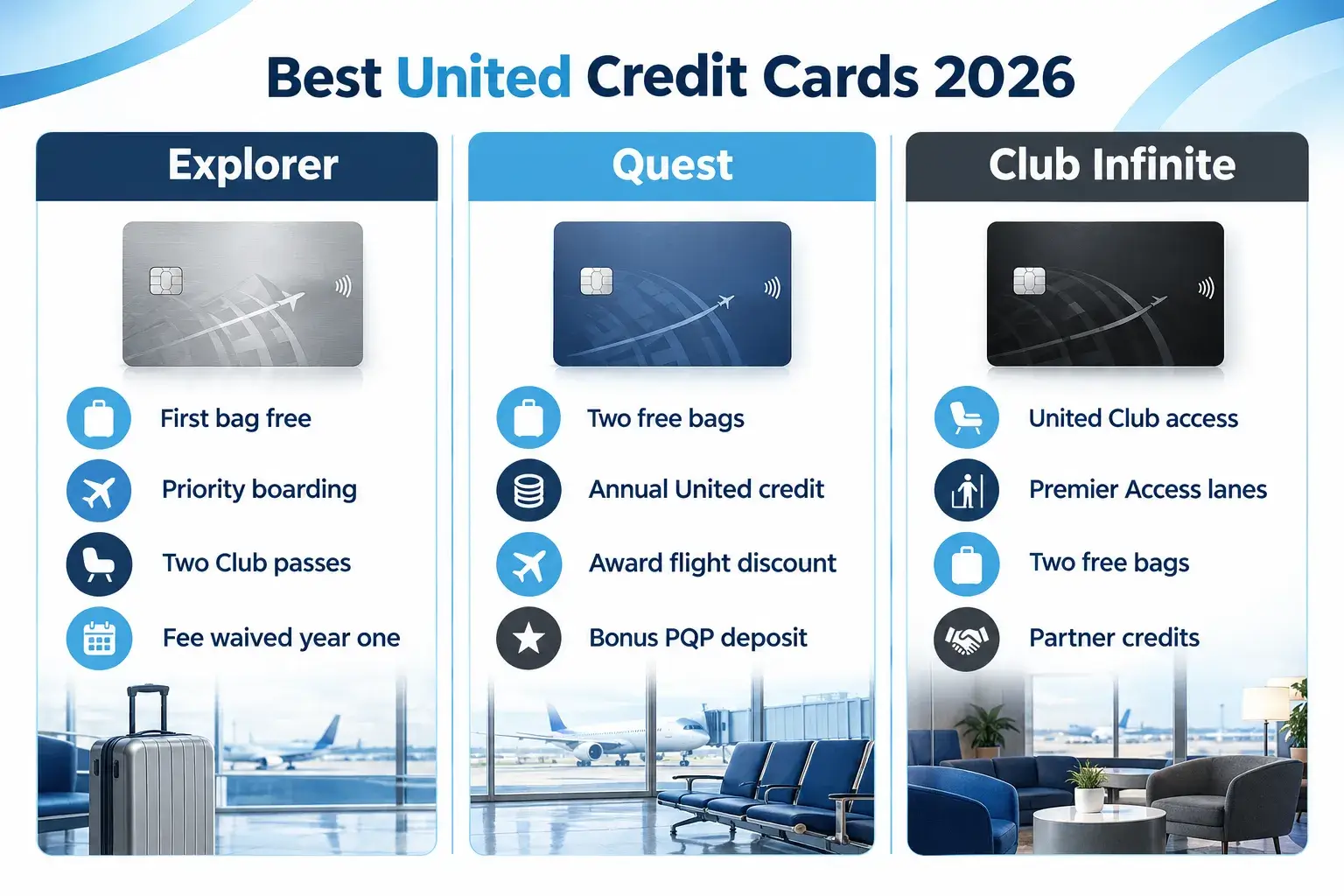
| Feature | Explorer | Quest | Club Infinite |
|---|---|---|---|
| Annual fee | $0 first year, then $150 | $350 | $695 |
| Welcome offer (max) | 80,000 miles | 90,000 miles + 500 PQP | 100,000 miles |
| Spend requirement | $3,000 in 3 months | $4,000 in 3 months | $5,000 in 3 months |
| Free checked bags | First bag | First and second bags | Two bags |
| Priority boarding | Yes | Yes | Premier Access |
| United Club access | Two one-time passes per year | No membership | Full membership |
| Headline recurring perks | Club passes, bag benefit | $200 United credit, 10,000-mile award discount, 1,000 PQP deposit | Club membership, $875+ in partner credits |
| Best for | Occasional flyers | Frequent flyers | Lounge-dependent travelers |
All three cards also share the cardmember perk of expanded award availability. United releases additional saver-level award space to its cardholders on many routes, which can matter more than the welcome bonus if you redeem regularly on United metal. It does not change pricing on dynamic awards that are already high, and it does not apply to partner airlines.
None of these cards includes Priority Pass. If you want broad third-party lounge coverage, a transferable points card is the better tool. None charges foreign transaction fees, and all three include Chase travel protections such as trip delay and baggage delay coverage. Coverage limits vary by card, so read the guide to benefits before relying on them.
1. United Explorer Card: Best for Occasional Flyers
The Explorer is the right card for someone who flies United a few times a year, checks a bag, and wants the annual fee to pay for itself with minimal effort. It keeps a $0 introductory annual fee for the first year, then charges $150.
The welcome offer. Earn 70,000 bonus miles after $3,000 in purchases within three months, plus 10,000 more miles after adding an authorized user in that window, for up to 80,000 miles. At 1.2 CPP, that is roughly $960 in travel value. For a deeper breakdown of how to redeem it, see our analysis of the United Explorer Card 80,000 bonus miles offer.
You may be interested



The bag math. The primary cardmember and one companion on the same reservation each get their first checked bag free when the ticket is paid with the card. For a couple taking one domestic round trip, that is four bags, or about $140 to $160 saved. Two round trips a year more than covers the $150 fee on bags alone.
The Club passes. You get two one-time United Club passes per year. United sells single-visit access for $59, so the passes carry about $118 in nominal value. Their real value is lower if you would never pay for entry, so count them at whatever you would actually spend.
Earning and status. The Explorer has historically earned 2x miles on United purchases, dining, and hotel stays booked direct, with 1x elsewhere. Confirm current rates on Chase’s terms page, since the refresh adjusted parts of the lineup. Spending also earns Premier Qualifying Points (PQP), but the Explorer’s cap is the lowest of the three. Treat it as a small boost, not a status strategy.
Best for: Travelers taking two to five United trips per year who check bags and fly with a companion. Not for: Anyone using the card as a primary spending card. Outside United and dining, the earn rate is weak compared with cards that earn Chase points, Amex points, or Capital One miles.
2. United Quest Card: Best for Frequent Flyers
The Quest is where the refresh made the biggest difference. The fee rose to $350, but the recurring benefits now offset most of it for anyone who flies United regularly. It is the card most frequent United flyers should evaluate first.

The welcome offer. You earn 500 PQP after the first purchase, 80,000 miles after $4,000 in purchases within three months, and 10,000 more miles for adding an authorized user, for up to 90,000 miles plus 500 PQP. There is no first-year fee waiver, so you pay $350 upfront.
The recurring value stack:
- $200 United travel credit. If you buy United tickets anyway, this effectively cuts the fee to $150.
- 10,000-mile award flight discount. Applied to an award booking each year, this is worth about $120 to $130 at typical valuations.
- 1,000 PQP deposit. Beginning in the calendar year after account opening, the card deposits 1,000 Card Bonus PQP annually, on top of PQP earned from spending.
- Free first and second checked bags for the cardmember and a companion on the same reservation.
Real-world example. A flyer who uses the $200 credit and the 10,000-mile discount has captured roughly $320 to $330 in value before checking a single bag. Add three round trips with one checked bag each and the card is comfortably net positive. If you would not book United cash fares, though, the credit loses most of its value, and the math looks closer to the Explorer.
Status progress. Quest’s combination of spend-based PQP and the annual deposit makes it the most efficient card for reaching Premier Silver or supporting a Gold run. Heavy spend toward status has an opportunity cost: the same dollars on a transferable points card might earn 2 to 3 points per dollar that can move to United or other Star Alliance partners.
Best for: Regular United flyers who check bags, want Premier progress, and do not need a lounge on every trip. Not for: Travelers who mostly fly other airlines or book United awards through partner programs instead of United directly.
3. United Club Infinite Card: Best for Lounge Access
The Club card makes sense if you would otherwise buy a United Club membership and you route through hubs like Newark, Houston, Chicago, Denver, or San Francisco often. At $695 with no first-year waiver, it is a lounge product first and a rewards card second.
The welcome offer. Earn 90,000 miles after $5,000 in purchases within three months, plus 10,000 miles for adding an authorized user, for up to 100,000 miles. That is about $1,200 to $1,300 in travel value at typical United redemptions.
What you get:
- United Club membership at United-branded Clubs, including access for eligible guests under United’s program rules.
- Premier Access travel services, meaning priority check-in, security lanes where available, and priority boarding.
- Two free checked bags.
- More than $875 in annual partner credits, according to Chase.
The partner-lounge catch. One reported change in the 2026 refresh is more restricted access to partner lounges. Club-card access continues at United-branded Clubs, but partner-lounge entry reportedly requires Premier Gold status or $50,000 in annual card spending. Confirm this in the cardmember agreement before applying, especially if you fly Star Alliance partners internationally.
Be skeptical of the credits. Partner credits are only worth what you would have spent anyway. If $875 in credits covers services you would not normally buy, count a fraction of that, not the full amount. Many cardholders realistically capture a few hundred dollars.
Who should skip it. If you visit a United Club fewer than about 10 times a year, the Quest plus paid day passes is usually cheaper. For a full cost-per-visit framework, see our guide to airport lounge access credit cards.
Best for: Hub-based United loyalists who use the lounge on most trips and would pay for a membership anyway. Not for: Travelers who want broad lounge coverage across airlines, or anyone counting on partner lounges abroad without Gold status.
Current Welcome Offers and Annual Fees
Here is how the October 2026 public offers compare on a first-year value basis. Values assume 1.2 CPP and full completion of the authorized-user bonus.
| Card | Max bonus | Approx. value | First-year fee | Net before perks |
|---|---|---|---|---|
| Explorer | 80,000 miles | ~$960 | $0 | ~$960 |
| Quest | 90,000 miles + 500 PQP | ~$1,080 | $350 | ~$730 |
| Club | 100,000 miles | ~$1,200 | $695 | ~$505 |
The Explorer wins on first-year net value, which surprises many readers. The higher bonuses on Quest and Club are real, but so are the fees. Year two matters more: once the bonus is gone, the card has to justify itself on recurring benefits alone.
Common pitfalls to avoid:
- Ignoring bonus eligibility. Chase applies its 5/24 rule and card-specific bonus restrictions. Holding multiple United cards is allowed, but you may not qualify for a bonus if you have or recently had the same card. Check the offer terms for current language.
- Assuming approval timing. Many applications are decided instantly. Others go to review and take a week or more. Do not apply the day before a big purchase you need for the spend requirement.
- Overvaluing miles. United uses dynamic pricing on its own flights, so saver availability and partner awards drive your real redemption value. Premium cabin awards on Star Alliance partners can push value higher, while peak-date United economy can push it lower.
If you are comparing these against broader options, our roundup of best credit card welcome bonuses for October 2026 shows where the United offers rank.
Which United Card Pays for Itself for You
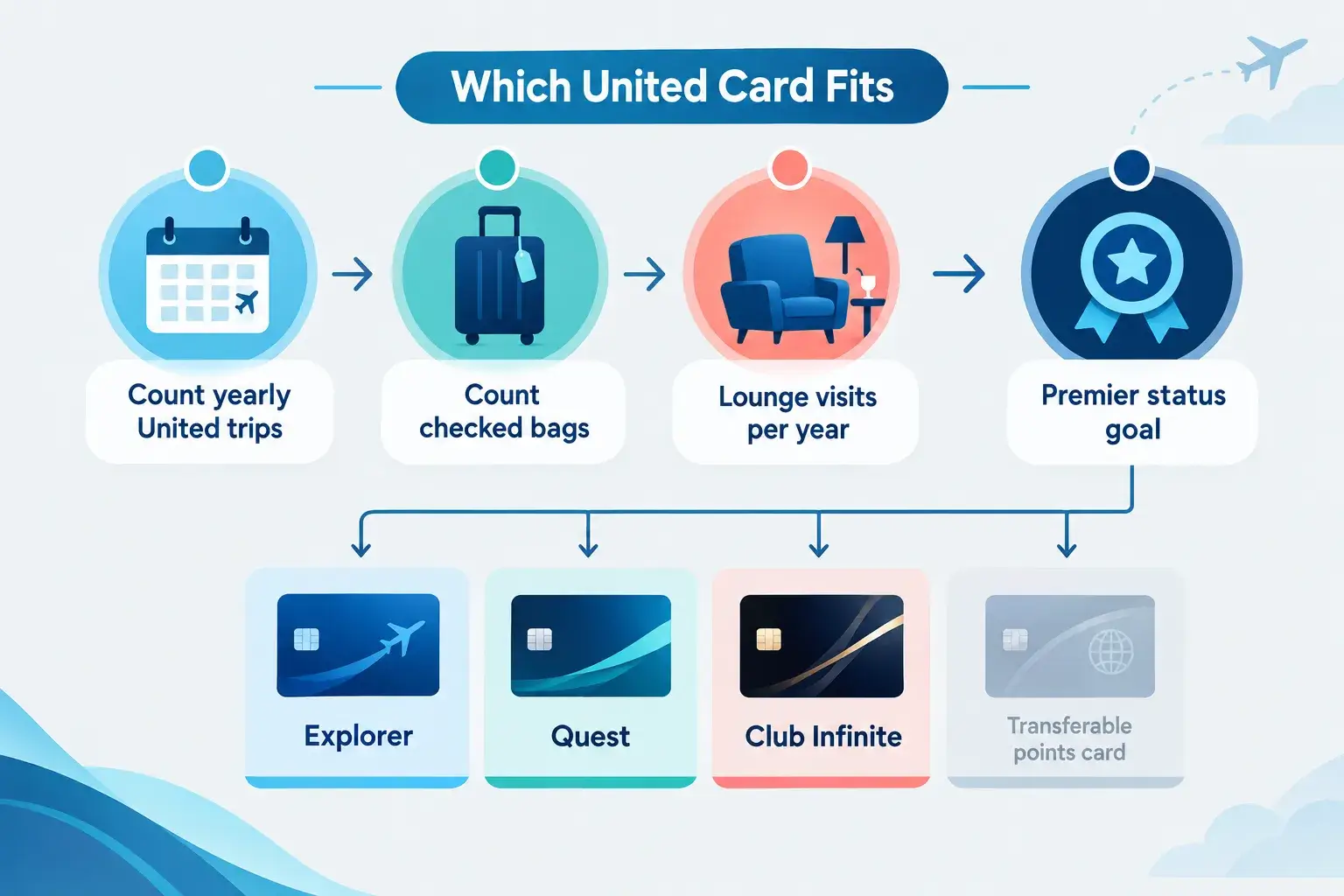
Use this decision framework. Answer the questions honestly, in order, and stop at the first card that fits.
- Fewer than two United trips a year? Skip co-branded cards. A transferable points card, such as one earning Chase points that transfer 1:1 to United, is more flexible. Our credit card transfer partners ratio chart shows every United-adjacent option.
- Two to five trips, check bags, no status goal? Explorer.
- Five or more trips, book United cash fares, want Premier progress? Quest.
- Ten or more lounge visits a year at United hubs? Club, after confirming the partner-lounge rules.
A note on which airline card is better. United cards are strongest for travelers based at United hubs. If your home airport is dominated by Delta, compare against the best Delta credit cards for 2026 instead of forcing a United card into your wallet.
Maximize what you hold. Pay for United tickets with the card to trigger bag benefits, use the Quest award discount on a high-mileage booking, and set a calendar reminder for your fee anniversary. If your travel drops, downgrading usually beats canceling, because it preserves credit history and avoids losing account age. Our guide on how to downgrade a travel credit card and keep your points walks through the options, and the Club-to-Quest or Quest-to-Explorer move is often the right call. Related topics worth reading next include United MileagePlus 2026 program changes and when Star Alliance partner redemptions beat booking United directly.
FAQ
Can you have multiple United credit cards? Yes. Chase allows holding more than one United card, but welcome bonus eligibility depends on the offer terms and your recent card history. Check the terms before applying for a second card.
Does any United card include Priority Pass? No. The Club card provides United Club access, not Priority Pass. For Priority Pass, look at premium transferable points cards.
Do United cards charge foreign transaction fees? No. Explorer, Quest, and Club carry no foreign transaction fees.
Is the Quest worth $350 if I rarely buy United tickets? Usually not. Without using the $200 United travel credit, the net cost rises sharply, and the Explorer becomes the better value.
Do United cardmembers get better award availability? Generally, yes. Cardmembers can see expanded saver award space on many United-operated flights. It does not apply to partner airlines.
Conclusion
The best United credit card is the cheapest one that covers how you actually fly. For most occasional travelers, that is the Explorer. For regular United flyers who can use the travel credit and award discount, the refreshed Quest offers the strongest year-two value. The Club card only pays off for travelers who are already in United lounges most weeks. Count your trips, bags, and lounge visits for the past 12 months, run the numbers above, and apply for the card that clears its fee without stretching.





Content on Award Travel Hub is independently created by Award Travel Hub Editorial Desk and, where noted, reviewed by Award Travel Hub Review Desk. Some pages may contain affiliate links, but compensation does not determine our coverage, opinions, or methodology.