

Last updated: September 25, 2026
Quick Answer
Travel points are a loyalty currency issued by banks, airlines, and hotels, and they are worth roughly 1 to 2.2 cents each, depending on the program and how you redeem them. Bank points from Chase, Amex, Capital One, Citi, and Bilt are most valuable for beginners because you can redeem them through a travel portal at a fixed rate or transfer them to airline and hotel partners for potentially higher value. The single biggest beginner mistake is redeeming points for merchandise, statement credits, or gift cards, which usually cuts their value roughly in half.
Key Takeaways
Points are a discounted foreign currency. They only have value when spent inside the issuing program’s ecosystem, and the issuer controls the exchange rate.
Three categories exist: bank (transferable) points, airline miles, and hotel points. Bank points are the most flexible and the safest place for a beginner to start.
As of September 2026, The Points Guy’s monthly valuations put Bilt around 2.2 cents, Chase Ultimate Rewards around 2.05 cents, Amex Membership Rewards around 2.0 cents, Citi ThankYou around 1.9 cents, and Capital One miles around 1.85 cents.
Portal redemptions give a fixed rate (typically 1.0 to 1.25 cents per point) with no blackout dates. Transfer partner redemptions can beat that, but require award availability.
Points expire in most airline and hotel programs after 18 to 24 months of no activity. Bank points generally don’t expire while the account is open and in good standing.
Sign-up bonuses are the fastest legitimate way to build a balance. Recent August 2026 offers included Chase Sapphire Preferred at 75,000 points after $5,000 in three months and Amex Gold at up to 100,000 Membership Rewards after $8,000 in six months.
You may be interested
Points are not always better than cash. If a redemption returns less than about 1.3 cents per point, paying cash and banking flat-rate cash back is often the stronger move.



What Travel Points Actually Are
Travel points are a private currency issued by a company, redeemable only for that company’s products or its partners’ products. A better mental model than “free travel” is this: points are a discounted foreign currency that you can only spend in one country, and the government of that country can devalue it at any time without notice.
That framing matters because it explains almost every rule beginners find confusing.
The issuer sets the exchange rate, and can change it.
The currency isn’t universally accepted, so you need an “award seat” or “award night” to exist before you can spend.
Hoarding is risky. Unlike a savings account, points lose purchasing power over time through devaluation, not inflation you can see.
Points are also earned in three basic ways: credit card spending, actually flying or staying, and promotional bonuses (sign-up offers, shopping portals, dining programs). For most U.S. consumers who aren’t road warriors, credit card spending and sign-up bonuses generate the overwhelming majority of the balance.
A point sitting unredeemed is not savings. It’s an unsecured IOU from a company that can change the terms.

Who travel points are for (and who they’re not for)
Best for: People who pay their credit card balance in full every month, travel at least once or twice a year, and have some flexibility on dates or destinations.
Not for: People carrying revolving credit card debt. Interest at typical APRs will exceed any reward value quickly. Also a poor fit for travelers who need exact dates on peak holidays with zero flexibility, since award space is the constraint, not the point balance.
The Three Places Points Come From
Points come from banks, airlines, and hotels, and those three categories behave very differently. Understanding which bucket a point sits in tells you how flexible it is, how fast it can be devalued, and whether it expires.
Bank points (transferable points)
Bank points are issued by a card issuer, not a travel company. The major U.S. programs are Chase Ultimate Rewards, American Express Membership Rewards, Capital One miles, Citi ThankYou points, and Bilt points.
What makes these valuable is optionality. Each can be:
Redeemed through the issuer’s travel portal at a fixed rate.
Transferred to airline or hotel transfer partners, usually at 1:1.
Cashed out for statement credits or gift cards, usually at a poor rate.
Transfer partner lists change. Citi ThankYou points, for example, gained American Airlines AAdvantage as a transfer partner, which materially changed how Citi points should be used. If you hold Citi points, read the details on how Citi ThankYou transfers to American AAdvantage work.
Airline miles
Airline miles live in one airline’s program: Delta SkyMiles, United MileagePlus, American AAdvantage, Air Canada Aeroplan, and so on. They can usually be spent on that airline and its alliance partners, which is where the best value tends to hide.
The tradeoff: miles are single-purpose. If the airline devalues its award chart or moves to dynamic pricing, there’s no exit.
Hotel points
Hotel points sit with a chain: Marriott Bonvoy, Hilton Honors, World of Hyatt, IHG One Rewards, Wyndham Rewards. Nightly award pricing is increasingly dynamic, which means the number of points for the same room can change day to day.
Hotel points generally have lower per-point value than airline miles, but they’re easier to use. Award nights are usually available whenever a standard room is for sale, which removes the availability guessing game.
Why Points From Different Programs Are Not Equal
Two accounts showing “100,000 points” can be worth wildly different amounts. Program, redemption method, and cabin class determine actual value, not the headline number.
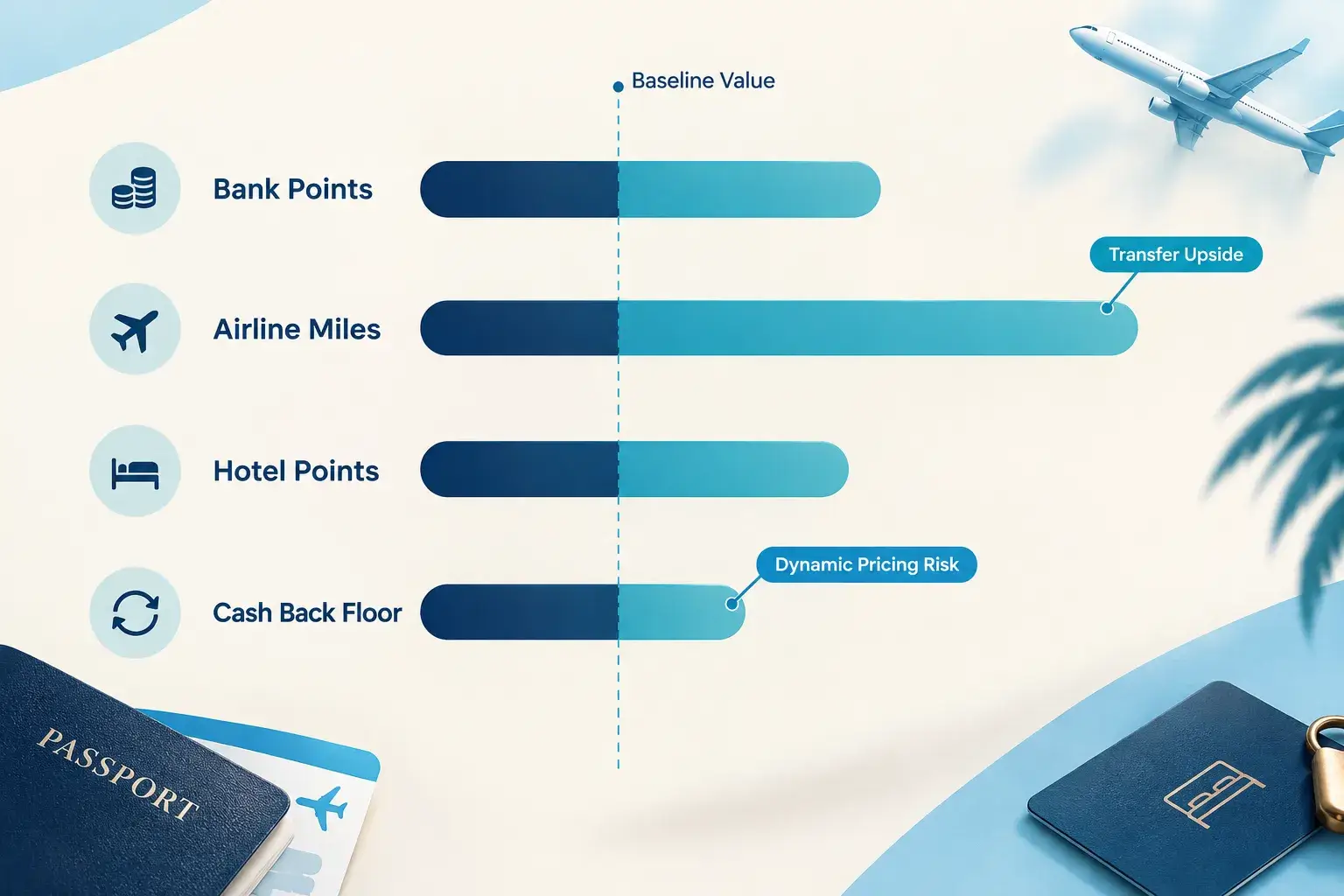
Here’s how the categories typically compare in 2026:
Points typeTypical value rangeBest realistic useMain riskBank points (Chase, Amex, Capital One, Citi, Bilt)1.0-2.2 centsTransfer to airline partner for international business classTransfer partner list can shrinkAirline miles (major U.S. carriers)1.1-1.5 centsPartner awards on alliance carriersDynamic pricing, devaluationAirline miles (partner-friendly foreign programs)1.3-2.0+ centsSweet spot award charts, stopoversFuel surcharges on some routesHotel points (Hyatt, Marriott, Hilton, IHG)0.5-2.0 centsStandard-room nights at high-cash-rate hotelsDynamic award pricing, resort feesCash backExactly 1.0 centAnythingNone, which is the point
The September 2026 TPG valuations give a rough ranking for bank programs: Bilt around 2.2 cents, Chase around 2.05 cents, Amex around 2.0 cents, Citi around 1.9 cents, Capital One around 1.85 cents. Treat those as benchmarks for comparison, not promises. They represent what a skilled redeemer can achieve, not what an average portal booking returns.
How to calculate cents per point (CPP)
CPP = (cash price of the trip − taxes and fees paid on the award) ÷ points used
Example: A round-trip economy flight sells for $620. The award costs 40,000 miles plus $38 in taxes.
($620 − $38) ÷ 40,000 = 1.46 cents per point
That’s a solid economy redemption. Run this math every single time before transferring. If you want to automate it, use the travel points calculator for valuing miles and points in 2026.
How airline loyalty programs calculate point value
Airlines don’t publish a fixed value per mile anymore. Most large U.S. carriers now price awards dynamically, meaning the mileage cost tracks the cash fare rather than a published award chart. When cash prices spike, so does the mileage price.
A handful of programs still publish region-based award charts, which is why partner bookings through those programs often beat booking directly with the operating airline. The practical rule: when a program publishes a chart, check it before you check the airline’s own website.
How Points Get Turned Into Travel
There are two main paths: book through the issuer’s travel portal at a fixed rate, or transfer points to an airline or hotel partner and book an award. Beginners should start with the portal and graduate to transfers once they’re comfortable searching award space.
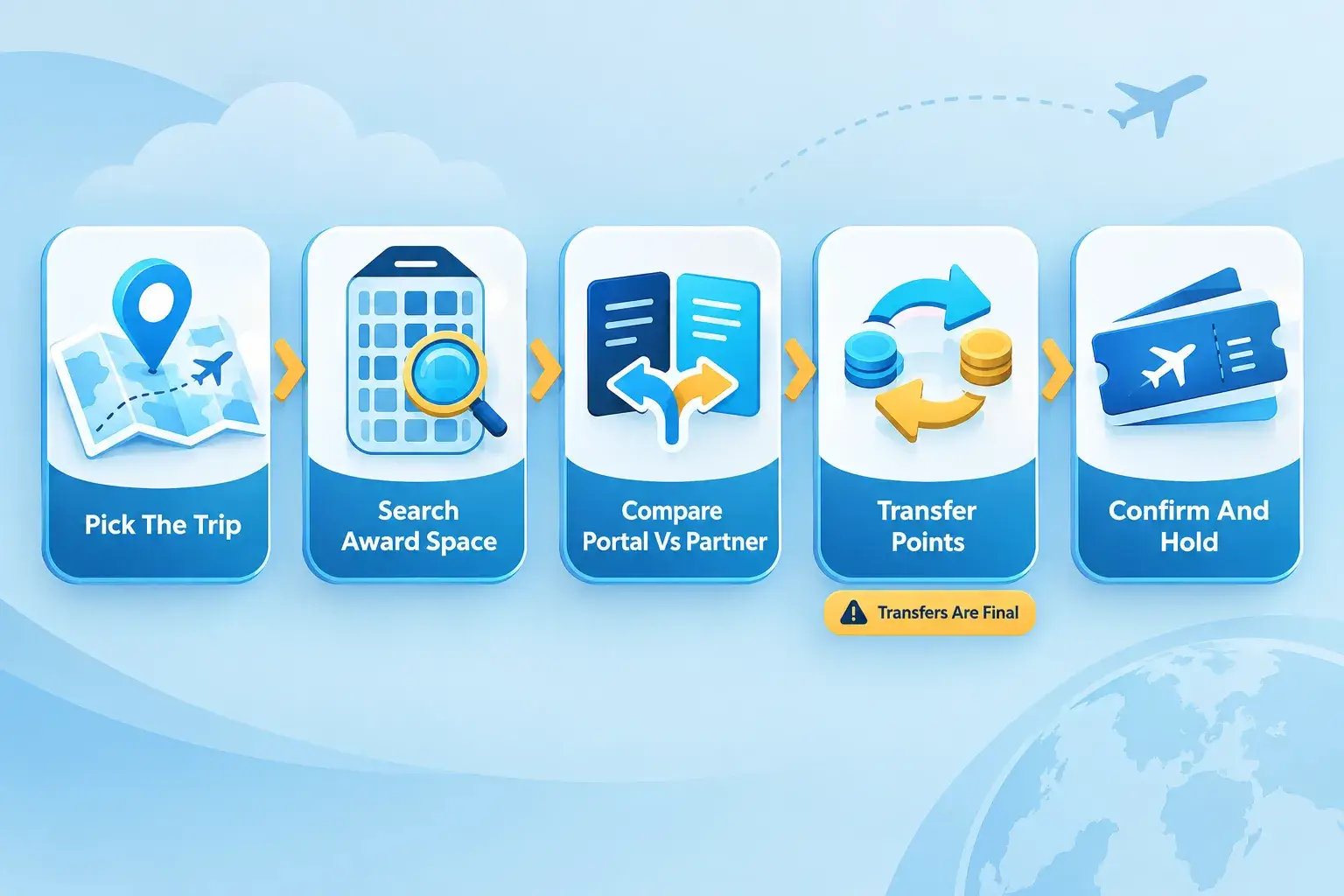
Portal versus transfer partner: the beginner comparison
FactorTravel portalTransfer partnerValue per pointFixed, usually 1.0-1.5 centsVariable, 0.8-5+ centsAvailabilityAny bookable seat or roomOnly if award space existsComplexityLow, works like a booking siteModerate to highReversibilityPoints usually returned on cancellationTransfers are almost always irreversibleEarns airline status/milesUsually yesNo
Choose the portal if: you need a specific flight on specific dates, the trip is domestic economy, or the transfer partner math doesn’t clear roughly 1.5 cents per point.
Choose a transfer partner if: you’re booking an international premium cabin, you’ve already confirmed award seats are bookable, and the CPP math is clearly better.
The rule that prevents the most expensive beginner error
Find the award seat first. Transfer second.
Transfers to airline partners can take anywhere from instant to several business days, and once points leave the bank program, they cannot come back. If award space disappears during a slow transfer, those points are now stuck in an airline program you may not have wanted.
A step-by-step redemption walkthrough
Pick the trip and set a cash benchmark. Note what the flight or hotel actually costs in dollars.
Check the portal price. This is your floor. Any transfer option has to beat it.
Search award availability using a tool that shows partner space (Google Flights for cash pricing, plus the airline program’s own award search or a dedicated award search tool).
Confirm the transfer ratio and partner. Most bank-to-airline transfers are 1:1, but some are not.
Check taxes, fees, and surcharges. Some programs add fuel surcharges of several hundred dollars on transatlantic partner awards. That kills the CPP.
Run the CPP calculation. Below about 1.3 cents, reconsider.
Transfer only the exact amount needed, then book immediately.
Can you use points for anything besides flights?
Yes, but usually at a worse rate. Bank points can be redeemed for gift cards, merchandise, statement credits, ride shares, and even charitable donations. These typically return 0.5 to 1.0 cents per point.
Points can also cover rail travel in some programs, which is genuinely useful in Europe. See the guide to maximizing points for train travel in Europe for how that works in practice.
Rough hierarchy of redemption value, best to worst:
International business or first class via transfer partners
High-value hotel award nights at expensive properties
Economy flights that beat 1.5 cents per point
Portal bookings at 1.25 cents
Statement credits and cash back at 1.0 cent
Gift cards, merchandise, and Amazon checkout at 0.5-0.8 cents
The Beginner Mistakes That Waste Points
The most common way to waste points isn’t a bad redemption. It’s inaction: sitting on a large balance while the program devalues around you.

Ten common pitfalls
Redeeming for merchandise or gift cards. Roughly half value, every time.
Hoarding for years. Devaluations are frequent and usually announced with little or no notice. The 2026 revaluation trend has been unfavorable in several major programs.
Transferring points speculatively. Never transfer without a confirmed award seat in front of you.
Ignoring surcharges. A “free” business class seat with $700 in carrier-imposed fees isn’t a great deal.
Opening too many cards too fast. Each application triggers a hard pull. Read up on how credit inquiries affect your score before applying.
Chasing a sign-up bonus you can’t hit organically. Manufactured spending to meet a minimum usually isn’t worth it.
Letting airline or hotel points expire through inactivity.
Assuming the portal is always worse. For domestic economy it’s often the correct choice.
Booking the wrong program for the same flight. The same seat can cost very different mileage amounts depending on which partner program issues the ticket.
Forgetting opportunity cost. Points spent on a $200 flight can’t be spent on a $4,000 business class seat.
Edge case worth knowing: married segments
Some airlines price connecting flights as a single unit rather than individually, so award space shown on one leg may not be bookable as part of your itinerary. If a search tool shows availability but the booking engine rejects it, married segment logic is a likely cause.
Your First Ninety Days: A Simple Starting Plan
A beginner should spend the first ninety days doing three things: pick one flexible bank points card, meet its sign-up bonus through normal spending, and define one specific trip to aim for. Do not open multiple cards in the first quarter.
Days 1-15: Pick one card and one goal
Choose a card whose points transfer to partners you’d actually use. Recent August 2026 offers included:
Chase Sapphire Preferred: 75,000 points after $5,000 spend in three months
Amex Gold: up to 100,000 Membership Rewards after $8,000 spend in six months
Capital One Venture X: 75,000-80,000 miles, worth at least $830 toward travel at the 1-cent floor
Citi AAdvantage: 80,000 AAdvantage miles after $3,500 spend in four months
Note the difference in the last one: AAdvantage miles are airline miles, not flexible bank points. Better for someone already committed to American Airlines, worse for someone who wants options. For a broader framework, review the beginner’s guide to travel rewards.
Decision rule: if the minimum spend requires changing your spending habits, pick a card with a lower threshold. A missed bonus is worse than a smaller bonus.
Days 16-75: Earn without distortion
Put routine spending on the card: groceries, gas, utilities, insurance, subscriptions. Add shopping portals and dining programs for incremental points. Set autopay for the statement balance in full.
Target for the quarter: around 100,000 points from the bonus plus organic spend. The beginner’s blueprint for earning your first 100,000 points covers the mechanics.
Days 76-90: Learn to search before you spend
Before redeeming anything, practice award searches for a trip you’d actually take. Check the portal price, check two transfer partners, and compute CPP for each. Even if you don’t book, the reps build judgment.
How to earn travel points fast without wrecking your credit
Sign-up bonuses are the highest-leverage lever. One bonus typically equals a year or more of organic spending.
Pay recurring bills with the card, including rent if you use a program that allows it.
Use shopping portals and dining registrations for stacked earning.
Add an authorized user only if the referral or bonus justifies it.
Space applications roughly 90 days apart and monitor issuer-specific application rules.
When Points Stop Being Worth the Effort
Points stop being worth the effort when the time spent searching exceeds the dollar value recovered, or when the redemption returns less than roughly 1.3 cents per point. For casual travelers taking one domestic trip a year, a flat cash back card often beats a points strategy.
Are travel points worth it for casual travelers?
Sometimes. Honest assessment:
Worth it if: you take two or more trips a year, you can hit a sign-up bonus organically, and you’re willing to spend an hour or two per booking comparing options.
Not worth it if: you travel once a year on fixed dates, you find the research tedious, or you’d carry a balance. A 2% flat cash back card delivers a guaranteed, predictable return with no expiration and no devaluation risk.
Travel points versus cash back: which is better?
Cash back wins on certainty. Points win on ceiling. A 2% cash back card returns 2 cents per dollar, always. Transferable points earning 2x on travel and returning 1.9 cents each return about 3.8 cents per dollar, but only if you execute the redemption well.
The practical test: if you would realistically redeem at or below 1.3 cents per point, take the cash back. For a deeper comparison, see when to use points versus paying cash.
Business travel versus personal use
Business travelers have a structural advantage: they earn points on spending they’d incur anyway, and many earn elite status from paid travel. Personal users rely more heavily on card bonuses and category spending.
One rule for both: keep business and personal accounts separate for clean records, and confirm your employer’s policy on keeping points from reimbursed travel. Policies vary and some employers prohibit it.
Expiration, blackout dates, and restrictions
Any qualifying activity, including a small shopping portal purchase or a dining transaction, typically resets the clock. Always verify the current rule in your specific program before assuming.
Blackout dates in the classic sense are largely gone. They’ve been replaced by something less visible: award availability limits and dynamic pricing. An airline may technically offer awards every day of the year while releasing zero saver-level seats on peak dates. The effect is the same, but it’s harder to spot.
Practical defense: book award travel as early as the schedule opens (usually 330 to 355 days out) for peak dates, and stay flexible by a day or two on either side. For more on managing this risk, read how to protect points from devaluation.
FAQ
How much is one travel point worth in dollars?
Most travel points are worth between 1.0 and 2.2 cents each. As of September 2026, TPG valuations put Bilt near 2.2 cents, Chase near 2.05 cents, Amex near 2.0 cents, Citi near 1.9 cents, and Capital One near 1.85 cents. Hotel points generally fall lower, between 0.5 and 2.0 cents.
Can you transfer travel points between airlines?
No, airline miles cannot be transferred directly between airline programs in most cases. However, bank points from Chase, Amex, Capital One, Citi, and Bilt can be transferred to multiple airline partners, usually at a 1:1 ratio. Transfers are one-way and cannot be reversed.
Do travel points expire?
Bank points from major card issuers generally do not expire while the account remains open and in good standing. Many airline and hotel programs expire points after 12 to 24 months of account inactivity, though any qualifying earning activity typically resets the clock.
What is the best way to use travel points for maximum value?
Transferring bank points to an airline partner for an international business or first class award typically produces the highest cents-per-point value. The tradeoff is that award space is limited and some programs add fuel surcharges that reduce the net benefit.
Are travel points better than cash back?
Cash back is better if you would redeem points at 1.3 cents or less, or if you value simplicity. Travel points are better if you can consistently redeem above roughly 1.5 cents per point through transfer partners and take at least two trips per year.
What is the most common mistake beginners make with points?
Redeeming points for gift cards, merchandise, or statement credits. Those options usually return 0.5 to 1.0 cents per point, roughly half of what a transfer partner redemption can deliver.
Conclusion
Travel points are a useful tool with clear limits. They’re worth roughly 1 to 2.2 cents each, they lose value over time through devaluations, and they only convert into travel when award space actually exists. Treat them as a currency with an expiration risk, not as a savings account.
Next steps:
Check your existing balances across every bank, airline, and hotel account, and note the expiration rule for each.
Pick one flexible bank points card and commit to hitting its sign-up bonus through normal spending over the next three months.
Before your next booking, run the cents-per-point math on both the portal price and one transfer partner. If the transfer doesn’t beat the portal by a meaningful margin, book the portal.
Set one specific trip goal for the next twelve months. A defined target prevents the hoarding trap.
Once you’ve earned that first balance, move on to the mechanics of comparing redemptions with the dollars-to-points valuation guide for 2026.





Content on Award Travel Hub is independently created by Award Travel Hub Editorial Desk and, where noted, reviewed by Award Travel Hub Review Desk. Some pages may contain affiliate links, but compensation does not determine our coverage, opinions, or methodology.