

Last updated: September 20, 2026
Quick Answer
The best travel credit cards 2026 ranking starts with the Chase Sapphire Preferred for most travelers, while Capital One Venture X remains the strongest premium-value option. The gap widened because the Sapphire Reserve rose to a $795 annual fee and the Amex Platinum reached $895, while Venture X stayed at $395.
The right card still depends on whether its credits match spending you’d do anyway. Lounge access, coupons, and inflated welcome offers should not rescue a card that fails the renewal-year math.
Key Takeaways
- Best overall: Chase Sapphire Preferred, because its $95 fee, transferable Chase points, travel protections, and expanded hotel credit remain practical for many travelers.
- Best premium value: Capital One Venture X, which kept its $395 annual fee while competing premium cards became more expensive.
- Best no-annual-fee option: Wells Fargo Autograph, especially for broad travel spending without premium benefits.
- Best business travel card: Ink Business Preferred, assuming its bonus categories fit genuine business expenses.
- Chase Sapphire Preferred’s hotel credit increased, but its Hyatt transfer ratio is scheduled to fall from 1:1 to 4:3 and its anniversary points bonus is being removed.
- Sapphire Reserve and Amex Platinum can still work for frequent travelers, but only when recurring benefits offset their fees without changing normal spending.
- Most general travel cards charge no foreign transaction fee, but cardholders should confirm this before international use.
- Welcome offers are temporary. Compare an elevated offer with the card’s long-term cost and program rules.
- Transfer points only after finding bookable award space. Transfers are generally irreversible.
- Travelers rebuilding credit should prioritize approval odds, payment history, and low costs rather than premium travel rewards.
What Changed in Travel Cards Between 2025 and 2026?
The largest 2026 change was premium-card fee inflation. Chase Sapphire Reserve increased to $795, Amex Platinum increased to $895, and Capital One Venture X remained at $395, changing the value comparison even before rewards or lounge visits are counted.
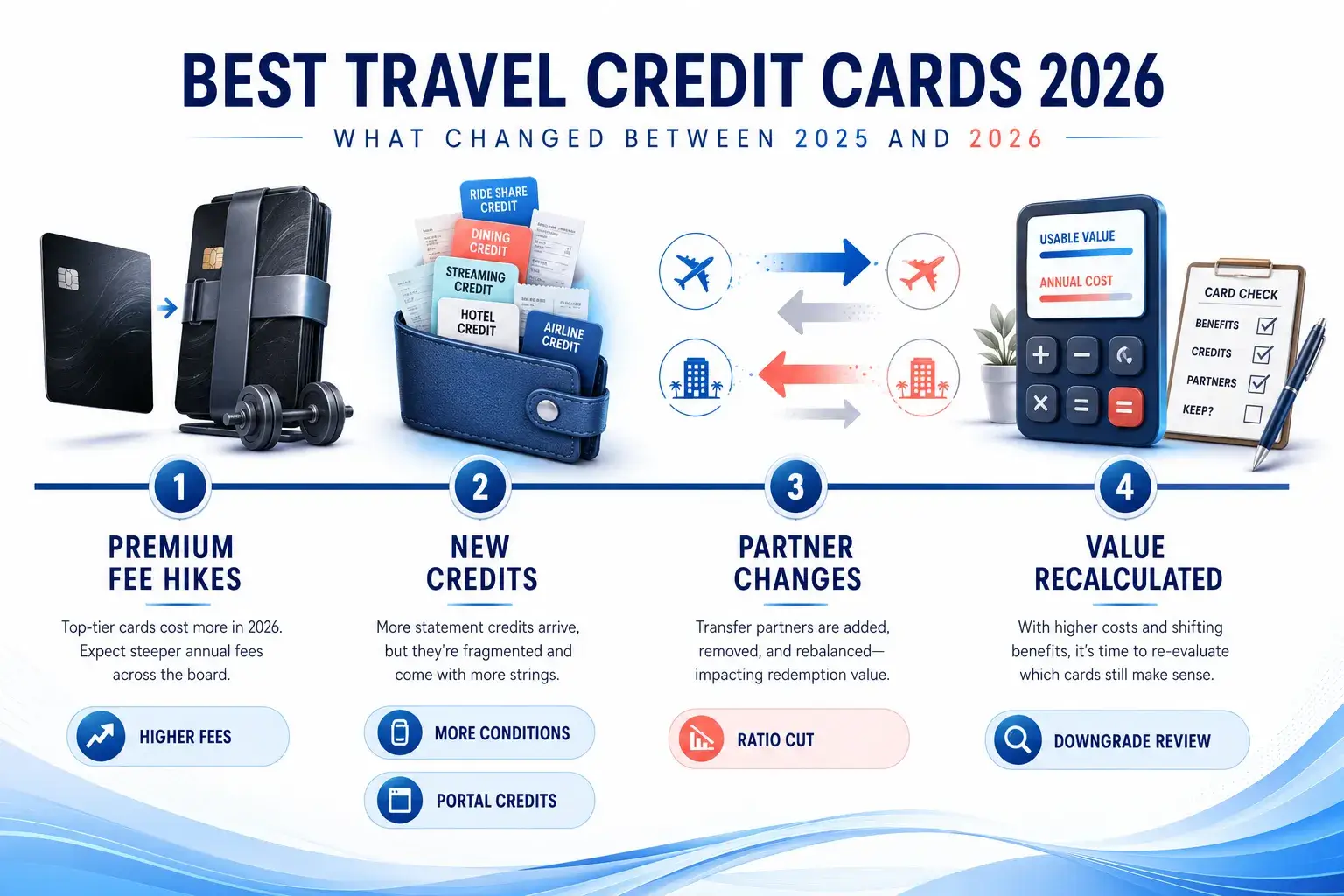
Chase also refreshed the Sapphire Preferred while keeping its annual fee at $95. The annual Chase Travel hotel credit increased from $50 to $100, but two valuable features moved in the other direction:
- Hyatt transfers change from 1:1 to 4:3.
- The 10% anniversary points bonus ends, effective October 1, 2026 for existing cardholders.
- New benefits and credits may exceed $200 on paper, but not every cardholder will use them.
- The larger hotel credit requires booking through Chase Travel rather than directly with the property.
That Hyatt change matters. A 40,000-point World of Hyatt redemption would require approximately 53,334 Chase points at a 4:3 ratio instead of 40,000 points at 1:1. That is a substantial increase for travelers who considered Hyatt the best use of Chase points.
The transfer ratio also raises opportunity cost. Before transferring, compare the Hyatt redemption with cash, other hotel points, and airline partner awards. A room costing $700 for 40,000 Hyatt points produces 1.75 cents per point before taxes and resort-fee considerations. Requiring about 53,334 Chase points reduces the effective return to roughly 1.31 cents per Chase point.
Which travel credit card benefits changed in 2026?
The most material changes were higher premium annual fees, a larger Sapphire Preferred portal-hotel credit, a weaker Hyatt transfer ratio, and the removal of the Sapphire Preferred anniversary bonus. Changes involving monthly or semiannual credits need individual review because face value doesn’t equal usable value.
You may be interested



A benefit has practical value only when all three statements are true:
- The cardholder would have made the purchase anyway.
- The merchant, portal, and timing restrictions are acceptable.
- Using the credit does not cause the traveler to pay more than booking elsewhere.
A $100 credit is not worth $100 when it requires an unnecessary purchase, a higher portal rate, or a booking that gives up hotel points and elite benefits.
Travelers facing a large renewal fee should compare retention offers, product-change options, and cancellation rules. The 2026 travel card keep, downgrade, or cancel guide provides a structured annual review.
Did transfer partners or transfer ratios change?
The Sapphire Preferred’s Hyatt ratio reduction is the most consequential announced transfer change for many Chase users. Losing part of the value of a major hotel partner weakens Chase’s historical advantage for hotel redemptions, although Chase points still have useful airline partners.
Judge points transfer partners by more than the number of logos. The practical questions are:
- Does the partner release award space to other programs?
- Are transfers instant or delayed?
- Does the program impose fuel surcharges?
- Are award charts stable, or is pricing dynamic?
- Can the same partner be reached through Amex points, Capital One miles, Citi points, or Bilt points?
- Does the program permit stopovers or useful mixed-cabin itineraries?
Review the best credit card transfer partners for 2026 before changing an earning strategy around one airline or hotel program.
How Were the Best Travel Credit Cards 2026 Ranked?
The rankings prioritize repeatable annual value, transferable points, useful protections, and flexible booking options. Temporary welcome offers matter, but they do not determine whether a card deserves to be kept after the first year.

The scoring framework uses six factors:
- Net annual cost: Annual fee minus credits a typical traveler can use at close to face value.
- Transfer quality: Useful partner airlines and hotels, transfer ratios, transfer speed, and access to award space.
- Earning potential: Rewards on realistic spending rather than narrow or capped categories.
- Travel protections: Trip delay, cancellation, baggage, rental-car, and purchase protections.
- Booking flexibility: Direct bookings, portal redemptions, cash-back alternatives, and transfer options.
- Complexity: Enrollment requirements, coupon schedules, merchant restrictions, and breakage risk.
Travel card annual fees versus rewards
Annual-fee comparisons should use conservative value, not the issuer’s maximum advertised total. A simple formula is:
Effective annual cost = annual fee − credits used naturally − conservative anniversary value
Consider two simplified examples:
| Card | Annual fee | Conservative recurring value | Estimated effective cost | Main limitation |
|---|---|---|---|---|
| Chase Sapphire Preferred | $95 | $100 hotel credit | About negative $5 | Portal booking required |
| Capital One Venture X | $395 | $300 portal credit plus at least $100 from anniversary miles | About negative $5 | Portal use and renewal required |
| Chase Sapphire Reserve | $795 | Varies by traveler | Highly individual | High break-even point |
| Amex Platinum | $895 | Varies widely | Highly individual | Fragmented credits |
| Wells Fargo Autograph | $0 | No credits needed | $0 | Fewer premium benefits |
These are estimates, not universal valuations. Capital One miles may be worth more than one cent each through partner airlines, but valuing the anniversary miles at one cent avoids assuming award availability or a successful premium-cabin transfer.
You should also discount the Sapphire Preferred hotel credit if Chase Travel charges more than the direct hotel rate. Portal bookings may not earn hotel points or trigger elite benefits.
What makes a travel credit card actually worth it?
A travel card is worth keeping when its recurring benefits exceed its annual fee without forcing extra spending and when its rewards fit the traveler’s booking strategy. Approval for a large sign-up bonus does not prove that the card offers long-term value.
Best for:
- Travelers who pay balances in full
- Cardholders who understand points transfer partners
- People with predictable travel spending
- Travelers willing to search several airline programs
Not for:
- Anyone carrying high-interest debt
- Travelers who cannot use restricted credits
- People who always book the cheapest basic fare
- Cardholders unwilling to monitor annual fees and benefit changes
A practical decision rule is to keep a card only if conservative recurring value covers at least the annual fee, before assigning value to speculative lounge visits or future transfer bonuses.
What Is the Best Overall Travel Card for 2026?
The Chase Sapphire Preferred is the best overall travel card for 2026 for travelers who want transferable points without a premium annual fee. Its $95 fee is manageable, the increased hotel credit can offset that fee, and Chase retains a useful group of airline transfer partners.

The card ranks first because it combines:
- Transferable Chase points
- Strong travel and dining earning categories
- Travel protections uncommon on many no-fee cards
- A $100 annual Chase Travel hotel credit
- Access to airline alliance partners and several useful award-booking paths
- A lower renewal burden than premium cards
The ranking is not an endorsement of every 2026 change. The Hyatt ratio cut weakens one of the card’s best sweet spots, while removal of the anniversary bonus reduces recurring value.
Best for: Travelers who want a flexible points program, useful insurance, and a fee below $100.
Not for: Travelers focused mainly on Hyatt awards or those who want unlimited lounge access.
Best travel credit cards for international flights in 2026
Chase Sapphire Preferred, Capital One Venture X, and cards earning Amex points or Citi points are strong choices for international flights because their transferable points can reach multiple airline alliances. The best card depends on which partners serve the route and release award space.
For example, suppose a business-class seat costs:
- 70,000 partner-airline miles
- $250 in taxes and fees
- $3,200 as a comparable cash ticket
The redemption value is:
($3,200 − $250) ÷ 70,000 = 4.21 cents per point
That is strong travel rewards math, but only if the traveler would reasonably pay close to the cash fare. A leisure traveler who would otherwise buy a $900 economy ticket should not claim that the redemption “saved” the full $3,200.
Also check surcharges and fees. Some first class redemptions and premium cabin awards carry hundreds of dollars in fuel surcharges. Positioning flights, mixed cabins, married segments, transfer delays, and limited award availability can further reduce value.
Use award travel tools and alerts for 2026 bookings before transferring points.
Do travel credit cards have foreign transaction fees?
Most travel-focused cards do not charge foreign transaction fees, but some entry-level and cash-back cards do. Confirm the card’s current pricing terms before traveling because a 3% foreign transaction fee can erase the value of rewards earned abroad.
A card should also use the Visa or Mastercard network if broad international acceptance is a priority. American Express acceptance has improved, but travelers should carry a backup Visa or Mastercard.
The best no-foreign-transaction-fee cards for 2026 compares broader options.
What should travelers know about sign-up bonuses in 2026?
Travel card sign-up bonuses can produce substantial first-year value, but offers change frequently and may vary by applicant, referral channel, or targeted promotion. Verify the public offer, spending deadline, eligibility language, and annual fee on the issuer’s application page.
An elevated bonus is worth pursuing only when:
- The required spending fits the normal budget.
- The applicant is eligible under issuer rules.
- A realistic redemption plan exists.
- The annual fee remains acceptable after year one.
- Opening the card will not interfere with a more valuable application.
Never transfer a welcome bonus speculatively because of a temporary transfer bonus. Airline miles can lose value, award charts can change, and desired award space can disappear before the transfer arrives.
What Is the Best Premium Card After the Fee Increases?
Capital One Venture X is the best premium-value travel card after the 2026 fee increases. Its $395 fee is far below the $795 Sapphire Reserve and $895 Amex Platinum, while its travel credit, anniversary miles, lounge access, and points transfer partners remain competitive.

Venture X is easiest to justify when the cardholder can use the Capital One Travel credit without overpaying. Its anniversary miles then cover the remaining fee under a conservative one-cent valuation.
Best for:
- Travelers comfortable booking some trips through Capital One Travel
- Cardholders who value lounge access
- People who prefer simple two-mile-per-dollar earning on general purchases
- Travelers using Capital One airline partners for international awards
Not for:
- Travelers who avoid portals
- Cardholders focused on domestic airline transfers
- People who rarely fly or visit lounges
- Anyone who cannot use the annual travel credit naturally
Capital One transfer partners can produce excellent business class deals, but domestic redemptions often require booking through alliance partners. That means finding partner award space rather than simply transferring to the airline operating the flight.
Why did Sapphire Reserve and Amex Platinum move down?
Sapphire Reserve and Amex Platinum moved down because their increased annual fees raised the break-even point. Both cards can still be valuable, but their credits and perks require more careful matching to existing spending.
A traveler should not value every benefit at face value. Apply these discounts:
- Value airline credits only for purchases that would happen anyway.
- Discount hotel credits when eligible rates cost more.
- Give lounge access zero value if visits are rare.
- Ignore merchant credits that trigger unnecessary spending.
- Account for authorized-user fees and guest restrictions.
- Compare travel protections, not only statement credits.
Frequent lounge users, heavy direct-airfare spenders, and travelers who use several Amex Platinum credits may still justify the $895 fee. Sapphire Reserve can work for travelers who maximize its travel benefits and prefer the Chase ecosystem. Neither is the default premium recommendation.
See the full premium travel cards value analysis for 2026 for cost-per-visit and credit-usage scenarios.
What Are the Best No-Annual-Fee and Sub-$100 Travel Cards?
Wells Fargo Autograph is a strong no-annual-fee travel card, while Chase Sapphire Preferred leads the sub-$100 category. Autograph suits low-cost earning; Sapphire Preferred adds stronger protections and a broader award-travel ecosystem.
| Category | Leading option | Best use | Main tradeoff |
|---|---|---|---|
| No annual fee | Wells Fargo Autograph | Broad travel and everyday categories | Limited premium perks |
| Transfer-focused under $100 | Chase Sapphire Preferred | Airline transfers and travel protection | Portal credit and weaker Hyatt ratio |
| Business under $100 | Ink Business Preferred | Business categories and Chase transfers | Requires eligible business activity |
| Simple miles | Capital One Venture family | Easy earning and transfer access | Best features may require a fee |
Which travel cards work if you do not fly much?
Travelers who do not fly much should prioritize no-fee cards, hotel benefits, flexible travel categories, or cash-back options. Premium lounge access has little value when it goes unused.
Good alternatives include:
- Wells Fargo Autograph for travel, dining, and other common categories
- A hotel card with an annual free-night certificate that matches actual stays
- A no-fee cash-back card when simple statement credits are preferable
- Chase Sapphire Preferred for road trips, hotels, rental cars, and occasional flights
A common mistake is transferring flexible points to a hotel program without comparing the cash price. Many hotel programs use dynamic pricing, and low-value transfers can produce less than one cent per point.
Which travel cards are best for hotel stays and accommodations?
The best hotel card depends on whether the traveler is loyal to one chain. A co-branded hotel card may provide status, a free-night certificate, or property credits, while a transferable-points card provides more flexibility.
Choose a hotel card when:
- You can use the annual certificate at a property you’d book anyway.
- Elite benefits apply at hotels you visit often.
- The program has acceptable award pricing and availability.
- Resort fees, destination fees, and certificate caps do not erase the value.
Choose transferable points when hotel loyalty is weak or when airline awards usually offer a higher best use of points. Compare dedicated options in the best hotel credit cards for 2026.
What is the best travel credit card for bad credit?
There is no premium travel card that is broadly best for bad credit. Applicants rebuilding credit should generally start with a secured card or accessible no-fee card, build on-time payment history, and avoid unnecessary hard inquiries.
Rewards should be secondary to:
- No annual fee or a very low fee
- Reporting to all three major credit bureaus
- A manageable deposit or credit limit
- A path to graduation or an unsecured product
- No foreign transaction fee, if international use is expected
Do not pay interest to earn travel rewards. One month of high credit card interest can exceed the value of an entire year of points.
Which travel cards have no annual fee?
Wells Fargo Autograph and select entry-level airline or bank cards offer travel rewards without an annual fee. These cards are best for infrequent travelers, beginners, or cardholders who want to preserve account age without managing annual credits.
No-fee cards usually have trade-offs:
- Limited or no lounge access
- Fewer travel protections
- Lower welcome offers
- Fewer transfer partners
- No annual travel credits
For more choices, see the best no-annual-fee travel credit cards for 2026.
What Is the Best Business Travel Card?
Ink Business Preferred is the best business travel card for many small-business owners because it earns transferable Chase points, has a $95 annual fee, and rewards several common business categories. It is most useful when business spending fits its bonus structure and Chase’s transfer partners support the owner’s travel plans.
Potential advantages include:
- Transferable Chase points
- Useful earning on eligible travel and business services
- Cellphone protection under applicable terms
- Employee cards
- Access to airline and hotel transfer partners
- A moderate annual fee
The card is not appropriate solely because someone wants another welcome bonus. Applicants need legitimate business activity, and personal and business expenses should remain separate.
Travel cards for business versus personal use
Business cards are better for eligible business expenses, employee controls, and business-category bonuses. Personal cards are usually better for household categories, consumer benefits, and personal travel credits.
A sole proprietor, freelancer, consultant, or online seller may qualify for a business card, but the application must be accurate. Revenue, time in business, and tax identification information should not be inflated.
Use this decision rule:
- Choose a business card when its earning categories match recurring operating expenses.
- Choose a personal card when its credits and categories match household spending.
- Use both only when the combined annual fees and minimum-spending requirements remain manageable.
Which Cards Dropped Out of the Ranking and Why?
Sapphire Reserve, Amex Platinum, and Citi Strata Elite dropped below the top positions because their recurring value became harder to prove for a typical traveler. These cards were not removed from consideration; they became more specialized.
Chase Sapphire Reserve
The $795 annual fee requires meaningful use of travel credits, lounge access, protections, and Chase redemptions. The card can still fit frequent travelers, but Sapphire Preferred offers access to the same transferable-point family at a much lower cost.
Amex Platinum
The $895 annual fee can work for travelers who use multiple credits and value premium lounge access. However, fragmented benefits create breakage risk, while Amex acceptance and some airline-program fuel surcharges require backup plans.
Citi Strata Elite
At $595, Citi Strata Elite competes directly in a crowded premium market. Citi points have useful partner airlines, but the card must provide enough recurring value to beat less expensive ways of accessing Citi’s transfer ecosystem.
Co-branded airline cards
Airline cards remain useful for free checked bags, priority boarding, companion benefits, and status-related perks. They usually rank below general travel cards for everyday spending because airline miles face devaluation risk and lack transfer flexibility.
How Should You Pick Between the Top Three?
Choose Chase Sapphire Preferred for balanced value, Capital One Venture X for premium benefits at a lower net cost, and Wells Fargo Autograph for no-fee simplicity. The best choice depends on portal tolerance, transfer-partner needs, flight frequency, and willingness to manage credits.
| Decision factor | Sapphire Preferred | Venture X | Wells Fargo Autograph |
|---|---|---|---|
| Annual-fee tolerance | Low | Moderate | None |
| Lounge access | Limited | Strong | None |
| Transfer flexibility | Strong | Strong internationally | Useful but narrower |
| Portal dependence | Hotel credit | Travel credit | Low |
| Travel protections | Strong for fee level | Premium-card package | More limited |
| Best fit | Most award travelers | Frequent flyers | Infrequent travelers |
Should you get multiple travel credit cards?
Multiple travel cards can make sense when each card has a separate job and the combined benefits exceed the fees. More cards are not automatically better because credits expire, points become fragmented, and minimum-spending requirements can distort the budget.
A sensible two-card setup might pair:
- Sapphire Preferred for travel protections and Chase points
- A no-fee card for higher everyday-category earnings
A premium setup might pair Venture X for lounges and general spending with another transferable-points card for dining or airline-specific transfer partners.
Avoid opening several cards at once if doing so creates missed payments, unused credits, or orphaned balances across too many programs.
How can travelers maximize credit card points?
The best way to maximize points is to start with a bookable trip, compare cash and award prices, search multiple partner programs, and transfer only after confirming award space.
Use this step-by-step guide:
- Set the route and date range. Include nearby airports and possible positioning flights.
- Search operating airlines. Check nonstop flights, alliance partners, and married-segment behavior.
- Compare programs. Review mileage price, taxes, fuel surcharges, change rules, and transfer ratios.
- Calculate CPP. Subtract award taxes from the comparable cash fare, then divide by points used.
- Check transfer bonuses. Confirm that the bonus applies to the correct program and arrives in time.
- Verify award space again. Availability can disappear during the transfer.
- Transfer the exact amount. Avoid creating a stranded airline-mile balance.
- Book immediately. Save the confirmation and review ticketing status.
Transfer bonuses can improve redemption value, but they should not create the trip. A 25% bonus means a 70,000-mile award requires 56,000 transferable points, assuming a 1:1 base ratio. It does not make poor award availability or heavy surcharges acceptable.
What common mistakes do people make with travel rewards cards?
The most expensive mistakes are carrying interest, valuing unusable credits at face value, transferring without confirmed award space, and keeping expensive cards for status alone.
Other common pitfalls include:
- Ignoring transfer delays
- Assuming every alliance partner sees the same award space
- Comparing an award with an unrealistic cash fare
- Forgetting taxes and fuel surcharges
- Booking portal hotels without checking direct rates
- Letting annual credits expire
- Missing minimum-spending deadlines
- Closing a card before protecting transferable points
- Overlooking downgrade options
- Failing to confirm that an award has ticketed
The safest booking strategy is conservative: search first, calculate the full cost, read program rules, and transfer last.
Frequently Asked Questions
What is the best travel credit card in 2026?
Chase Sapphire Preferred is the best overall choice for many travelers because it combines transferable points, travel protections, and a $95 annual fee. Capital One Venture X is better for travelers who want premium benefits.
Is Capital One Venture X still worth its annual fee?
Venture X can be worth its $395 annual fee when the cardholder naturally uses the Capital One Travel credit and values the anniversary miles. It is a poor fit for travelers who avoid booking portals.
Is Chase Sapphire Reserve worth $795?
Sapphire Reserve is worth $795 only for travelers who consistently use its credits, lounge access, protections, and Chase benefits. Sapphire Preferred is the better-value choice for many cardholders.
Is Amex Platinum worth $895?
Amex Platinum can be worth $895 for frequent travelers who use several recurring credits and premium lounge benefits. It isn’t worth keeping when credits require purchases you wouldn’t make anyway.
Are travel credit card points better than cash back?
Transferable points can outperform cash back on premium cabin awards, but only when award space exists and fees are reasonable. Cash back is safer when flexibility and predictable value matter more.
Should points be transferred during a transfer bonus?
Transfer during a transfer bonus only after confirming a specific award and the transfer timeline. Speculative transfers expose the cardholder to devaluation risk and unavailable seats.
Can a travel card be downgraded without losing points?
Often, but the outcome depends on the issuer and product family. Confirm whether the replacement card preserves the points account and transfer access before changing or closing the card.
How many travel credit cards should one person have?
There is no ideal number. Keep only cards with a clear earning, transfer, protection, or benefit role that exceeds the annual fee and management burden.
Conclusion
The 2026 fee increases changed the premium-card ranking more than they changed the fundamentals of award travel. Chase Sapphire Preferred remains the practical overall choice, Capital One Venture X offers the strongest premium value, and Wells Fargo Autograph is the safer option for travelers who do not want an annual fee.
Before applying, take three steps:
- Identify the airline and hotel partners most likely to support future trips.
- Calculate renewal value using only credits that match existing spending.
- Confirm the current welcome offer, eligibility rules, annual fee, and benefit terms directly with the issuer.
For existing cardholders, repeat the calculation when the annual fee posts. Keep the card when the recurring value is clear, downgrade when you need to preserve transfer access or account age, and cancel only after protecting every transferable point.





Content on Award Travel Hub is independently created by Award Travel Hub Editorial Desk and, where noted, reviewed by Award Travel Hub Review Desk. Some pages may contain affiliate links, but compensation does not determine our coverage, opinions, or methodology.