
Last updated: September 18, 2026
Quick Answer
The refreshed Chase Aeroplan card, relaunched September 10, 2026, now offers 115,000 total Aeroplan points split across two spending tiers, plus automatic Aeroplan 25K status with no minimum spend. Chase and several major points sites are calling it the best-ever welcome offer for this card, and the total point value backs that claim, but reaching the full bonus requires $24,000 in combined spending over 12 months, which is a meaningfully higher bar than past offers. Whether the air canada aeroplan card welcome offer is worth an application slot depends on spending capacity, existing 5/24 status, and how much Aeroplan award space actually fits a traveler’s routes.
Key Takeaways
- The current Air Canada Aeroplan card welcome offer totals 115,000 Aeroplan points: 75,000 after $4,000 spend in three months, plus 40,000 after $20,000 spend in the first 12 months.
- Automatic Aeroplan 25K status comes with the card, no minimum spend required, which is new to this offer cycle.
- The card carries a $95 annual fee and includes up to $100 in annual Air Canada statement credits and 15 percent savings on eligible Air Canada flight reward bookings.
- TPG and other outlets value the full 115,000-point bonus at roughly $1,725, based on their September 2026 valuation of Aeroplan points.
- Aeroplan prices partner (Star Alliance) awards on a distance-based chart, while Air Canada’s own flights use dynamic pricing.
- This is a Chase-issued personal card, so it counts toward the 5/24 rule both when applying and when Chase reviews the application.
- The offer rewards larger spenders more than past cycles did, since the second 40,000-point tier requires $20,000 in spend within 12 months.
The Current Offer: Bonus Size, Minimum Spend, and Deadline
The Air Canada Aeroplan card welcome offer, refreshed on September 10, 2026, awards 75,000 Aeroplan points after spending $4,000 within the first three months, plus a second bonus of 40,000 Aeroplan points after spending $20,000 total within the first 12 months. Combined, that is 115,000 points, making this the largest total bonus Chase has advertised for this card.
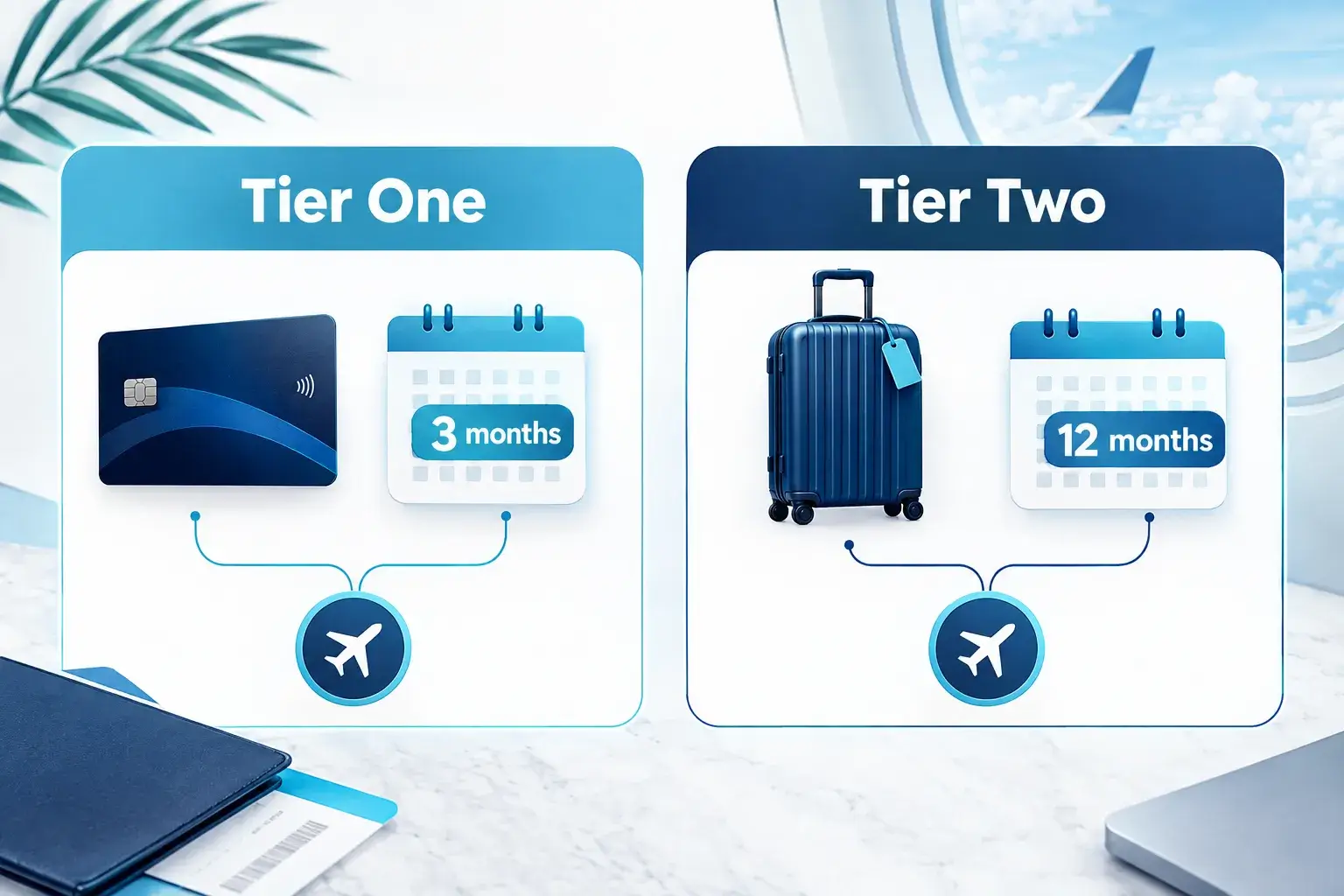
The structure matters as much as the headline number. Two separate spend thresholds apply:
- Tier one: 75,000 points for $4,000 in spend within 3 months of opening the account. This tier is achievable for most applicants who plan a large purchase or normal monthly spend around the account opening date.
- Tier two: 40,000 points for $20,000 in spend within the first 12 months. This is a much higher bar, averaging roughly $1,667 per month across the full year, and it will not be realistic for every applicant.
There is no published end date on the offer as of this writing, but elevated co-brand offers like this one typically run for a limited window before reverting to a lower baseline. Applicants who want the full 115,000-point total should confirm current terms directly on the application page before applying, since spend requirements and bonus tiers on airline co-brand cards change without much notice.
The card also includes automatic Aeroplan 25K status with no spend requirement, a notable addition compared to earlier offer cycles that tied status boosts to spend thresholds or omitted status altogether.
How It Compares to Past Aeroplan Card Offers
The 115,000-point total is the largest headline number Chase has attached to this card, but the “best-ever” framing depends on how spend requirements are weighted, not just the point count. Earlier Aeroplan card offers topped out in a lower range, often tied to a single spend threshold in the $3,000 to $5,000 range with no second tier. Readers who tracked the Chase Aeroplan bonus boost through mid-2025 saw a similar pattern: a temporary lift in points tied to a modest, single-tier spend requirement.
This cycle is different in structure. The bonus is split into two tiers, and the second tier alone demands $20,000 in spend within a year. That is a real commitment, and it changes who actually captures the full 115,000 points.
- If total spend stays near $4,000: the realistic bonus is 75,000 points, not 115,000.
- If total spend reaches $20,000+ within 12 months: the full 115,000-point bonus applies.
You may be interested



TPG’s September 2026 valuation places the full bonus at roughly $1,725, using its per-point valuation for Aeroplan miles. That figure only holds if the $20,000 spend tier is cleared. Anyone comparing this offer against historical highs should compare it against the effective bonus at realistic spend levels, not just the maximum advertised number. Judged purely on total points available, this is the largest offer to date. Judged on points-per-dollar-of-required-spend, it is not obviously better than prior single-tier offers with lower spend thresholds.
The Annual Fee and What Comes With It
The Aeroplan card carries a $95 annual fee, and its benefit package has grown meaningfully compared to earlier versions of the card. Evaluating whether the Air Canada Aeroplan card welcome offer justifies the fee requires looking at recurring, year-over-year value rather than just the one-time bonus.

Current benefits include:
- Automatic Aeroplan 25K status, with no spend requirement, which unlocks priority boarding, extra baggage allowance on some fares, and preferred seating options depending on route and fare class.
- Up to $100 in annual Air Canada statement credits, issued as two separate $50 credits, generally tied to eligible Air Canada purchases.
- Up to 5X total points on Air Canada purchases (3X from the card itself plus 2X from Aeroplan 25K status), which meaningfully accelerates earning for frequent Air Canada flyers.
- 3X points on travel purchases broadly, 2X on dining, grocery, and gas, and 1X on everything else.
- 15 percent savings on eligible Air Canada flight reward redemptions when booking with Aeroplan points, which functions like a built-in discount on many Air Canada award tickets.
Best for: travelers who fly Air Canada or Star Alliance partners at least once or twice a year and who can use the statement credits and status perks routinely.
Not for: travelers who rarely fly Air Canada, have no practical use for Star Alliance routes, or who would let the card sit unused after the welcome bonus posts. For those readers, a broader look at best travel credit cards for 2026 may turn up a better fit.
Run the math before applying. If the $100 in statement credits and the 15 percent redemption discount get used even once a year, the $95 fee is easy to clear. If neither perk applies to actual travel patterns, the fee becomes dead weight after the bonus posts, which is the same test worth applying to any annual-fee card, as covered in the annual fee keep-or-cancel review.
Why Aeroplan Points Are Worth Collecting: Star Alliance Access
Aeroplan points are valuable primarily because they unlock Star Alliance award space, including premium cabin awards on carriers like Lufthansa, ANA, Singapore Airlines, and Air China that are otherwise hard to book with a domestic U.S. program. This is the real reason the Air Canada Aeroplan card welcome offer matters more to points strategists than the statement credits or status perks.
Star Alliance membership gives Aeroplan holders access to:
- Business class awards on partner carriers that often cost less in Aeroplan miles than the equivalent cash fare or a comparable redemption through a U.S.-based program.
- One-way award booking flexibility, since Aeroplan does not require round-trip bookings, unlike some legacy charts.
- No fuel surcharges on most awards, including many partner redemptions, which sets Aeroplan apart from programs like British Airways Avios that still apply carrier-imposed surcharges on certain partners.
Because Aeroplan is a transfer partner of Chase, points earned through everyday Chase Ultimate Rewards spend can supplement whatever the card earns directly. Readers building a bigger Aeroplan balance should also watch for Chase-to-Aeroplan transfer bonuses, which periodically boost the transfer ratio and make it cheaper to top off a balance before booking an award.
For a full breakdown of the program’s sweet spots and partner network, the Air Canada Aeroplan transfer partners guide covers which partner airlines offer the best award availability and value per point.
Aeroplan’s Distance-Based Chart and Stopover Rules
Aeroplan prices partner (Star Alliance) awards using a distance-based chart, while Air Canada’s own flights are priced dynamically and do not follow the fixed chart. Understanding this split is essential before redeeming any points earned from the air canada aeroplan card welcome offer.

Under the distance-based model:
- Partner awards are priced by the total mileage flown, in bands (for example, short-haul, medium-haul, and long-haul distance brackets), not by cash price or route popularity.
- Air Canada awards use dynamic pricing, meaning the points cost moves with cash fare demand, similar to how Delta or United price their own metal.
- One stopover is permitted on round-trip distance-based itineraries, but Aeroplan reintroduced a stopover fee (a modest fixed charge, roughly in the range of a few thousand points or a small cash equivalent) for adding a stopover, which was not the case in earlier program versions.
Example: A round-trip business class award from the U.S. to Japan on a Star Alliance partner routed through Toronto could allow a stopover in Toronto on the outbound or return leg, subject to the stopover fee. That single stopover effectively turns one award ticket into two destinations, which is one of Aeroplan’s most cited sweet spots among experienced points users.
Common mistake: assuming all Aeroplan awards use the distance chart. Air Canada’s own dynamically priced flights do not follow it, so a route entirely on Air Canada metal can cost far more or less in points depending on cash demand, independent of mileage flown. Always check whether the itinerary includes Air Canada segments, partner segments, or both before assuming a chart price applies.
Timing, Taxes, and Troubleshooting the Welcome Offer
The air canada aeroplan card welcome offer bonus itself is not taxed as income under current IRS guidance, since it requires meeting a spending threshold rather than being awarded simply for opening an account, but any account credits or referral bonuses issued without a spend requirement could be treated differently. Applicants should also expect a short posting delay and understand a few common account issues before assuming something has gone wrong.
Key timing and troubleshooting points:
- How long it takes to get points after signing up: Once the qualifying spend threshold is met, points typically post within one to two billing cycles, generally four to eight weeks after the statement closes. Points do not post the moment the purchase clears.
- Bonus not showing up in the account: Before contacting support, confirm the full spend requirement was met and that a full billing cycle has closed since. If the deadline has passed and the bonus still has not posted, contact Chase directly with statement records showing the qualifying spend.
- Expiration of points earned from the welcome bonus: Aeroplan points do not expire as long as there is some account activity within an 18-month window, including earning or redeeming even a small number of points. For a full rundown of Aeroplan’s account activity rules, see the guide on whether Aeroplan points expire.
- Best time to apply: Applying when a large, planned purchase (a big travel booking, home project, or tax payment through an eligible processor) aligns with the account opening date makes the $4,000 first tier far easier to hit without changing normal spending habits.
- Hidden fees to watch for: The $95 annual fee is not waived the first year on most current terms, and the 15 percent redemption discount and $100 statement credits are tied to specific eligible purchases, not universal spend. Confirm current terms on the issuer’s page before assuming any credit applies automatically.
Application Rules and Whether This Card Counts Toward 5/24
The Chase Aeroplan card is a Chase-issued personal card, so it counts toward the Chase 5/24 rule in both directions: opening it uses one of the five slots, and applicants already at 5/24 or beyond will likely be denied regardless of the offer’s size. This is a standard rule for nearly all Chase personal cards, and Aeroplan is not an exception.

A few application rules worth confirming before applying:
- Bonus eligibility restrictions: Chase generally restricts new applicants from earning the welcome bonus again if they currently hold the card or received a bonus on it within a defined lookback period. Anyone who has held this exact card before should check current eligibility language carefully, since Chase’s standard practice is to limit repeat bonuses on the same product.
- 5/24 counts against approval, not just future applications: Being under 5/24 at the time of application is typically required for approval, not just a factor Chase considers loosely.
- Business versus personal distinction: This is the personal Aeroplan card. A separate Aeroplan business card, if held, may follow different bonus eligibility rules and does not necessarily share the same restriction with the personal product.
For a broader breakdown of how issuer-specific application rules interact across cards, see the guide to credit card application rules. Applicants juggling multiple pending bonuses should also review how welcome bonus clawbacks happen to avoid losing points over account closures or disputed charges before the bonus posts.
Who Should Take This Offer and Who Should Pass
The Air Canada Aeroplan card welcome offer is a strong option for travelers who fly Air Canada or other Star Alliance partners regularly and can comfortably clear at least the first spend tier without artificial spending. It is a weaker fit for infrequent flyers, especially those unlikely to reach the $20,000 second-tier threshold or use the Air Canada-specific perks.
Best for:
- Travelers who already plan international trips on Star Alliance carriers and can use Aeroplan miles for partner business class awards.
- Applicants who are comfortably under 5/24 and have a large, planned purchase lining up with the account opening date.
- Anyone who values automatic Aeroplan 25K status without a spend hurdle attached.
Not for:
- Travelers who rarely fly Star Alliance routes and would have no real use for Air Canada’s statement credits or 25K status perks.
- Applicants close to or over 5/24 who would rather preserve a slot for a card offering better ongoing value for their travel pattern.
- Anyone unlikely to reach $20,000 in spend within 12 months, since the effective bonus in that case is 75,000 points, not the full 115,000 headline figure.
Compared against other airline co-brand cards, the Aeroplan card’s edge is Star Alliance partner access and no-surcharge award redemptions on most routes, not raw earning rate on everyday spend. Travelers who want a broad comparison across airline and general travel cards before committing an application slot should review the current best travel credit card lineup alongside this offer.
Frequently Asked Questions
What is the current Air Canada Aeroplan card welcome bonus? The current offer, effective September 10, 2026, awards 75,000 Aeroplan points after $4,000 in spend within three months, plus 40,000 more points after $20,000 in spend within the first 12 months, for a combined total of 115,000 points.
Is the Aeroplan card annual fee worth it against the welcome bonus? The $95 annual fee is easy to justify against the bonus in year one. In later years, it depends on regularly using the $100 in statement credits, the 15 percent redemption discount, or the automatic Aeroplan 25K status perks.
Does the Aeroplan card count toward Chase’s 5/24 rule? Yes. It is a Chase-issued personal card, so both applying for it and getting approved are affected by the 5/24 rule like most other Chase personal products.
Can the welcome bonus be earned more than once? Generally, no. Chase typically restricts repeat bonuses for applicants who currently hold or previously held the exact same card and already received a bonus, so anyone reapplying should verify current eligibility terms before assuming the bonus applies.
Do Aeroplan points from the welcome bonus expire? Aeroplan points do not expire on a fixed calendar schedule, but the account needs some earning or redemption activity within an 18-month window to keep the balance active.
Is the Aeroplan card a good option for beginners in points and miles? It can work for beginners who already plan to fly Star Alliance routes, since the automatic status and no-surcharge redemptions are straightforward to use. Beginners without Star Alliance travel plans will likely get more consistent value from a flexible transferable points card instead.
Conclusion
The Air Canada Aeroplan Card welcome offer earns its “best-ever” label on total points offered, at 115,000, and the added perks, including automatic Aeroplan 25K status and the 15 percent redemption discount, make the card stronger on paper than prior versions. The catch is the second spend tier: reaching the full bonus requires $20,000 in spend within 12 months, which is a real commitment, not a formality.
Before applying, confirm your current 5/24 status, estimate realistic spend over the next year, and check whether Star Alliance partner routes fit your upcoming travel plans. Travelers who clear both spend tiers and use the card’s Air Canada perks get a genuinely strong deal. Travelers who would only hit the first tier, or who rarely fly Star Alliance airlines, should weigh this application slot against other current offers before committing.




Content on Award Travel Hub is independently created by Award Travel Hub Editorial Desk and, where noted, reviewed by Award Travel Hub Review Desk. Some pages may contain affiliate links, but compensation does not determine our coverage, opinions, or methodology.