
Last updated: July 25, 2026
Quick Answer
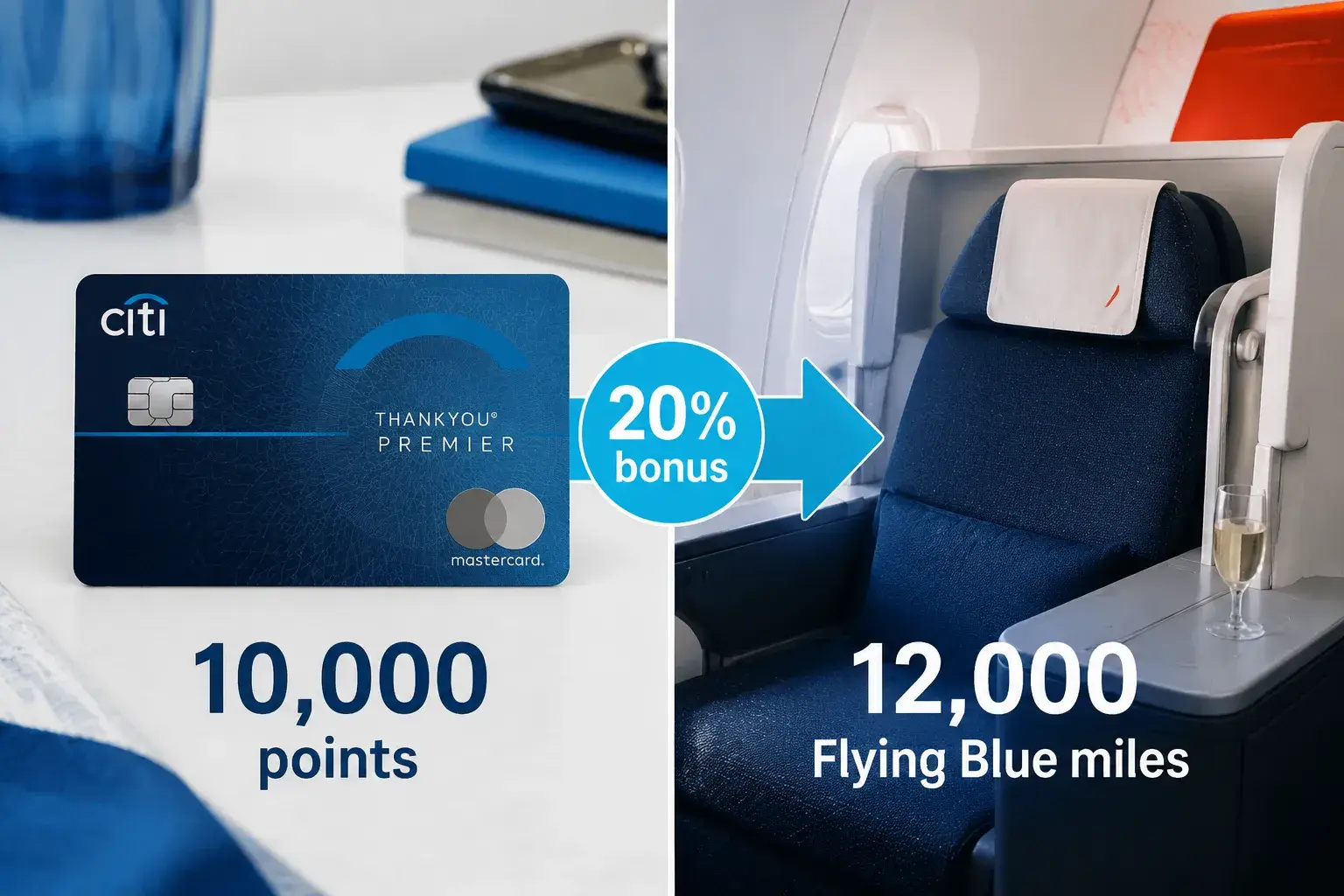
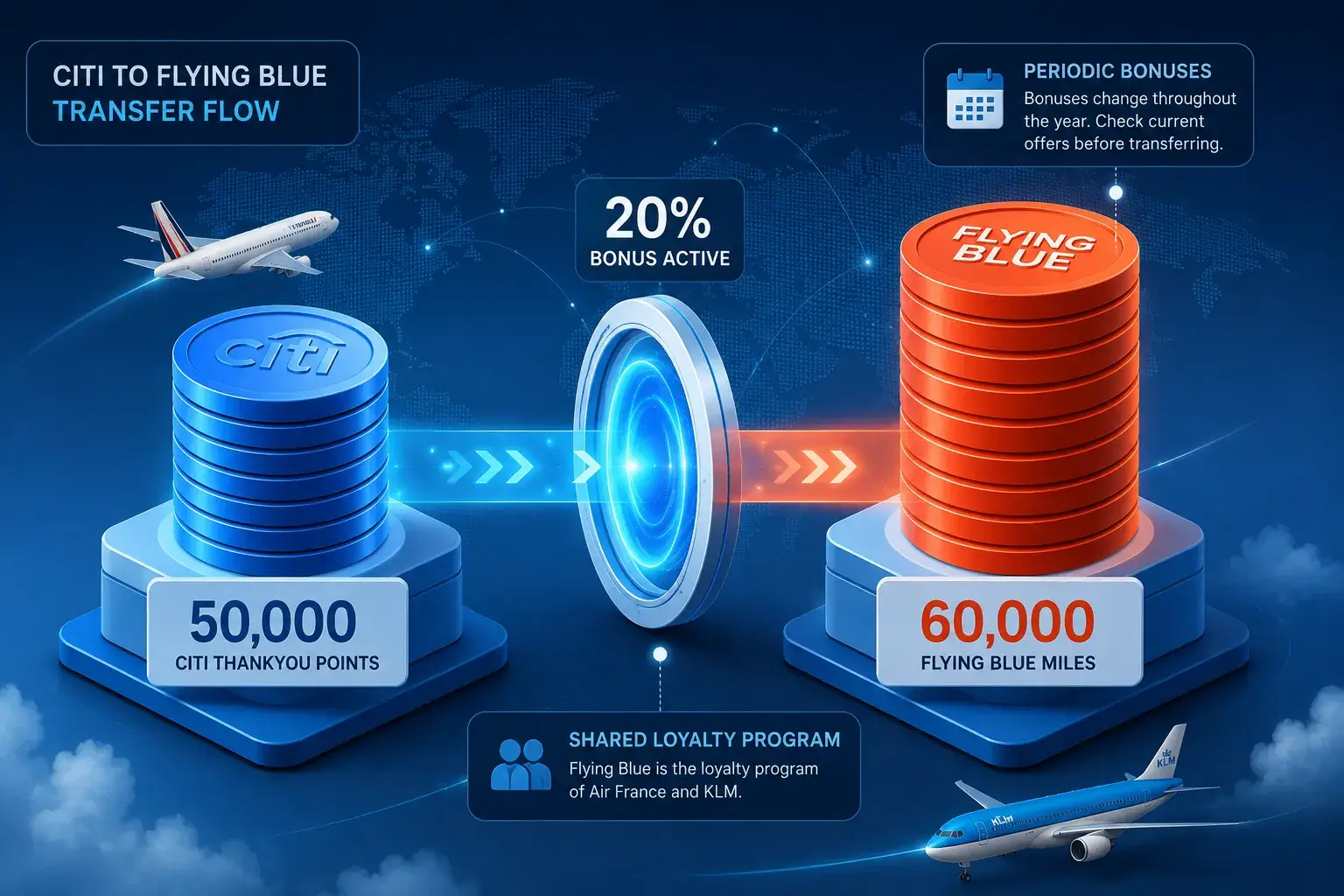
The current Citi to Flying Blue transfer bonus adds roughly 20% on top of your standard 1:1 transfer, meaning 10,000 Citi ThankYou points become about 12,000 Flying Blue miles. It’s worth it only if you already have a specific Air France/KLM award in mind, ideally a Promo Reward or a business-class deal to Europe. Because Flying Blue uses dynamic pricing and transfers are irreversible, transferring speculatively is the most common way to lose value. Confirm live award space first, then transfer.
Key Takeaways
- The Citi to Flying Blue transfer bonus is typically around 20%, turning a 1:1 base ratio into roughly 1.2:1.
- Transfers usually post instantly, but can occasionally take a few hours; treat “instant” as a best case, not a guarantee.
- The best use is booking confirmed award space before you transfer, not stockpiling miles.
- Flying Blue’s biggest sweet spot is business class from the U.S. to Europe, often bookable for fewer miles during monthly Promo Rewards.
- Flying Blue uses dynamic award pricing, so the same route can cost wildly different amounts depending on date and demand.
- Name matching matters: your Citi account and Flying Blue account must share the same name or the transfer can fail.
- A 20% bonus rarely justifies transferring “just in case.” Only move points you’re ready to spend soon.
What the Current Citi to Flying Blue Transfer Bonus Offers
The current Citi to Flying Blue transfer bonus adds about 20% to a standard 1:1 transfer, so 50,000 Citi ThankYou points would land as roughly 60,000 Flying Blue miles. Bonuses in this range appear periodically throughout the year, usually running for a few weeks at a time.
Flying Blue is the shared loyalty program for Air France and KLM, and it’s one of the more frequently discounted transfer partners across the major banks. Citi has run a steady cadence of transfer bonuses in 2026, including a 30% bonus to Virgin Atlantic (ending April 18, 2026), up to 25% to Avianca LifeMiles in the spring, and hotel-side promos like the Citi ThankYou to Leading Hotels 25% bonus.
A few things to confirm before you act:
- The exact bonus percentage and end date, since these change and sometimes get extended.
- Whether the promo requires registration (most Citi transfer bonuses do not, but check the terms).
- That your target award is actually available before you move any points.
Always verify the live offer on Citi’s transfer page and a current transfer bonus tracker before transferring.
How Citi ThankYou Points Transfer to Flying Blue

Citi ThankYou points transfer to Flying Blue at a base ratio of 1:1, and with the current bonus that effective ratio improves to about 1.2:1. Transfers are typically instant but not guaranteed.
Here’s how the mechanics work in practice:
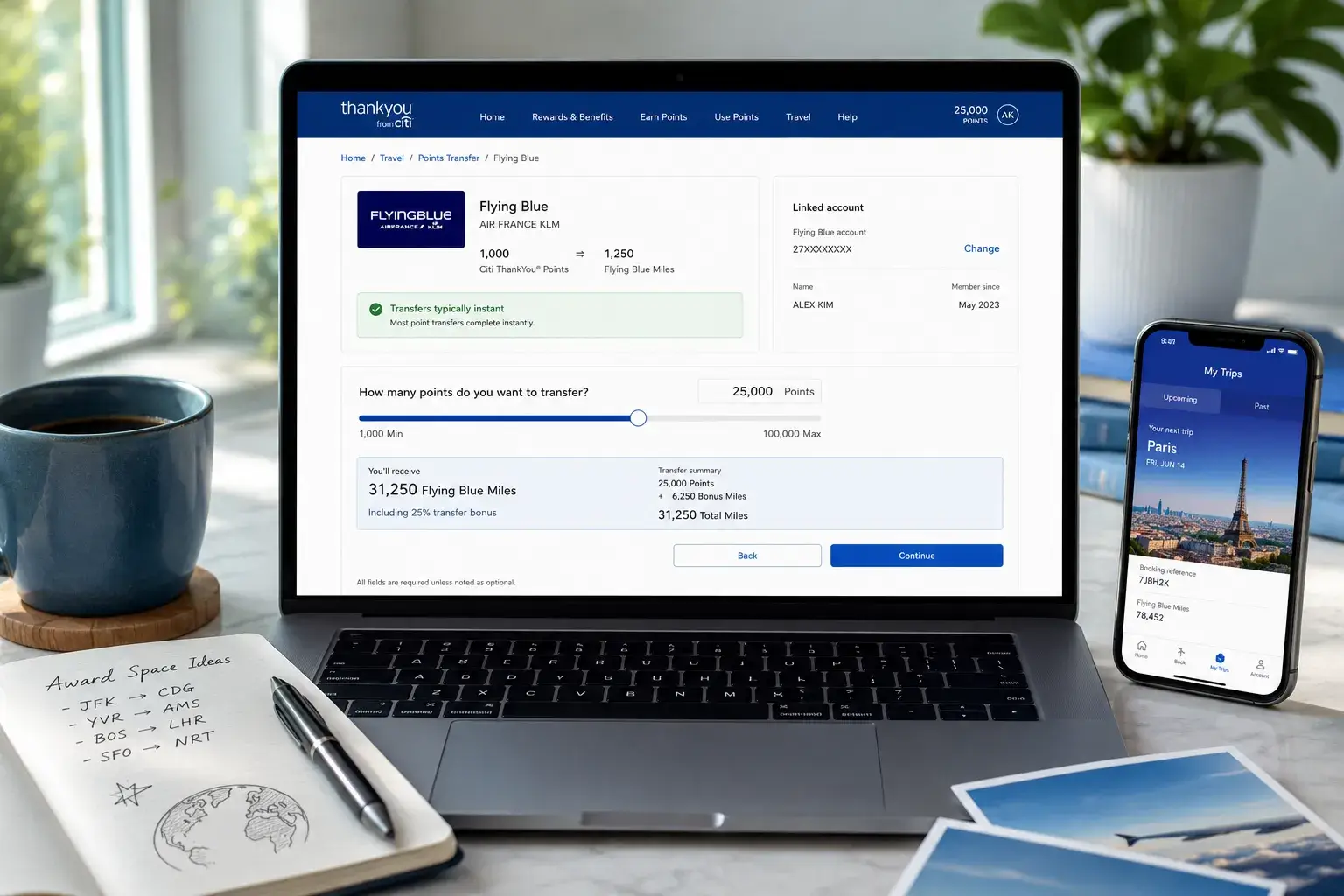
- Link your Flying Blue account inside the Citi ThankYou portal (one-time setup).
- Confirm the names match. Your Citi profile name and Flying Blue member name must be the same person; mismatches are the most common cause of failed or delayed transfers.
- Enter the transfer amount. The bonus is added automatically at the confirmation screen for eligible ThankYou cards.
- Wait for the miles to post. Most land within minutes, though some transfers take a few hours during high-volume promo periods.
Card-dependent effective ratios
Not every Citi card earns transferable ThankYou points. Cards like the Citi Strata Premier and the Citi Prestige (for existing holders) transfer at full value to airline partners. Cash-back-focused cards may only transfer at a reduced rate or not at all. Check your specific card before assuming you get the full 1:1 base.
You may be interested

For the full partner list and card eligibility, see the Citi ThankYou transfer partners guide.
Common mistake: Transferring before linking and verifying your Flying Blue account. If the transfer bounces, points can sit in limbo while you sort out a name mismatch, and you may miss the award space you were chasing.
Flying Blue Sweet Spots Worth Targeting
The strongest Flying Blue sweet spot is business class between the U.S. and Europe, which frequently prices well below what most other programs charge for the same cabin. Economy deals to Europe also show up regularly, especially during monthly promotions.
Because Flying Blue uses dynamic pricing, there’s no fixed award chart. Instead, think in terms of typical ranges:
| Route type | Cabin | Typical one-way range (miles) |
|---|---|---|
| U.S. to Europe | Economy | 20,000-35,000 |
| U.S. to Europe | Business | 50,000-88,000 |
| Within Europe | Economy | 10,000-20,000 |
| U.S. to Africa (via Europe) | Business | 75,000-120,000 |
These are estimates based on commonly observed pricing, not guaranteed rates. Peak dates and high-demand routes can price well above the top of each range.
Best for: Travelers with flexible dates who can catch business-class awards near the low end of the range.
Not for: Anyone locked into fixed peak-season dates, where dynamic pricing tends to spike.
Watch for fuel surcharges. Air France and KLM award tickets can carry meaningful carrier-imposed surcharges, especially on transatlantic business class, sometimes adding a few hundred dollars in taxes and fees. Always check the total cash cost at checkout before deciding the redemption is a good value.
For a deeper look at the best routes and partners, see the Flying Blue transfer partners guide.
Flying Blue Promo Awards and Monthly Deals
Flying Blue Promo Rewards are monthly discounted awards that can knock 20% to 50% off standard mileage pricing on select routes, and they stack cleanly on top of miles you transferred during a bonus. This is where the Citi to Flying Blue transfer bonus becomes genuinely compelling.
The combination works like this:
- You transfer Citi points during the 20% bonus, boosting your mile balance.
- You book a Promo Reward that’s already discounted below normal pricing.
- The two discounts stack, lowering your effective cents-per-point cost.
Promo Rewards refresh at the start of each month and cover a rotating list of origins and destinations. They usually apply to Air France/KLM’s own flights rather than partner airlines, and award space still has to be available.
For current picks and how to search them, read Flying Blue Promo Rewards 2026.
Quick example: A business-class Promo Reward from the U.S. East Coast to Paris at 50,000 miles (down from ~72,000) would cost roughly 41,700 Citi points after the 20% transfer bonus. If the cash fare is $3,500, that’s about 7 cents per point after subtracting taxes and fees, a strong return.
Running the Numbers: When the Citi Flying Blue Transfer Bonus Pays Off
The Citi Flying Blue transfer bonus pays off when your target redemption clears roughly 1.8 to 2 cents per point or better after the bonus, and falls short when you’re transferring speculatively or booking low-value economy awards. Run the math on the specific award, not the promo.
Use this simple framework:
Cents per point (CPP) = (cash price − taxes and fees) ÷ Citi points spent
Worked example, business class U.S. to Europe:
- Award price: 55,000 Flying Blue miles + $250 in taxes/surcharges
- With the 20% bonus, that’s about 45,800 Citi points
- Comparable cash fare: $2,800
- CPP = ($2,800 − $250) ÷ 45,800 = about 5.6 cents per point
That’s an excellent return. Now compare it to a weak redemption:
- Economy award: 30,000 miles + $200
- With the bonus: about 25,000 Citi points
- Cash fare: $650
- CPP = ($650 − $200) ÷ 25,000 = about 1.8 cents per point
Still fine, but not exciting, and you could likely do better booking the cash fare with a travel card or transferring elsewhere.
Decision rule
- Transfer if the award clears ~2 CPP or higher and you’re booking now.
- Skip the transfer if you’re stockpiling, or if the cash fare is cheap enough that points aren’t buying much.
For a broader look at when boosts justify a transfer, see transfer bonus math for 2026.
Risks: Dynamic Pricing and Irreversible Transfers
The two biggest risks with the Citi to Flying Blue transfer bonus are dynamic award pricing and the fact that transfers cannot be reversed. Once your Citi points become Flying Blue miles, they’re stuck in Flying Blue.
What can go wrong:
- Dynamic pricing spikes. The award you saw at 55,000 miles can jump to 88,000 by the time your miles post, especially on popular dates. Confirm the price is holding right before you transfer.
- Award space disappears. Business-class space is limited. If it’s gone when your miles arrive, you’re holding Flying Blue miles you may not want.
- Fuel surcharges erode value. High carrier-imposed fees on Air France/KLM metal can turn a “cheap” award into a mediocre deal.
- Devaluation risk. Flying Blue has adjusted pricing before, and dynamic programs can shift quietly. Miles held long-term carry devaluation risk.
Edge case: Flying Blue miles expire after 24 months of account inactivity, though any qualifying activity resets the clock. If you transfer speculatively and don’t book, you’ll need periodic activity to keep the miles alive.
The safest workflow: find and hold the award seat, verify the price, then transfer. Learn more about timing your points transfers to avoid stranding value.
Should You Transfer Now or Wait
Transfer now only if you have a confirmed, well-priced award ready to book; otherwise wait, because a 20% bonus rarely justifies moving points speculatively. Flying Blue bonuses recur, so missing one isn’t the mistake, stranding points is.
Use this quick decision guide:
Transfer now if:
- You’ve found live award space at a good price (ideally a Promo Reward).
- Your target redemption clears ~2 CPP or better after the bonus.
- Your Flying Blue account is linked and name-matched.
Wait if:
- You’re transferring “to have miles” without a booking in mind.
- The cash fare is cheap and points won’t buy much value.
- You’re unsure about dates or the award space is thin.
How this bonus compares to other airline transfer partners
Citi’s Flying Blue bonus competes with its other promos. A 30% bonus to Virgin Atlantic or Qatar Airways Privilege Club may deliver more value depending on your route. Virgin Atlantic shines for ANA and Delta redemptions, while Citi’s Virgin Atlantic transfer bonus can beat Flying Blue for certain trips. Compare where your specific award prices cheapest before defaulting to Flying Blue.
If you want a full side-by-side of the banks, see comparing transfer partners in 2026.
Frequently Asked Questions
How many points do you get with the Citi Flying Blue transfer bonus in 2026? With the current ~20% bonus, 10,000 Citi ThankYou points convert to about 12,000 Flying Blue miles. The base ratio is 1:1, and the bonus is added automatically at transfer for eligible cards.
How long does it take to transfer Citi points to Flying Blue? Transfers are usually instant, posting within minutes. During high-volume promo periods they can occasionally take a few hours, so don’t cut it close if you’re chasing limited award space.
Are there restrictions on Citi to Flying Blue transfers? Yes. Your Citi and Flying Blue accounts must share the same name, only ThankYou-earning cards qualify, and transfers are irreversible once completed. There’s usually no registration required, but confirm the promo terms.
Can you combine the Citi Flying Blue transfer bonus with other promotions? You can stack the transfer bonus with Flying Blue’s monthly Promo Rewards, which discount select routes. The two discounts compound, lowering your effective cost per point. You cannot stack two bank transfer bonuses on the same points.
What credit score do you need for a Citi ThankYou card? Citi’s transferable-points cards, such as the Strata Premier, generally call for good to excellent credit, roughly a 700+ FICO score. Approval also depends on income, existing Citi accounts, and recent application history.
Is Flying Blue membership worth it with the transfer bonus? Membership is free, so there’s no downside to signing up. It’s worth using when you have a business-class award to Europe or a Promo Reward that prices well. For pure economy value on cheap fares, points often go further elsewhere.
Conclusion
The Citi to Flying Blue transfer bonus is a solid, recurring promo that shines in one specific situation: booking a confirmed business-class award or a discounted Promo Reward to Europe. In that scenario, the 20% boost plus a monthly discount can push your value well past 5 cents per point. Outside of that, a 20% bonus rarely justifies moving points, and speculative transfers are the fastest way to strand value in a dynamic program.
Your next steps:
- Search live Flying Blue award space and check current Promo Rewards for your route.
- Run the CPP math on the specific award, including taxes and surcharges.
- Confirm your Flying Blue account is linked and name-matched to your Citi profile.
- Transfer only once the price holds and you’re ready to book immediately.
- If the numbers are weak, compare Citi’s other partners like Virgin Atlantic before committing.


Content on Award Travel Hub is independently created by Award Travel Hub Editorial Desk and, where noted, reviewed by Award Travel Hub Review Desk. Some pages may contain affiliate links, but compensation does not determine our coverage, opinions, or methodology.