

Last Updated: July 20, 2026
A $95 card can beat a $650 card if the free night is easier to use. That is the core decision with Marriott Bonvoy credit cards in 2026: do you want a low-cost annual certificate, premium elite status, or a welcome offer that can unlock several hotel nights right away?
For most Marriott guests, the Marriott Bonvoy Boundless Credit Card is the best long-term card to keep. Its annual 35,000-point free night certificate can now be topped off with up to 25,000 Marriott points, so it can cover nights costing up to 60,000 points. That is often enough for solid city hotels and many resort stays.
The Marriott Bonvoy Brilliant American Express Card can be worth it, but only for a narrower group: travelers who use the annual 85,000-point certificate, monthly dining credits, Priority Pass, and built-in Platinum Elite status. If those benefits go unused, the high annual fee becomes hard to justify.
For a broader comparison beyond Bonvoy, see our guide to the best hotel credit cards in 2026.
Key Takeaways
- Best overall Marriott card for most travelers: Marriott Bonvoy Boundless, because the annual 35K certificate can offset the annual fee.
- Best premium card: Marriott Bonvoy Brilliant, but only if Platinum Elite status and the 85K certificate match your travel pattern.
- Best no-fee option: Marriott Bonvoy Bold, mainly as a downgrade card or light Marriott status tool.
- Best certificate change in 2026: Marriott now allows up to a 25K points top-off on free night awards, making 35K, 50K, and 85K certificates much more useful.
- Best spending strategy: Use Bonvoy cards for Marriott stays and certificate benefits, not as your main everyday card if you also earn transferable points.
Practical rule: keep a Marriott card if you can use its annual free night certificate for more than the annual fee. Do not keep it just because the earning rate sounds good.
The Marriott Bonvoy Card Lineup in 2026
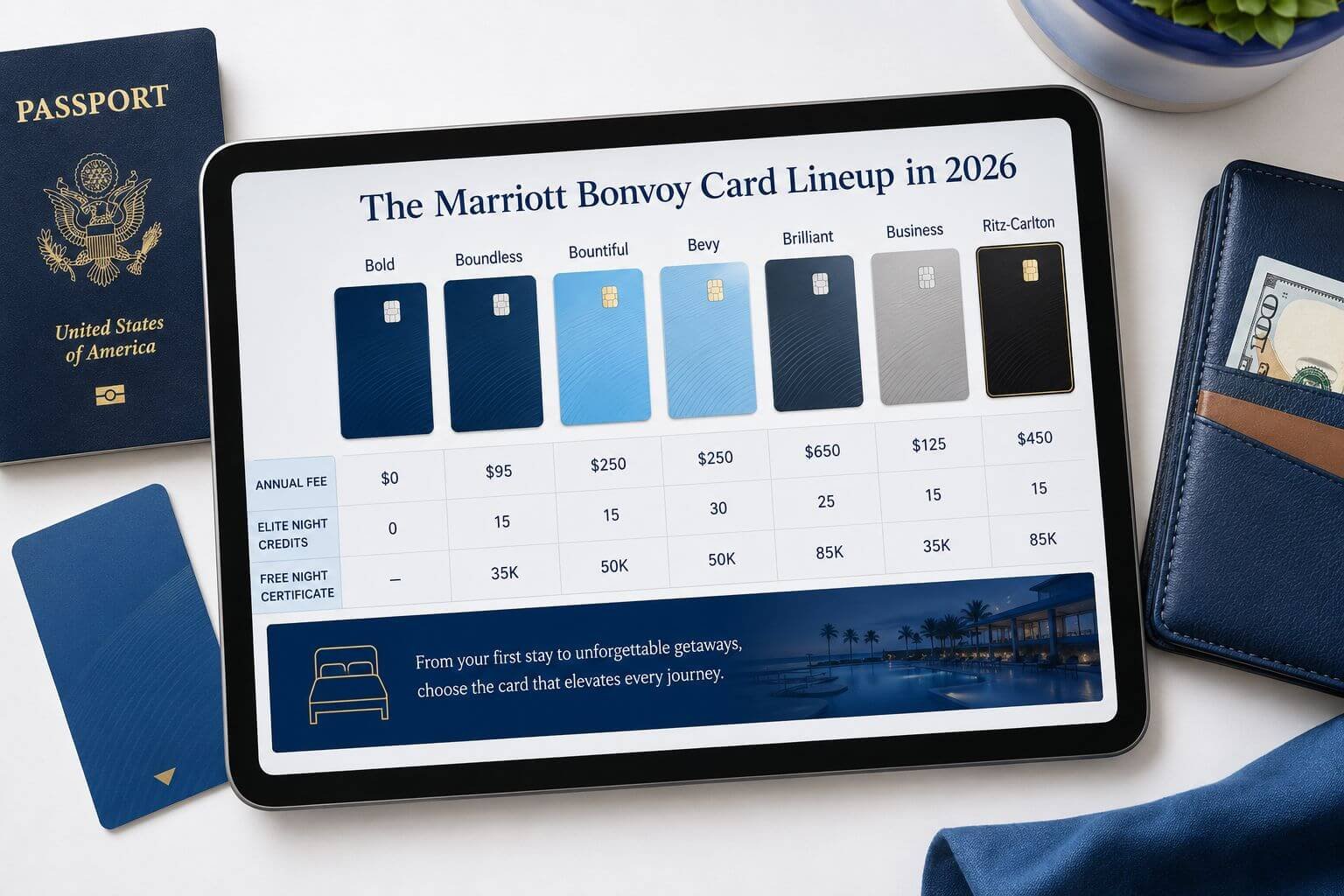
The U.S. Marriott card lineup is split between Chase and American Express. Some cards are open to new applicants, while others are legacy or product-change options.
Here is the practical comparison.
| Card | Issuer | Annual fee | Annual free night | Elite status | Elite night credits | Best for |
|---|---|---|---|---|---|---|
| Marriott Bonvoy Bold | Chase | $0 | None | Silver Elite | 5 | No-fee downgrade option |
| Marriott Bonvoy Boundless | Chase | $95 | 35K certificate | Silver Elite | 15 | Most Marriott guests |
| Marriott Bonvoy Bountiful | Chase | $250 | 50K certificate after $15K spend | Gold Elite | 15 | Big spenders who want a 50K cert |
| Marriott Bonvoy Bevy | Amex | $250 | 50K certificate after $15K spend | Gold Elite | 15 | Amex users with regular Marriott stays |
| Marriott Bonvoy Brilliant | Amex | $650 | 85K certificate | Platinum Elite | 25 | Heavy Marriott loyalists |
| Marriott Bonvoy Business | Amex | $125 | 35K certificate | Gold Elite | 15 business elite nights | Small-business owners |
| Ritz-Carlton Card | Chase | $450 | 85K certificate | Gold Elite | 15 | Product-change only premium keeper |
Annual fees and welcome offers can change. Always confirm the live offer before applying.
Best Direct Answer: Which Marriott Bonvoy Credit Card Is Worth It?
For most U.S.-based Marriott travelers in 2026:
- Choose Boundless if you want the simplest keeper card.
- Choose Brilliant if you value Platinum Elite status and can use an 85K certificate well.
- Choose Business Amex if you have a business and want 15 extra elite night credits that can stack with a personal card.
- Choose Bold if you want no annual fee or need a downgrade path.
- Be cautious with Bevy and Bountiful because the 50K certificate requires $15,000 in annual spending.
Important Eligibility Rules
Marriott card applications are more complex than many hotel cards because Chase and Amex both issue Bonvoy products. Welcome bonus eligibility can depend on which Marriott cards you have had, when you earned past bonuses, and whether you currently hold certain cards.
You may be interested



Before applying:
- Check current Chase 5/24 status.
- Review Amex once-per-lifetime welcome offer language.
- Confirm Marriott family restrictions.
- Avoid closing a card before the annual certificate posts.
- Do not apply only for a welcome bonus if you cannot use certificates before they expire.
For broader card strategy, see our best travel credit cards for 2026.
Annual Free Night Awards Compared

Free night awards are the main reason many Marriott Bonvoy credit cards are worth keeping. The earning rates are useful, but they are usually not the strongest part of the value proposition.
The major change for 2026 is the expanded certificate top-off rule. Marriott now allows members to add up to 25,000 points to a free night certificate.
That changes the real ceiling:
| Certificate type | Old practical cap with 15K top-off | 2026 cap with 25K top-off | Common cards |
|---|---|---|---|
| 35K certificate | Up to 50K points | Up to 60K points | Boundless, Business |
| 50K certificate | Up to 65K points | Up to 75K points | Bevy, Bountiful, some welcome offers |
| 85K certificate | Up to 100K points | Up to 110K points | Brilliant, Ritz-Carlton |
This matters because Marriott uses dynamic pricing. There is no fixed award chart for standard hotels. A property that costs 48,000 points one night might cost 62,000 points on another night.
The 25K top-off creates more room to work around that pricing.
What the Top-Off Rule Means in Real Life
Assume a Marriott property costs:
- 58,000 points for one night
- $430 cash after taxes and fees
- You hold a 35K certificate from the Boundless card
Under the 2026 top-off rule, you can use:
- 35K certificate
- 23,000 Marriott points
- Total award cost: 58,000 points
If you value Marriott points at about 0.7 cents per point, the 23,000-point top-off has an opportunity cost of about $161. Add the $95 annual fee, and your rough all-in cost is $256. Against a $430 cash rate, that can be a good use.
This is basic travel rewards math, but it matters. A free night is not truly free if you must add points that could be used elsewhere.
For a deeper certificate strategy, use our Marriott free night certificate guide.
When a Marriott Free Night Certificate Is Not Worth It
A certificate can be poor value when:
- You redeem a 35K certificate for a $120 airport hotel.
- You let the certificate expire.
- You top off too many points for a low cash-rate stay.
- You book during a weak cash market where paying cash earns points and elite credit.
- You keep a high-fee card but do not travel to hotels where the certificate shines.
The best use of points and certificates is not always the highest point price. It is the option that saves real cash without wasting flexible value.
Earning Rates and Welcome Offers
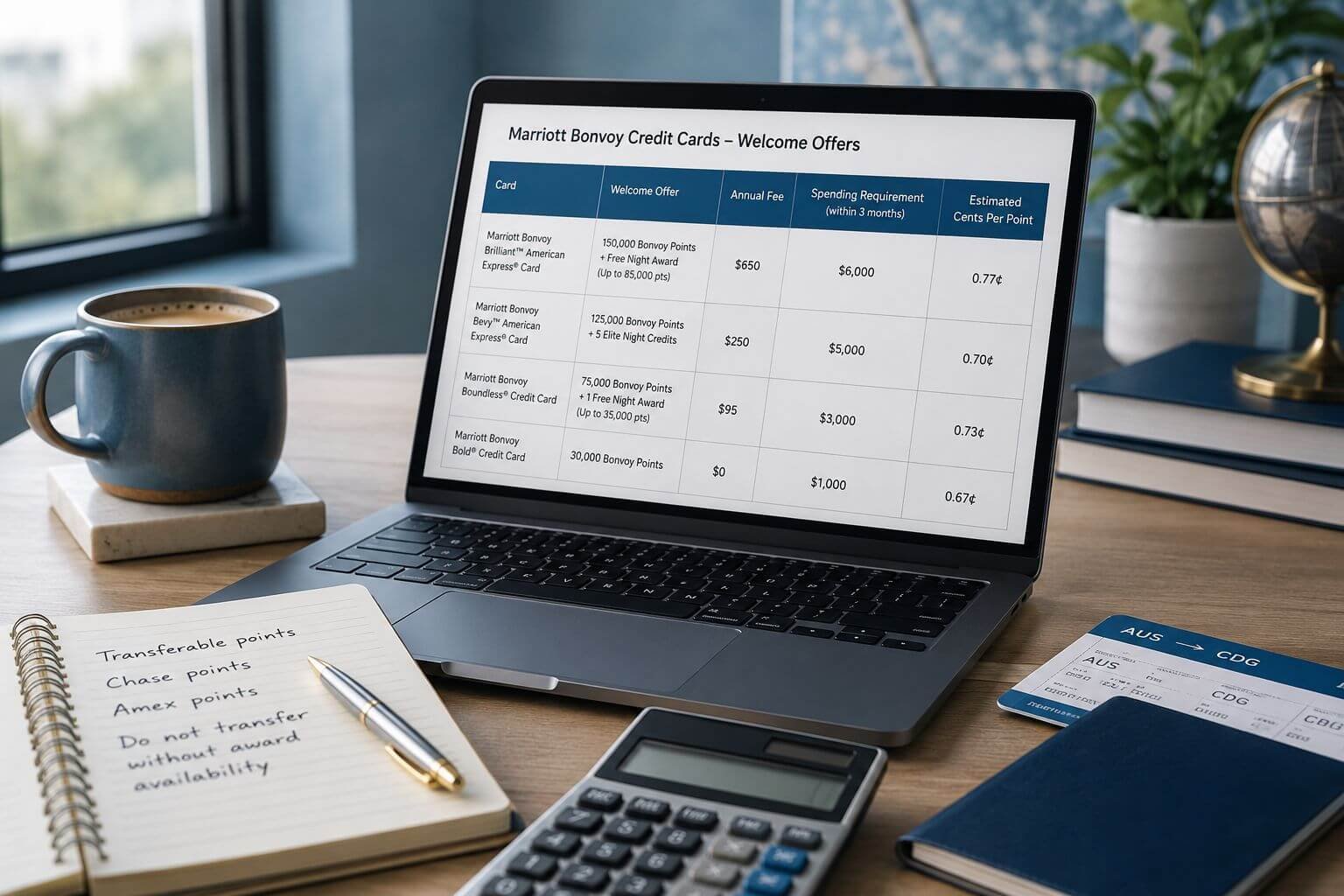
Welcome offers on Marriott Bonvoy credit cards can be strong in 2026, especially when they use free night certificates instead of plain points.
For example, the Boundless card has featured a major public offer with multiple 50K free night awards after meeting spending requirements. At times, the offer has reached four 50K certificates, with airline statement credits available through 2026 on qualifying direct airline purchases.
The Brilliant card also carries a large points-based offer, including a 200,000-point welcome bonus after meeting a higher spending requirement.
Offers change often. The best offer depends on your actual booking plan, not just the headline number.
Earning Rates by Card
| Card | Marriott spend | Dining, grocery, gas, or other bonus categories | Everyday spend |
|---|---|---|---|
| Bold | 3x | 2x on select travel | 1x |
| Boundless | 6x | 3x on gas, grocery, dining up to annual cap | 2x |
| Bountiful | 6x | 4x on dining and grocery up to annual cap | 2x |
| Bevy | 6x | 4x at restaurants and U.S. supermarkets up to annual cap | 2x |
| Brilliant | 6x | 3x at U.S. restaurants and flights booked directly | 2x |
| Business Amex | 6x | 4x in select business categories | 2x |
These rates are fine for Marriott stays. They are less compelling for unbonused daily purchases.
Why Transferable Points Often Beat Marriott Spend
Many readers earn Amex points, Chase points, Capital One miles, Citi points, and Bilt points. These transferable points are often more valuable because they can move to points transfer partners, including airline programs with premium cabin awards.
A simple decision framework:
- Use a Marriott card for paid Marriott stays when the bonus category and elite perks matter.
- Use a transferable-points card for dining, groceries, airfare, and everyday spend if it earns stronger flexible value.
- Transfer points to Marriott only when there is a clear booking strategy, award availability, and a strong cash-price comparison.
- Do not transfer flexible points speculatively because Marriott has devaluation risk and dynamic pricing.
This is especially important for travelers chasing Business Class deals, First Class redemptions, or partner airlines. Airline miles can sometimes unlock far higher CPP than hotel points, though award availability, fuel surcharges, married segments, positioning flights, and transfer delays all matter.
For current transfer bonus context, check our credit card transfer bonuses tracker. If a Chase to Marriott bonus is live, compare the math with our guide to whether a Chase to Marriott transfer bonus is worth it.
Welcome Offer Math: Points vs. Certificates
A 200,000-point welcome offer is flexible inside Marriott. You can split points across several stays, top off certificates, or book a fifth night free on eligible award stays.
A certificate-based offer can be more restrictive. Four 50K certificates can be powerful, but each certificate usually covers one night and has an expiration date.
Example:
- Four 50K certificates can cover four nights priced at 50K each.
- With top-offs, each can reach 75K.
- If the hotel costs 80K per night, the certificates do not work.
- If your target city has poor award space, the headline value drops.
This is why award search tools and real dates matter. Do not apply for a certificate-heavy offer unless you can use the nights.
Elite Status and Lounge Benefits

Elite status from Marriott Bonvoy credit cards can be useful, but not all tiers are equal.
| Status tier | Typical card path | Most useful benefits |
|---|---|---|
| Silver Elite | Bold, Boundless | Bonus points, late checkout when available |
| Gold Elite | Bevy, Bountiful, Business, Ritz | 2 p.m. late checkout when available, room upgrades when available |
| Platinum Elite | Brilliant | Breakfast at many brands, lounge access at eligible brands, 4 p.m. late checkout when guaranteed at many properties |
The biggest jump is from Gold to Platinum.
Gold status is better than no status, but it does not usually include free breakfast or lounge access. Platinum can be much more valuable on international trips, full-service hotels, and longer stays.
For a full status breakdown, see our Marriott Bonvoy guide for 2026.
The Brilliant Card’s Platinum Advantage
The Brilliant card gives automatic Platinum Elite status. That is the cleanest shortcut in the Marriott card lineup.
This can be valuable if you stay at:
- Full-service hotels with executive lounges
- International Marriott brands where elite treatment is stronger
- Resorts where breakfast costs $30 to $60 per person
- Properties where 4 p.m. checkout helps with evening flights
But there are limits.
Platinum benefits depend on brand rules, property participation, and availability. Some resorts limit upgrades. Some brands do not provide breakfast the way travelers expect. Lounge access is not useful if the property has no lounge.
The Brilliant card is not a universal recommendation. It is a premium tool for a specific traveler.
Elite Night Credit Stacking
Marriott elite night credits can help you earn higher status.
Key rules:
- Most personal Marriott cards provide 15 elite night credits.
- The Brilliant provides 25 elite night credits.
- The Marriott Bonvoy Business Amex provides 15 business elite night credits.
- A personal and business Marriott card can often stack, creating a faster path to status.
Example:
- Brilliant: 25 elite nights
- Business Amex: 15 elite nights
- Total before stays: 40 elite nights
- Platinum requirement: 50 elite nights
That leaves only 10 paid or award nights to reach Platinum through normal qualification. For a Marriott loyalist, that can be a strong setup.
For a casual traveler, it may be overbuilt.
Annual Fee vs. Free Night Value
The cleanest way to compare Marriott cards is to separate hard value from soft value.
Hard value includes:
- Free night certificate
- Dining credits
- Airline credits
- Travel credits
- Statement credits you will actually use
Soft value includes:
- Upgrades
- Late checkout
- Better rooms
- Lounge access
- Status progress
- Priority Pass access
Soft value is real, but it is less predictable.
Estimated Keeper Value by Card
Assume Marriott points are worth about 0.7 cents each. Also assume you redeem certificates well, not perfectly.
| Card | Annual fee | Main annual value | Practical keeper view |
|---|---|---|---|
| Bold | $0 | No free night | Keep if you want no-fee Marriott status |
| Boundless | $95 | 35K certificate worth $200 to $350 when used well | Strong keeper |
| Bountiful | $250 | 50K certificate only after $15K spend | Mixed value |
| Bevy | $250 | 50K certificate only after $15K spend | Mixed value |
| Brilliant | $650 | 85K certificate, $300 dining credits, Platinum status | Strong only for loyalists |
| Business Amex | $125 | 35K certificate, business elite nights | Strong for eligible owners |
| Ritz-Carlton | $450 | 85K certificate, travel credit, lounge benefits | Strong if you can product change and use credits |
Boundless vs. Brilliant
This is the most common comparison.
Boundless is better if:
- You want a low annual fee.
- You stay at Marriott a few times per year.
- You can use a 35K certificate at a hotel costing $200 or more.
- You do not need automatic Platinum status.
- You prefer to keep annual fees simple.
Brilliant is better if:
- You stay often enough to use Platinum benefits.
- You value breakfast and lounge access.
- You can redeem the 85K certificate at a high-cash-rate hotel.
- You use the $300 annual dining credit without changing behavior.
- You want 25 elite night credits.
Real-World Example: 35K Certificate
A traveler holds the Boundless card with a $95 annual fee.
They use the annual 35K certificate at a downtown hotel costing:
- $310 cash
- 42,000 Marriott points
They top off 7,000 points.
If Marriott points are worth 0.7 CPP, the 7,000-point top-off costs about $49 in opportunity value. Add the $95 annual fee, and the rough cost is $144.
Compared with $310 cash, that is a solid result.
Real-World Example: 85K Certificate
A traveler holds the Brilliant card with a $650 annual fee.
They use:
- $300 dining credits during the year
- 85K certificate at a resort costing $780 cash
- 20,000-point top-off for a 105,000-point night
At 0.7 CPP, the top-off costs about $140 in points value.
The rough math:
- Annual fee: $650
- Less dining credits: $300
- Net fee: $350
- Plus top-off opportunity cost: $140
- Effective cost: $490
- Cash room avoided: $780
That can work. But if the certificate is used at a $300 hotel, the math fails.
For a refresher on CPP math, use our guide to calculating cents per point.
Which Bonvoy Card Fits Which Traveler
Use this decision framework before applying for or keeping a Marriott card.
Best Marriott Bonvoy Credit Card for Most Travelers: Boundless
The Boundless card is the easiest recommendation because the annual fee is low and the 35K certificate is useful.
It is best for travelers who:
- Stay at Marriott at least once or twice per year
- Want 15 elite night credits
- Can use a certificate before it expires
- Prefer a simple keeper card
- Do not need premium lounge access from a hotel card
It is not best for travelers who:
- Avoid Marriott properties
- Want luxury status benefits
- Need no annual fee
- Would forget to use the free night
Best Premium Marriott Card: Brilliant
The Brilliant card is a strong premium option, not a default choice.
It is best for travelers who:
- Stay at Marriott often
- Value Platinum Elite status
- Can use the 85K certificate at expensive hotels
- Use monthly dining credits without effort
- Want a premium card with lounge access
It is not best for travelers who:
- Stay mostly at limited-service hotels
- Do not care about breakfast or lounge access
- Prefer Hyatt, Hilton, or independent hotels
- Are mainly earning transferable points for premium cabin awards
The opportunity cost is real. A traveler putting heavy spend on a Bonvoy card may be giving up Chase points, Amex points, Capital One miles, Citi points, or Bilt points that could be used for airline award charts, sweet spots, stopovers, or business class partner redemptions.
Best No-Fee Option: Bold
The Bold card is mainly a defensive card.
It works if you:
- Want to keep a Marriott card open
- Need a no-annual-fee downgrade
- Want basic Silver Elite status
- Want to preserve credit history
It is weak for earning and does not come with an annual free night.
If you are deciding whether to close or downgrade a card, read our travel credit card downgrade guide.
Best Small-Business Option: Marriott Bonvoy Business Amex
The Business Amex is useful because its elite night credits can stack with a personal Marriott card.
It is best for:
- Small-business owners
- Marriott loyalists chasing Platinum or Titanium
- Travelers who can use another 35K certificate
- Anyone who wants a separate business hotel card
It is not ideal for heavy unbonused spending. Transferable points cards often provide better long-term redemption value.
Bevy and Bountiful: Good on Paper, Harder in Practice
The Bevy and Bountiful cards sit in the middle of the lineup. They offer Gold Elite status and a path to a 50K certificate, but the certificate generally requires $15,000 in annual spending.
That spend has opportunity cost.
If $15,000 could earn transferable points instead, the lost value may be meaningful. Those points could support partner airlines, Premium Cabin awards, or hotel transfers when transfer bonuses line up.
These cards can make sense if:
- You spend heavily in their bonus categories.
- You value Gold status.
- You can use the 50K certificate well.
- You are not giving up better card rewards elsewhere.
They are less attractive if you want a certificate just for paying the annual fee.
Common Pitfalls to Avoid
Avoid these mistakes with Marriott Bonvoy credit cards:
- Applying without checking welcome bonus eligibility rules.
- Valuing a certificate at its maximum point cap instead of real cash saved.
- Transferring flexible points to Marriott before confirming award space.
- Ignoring dynamic pricing and assuming old award-chart logic.
- Holding a premium card for status you do not use.
- Redeeming certificates for low cash-rate nights.
- Forgetting that some hotels add resort fees on paid stays and may price awards differently.
For Marriott devaluation context, see our guide to Marriott Bonvoy points devaluation in 2026.
FAQ
What is the best Marriott Bonvoy credit card in 2026?
For most travelers, the Marriott Bonvoy Boundless card is the best Marriott Bonvoy credit card in 2026. Its $95 annual fee and annual 35K free night certificate create a simple value case.
Is the Marriott Bonvoy Brilliant worth its $650 annual fee?
It can be worth it if you use the 85K certificate, $300 dining credits, Platinum Elite status, and lounge benefits. It is not worth it for casual Marriott guests who only stay a few nights per year.
Can Marriott free night certificates be topped off with points?
Yes. In 2026, Marriott free night certificates can be topped off with up to 25,000 points. A 35K certificate can reach 60K, a 50K certificate can reach 75K, and an 85K certificate can reach 110K.
Should I use Marriott credit cards for everyday spending?
Usually not as a primary strategy. Marriott cards are best for Marriott stays, welcome offers, and free night certificates. Everyday spend often earns better value with transferable points cards.
Are Marriott points better than Chase points or Amex points?
Usually no. Chase points and Amex points are more flexible because they can transfer to multiple airline and hotel partners. Marriott points can be useful, but they carry dynamic pricing and devaluation risk.
Which Marriott card is best for elite status?
The Brilliant card is best for automatic status because it includes Platinum Elite status and 25 elite night credits. A personal Marriott card plus the Marriott Bonvoy Business Amex can also help stack elite night credits.
Conclusion
The best Marriott Bonvoy card in 2026 is not the one with the highest annual fee or the biggest headline offer. It is the card whose benefits match your actual hotel stays.
For most travelers, that points to the Marriott Bonvoy Boundless. The annual fee is modest, the 35K certificate is easier to use after the 25K top-off expansion, and the card provides 15 elite night credits.
For heavy Marriott loyalists, the Marriott Bonvoy Brilliant can be worth the premium fee. But the math depends on using the 85K certificate at a high-value property, taking the dining credits, and getting real value from Platinum Elite status.
Before applying or renewing, follow this step-by-step guide:
- Check where you stayed in the past 12 months.
- Estimate where you will use the next free night certificate.
- Compare the certificate’s real cash savings against the annual fee.
- Confirm current welcome offer eligibility.
- Keep transferable points flexible until you find real award availability.
- Do not transfer points to Marriott unless the redemption value is clear.
A Marriott card can be a strong part of a hotel strategy. It should not replace a broader points strategy built around transferable points, partner programs, and careful redemption math.


Content on Award Travel Hub is independently created by Award Travel Hub Editorial Desk and, where noted, reviewed by Award Travel Hub Review Desk. Some pages may contain affiliate links, but compensation does not determine our coverage, opinions, or methodology.