

Last Updated: June 26, 2026
The Chase Sapphire Preferred credit card has held the top spot on most “best starter travel card” lists for years. But in 2026, the landscape looks different. The Chase Sapphire Reserve now costs $795 per year, competing cards have sharpened their offers, and Chase quietly updated its Sapphire bonus eligibility rules in January 2026. So the real question isn’t whether the card is popular — it’s whether the math still works for you.
Here’s the short answer: for most intermediate points-and-miles users who want access to Chase Ultimate Rewards transfer partners without paying a premium annual fee, the Chase Sapphire Preferred credit card still earns its keep at $95. But it’s not the right card for everyone, and the decision is worth thinking through carefully.
Key Takeaways
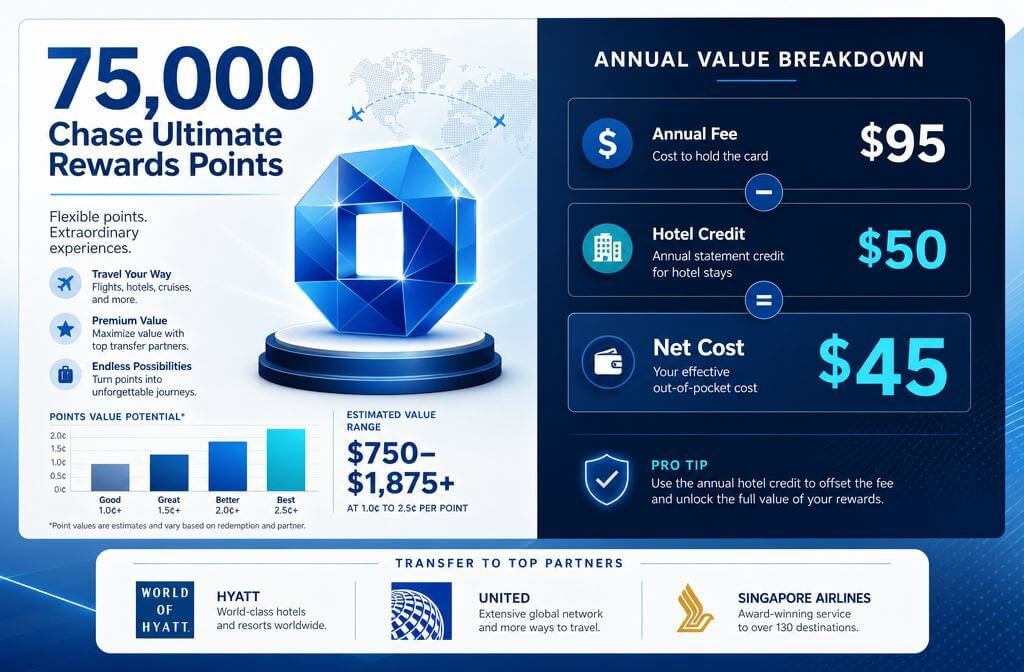
- Welcome bonus: 75,000 Ultimate Rewards points after $5,000 spend in the first 3 months — worth approximately $1,050–$1,500 depending on how you redeem.
- Net annual cost: After the $50 annual hotel credit, the effective fee is just $45/year.
- Best use of points: Transfer to Hyatt or United for premium cabin and hotel redemptions that beat the 1.25x portal rate.
- January 2026 rule change: You can now hold both the Preferred and Reserve simultaneously and earn a welcome bonus on each — a significant shift from prior restrictions.
- Not ideal for: Heavy dining spenders (Amex Gold wins), frequent flyers who want lounge access (Reserve or Venture X), or anyone over Chase’s 5/24 limit.
Chase Sapphire Preferred at a Glance: 2026 Snapshot
| Feature | Details |
|---|---|
| Annual Fee | $95 |
| Welcome Bonus | 75,000 points after $5,000 spend in 3 months |
| Earning Rates | 3x dining, 3x online grocery, 3x select streaming; 2x all travel; 1x everything else |
| Portal Redemption Value | 1.25 cents per point (Chase Travel℠) |
| Transfer Partners | 14 airline and hotel programs (1:1 ratio) |
| Annual Hotel Credit | $50 (Chase Travel hotel bookings) |
| Foreign Transaction Fee | None |
| Trip Delay / Cancel Coverage | Yes — up to $500/trip delay, $10,000/trip cancellation |
The card earns Chase Ultimate Rewards points, which are among the most flexible transferable points available. That flexibility is the core value proposition — not the portal.
Welcome Bonus and Minimum Spend Strategy for 2026
The current standard offer is 75,000 Ultimate Rewards points after $5,000 in purchases within the first 3 months of account opening.
At a conservative 1.4 cents per point (a reasonable baseline for transfer redemptions), that’s roughly $1,050 in value. At Hyatt sweet spots, that same 75,000 points can stretch to $1,500 or more. Either way, the bonus alone more than justifies the $95 annual fee — often for multiple years.
Important note on the $5,000 minimum spend: This is higher than many competing cards. Capital One Venture Rewards, for example, requires only $4,000 for its 75,000-mile bonus. If hitting $5,000 in 3 months requires manufactured spend or financial strain, factor that into your decision.
January 2026 Eligibility Rule Change
Chase updated its Sapphire bonus eligibility rules effective January 25, 2026. The key change: you can now earn a welcome bonus on the Preferred and the Reserve as separate lifetime bonuses, even if you currently hold the other card — provided you haven’t previously earned a bonus on that specific card.
Previously, Chase’s “One Sapphire” rule blocked holding both cards simultaneously. That restriction is now removed. This is a meaningful change for existing Preferred cardholders who have never held the Reserve, and vice versa.
You may be interested



What this means practically: If you’ve held the Preferred for years and never opened the Reserve, you can now apply for the Reserve and earn its welcome bonus without closing the Preferred first.
Chase’s proprietary eligibility system will still screen applicants. If you’re flagged as ineligible — even if you believe you qualify — there’s no guaranteed appeal path.
Earning Rates Across Categories and Real-World Math
The Chase Sapphire Preferred credit card earns:
- 3x on dining (restaurants, cafes, delivery)
- 3x on online grocery purchases (excludes Walmart, Target, wholesale clubs)
- 3x on select streaming services
- 2x on all travel (flights, hotels, rental cars, transit)
- 1x on everything else
Real-World Earning Example
Assume a typical month of spending:
| Category | Monthly Spend | Multiplier | Points Earned |
|---|---|---|---|
| Dining | $400 | 3x | 1,200 |
| Online Grocery | $300 | 3x | 900 |
| Travel | $200 | 2x | 400 |
| Other | $500 | 1x | 500 |
| Total | $1,400 | — | 3,000 |
At 3,000 points/month, that’s 36,000 points per year from everyday spend — before the welcome bonus. At 1.4 cents per point, that’s roughly $504 in annual value from ongoing earning alone.
Where the card falls short: The 1x on non-bonus categories is weak. If a large share of your spending falls outside dining, travel, and online grocery, a flat-rate card like the Capital One Venture (2x everywhere) may outperform on raw earning. The Sapphire Preferred wins when you spend heavily in its bonus categories and transfer points to high-value partners.
For a deeper look at how Chase Ultimate Rewards transfer partners stack up against Amex, Citi, and Capital One, see our full transfer partner comparison for 2026.
Redemption Options: Portal at 1.25x vs Transfer Partners
This is where the Chase Sapphire Preferred credit card either earns its keep or falls flat — depending entirely on how you redeem.
Option 1: Chase Travel Portal (1.25 cents per point)
Booking through Chase Travel℠ gives you 1.25 cents per point toward flights, hotels, and car rentals. That’s a guaranteed, no-hassle redemption.
- 75,000 bonus points = $937.50 in portal travel
- No transfer required, no award availability to search
This is fine for simple domestic flights or hotel stays. It’s not optimal for international premium cabins.
Option 2: Transfer Partners (1:1 ratio)
This is where transferable points earn their reputation. Chase transfers to 14 airline and hotel programs at 1:1, including:
- World of Hyatt — consistently the best hotel program for value; Category 1–4 properties at 3,500–15,000 points/night
- United MileagePlus — useful for Star Alliance partners, especially on routes where United’s own pricing is reasonable
- Air Canada Aeroplan — strong Star Alliance coverage, no fuel surcharges on most partners
- Singapore KrisFlyer — excellent for premium cabin redemptions on Singapore Airlines metal
- British Airways Avios — short-haul sweet spots, though fuel surcharges apply on BA-operated flights
Example: Hyatt transfer math
A Category 4 Hyatt property (e.g., Hyatt Regency Maui) costs 15,000 points/night. Cash rate: ~$450/night. That’s 3.0 cents per point — more than double the portal rate.
Transfer 30,000 Chase points → 2 nights at a Category 4 Hyatt = ~$900 in value vs. $375 at portal rate.
For more on maximizing Hyatt redemptions, see our Hyatt Award Chart 2026 Survival Guide.
The tradeoff: Transfers are instant for most partners but irreversible. Never transfer points without confirmed award availability. Use tools like Hyatt.com or United’s award calendar to verify space before initiating a transfer.
Travel Protections, Perks, and the Annual $50 Hotel Credit
The Chase Sapphire Preferred credit card’s non-points benefits are often undervalued.
$50 Annual Hotel Credit
Book a hotel through Chase Travel℠ and receive a $50 statement credit automatically each cardmember year. This effectively reduces the annual fee from $95 to $45 if you book even one qualifying hotel stay per year.
This isn’t a stretch — one hotel night through the portal triggers it. The $50 credit alone makes the card competitive against no-fee alternatives on a net-cost basis.
Trip Protections Worth Knowing
- Trip Cancellation/Interruption Insurance: Up to $10,000 per person, $20,000 per trip for covered reasons (illness, severe weather, etc.)
- Trip Delay Reimbursement: Up to $500 per ticket for delays of 12+ hours or requiring an overnight stay
- Baggage Delay Insurance: Up to $100/day for 5 days when bags are delayed 6+ hours
- Primary Auto Rental CDW: Covers damage/theft on rental cars when you decline the rental company’s coverage — and it’s primary, not secondary
The primary rental car coverage alone is worth noting. Most cards offer secondary coverage (meaning your personal auto insurance pays first). Primary coverage means you don’t need to file with your personal insurer, avoiding potential premium increases.
Other Benefits
- DoorDash DashPass: Complimentary membership (activate by December 31, 2027)
- Lyft Pink: Complimentary membership for 12 months
- No foreign transaction fees
These perks are useful but not the reason to carry the card. Don’t overweight them in your decision.
Who Should Apply (and Who Should Wait for the Reserve)
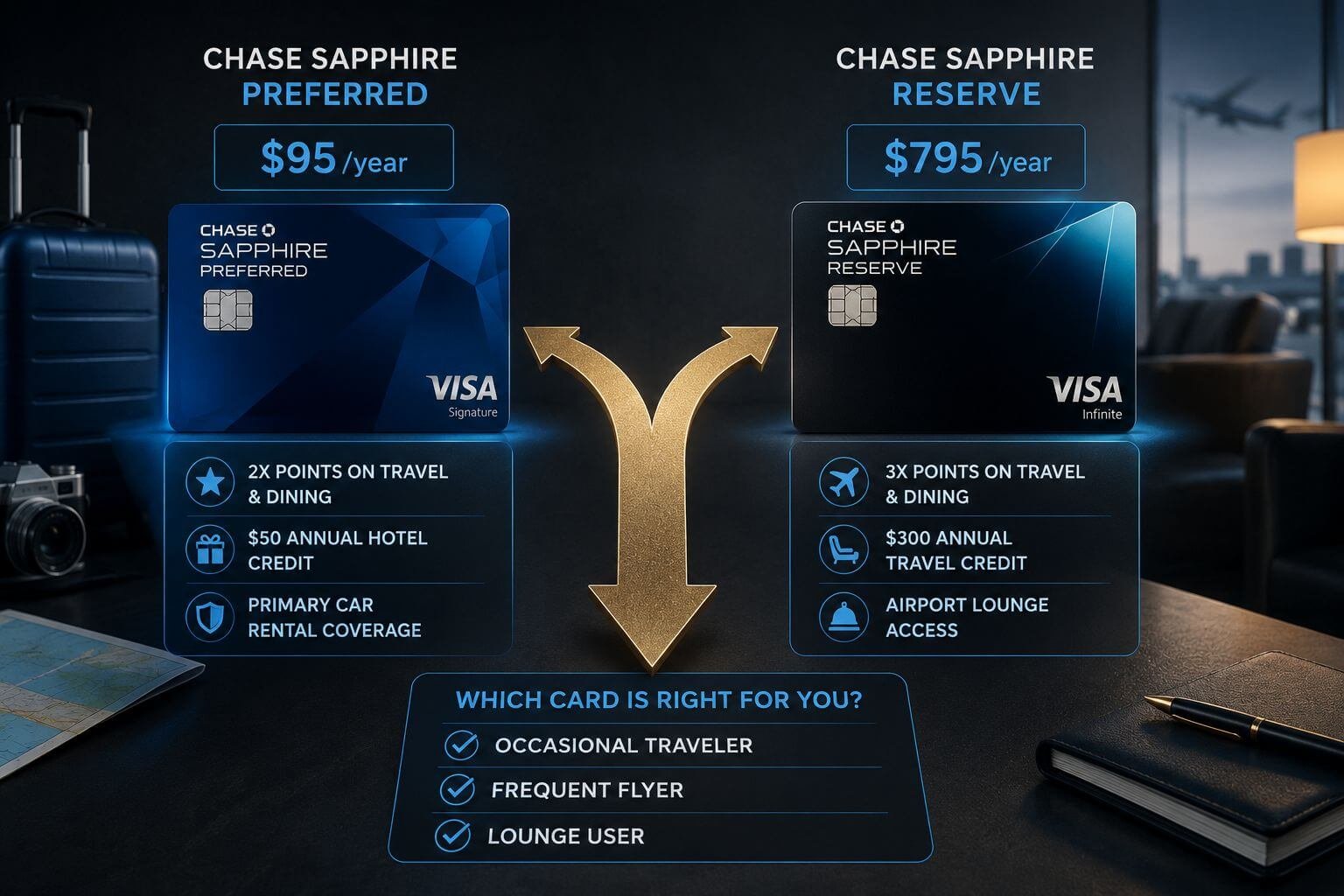
The Chase Sapphire Preferred credit card is a strong fit if you:
- Want access to Chase Ultimate Rewards transfer partners at the lowest annual fee entry point
- Spend regularly on dining, travel, and online grocery
- Plan to transfer points to Hyatt or a Star Alliance partner for a specific trip
- Are new to transferable points and want a low-risk way to build a points balance
- Already hold the Reserve and want to earn the Preferred’s separate welcome bonus (post-January 2026 rule change)
Consider a different card if you:
- Spend heavily on dining and groceries: The Amex Gold Card earns 4x on both (up to annual caps) and may deliver significantly more value despite its $325 fee.
- Want airport lounge access: The Preferred has no lounge benefit. The Reserve includes Priority Pass and access to Chase Sapphire Lounges. See our Chase Sapphire Lounge locations guide for 2026 coverage.
- Are over 5/24: Chase will not approve you if you’ve opened 5 or more new credit cards in the past 24 months, regardless of credit score. This is a hard rule with no known exceptions.
- Want a no-fee option: The Wells Fargo Autograph earns 3x on travel, dining, and streaming with no annual fee. For a full comparison, see best no-annual-fee travel cards in 2026.
- Are a high-volume traveler who can justify $795: The Reserve’s $300 travel credit, 1.5x portal rate, and lounge access may pencil out. Run the numbers with our Chase Sapphire Preferred vs Reserve 2026 breakdown.
Application Tips: 5/24, Sign-Up Bonus History, and Timing
Chase 5/24 Rule
Chase’s 5/24 rule is the single biggest application barrier for points-and-miles enthusiasts. If you’ve opened 5 or more personal credit cards (from any issuer) in the past 24 months, Chase will deny your application automatically.
Business cards from most issuers (including Chase’s own Ink cards) typically do not count toward 5/24 — but personal cards from every bank do.
Before applying: Count your new card openings over the past 24 months. If you’re at 4/24 or below, you’re likely clear. At 5/24 or above, wait until enough accounts age out of the 24-month window.
Welcome Bonus Eligibility
Under the January 2026 rule change:
- You can hold both the Preferred and Reserve simultaneously
- Each card has its own lifetime bonus eligibility
- If you’ve previously received a Sapphire Preferred bonus, you are not eligible for another Preferred bonus — this is a lifetime restriction, not a 48-month clock
- Chase’s system screens eligibility automatically; a pop-up during the application process will notify you if you’re ineligible before you submit
Timing consideration: If you’re planning a large trip within 6 months, apply early enough to hit the $5,000 minimum spend naturally through regular purchases. Avoid applying if your spending won’t reach the threshold without significant effort.
Credit Score Expectations
Most approvals for the Chase Sapphire Preferred credit card come in at a credit score of approximately 720 or above, though scores in the high 600s have been approved. A strong credit profile, low utilization, and clean payment history matter more than hitting a specific number.
For a broader look at how this card fits into a multi-card strategy, see our Chase Transfer Partners Guide 2026 and our overview of the best travel credit cards in 2026.
Conclusion: Is the Chase Sapphire Preferred Worth $95 in 2026?
For most intermediate points-and-miles users, yes — but with clear conditions.
The card earns its fee through the $50 hotel credit alone (net cost: $45), delivers meaningful earning rates in dining and travel categories, and — most importantly — gives you access to Chase Ultimate Rewards transfer partners. That access is the real product. The portal is a fallback, not the strategy.
The 75,000-point welcome bonus after $5,000 spend is the strongest reason to apply now if you’re eligible. At realistic transfer valuations, that bonus covers the annual fee for several years.
Where the card doesn’t win: flat-rate spending, lounge access, and dining-heavy budgets, where the Amex Gold’s 4x categories pull ahead. If you’re already over 5/24, the decision is made for you — wait.
Practical Next Steps
- Check your 5/24 status before applying. Count all personal card openings in the past 24 months.
- Verify bonus eligibility — if you’ve previously earned a Sapphire Preferred bonus, you won’t earn another.
- Identify your first redemption target before transferring any points. Hyatt and United are the two most reliable starting points for high-value redemptions.
- Use the $50 hotel credit within your first cardmember year to reduce your net fee to $45.
- Read next: If you’re weighing the Preferred against the Reserve, our Chase Sapphire Preferred vs Reserve 2026 math breakdown walks through the exact numbers. If you’re planning a Europe trip using these points, see our 2026 Europe award guide.


Content on Award Travel Hub is independently created by Award Travel Hub Editorial Desk and, where noted, reviewed by Award Travel Hub Review Desk. Some pages may contain affiliate links, but compensation does not determine our coverage, opinions, or methodology.