
Last updated: June 24, 2026
Quick Answer: Airline miles are the reward currency of frequent flyer programs. You earn them by flying, using co-branded credit cards, or transferring points from bank programs like Chase or Amex. You then redeem them for flights or upgrades — often at a fraction of the cash price. The best redemptions typically come from long-haul and premium cabin bookings, where a single award can be worth $1,500 or more.
Key Takeaways
- Airline miles are earned through flights, credit cards, shopping portals, and transferable points programs (Amex, Chase, Capital One, Citi, Bilt).
- Most airline miles are worth between 1 and 1.6 cents each, but value varies significantly by program and how you redeem.
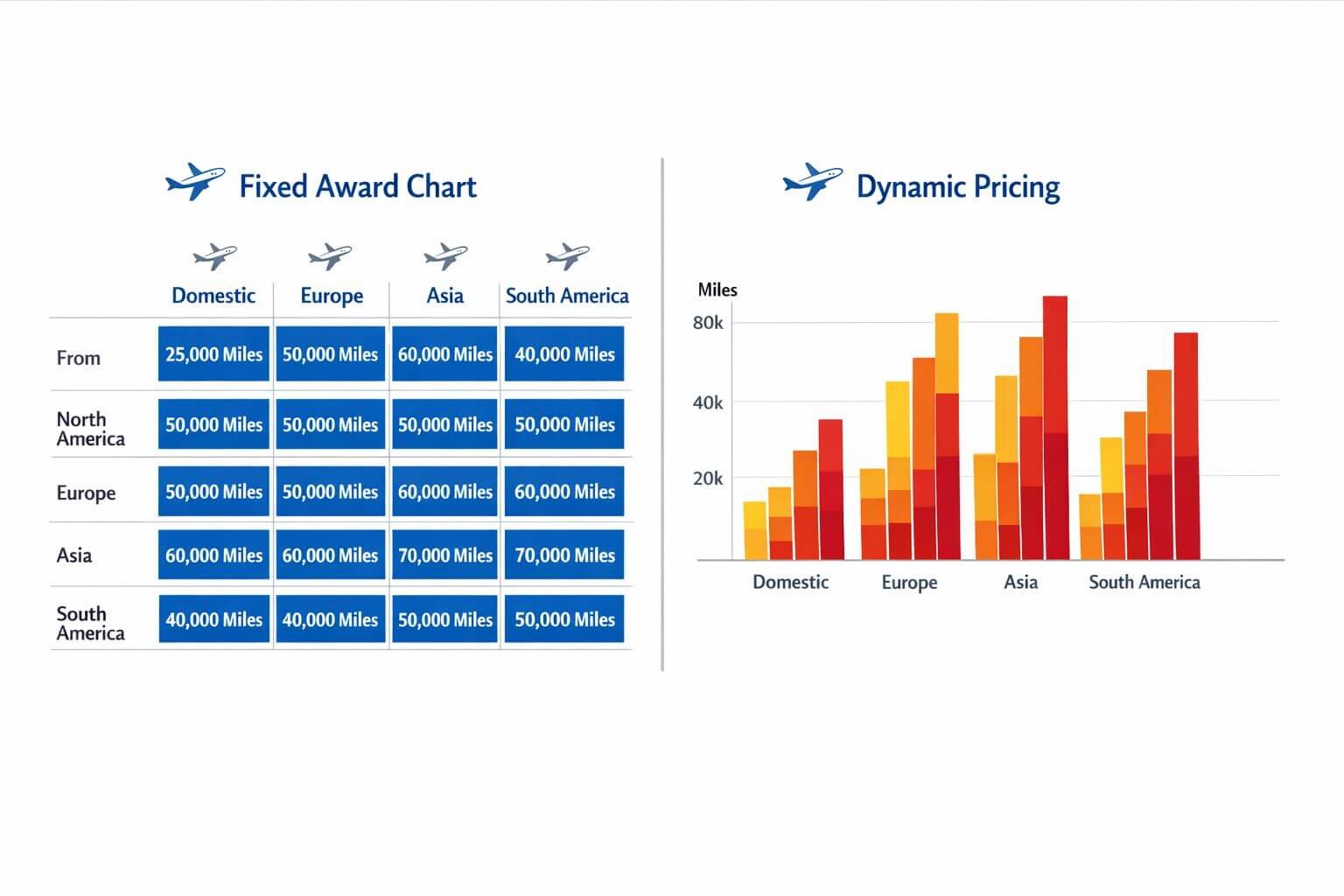
- Fixed award charts offer predictable mile costs by region; dynamic pricing fluctuates based on demand — knowing the difference changes your strategy.
- The best value almost always comes from long-haul business or first class redemptions, not domestic economy.
- Transferable points (Chase Ultimate Rewards, Amex Membership Rewards) give you flexibility across multiple airlines and reduce the risk of devaluation.
- Miles can expire if your account sits inactive — check your program’s rules now.
- Award availability is the biggest practical barrier; flexible dates and the right search tools make a major difference.
- A beginner can realistically earn enough miles for a free international flight within 3–6 months using a single credit card welcome bonus.
What Airline Miles Are and Why They Exist
Airline miles are a loyalty currency — a way for airlines to reward repeat customers and keep them flying with one carrier over another. Every major U.S. airline operates a frequent flyer program: American AAdvantage, United MileagePlus, Delta SkyMiles, Southwest Rapid Rewards, and others. When you fly or spend on a co-branded credit card, the program credits miles to your account. You later redeem those miles for award flights, upgrades, or other travel.
Airlines benefit because loyalty programs generate significant revenue — Delta SkyMiles was valued at an estimated $31.7 billion in 2026, largely because banks pay airlines for the miles they sell to credit card programs. You benefit because those miles can be redeemed for travel that would otherwise cost hundreds or thousands of dollars in cash.
The core mechanic is simple:
- Earn miles through qualifying activity.
- Accumulate enough miles for a target redemption.
- Book an award flight using miles instead of cash.
Understanding how do airline miles work at a deeper level — earning rates, redemption values, and program rules — is what separates a beginner from someone who books business class for less than the cost of economy.
How Do Airline Miles Work When You Earn Them?
You can earn airline miles through several channels. Most beginners focus on flying, but credit cards and transferable points programs are where the real volume comes from.
Earning by Flying
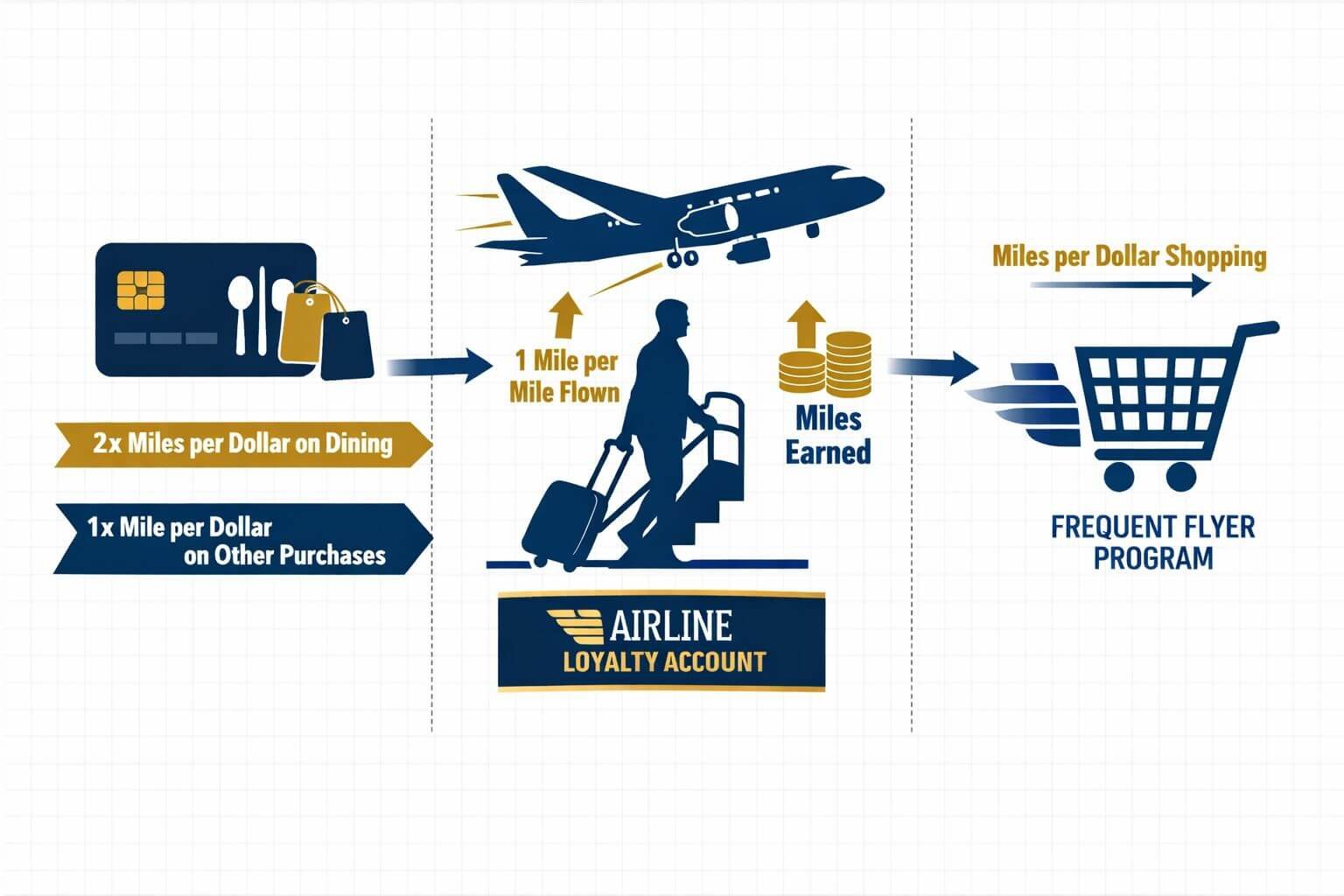
When you purchase a ticket and fly, the airline credits miles to your account. The amount depends on the program:
- Distance-based programs award miles based on miles flown (e.g., 1 mile per mile traveled).
- Spend-based programs award miles based on the dollars paid for the ticket. United MileagePlus, for example, dropped its base earning rate to 3 miles per dollar spent for general members in 2026, while co-branded cardholders earn significantly more.
- Segment-based programs award a flat number of miles per flight segment regardless of distance or price.
Important caveat: Booking in a discounted fare class (like basic economy) can reduce or eliminate miles earned. American Airlines basic economy tickets, for instance, no longer earn AAdvantage miles or Loyalty Points — a rule worth knowing before you book.
Earning Through Credit Cards
This is the fastest path for most people. Two types of cards earn airline miles:
- Co-branded airline cards (e.g., the Citi AAdvantage card, United Explorer card) earn miles directly in that airline’s program.
- Transferable points cards (Chase Sapphire Preferred, Amex Gold, Capital One Venture X, Citi Strata Premier, Bilt Mastercard) earn flexible points that transfer to multiple airline partners.
You may be interested



A typical welcome bonus on a mid-tier travel card runs 60,000–100,000 points after meeting a minimum spend requirement. That alone can cover a round-trip business class ticket to Europe on the right program.
Earning Through Transferable Points Programs
Transferable points are the most flexible tool in award travel. Programs like Chase Ultimate Rewards, Amex Membership Rewards, Capital One Miles, Citi ThankYou Points, and Bilt Points all let you transfer to airline partners at set ratios (often 1:1).
For example, 60,000 Chase points transfer to United MileagePlus at a 1:1 ratio, giving you 60,000 United miles to book a Saver award. The best transferable points programs in 2026 each have different airline partners, so the right program depends on which airlines serve your target routes.
Transfer bonuses occasionally boost the value further — a 20–30% bonus means 60,000 points become 72,000–78,000 miles. These promotions are time-limited and worth watching.
Other Earning Methods
- Shopping and dining portals: Airlines run portals where purchases at partner retailers earn bonus miles. Rates vary widely.
- Hotel and car rental partners: Booking through airline partner programs earns miles on non-flight spending.
- Promotions: Programs run limited-time offers. American AAdvantage ran a “Ready, Set, Jet” promotion in early 2026, offering up to 1,000 bonus Loyalty Points per flight segment to select Mexico destinations.
How Much Are Airline Miles Worth?
Airline miles are generally worth 1 to 1.6 cents each, but this range is an average — not a guarantee. The actual value of any mile depends entirely on how you redeem it.
| Redemption Type | Typical CPP (Cents Per Point) | Notes |
|---|---|---|
| Domestic economy | 0.8–1.2¢ | Often close to or below cash price |
| Long-haul economy | 1.0–1.4¢ | Better, but business class beats this |
| Business class (international) | 1.5–3.0¢+ | Best value for most programs |
| First class (international) | 2.0–5.0¢+ | Highest CPP, but availability is limited |
| Hotels/car rentals via miles | 0.5–0.8¢ | Generally poor value; avoid |
Cents per point (CPP) is the standard measure: divide the cash price of the flight by the miles required. If a Business Class seat costs $3,000 in cash and 80,000 miles, the CPP is 3.75¢ — well above the 1.5¢ threshold that makes a redemption worthwhile.
A practical benchmark: if a business class redemption costs fewer than 10,000 miles per hour of flight time, it’s generally a strong use of miles. An 8-hour transatlantic flight at 80,000 miles meets that threshold exactly.
For a full breakdown of how to calculate this, see the 2026 guide to cents-per-point math.
Common mistake: Redeeming miles for merchandise, gift cards, or statement credits. These typically return 0.5–0.8¢ per mile — well below what you’d get from a flight redemption.
Fixed Award Charts vs. Dynamic Pricing Explained Simply
This is one of the most important concepts for understanding how do airline miles work in practice — and it directly affects how many miles you’ll need for a specific flight.
Fixed Award Charts
A fixed award chart sets a specific mile cost for each route based on origin and destination region — regardless of when you fly or what the cash price is. If the chart says U.S. to Europe in business class costs 57,500 miles, that’s the price whether you fly in July or January, whether the cash ticket is $2,000 or $6,000.
Programs still using fixed or semi-fixed charts (as of 2026): American AAdvantage, United MileagePlus (for partner awards), Air Canada Aeroplan, Turkish Miles&Smiles, and others.
Fixed charts create sweet spots — routes where the fixed mile cost is low relative to the cash price. For example, American AAdvantage charges 60,000 miles for U.S. to Japan in business class, a seat that can retail for $5,000 or more.
Dynamic Pricing
Dynamic pricing ties the mile cost to the cash price of the ticket. When cash fares go up, miles required go up too. Delta SkyMiles is the most prominent example in the U.S. — there’s no published chart, and the same route can cost 30,000 miles one day and 80,000 miles the next.
Implication for beginners: With dynamic pricing programs, you need to compare the cost of miles against the cash price every time. A “deal” in miles only exists when the cash price is high, and the miles price hasn’t scaled proportionally, which happens, but requires active searching.
Which Is Better?
Fixed charts are generally more beginner-friendly because their values are predictable. Dynamic programs can occasionally offer low-mile redemptions during sales, but the floor is also higher on popular routes. Most experienced award travelers maintain miles in both types of programs.
Step-by-Step: How to Use Airline Miles to Book a Free Flight
This is where understanding how do airline miles work translates into an actual booking.
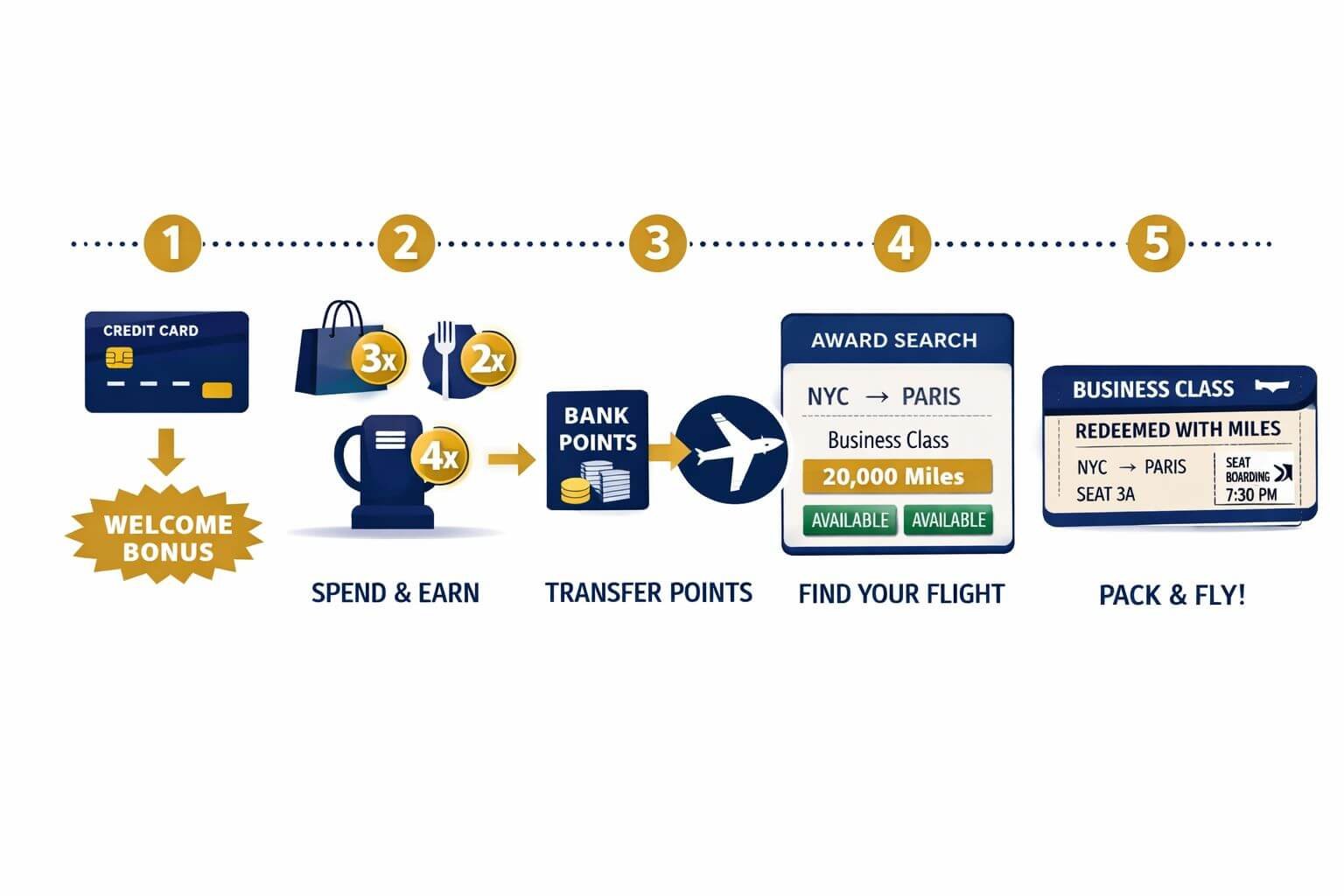
Step 1: Identify your target trip. Pick a destination and rough timeframe. Example: round-trip to Europe in business class, traveling in shoulder season (April or October).
Step 2: Estimate the miles needed. Research which programs cover that route and at what cost. For U.S. to Europe Business Class, programs like Aeroplan, Turkish Miles&Smiles, or Iberia Avios often have competitive rates (40,000–70,000 miles round-trip, depending on routing and program).
Step 3: Check award availability before transferring miles. This step is critical. Never transfer points from a bank program to an airline until you’ve confirmed award space exists. Use the airline’s own website or a dedicated award search tool to verify open seats on your target dates.
Step 4: Transfer points to the airline program. Once availability is confirmed, transfer the required points from your bank program (Chase, Amex, Capital One, etc.) to the airline. Most transfers complete within minutes to a few hours, though some take longer.
Step 5: Book the award. Log in to the airline’s website, select the award flight, and complete the booking with miles. You’ll still pay taxes and fees in cash — these vary by program. Some programs (particularly European carriers) add fuel surcharges that can run $200–$600 on long-haul routes. Factor this into your decision.
Step 6: Confirm and document the booking. Save the confirmation number and review the cancellation and change rules before finalizing. Award tickets can often be canceled for a fee or a free refund, depending on the program.
A Simple Starter Strategy to Earn Your First Free Trip
Here’s a concrete beginner plan — no advanced tactics required.
Goal: Round-trip business class to Europe for two people. Miles needed (estimate): 120,000–140,000 miles total (60,000–70,000 per person). Timeframe: 3–6 months.
The Plan
Month 1: Open one transferable points card. The Chase Sapphire Preferred is a practical starting point for most beginners. It earns Chase Ultimate Rewards points, transfers 1:1 to partners including United, Aeroplan, and British Airways Avios, and carries a manageable annual fee. A current welcome bonus of 60,000–100,000 points (after meeting minimum spend) covers a significant portion of the miles needed.
If you’re already past the Chase 5/24 threshold or prefer a different issuer, Amex Membership Rewards or Capital One Miles are strong alternatives with their own transfer partner networks.
Month 2–3: Meet the minimum spend requirement. Route your regular spending — groceries, dining, subscriptions — through the new card. Don’t manufacture spend or take on debt to hit the bonus. The goal is to redirect spending you’d do anyway.
Month 4: Search for award space. Use the airline’s website and award search tools to find Business Class availability on your target dates. Flexibility of 2–3 days on either side of your ideal travel window significantly increases options. Finding partner award space is a skill that improves with practice.
Month 5–6: Transfer and book. Once you’ve confirmed availability, transferred points, booked the award, and paid the taxes and fees in cash.
Best for: Anyone with a solid credit score (700+) who can meet a $3,000–$5,000 minimum spend in 3 months through normal expenses.
Not for: People carrying credit card balances, those who’ve opened 5+ cards in the past 24 months (Chase 5/24 restriction), or travelers with no flexibility on dates or destinations.
One risk to acknowledge: Miles can lose value through program devaluations — when an airline raises the miles required for the same award. This is a real and recurring event across all programs. The practical response is to earn with a purpose and redeem within 12–18 months rather than hoarding miles indefinitely. Also check your program’s expiration rules — some programs cancel miles after 18–24 months of account inactivity.
Conclusion and Next Steps
Airline miles work by converting everyday spending and flying into a parallel currency that can be redeemed for travel — often at a fraction of the retail price when used strategically. The fundamentals are straightforward: earn through credit cards and flights, understand whether your target program uses fixed or dynamic pricing, search for award availability before transferring, and prioritize long-haul Premium Cabin redemptions for the best value.
The beginner’s biggest advantage is the welcome bonus. A single well-chosen transferable points card can put 60,000–100,000 points in your account within a few months — enough for a meaningful first redemption.
Your next steps:
- Choose a transferable points program based on which airline partners serve your target routes. Compare options in the best transferable points programs guide.
- Calculate your target redemption value using the cents-per-point framework before committing miles.
- Practice searching award space using the tools covered in the beginner award search tools guide.
- Set a specific 2026 goal — a destination, a cabin class, a travel window — and work backward from there. The simple award travel goals guide walks through exactly how to do this.
Award travel rewards patience and specificity. Start with one program, one card, and one target trip — and the mechanics will become clear quickly.
Frequently Asked Questions
Are airline miles actually free? Not entirely. You pay taxes and fees on award tickets, which can range from $5 on a domestic flight to $600+ on a transatlantic route with fuel surcharges. The miles cover the base fare; cash covers the government taxes and carrier-imposed fees.
How many miles do I need for a free flight? It depends on the route, cabin, and program. Domestic economy awards typically start around 7,500–12,500 miles one-way. Long-haul business class can range from 40,000 to 120,000 miles one-way, depending on the program and pricing model.
Do airline miles expire? Yes, in most programs — but the rules vary. Delta, Southwest, JetBlue, and Alaska have no expiration as of 2026. American, United, and other airlines require account activity every 18–24 months to keep miles active. Check your specific program’s rules.
What’s the difference between airline miles and credit card points? Airline miles live in a specific airline’s loyalty program and can only be used with that airline or its partners. Credit card points (like Chase Ultimate Rewards or Amex Membership Rewards) are transferable — you can move them to multiple airline or hotel programs, giving you more flexibility.
Can I earn airline miles without flying? Yes. Credit card spending is the primary way most people accumulate miles without setting foot on a plane. Shopping portals, dining programs, and hotel partner bookings also earn miles.
Is it better to earn miles directly or through transferable points? Transferable points offer more flexibility and reduce the risk of a single program devaluing. Earning directly in an airline program makes sense if you fly that carrier frequently and want to build toward elite status.
What is a sweet spot in award travel? A sweet spot is a specific route or redemption where a fixed award chart prices the miles at a low cost relative to the cash value. For example, booking a U.S. to Japan in business class through American AAdvantage for 60,000 miles when the cash ticket costs $4,000–$6,000 is a well-known sweet spot.
What are fuel surcharges and how do I avoid them? Fuel surcharges are fees some airlines add to award tickets on top of government taxes. They’re most common on European carriers like Lufthansa and British Airways. To avoid them, book through a partner program that doesn’t pass surcharges through — for example, booking Lufthansa business class through United MileagePlus or Aeroplan instead of Lufthansa Miles & More.
How do I know if a miles redemption is worth it? Calculate the cents per point (CPP): divide the cash price of the flight by the miles required, then multiply by 100. A CPP above 1.5¢ is generally a good redemption. Above 2.5¢ is excellent.
Can I transfer miles between people? Most programs don’t allow direct mile transfers between members, or charge significant fees to do so. Some programs allow household pooling. In some cases, transferable bank points (Chase, Amex, etc.) can be transferred to a partner’s loyalty account, which is one workaround.


Content on Award Travel Hub is independently created by Award Travel Hub Editorial Desk and, where noted, reviewed by Award Travel Hub Review Desk. Some pages may contain affiliate links, but compensation does not determine our coverage, opinions, or methodology.