
Last updated: May 8, 2026
Quick Answer
The best use of Capital One transfer partners 2026 is usually transferring Venture miles to strong 1:1 airline partners, especially Turkish Miles&Smiles, Avianca LifeMiles, Flying Blue, Air Canada Aeroplan, and TAP Miles&Go, when award space is already available. For most readers, the weakest uses are speculative transfers, low-value hotel conversions, and 2:1.5 transfers unless the award is unusually strong or a transfer bonus closes the gap. Capital One is most competitive when a partner has low award pricing, low surcharges and fees, and fast transfers.
Key Takeaways
Start with 1:1 partners first. Most of the best Capital One miles redemptions still come from 1:1 airline transfers.
Turkish Miles&Smiles remains one of the top sweet spots for business class to Europe when space is available.
Avianca LifeMiles is still useful post-devaluation because it avoids fuel surcharges on many Star Alliance bookings.
Flying Blue is often the easiest practical option because of broad route coverage and regular promo-style discounts, but pricing is dynamic.
You may be interested
TAP Miles&Go can be strong for Portugal and Europe, especially when pricing undercuts Aeroplan or Flying Blue.
Qantas and Singapore at 2:1.5 need more scrutiny. They can still make sense, but only for a specific award or during a transfer bonus.
Do not transfer before finding award availability. Capital One transfers are generally one-way and irreversible.
Transfer bonuses can change the math fast. A 20% bonus means 1,000 Capital One miles become 1,200 partner miles; that can turn a good redemption into a great one.
Capital One is stronger than many readers think in 2026, especially after adding Qatar, JAL, and I Prefer in late 2025.
The practical workflow matters more than published sweet spots. A weaker chart with real award availability can beat a perfect chart with no seats.



For the full partner list and bank overview, see Award Travel Hub’s Capital One Miles transfer partners guide and broader bank transfer partners guide.
Which Capital One transfer partners are actually worth using in 2026?
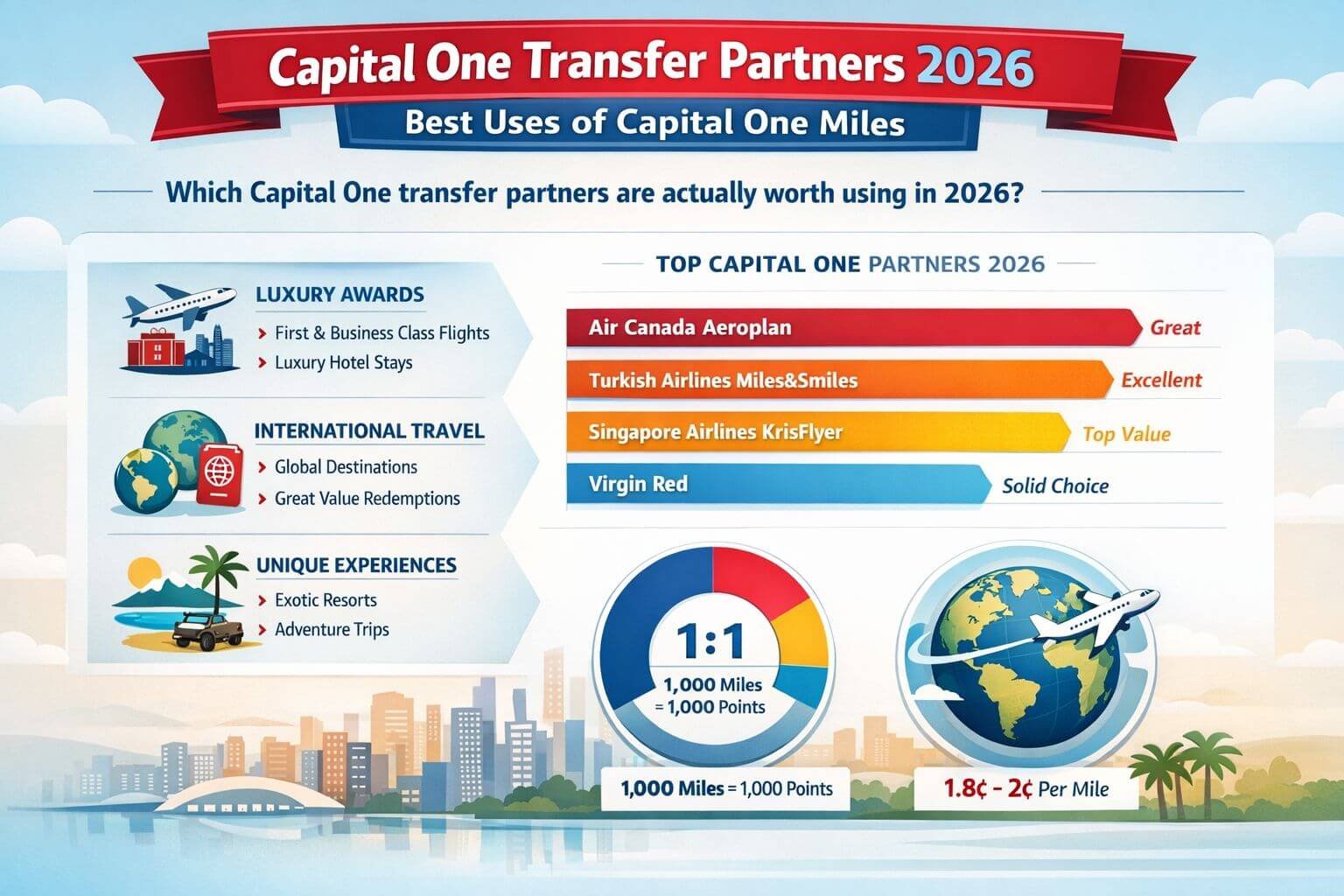
The short answer: focus on partners where award pricing is still reasonable, transfer ratios are 1:1, and booking friction is manageable. In May 2026, the standouts for most U.S.-based travelers are Turkish, Avianca, Flying Blue, Aeroplan, TAP, Virgin Red, Qatar, and sometimes Accor for hotel users.
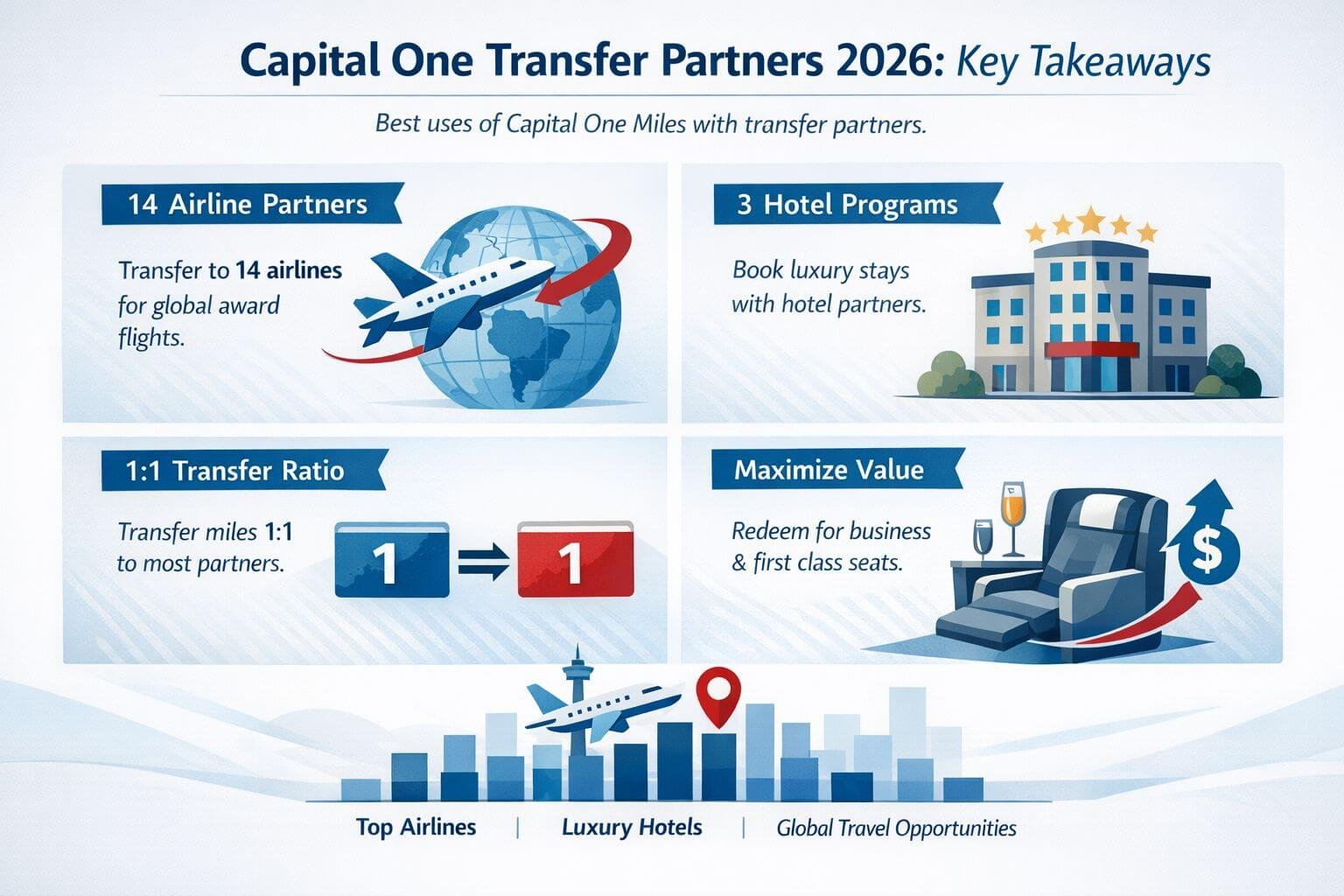
Capital One has 22 transfer partners as of early 2026, with most airline transfers at 1:1, while a few programs remain at 2:1.5 or other less favorable ratios.
Capital One transfer partner matrix (Current from ATH Transfer Partners page)
Transfer Partners
Transfer ratios and transfer times can change. Please verify details with the issuer before transferring points.
A practical rule
Choose a 1:1 partner unless one of three things is true:
The 2:1.5 partner is the only realistic way to book the seat.
A transfer bonus reduces or offsets the weak ratio.
The partner has a unique advantage in the award chart that still beats alternatives.
Best for / Not for
Best for:
Venture and Venture X cardholders booking international premium cabin awards
Readers are comfortable using partner airlines and search tools
Travelers comparing Capital One miles against Amex points, Chase points, Citi points, and Bilt points
Not ideal for:
Anyone who wants simple, reversible bookings
Travelers who only redeem through a fixed-value portal
Readers are unwilling to deal with award availability shifts
What are the best sweet spots among Capital One transfer partners 2026?
The best sweet spots are the awards where Capital One miles yield clearly above-average cents per point (CPP) after factoring in taxes, surcharges, fees, transfer ratios, and real-world availability. For most readers in 2026, Turkish, Avianca, and TAP lead the list.
Top sweet spots to check first
1. Turkish Miles&Smiles: business class to Europe
Turkish is one of the strongest Capital One transfer partners 2026 because saver Business Class pricing to Europe can still be compelling. The scenario highlighted in current market coverage is around 45,000 miles one-way in business class on eligible itineraries, which can produce roughly 3.2 cents per point when cash fares are high, and taxes remain moderate.
Choose Turkish if a space saver exists, and the exact route is bookable online or via an agent workflow.
2. Avianca LifeMiles: Star Alliance premium cabins
Avianca remains valuable after devaluation because it still offers broad access to the Star Alliance and often avoids fuel surcharges.
A practical example is 63,000 miles one-way in business class to parts of Asia, which can still be a strong redemption relative to cash fares.
3. TAP Miles&Go: Portugal and Europe
TAP Miles&Go can underprice competing programs on TAP-operated business class routes. The often-cited target is around 34,000 miles one-way in business class to Europe on select routes or promo-style pricing.
Choose TAP if your trip starts in a TAP gateway and taxes are acceptable.
4. Flying Blue: Europe when promos or lower dynamic pricing appear
Flying Blue uses dynamic pricing, meaning award prices can rise or fall rather than follow a fixed chart. That is a risk, but also an opportunity. Promo-style pricing to Europe can be excellent for economy and sometimes business class.
5. Air Canada Aeroplan: flexibility over the raw cheapest price
Aeroplan is not always the lowest-priced option, but it is often the easiest to actually book. Better search functionality, broad partner access, and stopover options make Aeroplan one of the most practical transfer destinations.
Quick example: how bonus math changes the ranking
Assume a business class award costs 45,000 Turkish miles.
No bonus: transfer 45,000 Capital One miles
30% bonus: transfer about 35,000 Capital One miles to receive 45,500 Turkish miles
That is why transfer bonuses matter. A solid sweet spot becomes much stronger if the transfer bonus is active. For broader context, see ATH’s transfer bonus strategy guide and the live transfer bonuses tracker.
Common mistake
A common mistake is chasing a published sweet spot without checking whether the same seat is easier to book through Aeroplan, Flying Blue, or Qatar Avios for a similar price. Award chart value means little if married segments, phantom space, or poor website functionality block the booking.
Is Turkish Miles&Smiles still the best Capital One transfer partner in 2026?
For many U.S.-based travelers, yes. Turkish is still one of the best Capital One transfer partners 2026 because the award chart can produce unusually cheap Star Alliance awards, especially in business class to Europe and some domestic United-operated itineraries.
The upside is clear:
Strong saver-level business class pricing
1:1 transfer ratio from Capital One
Frequent bonus history, including a 30% transfer bonus in February 2026 tracked by transfer-bonus sites
Access to Star Alliance partner airlines
The tradeoffs are also real:
Website reliability can be uneven
Some routes are easier to book by phone or with workarounds
Award availability can disappear before transferred miles arrive
Customer service friction is higher than with Aeroplan or Flying Blue
Decision rule
Choose Turkish when all three are true:
Saver partner space is visible
The same itinerary costs materially more via Aeroplan or Avianca
You are ready to book immediately after the transfer
Skip Turkish when:
The itinerary has tight connections or complex married segments
You need flexible cancellation handling
You are booking for multiple passengers and need easy changes
For more on program mechanics, see ATH’s Turkish Airlines Miles&Smiles guide.
Is Avianca LifeMiles still worth transferring to after the devaluation?
Yes, but with more discipline. Avianca LifeMiles is still worth using in 2026 when you find saver-level Star Alliance space and want to avoid fuel surcharges, but the margin for error is smaller than it was before.
Why LifeMiles still matters:
1:1 transfer from Capital One
Broad Star Alliance network
Often no fuel surcharges, which preserves value on premium cabin awards
Useful one-way pricing compared with some competitors
Why readers are more cautious now:
Devaluation reduced some headline bargains
Mixed IT reliability and occasional phantom award space
Customer support can be inconsistent
A realistic booking strategy
Search the itinerary through multiple tools.
Confirm the seat appears on LifeMiles before transferring.
Compare taxes and pricing against Aeroplan and United.
Transfer only the amount needed to book immediately.
Avianca often wins when cash fares are high and surcharges on other programs are ugly. If the route is simple and the space is real, LifeMiles still delivers. ATH also has a dedicated Avianca LifeMiles transfer partners guide and a recent Amex LifeMiles bonus analysis that helps when comparing transferable points across banks.
Which current transfer bonuses should Capital One cardholders watch?
The direct answer: do not transfer without checking bonuses first. A modest bonus can change the ranking of Capital One transfer partners 2026, especially for Turkish, Avianca, and niche hotel options.
Based on current and recent verified information:
Preferred Hotels & Resorts I Prefer: 30% bonus from March 1 to March 31, 2026, on top of the normal 1:2 ratio, making 1,000 Capital One miles become 2,600 I Prefer points.
Japan Airlines Mileage Bank: 30% bonus ended February 28, 2026.
Avianca: recent bonus activity has been tracked in 2026 by the points community and ATH’s Capital One Avianca bonus guide.
Turkish: recent 30% bonus activity was tracked in February 2026.

How to value a bonus quickly
Use this simple travel rewards math:
1:1 transfer + 20% bonus = 1,000 Capital One miles becomes 1,200 partner miles
Effective cost of a 60,000-mile award becomes 50,000 Capital One miles
A weaker program can become competitive if the bonus closes a pricing gap
Common pitfall
A transfer bonus does not fix a bad redemption. If the award has poor availability, high fuel surcharges, or weak cancellation rules, the bonus may not matter.
For a practical framework, see ATH’s guide to using transfer bonuses.
How does Capital One compare with Chase, Amex, Citi, and Bilt for transfers?
Capital One is strongest when you want breadth, especially with 22 partners and several good 1:1 airline options. Chase, Amex, Citi, and Bilt can still win on specific partners, but Capital One is no longer the backup currency many readers assume.
Where Capital One wins
More total transfer partners than Chase, based on current comparisons
Useful 1:1 options across Star Alliance, SkyTeam, and Avios-based programs
Strong access to Turkish, Avianca, TAP, Qatar, and Flying Blue
Good fit for cardholders who want multiple realistic redemption paths
Where Chase or Amex may win
Chase can be better if you value portal redemptions or Hyatt access
Amex may be better for certain premium cabin awards and niche airline partners
Citi can occasionally win on program-specific transfer bonuses or partner overlap
Bilt can be excellent for renters,
building balances,and accessing strong airline programs
Practical comparison rule
Choose Capital One if you hold Venture miles and want broad airline flexibility at 1:1.
Choose Chase if Hyatt is central to your strategy.
Choose Amex if your targets include specific Premium Cabin partner awards not well served by Capital One.
Choose whichever bank has the active transfer bonus if the same award is bookable through multiple programs.
For a full side-by-side comparison, use ATH’s transfer partner comparison for 2026.
How should you decide between airline and hotel transfers?
Most readers should transfer Capital One miles to airline partners rather than hotels. Airline redemptions usually offer the best use of points because Premium Cabin awards can exceed the return from fixed-value hotel transfers.
When airline transfers make sense
International business class deals
First class redemptions on partner airlines
Long-haul itineraries where cash fares are expensive
Cases where low surcharges preserve value
When hotel transfers can make sense
Accor Live Limitless if you want a more predictable value floor
Choice Privileges for select Nordic or Japan stays
Wyndham for specific fixed-price redemptions
I Prefer only during a strong bonus and for a high-cash-rate property
Decision rule
Transfer to hotels only if:
The hotel booking delivers similar or better value than your airline alternative
You have no near-term premium flight use
You want lower booking complexity and a fixed redemption value
To compare hotel options across programs, see ATH’s hotel transfer partners directory.
What is the safest step-by-step booking strategy for Capital One miles?
The safest strategy is simple: find the award first, compare the partner options, then transfer only what you need to book right away. That process reduces devaluation risk, transfer delays, and stranded miles.
Step-by-step guide
Start with the route, not the partner.
Decide your origin, destination, dates, and cabin.Search award availability in more than one program.
Compare Turkish, Avianca, Aeroplan, Flying Blue, Qatar, or British Airways depending on alliance.Check total cost, not just miles.
Include taxes, carrier surcharges, and cancellation fees.Prefer the easiest program if the price is close.
Saving 5,000 miles is not always worth worse customer service.Look for transfer bonuses.
Check live offers before moving points.Transfer only after the seat is confirmed.
Capital One transfers are generally irreversible.Book immediately and verify the ticket number.
For finding partner award space, ATH’s award space guide is a useful companion. If your best option needs a separate departure city, review the risks in this positioning flight guide.
Common mistakes to avoid
Transferring before confirming award availability
Ignoring fuel surcharges
Overvaluing 2:1.5 partners
Forgetting that dynamic pricing can change mid-search
Using a complex partner program for a trip that would be only slightly more expensive through Aeroplan or Flying Blue
FAQ
How many Capital One transfer partners are there in 2026?
Capital One has 22 transfer partners in early 2026, including airlines and hotels. Most airline partners transfer at 1:1, while a smaller group uses weaker ratios.
Are Capital One miles transfers reversible?
No. In practice, transfers from Capital One to partner programs should be treated as one-way and irreversible. Transfer only when you are ready to book.
What is the best Capital One transfer partner for Europe business class?
Turkish Miles&Smiles is often the best-value option for Europe business class when saver space is available. Flying Blue, TAP, and Aeroplan are also strong alternatives depending on route and taxes.
Is Avianca LifeMiles still good in 2026?
Yes. Avianca LifeMiles is still useful for Star Alliance awards, especially when avoiding fuel surcharges matters more than having the absolute lowest mileage price.
Are 2:1.5 Capital One transfer partners worth it?
Sometimes, but only for a specific high-value award or when a transfer bonus narrows the gap. For most travelers, 1:1 partners are the better default.
What is the fastest Capital One transfer partner?
Transfer speeds vary, but Turkish and Avianca are commonly treated as among the faster options in practice. Always allow for delays and verify before transferring.
Is Accor a good Capital One transfer partner?
Accor can be a reasonable choice if you want predictable hotel value and do not have a better airline redemption. It is usually not the highest-value transfer for premium travel.
Should Venture miles go to Qatar or British Airways Avios?
Choose Qatar for Qsuite-focused redemptions and choose British Airways for short-haul Avios uses or when BA pricing is lower. Since both sit in the Avios ecosystem, compare before moving points.
Conclusion
The best uses of Capital One miles in 2026 are still targeted airline transfers, not broad, speculative transfers. For most readers, the best starting points are Turkish Miles&Smiles, Avianca LifeMiles, TAP Miles&Go, Flying Blue, and Aeroplan, with Qatar and British Airways as strong supporting options.
The decision framework is straightforward:
Start with 1:1 partners
Check award space before transferring
Use bonuses when they improve a booking you already want
Avoid weak-ratio transfers unless they solve a real problem
Favor ease of booking when mileage differences are small
The next step is practical: identify one route, search it on two to four partner airlines, then compare mileage costs, taxes, and transfer times. Readers who do that consistently will get more value from Capital One miles than those who chase generic sweet spots.
Related reading


Content on Award Travel Hub is independently created by Award Travel Hub Editorial Desk and, where noted, reviewed by Award Travel Hub Review Desk. Some pages may contain affiliate links, but compensation does not determine our coverage, opinions, or methodology.