
Last updated: June 10, 2026
Quick Answer
Atmos Rewards lets you pick one status-earning method per year in 2026: 1 status point per mile flown, 5 status points per dollar of base airfare, or 500 status points per segment. Choose distance if you fly long-haul economy or book award flights, spend if you buy pricey tickets or fly premium cabins on paid fares, and segments if you stack short hops under 500 miles. Most West Coast flyers will earn fastest on distance; corporate and premium-cabin flyers win with spend.
Key Takeaways
- Atmos Rewards is the combined Alaska and Hawaiian loyalty program, and 2026 is the first year members can choose their earning method once per year.
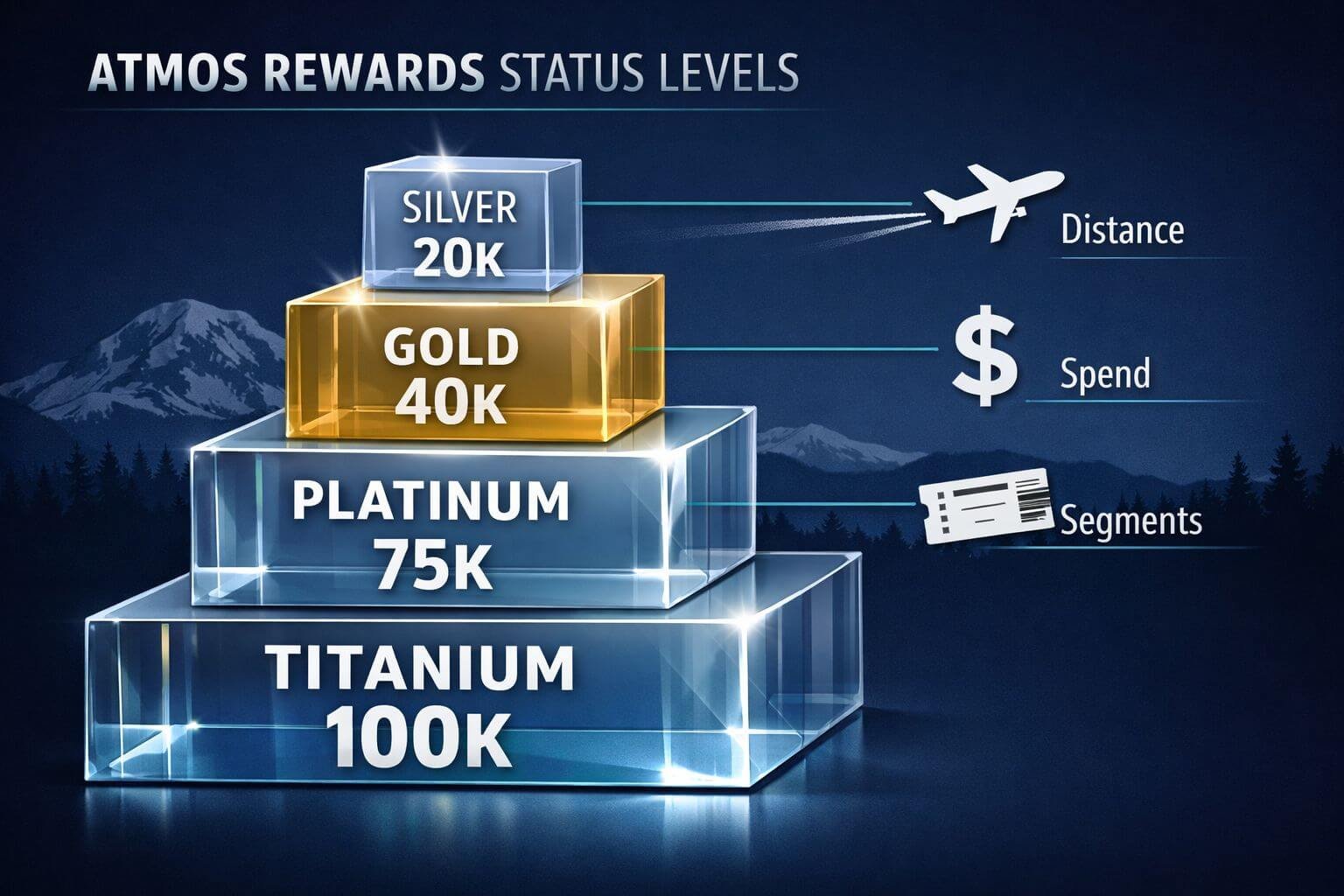
- Tier thresholds: Silver 20K, Gold 40K, Platinum 75K, Titanium 100K status points.
- Award flights still earn status points under the distance option — a major shift that rewards mileage runs on points.
- Segments (500 SP each) beat distance on short nonstops under ~500 miles.
- Spend (5 SP per $1 base fare) pulls ahead once average ticket price exceeds roughly $100 per 500 miles flown.
- None of the three options award class-of-service bonuses, which dulls premium-cabin paid-fare earning compared to legacy Mileage Plan.
- 2025 Platinum and Titanium members get a one-time 5,000 / 20,000 SP headstart in 2026.
- Credit card spend and Summit bonuses supplement all three paths but won’t replace flying.
How Atmos Rewards Elite Status Works in 2026
Atmos Rewards is the unified loyalty program from Alaska Airlines and Hawaiian Airlines, launched following the merger and fully rolled out on January 20, 2026. Elite status now runs on status points (SP) across four tiers, with oneworld benefits attached at Gold and above.
2026 status tiers and thresholds:
| Tier | Status Points | oneworld Equivalent |
|---|---|---|
| Silver | 20,000 | Ruby |
| Gold | 40,000 | Sapphire |
| Platinum | 75,000 | Sapphire+ |
| Titanium | 100,000 | Emerald |
The core change in 2026: members pick one of three earning methods at the start of each qualification year and can switch the following year. The three options:
- Distance: 1 SP per mile flown (including award flights on Alaska/Hawaiian metal under current rules)
- Spend: 5 SP per $1 of base airfare and paid upgrades
- Segments: 500 SP per flight segment
No class-of-service bonuses apply under any option. That’s a meaningful change from pre-merger Mileage Plan, where first class earned 2x–3x base miles.
Advisor note: The ability to include award flights under the distance method is the single most interesting detail in the 2026 ruleset. It rewrites mileage-run math for anyone sitting on Alaska miles or transferable points.
For a program primer, see the Alaska Atmos Rewards Guide 2026.
Distance-Based Earning: When Miles Flown Win
Choose distance if you fly long-haul economy, book award flights that still credit status, or buy cheap fares on long routes. One mile equals one status point, which sounds modest until you compare it to the alternatives on a $300 transcon.
Quick math: SEA–JFK round-trip
- Distance flown: ~4,950 miles → 4,950 SP
- Spend ($320 base fare): $320 × 5 = 1,600 SP
- Segments (2): 1,000 SP
You may be interested



Distance wins by a wide margin on this route, and it isn’t close.
Best for:
- West Coast flyers doing transcons or Hawaii routes in economy
- Anyone redeeming Alaska miles for award flights (status points still post)
- Long-haul international economy on Alaska/Hawaiian metal
Not for:
- Short-haul commuters on sub-500-mile hops
- Travelers buying expensive last-minute business-class fares
Common mistake: Assuming partner flights (American, Qatar, JAL, etc.) credit the same way. Partner earning under Atmos in 2026 uses fare-class multipliers on distance, not the flat 1 SP per mile — read the partner chart before projecting totals.
Spend-Based Earning: Best for Premium and Corporate Travelers
Choose spend if your average base fare runs above roughly $0.20 per mile flown, or if you frequently buy premium-cabin paid tickets. At 5 SP per dollar, a single $2,000 business-class ticket earns 10,000 SP — a quarter of the way to Gold from one booking.
Quick math: LAX–LHR paid business class
- Distance: ~10,880 miles → 10,880 SP
- Spend ($4,200 base fare): 21,000 SP
- Segments (2): 1,000 SP
Spend triples distance on a premium-cabin paid long-haul.
Best for:
- Corporate travelers on company-paid business class
- Flyers who consistently book premium economy or business on paid fares
- Hawaii visitors buying $500+ roundtrips for 2,500-mile routes
Not for:
- Award travelers (no base fare = near-zero SP on the tax portion)
- Deep-discount economy shoppers
Tradeoff to note: “Base fare” excludes taxes, carrier surcharges, and fees. A $1,200 transatlantic ticket might show only $650 in base fare after UK APD and carrier charges — run the real numbers before committing.
Segment-Based Earning: Short-Haul and Hop-Heavy Strategies
Choose segments if you regularly fly short nonstops under 500 miles, especially inter-Hawaii, intra-California, or Pacific Northwest puddle jumpers. At 500 SP per segment, two inter-island Hawaii flights (both under 300 miles) earn 1,000 SP versus maybe 500 SP on distance.
Quick math: 40 short-haul segments per year
- Average segment: 400 miles, $140 base fare
- Distance: 40 × 400 = 16,000 SP
- Spend: 40 × $140 × 5 = 28,000 SP
- Segments: 40 × 500 = 20,000 SP → Silver
Spend wins here if fares hold; segments beat distance cleanly.
Best for:
- Inter-island Hawaiian flyers
- Regional Alaska commuters (Anchorage–Fairbanks, Juneau–Seattle)
- California corridor hoppers (SAN–SFO, LAX–OAK)
Not for:
- Anyone whose typical flight exceeds 1,000 miles
- Travelers with fewer than ~25 segments annually
Edge case: A round-trip with a connection counts as 4 segments, not 2. If you intentionally route through SEA or PDX, you can double your segment earning at the cost of time.
Real-World Scenarios: Which Atmos Rewards Elite Status Earning Strategy Wins for Your Travel Pattern
Here are three archetypes with projected 2026 status points under each method. Assumptions stated inline.

Archetype 1: West Coast weekly commuter (SFO–SEA)
- 40 segments, ~679 miles each, $180 average base fare
- Distance: 27,160 SP → Silver+
- Spend: 36,000 SP → approaching Gold
- Segments: 20,000 SP → Silver
Winner: Spend, narrowly. Distance is a strong second and safer if fares drop.
Archetype 2: Leisure traveler with one long-haul + card spend
- 2 round-trips: SEA–HNL ($450) and LAX–LHR economy on Alaska partner ($800)
- 4 segments, ~14,500 total miles
- Distance: 14,500 SP
- Spend: 6,250 SP (base fare only)
- Segments: 2,000 SP
Winner: Distance by a mile. Add credit card SP from the Atmos co-brand card for a boost, but flying side, distance dominates.
Archetype 3: Long-haul international business flyer
- 6 round-trips in paid business: avg $5,500 base fare, 10,000 miles each
- 24 segments total
- Distance: 60,000 SP
- Spend: 165,000 SP → Titanium
- Segments: 12,000 SP
Winner: Spend, decisively. Titanium in a single qualification year from six premium trips.
Decision rule of thumb
- Average fare below $0.15/mile flown → distance
- Average fare above $0.25/mile flown → spend
- More than 30 segments per year, mostly under 500 miles each → segments
- Mix of award flights and paid short-hauls → distance (award flights tip it)
For a broader look at how Atmos stacks up against other programs, see Best Airline Loyalty Program 2026: Atmos vs United.
Including Award Flights and Credit Cards in Your Status Math
Award flights on Alaska/Hawaiian metal still earn status points under the distance method in 2026. This is the single biggest strategic lever in the new program, and it changes how transferable points holders should think about Atmos.
Award flights as a status booster
Redeem 30,000 Alaska miles for a SEA–HNL round-trip (~5,200 miles). Under distance earning, that’s 5,200 SP — roughly 13% of the way to Gold — for zero incremental cash outlay beyond taxes. Stack two or three of these in a qualification year and award flights alone can push you from Silver to Gold.
This math does not work under spend (base fare is effectively zero) or segments (only 1,000–2,000 SP for a round-trip).
Credit card contribution
The Atmos co-branded cards add status points through spend and annual bonuses. Typical structures for 2026:
- ~1 SP per $3 on everyday spend
- Summit bonuses at $6K, $12K, $24K spend tiers (up to 10,000 SP)
- Companion fare and anniversary perks
Card spend won’t carry a non-flyer to Titanium, but it can cover the final 5,000–15,000 SP gap to Gold or Platinum.
Related playbooks
- Alaska Atmos Rewards Guide 2026: Earn Status Without Flying
- Best Credit Card and Loyalty Shortcuts to Earn Hotel Status in 2026
- Best Ways to Find Partner Award Space Fast
Choosing and Revisiting Your Atmos Rewards Elite Status Earning Strategy Each Year
Pick your earning method before your first qualifying flight of the year, then audit quarterly. Atmos lets you choose once per calendar year — you can’t switch mid-year if your travel pattern changes, so projections matter.
Step-by-step: picking your 2026 method
- Pull 2025 flight history. Export from Alaska/Hawaiian or your expense tool.
- Calculate SP under all three methods using actual distance, base fare, and segment counts.
- Add expected 2026 award flights (distance only credits these).
- Add credit card projected SP as a flat addition — it applies regardless of method.
- Pick the method with the highest projected total, with a ~10% buffer for unplanned changes.
- Re-evaluate in Q3. If you’re tracking behind, adjust booking behavior (longer routes for distance, premium cabins for spend).
When to switch next year
- Changed jobs and now flying more short-haul → consider segments
- Got promoted to business-class travel budget → switch to spend
- Planning a points-heavy award year → lock in distance
Common pitfalls
- Ignoring partner earning rules. Distance on Alaska metal ≠ distance on American or Qatar.
- Assuming paid upgrades fully count. Only the upgrade dollar amount (not the underlying award ticket) adds to spend SP.
- Forgetting the 2025 headstart. If you earned Platinum or Titanium in 2025, you start 2026 with 5,000 or 20,000 SP respectively — factor it in.
- Chasing Titanium without a use case. Gold gets you oneworld Sapphire, free checked bags, and priority everything. The jump to Platinum/Titanium costs real money; make sure the upgrade cert and lounge access justify it.
Conclusion
The 2026 Atmos Rewards elite status earning strategy boils down to one honest question: what does your actual flight calendar look like? Distance is the default winner for award travelers, long-haul economy flyers, and most West Coast loyalists. Spend is the clear pick for premium-cabin and corporate travelers averaging high base fares. Segments quietly win for inter-island Hawaii and regional Alaska commuters stacking short nonstops.
Next steps:
- Run your 2025 numbers against all three formulas before booking your next 2026 flight.
- Lock in your earning method in your Atmos account, then set a Q3 calendar reminder to review.
- If your status math falls short, layer in the Atmos co-brand card or reposition an award flight to close the gap.
- Compare Atmos against other programs using our best airline loyalty program guide for 2026 before committing for 2027.
FAQ
Can I change my Atmos earning method mid-year? No. You pick one method per calendar year and can switch only when the next qualification year begins.
Do award flights really earn status points? Yes, on Alaska and Hawaiian metal under the distance earning method. Spend earning gives you near-zero SP on award tickets since the base fare is effectively zero.
Which method is best for West Coast flyers? For most economy West Coast travelers, distance wins. If you consistently pay over $0.25 per mile flown, spend overtakes it.
How do partner airline flights earn status points? Partner flights (American, Qatar, JAL, and other oneworld carriers) earn based on fare-class multipliers applied to distance, not the flat 1 SP per mile of Alaska/Hawaiian metal. Check the partner chart before projecting.
Is Titanium worth chasing over Platinum? Only if you’ll use the additional upgrade certificates and Emerald-level oneworld perks (first class lounges, extra baggage). For most flyers, Gold or Platinum is the sweet spot.
Do credit card points count toward Atmos status? Yes. The Atmos co-brand cards contribute SP through spend and Summit bonuses, but card SP alone won’t reach top-tier status without flying.
What happens to my 2025 Mileage Plan status? It maps to the equivalent Atmos tier, and 2025 Platinum/Titanium earners get a one-time 5,000 or 20,000 SP headstart in 2026.
Are there class-of-service bonuses under the new options? No. Unlike legacy Mileage Plan, none of the three 2026 earning methods award class-of-service multipliers. Premium cabins earn more only under the spend method via higher base fares.
Does Atmos offer rollover status points? Yes, excess SP above a tier threshold roll over to the next qualification year, similar to the legacy Mileage Plan approach.
Can I earn Atmos status purely from credit card spend? Realistically, no. You can close a gap of 10,000–15,000 SP, but flying still does the heavy lifting for Gold and above.


Content on Award Travel Hub is independently created by Award Travel Hub Editorial Desk and, where noted, reviewed by Award Travel Hub Review Desk. Some pages may contain affiliate links, but compensation does not determine our coverage, opinions, or methodology.