
Last updated: October 22, 2026
Quick Answer
In the Wells Fargo Autograph vs. Capital One SavorOne matchup, dining ties at 3X points (3% cash back). Autograph wins on category breadth (gas, transit, phone plans, travel) and redemption flexibility, and it still has a $0 annual fee. SavorOne wins for grocery and entertainment spending, but Capital One now lists it with a $39 annual fee, so it is no longer a no-fee card.
Key Takeaways
- Both cards pay 3X or 3% at restaurants and on popular streaming services.
- SavorOne adds 3% on entertainment and grocery stores. Autograph pays 1X on both.
- Autograph adds 3X on travel, gas, transit, and phone plans. SavorOne pays 1% on those.
- Capital One’s page, updated in October 2026, shows a $39 SavorOne annual fee. Older articles calling it fee-free are out of date.
- Autograph offers 20,000 bonus points after $1,000 in purchases within three months, with no annual fee.
- Autograph points are worth about 1 cent each at baseline and more when transferred well. SavorOne cash back is always worth face value.
- Capital One’s Savor card carries a $0 annual fee and a $200 bonus after $500 in spending, so check which offer prequalification shows.
Wells Fargo Autograph vs Capital One SavorOne at a Glance
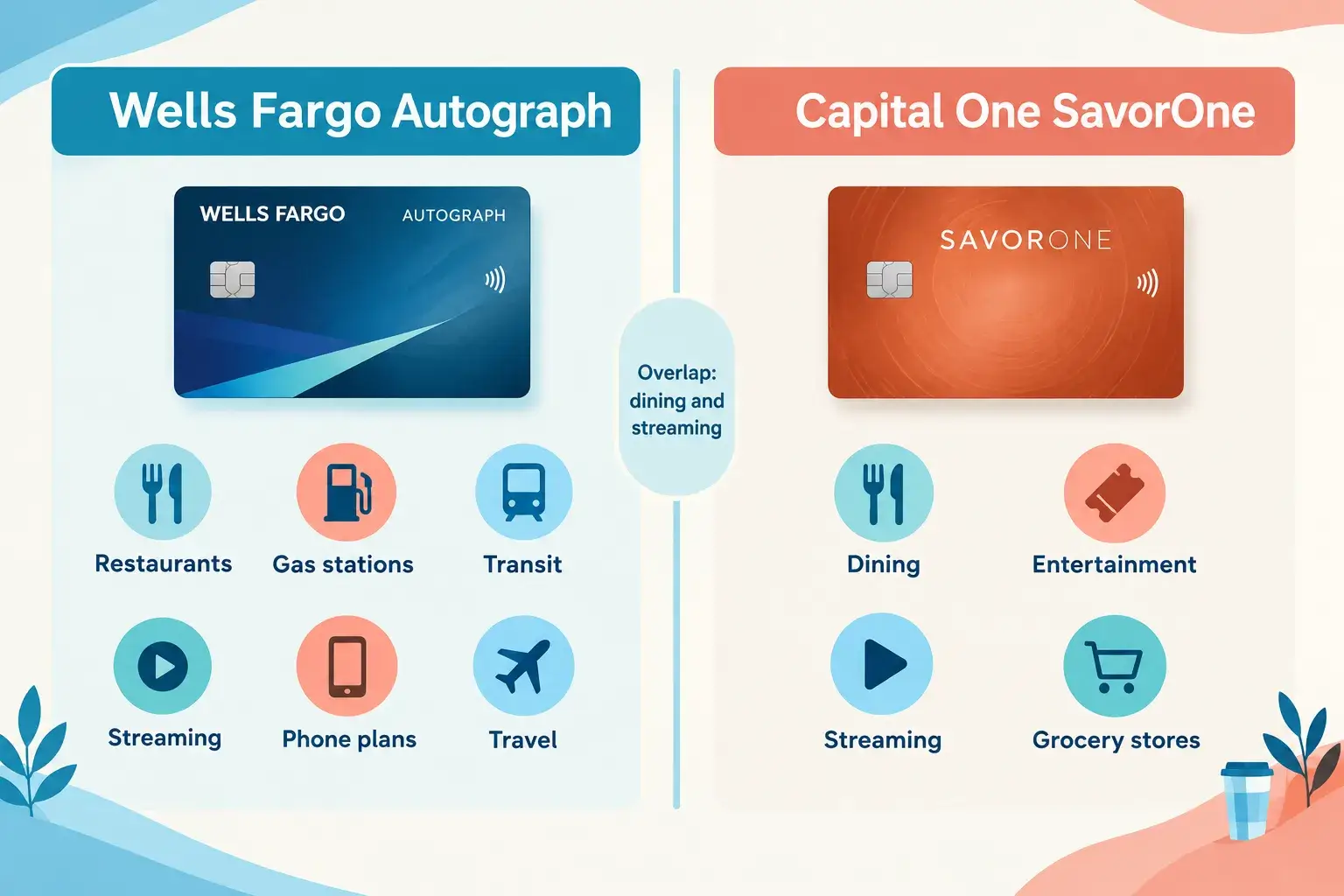
Autograph is the broader everyday card with optional travel upside. SavorOne is a narrower “food and fun” card that pays a flat 3% in its categories. Both are mid-tier products, not premium travel cards.
| Feature | Wells Fargo Autograph | Capital One SavorOne |
|---|---|---|
| Annual fee | $0 | $39 (per Capital One, October 2026) |
| Dining | 3X points | 3% cash back |
| Entertainment | Not a bonus category (1X) | 3% cash back |
| Streaming | 3X | 3% |
| Grocery stores | 1X | 3% |
| Travel, gas, transit, phone plans | 3X | 1% |
| Reward type | Points (cash or transfers) | Cash back |
| Welcome offer | 20,000 points after $1,000 in 3 months | Confirm on current offer page |
Main differences between Wells Fargo Autograph and Capital One SavorOne
Three differences matter: the annual fee, the bonus categories, and what rewards can do. Autograph has more earning categories and optional transfers. SavorOne has fewer categories but covers entertainment and groceries, which Autograph skips.
Can Wells Fargo Autograph be used internationally?
Yes. Autograph has been marketed without foreign transaction fees, and it earns 3X on travel purchases. SavorOne has also been offered without foreign transaction fees. Because SavorOne’s terms changed in 2026, confirm the current cardholder agreement before booking an international trip. Neither card has a travel category that makes it a primary international card (see how to compare travel credit card setups).
Earning Rates on Dining, Entertainment, and Travel
Dining earns the same headline rate on both cards, so the tiebreaker is everything around it. SavorOne pulls ahead on entertainment and groceries. Autograph pulls ahead on gas, transit, phone plans, and travel.
Which card has better dining rewards, Autograph or SavorOne?
Neither. Autograph pays 3X at restaurants, including dine-in, takeout, catering, and delivery. SavorOne pays 3% at restaurants, cafes, bars, lounges, fast-food chains, and bakeries.
The practical gap is value per point. Wells Fargo’s own example puts 51,960 points at $520, about 1 cent per point. At that baseline, 3X equals about 3%. Transfers or travel redemptions above 1 cent raise the return. Autograph’s dining return can therefore match or beat SavorOne’s, but never trail it.
SavorOne for restaurants and bars
SavorOne is a strong fit for restaurants and bars because the 3% rate covers bars and lounges as well as sit-down dining. Autograph’s restaurant category covers most of the same ground. Choose SavorOne only if the 3% on entertainment and groceries matters too, since dining alone does not separate the cards.
Autograph vs SavorOne entertainment rewards comparison
SavorOne wins entertainment. It pays 3% on entertainment (concerts, movies, sports, and similar events) plus popular streaming. Autograph pays 3X on popular streaming only, and live events earn 1X.
You may be interested



Edge case: ticket purchases made through some resale or third-party sites may not code as entertainment. Check how a merchant codes before assuming 3%.
SavorOne travel benefits vs Autograph
Autograph wins travel. It earns 3X on travel, gas, and transit, and its points can transfer to selected airline and hotel programs. SavorOne pays 1% on travel and offers no transfer partners. Neither card has lounge access or travel credits.
Autograph or SavorOne for casual dining
For casual dining alone, either card works, so pick on the rest of the spending profile. Fast-food and cafe purchases earn the elevated rate on both. A diner who also fills a tank weekly and pays a phone bill should lean Autograph. A diner who also buys groceries and concert tickets should lean SavorOne.
Welcome Offers and Annual Fees
Autograph offers 20,000 points after $1,000 in purchases during the first three months, with no annual fee. SavorOne carries a $39 fee on Capital One’s current page, and its welcome offer should be confirmed directly.

Autograph sign-up bonus in 2026
The Autograph bonus is 20,000 points after $1,000 in purchases in three months. At the 1-cent baseline, that equals about $200. The spending requirement is modest, but only count the bonus as extra value if the $1,000 reflects normal spending.
Is the Wells Fargo Autograph annual fee worth it?
The question is mostly moot because Autograph charges $0. Nothing needs to be earned back, so the card stays useful as a long-term keeper even at low spend.
Capital One SavorOne annual fee and benefits
Capital One’s page, updated October 9-10, 2026, lists SavorOne at $39 per year, positioned for fair credit, with 3% on grocery, dining, entertainment, and popular streaming, and 1% elsewhere. Capital One’s Savor card, by contrast, advertises a $0 fee and a $200 bonus after $500 in spending within three months. Applicants with good credit may see the Savor offer instead, so compare the exact card shown at prequalification.
Is Capital One SavorOne worth it with an annual fee?
It depends on the spending mix. Math against Autograph, using 1 cent per point:
- SavorOne earns 2 extra percentage points on groceries and entertainment versus Autograph’s 1X.
- The $39 fee is covered by about $1,950 a year in those two categories ($39 divided by 0.02).
- Autograph’s extra edge on gas, transit, phone plans, and travel offsets that.
Example (estimates, not guarantees): annual spend of $4,800 on dining, $6,000 on groceries, $1,200 on entertainment, $1,200 on streaming, $1,800 on gas, $1,440 on phone plans, and $600 on transit.
- SavorOne: $13,200 at 3% ($396) plus $3,840 at 1% (about $38), minus the $39 fee, nets about $395.
- Autograph: $9,840 at 3X plus $7,200 at 1X equals about 36,720 points, or about $367 at 1 cent each.
SavorOne leads here because groceries are heavy. Drop groceries to $1,500 and Autograph pulls ahead. That reversal is why a category audit comes first.
Redemption Options: Transfers vs Cash Back
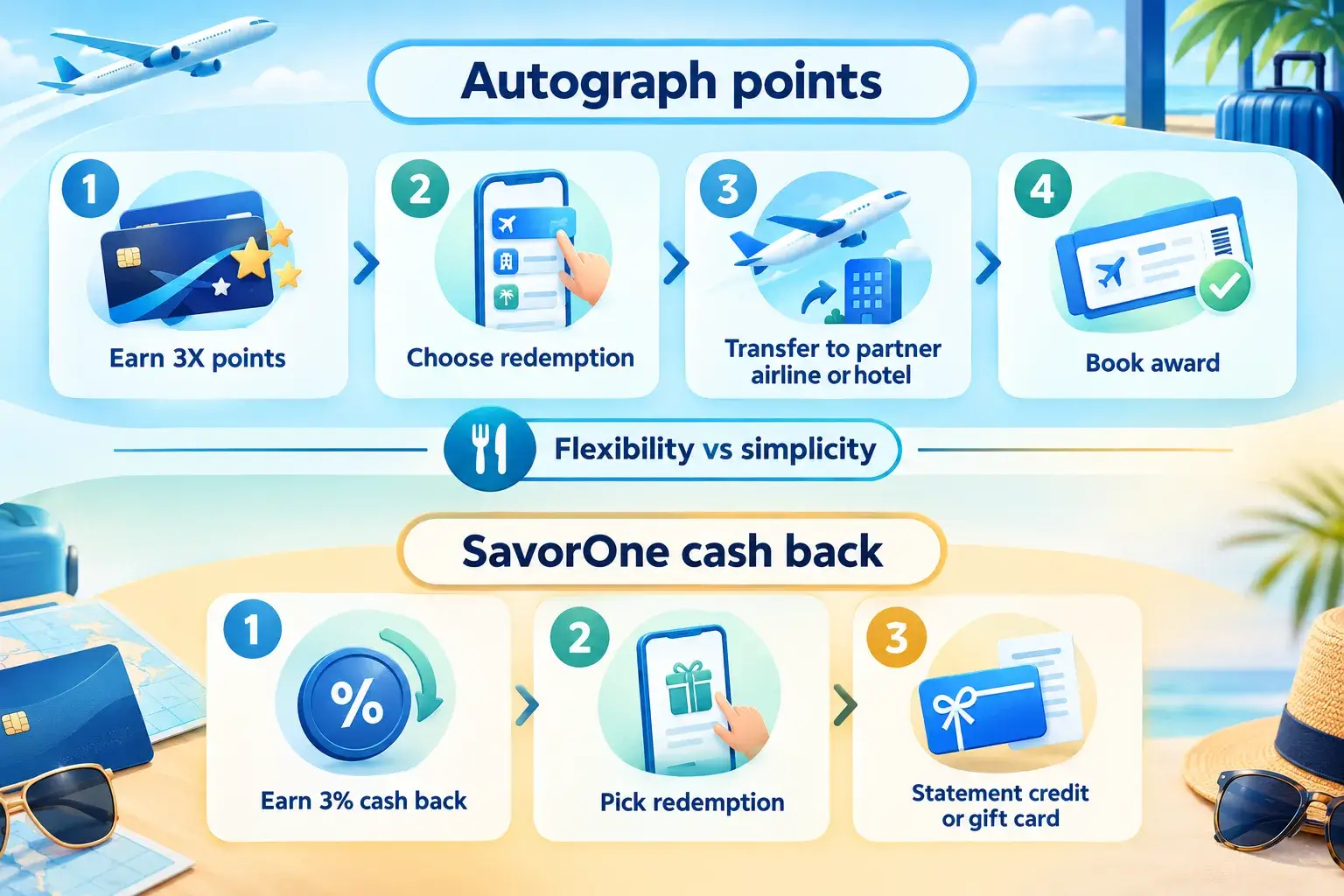
Autograph points are more flexible but more complex. SavorOne cash back is simple and worth exactly face value. Flexibility only pays off when points are used above the baseline.
Autograph points can be redeemed for statement credits, eligible purchases, gift cards, PayPal purchases, and transfers to selected travel programs. SavorOne cash back goes to a statement credit, check, gift card, or a recent purchase.
For readers who already work with transferable points, the useful question is whether Autograph transfers beat 1 cent per point. The partner list and ratios change, so verify them in the Wells Fargo Rewards portal before moving points. The Wells Fargo transfer partners guide tracks the current programs.
Tradeoffs on the Autograph side:
- Transfers are usually one-way and irreversible.
- Award availability and fuel surcharges can erase the advantage.
- Smaller points balances limit sweet-spot options.
- Devaluation risk is real for any points currency.
CNBC notes that cash-back rewards can be less valuable than travel-card rewards, but they are also far less work. For a deeper look at the tradeoff, see earning versus redeeming travel rewards.
How to maximize Wells Fargo Autograph rewards
- Route restaurants, gas, transit, streaming, phone plans, and travel purchases to Autograph.
- Use another card for groceries and entertainment, where Autograph pays only 1X.
- Set a redemption floor: statement credits at 1 cent, and transfers only when the math beats it.
- Compare cash price and points cost before every transfer.
- Keep points in Wells Fargo Rewards until a specific booking is confirmed available.
Which Card Wins for Your Spending
Autograph wins for mixed everyday spending and anyone avoiding fees. SavorOne wins for households with high grocery and entertainment spending who want zero redemption effort.
Who should get SavorOne instead of Autograph
Best for: Grocery-heavy households, frequent concert and sports ticket buyers, and people who want simple cash back.
Not for: Drivers with high gas and phone bills, frequent travelers, and anyone unwilling to pay $39 when a no-fee option exists.
Wells Fargo Autograph vs Capital One SavorOne: decision rules
- Choose Autograph if gas, transit, phone plans, or travel exceed grocery and entertainment spending.
- Choose SavorOne if grocery plus entertainment exceeds roughly $1,950 a year and the extra categories are used consistently.
- Choose Autograph if transfers to airline or hotel programs may ever matter.
- Check Capital One’s Savor card first if qualifying, since a $0 fee changes the math.
Common mistakes with dining rewards cards
- Assuming the category covers every merchant. Bars, delivery apps, and venue vendors code differently.
- Treating points as cash. Value depends on redemption, not the earning rate.
- Relying on outdated fee information, especially for SavorOne.
- Chasing welcome bonuses with spending that would not otherwise happen.
- Ignoring grocery or gas rates on a “dining” card, where the bulk of monthly spend often sits.
Pairing Options With Other Cards
Neither card is meant to carry all spending. A pair covers more categories, and each card should handle what it does best.
- Autograph plus a flat-rate card: Fill the groceries and entertainment gap with a general-purpose card. See the best travel credit cards compared for options.
- SavorOne or Savor plus Autograph: Covers dining, entertainment, groceries, gas, transit, and phone plans between them.
- Capital One Venture: Readers building toward Capital One miles can review the Capital One Venture Rewards review, since SavorOne earns cash back, not transferable miles.
- Venmo card: Venmo announced up to 4% cash back on dining and entertainment, starting October 15, 2026: 3% automatically plus 1% when splitting eligible purchases in Venmo. It suits frequent bill-splitters, and terms should be verified.
- Bilt: Bilt cardholders can compare dining returns using Bilt dining rewards on rent day.
- Chase Freedom: Rotating categories sometimes cover dining and grocery. See the Chase Freedom Q4 2026 categories.
FAQ
Which is better for dining, Autograph or SavorOne? Neither wins on rate. Both pay 3X or 3% on restaurants. Autograph adds more everyday categories, and SavorOne adds entertainment and groceries.
Does Wells Fargo Autograph have an annual fee? No. Wells Fargo lists a $0 annual fee for Autograph as of October 2026.
Does Capital One SavorOne still have no annual fee? No. Capital One’s page, updated October 9-10, 2026, shows a $39 annual fee. Capital One’s separate Savor card lists $0.
Can Autograph points transfer to travel partners? Yes, to selected airline and hotel programs. Partners and ratios change, so confirm them in the Wells Fargo Rewards portal before transferring.
Do either of these cards charge foreign transaction fees? Both have been offered without them. Confirm the current terms before traveling, especially for SavorOne after its 2026 changes.
Is Autograph or SavorOne better for entertainment? SavorOne. It pays 3% on entertainment and streaming, while Autograph pays 3X on streaming only.
Conclusion
For most readers, Autograph is the safer default: $0 annual fee, a 20,000-point bonus, and 3X across more categories, plus transfer options. SavorOne makes sense mainly when groceries and entertainment make up a large share of spending, and the $39 fee must be earned back.
Next steps:
- Total twelve months of spending across dining, groceries, entertainment, gas, transit, phone plans, and streaming.
- Run the break-even math above with real figures.
- Check Capital One prequalification to see whether the $0-fee Savor offer appears.
- If choosing Autograph, review the Wells Fargo transfer partners guide before moving any points.
- Compare against other options in best travel reward credit cards ranked by net value.


Content on Award Travel Hub is independently created by Award Travel Hub Editorial Desk and, where noted, reviewed by Award Travel Hub Review Desk. Some pages may contain affiliate links, but compensation does not determine our coverage, opinions, or methodology.