
Last updated: July 6, 2026
Quick Answer
The Route 66 centennial road trip 2026 is best booked as a practical hotel-points trip, not a luxury redemption project. Use hotel points and free night certificates for expensive or event-heavy nights, pay cash when roadside rates are low, and earn bonus rewards on gas, dining, and rental cars with the right travel cards.
Most travelers should plan 10 to 16 days for the full Chicago-to-Santa Monica drive, with 14 days being a reasonable balance between driving and sightseeing. Book key nights early in 2026, especially around centennial events, America 250 travel periods, and popular stops in Chicago, St. Louis, Tulsa, Oklahoma City, Amarillo, Albuquerque, Flagstaff, Los Angeles, and Santa Monica.
Key Takeaways
- Route 66 turns 100 in 2026, the same year as America 250, so demand may be higher around events, long weekends, and summer travel.
- The best use of points on Route 66 is often hotel points, not airline miles or premium cabin awards.
- Marriott, Hilton, IHG, Wyndham, Choice, and Hyatt can all work, but Hyatt has a smaller footprint along some roadside segments.
- Use transferable points carefully. Amex points, Chase points, Capital One miles, Citi points, and Bilt points can be more valuable for partner airlines than for average roadside hotels.
- Free night certificates can be useful in Chicago, Santa Monica, Los Angeles, Flagstaff, Albuquerque, and event-heavy cities.
- Gas and dining rewards matter because Route 66 is a long driving trip with repeated small expenses.
- One-way rental cars can add drop fees, so compare personal car, round-trip rental, and one-way rental costs before booking.
- Cash can beat points when roadside hotels price low, award rates are dynamic, or the cents per point value is weak.
- Do not transfer points speculatively unless award availability is confirmed and the transfer ratio makes sense.
- A flexible booking strategy is more valuable than chasing the highest CPP on every night.
Route 66 Turns 100 During America 250
Route 66 turns 100 in 2026, and that timing makes the Mother Road one of the clearest America 250 road trip ideas. The practical move is to treat the Route 66 centennial road trip 2026 as a limited-demand travel window: book key hotels early, keep cancellation flexibility, and use points where cash rates spike.
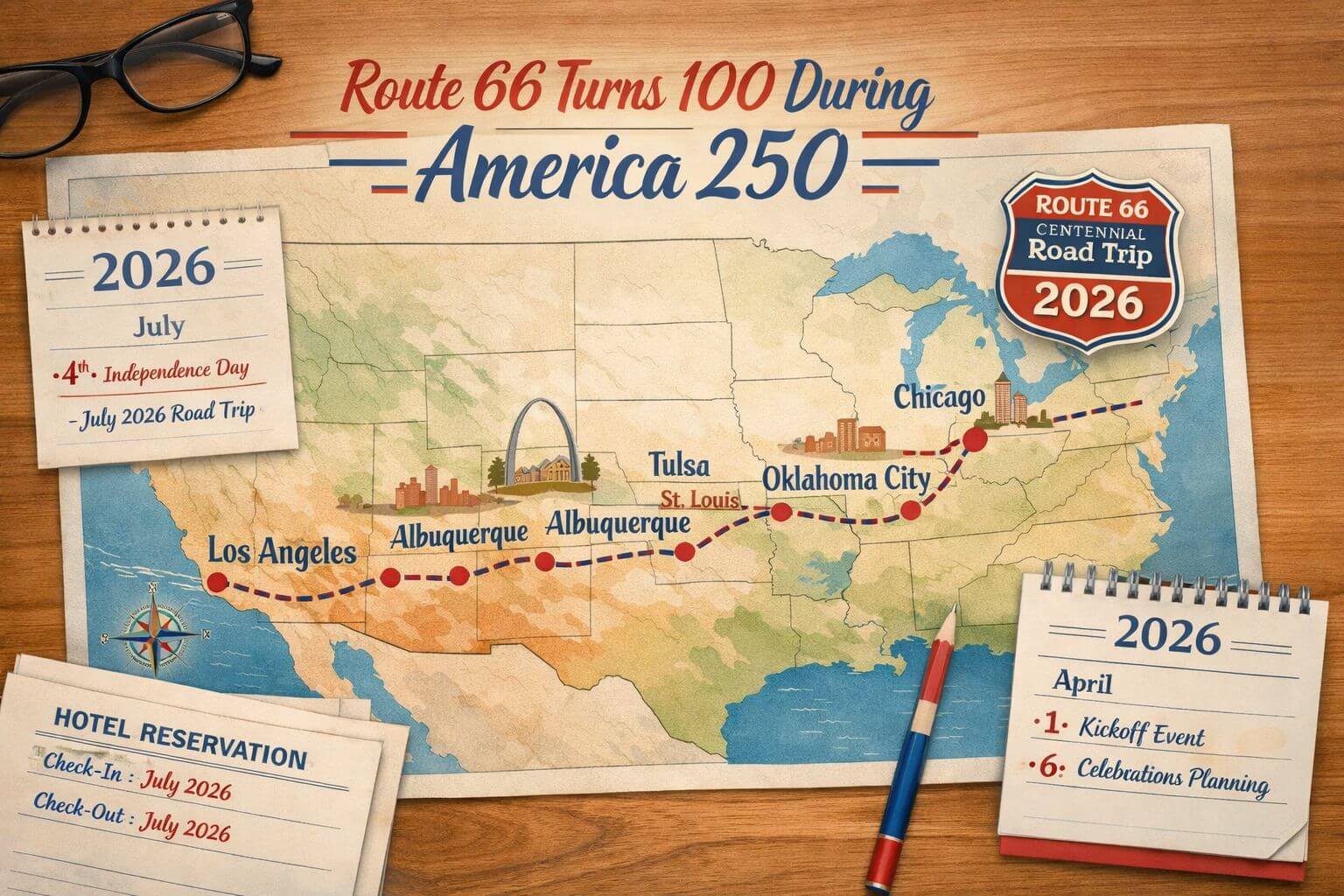
Route 66 was designated in 1926 and became one of the best-known highway routes in the United States. The classic route runs from Chicago to Santa Monica through eight states: Illinois, Missouri, Kansas, Oklahoma, Texas, New Mexico, Arizona, and California.
In 2026, Route 66 is not just a nostalgia trip. It overlaps with America 250 programming, state tourism campaigns, local festivals, car events, parades, museum exhibits, and community celebrations. That creates a travel rewards problem: demand may be uneven. Some towns may remain affordable, while certain nights near major events may price like a holiday weekend.
Decision rule: Book refundable hotels first, then improve the reservation later if award space, transfer bonuses, or better cash rates appear.
What makes 2026 different
A normal Route 66 trip can be planned around weather, time off, and sightseeing pace. A 2026 trip adds three extra variables:
- Centennial event dates: Local events may create short bursts of hotel demand.
- America 250 travel demand: More travelers may choose domestic road trips in 2026.
- Iconic lodging pressure: Historic motels and well-known inns may sell out earlier than chain hotels.
You may be interested



The official centennial period is not a single day of travel demand. Route 66 celebrations are spread across the year, with many communities hosting their own events. Travelers who want the “centennial atmosphere” do not need to drive the entire route. A focused Illinois-to-Oklahoma or Arizona-to-California trip can still make sense.
Best travel windows for a Route 66 centennial road trip 2026
For most travelers, spring and fall are easier than peak summer. Summer works if school schedules require it, but heat, crowds, and higher hotel prices can make the trip less efficient.
| Travel window | Best for | Tradeoffs |
|---|---|---|
| April to early June 2026 | Centennial events, milder weather, lower heat risk | Some event weekends may sell out early |
| July 2026 | America 250 tie-in and family travel | Higher demand, hotter desert segments |
| September to October 2026 | Better weather and fewer families on the road | Shorter daylight than summer |
| Around November 2026 | Anniversary-focused events near the original designation date | Cooler weather and possible schedule constraints |
Common mistake: Waiting until a few weeks before departure to book every night. Flexible road trips sound easy, but centennial events can make small-city hotel inventory tighter than expected.
Why Route 66 Is a Different Kind of Points-and-Miles Trip
Route 66 is a different kind of points-and-miles trip because the best redemptions are usually practical, not glamorous. This is a road trip where hotel points, gas rewards, dining bonuses, and flexible cash bookings often matter more than premium cabin awards or first class redemptions.
A classic award travel strategy often starts with flights: partner airlines, alliance partners, award charts, married segments, stopovers, and award search tools. Route 66 flips that logic. The flight may be simple, but the lodging pattern is complicated because the trip involves many one-night stays across different markets.
That means the best booking strategy is not “transfer everything to one program.” The better approach is to compare options each night:
- Pay cash when rates are low.
- Use hotel points when cash rates spike.
- Use free night certificates in cities where paid rates are high.
- Save transferable points for better airline or high-value hotel uses unless the math is clear.
- Keep backup refundable bookings in towns with limited inventory.
Route 66 is not the highest-CPP redemption story of 2026, but it may be one of the best practical uses for hotel points, free night certificates, and gas and dining rewards.
Where transferable points fit
Transferable points are useful, but they are not always the best currency for Route 66 hotels.
Amex points, Chase points, Capital One miles, Citi points, and Bilt points can transfer to points transfer partners. Those points may unlock sweet spots such as premium cabin awards, business class deals, or selective hotel redemptions. The opportunity cost is real: using flexible points for an average roadside hotel may mean giving up a better redemption later.
Use transferable points on Route 66 only when:
- The transfer ratio is favorable.
- Award availability exists before transferring.
- The cash rate is high enough to justify the transfer.
- The hotel program has reasonable cancellation rules.
- The redemption value beats your normal baseline.
If you need a refresher on transfer ratios and points transfer partners, use the Credit Card Transfer Partners Cheat Sheet 2026 before moving points.
A simple CPP example
Assume a Tulsa hotel costs $210 after taxes or 20,000 points for the same night.
- Cash price: $210
- Award price: 20,000 points
- Value: $210 / 20,000 = 1.05 cents per point
That can be a solid hotel redemption depending on the program. But if the same room costs $105 or 20,000 points on another date, the value drops to 0.53 CPP, and cash is likely better.
For a full method, use our guide on how to calculate cents per point in 2026.
Best for / not for
Best for:
- Travelers with mixed hotel point balances.
- Families using free night certificates.
- Drivers who want flexible, refundable bookings.
- Travelers who value out-of-pocket savings more than luxury.
Not for:
- Travelers trying to maximize CPP on every redemption.
- Anyone expecting consistent upscale hotels across the full route.
- People who dislike changing hotels often.
- Travelers who transfer points before checking award space.
Suggested Route Segments and Where Hotel Points Help Most
The most realistic Route 66 centennial road trip 2026 plan breaks the drive into city-based segments, not every historic alignment. Hotel points help most in major cities, event towns, national park gateways, and California coastal endpoints where cash rates can rise quickly.
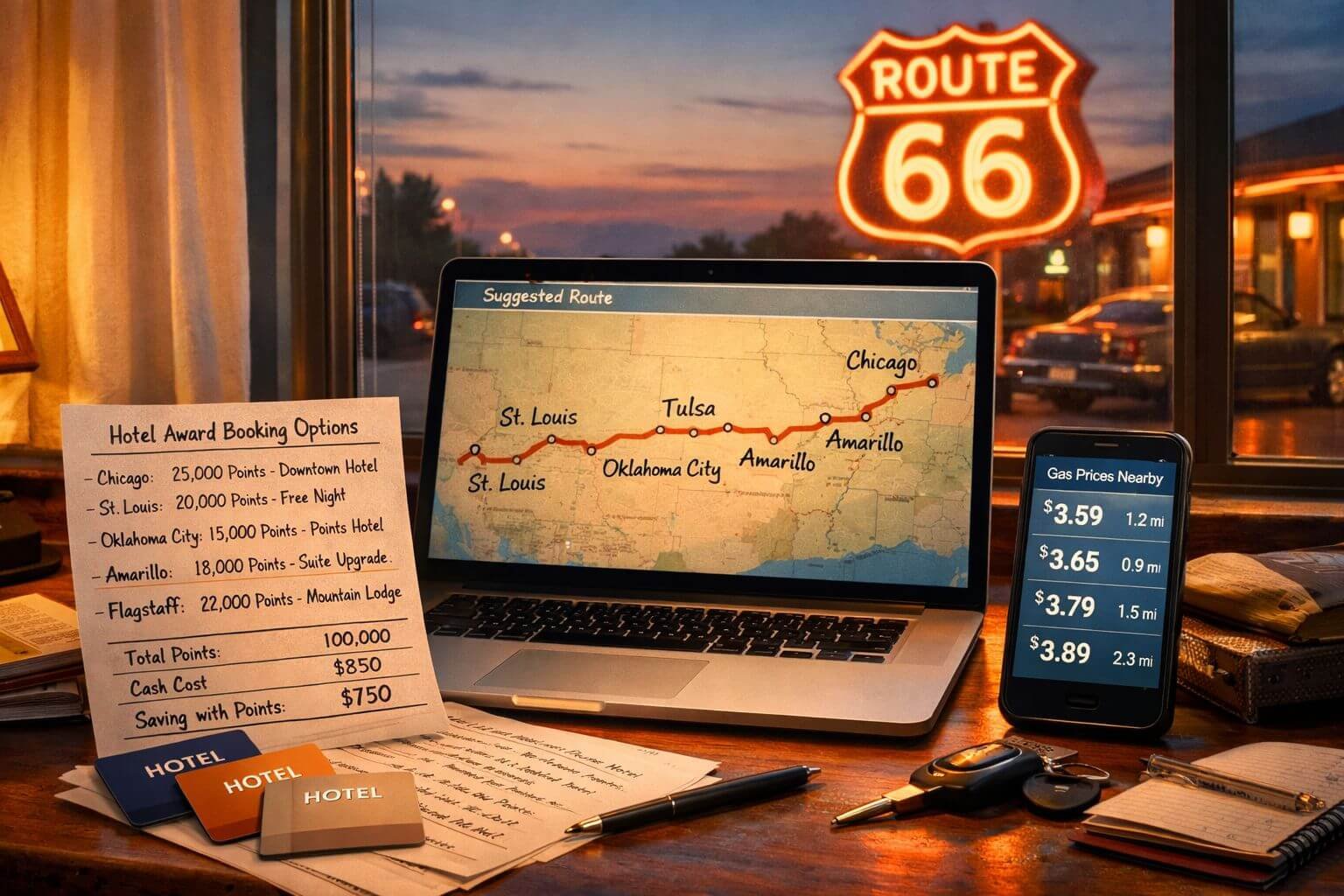
A full Route 66 drive is commonly planned over 10 to 16 days. Fourteen days is a practical target for travelers who want time for classic stops without turning every day into a long-distance driving assignment.
Route 66 is now a patchwork of historic alignments rather than one continuous U.S. highway. In practice, travelers will mix historic segments with modern highways, local detours, and city bypasses.
Sample 14-day routing
This sample routing is not a mile-by-mile guide. It is a points-and-miles structure that shows where to compare cash, points, and certificates.
| Night | Segment | Booking focus |
|---|---|---|
| 1 | Chicago | Use points or certificates if downtown rates are high |
| 2 | Springfield, Illinois or St. Louis | Compare cash vs points near event dates |
| 3 | Springfield, Missouri or Tulsa | Roadside chains may price reasonably in cash |
| 4 | Tulsa | Good candidate for hotel points during centennial events |
| 5 | Oklahoma City | Broad chain footprint; compare several programs |
| 6 | Amarillo | Often practical for cash, but check event spikes |
| 7 | Tucumcari or Santa Fe detour | Use cash for motels, points for chains |
| 8 | Albuquerque | Stronger chain options; points may help |
| 9 | Gallup, Winslow, or Flagstaff | Flagstaff can be expensive due to Grand Canyon access |
| 10 | Flagstaff or Williams | Free night certificates can be useful |
| 11 | Kingman or Needles | Cash may beat points at simpler properties |
| 12 | Barstow, Pasadena, or Los Angeles | Compare suburban points options |
| 13 | Los Angeles or Santa Monica | Points or certificates often make sense |
| 14 | Santa Monica / departure | Consider airport hotel points if flying home |
Quick example: If Flagstaff is $310 after taxes because travelers are combining Route 66 with Grand Canyon access, a 35,000-point certificate or a reasonable points rate can make sense. If Amarillo is $115 cash, paying cash and saving points is often the better move.
Chicago start: book early and compare location
Chicago is the classic eastern starting point for Route 66. Travelers who want a real start-line experience may prefer downtown, but airport or suburban hotels can cut costs.
Choose downtown Chicago if:
- You want easy access to the historic start.
- You are arriving by flight or train.
- You plan one or two sightseeing days before driving.
Choose airport or suburban Chicago if:
- You want lower parking costs.
- You are renting a car the next morning.
- You want to avoid city driving at the start.
St. Louis, Springfield, Tulsa, and Oklahoma City
The Midwest and Oklahoma segments can be strong for hotel points when centennial events overlap with weekends. Tulsa and Oklahoma City are especially useful because they have broader chain coverage than many smaller towns.
Common mistake: booking a historic motel for nostalgia without checking parking, cancellation rules, late arrival policy, or whether the room type works for your group.
Amarillo, Albuquerque, and Flagstaff
The western middle of the route is where planning becomes more important. Amarillo may be straightforward, but Albuquerque and Flagstaff can price higher during busy travel periods.
Flagstaff is a special case because it can absorb demand from Route 66 travelers, Grand Canyon visitors, national park trips, and general summer travel. That makes it a good place to check hotel points before assuming cash will be cheap.
Los Angeles and Santa Monica
The Santa Monica endpoint is emotionally satisfying but rarely cheap. Parking, resort-style fees, destination fees, and taxes can change the math quickly.
Decision rule: If Santa Monica hotel rates are high, compare three options:
- Use points or a certificate near Santa Monica.
- Stay in a lower-cost Los Angeles neighborhood.
- Stay near LAX if flying out early.
Do not ignore taxes and fees. A hotel that looks cheaper can become less attractive after parking and destination charges.
Best Hotel Programs for Route 66 Travelers
The best hotel programs for Route 66 travelers are the ones with wide roadside footprints and flexible booking rules. Marriott, Hilton, IHG, Wyndham, and Choice are often more useful across the full route, while Hyatt is strongest in selected cities.
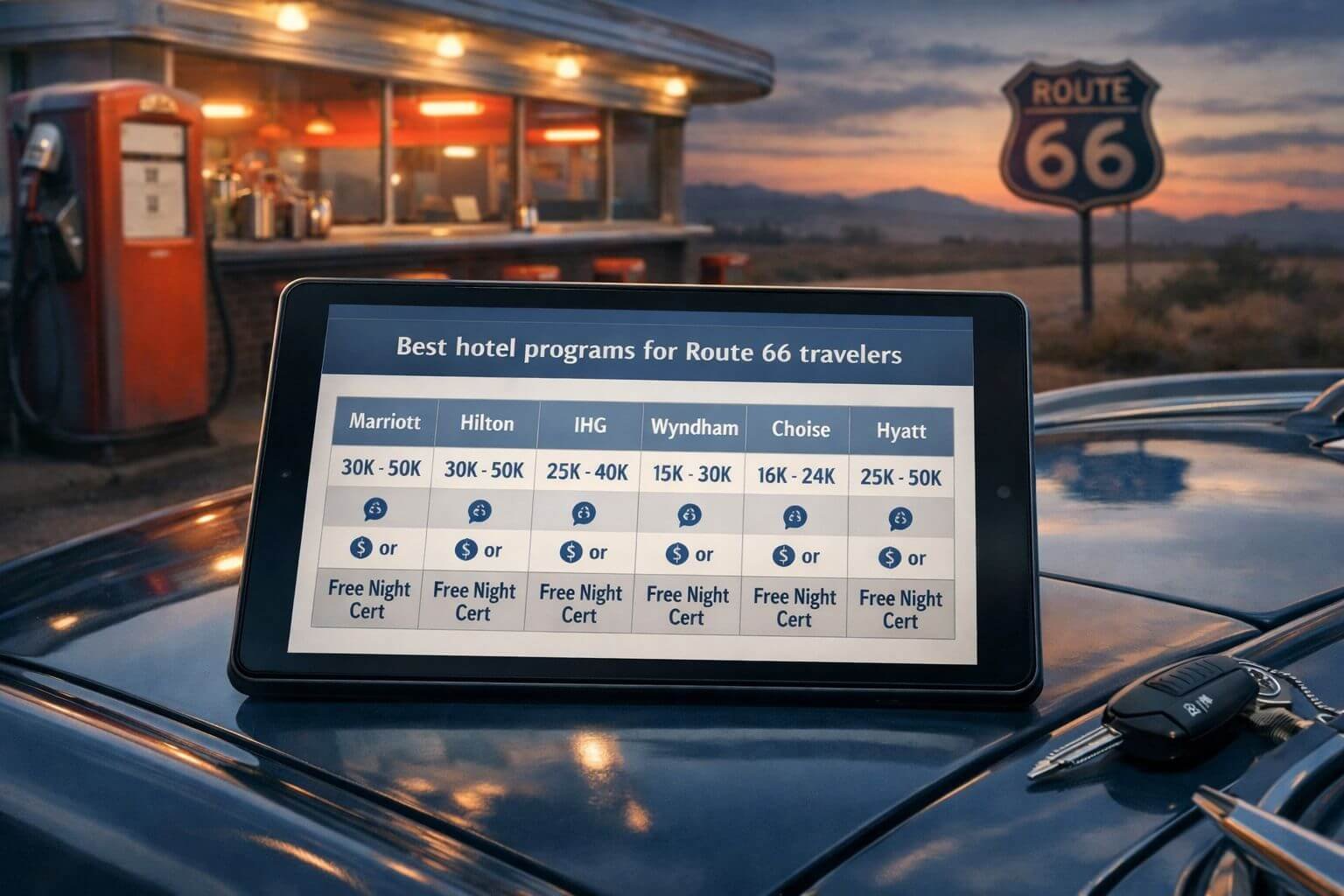
Route 66 is a practical hotel-points use case. The goal is not to create a perfect single-program itinerary. The goal is to avoid paying inflated cash rates when a reasonable award or certificate is available.
| Program | Route 66 strength | Best use | Main risk |
|---|---|---|---|
| Marriott Bonvoy | Broad footprint in cities and suburbs | Free night certificates, city stays | Dynamic pricing and fees |
| Hilton Honors | Wide coverage and many midscale brands | Families, multi-night city stops | Variable award pricing |
| IHG One Rewards | Strong roadside and midscale network | Holiday Inn Express-style stays | Dynamic pricing can swing |
| Wyndham Rewards | Useful for roadside economy brands | Simple one-night stops | Property quality varies |
| Choice Privileges | Strong economy and midscale options | Low-cost overnight stops | Booking windows and quality vary |
| World of Hyatt | Strong value where available | Chicago, St. Louis, Albuquerque, LA-area stays | Smaller footprint on rural segments |
Marriott, Hilton, and IHG
Marriott, Hilton, and IHG are the most likely programs to appear throughout a long Route 66 itinerary. They are useful for travelers who want predictable brands, breakfast options, and family-friendly room types.
Marriott can be useful for free night certificates and broader city coverage. Review the Marriott Bonvoy guide for 2026 if you are deciding whether to top up or redeem a certificate.
Hilton can work well for families who value breakfast benefits through elite status or co-branded cards. IHG can be strong in smaller markets where Holiday Inn Express or similar brands are common.
Decision rule: Use these programs when cash rates are inflated, but avoid weak redemptions under your normal CPP target unless you need to reduce cash costs.
Wyndham and Choice
Wyndham and Choice can be useful because Route 66 includes many smaller towns where economy and midscale brands matter. These programs are not always exciting, but they can solve real road trip problems.
Wyndham can be especially relevant for roadside stays, and Bilt users should watch for transfer bonuses when they appear. Before transferring, read the Wyndham Rewards transfer partner guide and confirm that the property you want has award availability.
Choice can also be useful in smaller markets, but program rules and booking windows can be less intuitive than major chains. Check cancellation terms carefully.
Hyatt
Hyatt can offer excellent redemption value where it has properties, but Route 66 is not a full Hyatt-first route. Hyatt works best in larger markets and selected stopover cities.
Good Hyatt candidates may include:
- Chicago
- St. Louis
- Oklahoma City
- Albuquerque
- Flagstaff or nearby areas, depending on availability
- Los Angeles area
The downside is footprint. A Hyatt-only strategy can force awkward driving days or location compromises.
If Hyatt is part of your plan, account for award category changes and devaluation risk. Our hotel loyalty strategy after devaluation 2026 can help you decide when to burn points versus conserve them.
Should you transfer flexible points to hotel programs?
Transfer flexible points to hotel programs only when the math is clearly favorable. Chase points to Hyatt can be a strong use in the right city, but many other hotel transfers from flexible currencies can produce weak redemption value.
Be cautious with:
- Amex points to hotel programs without a strong transfer bonus.
- Capital One miles to hotel partners when cash rates are modest.
- Citi points transfers where the hotel redemption value is unclear.
- Bilt points transfers before award availability is confirmed.
Transfer bonuses can improve the math, but they do not fix a bad redemption. A 30% transfer bonus to a hotel program may still be weak if the hotel is cheap in cash.
For card-level planning, compare benefits and earning categories in our Best Hotel Credit Cards After the 2026 Devaluations.
Gas, Dining, and Rental Car Credit Card Strategy
The best credit card for a Route 66 road trip depends on where you spend the most: gas, dining, hotels, or rental cars. A strong strategy uses one card for fuel, one for dining, and one for travel protections or rental car coverage, unless a single card earns well across all categories.
Gas and food costs are repeated throughout the trip. Even if each purchase is small, the total can be meaningful over 2,400-plus miles, especially with detours and city driving.
Gas rewards strategy
Use a card that earns strong rewards at U.S. gas stations. Then stack rewards where allowed:
- Pay with a gas-bonus credit card.
- Add a fuel rewards membership if the station supports one.
- Use grocery fuel points if they fit your route.
- Compare station pricing before driving out of the way.
Common mistake: driving several miles to save a few cents per gallon. The extra time and fuel can erase the savings.
Dining rewards strategy
Route 66 dining is part of the trip. Diners, cafes, barbecue spots, and local restaurants can add up, especially for families.
Use a dining-bonus card when:
- The restaurant codes as dining.
- You are not paying a card surcharge that wipes out the rewards.
- The card has no foreign transaction issue, which is not relevant domestically but may matter if you keep the same wallet for other trips.
Travel rewards math still applies. A 3x or 4x dining category can be valuable, but paying a high surcharge for card use may not be worth it.
Rental car versus personal car versus one-way rental
Your vehicle decision can change the whole budget.
| Option | Best for | Watch out for |
|---|---|---|
| Personal car | Travelers starting near the route or doing a loop | Wear and tear, maintenance, breakdown risk |
| Round-trip rental | Travelers returning to the start region | Extra driving time to return the car |
| One-way rental | Classic Chicago-to-LA itinerary | Drop fees, limited inventory, higher base rates |
| Fly-and-drive segments | Travelers with limited time | Positioning flights and split rentals |
One-way rentals can look reasonable until taxes and drop fees appear. Compare the final price, not the daily base rate.
If flying to Chicago and home from Los Angeles, also compare airline miles and cash fares. Domestic award pricing can be dynamic, and cheap cash fares may beat miles. For broader card selection, see the Best Travel Credit Cards 2026.
Positioning flights and stopovers
Some travelers may use positioning flights to start in Chicago or return from Los Angeles. This is where traditional airline miles still matter.
Check:
- Cash fares first.
- Airline miles pricing second.
- Transfer partner award space third.
- Baggage costs and basic economy restrictions.
- Rental car pickup and drop-off timing.
Partner airlines and alliance partners can help, but domestic award space is often dynamically priced. Do not transfer points until seats are available and the program rules are clear.
When Cash Is Better Than Points on a Road Trip
Cash is better than points when hotel rates are low, award pricing is inflated, or using points creates too much opportunity cost. On Route 66, many roadside nights may be better paid in cash while saving hotel points for high-demand cities and expensive endpoints.
A good Route 66 points strategy is selective. Points are a tool, not the default answer.
Use cash when the CPP is weak
If a hotel costs $95 after taxes or 25,000 points, the redemption value is 0.38 CPP. That is usually not the best use of points.
Cash also preserves flexibility when:
- Plans may change.
- A better property may open later.
- You are not sure how far you will drive.
- The points booking has a stricter cancellation rule.
Use points when cash spikes
Points can be valuable when a local event, holiday period, or last-room pricing pushes cash rates higher.
Good candidates for points:
- Chicago before starting the drive.
- Tulsa or Oklahoma City during centennial events.
- Albuquerque during busy weekends.
- Flagstaff during Grand Canyon-heavy travel periods.
- Santa Monica or Los Angeles at the end of the trip.
Watch resort, parking, and destination fees
Award nights do not always remove all costs. Some programs waive certain fees for award stays; others do not. Parking can be a major issue in Chicago, Los Angeles, and Santa Monica.
Before booking, check:
- Parking cost per night.
- Destination or amenity fees.
- Pet fees, if relevant.
- Breakfast inclusion.
- Cancellation deadline.
- Whether taxes are included in the displayed cash rate.
Do not chase CPP at the expense of the trip
A high CPP redemption can still be a poor decision if it places you far from the route, forces a late-night drive, or creates extra parking costs. Route 66 is about pacing and logistics as much as redemption value.
Common pitfall: booking a points hotel 35 miles off-route because the award value looks better. The extra driving time, fuel, and fatigue can outweigh the savings.
Final Route 66 Booking Checklist
The best Route 66 centennial road trip 2026 booking checklist starts with routing, then refundable hotels, then points decisions, then gas and rental car strategy. Do not start by transferring points; start by building a flexible itinerary.
Use this step-by-step guide before locking in your trip.
Step 1: Choose your trip type
Pick one:
- Full Chicago-to-Santa Monica drive.
- Half-route trip, such as Chicago to Oklahoma City or Albuquerque to Santa Monica.
- Fly-and-drive segment around one or two states.
- Event-focused trip around a centennial weekend.
Decision rule: If you have fewer than 10 days, consider a segment instead of the full route.
Step 2: Map overnight stops
Build your plan around realistic driving days. Avoid stacking too many long days at the beginning because fatigue compounds.
A practical full-route structure:
- Chicago
- St. Louis or Springfield, Illinois
- Springfield, Missouri or Tulsa
- Oklahoma City
- Amarillo
- Albuquerque
- Flagstaff or Williams
- Los Angeles or Santa Monica
Then add smaller towns or detours if time allows.
Step 3: Book refundable cash rates first
Refundable bookings protect you while you search for better options. This is especially useful in 2026 because centennial events may create uneven demand.
Book early for:
- Chicago arrival.
- Event weekends.
- Flagstaff and Grand Canyon-adjacent nights.
- Santa Monica or Los Angeles endpoint.
- Any historic motel you strongly want.
Step 4: Compare hotel points against cash
For each night, calculate:
- Cash price after taxes and fees.
- Points price.
- Certificate option, if any.
- Parking and resort-style fees.
- Cancellation rules.
- Location value.
Use points where they solve a real problem. Use cash where rates are low.
Step 5: Check transfer bonuses, but do not force them
Transfer bonuses can help maximize points, but only when the booking is already good. A bonus does not matter if the property has no award space or the hotel is cheap in cash.
Before transferring:
- Confirm award availability.
- Confirm the transfer ratio.
- Confirm the transfer is not delayed.
- Confirm cancellation rules.
- Confirm the points will not be stranded if plans change.
For a broader transfer framework, see the Bank Transfer Partners Guide 2026.
Step 6: Plan gas, dining, and rental payments
Assign cards before departure:
- Gas card.
- Dining card.
- Hotel incidentals card.
- Rental car card with appropriate coverage.
- Backup card in case a merchant does not accept your first choice.
Also download hotel apps before departure so you can monitor rates, change bookings, and check in from the road.
Step 7: Recheck reservations two weeks before departure
Two weeks before the trip, review every booking:
- Has the cash rate dropped?
- Has award space opened?
- Did an event change the area’s hotel demand?
- Are cancellation deadlines approaching?
- Are arrival times realistic?
- Do any hotels charge unexpected parking or destination fees?
This final check often catches avoidable mistakes.
FAQ
Is Route 66 worth driving in 2026?
Yes, Route 66 is especially relevant in 2026 because the highway turns 100 during America 250. Travelers should expect more events, stronger tourism interest, and higher demand in select cities and towns.
How many days do you need for a Route 66 centennial road trip?
Most travelers should plan 10 to 16 days for the full Chicago-to-Santa Monica drive. A 14-day itinerary is a practical balance for sightseeing, driving, and rest.
Are hotel points useful on Route 66?
Yes, hotel points are useful on Route 66 because the route includes many chain hotels in cities, suburbs, and roadside markets. Points are most valuable when cash rates rise near events or popular stops.
Which hotel program is best for Route 66?
There is no single best program for the full route. Marriott, Hilton, IHG, Wyndham, and Choice have wide practical coverage, while Hyatt can be valuable in selected larger cities.
Should I transfer Chase points to Hyatt for Route 66?
Transferring Chase points to Hyatt can make sense in cities where Hyatt has award space and cash rates are high. Do not transfer until you confirm availability and cancellation rules.
Should I use Amex points for Route 66 hotels?
Amex points are often better saved for airline transfer partners unless a hotel transfer bonus creates strong value. Always compare the cash rate, points rate, and opportunity cost before transferring.
Is a one-way rental car a good idea for Route 66?
A one-way rental can be convenient for a Chicago-to-Los Angeles trip, but drop fees can be expensive. Compare the final all-in price against a round-trip rental, personal car, or shorter segment trip.
When should I book Route 66 hotels for 2026?
Book key 2026 Route 66 hotels as early as your plans are firm, especially for weekends, centennial events, Chicago, Flagstaff, Los Angeles, and Santa Monica. Refundable rates are useful while plans evolve.
Is cash or points better for roadside hotels?
Cash is better when roadside hotels are inexpensive or award rates are inflated. Points are better when cash prices spike and the redemption value meets your normal CPP target.
Can I do Route 66 without driving the whole route?
Yes, a segment trip can still deliver the Route 66 centennial experience. Illinois-to-Oklahoma and Arizona-to-California are practical choices for travelers with limited time.
Related Reading
- Best Hotel Credit Cards After the 2026 Devaluations
- Hotel Loyalty Strategy After Devaluation 2026
- Best Travel Credit Cards 2026
- How to Calculate Cents Per Point 2026
- Credit Card Transfer Partners Cheat Sheet 2026
Conclusion
The Route 66 centennial road trip 2026 is a strong America 250 trip for travelers who want a classic U.S. drive and a practical way to use rewards. The best strategy is not to chase luxury. It is to reduce real costs across many hotel nights, fuel stops, meals, and rental car charges.
Start by choosing your route length and booking refundable hotels in key cities. Then compare cash rates against hotel points, certificates, and transfer options one night at a time. Save transferable points for high-value uses unless the hotel math is clearly favorable.
The next best step is simple: map your overnight stops, reserve cancellable rooms, and build a points plan around the expensive nights first. That approach gives you flexibility, protects you from 2026 demand spikes, and helps you avoid wasting points on low-value roadside redemptions.


Content on Award Travel Hub is independently created by Award Travel Hub Editorial Desk and, where noted, reviewed by Award Travel Hub Review Desk. Some pages may contain affiliate links, but compensation does not determine our coverage, opinions, or methodology.