Lasr Updated: July 11, 2026
The Chase Freedom Unlimited credit card earns 1.5% back on every purchase — but that number undersells what the card actually does for a points-and-miles strategy. When held alongside a Chase Sapphire Preferred or Reserve card, those “cash back” earnings convert into fully transferable Chase Ultimate Rewards points, worth 2 cents per point (CPP) or more toward premium cabin awards. That changes the math considerably.
The real question in 2026 isn’t whether this is a decent cash-back card. It is. The question is whether it fits your current card lineup and whether you’re positioned to extract more than its face value.
Key Takeaways
- No annual fee and a straightforward earning structure make this a low-risk addition to most Chase lineups.
- The standard welcome offer is $200 after $500 spend in the first 3 months — easy to hit, but not exceptional on its own.
- The card’s real value unlocks when paired with a Sapphire Preferred or Reserve, converting 1.5x earnings into transferable Ultimate Rewards points.
- A 3% foreign transaction fee makes this a poor choice for international spending.
- Chase’s 5/24 rule applies — if you’re near the limit, think carefully about whether this card earns a slot.
What the Chase Freedom Unlimited Earns in 2026
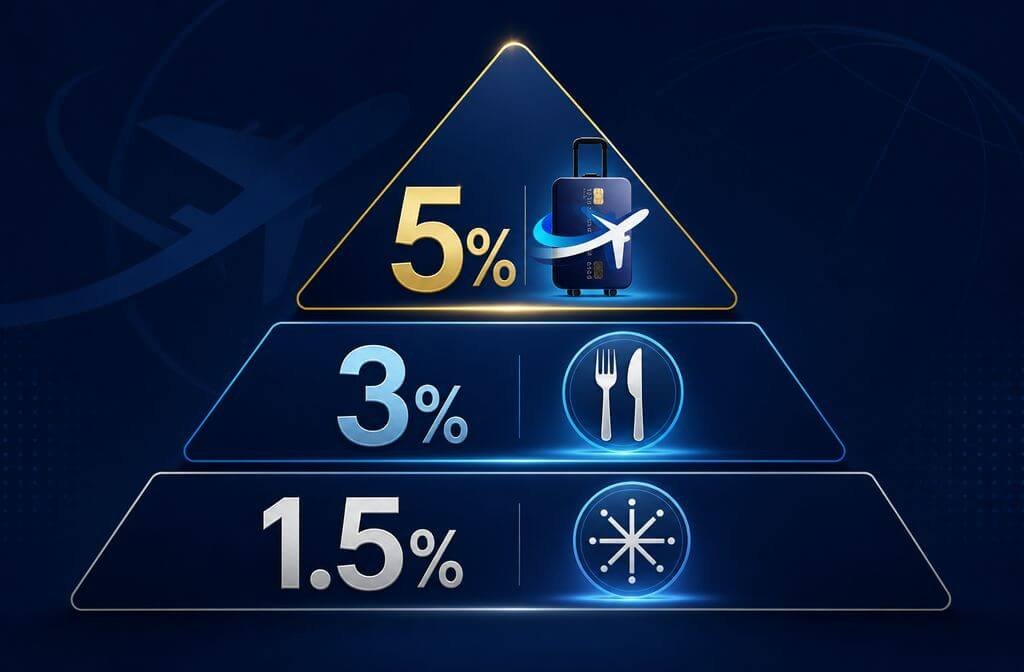
The earning structure on the Chase Freedom Unlimited credit card has remained consistent heading into mid-2026:
| Spend Category | Earn Rate |
|---|---|
| Travel booked through Chase Travel | 5% (5x points) |
| Dining (restaurants, takeout, delivery) | 3% (3x points) |
| Drugstore purchases | 3% (3x points) |
| Lyft rides (through September 2027) | 2% (2x points) |
| Everything else | 1.5% (1.5x points) |
The 1.5% base rate is the headline feature. Most no-annual-fee cards offer either 1x on general purchases or require category activation to beat that floor. Freedom Unlimited earns 1.5x automatically on every purchase that doesn’t fall into a higher tier.
How this plays out in practice:
- $500/month in general spending → 750 points
- $300/month on dining → 900 points
- $100/month at drugstores → 300 points
- $200/month through Chase Travel → 1,000 points
That’s roughly 2,950 points per month — or about 35,400 points per year — from a card with no annual fee.
At 1 cent per point (cash back value), that’s $354 in cash back annually. At 2 CPP via a transfer partner sweet spot, that same balance is worth closer to $708 in travel value. The difference depends entirely on whether you have a pairing card to unlock transfers.
You may be interested



For a deeper look at how cents-per-point math works across programs, see our guide to calculating cents per point.
Current Welcome Offer and Spending Requirement
The standard public welcome offer on the Chase Freedom Unlimited credit card in 2026 is $200 cash back after spending $500 in the first 3 months.
That $500 minimum spend is among the lowest of any rewards card on the market. For most applicants, hitting $500 in 90 days is straightforward — a couple of grocery runs and a utility bill covers it.
A few things to know about the welcome offer:
- Earlier in 2026 (mid-March through late April), Chase ran a limited-time elevated bonus of $250 after the same $500 spend. That promotion has since lapsed.
- A $300 bonus was briefly available in late 2025 (December through mid-January 2026) before returning to the standard $200 offer.
- The welcome offer is structured as cash back but is actually deposited as 20,000 Ultimate Rewards points (at 1 cent each). If you later add a Sapphire card to your account, those points can be transferred to airline or hotel partners.
⚠️ Important: Chase’s 5/24 rule applies to the Freedom Unlimited. If you’ve opened 5 or more personal credit cards across all issuers in the past 24 months, Chase will likely deny the application regardless of credit score. Check your count before applying.
The $200 offer is solid for a no-annual-fee card, but it’s not a reason to rush an application if you’re close to 5/24 and have higher-value Chase cards still on your target list — like the Sapphire Preferred or a Chase Ink Business card.
Why the Card Shines When Paired With Sapphire or Ink Cards
This is the core value proposition of the Chase Freedom Unlimited credit card for points-and-miles users.
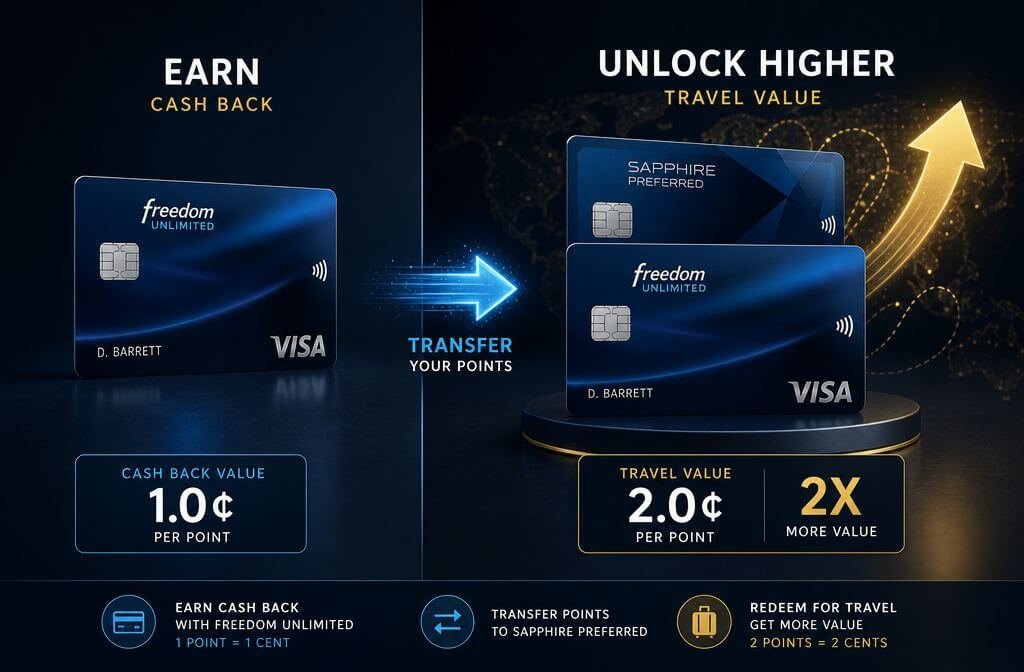
On its own, the card earns cash back at 1 cent per point. Paired with a Chase Sapphire Preferred (annual fee: $95) or Chase Sapphire Reserve (annual fee: $550), those points become transferable to Chase’s 14 airline and hotel partners — including Hyatt, United, Air Canada Aeroplan, British Airways Avios, and Singapore Airlines KrisFlyer.
The pairing math:
| Scenario | Points Value | Effective CPP |
|---|---|---|
| Freedom Unlimited alone, redeemed for cash | 1 cent/point | 1.0¢ |
| Paired with Sapphire Preferred, redeemed via Chase Travel portal | 1.25 cents/point | 1.25¢ |
| Paired with Sapphire Reserve, redeemed via Chase Travel portal | 1.5 cents/point | 1.5¢ |
| Paired with either Sapphire, transferred to Hyatt for peak property | 2.0–2.5 cents/point | 2.0–2.5¢ |
Example: A $3,000 spend on dining over 12 months earns 9,000 points on the Freedom Unlimited. Transferred to World of Hyatt and redeemed at a Category 4 property (22,000 points/night), those points contribute meaningfully toward a stay that might cost $250+ per night in cash.
To understand the full range of what Chase points can do through transfer partners, see our Chase Ultimate Rewards transfer partners guide and the Chase Sapphire Preferred vs Reserve breakdown to decide which pairing card makes sense.
The Ink Business cards (Ink Cash, Ink Unlimited, Ink Preferred) work the same way — points pool together across all Chase Ultimate Rewards cards under one login, so a business owner can run Freedom Unlimited for personal spending and an Ink card for business expenses, then transfer everything from a single Sapphire account.
Annual Fee, APR, and Fee-Free Use Cases
Annual fee: $0. No fee, no break-even calculation required.
Other key terms for 2026:
- Intro APR: 0% on purchases and balance transfers for the first 15 months, then a variable rate applies (currently in the mid-to-high 20% range depending on creditworthiness).
- Balance transfer fee: 3% intro (minimum $5) for the first 60 days, then 5%.
- Foreign transaction fee: 3% — a significant drawback covered in the next section.
- No rotating category activation required — unlike the Chase Freedom Flex, earnings are automatic.
The 0% intro APR window is useful for planned large purchases — home appliances, medical expenses, a vacation prepayment — where paying over time without interest is the goal. It’s not a reason to carry a balance beyond that window.
The no-annual-fee structure also makes this card worth keeping long-term even if spending patterns shift. Keeping the account open helps with credit utilization and average account age, two factors that affect credit scores. If you ever want to step back from a premium Chase card, downgrading to a no-fee card like Freedom Unlimited is a common strategy to preserve your Ultimate Rewards balance without paying an annual fee.
Best Categories and Real-World Earning Examples
The Chase Freedom Unlimited credit card works best as a catch-all card for spending that doesn’t fit a higher-earning category on another card.
Where it earns best:
- 🍽️ Dining — 3x is competitive with most mid-tier cards. If you don’t have an Amex Gold (4x dining) or Chase Sapphire Reserve (3x dining), this is a strong option.
- 🏥 Drugstores — 3x at CVS, Walgreens, and Rite Aid. Useful for household staples, gift cards, and prescriptions.
- ✈️ Chase Travel portal — 5x is the highest earn rate on the card. Booking flights or hotels through Chase Travel at 5x, then redeeming at 1.5x via the Reserve portal, produces an effective 7.5% return on travel spend.
- 💳 Everything else — 1.5x on utilities, subscriptions, insurance, and other non-bonus categories beats the 1x baseline on most cards.
Real-world example — moderate spender, 12 months:
| Category | Monthly Spend | Annual Points |
|---|---|---|
| Dining | $400 | 14,400 |
| Drugstores | $75 | 2,700 |
| Chase Travel | $150 | 9,000 |
| General (1.5x) | $800 | 14,400 |
| Total | $1,425/mo | 40,500/yr |
At 1 CPP: $405 in cash back. At 2 CPP (Hyatt transfer): $810 in travel value. The gap between cash and travel redemption is where the real return lives — but only if you have the right pairing card and the award availability to use it.
For context on how this compares to other no-fee options, see our best no-annual-fee travel cards guide for 2026.
Drawbacks, Foreign Transaction Fees, and Who Should Skip It
The Chase Freedom Unlimited credit card has real limitations. Here’s where it falls short:
❌ 3% foreign transaction fee This is the most significant drawback for travelers. Using this card abroad on a $2,000 trip adds $60 in fees — more than the rewards earned on general spending. Use a no-foreign-transaction-fee card (Sapphire Preferred, Sapphire Reserve, or Capital One Venture X) for international purchases.
❌ No travel protections on its own Trip delay, baggage delay, and primary rental car insurance are not included on the Freedom Unlimited. Those protections live on the Sapphire cards. If travel insurance coverage matters, book travel on the Sapphire card, not this one.
❌ 1.5x base rate is only competitive, not exceptional Cards like the Citi Double Cash (effectively 2% back) and the Alliant Visa Signature (2.5% back) beat the 1.5x base rate for pure cash-back users who won’t transfer points to travel partners.
❌ Chase 5/24 rule Applying for this card costs one of your five Chase slots. If you’re at 4/24 and still want a Sapphire Preferred, Chase Ink card, or another high-value Chase product, consider whether the Freedom Unlimited is the best use of that slot right now.
Who should skip it:
- Travelers who spend heavily abroad and need a foreign-transaction-fee-free card
- Anyone already at 4/24 who hasn’t secured a Sapphire or Ink card yet
- Pure cash-back users who want the highest flat rate without managing a points ecosystem
Who it’s best for:
- Existing Sapphire or Ink cardholders who want a no-fee card to earn 1.5x on general spending
- New Chase customers building toward a full Ultimate Rewards setup
- Anyone who wants a simple, low-maintenance card that earns solid rewards without category activation
How It Compares to Citi Double Cash and Capital One Quicksilver
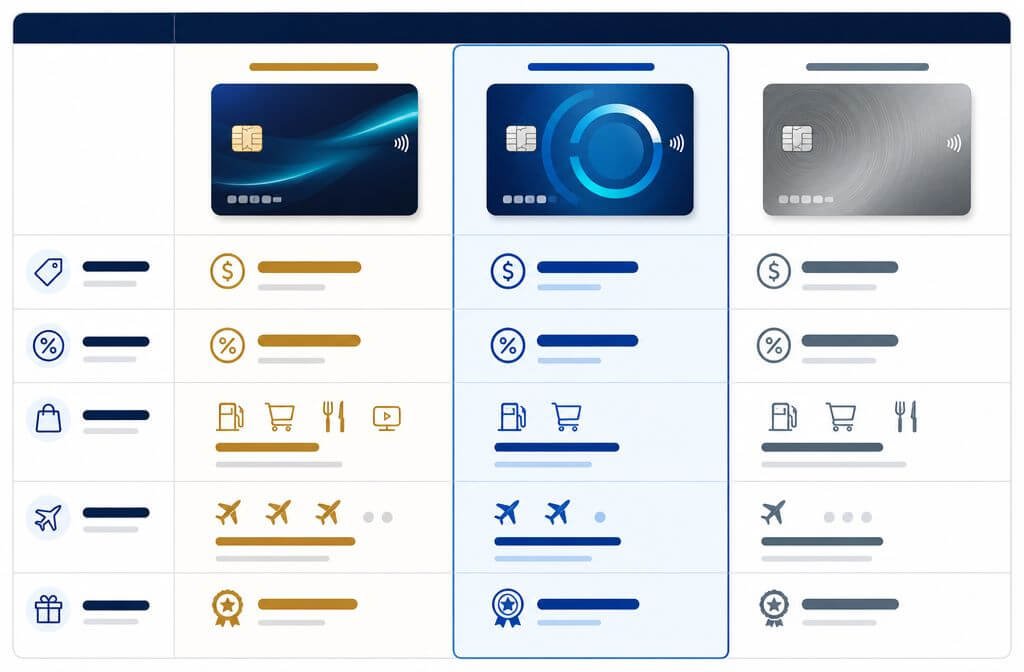
| Feature | Chase Freedom Unlimited | Citi Double Cash | Capital One Quicksilver |
|---|---|---|---|
| Annual fee | $0 | $0 | $0 |
| Base earn rate | 1.5x (1.5%) | 2x (2%) | 1.5x (1.5%) |
| Bonus categories | 5x travel, 3x dining/drugstores | None | None |
| Transferable points | ✅ Yes (with Sapphire/Ink) | ✅ Yes (with Citi Strata Premier) | ✅ Yes (with Venture X) |
| Transfer partners | 14 (airline + hotel) | 18+ (airline + hotel) | 15+ (airline + hotel) |
| Foreign transaction fee | 3% | 3% | None |
| Welcome offer | $200 / 20,000 UR points | $200 cash back | $200 cash back |
| Intro APR | 0% for 15 months | 0% for 18 months | 0% for 15 months |
The honest comparison:
Citi Double Cash earns more on general spending (2% vs 1.5%) and has a longer intro APR window. It also connects to Citi ThankYou points when paired with the Citi Strata Premier. For pure flat-rate earning, Double Cash has the edge on base rate. But it has no bonus categories, so heavy dining and travel spenders will earn more with Freedom Unlimited overall.
Capital One Quicksilver matches Freedom Unlimited’s 1.5% base rate but has no bonus categories and a thinner transfer partner network. Its main advantage is no foreign transaction fee, which Freedom Unlimited lacks.
Freedom Unlimited wins when you already have or plan to get a Chase Sapphire or Ink card. The bonus categories (especially 3x dining and 5x Chase Travel) and the deep Ultimate Rewards transfer partner network — particularly World of Hyatt and Aeroplan — give it a higher ceiling than either competitor for points-focused users.
For a broader look at how Chase’s transfer partners stack up against Amex, Citi, and Capital One, see our transfer partner comparison guide.
Frequently Asked Questions
Does the Chase Freedom Unlimited credit card count toward Chase 5/24? Yes. Applying for Freedom Unlimited adds one card to your 5/24 count. If you’re at 4/24 and still want a Sapphire Preferred or Chase Ink card, apply for those first. Freedom Unlimited can be added later since it’s generally easier to approve and less strategically constrained.
Can Freedom Unlimited points be transferred to airlines and hotels? Not directly. Points earned on Freedom Unlimited are stored as Ultimate Rewards points at 1 cent each. To unlock transfers to airline and hotel partners, you need to hold a Chase Sapphire Preferred, Sapphire Reserve, or Chase Ink Preferred in the same household. Once you have one of those cards, you can combine all your Ultimate Rewards balances and transfer them.
What’s the current welcome offer in mid-2026? The standard offer is $200 (20,000 points) after spending $500 in the first 3 months. A limited-time $250 offer ran from mid-March through late April 2026 but has since expired. Check Chase’s current offer page before applying, as promotional bonuses rotate.
Is the Freedom Unlimited worth keeping long-term? Yes, for most Chase cardholders. The no annual fee means there’s no break-even pressure. Keeping it open maintains your credit history length and gives you a solid 1.5x catch-all for non-bonus spending. It also preserves your Ultimate Rewards balance if you ever downgrade a Sapphire card.
Does Freedom Unlimited have travel insurance? Limited coverage only. It includes secondary rental car coverage and some purchase protection, but it does not offer trip delay reimbursement, baggage delay coverage, or primary rental car insurance. For travel protection, book trips on a Sapphire Preferred or Reserve.
How does the DashPass benefit work? New Freedom Unlimited cardholders can activate a complimentary 6-month DashPass subscription (DoorDash’s membership program, which waives delivery fees on qualifying orders) through December 31, 2027. After the free period, it auto-renews at the standard monthly rate unless canceled.
Conclusion
The Chase Freedom Unlimited credit card earns its place in most Chase lineups — not because the welcome offer is exceptional or the base rate is the highest available, but because it fills a specific gap cleanly: 1.5x on everything else, 3x on dining and drugstores, and 5x on Chase Travel, all with no annual fee.
For someone who already holds a Sapphire Preferred or Reserve, adding Freedom Unlimited is a straightforward way to earn more on general spending without paying another annual fee. The points pool together, and the combined earning power across both cards is meaningfully better than either card alone.
For someone just starting with Chase, the card is a reasonable first step — but only if a Sapphire or Ink card is already in the plan. Without a pairing card, Freedom Unlimited is a decent cash-back card that competes with, but doesn’t clearly beat, the Citi Double Cash on flat-rate earning.
Practical next steps:
- If you’re under 5/24 and don’t yet have a Sapphire card, consider applying for the Sapphire Preferred first — it unlocks more value from Freedom Unlimited points.
- If you already have a Sapphire or Ink card, Freedom Unlimited is a strong no-fee addition for dining, drugstore, and general spending.
- Before applying, check whether a premium travel card might be a better use of your 5/24 slot given your travel goals.
- If you’re comparing no-fee options head-to-head, review our best no-annual-fee travel cards for 2026 before deciding.


Content on Award Travel Hub is independently created by Award Travel Hub Editorial Desk and, where noted, reviewed by Award Travel Hub Review Desk. Some pages may contain affiliate links, but compensation does not determine our coverage, opinions, or methodology.