

Last updated: June 18, 2026
Quick Answer
For most intermediate travelers, Chase Sapphire Preferred is the better first Sapphire card, while Chase Sapphire Reserve is better only if you will clearly use lounge access, premium travel credits, or the higher Chase Travel redemption rate. In a straight Chase Sapphire Preferred vs Reserve comparison, the real winner depends less on “how often you travel” and more on whether your annual value from credits and perks exceeds the fee gap.
Key Takeaways
- Chase Sapphire Preferred has a lower annual fee and is usually the safer choice for a first Sapphire card.
- Chase Sapphire Reserve can be worth it, but only if you use the travel credit, lounge access, and premium redemption options consistently.
- As of March 2026, Preferred carries a 75,000-point welcome bonus after qualifying spend, while Reserve carries a 125,000-point welcome bonus after higher qualifying spend.
- Reserve’s travel credit sharply reduces its real cost, but the card still needs meaningful ongoing use to beat Preferred year after year.
- Both cards earn Chase points, which matter most when transferred to airline and hotel partners rather than used casually.
- If the plan is to book Hyatt stays, partner airlines, or occasional Business Class deals, either card can fit a strong booking strategy.
- The biggest mistake is choosing Reserve for prestige, then failing to use lounge access, credits, or portal redemptions enough to justify the fee.
- Chase’s updated 2026 bonus rules and longer Sapphire waiting period make the “get one now, switch later” strategy less flexible than before.
- Travelers under Chase’s approval limits should also review the Chase 5/24 rule before applying.

What is the main difference between Chase Sapphire Preferred and Reserve?
The main difference between Chase Sapphire Preferred and Reserve is simple: Preferred is lower-cost and easier to justify, while Reserve is built for travelers who actively use premium benefits. Both cards earn transferable points, but Reserve offers stronger premium travel perks and a higher redemption floor in Chase Travel.
Side-by-side feature comparison
| Feature | Sapphire Preferred | Sapphire Reserve |
|---|---|---|
| Annual fee | $95 | $795 |
| Welcome bonus (March 2026) | 75,000 UR after $5,000 in 3 months | 125,000 UR after $6,000 in 3 months |
| Dining earnings | 3x | 3x |
| General travel earnings | 2x direct travel, 5x Chase Travel | 4x flights/hotels direct, 8x Chase Travel |
| Hotel credit | $50 annual Chase Travel hotel credit | $300 annual travel credit, plus 2026 hotel credits tied to The Edit/Chase Travel |
| Chase Travel redemption rate | 1.25 cents per point | 1.5 cents per point |
| Lounge access | No | Yes, including Priority Pass and Sapphire Lounge access |
| Primary rental car CDW | Yes | Yes |
| Target user | Value-focused traveler | Frequent traveler who uses premium perks |
What matters most
- Annual fee gap: Preferred is much easier to keep long term.
- Travel credits: Reserve can offset a large portion of its fee if the credits fit actual travel habits.
- Redemption style: Reserve helps more if Chase Travel portal redemptions are part of the plan.
- Transfer strategy: If points are mostly transferred to Hyatt or partner airlines, the redemption gap matters less.
Decision rule: Choose Preferred if the goal is low-fee flexibility. Choose Reserve only if premium benefits will be used on purpose, not “maybe.”
For a broader look at how Chase points fit against other issuers, see Comparing Transfer Partners 2026: Chase vs Amex vs Citi vs Capital One.
How much do you actually pay after credits?
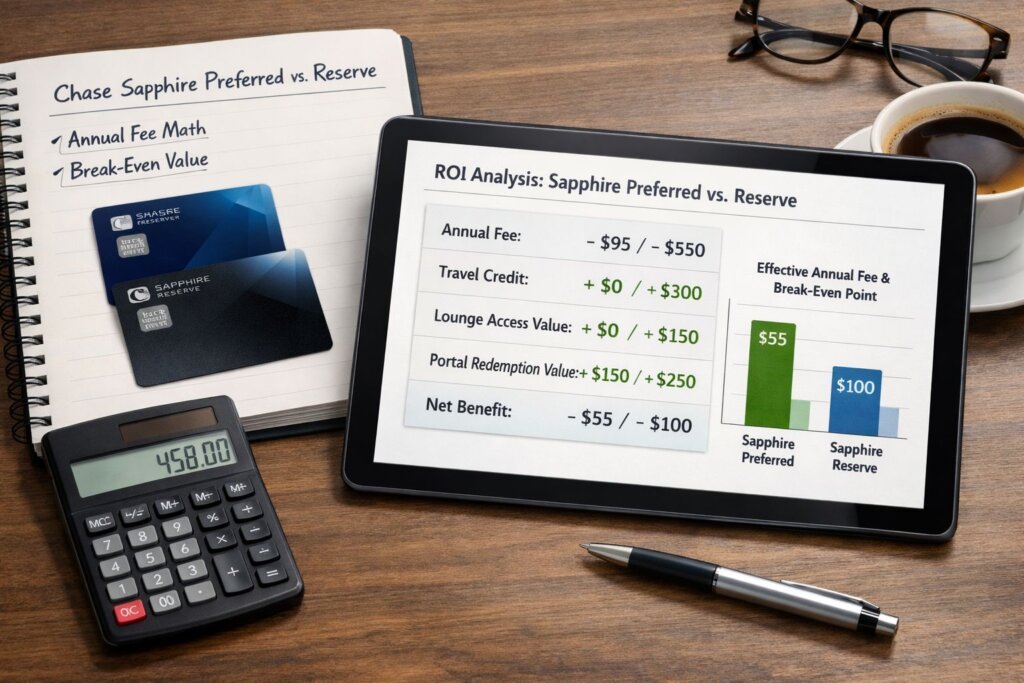
The answer is that the sticker price is not the real cost, especially for Reserve. In a useful Chase Sapphire Preferred vs Reserve decision, the right comparison is net annual fee after benefits you will actually use.
Effective annual fee math
Sapphire Preferred
- $95 annual fee
- $50 annual hotel credit through Chase Travel
- Practical net cost: about $45 if the hotel credit is fully used
You may be interested



Sapphire Reserve
- $795 annual fee
- $300 annual travel credit
- Additional 2026 hotel credits can add value, but only if they fit booked stays
- Practical net cost: at least $495 after the easy travel credit
- Real cost can be lower if the hotel credits are fully used, but only for travelers who would have booked those stays anyway
Why is some older math outdated
Many older articles describe Reserve as a card with a $250 effective annual fee. That was useful under prior benefit structures, but it does not reflect the current 2026 fee and credit setup. The better question now is not “Is the travel credit automatic?” but “Will the full bundle of premium benefits be used without overspending to justify them?”
Common mistake
A common mistake is valuing every credit at face value. A $250 hotel credit is not worth $250 if it pushes a traveler into a more expensive booking channel, changes hotel choice, or replaces a cheaper rate.
The right annual fee math uses only benefits that match trips already planned.
Which card earns more Chase points and gives better redemption value?
Reserve earns faster on certain travel purchases and gives a higher Chase Travel redemption rate, but Preferred often wins on simplicity and cost-adjusted value. If the plan is to transfer points to partners, the earning gap matters more than the portal gap.
Earning rates that matter
Preferred
- 3x on dining
- 2x on direct travel
- 5x on travel booked through Chase Travel
Reserve
- 3x on dining
- 4x on flights and hotels booked direct
- 8x on travel booked through Chase Travel
Redemption value
If redeeming through Chase Travel:
- Preferred gives 1.25 cents per point (CPP)
- Reserve gives 1.5 cents per point
If transferring to partners:
- Both cards can access the same core Chase points transfer partners when paired as full Ultimate Rewards-earning cards
- Real value depends on award availability, dynamic pricing, and whether a transfer unlocks true sweet spots
For many Award Travel Hub readers, the best use of points is often Hyatt, Aeroplan, Flying Blue, Avios, or other partner airlines, not fixed portal value. In that case, Reserve’s portal edge matters less than many comparison posts suggest. Start with the Chase Transfer Partners Guide 2026 if the plan is to maximize points through transfers.
Quick example
Assume $10,000 in annual combined dining and direct travel spend:
- Preferred at blended 2.5x average = roughly 25,000 points
- Reserve at blended 3.5x average = roughly 35,000 points
That 10,000-point gap is meaningful, but it does not automatically justify an extra annual fee of several hundred dollars unless those extra points and benefits are consistently used.
Best for / Not for
Best for Preferred
- Travelers who mainly want transferable points at low cost
- Hyatt users
- People building a Chase trifecta with Freedom cards
Not for Preferred
- Travelers who strongly value airport lounges and premium booking benefits
Best for Reserve
- Travelers who book frequent direct flights/hotels
- Users who redeem through Chase Travel regularly
- Travelers who can use premium credits without forcing spend
Not for Reserve
- People who transfer points occasionally but rarely use lounges or premium credits
To improve earnings beyond either Sapphire card, pair one with rotating-category cards and review the Chase Freedom Q2 2026 bonus categories.
Are the travel benefits and lounge perks worth paying more for?
Reserve’s travel benefits are valuable, but only frequent travelers usually get enough real-world use from them to justify the fee difference. Preferred already covers several practical protections, including primary rental car coverage.
What Reserve adds
- Priority Pass lounge membership
- Access to Sapphire Lounge locations where eligible
- Higher-end travel and trip protections
- Stronger direct travel earning
- Better Chase Travel redemption rate
If lounge access is a major reason to upgrade, review current access limits and guest details in the Chase Sapphire Lounge locations and access guide.
What Preferred already does well
- Primary rental car CDW
- Solid trip protections
- Strong dining earnings
- Easy-to-justify annual fee
- Access to Chase transfer partners
Edge case: the traveler who transfers everything
If nearly all Chase points are transferred to Hyatt or airline programs, and airport lounge visits are rare, Reserve’s extra annual fee often becomes hard to justify. The card is strongest for a traveler who uses both premium benefits and stronger earning rates.
For broader insurance context, see credit card travel insurance explained.
Which card wins for different traveler types?
For most moderate spenders, Preferred wins on net value. Reserve starts making more sense when annual travel and dining spend is high and lounge/credit usage is reliable.
Persona 1: Casual traveler, $5,000 annual dining + travel spend
Assumptions
- 60% dining, 40% travel
- Uses Preferred’s $50 hotel credit
- Uses Reserve’s $300 travel credit
- Values lounge access at $0 to $75 because travel is infrequent
- Redeems mostly via transfers, not portal
Estimated first-year and ongoing logic
- Preferred: low fee, decent earning, easy credit use
- Reserve: better earning, but fee drag remains large
Net annual value winner: Preferred
Persona 2: Frequent business traveler, $20,000 annual dining + travel spend
Assumptions
- Frequent direct airline and hotel bookings
- Fully uses Reserve’s travel credit
- Gets real value from lounges
- May also use premium hotel credits
- Values time savings and backup protections
Estimated outcome
- Reserve’s higher earn rate can generate a large points gap
- Lounge visits and credits can reasonably close the fee gap
- Better for travelers who redeem in portal at 1.5 CPP or mix portal and partner transfers
Net annual value winner: Reserve
Persona 3: Family vacation traveler, $10,000 annual dining + travel spend
Assumptions
- Two major trips and a few smaller ones
- Mixed direct and portal bookings
- Lounge use matters, but family guest rules can limit value
- Credits are only partially used beyond the travel credit
Estimated outcome
- Preferred usually wins if trips are mostly economy, Hyatt stays, or partner redemptions
- Reserve can win only if family lounge access is genuinely useful and credits are fully used
Net annual value winner: Usually Preferred
Break-even rule of thumb
Reserve begins to look stronger when:
- annual dining + travel spend is roughly $12,000 or more, and
- the $300 travel credit is fully used, and
- lounge access or other premium credits create at least modest real value
That does not mean everyone above $12,000 should get Reserve. It means that is the rough point where the math becomes worth checking closely.
If annual fee decisions are part of a wider review, use the annual fee ROI calculator guide.
Should you start with Preferred, upgrade to Reserve, or apply separately?
For most readers, starting with Preferred is the lower-risk move. In 2026, Chase’s updated Sapphire bonus rules make “product change now, new bonus later” less straightforward than before.
What changed in 2026
- Chase extended the Sapphire family bonus waiting period to 60 months
- Chase also clarified that a cardholder may be eligible for the other Sapphire card’s bonus if that exact version’s bonus has never been earned before
That means strategy matters:
- If eligible and under 5/24, applying fresh for the card that best fits long-term value is usually better than guessing and hoping to switch later
- Upgrades can make sense for existing Preferred holders who already know Reserve’s lounge and credit package will be used heavily
- Downgrades can also make sense if Reserve no longer pays for itself
Practical decision framework
Choose Sapphire Preferred if:
- this is the first Sapphire card
- annual travel is moderate
- points will mostly transfer to partners
- low fee matters more than premium perks
Choose Sapphire Reserve if:
- annual travel and dining spend is high
- lounge access gets regular use
- travel credits will be fully used
- portal redemptions at 1.5 CPP are part of the plan
If comparing against other ecosystems, readers also often check Points vs Cash Back: Which Credit Card Strategy Wins 2026?.
What are the most common mistakes when choosing between CSP and CSR?
The biggest mistakes are overvaluing credit, ignoring redemption habits, and choosing a card based on internet consensus rather than personal math. The best choice between Chase Sapphire Preferred and Reserve is the one that fits actual behavior.
Common pitfalls
- Choosing Reserve for lounge access, then taking only two trips a year
- Valuing hotel credits at full face value when they change booking behavior
- Ignoring transfer partner value and focusing only on portal CPP
- Forgetting Chase approval rules, especially 5/24 and Sapphire timing limits
- Upgrading without checking whether a new application bonus would be better
Quick checklist before applying
- Estimate annual dining and travel spend.
- Decide whether points will be used in portal or transferred.
- Count likely lounge visits.
- Value each credit conservatively.
- Check Chase application timing rules.
- Pick the card with the highest realistic, not theoretical, value.
FAQ
Is Chase Sapphire Reserve worth it in 2026?
Chase Sapphire Reserve is worth it in 2026 for travelers who fully use the travel credit, get regular lounge value, and spend enough on travel to benefit from the stronger earning rates.
Is Chase Sapphire Preferred better than Reserve for most people?
Yes, Chase Sapphire Preferred is better for most people because the annual fee is low, the benefits are useful, and the card still earns transferable Chase points.
Does Reserve earn more points than Preferred?
Yes, Reserve earns more on direct flights and hotels and also pays more on Chase Travel bookings, but the extra annual fee can erase that advantage for moderate spenders.
Is the 1.5 cent Chase Travel rate enough reason to get Reserve?
No, the 1.5 cent Chase Travel rate alone usually is not enough reason to get Reserve. It works best when combined with high spend and frequent use of Reserve perks.
Can you have both Sapphire Preferred and Sapphire Reserve?
Under current 2026 guidance, holding one Sapphire card does not automatically block a bonus on the other version if that specific version’s bonus has never been earned, but approval and eligibility still depend on Chase rules.
Which card is better for Hyatt transfers?
Both cards are excellent for Hyatt transfers because both earn Chase Ultimate Rewards points that can transfer to Hyatt. Preferred is often the better value if Hyatt transfers are the main goal.
Should an existing Sapphire Preferred holder upgrade to Reserve?
An existing Sapphire Preferred holder should upgrade to Reserve only if annual travel is increasing and lounge access, travel credits, and higher earnings will be used enough to offset the higher fee.
Related reading
- Best ways to use Chase Ultimate Rewards transfer partners
- How Chase 5/24 affects your next application
- Chase Sapphire Lounge locations and guest rules
- How to review annual fee ROI before renewal
- Chase points vs cash back strategy
Conclusion
In a practical Chase Sapphire Preferred vs Reserve decision, Preferred is the better default choice, and Reserve is the better specialized choice. Preferred works for most intermediate cardholders because it keeps costs low while preserving access to valuable Chase points and points transfer partners. Reserve becomes the right answer when travel spend is high, lounge access is used often, and premium credits fit trips already being booked.
The next step is simple: map the last 12 months of dining and travel spend, estimate how points will actually be redeemed, and value only the benefits that will be used without stretching. If the math is close, Preferred is usually the safer starting point. If the math is clearly in Reserve’s favor, then Reserve can be one of the strongest premium cards in the Chase ecosystem.


Content on Award Travel Hub is independently created by Award Travel Hub Editorial Desk and, where noted, reviewed by Award Travel Hub Review Desk. Some pages may contain affiliate links, but compensation does not determine our coverage, opinions, or methodology.