

Last Updated: July 21, 2026
Most travelers overpay for travel insurance they could get free from a credit card — or skip lounge access they already qualify for. The right credit cards with travel benefits can offset hundreds of dollars in annual fees through protections, credits, and perks that activate the moment you book with the card. The wrong ones charge $550 a year for benefits you will never use.
This guide cuts through the noise. It covers which travel perks deliver real, measurable value in 2026, which cards carry them, and how to match the right card to how you actually travel — not how you wish you traveled.
Key Takeaways
- Travel insurance, lounge access, and annual travel credits are the three benefit categories that most reliably offset annual fees on premium cards.
- Chase Sapphire Preferred remains the best starting point for most travelers in 2026: strong protections, transferable points, and a $95 annual fee.
- Chase Sapphire Reserve and Amex Platinum justify higher fees only when you use the credits and fly frequently enough to use the lounges.
- Co-branded airline cards (United, Southwest, Delta) deliver outsized value specifically through free checked bags and priority boarding — not through points earning rates.
- Matching perks to your actual travel patterns is the only reliable way to evaluate whether an annual fee is worth paying.
Which Travel Benefits Actually Matter
Not all travel perks are equal. Some save real money on every trip. Others are theoretical benefits that most cardholders never trigger.
Benefits with clear, measurable value:
- Trip delay and cancellation insurance — Covers hotels, meals, and rebooking costs when flights are delayed or canceled. Coverage limits typically range from $500 to $10,000 per trip depending on the card.
- Primary rental car coverage — Replaces the $20–$30/day collision damage waiver the rental counter pushes. On a 10-day rental, that is $200–$300 saved directly.
- Lounge access — Eliminates $35–$60 per-visit lounge fees. A traveler with 20 lounge visits per year at $45 average is saving $900 annually.
- Annual travel credits — Cash-equivalent offsets against the annual fee. A $300 travel credit on a $550 card brings the effective fee to $250 before any other benefit is counted.
- Free checked bags — On a round trip with one checked bag, that is $35–$40 each way, or $70–$80 per trip. Two travelers flying four round trips per year: $560–$640 in savings.
- Global Entry / TSA PreCheck credit — A $100 credit every four to five years. Modest but automatic.
Benefits with limited real-world value for most travelers:
- Concierge services (rarely used, rarely better than a quick search)
- Shopping portals and credits tied to specific merchants (only valuable if you already use those merchants)
- Trip accident insurance (redundant with most existing life and health coverage)
The practical rule: count only the benefits you will actually use, at their actual dollar value, then subtract the annual fee. If the math is positive, the card earns its keep.
For a deeper look at how to activate the most valuable perks from the start, see this guide to credit card perks worth activating early in the year.
Best Cards for Travel Insurance and Protections

You may be interested



Travel insurance is one of the most underrated benefits on premium cards. A single trip cancellation or a two-day delay can cost $500–$2,000 out of pocket. Cards with strong protections eliminate that exposure — but only if you book travel with the card.
Key rule: Most card travel protections only activate when you pay for the trip (or at least the common carrier ticket) with that card. Booking with points or through a third-party portal can void coverage. Confirm your card’s terms before each trip.
Chase Sapphire Preferred
- Trip delay: Up to $500 per ticket after a 12-hour delay or overnight stay required
- Trip cancellation/interruption: Up to $10,000 per person, $20,000 per trip
- Baggage delay: Up to $100/day for five days after a six-hour delay
- Primary rental car coverage: Yes, up to the actual cash value of the vehicle
- Annual fee: $95
For most travelers, Sapphire Preferred delivers the best protection-to-fee ratio available. The $10,000 cancellation limit is competitive with cards charging four times the annual fee.
Chase Sapphire Reserve
- Trip delay: Up to $500 per ticket after a six-hour delay (shorter trigger than Preferred)
- Trip cancellation/interruption: Up to $10,000 per person, $20,000 per trip
- Emergency evacuation and transportation: Up to $100,000
- Primary rental car coverage: Yes, up to $75,000
- Annual fee: $550 (effective fee after $300 travel credit: $250)
Reserve adds emergency evacuation coverage and a higher rental car limit, which matters for international travel and luxury vehicle rentals. The six-hour delay trigger (vs. 12 hours on Preferred) also means more frequent activation.
American Express Platinum
- Trip delay: Up to $500 per covered trip after a six-hour delay
- Trip cancellation/interruption: Up to $10,000 per trip, $20,000 per year
- Car rental loss and damage: Secondary coverage (not primary — a meaningful limitation)
- Annual fee: $695
Amex Platinum’s rental car coverage is secondary, meaning your personal auto insurance pays first. That reduces its practical value compared to Chase’s primary coverage. For travelers who primarily want insurance, Chase cards have a structural edge here.
For a full breakdown of credit card travel insurance terms, limits, and what to watch for, the 2025 guide to travel insurance benefits on credit cards covers the fine print in detail.
Best Cards for Lounge Access

Lounge access has become one of the most contested benefits in the premium card space. Issuers have added guest fees, visit caps, and income thresholds in recent years. Knowing exactly what your card covers — and what it no longer covers — matters before you count lounge access as a benefit.
American Express Platinum — Centurion + Priority Pass
Amex Platinum provides access to:
- Centurion Lounges (owned by Amex, widely considered the best domestic lounge network)
- Priority Pass Select (1,300+ airport lounges globally)
- Delta Sky Clubs (when flying Delta same-day)
- Plaza Premium, Escape, and Airspace lounges
Guest policy: As of 2024, Centurion Lounge guests cost $50 each unless the cardholder spends $75,000+ on the card annually. Priority Pass guests are also subject to fees at many locations. Count guest costs carefully if you travel with others.
For travelers who fly frequently through major U.S. hubs with Centurion Lounges (JFK, LAX, SFO, MIA, DFW, SEA, LAS, PHX, CLT, DEN, BOS, IAD), Amex Platinum’s lounge network is unmatched.
Chase Sapphire Reserve — Chase Sapphire Lounges + Priority Pass
- Chase Sapphire Lounges (newer, high-quality owned lounges at select airports: BOS, HKG, JFK, LAS, LGA, PHX, and more expanding)
- Priority Pass Select with two free guests per visit
Reserve’s Priority Pass benefit still includes two free guests, making it more family-friendly than Amex Platinum’s current guest policy. For a current list of Chase lounge locations, see the Chase Sapphire Lounge locations guide for 2026.
Capital One Venture X — Capital One Lounges + Priority Pass
- Capital One Lounges (DFW, DEN, IAD, with more planned)
- Priority Pass with unlimited guests
At a $395 annual fee with a $300 travel credit (bringing effective cost to $95), Venture X offers strong lounge value for the price — particularly for travelers based near DFW, DEN, or IAD. The unlimited guest policy is a standout at this price point.
Lounge access decision framework:
| Card | Owned Lounge Network | Guest Policy | Effective Annual Fee |
|---|---|---|---|
| Amex Platinum | Centurion (best domestic) | $50/guest (under $75K spend) | $695 |
| Chase Sapphire Reserve | Chase Sapphire Lounges | 2 free guests (Priority Pass) | $250 (after $300 credit) |
| Capital One Venture X | Capital One Lounges | Unlimited guests | $95 (after $300 credit) |
Best Cards for Travel Credits
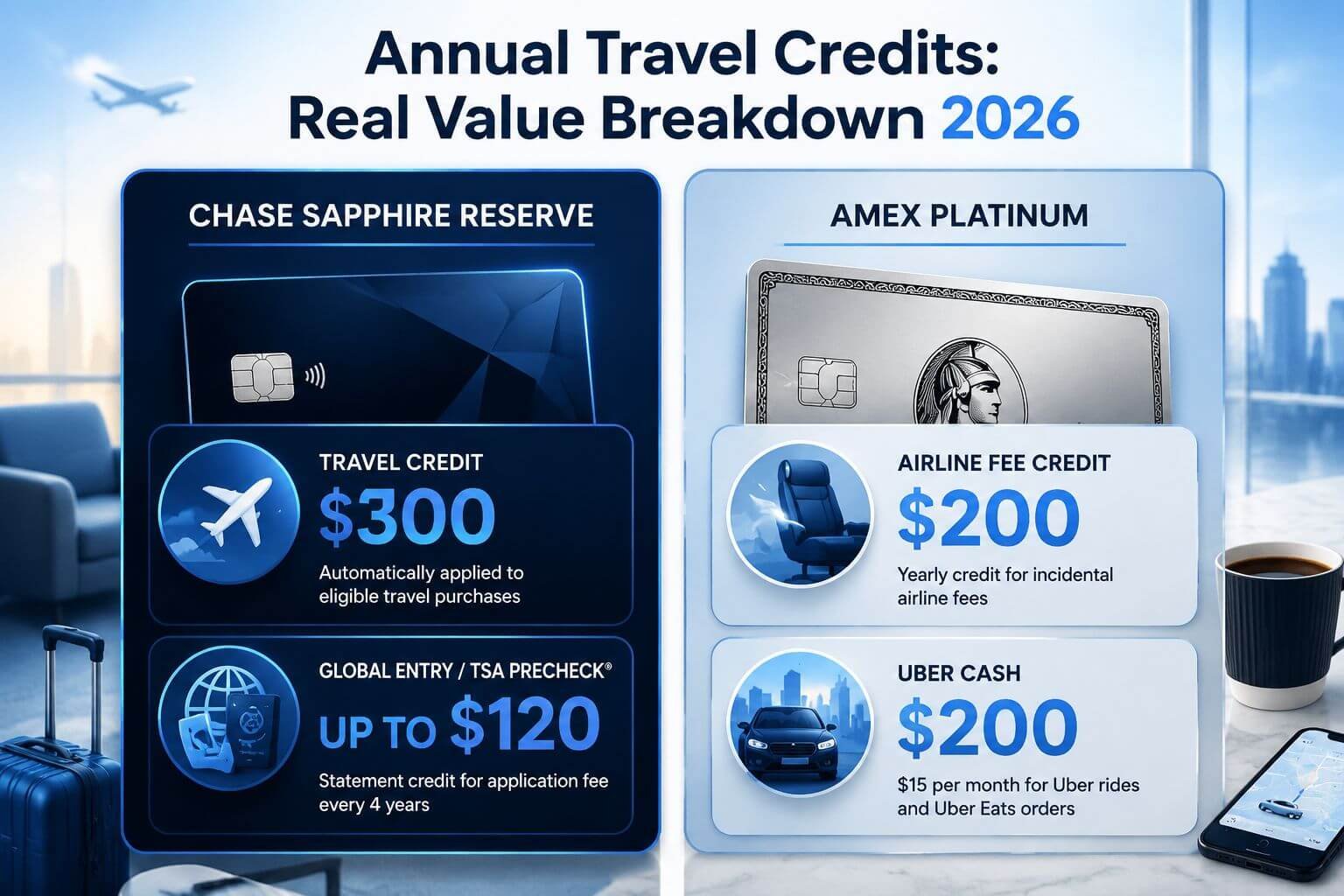
Annual travel credits are the most direct way to offset a card’s annual fee. But not all credits are equally easy to use. A $300 credit that applies automatically to any travel purchase is worth more in practice than a $200 credit split across four specific merchant categories.
Chase Sapphire Reserve — $300 Travel Credit
The $300 annual travel credit on Sapphire Reserve is the cleanest credit in the premium card space. It applies automatically to the first $300 in travel purchases each year — airlines, hotels, Uber, Lyft, parking, tolls, and more. No enrollment, no categories to track.
After the $300 credit, the effective annual fee is $250. That is the real number to evaluate.
American Express Platinum — Up to $695 in Credits (Fragmented)
Amex Platinum offers a larger total credit package, but it is split across multiple categories:
- $200 airline fee credit (one selected airline, incidental fees only — not ticket purchases)
- $200 hotel credit (Fine Hotels + Resorts or The Hotel Collection bookings via Amex Travel)
- $240 digital entertainment credit ($20/month at select streaming services)
- $155 Walmart+ credit
- $200 Uber Cash ($15/month + $20 in December)
- $100 Saks Fifth Avenue credit ($50 semi-annually)
In total, these credits can offset most or all of the $695 annual fee — but only if you use each category. Travelers who do not use Walmart+, Saks, or specific streaming services will leave significant value on the table.
For a detailed walkthrough of maximizing Amex Platinum credits, see the guide to maximizing Amex Platinum airline fee credit benefits.
American Express Gold — $250 in Credits Against a $250 Fee
Amex Gold offers:
- $120 dining credit ($10/month at Grubhub, The Cheesecake Factory, Goldbelly, Wine.com, and select others)
- $120 Uber Cash ($10/month)
Combined, these credits can fully offset the $250 annual fee for cardholders who use both. The card also earns 4x on dining and U.S. supermarkets and 3x on flights — making it the strongest earning card for food-heavy spenders who also travel.
A household spending $6,000 on dining and $6,000 on groceries annually earns roughly 48,000 Membership Rewards points from those categories alone — worth $480–$960 in travel value depending on how the points are redeemed.
Best Cards for Free Checked Bags and Priority Boarding

Co-branded airline credit cards do not always win on points earning rates or transferable value. Where they consistently deliver is on operational perks: free checked bags, priority boarding, and companion certificates.
United Explorer Card — Free Checked Bag + Priority Boarding
- First checked bag free for cardholder and one companion on the same reservation
- Priority boarding (Group 2)
- Two United Club one-time passes per year
- Annual fee: $95 (waived first year)
On a round trip with two travelers, the free bag benefit alone saves $140–$160. That covers the annual fee with a single trip. For a full comparison of United card options, see the best United credit cards guide for 2026.
Southwest Rapid Rewards Priority Card — EarlyBird Check-In + Upgraded Boarding
- 7,500 anniversary bonus points (worth ~$100 in Southwest flights)
- $75 Southwest annual travel credit
- Four Upgraded Boardings per year (A1–A15 boarding position)
- Annual fee: $149
Southwest does not charge for checked bags on any ticket, so the value here comes from the boarding credits and anniversary points. For travelers who fly Southwest regularly, the $75 credit and 7,500 points alone nearly cover the fee.
Delta SkyMiles Gold Card — Free Checked Bag + Priority Boarding
- First checked bag free for cardholder and up to eight companions
- Main Cabin 1 priority boarding
- $200 Delta flight credit after $10,000 in annual spend
- Annual fee: $150 (waived first year)
The eight-companion bag benefit is one of the most generous in the co-branded space. A family of four flying two round trips per year saves $560–$640 in bag fees alone.
Checked bag value calculator (round trip, one bag):
| Airline | Bag Fee (each way) | Round Trip Savings (2 travelers) |
|---|---|---|
| United | $35–$40 | $140–$160 |
| Delta | $35–$40 | $140–$160 |
| American | $35–$40 | $140–$160 |
| Southwest | $0 (free for all) | N/A |
Matching Travel Perks to How You Travel
The most common mistake with travel credit cards is choosing a card based on its benefit list rather than your actual travel patterns. Here is a practical decision framework.
If you fly 2–8 times per year on mixed airlines: Start with Chase Sapphire Preferred. The $95 fee is easy to justify through trip insurance alone, and the transferable Chase points give you flexibility across multiple transfer partners including United, Hyatt, Southwest, and Marriott. Compare this against the Venture X in the Venture X vs. Sapphire Reserve comparison.
If you fly 10+ times per year and pass through major hub airports: Chase Sapphire Reserve or Amex Platinum. The lounge access and credits justify the higher fees at that travel frequency. Run the math on your specific airports — if Centurion Lounges are not at your home airport, Amex Platinum’s lounge advantage shrinks considerably.
If you are loyal to one airline: A co-branded card for that airline makes sense as a second card, primarily for the bag fee savings and priority boarding. Do not make it your only card — co-branded points are less flexible than transferable points.
If you want the lowest effective annual fee with solid perks: Capital One Venture X at $395 gross ($95 effective after the $300 travel credit) covers lounge access, primary rental car coverage, and solid travel protections without the complexity of Amex Platinum’s fragmented credits.
Before applying for any new card, review common mistakes travelers make with travel credit cards to avoid misaligned applications and wasted welcome bonuses.
Frequently Asked Questions
Which credit cards with travel benefits have the best trip cancellation coverage? Chase Sapphire Preferred and Reserve both offer up to $10,000 per person and $20,000 per trip in trip cancellation and interruption coverage. Amex Platinum matches the per-trip limit. The key difference: coverage only activates when you charge the trip to the card, and some booking methods (third-party portals, points-only bookings) may not qualify.
Is primary rental car coverage worth paying for on a travel card? Yes, for most travelers. Primary coverage means the card pays first, without involving your personal auto insurance. That avoids premium increases and deductibles. Chase Sapphire Preferred and Reserve both include primary rental car coverage. Amex Platinum’s coverage is secondary — a meaningful gap.
Do lounge access benefits have guest fees or visit limits? Yes, and the policies have tightened. Amex Platinum now charges $50 per Centurion Lounge guest unless you spend $75,000+ annually on the card. Chase Sapphire Reserve’s Priority Pass benefit includes two free guests per visit. Capital One Venture X allows unlimited guests. Always verify current guest policies before your trip.
Can you use travel credits on any purchase? It depends on the card. Chase Sapphire Reserve’s $300 travel credit applies automatically to a broad range of travel purchases (airlines, hotels, rideshare, parking). Amex Platinum’s credits are category-specific and require using specific merchants or booking channels. The Chase credit is simpler and more flexible.
Is it worth paying a $550+ annual fee for travel perks? Only if you use enough of the benefits to exceed the fee in real value. Chase Sapphire Reserve’s math works when you use the $300 travel credit (bringing effective fee to $250), fly through Chase Sapphire Lounges regularly, and spend heavily on travel and dining. Amex Platinum works when you use most of its fragmented credits. Neither is worth it if you travel infrequently or skip the credits.
What is the best card for someone just starting to build a travel perks strategy? Chase Sapphire Preferred at $95 is the most practical starting point. It covers trip cancellation, primary rental car insurance, baggage delay, and earns transferable Chase points. The low fee means the protections alone can justify the cost before counting any rewards value. See the best travel credit cards of 2026 for a broader comparison.
Conclusion
The best credit cards with travel benefits in 2026 are not necessarily the ones with the longest list of perks. They are the ones whose perks align with how you actually travel.
For most travelers, that means starting with Chase Sapphire Preferred: strong protections, transferable points, and a fee that pays for itself quickly. Frequent flyers who pass through major hub airports regularly can upgrade to Sapphire Reserve or Amex Platinum once the math supports it. Co-branded airline cards make sense as a complement — not a replacement — when you fly one carrier consistently enough to capture bag fee savings.
Practical next steps:
- List every trip you took in the past 12 months and calculate what you paid in checked bag fees, rental car CDW, and travel insurance.
- Compare that number against the effective annual fee (gross fee minus credits you would actually use) on the card you are considering.
- If the savings exceed the effective fee, the card earns its keep. If not, a lower-fee option likely serves you better.
- Check the best travel credit cards comparison for 2026 before applying to confirm current welcome bonuses and benefit terms.
Travel perks are only worth paying for when you use them. Build your card strategy around your real travel patterns, not aspirational ones.


Content on Award Travel Hub is independently created by Award Travel Hub Editorial Desk and, where noted, reviewed by Award Travel Hub Review Desk. Some pages may contain affiliate links, but compensation does not determine our coverage, opinions, or methodology.