

Last Updated: July 9. 2026
The Chase Sapphire Reserve now costs $795 per year — and that number stops a lot of people cold. But the more useful question isn’t whether $795 feels expensive. It’s whether the credits, points earning, and travel benefits you’ll actually use bring that net cost below what a comparable card would charge.
So is the Chase Sapphire Reserve worth it in 2026? For the right cardholder, the answer is yes — but only if you engage with the credits consistently and understand the tradeoffs the latest refresh introduced. For others, the math simply doesn’t close.
This guide breaks down the current annual fee, every available credit, realistic break-even scenarios, and how the card stacks up against the Amex Platinum and Capital One Venture X. If you’re deciding whether to renew, apply, or downgrade, the numbers below will give you a clear answer.
Key Takeaways
The Chase Sapphire Reserve carries a $795 annual fee in 2026, unchanged since the June 2025 refresh.
Available credits total $1,250+ in face value, but realistic utilization drops net cost significantly.
A 150,000-point welcome bonus (highest in the card’s history) is currently available for new applicants.
The card is worth it for frequent travelers and diners who actively use credits; it’s harder to justify for occasional travelers.
You may be interested
Compared to the Amex Platinum ($895) and Capital One Venture X ($395), the CSR sits in a distinct middle tier with its own set of tradeoffs.



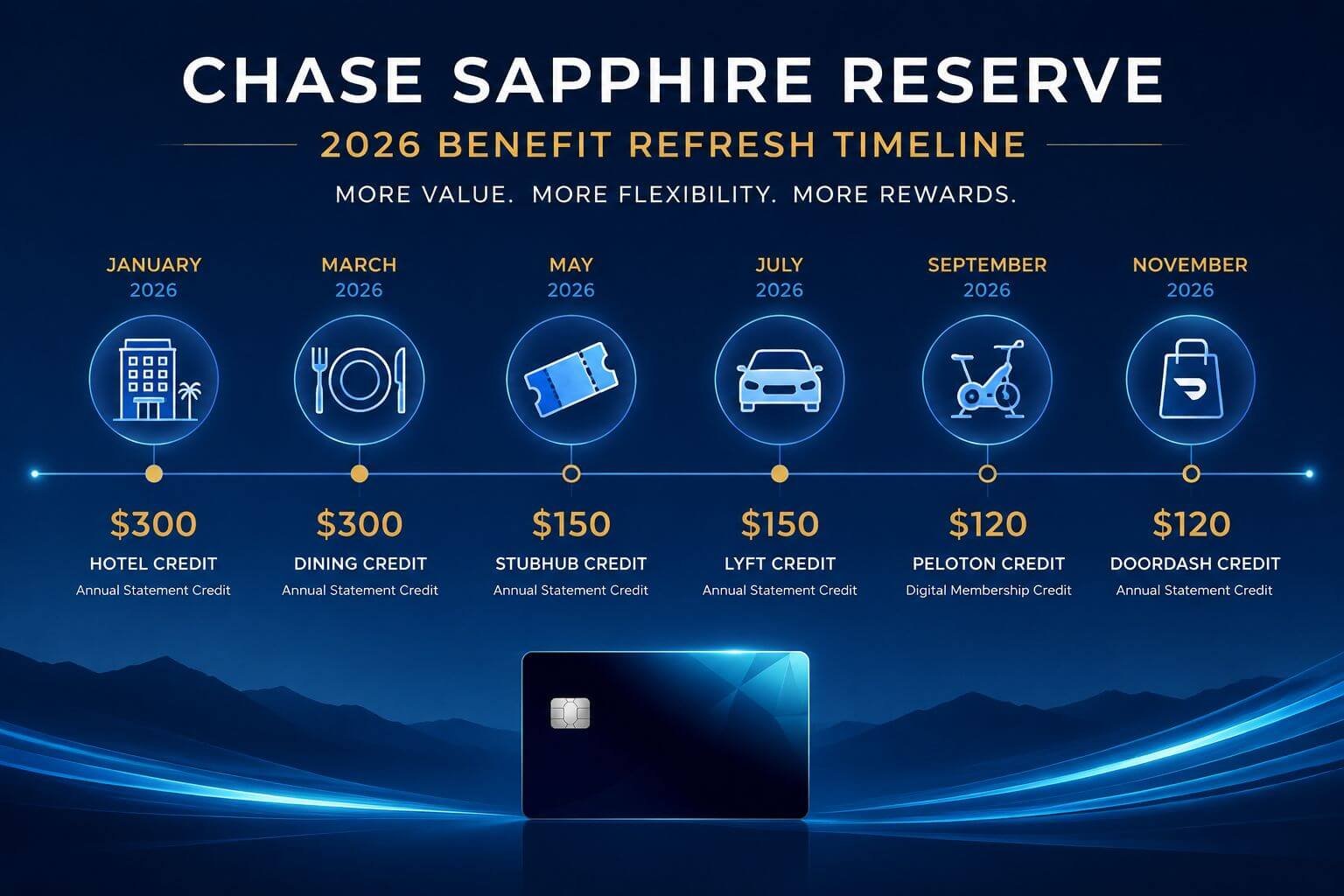
What Changed With the Chase Sapphire Reserve in 2026
The June 2025 refresh introduced the most significant restructuring the card had seen in years. Heading into 2026, those changes are now fully in effect — and a few additional tweaks have followed.
Key changes now active in 2026:
The Edit hotel credit restructured to two separate $250 credits, each usable anytime within the calendar year (no minimum stay requirement for the credits themselves, though individual properties may have 2-night minimums)
One-time $250 Chase Travel hotel credit for select properties (IHG, Omni, and similar partners), valid only through December 31, 2026
Lifestyle credits extended through 2027: StubHub/viagogo up to $300 ($150 per biannual period), Lyft up to $120 ($10/month), Peloton up to $120 ($10/month)
DoorDash DashPass membership and promotional credits remain active
$300 travel credit continues to apply broadly across travel purchases — airlines, hotels, rideshare, parking, and more
One notable January 2026 update: Chase expanded bonus eligibility rules, now allowing cardholders to hold both the Sapphire Preferred and Sapphire Reserve simultaneously. This matters for product change strategy (more on that in the Who Should Keep section).
What the refresh removed or narrowed: the old broad 3x earning on all travel purchases is now more category-specific, and some hotel credits come with fine print — including 2-night minimums at certain Edit properties — that reduces flexibility compared to the original $300 travel credit structure.
For a deeper look at how the transfer partner lineup compares across banks, see our Chase vs. Amex vs. Citi vs. Capital One transfer partner comparison for 2026.
Annual Fee Breakdown: Current Fee vs Credit Value
The $795 annual fee is the starting point. Here’s how the available credits stack up against it.
CreditAnnual ValueNotesTravel credit$300Broad categories; auto-appliesThe Edit hotel credit$500Two $250 credits; calendar yearOne-time Chase Travel hotel credit$250Select properties; expires Dec 31, 2026StubHub/viagogo credit$300$150 per biannual periodLyft credit$120$10/month; requires activationPeloton credit$120$10/month; app or equipmentDoorDash DashPass~$96Estimated membership valueTotal face value~$1,686Net after fee (100% use)~+$891 positive
The $300 travel credit is the easiest to use — it applies automatically to most travel purchases and is typically exhausted within the first few months for active travelers. The Edit hotel credits require booking through The Edit portal, which has a curated but limited property list.
The StubHub, Lyft, Peloton, and DoorDash credits require deliberate activation and consistent monthly or biannual use. If you don’t use Lyft regularly or subscribe to Peloton, those credits have zero value to you.
The honest math: Not every credit applies to every cardholder’s lifestyle. The $300 travel credit and $300 dining credit (via Sapphire Exclusive Tables) are the most universally accessible. The hotel credits require specific booking behavior.
For more context on how this card compares to the Preferred at a lower fee, see our Chase Sapphire Preferred vs. Reserve 2026 breakdown.
Calculating Break-Even on Travel, Dining, and DoorDash Credits
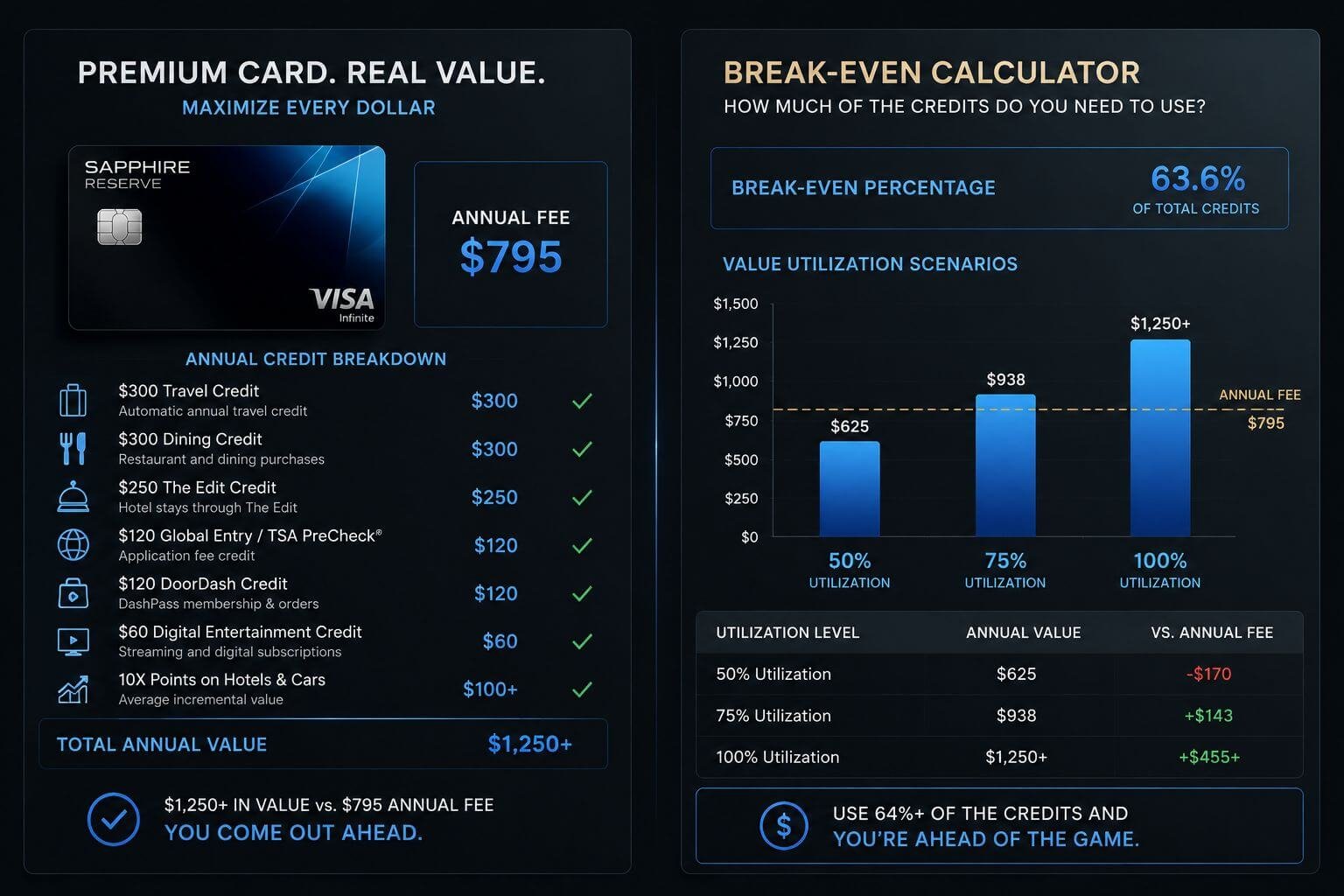
Break-even analysis depends on two variables: which credits you actually use, and how much you value Chase Ultimate Rewards points.
Scenario 1: Minimal Engagement (50% credit utilization)
ItemValueTravel credit$300One Edit hotel credit used$250Lyft (partial use)$60StubHub (one period)$150Total credits used$760Net annual fee$795 − $760 = $35
At 50% utilization, you’re essentially paying $35 for the card’s core benefits: 3x on dining, 1:1 transfer partners, primary rental car insurance, and Priority Pass access. That’s a reasonable deal — but only if those benefits have clear value to you.
Scenario 2: Active User (75% credit utilization)
ItemValueTravel credit$300Both Edit hotel credits$500Lyft ($10/month, 9 months)$90StubHub (both periods)$300DoorDash DashPass$96Total credits used$1,286Net annual fee$795 − $1,286 = −$491 positive
At 75% utilization, the card generates net positive value before accounting for points earned on spending.
Scenario 3: Full Utilization (100%)
At full utilization of all credits, the face value exceeds $1,600 — meaning the card theoretically pays for itself and then some. In practice, this requires using Peloton, DoorDash, Lyft, StubHub, and The Edit hotels regularly throughout the year.
Points Earning Math
The card earns 8x on Chase Travel portal bookings, 3x on dining, and 1x on most other purchases. At a conservative valuation of 1.8–2.0 cents per Ultimate Rewards point, $10,000 in annual dining spend generates roughly 30,000 points worth $540–$600 in transfer value.
The current 150,000-point welcome bonus — the highest ever offered on this card — adds approximately $2,700–$3,000 in transfer value for new applicants, depending on how the points are redeemed. That alone justifies the first-year fee many times over.
For strategies on maximizing those points, see our guide on the best use of 100,000 Chase Ultimate Rewards points in 2026.
Travel Insurance, Priority Pass, and Lounge Access in 2026
The CSR’s non-credit benefits remain among the strongest in the premium card space.
Travel insurance highlights:
Primary rental car insurance — covers damage and theft without filing against personal auto insurance first; this alone can save $30–$50/day on rental fees
Trip cancellation/interruption: up to $10,000 per person, $20,000 per trip
Trip delay reimbursement: $500 per ticket after 6-hour delays
Baggage delay: $100/day up to 5 days after 6-hour delays
Emergency evacuation: up to $100,000
These protections have real dollar value that doesn’t show up in credit calculations, but they meaningfully reduce out-of-pocket risk for frequent travelers.
Lounge access in 2026:
Sapphire Lounge by The Club: Currently available at select U.S. airports including Boston Logan, Hong Kong, Las Vegas, New York LaGuardia, Philadelphia, and a growing list. See the current Sapphire Lounge locations for 2026 for the latest openings.
Priority Pass Select: Unlimited visits for the primary cardholder and up to two guests per visit. Priority Pass covers 1,300+ lounges globally.
The lounge network has expanded meaningfully since 2024. Sapphire Lounges are well-regarded for the quality of their food and beverages, and their guest policy remains more generous than what Capital One Venture X now offers after its February 2026 policy tightening.
Comparing Renewal Math to Amex Platinum and Venture X
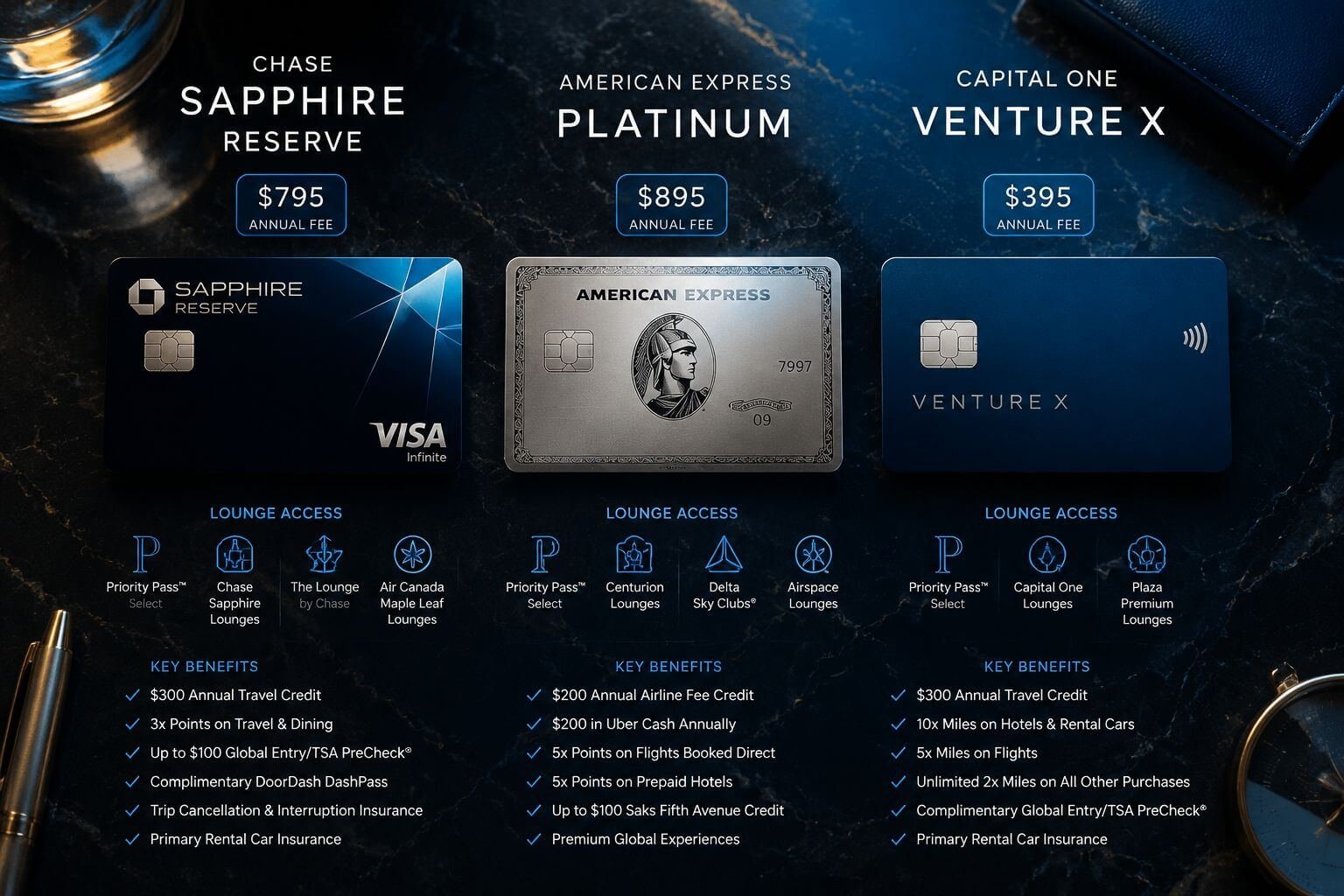
Is the Chase Sapphire Reserve worth it compared to its two main competitors? Here’s how the math compares.
FeatureChase Sapphire ReserveAmex PlatinumCapital One Venture XAnnual fee$795$895$395Travel credit$300 (broad)$200 (airline fees only)$300 (portal travel)Lounge accessPriority Pass + SapphireCenturion + Priority PassCapital One + Priority PassHotel elite statusNoneHilton Gold, Marriott GoldNoneDining earning3x everywhere4x at U.S. restaurants2x everywhereTransfer partners14 airlines/hotels21 airlines/hotels15+ airlines/hotelsRental car insurancePrimarySecondaryPrimaryAU fee$195$195$75
CSR vs. Amex Platinum: The Amex Platinum wins on lounge network breadth (Centurion Lounges are a significant upgrade), hotel elite status perks, and total transfer partner count. The CSR wins on lower fees, broader travel credit usability, 3x dining everywhere, and primary rental car insurance. If lounge access is your top priority and you stay at Hilton or Marriott frequently, the Platinum may edge ahead. For diners and road warriors, the CSR is more practical.
For a full breakdown of Amex transfer partner value, see our Amex transfer partners ranked guide for 2026.
CSR vs. Capital One Venture X: The Venture X costs $400 less per year and still offers Priority Pass and Capital One lounge access. But the transfer partner ecosystem is weaker for premium cabin redemptions, dining earn rates are lower, and the card lacks the CSR’s travel insurance depth. For casual travelers, the Venture X is the better value. For points-focused travelers targeting Business Class or First Class redemptions, the CSR’s transfer partners — particularly to Hyatt, United, and Singapore KrisFlyer — justify the higher fee.
See our Capital One Venture X vs. Chase Sapphire Reserve comparison for a deeper side-by-side analysis.
Who Should Keep, Downgrade, or Cancel the CSR
✅ Keep the CSR if:
You use the $300 travel credit and at least one $250 Edit hotel credit annually
You dine out regularly and value 3x earning on restaurant spending
You transfer points to Hyatt, United, Singapore Airlines, or other Chase partners for premium cabin awards
You rent cars frequently and benefit from primary rental insurance
You’re earning toward or planning a large redemption (e.g., business class to Asia or Europe)
⚠️ Downgrade to Sapphire Preferred if:
Your travel frequency has dropped and you’re not using the hotel credits
The $95 annual fee on the Preferred fits your current spend level better
You still want Chase transfer partners but don’t need the CSR’s insurance depth or lounge access
The January 2026 rule change means you can now hold both the Preferred and Reserve simultaneously, which changes the downgrade calculus — you don’t have to give up one to keep the other.
❌ Cancel or product-change if:
You’re not traveling internationally and don’t use transfer partners
The credits don’t match your lifestyle (no Peloton, no Lyft, no DoorDash, no StubHub)
You’re below Chase’s 5/24 threshold and want to preserve application slots for higher-value cards
If you’re considering a product change, our guide on downgrading a travel card while keeping your points walks through the mechanics step by step.
FAQ: Product Changes, Authorized User Math, and Credit Stacking
Q: What does an authorized user cost on the CSR in 2026?
Authorized users cost $195 per year. They get Priority Pass access and lounge entry, but credits do not stack — the household shares the same $300 travel credit, Edit hotel credits, and lifestyle credits. If an AU travels frequently and regularly uses lounge access, the $195 fee can be justified. If not, it’s a hard-to-justify add-on.
Q: Can I hold the Sapphire Preferred and Reserve at the same time?
Yes, as of January 2026. Chase updated its eligibility rules to allow simultaneous holding of both Sapphire products. This matters for cardholders who want to downgrade without losing their Reserve points or who want to test the Preferred’s lower fee before canceling the Reserve.
Q: Does the $300 travel credit apply to Chase Travel portal bookings?
Yes. The $300 travel credit applies broadly — airlines, hotels, car rentals, rideshare, tolls, parking, and Chase Travel portal purchases all qualify. It’s the most flexible credit on the card and typically the easiest to exhaust.
Q: Can I stack the Edit hotel credit with the one-time $250 Chase Travel hotel credit?
These are separate credits for separate booking types. The Edit credits apply to The Edit hotel collection. The one-time $250 credit applies to select Chase Travel hotels (IHG, Omni, etc.) and expires December 31, 2026. You can use both in the same year if you book qualifying stays through each respective channel.
Q: Is the Chase Sapphire Reserve worth it for the welcome bonus alone?
For new applicants, the 150,000-point bonus after $6,000 spend in 3 months is the highest the card has ever offered. At 1.8–2.0 cents per point in transfer value, that’s $2,700–$3,000 in award travel — well above the first-year fee. The first year is almost always worth it for new applicants who can meet the spend requirement. The renewal decision is where the math gets more nuanced.
For more on how to use those points effectively, see our Chase Ultimate Rewards transfer partners guide and our breakdown of premium travel cards worth it in 2026.
Conclusion
The Chase Sapphire Reserve is worth it in 2026 for a specific type of cardholder: someone who travels several times a year, dines out regularly, and actively uses the card’s credits rather than letting them expire. At 75%+ credit utilization, the net cost drops well below $300 — and the transfer partner access, primary rental insurance, and lounge benefits add value on top of that.
It is not worth it for occasional travelers, cardholders who won’t engage with The Edit hotel portal, or anyone who doesn’t use Lyft, DoorDash, or Peloton. In those cases, the Sapphire Preferred or Capital One Venture X offers a better cost-to-benefit ratio.
Practical next steps:
Audit your last 12 months of credit usage — did you use the travel credit, hotel credits, and at least two lifestyle credits?
Compare your actual net cost using the break-even table above
Check transfer partner value for any upcoming award bookings — if you’re targeting Hyatt, United, or Singapore Airlines redemptions, the CSR’s ecosystem is hard to replace
New applicants: The 150,000-point welcome offer makes the first year a clear yes; evaluate renewal after year one based on actual credit utilization
For a side-by-side fee comparison with the Preferred, see our Chase Sapphire Preferred vs. Reserve 2026 guide.


Content on Award Travel Hub is independently created by Award Travel Hub Editorial Desk and, where noted, reviewed by Award Travel Hub Review Desk. Some pages may contain affiliate links, but compensation does not determine our coverage, opinions, or methodology.