

Last updated: June 04, 2026
Quick Answer: For most Southwest loyalists who fly four or more times per year, the Southwest Priority Card’s $229 annual fee pays for itself through anniversary points, free checked bags, and preferred seating perks — especially after the January 2026 assigned seating rollout made boarding position meaningfully more valuable. Occasional Southwest flyers (one to two trips per year) are harder to justify, and those who split travel across multiple airlines should seriously consider a general travel card instead.
Key Takeaways
- The Southwest Priority Card rose to $229/year in 2026 (up from $149), but gained enhanced perks including free first checked bag for up to nine travelers and unlimited preferred seating upgrades 48 hours before departure.
- Anniversary points (7,500 on Priority, 3,000 on Plus) offset a meaningful portion of each card’s annual fee — worth roughly $100 and $40, respectively at standard Rapid Rewards valuations.
- The Companion Pass remains the single most powerful reason to hold a Southwest card; the fee is almost always worth it if you’re actively working toward or already holding a Companion Pass.
- The Southwest Plus Card ($99/year) is sufficient for occasional flyers who want basic Rapid Rewards earning and a small anniversary bonus.
- The Premier Card ($149/year) sits in an awkward middle ground — higher fee than Plus, fewer perks than Priority. Most cardholders should move up to Priority or down to Plus.
- The Performance Business Card ($199/year) makes sense for business owners who spend significantly on Southwest routes and want Global Entry/TSA PreCheck credit plus 9,000 anniversary points.
- If you fly Southwest fewer than three times per year and aren’t chasing Companion Pass, a general travel card (Chase Sapphire Preferred, Amex Gold) likely delivers better overall value.
- Southwest hired a new loyalty chief with a United background in April 2026 — a signal that changes to the Rapid Rewards program may be coming; factor in devaluation risk when evaluating long-term card value.
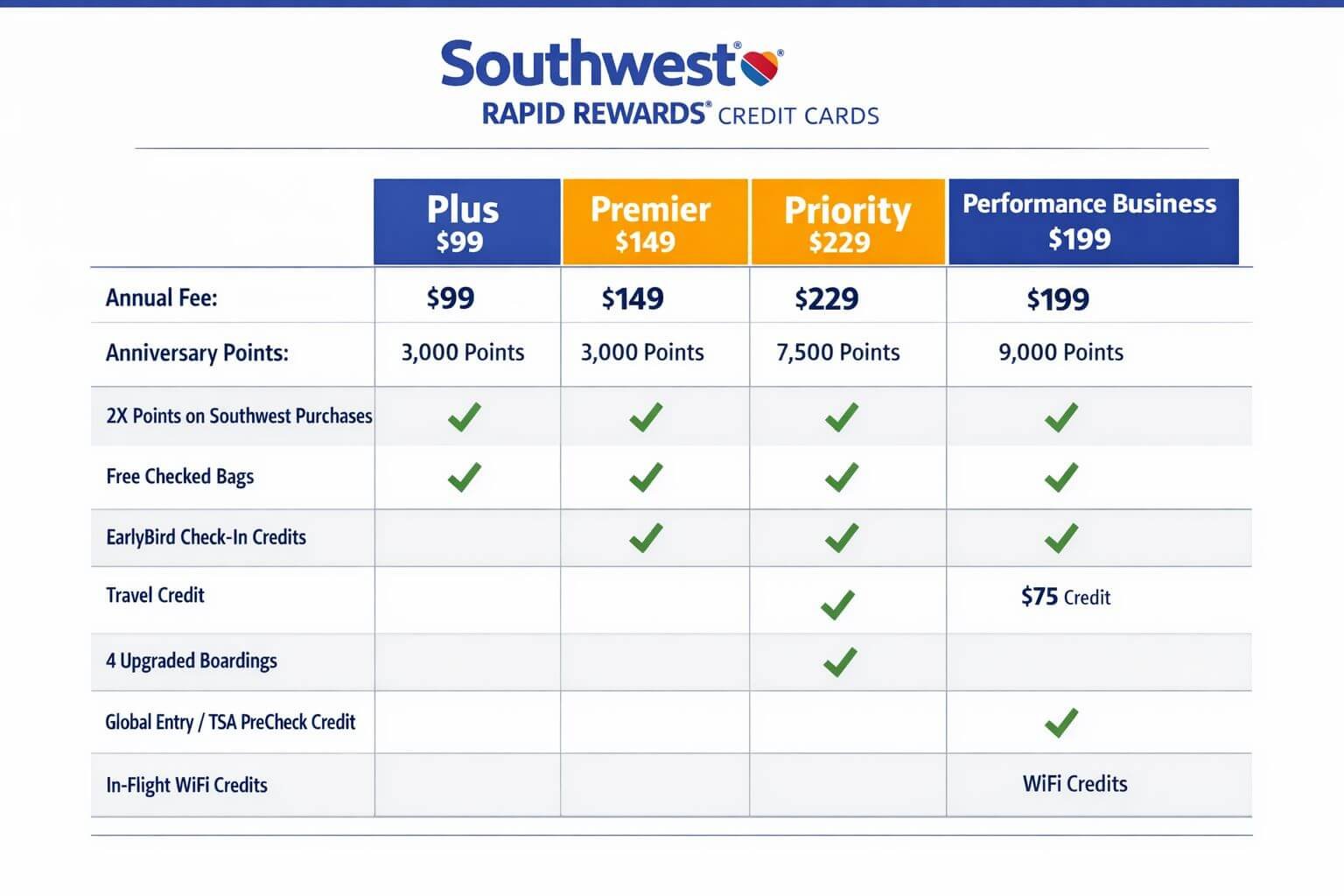
What Do You Actually Get for the Southwest Credit Card Annual Fee?
The short answer: more than you did two years ago, but only if you use the benefits actively. The 2025 card refresh (which most cardholders are experiencing for the first time on their 2026 anniversary dates) added perks that directly address Southwest’s biggest loyalty gap — seating and baggage.
Here’s a clean breakdown of what each personal card delivers in 2026:
| Card | Annual Fee | Anniversary Points | Free Checked Bag | Preferred Seating | Tier Qualifying Points Boost |
|---|---|---|---|---|---|
| Southwest Plus | $99 | 3,000 | No | No | 1,500 TQPs |
| Southwest Premier | $149 | 6,000 | No | No | 1,500 TQPs |
| Southwest Priority | $229 | 7,500 | 1st bag free (up to 9 people) | Unlimited upgrades (48 hrs out) | 10,000 TQPs |
| Performance Business | $199 | 9,000 | No | No | 1,500 TQPs + Global Entry credit |
What changed in 2026: The Priority Card’s free first checked bag benefit now covers up to nine passengers on the same reservation — a significant shift for families and group travelers. Combined with the January 2026 assigned seating rollout, the unlimited preferred seating upgrades (available 48 hours before departure) now translate to real seat selection value, not just boarding order.
Common mistake: Many cardholders forget that anniversary points post after the annual fee is charged and the statement closes — not on the card’s anniversary date itself. If you’re evaluating whether to cancel, check whether those points have already posted before making a decision. See our guide on credit card downgrade versus cancel decisions for the full framework.
How to Value Anniversary Points, Credits, and Companion Pass Progress
The southwest credit card annual fee only makes mathematical sense when you assign concrete values to each benefit. Here’s how to do that accurately.
Anniversary Points Value
Southwest Rapid Rewards points are generally valued at 1.3–1.5 cents per point (CPP) for domestic redemptions, based on typical cash fare comparisons. Using 1.35 CPP as a working estimate:
- 3,000 points (Plus) = ~$40 value
- 6,000 points (Premier) = ~$81 value
- 7,500 points (Priority) = ~$101 value
- 9,000 points (Performance Business) = ~$122 value
You may be interested



These are conservative estimates. If you consistently book higher-fare routes where points stretch further, your CPP may land closer to 1.5 cents, pushing these values higher.
Free Checked Bag (Priority Card)
Southwest still doesn’t charge for the first two bags on any ticket — but that applies to the cardholder. The 2026 Priority benefit extends the first bag free to up to nine people on the same reservation. For a family of four checking bags on a round trip, that’s potentially $200–$280 in avoided fees depending on the route, calculated at standard airline checked bag rates.
Preferred Seating Upgrades
With assigned seating now live across Southwest’s network, preferred and extra legroom seats carry real value. The Priority Card’s unlimited upgrades at the 48-hour window are worth roughly $15–$40 per flight depending on route length and seat availability. For a traveler flying eight Southwest segments per year, that’s $120–$320 in potential seat upgrade value.
Companion Pass Progress
This is where the math can shift dramatically. Every dollar spent on a Southwest card earns Qualifying Points (QPs) toward the 135,000-point threshold needed for Companion Pass. The Companion Pass lets a designated companion fly free (paying only taxes and fees) on every Southwest flight you take for the remainder of the calendar year plus the following full year. For our deeper breakdown of how to reach that threshold efficiently, see the Southwest Companion Pass 2026 guide.
If you’re within striking distance of Companion Pass, the annual fee on any Southwest card is almost always worth paying — the pass itself is worth hundreds to thousands of dollars depending on how often your companion travels with you.
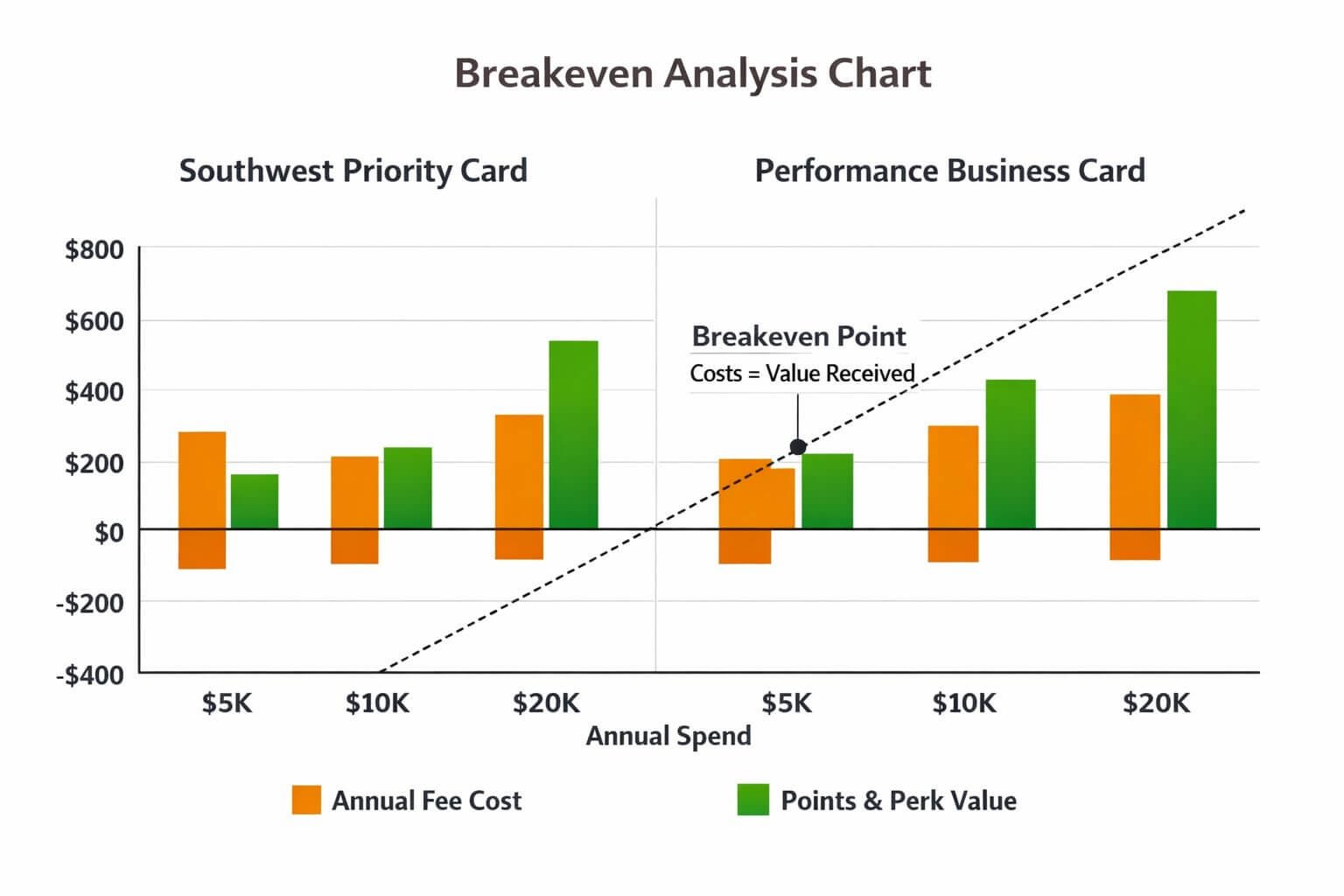
Breakeven Scenarios: When the Southwest Credit Card Annual Fee Pays Off
The breakeven point depends on three variables: which card you hold, how often you fly Southwest, and whether you’re pursuing Companion Pass. The scenarios below use conservative benefit valuations.
Southwest Priority Card ($229/year)
Scenario A — Moderate Southwest Flyer (6 round trips/year, family of 3)
| Benefit | Estimated Value |
|---|---|
| 7,500 anniversary points | $101 |
| Free checked bags (3 people × 6 RT) | $216 |
| Preferred seating (12 segments) | $180 |
| 10,000 TQP boost toward A-List | $50 (estimated) |
| Total estimated value | $547 |
| Annual fee | $229 |
| Net value | +$318 |
Scenario B — Solo occasional flyer (2 round trips/year, no bags)
| Benefit | Estimated Value |
|---|---|
| 7,500 anniversary points | $101 |
| Free checked bags (1 person × 2 RT) | $0 (Southwest is free anyway) |
| Preferred seating (4 segments) | $60 |
| Total estimated value | $161 |
| Annual fee | $229 |
| Net value | -$68 |
Takeaway: The Priority Card crosses its breakeven point clearly at four or more Southwest round trips per year, especially for travelers with companions or checked bags. Solo light flyers without bags are likely underwater.
Southwest Plus Card ($99/year)
For a solo traveler flying Southwest twice per year with no checked bags, the Plus Card’s 3,000 anniversary points (~$40) plus basic Rapid Rewards earning doesn’t fully offset the $99 fee on perks alone. The card makes sense primarily as a Companion Pass acceleration tool or for travelers who want to maintain a Southwest card relationship at the lowest cost. If you’re not flying Southwest at least three times per year, compare this against the best no-annual-fee travel cards before renewing.
Southwest Performance Business Card ($199/year)
For business owners who regularly put $20,000+ annually on Southwest routes:
- 9,000 anniversary points (~$122 value)
- Global Entry/TSA PreCheck credit ($100 every 4.5 years, so ~$22/year)
- 3x points on Southwest purchases (vs. 2x on Plus/Premier)
- 4x on Rapid Rewards hotel and car partners
The fee breaks even quickly for active Southwest business travelers. The card also earns toward Companion Pass separately from personal cards, making it a powerful pairing for households running a two-player credit card strategy.
When a General Travel Card Beats a Southwest Co-Brand in 2026
Southwest co-brand cards are purpose-built for one airline’s domestic network. That’s their strength and their limitation. A general travel card wins in these situations:
Choose a general travel card if:
- You fly multiple airlines and don’t have a clear Southwest preference
- You travel internationally (Southwest’s network is almost entirely U.S., Mexico, and Caribbean)
- You want transferable points that can move to multiple airline and hotel programs
- You value lounge access, trip delay insurance, or primary rental car coverage
- Your annual Southwest spend is under $5,000
For example, the Chase Sapphire Preferred ($95/year) earns 3x on dining and online groceries, offers Chase Ultimate Rewards transfers to Southwest (among 14 other partners), and provides strong travel protections. It’s a better fit for travelers who fly Southwest occasionally but don’t want to lock their earning into one program.
The Amex Gold Card ($325/year) earns 4x at restaurants and U.S. supermarkets and transfers Amex Membership Rewards points to a wide range of airline partners. For a full breakdown of whether that fee makes sense, see Is the Amex Gold Worth $325 in 2026?
For a broader comparison of co-brand versus transferable points strategies, the maximizing rewards with co-branded credit cards guide covers the tradeoffs in detail.
Important tradeoff to note: Southwest Rapid Rewards points are not transferable to other airlines. Once earned, they’re locked to Southwest redemptions. If Southwest devalues its award chart or changes Companion Pass rules — a real risk given the new loyalty leadership announced in April 2026 — those points lose value with no exit ramp. Transferable points (Amex, Chase, Capital One, Citi, Bilt) offer more flexibility by design. See how the major programs stack up in our transfer partners comparison for 2026.
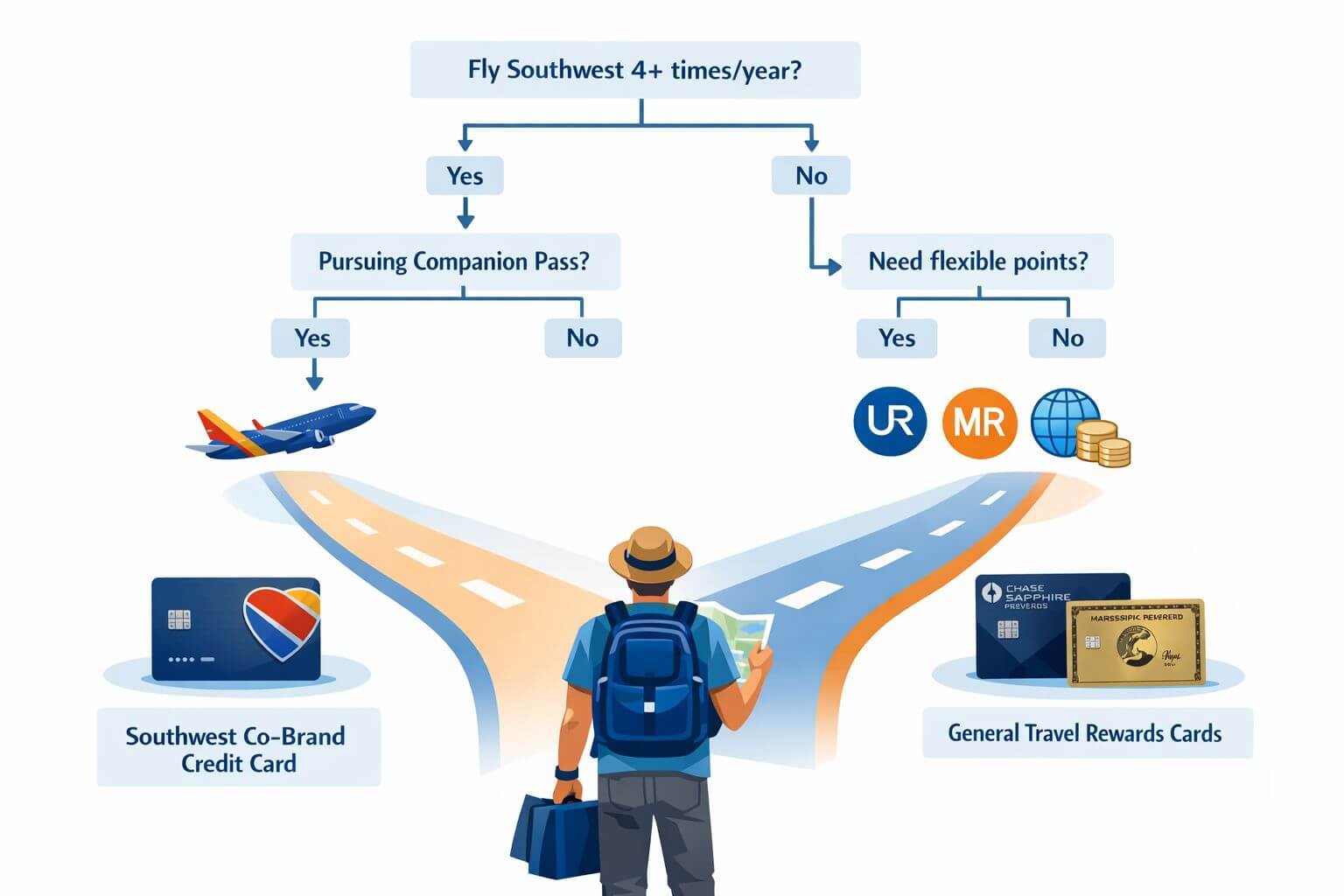
Keep, Downgrade, or Cancel? A Simple Decision Framework
When your annual fee posts, run through this framework before deciding.
Step 1: Calculate your actual benefit usage from the past year. Did you use the free checked bag benefit? Did you take the preferred seating upgrades? Did the anniversary points post? Add up the dollar value using the estimates above.
Step 2: Check your Companion Pass status.
- If you hold a Companion Pass: Keep the card. The pass multiplies every Southwest flight’s value.
- If you’re within 30,000 QPs of the threshold: Keep the card through the earning year.
- If you’re more than 50,000 QPs away with no clear path: Companion Pass shouldn’t be the primary justification.
Step 3: Apply the quick decision rules.
| Your Situation | Recommended Action |
|---|---|
| Fly Southwest 4+ times/year, use bags or seating | Keep Priority — fee pays off |
| Fly Southwest 2–3 times/year, solo, no bags | Downgrade to Plus or evaluate general card |
| Fly Southwest 1–2 times/year, no Companion Pass goal | Cancel or switch to a no-annual-fee card |
| Business owner, $15K+ Southwest spend/year | Keep Performance Business |
| Premier cardholder with no clear upgrade path | Move to Priority or Plus — Premier is the weakest value tier |
Step 4: Before canceling, call and ask for a retention offer. Chase periodically offers statement credits or bonus points to cardholders considering cancellation. This is worth a five-minute call before making a final decision. Also review the welcome bonus clawback rules to ensure you’re past any minimum holding periods.
For a broader look at whether premium card fees are justified across your entire wallet, the premium travel cards worth it in 2026 breakeven guide provides a useful framework.
Conclusion: Is the Southwest Credit Card Annual Fee Worth It in 2026?
For the right traveler, yes — clearly. The Priority Card at $229 delivers well over $400 in tangible value for families and frequent Southwest flyers who use the checked bag and seating benefits. The Performance Business Card makes strong sense for business owners with concentrated Southwest spend.
For occasional flyers, the math is tighter. If you’re flying Southwest twice a year as a solo traveler without checked bags, the fee is hard to justify on perks alone. In that case, a general travel card with transferable points gives you more flexibility and likely more overall value.
The one scenario where any Southwest card fee is almost always worth it: active Companion Pass pursuit. The pass’s value — a companion flying free on every flight for up to two years — dwarfs any annual fee when used consistently.
Your next steps:
- Calculate your actual benefit usage from the past 12 months using the value estimates in this guide.
- Check your Companion Pass progress in your Rapid Rewards account before making any card decisions.
- Compare the Priority Card against your current general travel card using the breakeven table above.
- Review the full Companion Pass strategy in our Southwest Companion Pass 2026 guide if you’re within reach of the threshold.
- If you’re reconsidering the card entirely, see the best travel credit cards for 2026 for alternatives that may serve your broader travel goals better.
Frequently Asked Questions
Q: What is the Southwest Priority Card annual fee in 2026? The Southwest Priority Card charges a $229 annual fee in 2026, increased from $149 as part of the 2025 card refresh. The fee increase came with enhanced perks including free first checked bag for up to nine travelers and unlimited preferred seating upgrades.
Q: Are Southwest credit card annual fees worth it if I only fly twice a year? For most solo travelers flying Southwest twice per year without checked bags, the fee is difficult to justify on perks alone. The 7,500 anniversary points on the Priority Card are worth roughly $100, leaving $129 in fee you’d need to recover from seating upgrades and other benefits. Consider downgrading to the Plus Card or switching to a no-annual-fee travel card.
Q: Does the Southwest Plus Card still make sense in 2026? The Plus Card ($99/year) makes sense primarily as a low-cost Companion Pass acceleration tool or for travelers who want to maintain a Southwest card at minimal cost. Its 3,000 anniversary points (~$40 value) don’t fully offset the fee on their own, so active Southwest flying is still required to justify it.
Q: How do anniversary points offset the Southwest credit card annual fee? Anniversary points post after your annual fee charges and your statement closes. At roughly 1.35 cents per point, the Priority Card’s 7,500 points are worth about $101 — reducing the effective annual fee to approximately $128 before counting any other perks.
Q: Is the Southwest Performance Business Card worth the annual fee? For business owners who regularly spend $15,000 or more annually on Southwest flights and related travel, the Performance Business Card ($199/year) pays off through 9,000 anniversary points (~$122), a Global Entry/TSA PreCheck credit, and higher earning rates on Southwest purchases. It also earns Qualifying Points toward Companion Pass independently from personal cards.
Q: Should I downgrade my Southwest Priority Card instead of canceling? Downgrading to the Plus Card preserves your Rapid Rewards account history and credit line while reducing your annual fee from $229 to $99. This makes sense if you want to maintain Southwest card earning at lower cost without closing the account. See the full downgrade versus cancel guide for step-by-step instructions.
Q: Does the Southwest credit card annual fee include Companion Pass? No. The Companion Pass is earned by accumulating 135,000 Qualifying Points in a calendar year — card spending contributes to that total, but the pass itself is a program milestone, not a card benefit. Holding a Southwest card accelerates Companion Pass progress; it doesn’t guarantee it.
Q: How does the Southwest Priority Card compare to Chase Sapphire Preferred for value? The Chase Sapphire Preferred ($95/year) offers transferable Chase Ultimate Rewards points usable across 14+ airline and hotel partners, stronger travel protections, and 3x on dining. The Priority Card ($229/year) is better for dedicated Southwest flyers who want Companion Pass progress, free bags, and preferred seating. If you split travel across airlines, the Sapphire Preferred offers more flexibility at a lower fee.
Q: Will Southwest Rapid Rewards points be devalued in 2026? No formal devaluation has been announced as of April 2026. However, Southwest hired a new loyalty chief with a background at United Airlines in April 2026, which some analysts view as a signal of potential program restructuring. Southwest Rapid Rewards points are not transferable to other programs, so the risk of devaluation is worth factoring into long-term card value assessments.
Q: What is the breakeven spend for the Southwest Priority Card? At 2x points per dollar on Southwest purchases (valued at 1.35 CPP), you’d need to spend roughly $8,500 annually on Southwest flights to generate $229 in points value from spend alone — before counting anniversary points, bag fees, or seating upgrades. With those perks included, the breakeven spend drops significantly for travelers who use all available benefits.


Content on Award Travel Hub is independently created by Award Travel Hub Editorial Desk and, where noted, reviewed by Award Travel Hub Review Desk. Some pages may contain affiliate links, but compensation does not determine our coverage, opinions, or methodology.