
Last updated: April 21, 2026
A transfer bonus can save thousands of points, but stacking transfer bonuses 2026 only works when the award is actually bookable. The smartest approach is simple: find award availability first, confirm the program rules, then decide whether the bonus improves the redemption enough to justify an irreversible transfer.
Key Takeaways
- Availability first, bonus second, is the best rule for intermediate points users.
- Transfer bonuses change the math by reducing how many transferable points you need, but they do not fix weak award availability.
- The best transfer bonus strategy in 2026 is usually strongest for Premium Cabin partner awards, selective short-haul Avios bookings, and a few hotel transfer bonus cases.
- Cross-bank overlap matters more than “stacking” within a single account. A Chase bonus and an earlier Amex or Citi bonus to the same ecosystem can help households with balances across banks.
- Irreversible transfers, devaluation risk, and fuel surcharges can quickly erode bonus value.
- Portal bookings can be better when award space is poor or the transfer partner uses dynamic pricing.
- Citi and Chase both ran Wyndham bonuses in March 2026, and Chase launched a 20% bonus to British Airways, Iberia, and Aer Lingus Avios on March 1, 2026. Amex also had a 15% Avianca LifeMiles bonus active in March 2026.
- Low-value hotel transfers usually do not become good just because a bonus exists.
- Use a simple decision framework: bookable award + strong redemption math + acceptable fees + low regret if plans change.
- For a broader program context, compare your options in ATH’s bank transfer partners guide for 2026.
Quick Answer
Stacking transfer bonuses 2026 is worth it when multiple banks offer overlapping bonuses to a partner ecosystem you can use right now, and the bonus lowers your transferable points cost enough to beat portal or cash alternatives. It is not worth chasing when you have not confirmed award space, when the partner adds heavy surcharges and fees, or when the transfer creates orphan miles that may lose value in a future devaluation.
What does stacking transfer bonuses 2026 actually mean?
In practice, stacking transfer bonuses 2026 usually means using overlapping bonuses across different banks and related loyalty ecosystems, not multiplying two bonuses on one single transfer. Most programs do not allow one to transfer and receive two bank bonuses at the same time.
Examples that matter in 2026:
- Avios ecosystem: Chase launched a 20% bonus to British Airways, Iberia, and Aer Lingus Avios on March 1, 2026. That matters because Avios can often be transferred between related Avios programs, offering more ways to book on partner airlines.
- Wyndham overlap: Citi ran a 25% Wyndham bonus from Feb. 22 to March 21, 2026, and Chase launched a Wyndham bonus from March 5 to March 31, 2026.
- LifeMiles overlap by timing: Amex had a 15% bonus to Avianca LifeMiles through March 28, 2026, following Capital One’s previous Avianca bonus.
Decision rule: Treat stacking as a portfolio timing strategy, not a magic multiplier.
Best for
- Households with balances across Amex points, Chase points, Capital One miles, Citi points, and Bilt points
- Travelers booking premium cabin awards through partner airlines
- Readers who can move quickly when award availability appears
Not for
- Anyone transferring speculatively
- Travelers who mainly redeem through bank travel portals
- Anyone without flexibility on dates or positioning flights
How do transfer bonuses really change the math?
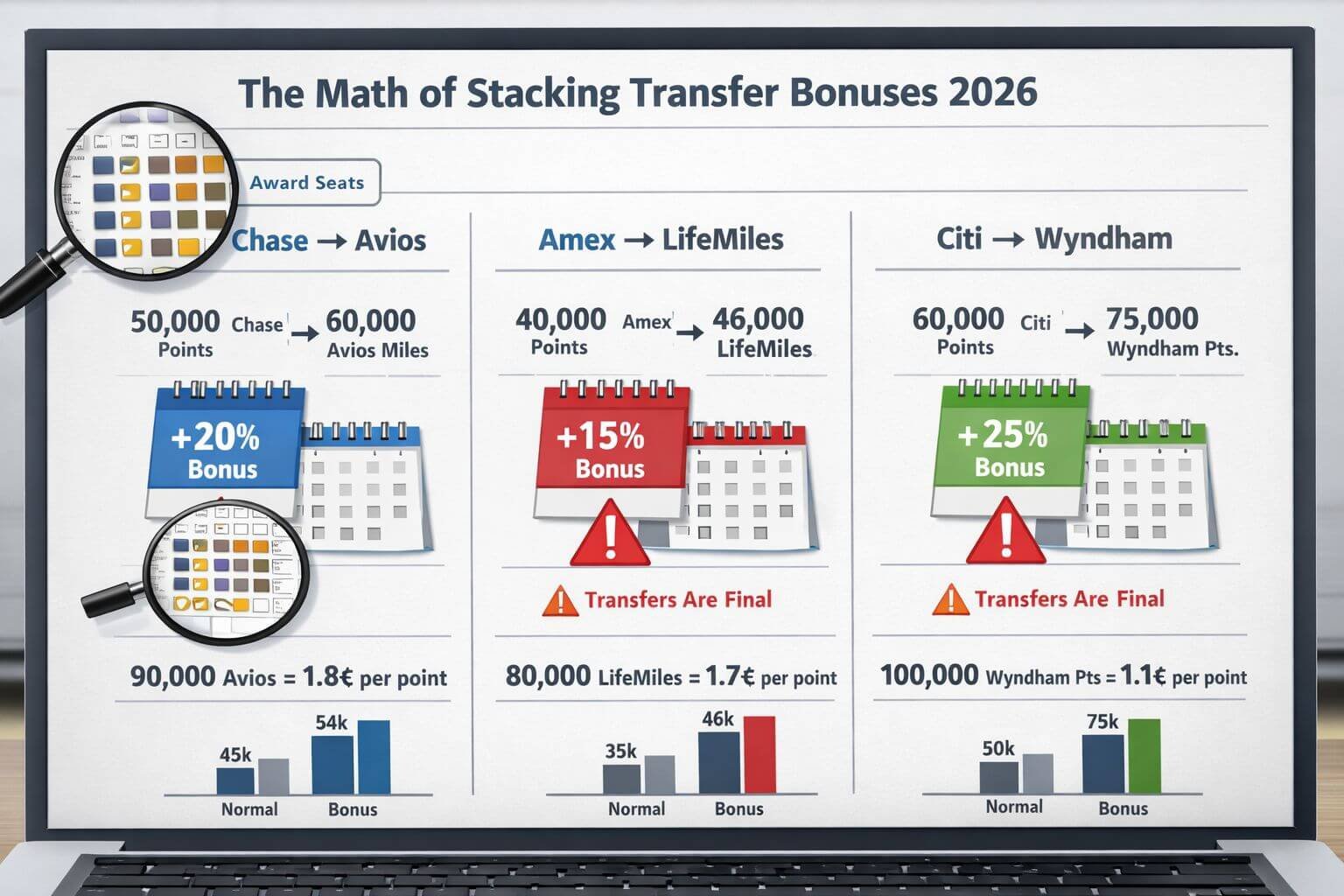
Transfer bonuses reduce the number of bank points needed for the same award. The right way to measure the improvement is to compare pre-bonus bank points, bonus-adjusted bank points, and final cents per point (CPP).
You may be interested



Use this formula:
- Bank points needed = partner points price ÷ (1 + bonus percentage)
- CPP = cash price ÷ bank points used
Real-world examples across major banks
Assumptions: cash prices are estimates for comparable itineraries or stays booked at the same time. Taxes and surcharges are called out separately because they matter.
| Scenario | Partner price | Bonus | Bank points needed | Est. cash price | Est. fees | CPP on bank points |
|---|---|---|---|---|---|---|
| Chase to British Airways Avios, short-haul Europe flight | 9,000 Avios | 20% | 7,500 Chase points | $135 | $25 | 1.47 |
| Chase to Iberia Avios, business class off-peak | 34,000 Avios | 20% | 28,334 Chase points | $650 | $120 | 1.88 |
| Amex to LifeMiles, U.S.-Europe Star Alliance business | 63,000 miles | 15% | 54,783 Amex points | $2,200 | $50 | 3.92 |
| Capital One to JAL, business class example | 50,000 miles | 30% | 38,462 Capital One miles | $1,900 | $180 | 4.47 |
| Citi to Wyndham, 15k hotel night | 15,000 points | 25% | 12,000 Citi points | $120 | $0 | 1.00 |
| Chase to Wyndham, 15k hotel night | 15,000 points | 30% | 11,539 Chase points | $120 | $0 | 1.04 |
What these examples show:
- Airline sweet spots often improve meaningfully with a bonus.
- Hotel transfers need a strong hotel redemption to become compelling.
- A big bonus can still produce a weak result if the underlying award chart or dynamic pricing is poor.
For more examples of valuation, see ATH’s 2026 guide to cents per point.
When is stacking transfer bonuses 2026 worth chasing?
It is worth chasing when the bonus improves a redemption you were already ready to book. The strongest cases are usually premium cabin awards, select Avios short-haul flights, and a few hotel redemptions where cash prices are very high.
Three strong use cases
1. Premium cabin partner bonus with low surcharges
This is often the best use of points. A 15% Amex bonus to LifeMiles can materially lower the cost of a Star Alliance business class deal, and LifeMiles often avoids the worst fuel surcharges.
Choose this if:
- Award availability is already visible
- Taxes are reasonable
- The route is hard to book through a portal at good value
Relevant ATH guides:
- Amex LifeMiles 15% Transfer Bonus: Best Sweet Spots (2026)
- Best Use of 100,000 Points: Transfer Partner Value 2026
2. Avios for short-haul or off-peak business class
Chase’s March 2026 20% bonus to British Airways, Iberia, and Aer Lingus Avios improved several common sweet spots. This can work well for short-haul economy and some Iberia business class deals.
Choose this if:
- You understand Avios pricing differences by program
- You checked alliance partners and segment pricing
- You can avoid high British Airways surcharges when possible
Helpful reading:
- Chase to Avios 20% Transfer Bonus March 2026 Guide
- How to Maximize Chase to Avios 30% Transfer Bonus Before It Ends
3. Hotel-heavy portfolios with a specific redemption in hand
Capital One’s 30% bonus to Preferred Hotels & Resorts I Prefer was notable because it gave hotel-focused users another targeted option in March 2026. Citi and Chase also overlapped on Wyndham bonuses.
Choose this if:
- The hotel night price is fixed and valuable
- You have already compared cash rates and portal rates
- You are not giving up a better airline transfer opportunity
When do transfer bonuses create bad decisions?
Transfer bonuses create bad decisions when they trigger false urgency. A bonus deadline is not the same as a good booking opportunity.
Common situations where the strategy breaks:
- No award availability: The most common mistake on social media is moving points before confirming that the award can be ticketed.
- Dynamic pricing programs: A transfer bonus does little if award prices jump constantly.
- Fuel surcharges: A “discounted” award can still be expensive out of pocket.
- Devaluation risk: Programs can change award charts or partner pricing with little notice.
- Weak hotel ratios: Some hotel transfers remain poor even after a 25% or 30% bonus.
- Orphan miles: A transfer can leave a small leftover balance with no easy use.
A transfer bonus improves the math only after a specific award passes the availability, fee, and fallback tests.
Common mistake: Seeing “30% bonus” and assuming it is automatically better than booking through a portal at 1.25 to 1.5 cpp or paying cash and saving points for later.
If you need a broader timing framework, start with ATH’s transfer bonus strategy guide for 2026 and then compare programs in Comparing Transfer Partners 2026: Chase vs Amex vs Citi vs Capital One.
What is the smarter decision framework for stacking transfer bonuses 2026?
The best framework is short: search, price, compare, transfer, ticket. If one step fails, stop.
Step-by-step checklist
Search for award availability first
- Confirm the exact flight or hotel is bookable.
- Check for married segments, stopovers, and partner inventory quirks if relevant.
Price the same trip in at least two ways
- Partner award cost
- Bank portal price
- Cash price, if realistic
Adjust for the bonus
- Convert partner points into required bank points.
- Include surcharges and fees.
Check transfer timing and rules
- Is the transfer instant or delayed?
- Can the award be held?
- What are the cancellation terms?
Review downside risk
- Could the partner devalue soon?
- Will a schedule change create a hard-to-fix problem?
- Are you relying on positioning flights?
Transfer only what you need
- Avoid speculative top-ups unless the program is a regular keeper for your travel pattern.
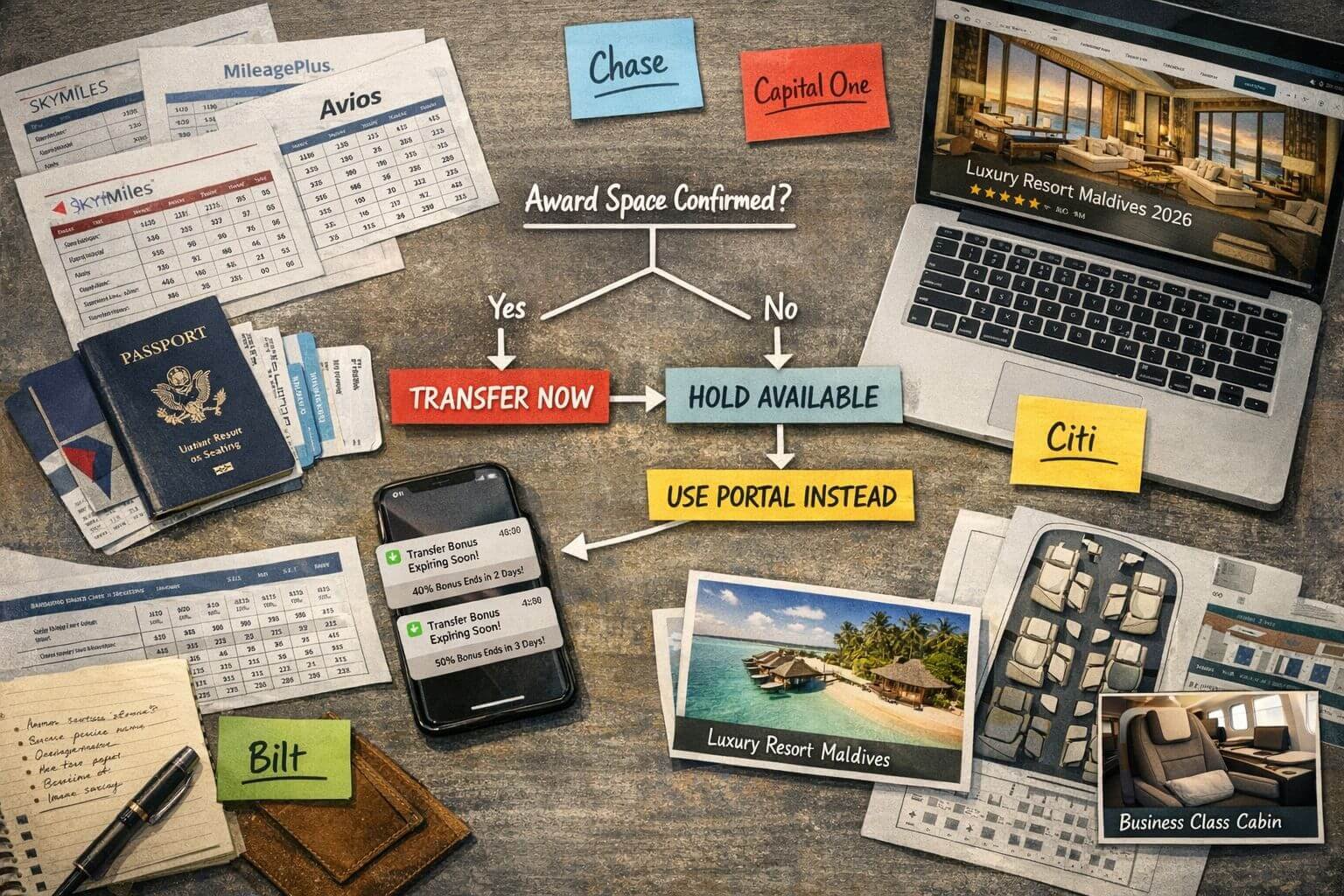
A quick decision tree
- Choose transfer now if: award space is live, transfer is fast, fees are acceptable, and CPP beats your portal alternative.
- Choose wait if: space is unstable, the bonus is modest, or you cannot use the miles soon.
- Choose portal or cash if the partner price is volatile or the transfer would result in unused points.
Which banks and bonus types are usually most useful?
Not all transfer bonuses are equal. In 2026, the most useful bonuses are usually the ones tied to strong airline sweet spots or a clear near-term hotel redemption.
Broad patterns that matter
- Amex points: Often useful for international airline partners. The March 2026 LifeMiles bonus is a good example.
- Chase points: Strong when a Chase transfer bonus aligns with Avios, Flying Blue, or Aeroplan-style use cases.
- Capital One miles: Helpful when a partner has fewer bonus promotions or a strong niche award, such as JAL-focused opportunities.
- Citi points: Best when Citi has a unique or timely partner path, but hotel bonuses need stricter math.
- Bilt points: Most useful when Rent Day creates short windows for outsized value.
Rule of thumb: Airline bonuses usually beat hotel bonuses for value, unless the hotel redemption is unusually expensive in cash.
For bank-specific comparisons, use ATH’s Bank Transfer Partners Guide 2026 and Capital One Travel vs Transfer Partners.
How should intermediate users compare bonuses across banks?
Compare bonuses by net booking value, not by headline percentage. A 15% bonus to a strong partner can beat a 30% bonus to a weak one.
Use these filters in order:
- Can the award be booked now?
- How many bank points will the bonus save?
- What are the total taxes, fuel surcharges, and fees?
- How easy is cancellation or redeposit?
- Will the transfer leave unusable leftovers?
Simple compare-options example
Suppose a traveler wants a business class deal to Europe:
- Option A: Amex to LifeMiles with 15% bonus, 63,000-mile award, low fees
- Option B: Chase portal at 1.25 cpp with no transfer risk
- Option C: Cash fare sale
If the LifeMiles award is available and transfers quickly, Option A is often best. If the award is phantom or delayed, the portal may be the safer booking strategy.
What are the biggest pitfalls and edge cases?
The main pitfalls are transfer delays, phantom award availability, and booking the wrong program inside the same alliance. Intermediate users often know the partner airlines, but miss one program-specific rule.
Watch for these edge cases:
- Phantom availability: Some search tools show seats that cannot be ticketed.
- Married segments: A route may be priced only as part of a longer itinerary.
- Positioning flights: A cheap long-haul award can become a bad value after adding separate domestic flights.
- Household point fragmentation: Splitting balances across banks helps flexibility, but can also leave each account slightly short.
- Program changes: Citi’s Aeromexico removal in January 2026 is a reminder that partner lists can change.
If you are booking a partner with poor change policies, review ATH’s best award cancellation and change rules. If Emirates-style pricing changes worry you, ATH’s Emirates devaluation coverage should be part of your risk check before transferring.
Related reading
- Transfer Bonus Strategy: When to Transfer Points in 2026
- Bank Transfer Partners Guide 2026 | Points Currencies
- Capital One Travel vs Transfer Partners
- Maximizing Aeroplan Awards with Current Chase and Bank Transfer Bonuses
- Citi ThankYou Wyndham 25% Transfer Bonus: Worth It?
FAQ
Can you actually stack two transfer bonuses on one transfer?
Usually no. Most of the time, stacking means using overlapping bonuses from different banks or related programs, not applying two bonuses to a single transfer.
Is the 2026 stacking transfer bonus mainly for flights or hotels?
Flights are usually the better fit. Premium cabin awards and select short-haul sweet spots tend to produce stronger value than hotel transfers.
Should points be transferred before award space appears?
No. Award Travel Hub’s practical rule is availability first, bonus second.
Are transfer bonuses better than booking through a portal?
Sometimes. A transfer bonus is better only when the award is bookable, fees are reasonable, and the final CPP beats your portal value.
Which 2026 bonus types looked strongest?
Avios-related airline bonuses, LifeMiles airline bonuses, and a few targeted hotel bonuses stood out more than generic hotel transfers.
Do transfer bonuses protect against devaluations?
No. After transfer, points are exposed to the partner program’s pricing changes and rules.
Are small bonuses like 15% still worth using?
Yes, if the underlying redemption is already strong. A 15% bonus to a great partner can beat a 30% bonus to a poor one.
What if the transfer is not instant?
If the transfer is not instant, the risk goes up. In that case, use programs with holds when possible or consider a portal booking instead.
Conclusion
Stacking transfer bonuses 2026 is less about chasing promotions and more about timing a transfer around a bookable, high-value redemption. The smartest users do not start with the bonus. They start with award availability, program rules, surcharges and fees, and a fallback option.
The practical next steps are clear:
- Check the exact trip you want to book.
- Compare the partner award against the portal and cash options.
- Adjust the math for the active bonus.
- Transfer only when the booking is ready to be ticketed.
- Keep a diversified points portfolio so future overlaps across Amex, Chase, Capital One, Citi, and Bilt stay useful.
If a bonus is live now, start with the most relevant partner guide for your trip, then use ATH’s broader transfer-partner comparisons to confirm it is still the best use of points.


Content on Award Travel Hub is independently created by Award Travel Hub Editorial Desk and, where noted, reviewed by Award Travel Hub Review Desk. Some pages may contain affiliate links, but compensation does not determine our coverage, opinions, or methodology.