

Last updated: May 5, 2026
Quick Answer
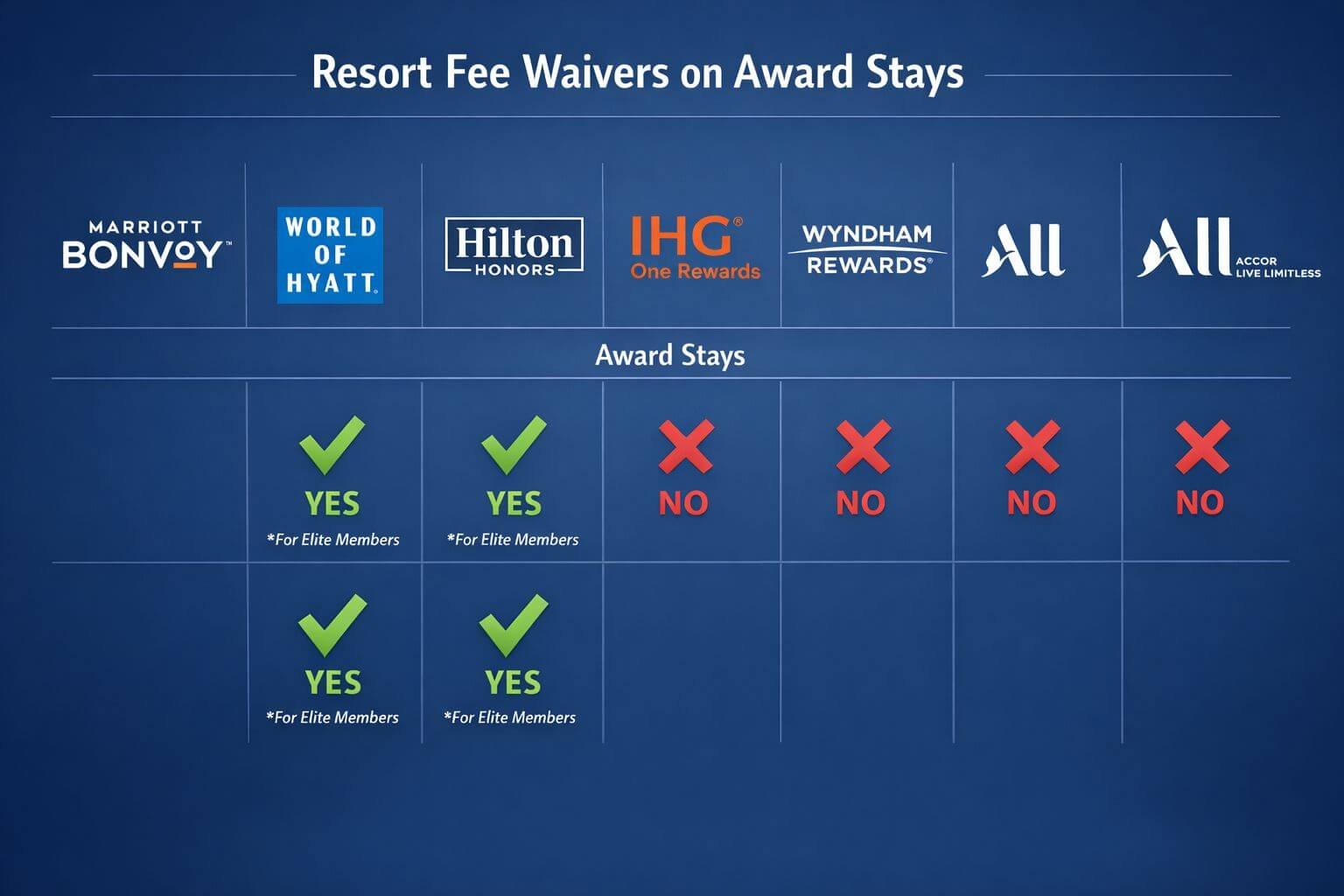
Resort fees on award stays vary dramatically by hotel chain. Hilton waives all resort fees on points bookings regardless of elite status, while Marriott charges full resort fees even on award nights. Hyatt waives fees for Globalist members on cash stays, but policies on award bookings remain inconsistent. IHG and Wyndham officially waive fees on award stays, but enforcement at individual properties can be spotty. These mandatory charges—often $30-60 per night—can destroy the value proposition of “free” hotel nights, turning a seemingly strong redemption into a poor use of points.
Key Takeaways
- Hilton is the clear winner: All resort fees are waived on Hilton Honors award stays, regardless of elite status or property type.
- Marriott charges full fees: Bonvoy properties can (and do) charge resort fees on award nights, adding $40-50+ per night to “free” stays.
- Hyatt’s policy is murky: Globalist members get fee waivers on paid stays, but award booking policies vary by property, and recent changes suggest potential reductions.
- IHG and Wyndham officially waive fees: Both chains state resort fees should not apply to award stays, but individual properties don’t always comply without pushback.
- Resort fees average $25-50 per night: A five-night award stay can easily cost $200-300 in mandatory fees at chains that don’t waive them.
- CPP calculations must include fees: When resort fees apply, your effective cents-per-point value drops significantly—sometimes below paying cash.
- Check fee policies before transferring points: Always verify a specific property’s resort fee policy and whether it applies to award stays before moving points from Amex, Chase, or other transferable points programs.
How Resort Fees Work on Award Bookings
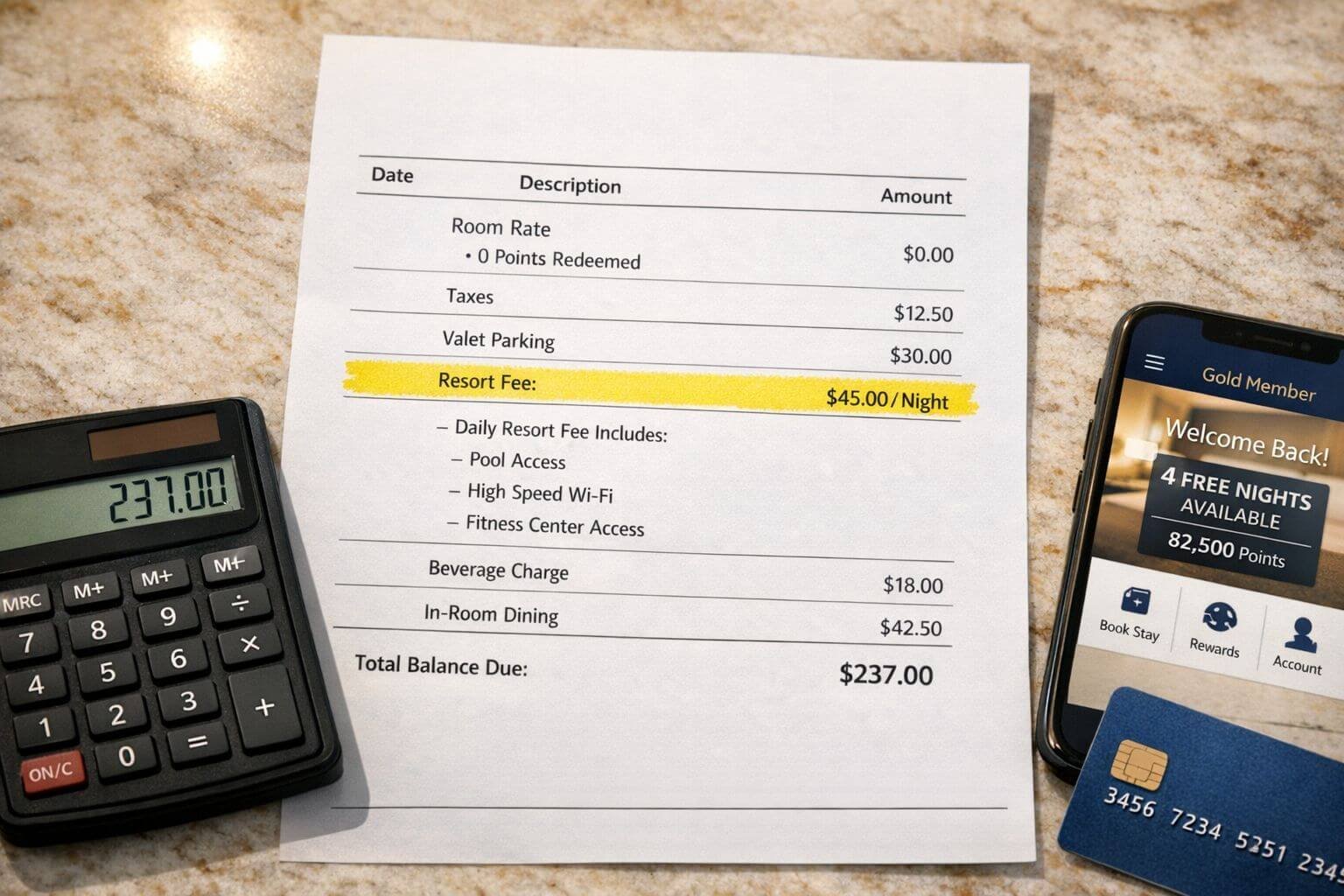
Resort fees (also called destination fees or amenity fees) are mandatory daily charges that hotels add to cover amenities such as pool access, Wi-Fi, fitness centers, and newspapers. These fees typically range from $15 to $60 per night, with an average of $25-50 at major chains.
The key issue: most hotel chains treat award stays differently from paid stays when it comes to these fees. While some programs treat points redemptions as paid bookings and waive fees accordingly, others view award nights as “complimentary” stays that still incur mandatory charges.
This creates a confusing landscape where identical hotels under different brands have completely opposite policies. A Hilton property in Las Vegas will waive a $45 resort fee on a 95,000-point award night, while a comparable Marriott property across the street will charge the full $50 fee on an 85,000-point redemption.
Why hotels charge resort fees in the first place: These unbundled fees allow properties to advertise lower base room rates in search results and comparison tools. A $200 room with a $40 resort fee appears as $200 in initial searches, ranking higher than a $240 all-inclusive rate—even though the final cost is $240 either way.
The Federal Trade Commission implemented a full-price disclosure rule in May 2025, requiring upfront fee transparency, but it only mandates disclosure; it doesn’t eliminate the fees themselves. Hotels must now show the full price, including resort fees, earlier in the booking process, but the charges remain.
The Impact on Award Value
Resort fees dramatically affect your redemption math. Consider a standard award night calculation:
You may be interested



Without resort fees:
- Cash rate: $300
- Award rate: 50,000 points
- Cents per point (CPP): 0.6 cents
With $45 resort fee:
- Effective cash rate: $255 (since you still pay $45)
- Award rate: 50,000 points + $45 cash
- Effective CPP: 0.51 cents
That resort fee just reduced your redemption value by 15%. Over a five-night stay, you’re paying $225 out of pocket for what you thought was a “free” vacation. For a detailed breakdown of how to calculate true redemption value, see our guide to cents-per-point math.
Which Major Hotel Chains Waive Resort Fees on Award Stays
Policy clarity varies significantly across programs. Here’s the current state of play as of mid-2026:
Hilton Honors: Complete Fee Waiver
Policy: Hilton waives all resort fees on award stays, regardless of elite status.
Coverage: Applies to standard award nights booked with Hilton Honors points across all brands (Waldorf Astoria, Conrad, Hilton, DoubleTree, Embassy Suites, etc.).
Reliability: Consistent implementation across properties. This is Hilton’s official policy and is honored system-wide.
Example: The Hilton Hawaiian Village in Waikiki charges a $50 daily resort fee on paid stays. On a standard award night (80,000 points), this fee is waived in full. Over five nights, that’s $250 in savings beyond the points value.
Bottom line: Hilton offers the cleanest, most traveler-friendly resort fee policy for award stays. This makes Hilton points particularly valuable at resort properties where fees are highest. For strategies to maximize Hilton redemptions, check our hotel transfer partners directory.
World of Hyatt: Elite-Dependent and Inconsistent
Official policy: Hyatt Globalist members receive waived resort fees on eligible stays.
The complication: This benefit officially applies to paid stays, and implementation on award bookings varies by property. Recent reports from February-March 2026 suggest some properties may be moving from 100% fee waivers to 50% waivers for Globalists, though data remains conflicting.
Award stay reality: Many Hyatt properties do waive resort fees for Globalist members on award stays, but it’s not guaranteed and requires confirmation at the time of booking.
Non-elite members: Lower-tier members (Discoverist, Explorist) and members with no status typically pay full resort fees on award stays.
Example: The Hyatt Regency Maui charges a $50 daily resort fee. A Globalist booking a 25,000-point award night may see the fee waived, but should confirm at booking and check-in. Non-Globalists will pay the full $50 per night.
Recent changes: Hyatt is implementing significant award chart changes in May 2026, with Category 8 properties jumping from 45,000 to 75,000 points at peak. While these changes don’t directly affect resort fee policies, they do impact overall redemption value calculations.
Bottom line: Hyatt’s resort fee policy on award stays is the least transparent among major chains. Globalists have the best chance of waivers, but confirmation is essential before booking.
Marriott Bonvoy: Fees Apply to Award Stays
Policy: Marriott properties can charge resort fees on award stays. The program explicitly allows this in its terms.
Coverage: Applies across all Marriott brands (Ritz-Carlton, St. Regis, Marriott, Westin, Sheraton, etc.).
Elite status: Even top-tier Titanium and Ambassador Elite members pay resort fees on award stays. Marriott’s franchise agreement gives the company the right to waive fees for elite members but chooses not to implement this benefit.
Average fees: NerdWallet’s 2026 analysis found Marriott properties average $50 in resort fees—the highest among major chains.
Example: The Marriott Marquis San Diego Marina charges a $49 daily resort fee. On a 50,000-point award night, you’ll pay the full $49. Over a week-long stay, that’s $343 in out-of-pocket costs on top of 350,000 points.
Recent updates: Marriott expanded its free night certificate top-up feature in March 2026, allowing members to add up to 25,000 points to certificates (up from 15,000). However, this doesn’t change resort fee policies—fees still apply to all award redemptions.
Bottom line: Marriott has the least favorable resort fee policy for award stays among major chains. Factor these mandatory charges into your redemption calculations, especially at resort properties where fees are highest.
IHG One Rewards: Official Waiver, Inconsistent Enforcement
Policy: IHG’s official terms state that resort fees should be waived on award stays.
The problem: Individual properties don’t always honor this policy automatically. Members frequently report being charged resort fees at check-in or checkout, then needing to contact IHG customer service or show the terms to hotel staff.
Coverage: Should apply to standard award nights across InterContinental, Kimpton, Hotel Indigo, Holiday Inn, and other IHG brands.
Average fees: NerdWallet found IHG properties average $32.57 in resort fees.
Enforcement strategy: If charged a resort fee on an award stay, politely reference IHG’s terms and request the charge be removed. If the property refuses, contact IHG customer service after checkout for a refund.
Example: The InterContinental San Diego lists a $35 daily resort fee. On a 70,000-point award night, this fee should be waived per IHG policy, but you may need to proactively request the waiver at check-in.
Bottom line: IHG has a traveler-friendly policy on paper, but requires vigilance to ensure properties actually honor it. Always confirm a fee waiver at booking and check-in.
Wyndham Rewards: Official Waiver, Property-Level Gaps
Policy: Wyndham’s official terms state that resort fees are waived on award stays.
Implementation: Similar to IHG, individual properties sometimes charge fees despite the official policy. Members report needing to show Wyndham’s terms or contact customer service to enforce waivers.
Coverage: Should apply to award nights at Wyndham, Ramada, Days Inn, La Quinta, and other Wyndham brands.
Average fees: NerdWallet found Wyndham properties average $25 in resort fees—the lowest among major chains.
Recent transfer bonus: Chase offered a 30% transfer bonus to Wyndham in March 2026, making Wyndham points particularly valuable. However, gaps in the resort fee waiver policy remain.
Bottom line: Wyndham has a good official policy but inconsistent execution at the property level. Come prepared with documentation and be ready to escalate if needed.
Accor Live Limitless: Property-Specific Policies
Policy: Accor leaves resort fee decisions to individual properties. There is no chain-wide policy on award stay fee waivers.
Coverage: Varies by property across Raffles, Fairmont, Sofitel, MGallery, Novotel, and other Accor brands.
Research requirement: Check each property’s specific resort fee policy and whether it applies to award stays before booking.
Bottom line: Accor requires the most research before booking. Don’t assume fees will be waived on award stays.
Quick Reference Table
| Hotel Chain | Resort Fees on Award Stays | Elite Status Impact | Reliability |
|---|---|---|---|
| Hilton Honors | Waived | None needed | Excellent |
| World of Hyatt | Varies (Globalist may get waiver) | High | Inconsistent |
| Marriott Bonvoy | Charged | None | Consistent (fees apply) |
| IHG One Rewards | Should be waived | None needed | Requires enforcement |
| Wyndham Rewards | Should be waived | None needed | Requires enforcement |
| Accor Live Limitless | Property-specific | Varies | Research required |
Real Booking Examples: When Award Nights Still Cost Hundreds in Fees
Abstract policy descriptions don’t capture the real financial impact of resort fees on award stays. Here are concrete examples showing how fees change redemption value:
Example 1: Las Vegas Five-Night Stay
Scenario: Five-night stay in Las Vegas during a conference.
Marriott Option (JW Marriott Las Vegas):
- Cash rate: $250/night = $1,250 total
- Award rate: 50,000 points/night = 250,000 points
- Resort fee: $45/night = $225 total (not waived)
- Out-of-pocket cost: $225
- Effective value: ($1,250 – $225) ÷ 250,000 = 0.41 CPP
Hilton Option (Hilton Grand Vacations on the Strip):
- Cash rate: $220/night = $1,100 total
- Award rate: 80,000 points/night = 400,000 points
- Resort fee: $45/night = $225 total (waived on award stay)
- Out-of-pocket cost: $0
- Effective value: $1,100 ÷ 400,000 = 0.275 CPP
Analysis: Even though Marriott requires fewer points per night, the $225 in resort fees makes it a worse deal than Hilton. The Marriott redemption costs real money and delivers only 0.41 CPP, while Hilton is truly free (though at lower CPP due to higher point cost).
Better strategy: If you value avoiding out-of-pocket costs, choose Hilton. If you’re optimizing pure CPP and don’t mind paying fees, Marriott edges ahead—but only slightly.
Example 2: Hawaii Resort Week
Scenario: Seven-night family vacation in Maui.
Hyatt Option (Hyatt Regency Maui) – Non-Globalist:
- Cash rate: $450/night = $3,150 total
- Award rate: 25,000 points/night = 175,000 points
- Resort fee: $50/night = $350 total (not waived for non-elite)
- Out-of-pocket cost: $350
- Effective value: ($3,150 – $350) ÷ 175,000 = 1.6 CPP
Hyatt Option (Same Property) – Globalist Member:
- Cash rate: $450/night = $3,150 total
- Award rate: 25,000 points/night = 175,000 points
- Resort fee: $50/night = $350 total (may be waived, requires confirmation)
- Out-of-pocket cost: $0 (if waiver confirmed)
- Effective value: $3,150 ÷ 175,000 = 1.8 CPP
Analysis: The $350 in resort fees reduces redemption value by 0.2 CPP for non-elite members. For a family vacation, that’s $350 in unexpected costs. Globalist status could save this amount, making it worth pursuing for frequent resort travelers.
Example 3: Orlando Theme Park Stay
Scenario: Four-night Disney World vacation.
IHG Option (Kimpton Grand Bohemian Orlando):
- Cash rate: $280/night = $1,120 total
- Award rate: 60,000 points/night = 240,000 points
- Resort fee: $35/night = $140 total (should be waived per policy)
- Out-of-pocket cost: $0 (if policy enforced)
- Effective value: $1,120 ÷ 240,000 = 0.47 CPP
If resort fee is charged (enforcement failure):
- Out-of-pocket cost: $140
- Effective value: ($1,120 – $140) ÷ 240,000 = 0.41 CPP
Analysis: The $140 difference between proper policy enforcement and being charged fees represents a 13% reduction in redemption value. This example shows why it’s worth the effort to confirm fee waivers at booking and check-in.
When to Pay Cash, Use Points, or Pick Another Hotel
Resort fees fundamentally change the decision framework for award bookings. Here’s how to evaluate your options:
Decision Framework
Choose to pay cash when:
- Resort fees would apply to award stays but not paid stays (rare, but check elite benefits)
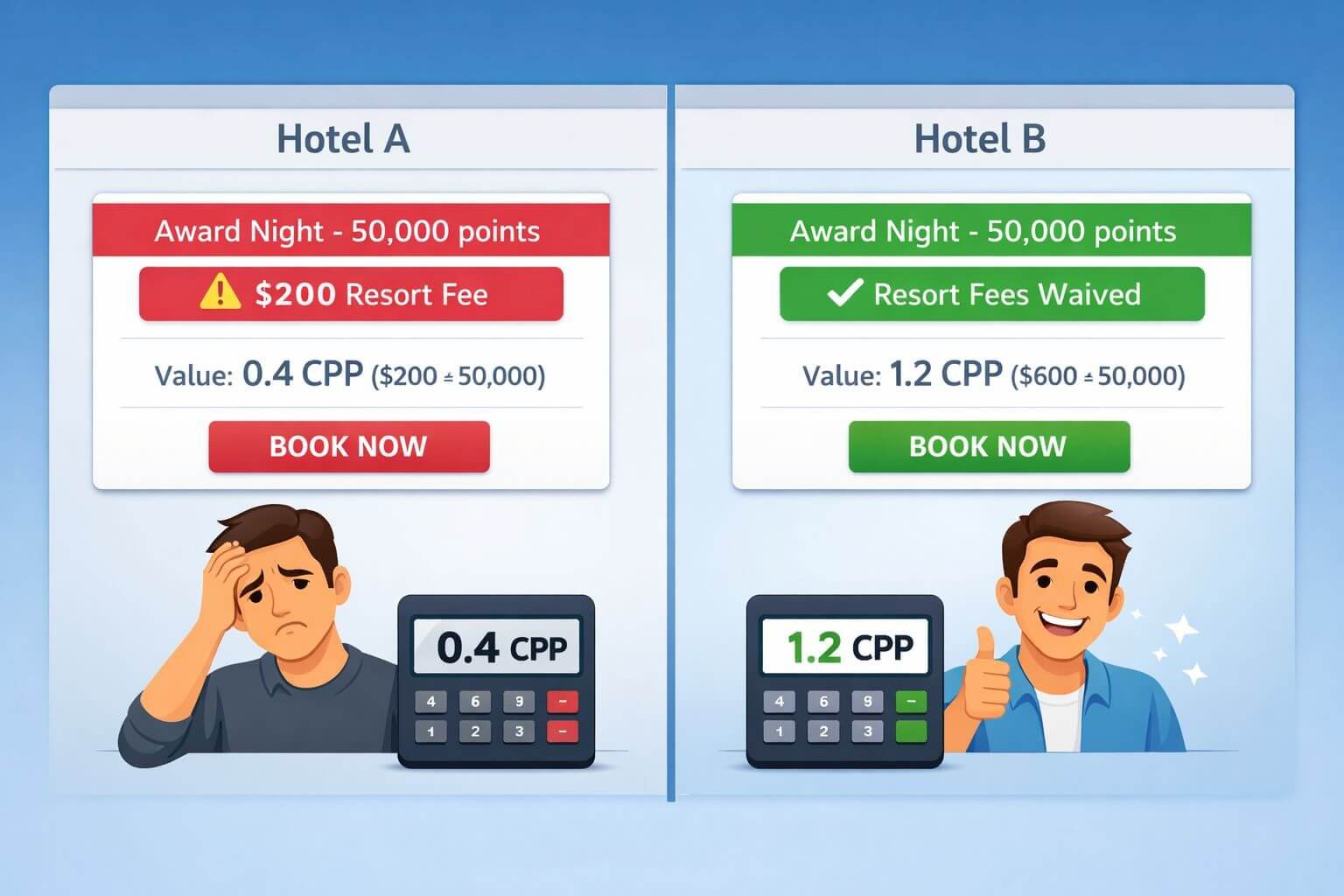
- The cash rate minus resort fee, divided by points required, yields CPP below your minimum threshold (typically 0.5 CPP for hotel points)
- You’re earning significant points or elite-qualifying nights on the paid stay
- Cash rates are unusually low (off-season, sales), and points costs are high (peak pricing)
Use points when:
- The hotel waives resort fees on award stays (Hilton, IHG, Wyndham)
- You’re a Hyatt Globalist and can confirm a fee waiver
- Cash rates are extremely high (holiday periods, events), making even fee-inclusive redemptions good value
- You have expiring points or free night certificates that would otherwise go unused
Pick a different hotel when:
- Resort fees apply to award stays and exceed $40/night for multi-night bookings
- The effective CPP, including fees, drops below 0.4 cents
- A nearby property with similar amenities has no resort fees (or waives them on awards)
- Alternative lodging (vacation rentals, non-resort hotels) offers better value
Common Mistakes to Avoid
Mistake 1: Not checking resort fees before transferring points
Many travelers transfer Chase, Amex, or Capital One points to hotel partners, then discover resort fees at booking. Points transfers are typically one-way and immediate, so you can’t reverse the decision.
Solution: Always search for award availability and check the specific property’s resort fee policy before initiating a transfer. Use the hotel program’s website to pull up the exact property and look for fee disclosures.
Mistake 2: Assuming elite status waives fees on award stays
Elite benefits vary by program. Marriott Platinum doesn’t waive resort fees on award stays. Hyatt Globalist might, but it’s inconsistent. Only Hilton offers universal fee waivers regardless of status.
Solution: Read the specific program’s terms for award stay benefits. Don’t extrapolate paid-stay benefits to award bookings.
Mistake 3: Booking without confirming fee waiver at properties that “should” waive
IHG and Wyndham officially waive resort fees on award stays, but individual properties don’t always comply automatically.
Solution: At booking, note the confirmation number and policy terms. At check-in, proactively confirm with the front desk that resort fees are waived per program policy. Keep documentation ready.
Mistake 4: Ignoring resort fees in CPP calculations
Calculating cents per point using the full cash rate when you’ll still pay resort fees overstates redemption value.
Solution: Subtract resort fees from the cash rate before dividing by points cost. Your effective CPP is (cash rate – fees) ÷ points.
Mistake 5: Using free night certificates at high-fee properties
Free night certificates from credit cards (Marriott, Hyatt, IHG, Hilton) are subject to the same resort fee policies as standard award nights. A “free” certificate can still cost $50+ in fees per night.
Solution: Use free night certificates at properties with no resort fees, or at least factor in the fees when assessing value. For more on maximizing certificate value, see our guide on free night certificates vs. points nights.
Quick Decision Tree
Does the chain waive resort fees on award stays?
- Yes (Hilton) → Proceed with booking
- Maybe (Hyatt, IHG, Wyndham) → Confirm policy for specific property and your status
- No (Marriott) → Continue to step 2
Calculate effective CPP including fees:
- Above 0.5 CPP → Good redemption, proceed
- 0.4-0.5 CPP → Marginal, compared to cash rate
- Below 0.4 CPP → Consider paying cash or choosing a different property
Compare to alternative properties:
- Is there a nearby hotel with similar amenities that waives fees?
- Would a non-resort property (no fees) meet your needs?
- Is the resort fee providing value you’ll actually use?
Factor in your points balance and goals:
- Are you sitting on expiring points?
- Do you have better redemption opportunities coming up?
- Is this the best use of your transferable points?
Future Outlook: Junk Fee Rules and Hotel Policy Shifts to Watch
The regulatory and legal landscape around resort fees is shifting rapidly in 2026, with potential implications for award stay policies.
Recent Regulatory Actions
FTC Full-Price Disclosure Rule (May 2025): Hotels must now display the full price, including all mandatory fees, upfront during the booking process. This increases transparency but doesn’t eliminate fees.
Impact on award bookings: Award search tools now more clearly display which resort fees will apply, making it easier to spot properties with fees before transferring points.
Texas Settlement (January 2026): Hyatt agreed to pay $1.25 million to settle a lawsuit over hidden junk fees, joining five other major chains in similar settlements. The agreement requires upfront disclosure of all fees in advertised prices.
Broader trend: Texas Attorney General Ken Paxton has secured settlements from multiple hotel chains over junk-fee practices, creating pressure for industry-wide policy changes.
What May Change
Possible scenario 1: Standardized disclosure for award stays
Regulators may push for clearer disclosure of whether resort fees apply to award bookings, making policies easier to compare before transferring points.
Likelihood: Moderate. The FTC rule already mandates fee disclosure, but extending this specifically to points bookings would require additional guidance.
Possible scenario 2: Voluntary fee elimination on award stays
Facing continued backlash and regulatory pressure, more chains may follow Hilton’s lead and waive resort fees on award bookings to improve member satisfaction.
Likelihood: Low in the near term. Resort fees generate significant revenue, and most chains show no signs of voluntarily reducing this income stream. Travel industry experts, including consumer advocate Christopher Elliott, express skepticism that hotels would voluntarily reduce fees despite regulatory pressure.
Possible scenario 3: Elite status benefit expansion
Programs may expand resort fee waivers as an elite benefit to differentiate status tiers and increase loyalty.
Likelihood: Moderate. This is a lower-cost option for chains than universal waivers, and some programs (Hyatt) already offer versions of this benefit.
Devaluation Risk
Hotel programs continue to adjust award charts and policies. Recent examples:
- Hyatt’s May 2026 devaluation: Category 8 properties jumped from 45,000 to 75,000 points at peak, a 67% increase
- Marriott’s ongoing dynamic pricing: More properties moving to variable award pricing with higher peak costs
- Hilton’s point inflation: Standard room awards at top properties now regularly exceed 95,000 points per night
These changes don’t directly affect resort fee policies, but they do impact overall redemption value. When combined with resort fees, the value proposition of award stays at certain chains continues to erode.
For detailed coverage of recent program changes, see our analysis of Hyatt’s 2026 award chart changes.
What to Watch in 2026-2027
- Hyatt Globalist benefit clarity: Will Hyatt formalize its resort fee waiver policy for award stays, or continue property-by-property implementation?
- IHG and Wyndham enforcement: Will these chains improve property-level compliance with their official fee waiver policies?
- Marriott competitive pressure: As the only major chain charging full resort fees on award stays, will Marriott face enough member backlash to change course?
- Regulatory expansion: Will the FTC or state attorneys general push beyond disclosure requirements to actual fee limitations?
How to Check Fee Policies Before You Transfer Points
Transferring points from Amex, Chase, Capital One, Citi, or Bilt to hotel partners is typically immediate and irreversible. Once points land in a hotel program, you can’t transfer them back or move them elsewhere.
This makes pre-transfer research critical. Here’s how to verify resort fee policies before committing points:
Step-by-Step Verification Process
Step 1: Search award availability
Log into the hotel program’s website or app and search for your desired dates and property. Don’t transfer points yet—just search as if you were booking.
Step 2: Select the specific room and dates
Click through to the booking page for your exact dates and room type. Look for fee disclosures before the final confirmation screen.
Step 3: Check for fee disclosures
Most hotel booking pages now display resort fees (if applicable) before final confirmation, thanks to the FTC’s 2025 rule. Look for:
- “Resort fee: $XX per night”
- “Destination fee: $XX per night”
- “Amenity fee: $XX per night”
- “Additional mandatory fees apply”
Step 4: Verify the chain’s official policy
Visit the hotel program’s terms and conditions page (usually linked in the footer) and search for “resort fee” or “destination fee.” Look for specific language about award stays.
Example searches:
- “Hilton Honors resort fee award”
- “Marriott Bonvoy destination fee points”
- “IHG One Rewards resort fee redemption”
Step 5: Call the property directly (for unclear policies)
If the website doesn’t clearly state whether resort fees apply to award stays, call the specific hotel property and ask:
“I’m planning to book a standard award night using [program name] points. Will the $XX resort fee be charged on a points booking, or is it waived for award stays?”
Get the agent’s name and note the date/time of your call for reference.
Step 6: Check recent reports
Search FlyerTalk, Reddit (r/awardtravel), and hotel program Facebook groups for recent reports from travelers who booked award stays at the specific property.
Example search: “[Hotel name] resort fee award stay 2026”
Red Flags That Warrant Extra Research
- Property is in a resort market (Las Vegas, Hawaii, Orlando, Caribbean)
- Cash rates show resort fees above $40/night
- Hotel program is Marriott (fees almost always apply)
- Hotel program is Hyatt, and you’re not a Globalist
- Hotel program is IHG or Wyndham (official policy is good, but enforcement varies)
- You’re using a free night certificate (same fee policies apply)
Documentation to Keep
Once you confirm the fee policy and book:
- Screenshot the booking confirmation showing total charges
- Save email confirmations
- Note any phone conversations with property or program customer service
- Keep program terms and conditions showing fee waiver policy (for IHG/Wyndham)
This documentation is essential if you’re charged fees that should have been waived and need to dispute them or request a refund.
Alternative Research Tools
Hotel program apps: Mobile apps often display fees more clearly than websites. Check the app before transferring points.
Award search tools: Services like Award Tool, Point.me, and Roame show award availability across programs but may not always display resort fees. Use these for initial searches, then verify fees on the official program site.
Points valuation calculators: Our CPP calculator can help you factor in resort fees when calculating redemption value.
Frequently Asked Questions About Resort Fees on Award Stays
Do all hotels charge resort fees on award stays?
No. Policies vary by chain. Hilton waives all resort fees on award stays. Marriott charges full fees. IHG and Wyndham officially waive fees but enforcement is inconsistent. Hyatt’s policy depends on elite status and varies by property.
Can I dispute resort fees charged on an award stay if the chain policy says they should be waived?
Yes. If a hotel charges resort fees when the program’s official policy says they should be waived (as with IHG or Wyndham), contact the hotel first to request removal. If they refuse, contact the hotel program’s customer service with your confirmation number and reference the official policy. You can also dispute the charge with your credit card if other methods fail.
Do free night certificates from credit cards also get charged resort fees?
Yes. Free night certificates are subject to the same resort fee policies as standard award nights. A Marriott free night certificate will incur resort fees at properties that charge them. A Hilton free night certificate will not, since Hilton waives fees on all award stays.
Does elite status help with resort fees on award stays?
It depends on the program. Hilton waives fees for everyone regardless of status. Hyatt Globalists may get fee waivers on award stays, but it’s not guaranteed. Marriott elite status does not waive resort fees on award stays, even at the highest tiers. IHG and Wyndham fee waivers apply regardless of status.
How can I find hotels that don’t charge resort fees at all?
Search for properties outside traditional resort markets. Business hotels in city centers, airport hotels, and suburban properties rarely charge resort fees. When searching award availability, look at multiple properties in the area and compare fee disclosures. Non-resort brands within a chain (Hampton, Courtyard, Holiday Inn Express) typically don’t have resort fees.
Are resort fees refundable if I cancel an award stay?
If you haven’t checked in yet, resort fees shouldn’t be charged at all (since they’re per-night charges). If you’ve already checked in and then check out early, refund policies vary by property. Most hotels won’t refund resort fees for nights you’ve already stayed, but may waive fees for remaining nights if you cancel the rest of your reservation.
Can I negotiate resort fees at check-in?
Rarely. Resort fees are set by corporate policy, and individual front desk agents typically can’t waive them. Your best leverage is citing official program policy (for IHG/Wyndham) or elite status benefits (for Hyatt Globalists). Negotiating based on personal preference usually doesn’t work.
Do resort fees count toward elite status earning?
Generally no. Resort fees are separate charges and don’t count toward base points earned or elite-qualifying night credits. Only the room rate (or points redeemed) counts toward status progress.
Will the recent lawsuits and regulations eliminate resort fees?
Unlikely in the near term. The FTC rule and state settlements require better disclosure of fees, but don’t prohibit fees themselves. Hotels generate significant revenue from resort fees and show little willingness to voluntarily eliminate them. Regulatory pressure may eventually lead to restrictions, but not in 2026.
What’s the best hotel program for avoiding resort fees on award stays?
Hilton Honors has the clearest and most traveler-friendly policy: all resort fees are waived on award stays, regardless of elite status or property type. This makes Hilton points particularly valuable at resort properties where fees are highest.
Should I avoid transferring points to Marriott because of resort fees?
Not necessarily. Marriott has excellent properties and can offer strong redemption value even with resort fees, especially at high-end properties where cash rates are very high. The key is to factor in resort fees when calculating your CPP before transferring. If the effective CPP remains above 0.5 cents and you want to stay at that property, the redemption can still make sense.
How do I calculate the true value of an award stay with resort fees?
Subtract the resort fee from the cash rate, then divide by the points cost. Formula: (Cash rate – Resort fee) ÷ Points = Effective CPP. For example: ($300 cash rate – $45 resort fee) ÷ 50,000 points = $255 ÷ 50,000 = 0.51 CPP. Compare this to your minimum redemption threshold (typically 0.5 CPP for hotel points).
Conclusion
Resort fees on award stays are among the most frustrating gaps between “free” hotel nights and truly free travel. While you’ve earned the points for a complimentary stay, mandatory daily fees of $30-60 can add hundreds of dollars in out-of-pocket costs to what should be a zero-cash redemption.
The good news: you can avoid these nasty surprises with proper research and strategic program selection. Hilton offers the cleanest policy with universal fee waivers on award stays. IHG and Wyndham have good official policies that require enforcement. Hyatt’s policy is inconsistent but potentially favorable for Globalists. Marriott charges full fees but can still offer value at high-end properties if you factor fees into your math.
Your action plan:
Before transferring points: Always verify the specific property’s resort fee policy and whether it applies to award stays. Check the hotel program’s website, call the property, and search recent traveler reports.
Calculate effective CPP: Subtract resort fees from cash rates before calculating cents per point. Only transfer if the effective CPP meets your minimum threshold (typically 0.5+ cents).
Choose programs strategically: Favor Hilton for resort properties where fees are highest. Consider IHG and Wyndham, but be prepared to enforce policy. Use Marriott only when the redemption value remains strong even with fees.
Document everything: save confirmation emails, take screenshots of booking pages, and note customer service conversations. This documentation is essential if you need to dispute charges.
Stay informed: Hotel programs frequently change policies. Check our hotel transfer partners directory for updated program rules before each booking.
Resort fees won’t disappear overnight despite regulatory pressure, but informed travelers can minimize their impact by strategically selecting programs and conducting thorough pre-booking research. The difference between a 0.6 CPP redemption and a 0.4 CPP redemption often comes down to a single policy check before transferring points.
For more strategies on maximizing hotel points and avoiding hidden costs, explore our guides on hidden costs in award travel and best hotel redemption strategies.


Content on Award Travel Hub is independently created by Award Travel Hub Editorial Desk and, where noted, reviewed by Award Travel Hub Review Desk. Some pages may contain affiliate links, but compensation does not determine our coverage, opinions, or methodology.