

Last updated: May 31, 2026
Aeroplan’s January 2026 overhaul changed how members earn points and qualify for status, but it left the program’s best feature mostly intact: a fixed partner award chart with stopovers, multi-carrier routings, and some of the strongest cents-per-point values in the Star Alliance. For US-based travelers who fund Aeroplan through bank transfers rather than flying Air Canada, the Aeroplan 2026 sweet spots are as relevant as ever. This guide identifies the 7 strongest redemptions from US gateways, calculates real CPP values, and explains when Aeroplan beats United MileagePlus or LifeMiles for the same routes.
Key Takeaways
- The 2026 overhaul primarily affects earning and status, not the partner award chart. Distance-based pricing for partner flights remains largely unchanged.
- US travelers who transfer points from Amex, Chase, Capital One, Citi, or Bilt can still access Aeroplan’s best redemptions without earning a single SQC.
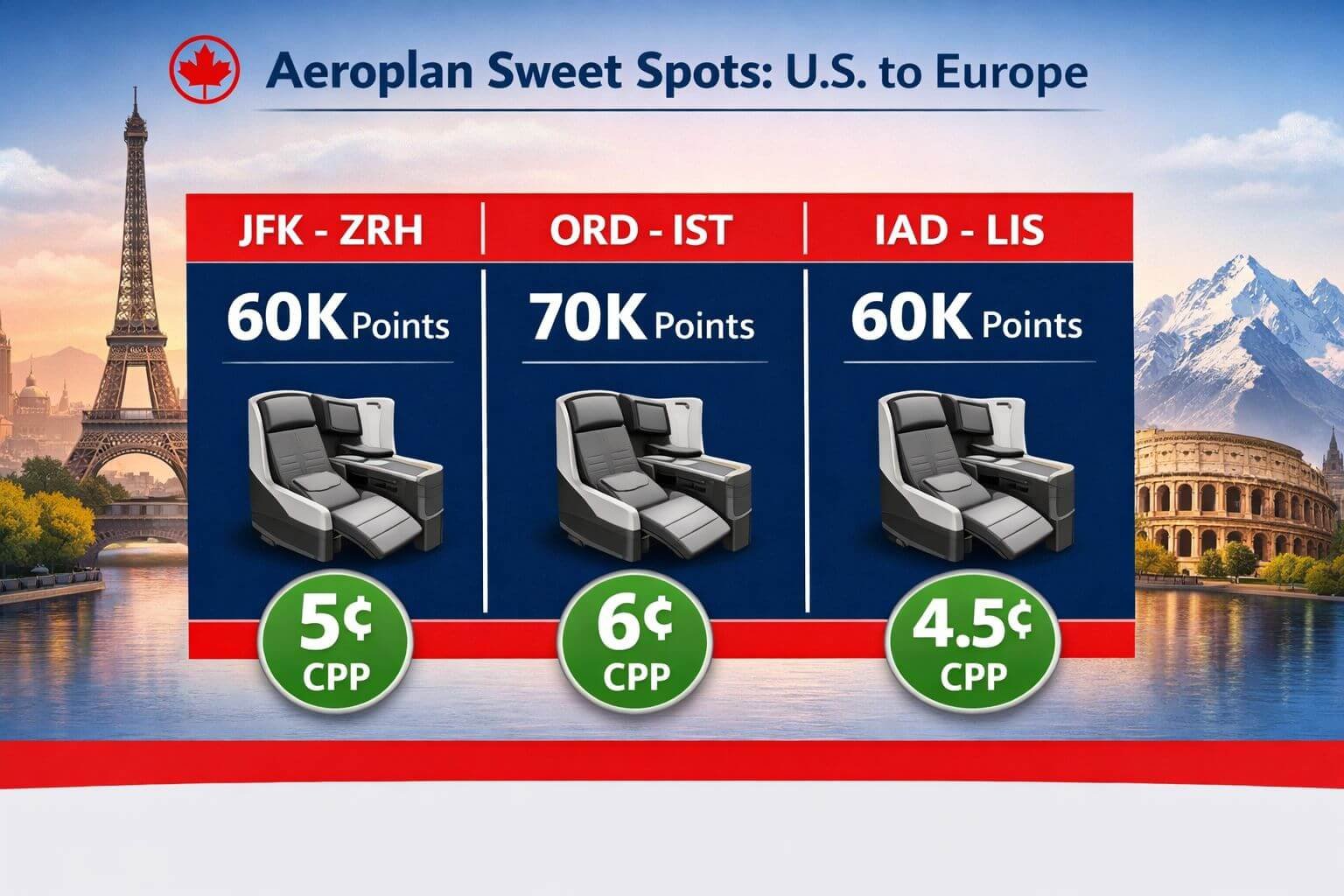
- Business class to Europe on partners (Swiss, Turkish, TAP, Lufthansa) prices at 60,000–70,000 points one-way, often delivering 4–6 CPP against cash fares.
- Paid stopovers (5,000 points extra) remain available and add enormous value on long-haul itineraries to Asia or the Middle East via Europe.
- Partner awards avoid Air Canada’s dynamic pricing, which can inflate economy redemptions on AC metal.
- Aeroplan beats United on complex routings and stopovers; LifeMiles beats Aeroplan on pure price for some economy routes but lacks stopover flexibility.
- SQC-based status is largely irrelevant for US-based members who don’t fly Air Canada frequently; treat Aeroplan as a pure redemption program funded by transferable points.
Quick Answer
Aeroplan remains one of the best Star Alliance redemption programs for US-based travelers in 2026, particularly for business class flights to Europe, Asia, and the Middle East booked on partner airlines. The earning overhaul (revenue-based points, SQC status) matters most for frequent Air Canada flyers. If you earn transferable points from major US banks and use Aeroplan purely for redemptions, the sweet spots identified below still deliver 3–6+ CPP, making Aeroplan a top-tier transfer partner.
What Stayed the Same (and What Didn’t) in Aeroplan 2026
The short version: Earning changed significantly. Redemptions on partner airlines did not.
What changed on January 1, 2026
- Earning shifted to revenue-based: Members now earn 1 Aeroplan point per $1 CAD spent on base fares and carrier surcharges on Air Canada, replacing the old distance-based formula. Budget long-haul economy fares earn far fewer points than before.
- SQC replaced all prior status metrics: Status Qualifying Miles (SQM), Segments (SQS), and Dollars (SQD) were consolidated into a single Status Qualifying Credits (SQC) currency. Thresholds run from 25K (25K status) through 125K for Super Elite.
- Elite multipliers reward status holders: Members with elite status earn 2–6x points per dollar on Air Canada flights, benefiting Premium Cabin flyers.
- Milestone Benefits replaced threshold benefits: Members earn rewards every 10,000 SQC, including eUpgrade credits.
What stayed the same for redemptions
- Partner award chart pricing remains distance-based and fixed (updated quarterly with modest adjustments).
- Stopovers are still available for 5,000 points on round-trip or multi-city awards.
- Multi-partner itineraries across Star Alliance carriers remain bookable through Aeroplan.
- Transfer ratios from US banks are unchanged: 1:1 from Amex, Chase, Capital One, and Bilt; 1:1 from Citi ThankYou.
Bottom line for US-based point collectors: If you don’t fly Air Canada regularly, the 2026 overhaul barely affects you. Aeroplan is a redemption tool, not an earning vehicle. Fund it with bank points and focus on the sweet spots below.
For a broader look at how transfer partners stack up this year, see our comparison of Chase vs. Amex vs. Citi vs. Capital One transfer partners.
Top Aeroplan 2026 Sweet Spots: US to Europe in Business Class
Europe is where Aeroplan consistently delivers its best value for US travelers. Partner business class awards price at 60,000–70,000 points one-way, depending on distance, with low surcharges on select carriers.
Sweet Spot #1: US to Switzerland on SWISS (60,000 points)
| Detail | Value |
|---|---|
| Route example | JFK → ZRH or EWR → ZRH |
| Points (one-way, business) | 60,000 |
| Taxes/fees | ~$50–$80 (SWISS imposes minimal fuel surcharges on awards) |
| Cash fare comparison | $4,200–$5,800 round-trip in business (peak summer vs. shoulder) |
| CPP (round-trip, 120K points) | 3.5–4.8 CPP |
SWISS operates direct flights from JFK, EWR, and seasonal routes from other US cities. The combination of a competitive award price and low surcharges makes this one of the strongest Aeroplan 2026 sweet spots to Europe.
Sweet Spot #2: US to Turkey on Turkish Airlines (70,000 points)
| Detail | Value |
|---|---|
| Route example | IAD → IST, JFK → IST, ORD → IST |
| Points (one-way, business) | 70,000 |
| Taxes/fees | ~$100–$150 |
| Cash fare comparison | $4,500–$7,000 round-trip in business |
| CPP (round-trip, 140K points) | 3.2–5.0 CPP |
Turkish Airlines business class is a strong hard product, and Istanbul serves as a natural gateway to the Middle East, Central Asia, and the Indian subcontinent. Availability can be tight but tends to open 2–3 weeks before departure. Use our guide on finding partner award space fast to set alerts.
Sweet Spot #3: US to Portugal on TAP Air Portugal (55,000–60,000 points)
TAP operates from Newark, JFK, Boston, and Miami to Lisbon. Business class award price at 55,000–60,000 points one-way with taxes under $100. Cash fares to Lisbon in business frequently run $3,000–$4,500 round-trip, yielding 2.5–4.0 CPP. TAP’s business class product is a step below SWISS or Turkish, but the lower point cost compensates.
Sweet Spot #4: US to Germany/Austria on Lufthansa Group (70,000 points)
Lufthansa, Austrian, and Brussels Airlines release Star Alliance partner award space through Aeroplan. The catch: Lufthansa imposes significant fuel surcharges ($200–$400+ per direction on awards). This erodes CPP substantially. Austrian tends to have lower surcharges and a solid Business product on the 777. Choose Austrian via Vienna when possible.
You may be interested



Common mistake: Booking Lufthansa without checking surcharges first. Always compare the total out-of-pocket cost (points + cash) before committing.
For a complete walkthrough on booking these routes, see our Star Alliance Business Class awards guide.
Best Aeroplan Routes to Asia, India, and the Middle East in 2026
Long-haul awards to Asia and the Middle East are where Aeroplan’s stopover rules and multi-carrier flexibility create the biggest value gap versus competing programs.
Sweet Spot #5: US to Japan on ANA (75,000–85,000 points)
| Detail | Value |
|---|---|
| Route example | SFO → NRT, LAX → HND, ORD → NRT |
| Points (one-way, business) | 75,000–85,000 (distance-dependent) |
| Taxes/fees | ~$50–$100 |
| Cash fare comparison | $5,000–$9,000 round-trip in business |
| CPP (round-trip, 150K–170K points) | 3.3–5.3 CPP |
ANA business class (“The Room” on the 777) is one of the best products in the sky. Award availability is notoriously limited, but Aeroplan often sees space that doesn’t appear on United. Search directly on aeroplan.com for ANA metal. West Coast departures offer the shortest flight times and best availability.
Sweet Spot #6: US to India via Europe (75,000–85,000 points + 5,000 stopover)
This is arguably the single best Aeroplan 2026 sweet spot for value maximization. Route it as a multi-city itinerary:
Example: JFK → ZRH (stopover 2–3 days) → DEL on SWISS + Air India or Lufthansa Group
- Points: 75,000–85,000 one-way + 5,000 for the stopover = 80,000–90,000 total
- Cash fare comparison: JFK–ZRH–DEL in business easily runs $5,500–$8,000+ one-way in cash
- CPP: 4.0–6.5+ CPP on a round-trip basis
You get two trips in one: a European stopover and a final destination in India. The 5,000-point stopover fee is one of the best deals in award travel. For detailed stopover strategies, check out our award flight stopover tricks guide.
Sweet Spot #7: US to the Middle East via Istanbul (70,000–80,000 points)
Route through Istanbul on Turkish Airlines, then connect onward to Doha, Dubai, or Riyadh on Turkish or a Star Alliance partner. Turkish’s hub in Istanbul provides excellent connectivity to the Gulf region, and the combined routing often prices lower than booking US–Middle East direct on other programs.
Best for: Travelers headed to the UAE, Qatar, or Saudi Arabia who want a strong business class product and a potential Istanbul stopover.
Not for: Travelers who need nonstop service to Dubai or Doha (Emirates and Qatar Airways aren’t in Star Alliance).
Using Stopovers and Mixed Cabins for Extra Value
Aeroplan’s stopover and mixed-cabin rules are what separate it from nearly every other frequent flyer program for US-based travelers.
Stopover strategy
- Cost: 5,000 Aeroplan points per stopover on round-trip or multi-city awards.
- Duration: Stay as long as you want (within the ticket’s validity period).
- Where it works best: Europe en route to Asia, the Middle East, or Africa. Add a few days in Zurich, Istanbul, Vienna, or Lisbon at minimal incremental cost.
- Rule of thumb: If your route naturally passes through a city you’d want to visit, always add a stopover. The 5,000-point cost is trivial compared to a separate positioning flight or hotel stay.
Mixed-cabin strategy
Aeroplan prices each segment based on the cabin booked for that segment. This means you can:
- Book the long-haul transoceanic segment in business class
- Book the shorter intra-Europe or intra-Asia connection in Economy
- Pay significantly fewer points than an all-business itinerary
Example: JFK → FRA (business, 60,000 points) → ATH (economy, priced as part of the itinerary at a lower rate). The transatlantic segment is where business class matters most; the 90-minute hop to Athens in economy is a reasonable tradeoff.
Common pitfall: Assuming mixed-cabin pricing always saves points. On some routings, the system prices the entire itinerary at the higher cabin. Always compare the mixed-cabin quote against an all-business quote before booking.
For broader strategies on planning complex award itineraries, see our guide to planning aspirational trips with points.
When to Choose Aeroplan vs. United or LifeMiles
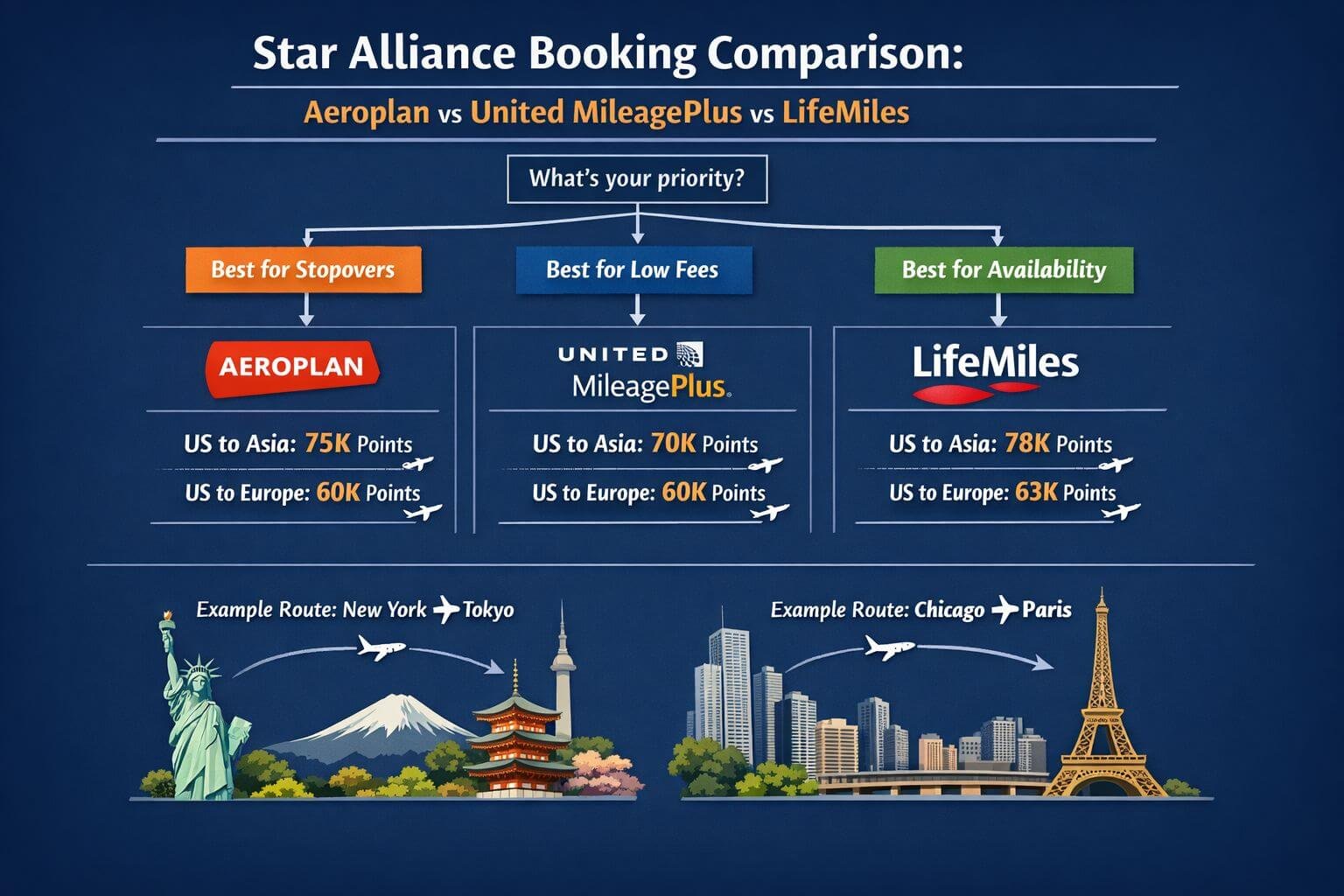
All three programs access Star Alliance inventory, but they price and handle awards differently. Here’s a decision framework:
| Factor | Aeroplan | United MileagePlus | LifeMiles |
|---|---|---|---|
| Award chart | Fixed (partner), dynamic (AC metal) | Fully dynamic | Fixed chart |
| Stopovers | Yes (5,000 pts) | No | No |
| Multi-partner routing | Yes, complex itineraries | Limited | Limited |
| Surcharges | Passes through carrier surcharges | Generally low | Generally low |
| Transfer partners | Amex, Chase, Capital One, Citi, Bilt | Chase, Bilt | Amex, Capital One, Citi, Bilt |
| Best for | Complex trips, stopovers, business class | Simple point-to-point, saver fares | Low-cost economy, no-surcharge bookings |
| Devaluation risk | Moderate (quarterly adjustments) | High (fully dynamic) | Moderate |
Choose Aeroplan when:
- You want a stopover en route to your final destination
- You’re booking business or first class on partner airlines (fixed pricing advantage)
- Your routing involves multiple Star Alliance carriers
- You have points across multiple bank programs (Aeroplan is a transfer partner for all five major US programs)
Choose United when:
- You find a saver-level fare on united.com that prices below Aeroplan’s chart
- You need a simple one-way on United metal with no connections
- You want to avoid carrier surcharges entirely
Choose LifeMiles when:
- You’re booking economy and want the lowest possible point cost
- You want to avoid fuel surcharges on Lufthansa Group carriers (LifeMiles doesn’t pass them through)
- You’re focused on a single long-haul segment without complex routing needs
For a deeper comparison of LifeMiles strategies, see our LifeMiles Star Alliance sweet spots guide.
How SQC-Based Status Affects US-Based Travelers
Short answer: For most US-based award travelers, it doesn’t.
The new SQC system rewards revenue spending on Air Canada. If you don’t fly AC regularly, you won’t accumulate meaningful SQC. And that’s fine. The elite multipliers (2–6x earning) only apply to points earned on AC flights, not to points transferred from banks.
Decision rule:
- If you fly Air Canada 10+ times per year: The SQC system and elite multipliers may be worth pursuing. Credit flights to Aeroplan and work toward status.
- If you fly Air Canada occasionally or never: Treat Aeroplan purely as a redemption program. Transfer points in only when you have a specific booking ready. Don’t let SQC considerations influence your credit card strategy.
This framing matters because many online discussions about Aeroplan in 2026 focus on status earning under SQC. For US-based travelers with Chase points, Amex points, Capital One miles, Citi points, or Bilt points, the redemption side is what matters. To see how Aeroplan fits into a broader transfer strategy, review our Aeroplan transfer partners guide.
How to Fund These Redemptions With Transferable Points
Aeroplan is one of the few programs that’s a transfer partner for all five major US transferable points currencies:
- Amex Membership Rewards → Aeroplan at 1:1
- Chase Ultimate Rewards → Aeroplan at 1:1
- Capital One Miles → Aeroplan at 1:1
- Citi ThankYou Points → Aeroplan at 1:1
- Bilt Points → Aeroplan at 1:1
This universality is a major advantage. You can pool points from multiple programs toward a single Aeroplan booking. Watch for periodic transfer bonuses (typically 15–30% extra) that reduce the effective cost of these sweet spots even further.
Practical tip: Don’t transfer points speculatively. Find the award space first on aeroplan.com, confirm pricing, then transfer. Transfers from most banks complete within minutes to a few hours. For current transfer bonus opportunities, check our guide to maximizing Aeroplan with bank transfer bonuses.
Conclusion and Next Steps
The Aeroplan 2026 overhaul was primarily an earning and status story, not a redemption story. For US-based travelers who use transferable points, the program’s core strengths remain: fixed partner award pricing, paid stopovers, multi-carrier routings, and access to some of the best Star Alliance Business Class products at 60,000–85,000 points one-way.
Your action plan:
- Identify your target route from the sweet spots above (Europe, Asia, Middle East/India).
- Search availability on aeroplan.com before transferring any points. Use our award search tools guide to set alerts.
- Check surcharges for your specific carrier. Avoid Lufthansa when surcharges exceed $300 per direction; consider Austrian, SWISS, or TAP instead.
- Add a stopover if your routing connects through an interesting city. The 5,000-point cost is almost always worth it.
- Transfer points only when you’re ready to book. Use whichever bank currency has the best current transfer bonus or the balance you can most easily replenish.
- Compare against United and LifeMiles for simple routings where Aeroplan’s complexity advantages don’t apply.
Aeroplan’s flexibility makes it one of the most powerful tools in a US-based award traveler’s toolkit, and the 2026 changes haven’t diminished that. The key is treating it as a redemption-first program, funded by bank points, and focusing on the partner airline sweet spots where fixed pricing delivers outsized value.
FAQ
Q: Did Aeroplan’s award chart change in 2026? A: The partner award chart was not overhauled. Aeroplan makes quarterly adjustments to median pricing bands, but the structure for partner flights remains distance-based. Air Canada’s own flights use dynamic pricing.
Q: Can I still book stopovers on Aeroplan awards? A: Yes. Stopovers cost 5,000 Aeroplan points on round-trip or multi-city itineraries and remain one of the program’s biggest advantages.
Q: Which US bank points transfer to Aeroplan? A: All five major programs: Amex Membership Rewards, Chase Ultimate Rewards, Capital One Miles, Citi ThankYou Points, and Bilt Points. All transfer at 1:1.
Q: Is Aeroplan status worth pursuing for US-based travelers? A: Only if you fly Air Canada frequently. The SQC system rewards revenue spending on AC. For most US-based award travelers, Aeroplan is best used as a pure redemption partner funded by bank transfers.
Q: How do I avoid high fuel surcharges on Aeroplan awards? A: Choose partners with low surcharges: SWISS, TAP Air Portugal, ANA, and Turkish Airlines. Avoid Lufthansa and British Airways (not Star Alliance, but a common confusion). Always check total taxes and fees before transferring points.
Q: Is Aeroplan better than LifeMiles for Star Alliance awards? A: It depends on the trip. Aeroplan is better for complex multi-city itineraries with stopovers. LifeMiles is often cheaper for simple one-way flights and doesn’t pass through Lufthansa fuel surcharges. Compare both for your specific routing.
Q: How far in advance should I search for Aeroplan partner awards? A: Most Star Alliance partners release award space 330–355 days in advance. However, some carriers (notably ANA) release close-in availability 2–3 weeks before departure. Search early for peak dates, but don’t give up on last-minute options.
Q: Can I book first class on Aeroplan from the US? A: Yes, though First Class availability is extremely limited. Lufthansa First Class occasionally appears for 90,000–100,000 points one-way, but expect high surcharges. ANA First Class from the US prices at approximately 110,000 points one-way with minimal fees—a strong redemption when available.
Q: What’s the biggest risk with Aeroplan sweet spots in 2026? A: Devaluation risk through quarterly award chart adjustments. Aeroplan has gradually increased pricing on some distance bands. The best defense is to book promptly when you find good availability rather than hoarding points indefinitely.


Content on Award Travel Hub is independently created by Award Travel Hub Editorial Desk and, where noted, reviewed by Award Travel Hub Review Desk. Some pages may contain affiliate links, but compensation does not determine our coverage, opinions, or methodology.