

Last updated: July 16, 2026
Quick Answer
The best way to compare travel credit cards in 2026 is to compare ecosystems, not just individual cards. For most intermediate travelers, the right setup is a 2–3-card mix built around one transferable points program, your top spending categories, and the type of awards you actually book, such as Business Class to Europe, family economy trips, or rent-driven earning with Bilt.
A good setup should do three things well: earn efficiently, transfer to useful partners, and justify its annual fees. If one of those pieces is weak, the setup usually underperforms, no matter how attractive the welcome bonus looks.
Key Takeaways
- Compare travel credit cards by ecosystem first: Chase, Amex, Capital One, Citi, and Bilt each have different points transfer partners and strengths.
- The best 2-card setup is usually simpler and stronger than a cluttered 5-card wallet.
- Bilt matters more in 2026 because rent and mortgage-related earning structures can change the math for renters and some homeowners.
- Transfer bonuses can flip the best option for a specific redemption, but they should not be the only reason to choose a setup.
- Dynamic pricing reduces value in some programs, so fixed-value portal redemptions and partner airline awards should both be part of the comparison.
- Chase is often the easiest all-around ecosystem for Hyatt and broad travel use.
- Amex is strongest for high earn rates and premium perks, but coupon-style benefits and higher annual fees make fit more important.
- Capital One is strong for simple earning plus premium travel benefits, especially for people who want fewer cards.
- Citi can be powerful for transfer value, but some readers will prefer stronger travel protections from other issuers.
- Do the travel rewards math with your real spending, not a generic “best card” list.
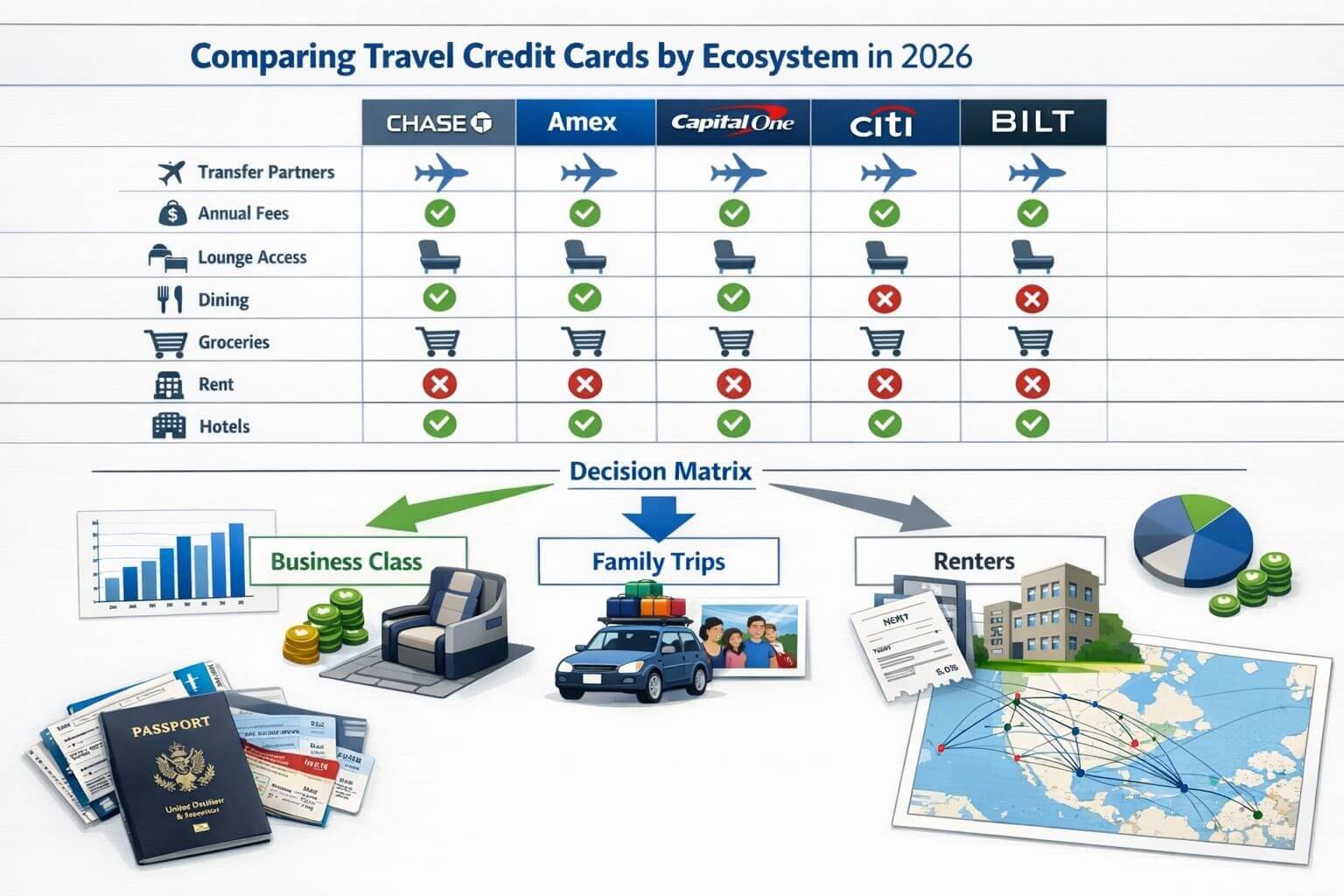
What should you consider when you compare travel credit cards in 2026?
Start with three filters: where points can go, how fast you earn them, and what the card setup costs you, net of usable credits. Those three factors matter more than marketing language or headline bonuses.
When readers compare travel credit cards, the common mistake is to compare card A against card B in isolation. That misses the bigger question: Which 2–3-card setup creates the most useful points for your trips?
Use this decision framework
Pick your likely redemption goal
- Premium Cabin awards to Europe or Asia
- Family economy trips
- Hotel-heavy travel
- Mixed travel with occasional portal use
You may be interested
List your top spend categories
- Dining
- Groceries
- Travel
- Everyday non-bonus spend
- Rent or mortgage-related eligible earning
- Business expenses
Check partner coverage
- “Partner airline” means an airline program that receives transfers from your bank points.
- Focus on programs you would actually use, such as Aeroplan, Flying Blue, Avios, Virgin Atlantic, or Hyatt on the hotel side.
Calculate the real annual fee
- Start with the posted annual fee.
- Subtract only credits you can use consistently.
- Ignore “theoretical value” from benefits you do not use.
Stress-test the setup against one real redemption
- Example: round-trip Business Class to Europe for one traveler
- Example: four economy tickets to Orlando
- Example: three Hyatt nights in peak season



What matters most in 2026
- Transfer bonuses are more frequent, but not guaranteed.
- Dynamic pricing means some award prices move with demand, often reducing predictable value.
- Devaluation risk remains real, especially if you stockpile transferable points without a plan.
- Merchant behavior may also matter more if premium-card surcharges become more common in some contexts.
Rule of thumb: Choose the setup that works without a transfer bonus. Treat transfer bonuses as upside, not the foundation.
How do the major ecosystems compare when you compare travel credit cards?
The five major transferable points ecosystems all work, but they do not solve the same problem. Chase is usually the easiest all-around choice; Amex is strongest for high-category earning and luxury perks; Capital One is strong for simplicity and premium travel benefits; Citi can deliver strong airline value; and Bilt is now more relevant for renters and transfer-bonus hunters.
For a broader market view, see Best Travel Credit Cards 2026: Compare Rewards, Benefits, and More and ATH’s deeper look at transfer partners across major banks.
Quick ecosystem snapshot
| Ecosystem | Best known for | Tradeoff |
|---|---|---|
| Chase points | Hyatt transfers, simple 2-card setups, strong general flexibility | Fewer airline niches than Amex |
| Amex points | High earn rates, premium benefits, broad airline utility | Higher fees, more credits to manage |
| Capital One miles | Simple earning, Venture X value, growing transfer utility | Fewer category specialists |
| Citi points | Good airline transfer value, useful for optimized redemptions | Often weaker overall protections/perks mix |
| Bilt points | Rent earning, Rent Day offers, useful airline partners | Program changes require close attention |
Best for / Not for
Chase
- Best for: Hyatt users, travelers who want a clean 2-card setup, couples building a practical shared strategy
- Not for: Those chasing the highest grocery or dining multipliers above all else
Amex
- Best for: Frequent travelers who can use lounge access and statement credits, and who spend heavily in bonus categories
- Not for: Readers who dislike tracking credits or carrying high-fee cards
Capital One
- Best for: People who want one premium card plus one earning card with low friction
- Not for: Travelers who want Hyatt transfers
Citi
- Best for: Readers comfortable with program rules and airline-focused redemption strategy
- Not for: Those who want the most polished all-around travel card package
Bilt
- Best for: Renters, some users focused on monthly transfer opportunities, and those who value niche airline access
- Not for: Readers who cannot use the program’s earning structure consistently
Common mistake: Picking an issuer because a friend got a good value once on a single sweet spot. Sweet spots are useful, but a setup should still work when award availability disappears.
Which 2-card and 3-card setups are strongest in 2026?
For most readers, four setups stand out in 2026 because they cover the main use cases well. The right answer depends on whether the goal is Hyatt access, premium benefits, simple earning, or rent-driven points.

1) Chase Sapphire Preferred or Reserve + Freedom card
Why it works: This is still one of the easiest ways to maximize points with low complexity. Chase points stay strong because Hyatt remains a major advantage, and Chase often works well for Europe bookings through Aeroplan, Flying Blue, and Avios-type partners.
Estimated annual points from sample spend
Assumption: $1,000 dining, $800 groceries, $500 travel, $1,200 general spend per month. Category allocation depends on card details and rotating categories, so this is an estimate.
- Approximate annual earn: 55,000 to 75,000 Chase points
- Annual fee range: Low to moderate, depending on Sapphire version
Best for
- Travelers who want balanced flexibility
- Hyatt fans
- Readers who prefer straightforward rules
2) Amex Gold + Amex Platinum
Why it works: This setup earns fast in common categories and gives access to broad Amex points transfer partners. It is often strongest for people booking Premium Cabin awards and using lounges, airline credits, and hotel benefits.
Estimated annual points from sample spend
- Approximate annual earn: 75,000 to 95,000 Amex points
- Annual fee range: High
Best for
- Frequent travelers
- Premium Cabin awards
- Readers who can fully use card perks
Not for
- Anyone unsure they can offset the annual fees
- Travelers who want simplicity over optimization
For a fee-focused breakdown, see Is Amex Gold Worth $325 in 2026? and Are Premium Travel Cards Worth It in 2026?.
3) Venture X + Savor-type earning card
Why it works: This is the cleanest premium setup for many households. Capital One miles are easy to earn, Venture X can offset much of its fee for travelers who use the travel credit and lounge access, and transfer partners are good enough for many airline redemptions.
Estimated annual points from sample spend
- Approximate annual earn: 60,000 to 85,000 Capital One miles
- Annual fee range: Moderate, often effectively lower if credits are used
Best for
- People who want a practical 2-card wallet
- Mixed domestic and international travelers
- Readers who value lounge access but dislike coupon-heavy setups
Related reading: Venture X benefits in 2026 and ATH’s guide to award search tools and alerts.
4) Bilt-focused setup: Bilt card + partner dining/travel card
Why it works: Bilt points can materially improve a setup if rent is part of the equation and if the traveler can take advantage of Bilt transfer bonuses or partner airline opportunities. In 2026, Bilt 2.0 adds more complexity, which makes comparison more important, not less.
Estimated annual points from sample spend
- Approximate annual earn: Highly variable
- A renter with $2,000 monthly rent plus regular spend may generate a meaningful points balance even without heavy card churn.
Best for
- Renters
- Readers watching Rent Day promotions
- Travelers willing to act when transfer bonuses appear
Edge case: Bilt can be the best “secondary ecosystem” rather than the primary one. That is especially true if rent produces points, but the traveler still wants Chase or Capital One for the rest of the wallet.
For Bilt-specific timing and bonus context, see Bilt Rent Day March 2026: 125% JAL Bonus + Double Points.
How do sample redemptions change the comparison?
A setup is only as good as the awards it can actually book. The best way to compare travel credit cards is to test each ecosystem against the same trip and note transfer partner access, award availability, surcharges and fees, and backup options.
Example: one round-trip Business Class award to Europe
Assumptions:
- U.S. East Coast to a major Europe gateway
- Booking 4–9 months out
- Flexible on dates and airport
- Using partner airlines, not fixed portal pricing unless needed
What the comparison often looks like
Chase points
- Strong if transferred to Aeroplan, Flying Blue, or Avios-type programs
- Also valuable if the traveler pivots to Hyatt instead of a flight
- Good all-around hedge against dynamic pricing
Amex points
- Strong for Flying Blue, Air Canada, Virgin Atlantic, and other Premium Cabin awards
- Often the easiest path when transfer bonuses align
- Can face higher surcharges depending on program and route
- Competitive for many of the same airline programs
- Best when the traveler wants simple earning and enough flexibility for airline transfers
- Less distinctive on hotels if Hyatt matters
Citi points
- Can perform very well on airline-focused redemptions
- Worth checking when the target program is a Citi transfer partner but not a Chase option
Bilt points
- Can be excellent if the relevant airline partner is available and the traveler earned a large balance from rent
- Transfer-bonus timing can create unusually strong value
Practical takeaway
For a Europe Business Class booking, the best ecosystem is often the one that gives access to multiple alliance partners and lets the traveler compare options. If one airline program shows no saver-level award availability, another may still work.
Brief definitions:
- CPP, or cents per point: the value received per point based on cash price divided by points used.
- Married segments: when airlines release award space only if certain flight segments are booked together.
- Positioning flight: a separate ticket used to reach the city where the better award starts.
For more on timing and search strategy, see When to Book Award Flights in 2026 and ATH’s transfer bonuses tracker.
How do transfer bonuses and dynamic pricing change the best setup in 2026?
Transfer bonuses matter, but they should change which program you use for a booking, not necessarily which wallet you build. Dynamic pricing matters because it reduces the reliability of old award-chart assumptions.
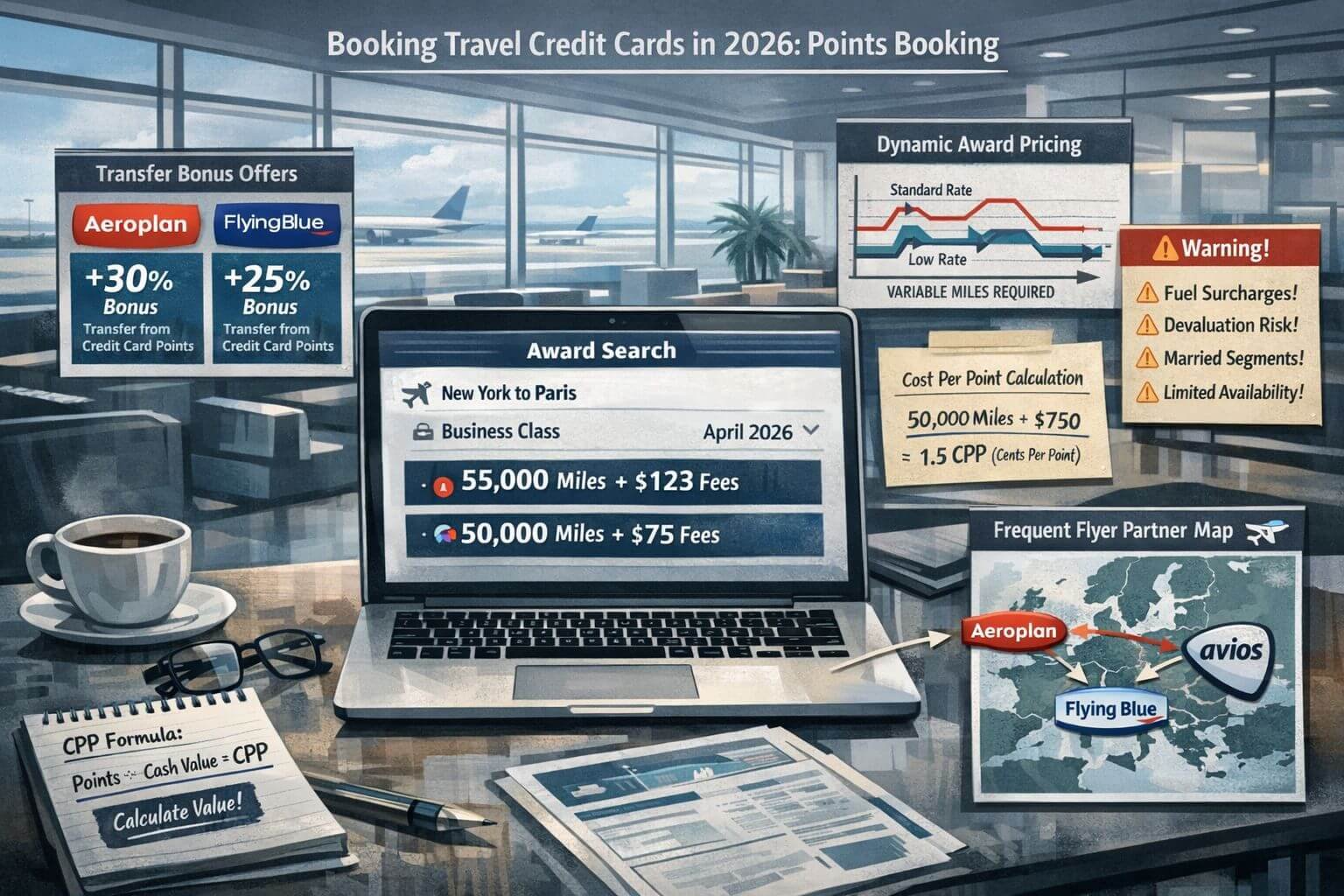
How to use transfer bonuses correctly
- Check whether the bonus applies to a partner you already planned to use.
- Confirm award availability before transferring.
- Compare post-bonus cost against other programs, not just the pre-bonus headline.
- Watch taxes, fuel surcharges, and routing rules.
A 20% to 30% transfer bonus can turn an average redemption into a very good one. But a bad award with high fees is still a bad award after the bonus.
How dynamic pricing changes strategy
- Dynamic pricing weakens simple “X points always gets Y” assumptions.
- Fixed award charts are less common, and sweet spots can disappear quickly.
- Flexible currencies become more valuable because they let you compare options across programs.
Decision rule: If the trip is date-sensitive and cash fares are reasonable, portal redemptions or cash may beat the cost of transferring. If the trip is for Premium Cabin awards during expensive travel periods, transferable points usually have more upside.
To sharpen the math, use ATH’s 2026 cents-per-point guide and best use of 100,000 points examples.
How should different travelers compare travel credit cards and choose a setup?
Most readers do best with a setup matched to one of three real-world goals. The best travel card comparison 2026 answer is not universal.
Setup recommendation 1: Luxury Business Class traveler
Choose: Amex Gold + Platinum, or Chase Sapphire + Freedom if Hyatt matters more than lounges.
Why
- Amex points often earn faster in key categories.
- Chase points offer easier balance and stronger hotel optionality.
- Either setup works if the traveler checks award availability across alliance partners.
Good fit if
- Trips are international
- Cabin preference is business or first
- Flexibility on dates is realistic
Setup recommendation 2: Family economy traveler
Choose: Chase Sapphire Preferred + Freedom, or Venture X + companion earning card.
Why
- Families usually benefit from lower fees, easier point use, and broad backup options.
- Hyatt can stretch Chase points well for family stays.
- Capital One can simplify everyday earning and travel protections.
Good fit if
- Redemptions are mixed flights and hotels
- Simplicity matters
- The family values practical over aspirational redemptions
Setup recommendation 3: Rent-focused renter
Choose: Bilt as a core or secondary ecosystem, paired with Chase or Capital One.
Why
- Bilt points from rent can materially change annual earning.
- Pairing Bilt with another bank adds backup transfer options.
- This reduces the risk of being locked into one program’s devaluation or poor award availability.
Common pitfall: Trying to force all redemptions through one ecosystem just because the points balance is larger there.
What is the step-by-step process to choose your ideal card mix?
Use a simple process and decide in one sitting. Most “analysis paralysis” comes from comparing too many perks that do not change real outcomes.
Step-by-step guide
Write down one primary goal for the next 12 months
- Example: one Business Class trip to Europe
- Example: two family trips with hotel stays
Estimate annual spend by category
- Dining
- Groceries
- Travel
- Non-bonus
- Rent
Pick one primary ecosystem
- Chase for balance and Hyatt
- Amex for premium rewards and high-category earn
- Capital One for simplicity
- Citi for airline-focused value
- Bilt if rent is central
Add one support card
- Fill the weakest category in your primary setup
- Avoid duplicate perks unless they deliver real value
Price the setup honestly
- Count only credits you will use
- Ignore lounge access if you rarely fly
- Ignore hotel status if you do not stay enough nights
Test one real redemption
- Search transfer partners
- Compare miles needed, taxes, and availability
- Check whether transfer times create risk
Keep a downgrade path
- Every premium setup should have an exit option if travel patterns change
If credits and downgrade options are part of your decision, ATH’s downgrade versus cancel guide is a useful next read.
What common mistakes should you avoid when you compare travel credit cards?
Most bad outcomes come from overvaluing bonuses, underestimating fees, or ignoring actual redemption patterns. A strong setup is boring in the best way: it earns well, transfers well, and matches the traveler’s habits.
Common mistakes
- Choosing based on a welcome bonus alone
- Building across too many ecosystems at once
- Ignoring transfer times and award availability
- Valuing statement credits you rarely use
- Forgetting fuel surcharges and fees
- Holding points too long and taking devaluation risk
- Assuming portal bookings always beat transfer partners
- Copying a high-fee influencer setup without similar travel volume
A practical setup usually beats an “aspirational” one that never gets used well.
Related reading
- Best Travel Credit Cards 2026: Compare Rewards, Benefits, and More
- Comparing transfer partners in 2026
- Best award travel tools and alerts for 2026 bookings
- Two-player mode strategy for couples
FAQ
What is the best way to compare travel credit cards in 2026?
The best way is to compare complete ecosystems, transfer partners, earning rates, and net annual fees, then test one real redemption you expect to book.
Is Chase or Amex better for transferable points?
Chase is usually better for simplicity and Hyatt access, while Amex is often better for high earning rates and Premium Cabin transfer options.
Is Bilt worth adding to a travel card setup?
Bilt can be worth adding if rent is a major expense and the traveler can use Bilt points transfer partners or Rent Day transfer bonuses effectively.
Are 3-card setups better than 2-card setups?
Not always. A 3-card setup is only better if the third card fills a meaningful gap in earning, transfer options, or travel benefits.
Should transfer bonuses determine which card ecosystem to choose?
No. Transfer bonuses should influence redemption timing, but the core setup should still make sense without them.
Which setup is best for Business Class deals?
Amex and Chase are often the strongest choices for Business Class deals because of partner coverage and strong transfer utility, though Capital One can also work well.
Which setup is best for family travel?
Chase and Capital One are often the best fits for family travel because they balance easier earning, manageable fees, and flexible redemption options.
Are premium travel cards still worth it in 2026?
Premium cards are worth it only if the traveler uses the credits, lounge access, and protections often enough to offset the annual fee.
How many ecosystems should most people focus on?
Most people should focus on one primary ecosystem and, at most, one secondary source like Bilt for rent or a niche transfer opportunity.
What should I check before transferring points?
Check award availability, taxes and surcharges, transfer timing, cancellation rules, and whether another partner offers a better price.
Conclusion
To compare travel credit cards well in 2026, start with the trip you want to book, not the card you want to carry. Then choose a 2–3-card setup that earns transferable points efficiently, gives access to useful points transfer partners, and keeps annual fees under control.
For many readers, the strongest paths are clear:
- Choose Chase for a balanced setup with Hyatt value and strong all-around flexibility.
- Choose Amex for Premium Cabin focus and higher-category earning, if the fees and credits fit.
- Choose Capital One for a simpler premium wallet with solid transfer options.
- Choose Bilt as a core or side strategy if rent changes the earning math in your favor.
Next steps
- Pick one target redemption for the next 12 months.
- Run your real spending through two competing setups.
- Check current transfer bonuses and partner coverage before applying.
- Read program-specific ATH guides before any point transfer, especially for Aeroplan, Flying Blue, Hyatt, and Bilt Rent Day opportunities.


Content on Award Travel Hub is independently created by Award Travel Hub Editorial Desk and, where noted, reviewed by Award Travel Hub Review Desk. Some pages may contain affiliate links, but compensation does not determine our coverage, opinions, or methodology.