
Last updated: May 27, 2026
Quick Answer
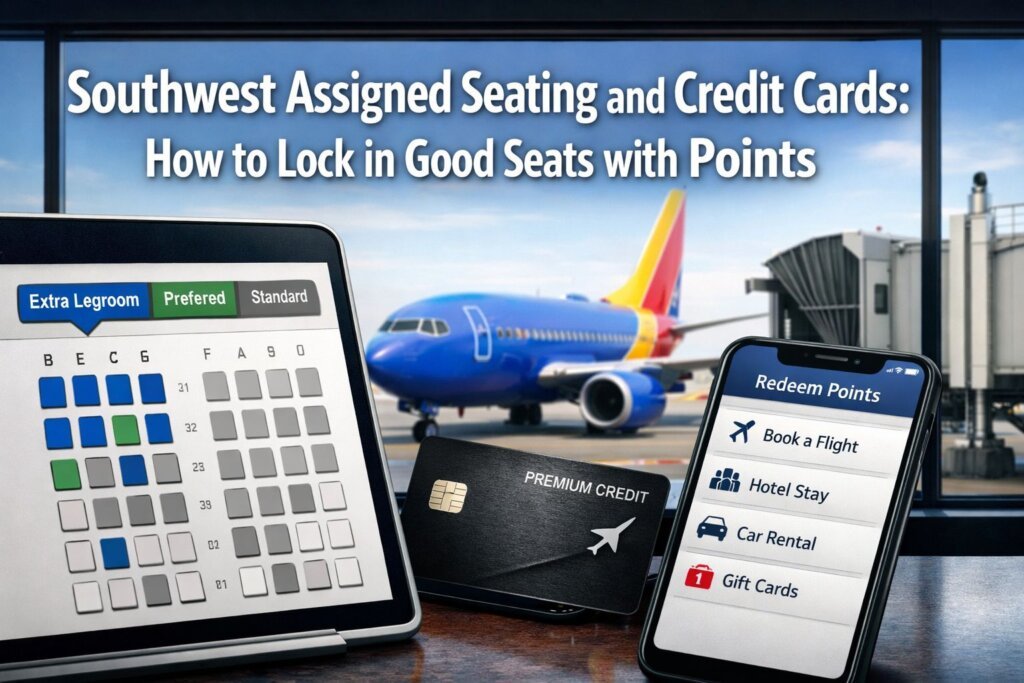
Southwest assigned seating credit card benefits matter much more in 2026 than boarding position ever did. Priority and Performance Business cardholders can generally choose Standard and Preferred seats at booking, and may access Extra Legroom seats within 48 hours of departure, while Basic fare flyers without the right card usually wait until check-in for seat assignment. That means the best strategy is no longer “check in at T-24,” but “book the right fare or hold the right card, then decide whether points or cash gives better value after seat costs are added.”
Key Takeaways
- Southwest fully moved from open seating to assigned seats for flights departing January 27, 2026.
- Seat types now include Extra Legroom, Preferred, and Standard, plus eight numbered boarding groups.
- Basic fares usually do not choose seats at booking; they receive seats at check-in unless a card or status benefit changes access.
- Priority and Performance Business cardholders get the strongest Southwest assigned seating credit card benefits, including complimentary Preferred seating at booking on eligible itineraries.
- Plus and Premier cardholders offer weaker seat benefits, mainly closer to departure rather than at booking.
- A-List and A-List Preferred status can rival or beat card perks for frequent Southwest flyers.
- T-24 check-in is much less important for seat choice than before, but it can still matter for overhead bin access and boarding order.
- Because Southwest award pricing is more dynamic in 2026, always compare cash fare + seat cost versus points fare + seat cost using simple cents per point (CPP) math.
- Families now need a more deliberate booking strategy if they want to sit together without paying for the highest fare bundle.
- For a broader context, start with ATH’s Southwest assigned seating guide and the 2026 CPP guide.
How does Southwest’s assigned seating work in 2026?
Southwest assigned seating now works more like the major U.S. airlines: your fare, elite status, and card tier determine when you can pick a seat and which seat types are included. The biggest practical change is that boarding position no longer decides whether you get an aisle or a window.
Southwest’s network-wide rollout began for flights departing January 27, 2026, ending decades of open seating. The airline also introduced new fare bundles and seat categories.
Seat types at a glance
- Extra Legroom: best onboard location and more pitch, usually the highest fee
- Preferred: better cabin location, typically front/mid-cabin
- Standard: regular seat selection, usually the broadest inventory
- Check-in assigned seats: especially relevant on Basic fares
What changed from the old system
- Old system: the boarding group largely determined seat quality
- New system: seat quality is locked in earlier, often at booking
- Main implication: Southwest assigned seating credit card benefits now affect trip value much more directly
If a traveler cares about seat location, the new Southwest game is decided at booking, not at check-in.
Common mistake: assuming EarlyBird-style habits still control the outcome. In 2026, the more important question is whether the fare, card, or status allows seat selection before inventory shrinks.
Which fares let you choose seats, and when?
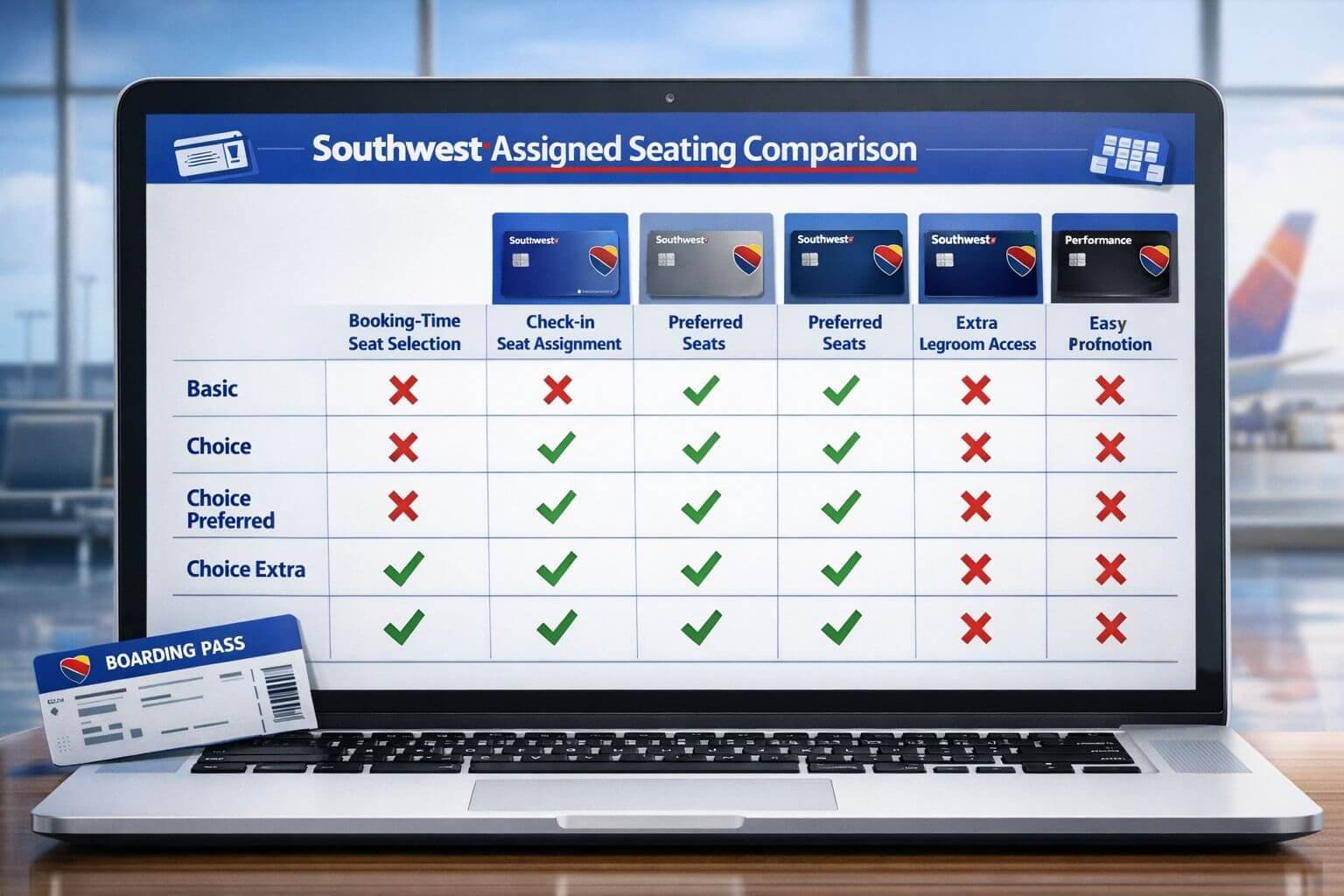
Southwest fare bundles now determine base seat access before card or elite benefits are added. Basic is the most restrictive, while Choice Preferred and Choice Extra include progressively better seat rights.
The exact bundle names and inclusions may evolve, but the framework below aligns with the current 2026 structure described by Southwest and reported in the industry.
Southwest fare and seat selection matrix
| Fare | Seat choice at booking | Seat assignment at check-in | Preferred included | Extra Legroom included |
|---|---|---|---|---|
| Basic | No, unless status/card changes it | Yes | No | No |
| Choice | Standard seat selection at booking in many cases | Not the default path | Usually no | No |
| Choice Preferred | Yes | N/A | Yes | No |
| Choice Extra | Yes | N/A | Yes | Yes |
What Basic fare flyers should know
You may be interested



Basic is now a weaker product than many Southwest regulars were used to before 2026.
- Seat assignment generally happens at check-in
- Earnings on Basic fares are lower than before, which weakens the long-term Rapid Rewards value
- Buying Basic and hoping for a great seat later is usually a poor strategy on busy flights
Decision rule: choose Basic only if seat location does not matter, the flight is short, and the savings are meaningful after comparing the buy-up cost.
Which Southwest cards actually help with seat selection?
The strongest Southwest assigned seating credit card benefits come from the Priority and Performance Business cards. Those cards are the most useful for travelers who want good seats at booking without buying the highest fare bundle.
According to Southwest’s current cardmember benefits page, the practical card hierarchy looks like this:
Card benefit overlay by tier
| Card tier | Standard seat access | Preferred seat access | Extra Legroom access | Best use case |
|---|---|---|---|---|
| Plus | Limited, closer to departure | Limited, closer to departure | Not a core benefit | Occasional flyer who wants lower annual fee |
| Premier | Limited, closer to departure | Limited, closer to departure | Not a core benefit | Moderate flyer, weaker seat strategy |
| Priority | Complimentary Standard and Preferred at booking | Yes, at booking | Free upgrade window within 48 hours if available | Best personal card for assigned seating |
| Performance Business | Complimentary Standard and Preferred at booking | Yes, at booking | Free upgrade window within 48 hours if available | Best business card for team/family-style bookings |
Southwest also says the strongest card perks can extend to companions on the same reservation, up to the published cap.
What that means in practice
- Priority / Performance Business: best if assigned seating is now a top reason you fly Southwest
- Plus / Premier: better than nothing, but weaker for travelers who want certainty at booking
- No Southwest card: seat strategy depends mostly on fare family and status
For a wider card comparison framework, see ATH’s best travel credit cards in 2026 and our take on when co-branded cards are worth it.
How do A-List and A-List Preferred compare with Southwest assigned seating credit card benefits?
Elite status can be as valuable as, or better than, card perks for frequent flyers. A-List and A-List Preferred members generally get stronger boarding and seating treatment than casual travelers, especially on higher fares.
Simple comparison
- A-List / A-List Preferred is better for travelers who fly Southwest enough to earn status naturally
- Priority / Performance Business is better for travelers who want seating benefits without heavy flying
- Best setup: status plus a strong card, especially for family bookings
Rule of thumb
Choose status-first if:
- Southwest is a primary airline
- You fly often enough to maintain status
- You care about upgrade priority and smoother day-of-travel handling
Choose card-first if:
- You fly only a few Southwest trips per year
- You want immediate value at booking
- You often travel with companions who can share the reservation benefit
Edge case: a traveler with A-List and only a Basic fare may still do better than a non-elite traveler with no card, but inventory controls still matter. On sold-out routes, even elite benefits do not create seats that are already gone.
Do Basic fare flyers with a Southwest card get seats 48 hours before departure?
Sometimes, but not always in the way many travelers expect. The confusion comes from the difference between booking-time seat access and 48-hour upgrade windows, which are not the same benefit.
This is the key issue showing up in Southwest forums and comment threads: cardholders on Basic fares often assume any card means they can pick seats 48 hours before departure. That is too broad.
Practical framework
- Priority / Performance Business: strongest chance at meaningful access, including complimentary Preferred at booking on eligible bookings and Extra Legroom within 48 hours if available.
- Plus / Premier: weaker access, often nearer departure rather than true booking-time control.
- No card: Basic generally receives seat assignment at check-in.
What still matters at T-24?
Checking in exactly 24 hours before departure matters less for seat location, but it can still matter for:
- boarding group within Southwest’s new numbered system
- overhead bin access
- reducing the chance of a later, less favorable seat shuffle on irregular operations
Common mistake: thinking T-24 replaces advance seat selection. It does not.
What is the best strategy for families to sit together without overpaying?
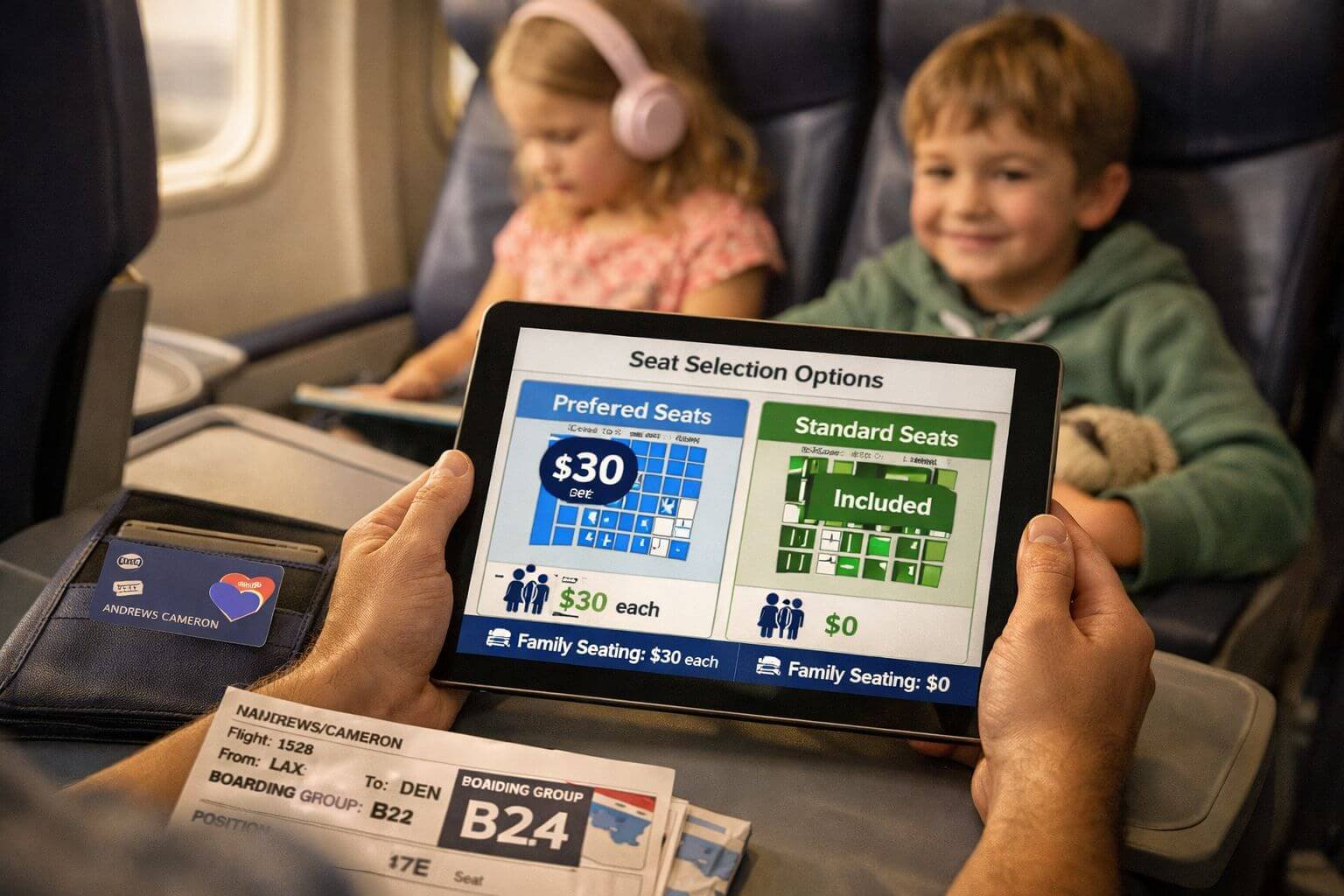
Families should either book early with a card that gives booking-time seat choice or pay up selectively on only the travelers who need certainty. Waiting until check-in is the highest-risk approach on full flights.
Southwest has adjusted some operational details after launch, including boarding and bin-space refinements, but families should still assume that free seat-together outcomes are less automatic than under the old open-seating system.
Best family booking paths
Hold a Priority or Performance Business card
- Best if a parent regularly books for multiple travelers
- Strongest route to locking in adjacent Preferred seats at booking
Buy Choice Preferred only when needed
- Works if you take just one or two Southwest trips a year
- Avoids paying an annual fee for infrequent travel
Mix fares strategically
- Example: book adults on a bundle or card-enabled reservation with stronger seat access
- Keep children on the same reservation when possible
Real-world family example
A family of four flying a popular leisure route during a school break may see Preferred seat fees add up quickly. Frequent Miler noted that one one-way trip can produce over $100 in seat savings for a family when using a stronger Southwest card benefit.
Best for: families taking at least one or two Southwest roundtrips a year
Not for: solo travelers who do not care where they sit
When should you use points instead of cash now that Southwest pricing is more dynamic?
Use points when the redemption value remains solid after accounting for seat costs. Pay cash when the fare is cheap, the points rate is inflated, or a higher fare bundle provides better all-in value.
Southwest has leaned further into dynamic pricing, so there is no fixed award chart sweet spot to rely on. That makes simple travel rewards math more important. For the full framework, see ATH’s Beginner’s Guide to cents per point in 2026.
Quick CPP formula
CPP = (cash price you avoid – taxes/fees still paid) ÷ points used
Then add seat fees back into the comparison if they are not included.
Decision framework
Use points if:
- CPP is in your acceptable Rapid Rewards range
- cash fares are elevated
- you already hold a card that reduces seat costs
- you need the flexibility of Southwest award cancellations
Use cash if:
- the fare is low
- the award price moved up faster than the cash price
- buying a better fare bundle adds enough seat value to justify cash
Important tradeoff
Rapid Rewards points do not come from transferable points ecosystems in the same way many partner airlines do, so compare Southwest redemptions against what those same Amex points, Chase points, Capital One miles, Citi points, or Bilt points could do with transfer partners for premium cabin awards. For many readers, Southwest is about convenience, not maximum aspirational value.
What do the numbers look like on real 2026 routes?
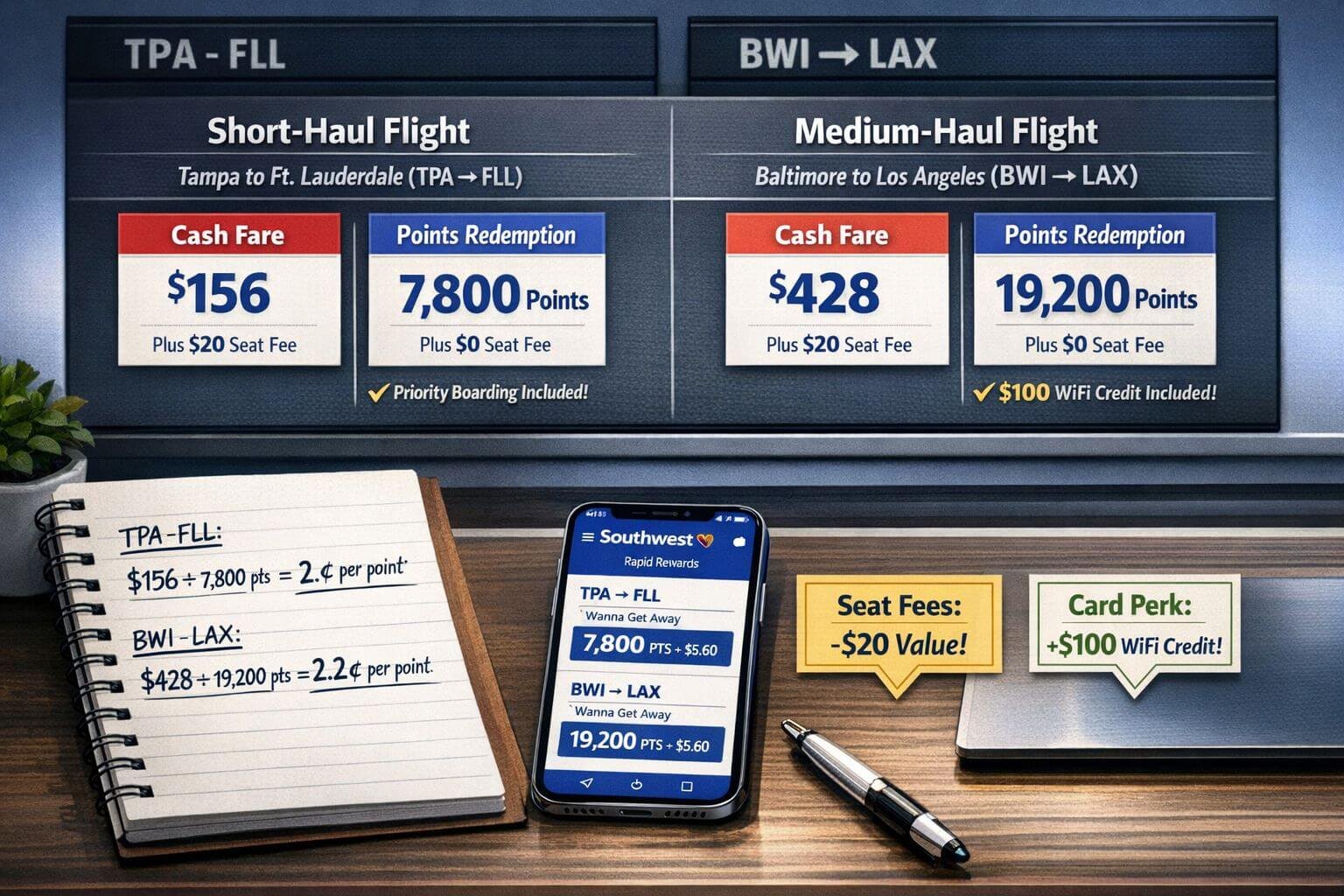
On real itineraries, card perks can beat paying seat fees outright, especially for two or more travelers. But on very cheap short-haul flights, paying cash for the ticket and skipping premium seats may still win.
The examples below are illustrative 2026 scenarios, using realistic pricing assumptions based on current Southwest fare structure and seat categories. Actual prices vary by date and demand.
Example 1: TPA to FLL, short-haul leisure route
Assumptions
- Basic cash fare: $79
- Choice cash fare: $99
- Preferred seat fee if bought separately: $18
- Award price on Basic-equivalent ticket: 5,800 points + $5.60
Comparison
| Option | Out-of-pocket | Notes |
|---|---|---|
| Pay Basic cash + buy Preferred seat | $97 | Cheapest path to better seat without card |
| Redeem 5,800 points + $5.60 + buy Preferred seat | $23.60 + 5,800 pts | Good only if points are plentiful |
| Hold Priority card, book eligible fare, get Preferred seat benefit | $79 cash fare | Best if you already hold the card |
| Buy Choice fare | $99 | Simpler than Basic + seat fee, but not always cheaper |
Takeaway: on short-haul flights, a strong card can erase most of the seat-selection premium.
Example 2: BWI to LAX, medium-haul route
Assumptions
- Basic cash fare: $249
- Choice cash fare: $289
- Preferred seat fee: $42
- Extra Legroom fee: $78
- Award price: 18,500 points + $5.60
Comparison
| Option | Out-of-pocket | Notes |
|---|---|---|
| Pay Basic cash + Preferred seat | $291 | Near Choice pricing |
| Pay Basic cash + Extra Legroom | $327 | May still be worth it for a 5+ hour flight |
| Priority cardholder gets Preferred at booking | $249 | Strong value difference |
| Priority cardholder upgrades to Extra Legroom within 48 hours if available | $249 | Highest upside, but not guaranteed |
| Redeem 18,500 points + $5.60, then buy Preferred seat | $47.60 + 18,500 pts | Compare CPP carefully |
If the $249 fare corresponds to 18,500 points, the raw value is about 1.31 CPP before considering seat fees. That can be reasonable, but if paying cash also earns points and preserves transferable points for higher-value partner airline redemptions, cash may still be the better move.
For a broader strategy, see ATH’s points vs cash back comparison and Southwest Companion Pass 2026 guide.
How should you future-proof your Southwest strategy?
The safest Southwest strategy in 2026 is to treat seating, fare bundle, and redemption value as one combined purchase decision. Book early, compare all-in trip cost, and avoid assuming old Southwest habits still apply.
Practical checklist
- Check whether seat location matters on this trip
- Compare Basic + seat fee against Choice/Choice Preferred
- If flying Southwest regularly, price out Priority or Performance Business
- If flying only occasionally, do not overpay for a card just for one trip
- Run simple CPP math before redeeming points
- Book families early, especially on peak routes
- Re-check seat maps inside the 48-hour window for Extra Legroom opportunities
Common pitfalls
- booking Basic on a high-demand flight and expecting family seating to sort itself out
- redeeming points without adding seat fees into the math
- choosing a low-tier Southwest card and expecting Priority-level access
- valuing Southwest points as if they were transferable points with premium cabin upside
Related reading
- Southwest Assigned Seating Jan 2026: Rapid Rewards Guide
- 2026 Guide to Cents-Per-Point
- Southwest Companion Pass 2026: Fastest ways to earn 135,000 points
- Secrets to booking award flights with flexible points
Frequently asked questions about Southwest assigned seating in 2026
Do I still need to check in exactly 24 hours before a Southwest flight?
Not for seat choice in most cases. T-24 matters less now because seats are assigned earlier, but it can still help with boarding position and bin space.
Which Southwest card gets free seat selection?
The strongest benefits are on the Southwest Priority and Performance Business cards, which can provide complimentary Standard and Preferred seats at the time of booking on eligible itineraries.
Can Basic fare passengers choose seats on Southwest?
Usually not at booking. Basic fare passengers typically receive seat assignments at check-in unless elite status or a qualifying card benefit changes access.
Is the Southwest Priority card the best for assigned seating?
For most personal cardholders, yes. It offers the strongest seating value among Southwest consumer cards in 2026.
Do Plus and Premier cards give the same seat perks as Priority?
No. Plus and Premier have weaker seat-selection benefits and generally do not offer the same Preferred seat access by booking time as Priority.
Can families still sit together for free on Southwest?
Sometimes, but it is less automatic than under open seating. Families improve their odds by booking early, using a stronger card benefit, or choosing a fare bundle with seat selection.
Are Southwest points still worth using in 2026?
Yes, but only when the redemption value is reasonable after adding any seat fees. Dynamic pricing means each booking should be evaluated individually.
Is a higher fare bundle better than holding a Southwest card?
For occasional travelers, maybe. For repeat Southwest flyers or families, a stronger card often delivers better value across multiple trips.
Conclusion
Southwest assigned seating credit card benefits now play a direct role in where you sit, what you pay, and whether redeeming points still makes sense. The old Southwest strategy centered on boarding position; the 2026 strategy centers on fare bundle + card tier + all-in price.
For most intermediate Southwest flyers, the clearest path is simple:
- choose Priority or Performance Business if good seats matter on more than one or two trips a year
- book early if traveling as a family
- compare cash fare, award cost, and seat fees together
- use points only when the CPP is solid and the card or fare keeps seat costs under control
Next steps: review your current Southwest card, compare it against expected 2026 travel, and run one test booking on an actual route you fly often. Then decide whether a fare upgrade, a better card, or plain cash is the smarter move.




Content on Award Travel Hub is independently created by Award Travel Hub Editorial Desk and, where noted, reviewed by Award Travel Hub Review Desk. Some pages may contain affiliate links, but compensation does not determine our coverage, opinions, or methodology.