
Last updated: May 26, 2026
Quick Answer: United Airlines will replace its fixed PlusPoints upgrade chart with dynamic pricing in February 2027, making 2026 the last full year of predictable upgrade costs. Premier Gold, Platinum, and 1K members holding PlusPoints should prioritize burning them on high-value routes — particularly transcon Polaris (80–120 PlusPoints one-way) and long-haul international business class (140–280 PlusPoints) — before the chart disappears. Domestic first class upgrades (20–40 PlusPoints) are lower priority unless they represent your best remaining use case.
Key Takeaways
- United announced in December 2025 that dynamic PlusPoints pricing takes effect in February 2027, retiring the current fixed chart.
- The fixed chart currently costs 20–40 PlusPoints for domestic first class, 80–120 for transcon Polaris, and 140–280 for long-haul international Business/First Class.
- As of February 1, 2026, PlusPoints and Complimentary Premier Upgrades (CPUs) can now be used on award tickets, significantly expanding redemption eligibility.
- Premier 1K members now earn unlimited additional PlusPoints from Premier Qualifying Points (PQP) via eligible United credit card spending starting January 1, 2026.
- United’s COO of MileagePlus confirmed dynamic pricing won’t fluctuate minute-to-minute but will rise as flights fill and fall if seats remain open.
- High-demand routes — transcon Polaris, peak international business class — carry the highest risk of cost increases under dynamic pricing.
- Five new PlusPoints redemption options (WiFi, seats, onboard perks) exist, but cabin upgrades deliver substantially higher value per PlusPoint on most routes.
- The burn-vs-hold debate is largely settled for 2026: burn on premium routes now, especially if you have PlusPoints expiring in early 2027.
What Exactly Is Changing — and When?
United Airlines announced in December 2025 that the fixed PlusPoints upgrade chart will be retired in February 2027, replaced by a dynamic model that varies by route, cabin, and demand. This is not a minor adjustment — it’s the most significant structural change to the PlusPoints program since its introduction.
Under the current fixed chart, every Premier member can calculate the exact cost of an upgrade before requesting it. Under dynamic pricing, the cost will shift based on how full a flight is and how much demand exists for premium cabin seats. United’s COO Luc Bondar described the model as one that adjusts with demand — rising as flights fill, falling if seats remain unsold — with the stated goal of improving upgrade clearance rates.
What this means in practice: Popular routes during peak travel periods will almost certainly cost more PlusPoints. Less-traveled routes or off-peak flights may cost less. The net effect for most Premier members flying high-demand routes is a devaluation of existing PlusPoints balances.
The February 2027 implementation date gives members roughly nine months to use PlusPoints at known, predictable costs. That window matters.
Current PlusPoints Chart: Best Value Routes (May 2026)
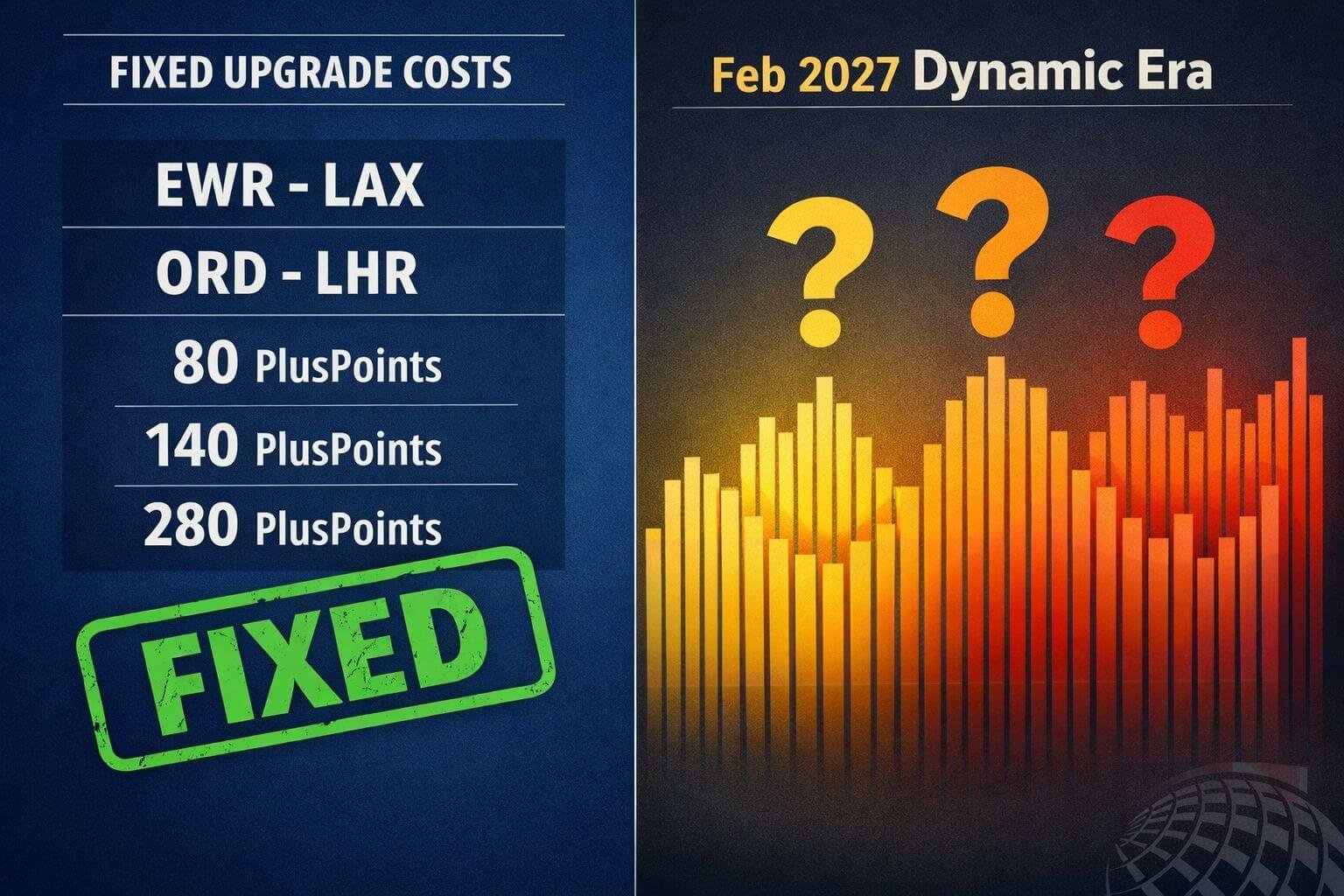
The fixed chart as of May 2026 is straightforward. Here are the key route tiers with estimated cash upgrade values and calculated cents per PlusPoint (CPP):
| Route | Cabin | PlusPoints (OW) | Est. Cash Upgrade | CPP | Priority |
|---|---|---|---|---|---|
| ORD–LAX (domestic) | First Class | 20–30 | $150–$250 | ~0.8–1.2¢ | Low |
| EWR–SFO (transcon) | Polaris | 80–100 | $400–$700 | ~0.5–0.9¢ | Medium |
| IAD–LHR (transatlantic) | Polaris Business | 140–180 | $1,200–$2,000 | ~0.8–1.3¢ | High |
| ORD–NRT (transpacific) | Polaris Business | 200–240 | $1,800–$2,800 | ~0.9–1.4¢ | High |
| EWR–GRU (South America) | Polaris Business | 160–200 | $1,000–$1,600 | ~0.7–1.0¢ | Medium-High |
| LAX–SYD (transpacific) | Polaris Business | 240–280 | $2,400–$3,500 | ~1.0–1.5¢ | Burn Now |
Assumptions: Cash upgrade values based on estimated May 2026 fare differentials between economy and business class on United.com. CPP is calculated as (cash upgrade value ÷ PlusPoints required). Routes where CPP exceeds 1.8¢ would be flagged as burn-now priority; none currently reach that threshold on the fixed chart, underscoring that PlusPoints are most valuable when the alternative is paying full Business Class fares rather than upgrading from discounted economy.
Practical note on CPP: For a deeper explanation of how cents-per-point math works across programs, see the 2026 guide to cents-per-point redemption math. The key insight here is that PlusPoints derive their value from the cash cost of the upgrade you’re avoiding — not from a fixed exchange rate.
You may be interested


Common mistake: Many members calculate CPP against the full Business Class fare rather than the upgrade differential. If you bought a discounted economy ticket and the upgrade costs $300 cash, that’s the relevant comparison — not the $4,000 Business Class fare.
Burn Now Priority: Which Upgrades Justify Immediate Use
The clearest guidance for United PlusPoints upgrades in 2026 is this: burn on long-haul international and transcon Polaris routes first, because those are where dynamic pricing is most likely to increase costs.
Routes to prioritize (burn now):
- Transpacific Polaris (LAX/SFO–NRT/HND/ICN/SYD): These routes see consistently high demand for premium cabin seats. At 200–280 PlusPoints one-way under the fixed chart, they represent the highest absolute cost — and the highest risk of price increases under dynamic pricing.
- Transatlantic Polaris (EWR/IAD/ORD–LHR/FRA/CDG): Peak summer and holiday travel on these routes fills business class quickly. Dynamic pricing on a full flight could push costs well above 180 PlusPoints.
- Transcon Polaris (EWR/JFK–LAX/SFO): At 80–120 PlusPoints, these are the most accessible premium upgrades. FlyerTalk analysts expect demand-based pricing to increase costs on peak travel days, particularly Friday/Sunday transcons.
Routes where holding or waiting is more defensible:
- Domestic first class (20–40 PlusPoints): The absolute cost is low enough that even a 50% dynamic increase is manageable. These are also the routes where dynamic pricing may actually decrease costs on less-traveled routes or off-peak days.
- Mid-haul international (e.g., ORD–GRU, IAH–SCL): Moderate demand means dynamic pricing could go either direction. If you have surplus PlusPoints, using them here before February 2027 is reasonable but not urgent.
Decision rule: If you have a confirmed international Polaris flight booked before February 2027, request the upgrade now under the fixed chart. Don’t wait to see how dynamic pricing shakes out on that specific route.
For members also evaluating whether to book Premium Cabin awards outright using transferable points, the guide to booking business class with points in 2026 covers the MileagePlus partner award angle — a separate but complementary strategy.
5 New PlusPoints Uses — Are They Worth It vs. Cabin Upgrades?
Since 2024, United has offered alternative PlusPoints redemptions beyond cabin upgrades: WiFi passes, preferred seat upgrades, Economy Plus access, onboard food/beverage credits, and conversion to miles or travel credits. These options expanded further in early 2026.
Honest assessment — these alternatives are rarely the best use:
| Redemption | PlusPoints Cost | Estimated Value | CPP |
|---|---|---|---|
| WiFi pass (flight) | 5–10 | $8–$22 | ~0.9–2.2¢ |
| Economy Plus seat | 10–20 | $30–$80 | ~1.5–4.0¢ |
| Onboard food/beverage | 5–15 | $10–$30 | ~0.7–2.0¢ |
| Convert to miles | Variable | ~0.5–1.0¢/mile | Low |
| Convert to travel credit | Variable | Face value | ~1.0¢ |
Economy Plus seat upgrades can deliver 1.5–4.0¢ per PlusPoint depending on route and cash price — occasionally competitive with cabin upgrades. WiFi passes are situationally valuable. Converting to miles or travel credits is generally the weakest option.
Best for: Members with small PlusPoints balances (under 40) who can’t clear a cabin upgrade waitlist and have an upcoming flight where Economy Plus or WiFi would be valuable.
Not for: Members with 80+ PlusPoints who have any international or transcon flights planned before February 2027. Cabin upgrades will almost always deliver more value per PlusPoint.
Edge case: If your PlusPoints are expiring and you have no eligible upgrade flights booked, Economy Plus redemptions are a reasonable fallback — better than letting points expire entirely.
Upgrade Clearance Tactics While the Fixed Chart Still Applies
Knowing the cost is only half the equation. Getting the upgrade to actually clear is the other challenge — and the tactics here remain the same whether pricing is fixed or dynamic.
Step-by-step upgrade request process:
- Book the flight on a paid fare (not basic economy; upgrades require at least standard economy). As of February 2026, PlusPoints upgrades also clear on award tickets.
- Request the upgrade immediately after booking — waitlist position matters, and earlier requests rank higher among members at the same status tier.
- Check upgrade availability on United.com under “My Trips.” The waitlist position updates dynamically.
- Target flights with open Polaris inventory — use ExpertFlyer or United’s own availability search to identify flights showing “PZ” or “PN” class availability, which signals premium cabin seats are accessible for upgrades.
- Avoid peak travel days when possible. Friday/Sunday transcons and holiday international departures clear upgrades at significantly lower rates.
- Consider positioning flights — if your originating city has poor upgrade clearance rates, flying to a hub on a separate ticket and originating the long-haul from there can improve odds.
Common mistake: Requesting an upgrade on a connecting itinerary and expecting both segments to clear. United processes upgrade requests segment by segment, and a long-haul upgrade won’t automatically clear the domestic connection.
For members tracking award availability alongside upgrade availability, the best tools for finding partner award space in 2026 covers the search tools that also surface upgrade inventory.
Dynamic Pricing Scenarios: Winners, Losers, and Unknowns
United’s COO framed dynamic pricing as a system where some upgrades cost less, others cost more or similar. That’s technically accurate but requires context.
Likely winners under dynamic pricing:
- Members who fly off-peak, less-traveled routes where business class fills slowly
- Members flexible enough to book flights with lower demand (mid-week, secondary hubs)
- Members with large PlusPoints balances who can afford to wait for low-demand windows
Likely losers:
- Members with fixed travel schedules tied to business needs (peak Monday/Friday transcons, holiday international)
- Members who hold PlusPoints hoping to use them on specific high-demand routes
- Members with smaller balances who can’t absorb a 30–50% cost increase on a single upgrade
Unknowns that matter:
- Whether United will cap dynamic pricing (a ceiling per route/cabin)
- Whether status tier will affect the dynamic price (1K vs. Platinum paying different amounts)
- Whether the upgrade waitlist priority system changes alongside pricing
Analyst commentary from Frequent Miler suggests the dynamic model will mirror what happened when United eliminated its award chart in 2019 — an initial period of uncertainty followed by generally higher costs on premium routes. That precedent is worth taking seriously when deciding how aggressively to burn PlusPoints before February 2027.
For broader context on how dynamic pricing is reshaping award travel across programs in 2026, see the award travel predictions for 2026 — the trend extends well beyond United.
Your 2026–2027 Decision Matrix by Traveler Type
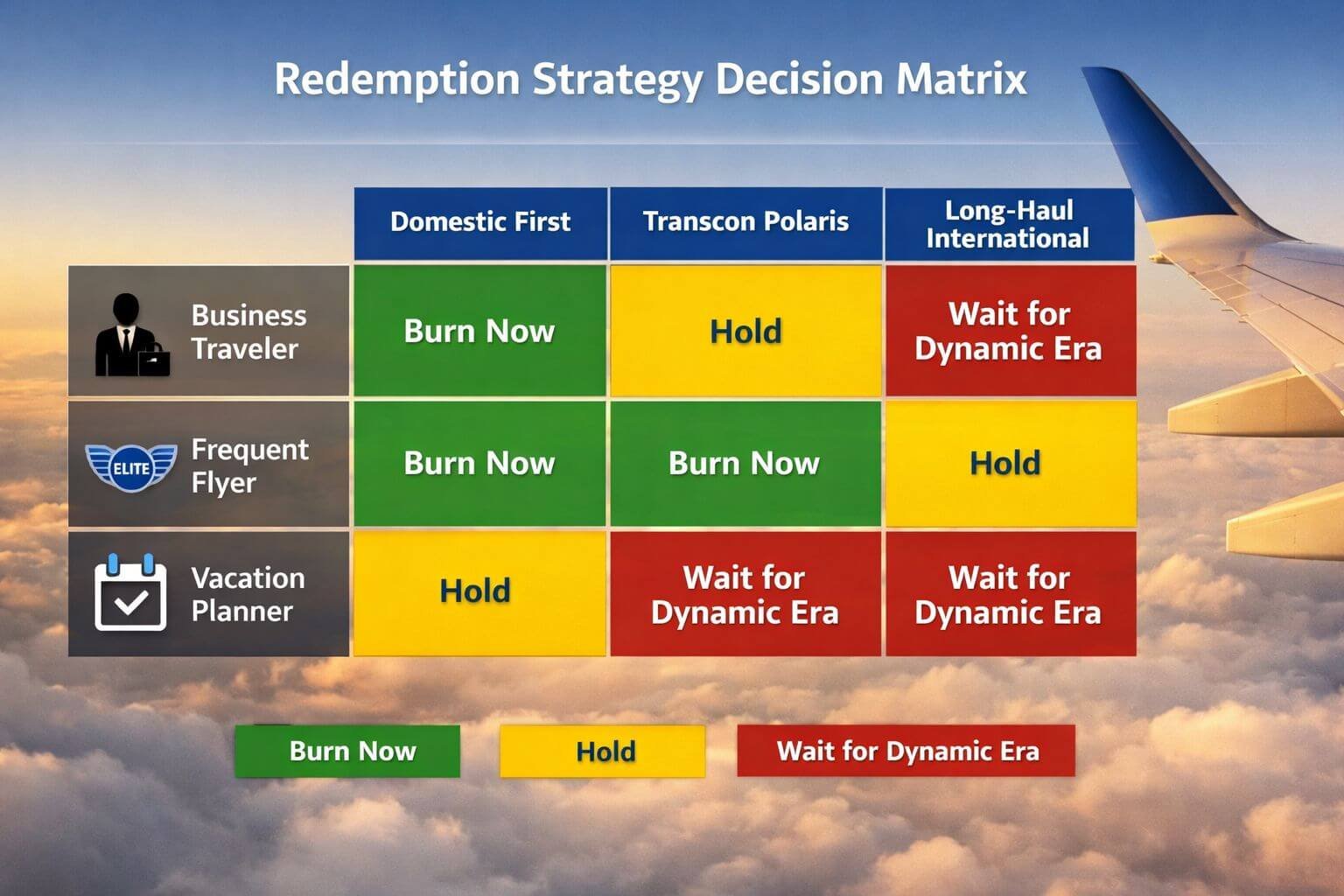
The right strategy for United PlusPoints upgrades in 2026 depends on your travel patterns, balance size, and timeline. Use this framework:
Premier 1K with 200+ PlusPoints and regular international travel:
- Burn aggressively on long-haul Polaris routes now
- Request upgrades at booking on every eligible international flight through January 2027
- Use Economy Plus redemptions only for small residual balances
Premier Platinum with 80–150 PlusPoints and mixed domestic/international travel:
- Prioritize any transcon or international Polaris upgrades first
- Use domestic first class upgrades as secondary option
- Don’t convert to miles — the value is too low
Premier Gold with 40–80 PlusPoints and mostly domestic travel:
- Domestic first class upgrades remain your primary use case
- Consider Economy Plus redemptions if upgrade waitlists aren’t clearing
- Monitor dynamic pricing rollout — domestic first class may not increase significantly
Any tier with expiring PlusPoints (expiring before June 2027):
- Burn immediately on the highest-value upgrade available, even if imperfect
- Economy Plus or WiFi redemptions beat expiration
- Check whether converting to travel credit makes sense as a last resort
Members considering whether to earn more PlusPoints via credit card spending (1K only):
- The unlimited PlusPoints earn from PQP via United credit cards (effective January 2026) is valuable only if you can use them before dynamic pricing makes costs unpredictable
- Earning more PlusPoints in 2026 to burn before February 2027 is a reasonable strategy for 1K members with confirmed international travel planned
For members also managing broader points strategy decisions — including whether to prioritize transferable points for outright Premium Cabin awards versus PlusPoints for upgrades — the best use of 100,000 points guide provides a useful comparison framework. And if you’re evaluating your overall points portfolio heading into year-end, the end-of-year points and miles reset checklist for 2026 is worth running through before December.
FAQ
When exactly does United’s dynamic PlusPoints pricing take effect? February 2027, as announced in December 2025. The fixed chart remains in place through at least January 2027.
Will dynamic pricing affect all routes or just international? United has not specified route exclusions. Based on the announced model, all PlusPoints upgrade routes are expected to transition to dynamic pricing.
Can I use PlusPoints on award tickets in 2026? Yes. As of February 1, 2026, Premier members can use PlusPoints and CPUs on award tickets — a significant expansion from previous rules.
What happens to PlusPoints that don’t expire before February 2027? They remain valid and usable — just under dynamic pricing rules after the transition. PlusPoints don’t expire solely because of the pricing change.
Is it worth converting PlusPoints to miles before February 2027? Generally no. The conversion rate to miles delivers poor value (approximately 0.5–1.0¢ per PlusPoint equivalent), well below what cabin upgrades can yield on premium routes.
How does dynamic pricing affect the upgrade waitlist? United’s COO suggested dynamic pricing aims to improve clearance rates by pricing out low-demand upgrades. Whether waitlist logic changes alongside pricing is not yet confirmed.
Which routes face the highest risk of PlusPoints cost increases? Transcon Polaris (EWR/JFK–LAX/SFO) and peak transatlantic/transpacific Polaris routes carry the highest risk based on demand patterns and analyst commentary.
Do Premier Gold members benefit from the new unlimited PlusPoints earn? No. The unlimited PlusPoints earned from PQP via United credit cards apply to Premier 1K and above only, effective January 1, 2026
Should I book flights specifically to use PlusPoints before February 2027? Only if the travel makes sense on its own. Booking unnecessary flights to burn PlusPoints before a price change is rarely cost-effective when you factor in base fares.
What’s the best alternative if upgrade waitlists aren’t clearing? Economy Plus redemptions offer reasonable value (1.5–4.0¢ per PlusPoint on some routes). Alternatively, evaluate Mileage Upgrade Awards (MUAs) as a separate upgrade mechanism with different inventory access.
Conclusion
The February 2027 dynamic pricing transition is the most consequential change to United PlusPoints in six years. For Premier Gold, Platinum, and 1K members holding meaningful PlusPoints balances, 2026 is a defined window — not an indefinite runway.
The clearest action items:
- Identify every international and transcontinental Polaris flight you have booked or plan to book through January 2027 and request PlusPoints upgrades immediately.
- Prioritize long-haul transpacific and transatlantic routes where the fixed chart cost (140–280 PlusPoints) is most likely to increase under dynamic pricing.
- Use Economy Plus or WiFi redemptions only for residual balances that can’t support a cabin upgrade.
- Don’t convert to miles — it’s the weakest use of PlusPoints in almost every scenario.
- If you’re a 1K member, the unlimited PlusPoints earned from credit card PQP spending is worth accelerating in 2026, specifically to build a buffer for fixed-chart use before February 2027.
The dynamic era may eventually offer genuine value for off-peak travelers — United’s COO made that case directly. But for members with predictable, high-demand travel patterns, the fixed chart is a known quantity that disappears in roughly nine months. Use it accordingly.
Related reading:
- How to book business class with points in 2026
- Award travel trends 2026: 8 strategies for your points plan
- United MileagePlus transfer partners guide (2026)


Content on Award Travel Hub is independently created by Award Travel Hub Editorial Desk and, where noted, reviewed by Award Travel Hub Review Desk. Some pages may contain affiliate links, but compensation does not determine our coverage, opinions, or methodology.