

Last updated: May 24, 2026
Quick Answer: Avianca LifeMiles raised Star Alliance premium cabin award rates to Asia by roughly 11–50% across two devaluations in 2024–2025, with no rollback as of 2026. Business class from the U.S. to Asia now costs approximately 100,000 miles one-way. But LifeMiles still charges zero fuel surcharges on partner awards, and several routes — particularly ANA to Japan and Thai Airways to Southeast Asia — still deliver 1.6–2.0 cents per point (CPP) value, making them worth booking before further changes hit.
Key Takeaways
- LifeMiles business class to Asia jumped from ~63,000–88,000 to ~100,000 miles one-way after successive devaluations in August 2024 and February 2025, with no reversal through 2026.
- Zero fuel surcharges remain the program’s biggest advantage. On carriers like ANA, Singapore Airlines, Thai Airways, and Asiana, taxes and fees on LifeMiles awards typically run $30–$80 total.
- Japan on ANA business class at 100,000 LifeMiles still delivers ~1.6–1.8 CPP against current cash fares, keeping it in “worth booking” territory.
- Singapore Airlines Suites/First at ~130,000 miles is situational — strong CPP only when cash fares exceed $8,000.
- Southeast Asia on Thai Airways (off-peak) can hit 1.8–2.0 CPP, one of the best remaining LifeMiles Asia devaluation 2026 sweet spots.
- Routes to skip: U.S. to India and U.S. to Oceania in business class are now priced poorly via LifeMiles; Aeroplan or the Alaska Mileage Plan often beat it.
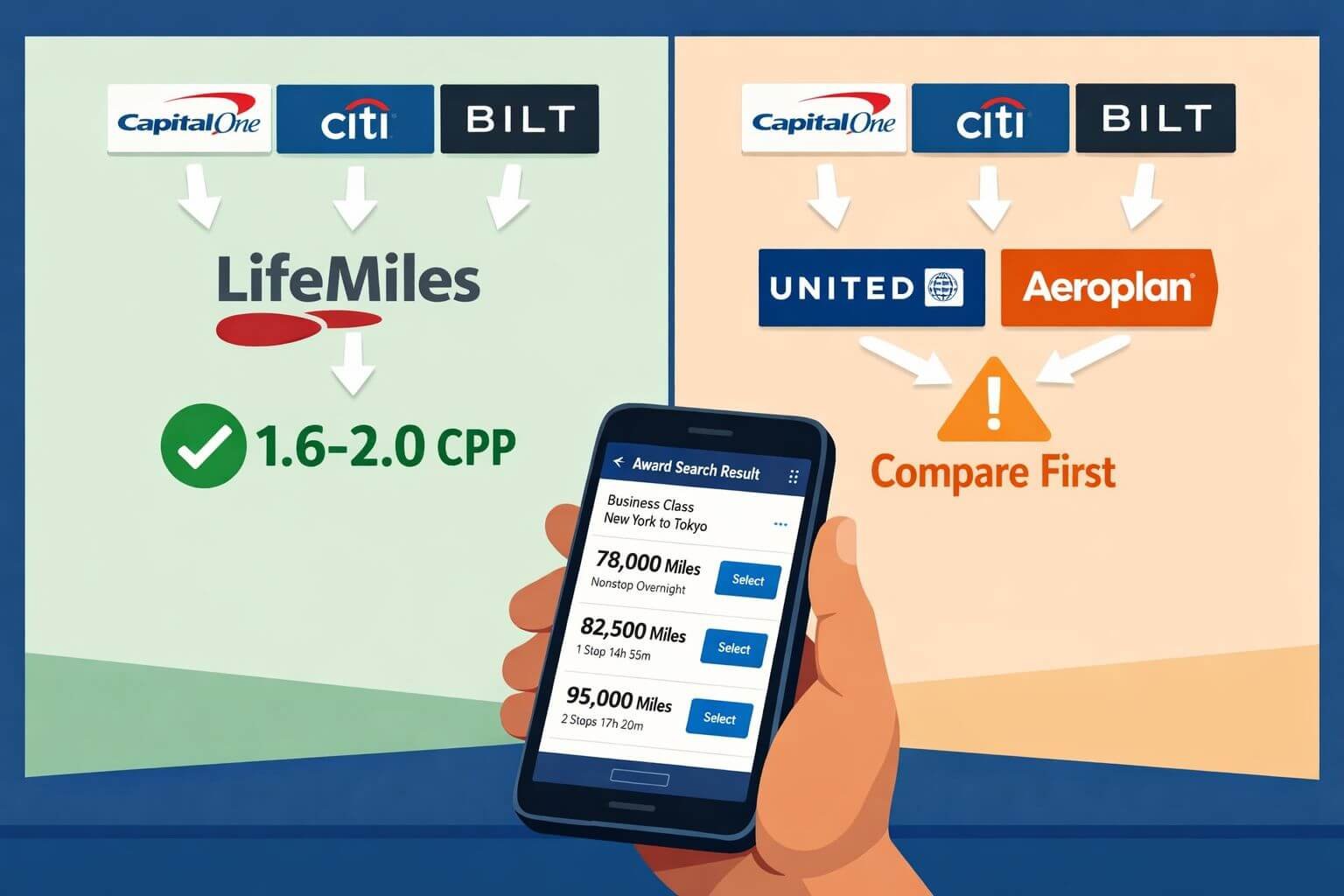
- Capital One, Citi, and Bilt all transfer 1:1 to LifeMiles, and transfer bonuses (like Citi’s 25% bonus in Q1 2026) dramatically improve effective CPP.
- Never transfer points speculatively. LifeMiles has devalued twice in six months without warning. Transfer only when you’ve confirmed award availability.
- The LifeMiles+ subscription ($20/month) offers a 10% redemption discount, which can claw back some of the devaluation losses on expensive bookings.
- Partner award blocking is a growing issue — Lufthansa and some Thai Airways routes show less availability through LifeMiles than through other Star Alliance programs.
What Changed: LifeMiles Asia Award Chart Before and After the Devaluations
LifeMiles didn’t just devalue once. It hit Asia awards twice in rapid succession, and the cumulative damage is significant.
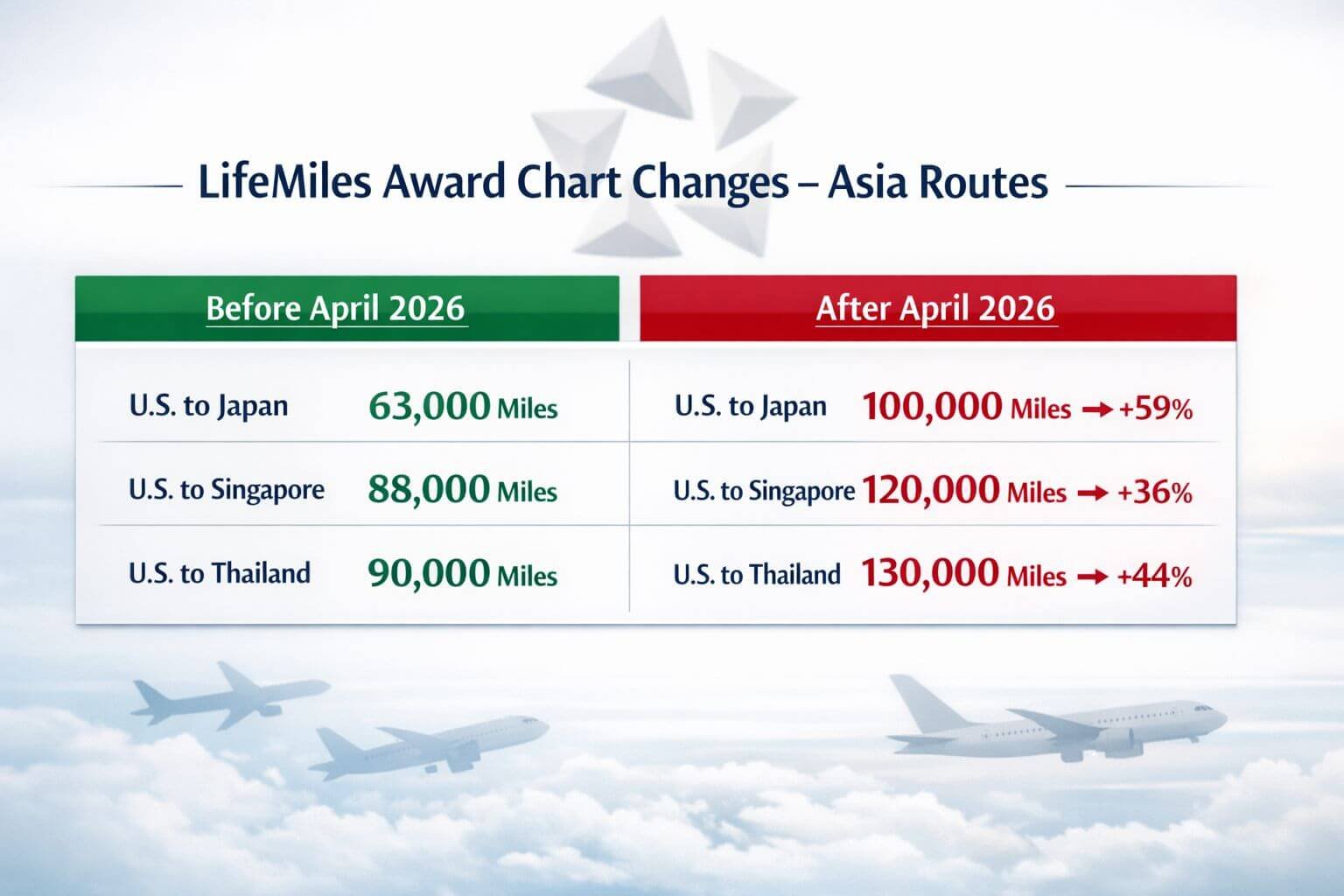
In August 2024, LifeMiles raised long-haul premium cabin rates by up to 50% on select routes. Then in February 2025, a second increase pushed the U.S.-to-Asia economy from ~46,500 to 55,000 miles (an 18% hike) and business class from ~90,000 to 100,000 miles one-way (an 11% increase on top of the prior jump). Neither increase was announced in advance — pricing simply changed on the website.
Here’s how the key U.S.-to-Asia routes compare:
| Route | Cabin | Pre-Aug 2024 | Post-Feb 2025 | % Increase |
|---|---|---|---|---|
| U.S. → Japan | Economy | ~35,000 | 55,000 | ~57% |
| U.S. → Japan | Business | ~63,000 | 100,000 | ~59% |
| U.S. → Singapore | Business | ~88,000 | 100,000 | ~14% |
| U.S. → Singapore | First/Suites | ~90,000–110,000 | ~130,000 | ~30–44% |
| U.S. → Thailand | Business | ~80,000 | 100,000 | ~25% |
| U.S. → Oceania | Business | ~80,000 | 100,000 | ~25% |
Key context: LifeMiles no longer publishes a traditional award chart on its website. Pricing is visible only during the booking flow, making it harder to track changes. The figures above reflect community-reported pricing that has remained consistent through the early 2026 period.
Despite these increases, LifeMiles retains one structural advantage that no devaluation can erase: zero fuel surcharges on all Star Alliance partner awards. On a route where British Airways Avios or Aeroplan might add $300–$600 in carrier-imposed surcharges, LifeMiles keeps total fees under $80. That difference alone can offset a significant portion of the mileage increase.
For a broader context on how devaluations affect booking strategy, see our award travel predictions for 2026.
Best Remaining Sweet Spots: Japan on ANA Business Class (CPP Analysis)
ANA business class from the U.S. to Japan remains the single best LifeMiles Asia devaluation 2026 sweet spot, even at 100,000 miles one-way.
You may be interested


Here’s why the math still works. As of May 2026, nonstop business class cash fares from major U.S. gateways (LAX, SFO, JFK, ORD) to Tokyo typically range from $5,500 to $7,500 one-way on ANA. Using 100,000 LifeMiles plus approximately $50 in taxes:
| Scenario | Miles Required | Taxes/Fees | Cash Fare | Effective CPP |
|---|---|---|---|---|
| Off-peak (Jan–Mar, Oct–Nov) | 100,000 | ~$50 | ~$5,500 | 1.65 CPP |
| Peak (cherry blossom, summer) | 100,000 | ~$50 | ~$7,500 | 1.80 CPP |
| With 25% Citi transfer bonus | 80,000 (effective) | ~$50 | ~$6,500 | 2.06 CPP |
Any redemption above 1.5 CPP is strong for transferable points. Above 2.0 CPP with a transfer bonus, it’s among the best uses of Capital One, Citi, or Bilt points available in 2026.
Common mistake: Searching only on LifeMiles.com. ANA partner award space is often released 330 days out but in limited quantities. Use award search tools like Seats.aero or United.com (which shows the same Star Alliance inventory) to find open dates before transferring points.
Who this is best for: Travelers with Capital One miles, Citi ThankYou points, or Bilt points targeting Japan. ANA’s “The Room” Business Class product on the 777-300ER is widely considered one of the best business class seats in the world.
Who should skip it: If you can find JAL business class availability, Alaska Mileage Plan charges just 60,000–65,000 miles for the same route — a significantly better rate. Check our Star Alliance award booking guide for step-by-step comparisons.
Singapore Airlines Awards: When LifeMiles Still Makes Sense Post-Devaluation
Singapore Airlines Suites (true first class) and business class remain bookable through LifeMiles, but the value proposition has narrowed considerably.
Business class from the U.S. to Singapore now prices at approximately 100,000 LifeMiles one-way. Cash fares for SQ business on the JFK–SIN or LAX–SIN routes typically run $4,500–$6,500, yielding 1.4–1.6 CPP. That’s borderline — acceptable but not compelling.
Suites class (available on select A380 routes) prices at roughly 130,000 LifeMiles. Cash fares for Suites often exceed $8,000–$12,000 when available for purchase, pushing CPP to 1.8–2.5+. The catch: Suites award availability is extremely limited, often releasing only 1–2 seats per flight, and LifeMiles has experienced increased partner blocking on Singapore Airlines inventory.
Decision framework for Singapore Airlines via LifeMiles:
- Book if: You find Suites availability (rare but worth it at 130K miles), or business class cash fares exceed $6,000 on your dates
- Skip if: Business class cash fares are under $5,000 — consider Aeroplan instead, which prices similar routes at competitive rates with better online booking tools
- Watch for: Transfer bonuses. A 25% Citi bonus drops the effective cost of Suites to ~104,000 points, pushing CPP well above 2.0
For a deeper look at combining transfer bonuses with LifeMiles bookings, see our guide on maximizing Amex to LifeMiles transfers.
Southeast Asia and Thailand Routes Where LifeMiles Beats the Competition
Off-peak Thai Airways business class from the U.S. to Bangkok is quietly one of the strongest LifeMiles Asia devaluation 2026 sweet spots still standing.
Thai Airways’ Royal Silk business class operates wide-body aircraft on routes from Europe (with connections from the U.S. via Star Alliance partners). At 100,000 LifeMiles with zero fuel surcharges, and cash fares regularly hitting $5,500–$7,000 one-way in business class from U.S. gateways, the CPP math is favorable:
| Route | Miles | Taxes | Cash Fare Range | CPP Range |
|---|---|---|---|---|
| U.S. → Bangkok (Thai Airways) | 100,000 | ~$60 | $5,500–$7,000 | 1.6–1.8 |
| U.S. → Bangkok (with 25% bonus) | 80,000 eff. | ~$60 | $5,500–$7,000 | 2.0–2.2 |
| U.S. → Taipei (EVA Air) | 100,000 | ~$50 | $4,500–$5,500 | 1.4–1.6 |
| U.S. → Seoul (Asiana) | 100,000 | ~$45 | $4,000–$5,500 | 1.3–1.6 |
Important caveat on Thai Airways: LifeMiles has shown reduced partner award availability for Thai Airways since early 2025. Flights that appear available on United.com may not price out on LifeMiles. Always verify availability directly on the LifeMiles website before transferring points.
EVA Air to Taipei sits in “situational value” territory. At 100,000 miles, you need cash fares above $5,000 to hit 1.5 CPP. EVA’s Business Class product is excellent, but the value depends heavily on travel dates.
Asiana to Seoul is the weakest of the group. Cash fares on this route are often lower, and Asiana’s uncertain future (post-merger with Korean Air) adds risk to long-term availability.
For a broader framework on combining multiple programs to cover Asia trips, check our sweet-spot baskets strategy guide.
Routes to Avoid: Where United, Aeroplan, or Alaska Miles Offer Better Value
Not every LifeMiles Asia redemption is worth it anymore. Here are the routes where alternative programs clearly win.
U.S. to India (Business Class): LifeMiles prices this at ~100,000 miles. Air Canada Aeroplan offers similar Star Alliance routing for 75,000–90,000 points in business class, often with better availability on connections to Air India and EVA Air. Aeroplan wins, even accounting for slightly higher surcharges on some carriers.
U.S. to Australia/New Zealand (Business Class): Post-devaluation, LifeMiles charges ~100,000 miles for Oceania. United MileagePlus prices saver business class at 80,000–90,000 miles on the same flights. And if you’re flexible, Alaska Mileage Plan can book Fiji Airways or partner routings for less.
U.S. to Japan (Economy Class): At 55,000 LifeMiles for economy, the CPP drops below 1.0 on most dates (economy cash fares to Japan often run $500–$700 round-trip on sale). United charges 35,000–45,000 miles for the same economy flights. Skip LifeMiles for economy entirely.
Quick comparison for common Asia routes (Business Class, one-way):
| Route | LifeMiles | Aeroplan | United | Alaska |
|---|---|---|---|---|
| U.S. → Japan | 100,000 | 75,000–90,000 | 80,000–100,000 | 55,000–65,000 (JAL) |
| U.S. → Singapore | 100,000 | 75,000–90,000 | 80,000–100,000 | N/A |
| U.S. → India | 100,000 | 75,000–90,000 | 80,000–100,000 | N/A |
| U.S. → Australia | 100,000 | 75,000–90,000 | 80,000–90,000 | 55,000–70,000 |
The LifeMiles advantage narrows to routes where zero surcharges matter most — primarily ANA (which charges heavy surcharges through other programs) and Thai Airways. Regardless of low surcharges, Aeroplan and Alaska often price better.
For a full comparison of which transfer partner works best for each situation, see our comparing transfer partners guide.
How to Find and Book LifeMiles Asia Awards (Tools and Tactics)
Finding award space is the hardest part. Here’s a step-by-step process that works in 2026.
Step 1: Search on United.com first. United shows Star Alliance partner award availability without requiring a login. Search for “saver” level awards — these are the seats LifeMiles can book. If United shows availability, there’s a good chance LifeMiles can access it (but not guaranteed due to partner blocking).
Step 2: Cross-reference with Seats.aero or Point.me. These award search tools aggregate availability across programs and can flag when LifeMiles-specific inventory opens up.
Step 3: Verify on LifeMiles.com. Before transferring any points, run the exact search on the LifeMiles website. Confirm the mileage price and that the flight actually appears. Partner blocking means some flights visible on United won’t show on LifeMiles.
Step 4: Transfer points only after confirming availability. Capital One, Citi, and Bilt transfers to LifeMiles are typically instant or complete within minutes. Amex transfers can take 1–2 business days. Never transfer speculatively.
Step 5: Book immediately after transfer. Award space can disappear within hours, especially on popular ANA routes to Japan.
Fees to watch:
- Close-in booking fee: $25–$50 for awards within 15 days of departure
- Phone booking fee: Required for mixed-cabin itineraries; may add $25–$35
- Cancellation: LifeMiles charges fees for cancellations; review award cancellation rules before booking
Common pitfall: Transferring points during a transfer bonus promotion without confirmed availability. If the award disappears, your points are stuck in LifeMiles — a program with limited domestic U.S. redemption value.
Transfer Partner Strategy: When to Move Points to LifeMiles in 2026
The right time to transfer to LifeMiles is narrow and specific. Here’s the decision framework.
Transfer to LifeMiles when all three conditions are met:
- You’ve confirmed saver-level award availability on LifeMiles.com
- The route involves a carrier with high fuel surcharges elsewhere (ANA, Thai Airways, Lufthansa)
- CPP exceeds 1.5 based on current cash fares
Wait for a transfer bonus when:
- You have flexibility on travel dates (2+ weeks of possible departure dates)
- You’re targeting a high-value redemption (Suites class, peak-season ANA business)
- Citi, Capital One, or Amex has historically offered bonuses to LifeMiles in the current quarter
As of early 2026, Citi offered a 25% transfer bonus to LifeMiles in Q1 2026. These bonuses typically recur every 3–6 months. A 25% bonus on a 100,000-mile redemption means you only need to transfer 80,000 Citi ThankYou points — a massive difference.
LifeMiles+ subscription consideration: At $20/month, the 10% redemption discount saves 10,000 miles on a 100,000-mile award. If you’re booking two or more premium cabin awards within a month, the subscription pays for itself. Cancel after booking.
For readers weighing how to allocate a large points balance, our guide on the best use of 100,000 points walks through the math across all major transfer partners.
Conclusion: What to Book Now and What to Watch
The LifeMiles Asia devaluation 2026 sweet spots have shrunk, but they haven’t disappeared. The program’s zero-surcharge advantage on carriers like ANA and Thai Airways keeps specific routes competitive — particularly Japan business class and off-peak Thailand awards, where CPP still lands between 1.6 and 2.0.
Your next steps:
- Set award alerts for ANA business class to Tokyo and Thai Airways to Bangkok using Seats.aero or Point.me
- Hold your transferable points in Capital One, Citi, or Bilt until you confirm availability — do not pre-transfer
- Watch for transfer bonuses — a 15–25% bonus to LifeMiles turns a “good” redemption into a great one
- Compare before booking — run the same route through Aeroplan and United to confirm LifeMiles is actually the best option for your specific dates
- Consider LifeMiles+ for one month if booking multiple premium awards to capture the 10% discount
The days of 63,000-mile ANA business class are gone. But for travelers holding transferable points and willing to search strategically, LifeMiles still earns its place in the booking toolkit — just not for every route.
FAQ
Q: Did LifeMiles announce the Asia devaluation in advance? A: No. Both the August 2024 and February 2025 increases took effect without prior notice. Pricing simply changed on the website.
Q: What transfer partners send points to LifeMiles? A: Capital One (1:1), Citi ThankYou (1:1), Bilt Rewards (1:1), and Amex Membership Rewards (1:1). Chase Ultimate Rewards does not transfer to LifeMiles.
Q: Does LifeMiles charge fuel surcharges on partner awards? A: No. LifeMiles charges zero fuel surcharges on all Star Alliance partner awards, including ANA, Singapore Airlines, Thai Airways, Lufthansa, and Asiana. Total taxes and fees typically run $30–$80.
Q: Is LifeMiles economy class to Asia still a good deal? A: Generally, no. At 55,000 miles one-way for economy to Asia, the CPP drops below 1.0 on most routes. United MileagePlus or Aeroplan offer better economy pricing.
Q: How fast do points transfer to LifeMiles? A: Capital One, Citi, and Bilt transfers are typically instant to a few minutes. Amex transfers can take 1–2 business days. Always confirm availability before transferring.
Q: Can I book Singapore Airlines Suites through LifeMiles? A: Yes, when availability exists. Suites class prices at approximately 130,000 LifeMiles one-way from the U.S. to Singapore. Availability is extremely limited — typically 1–2 seats per flight.
Q: Is the LifeMiles+ subscription worth it? A: For a single premium cabin booking, the 10% discount (saving ~10,000 miles on a 100K award) is worth more than the $20 monthly fee. Subscribe for one month, book, then cancel.
Q: Should I buy LifeMiles during a sale instead of transferring? A: LifeMiles sales (like the March 2026 sale at 1.27 cents/mile) can make sense for top-tier redemptions where CPP exceeds 2.0. For most bookings, transferring from credit card programs — especially during a bonus — is more cost-effective. See our guide to buying airline miles for the full analysis.
Q: What’s the biggest risk with LifeMiles right now? A: Partner award blocking. Some Star Alliance flights that appear available through United or Aeroplan don’t show up on LifeMiles. Always verify on LifeMiles.com before transferring points.
Q: Will LifeMiles devalue again? A: There’s no way to predict this with certainty, but the trend is clear — two devaluations in six months suggest further increases are possible. This is why transferring points only after confirming availability is critical.


Content on Award Travel Hub is independently created by Award Travel Hub Editorial Desk and, where noted, reviewed by Award Travel Hub Review Desk. Some pages may contain affiliate links, but compensation does not determine our coverage, opinions, or methodology.