
Last updated: April 20, 2026
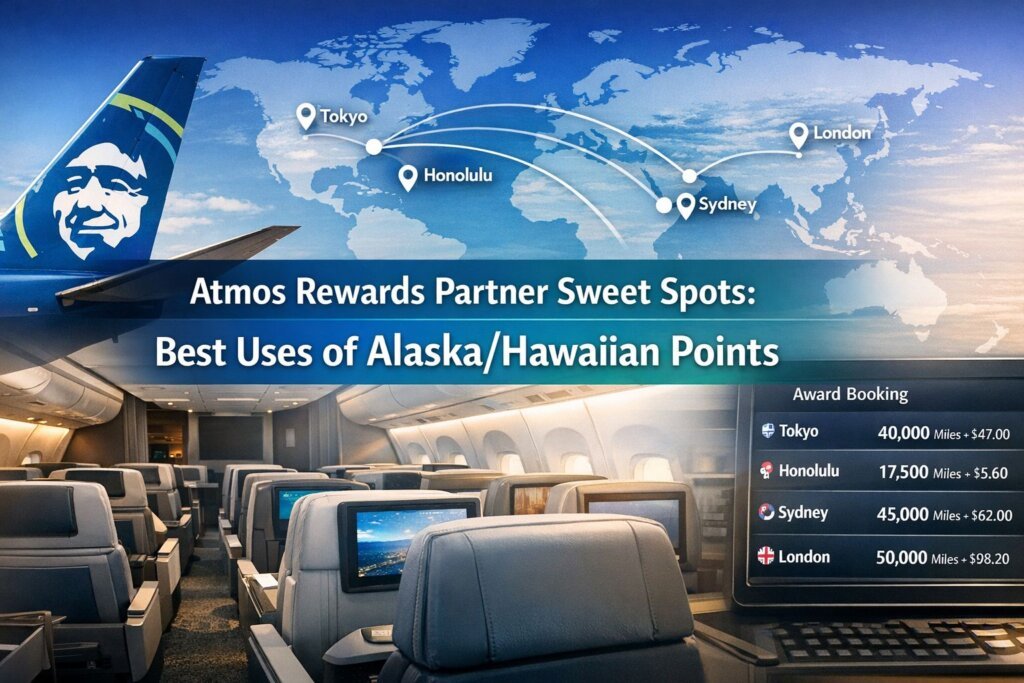
Atmos Rewards sweet spots are real, but only a few are strong enough to matter in actual bookings. The best uses of Alaska and Hawaiian-linked points in 2026 are still partner awards to Asia, select Hawaii flights, and a handful of short-haul and Premium Cabin redemptions where fixed or semi-structured pricing beats dynamic cash-like programs.
Key Takeaways
- Atmos Rewards sweet spots still exist in 2026, especially on partner airlines and Hawaii routes.
- The best values are not always the lowest headline prices. Award availability, taxes, and booking friction matter just as much.
- West Coast to Hawaii remains one of the most practical uses, often at around 10,000 points one-way when saver-level space is available.
- Premium cabin partner awards on Japan Airlines, Starlux, Fiji Airways, Qantas, and Qatar can offer strong value, but some are hard to book in practice.
- The Alaska-Hawaiian integration has added more earning flexibility and new program branding, but core partner sweet spots have not disappeared.
- Use Alaska/Hawaiian-linked points when you can book a high-value partner seat directly. Do not transfer speculatively.
- If a redemption has high fuel surcharges, poor availability, or only mixed-cabin space, it may be a good deal on paper but not a good booking strategy.
- For the award search workflow, start with flexible dates and partner space tools, then compare with alternatives like Aeroplan or AAdvantage.
Quick Answer
The best Atmos Rewards sweet spots in 2026 are partner awards where Alaska/Hawaiian-linked points still price below cash rates and below competing programs. For most travelers, the most practical options are West Coast to Hawaii, inter-island Hawaii flights, Japan Airlines business or first to Asia, Starlux business class, and selected Fiji or Qantas long-haul awards.
How do Atmos partner awards work?
Atmos Rewards now covers the combined Alaska-Hawaiian loyalty ecosystem, but partner award value still comes from Alaska-style redemption logic more than from broad transfer flexibility. In simple terms, the best uses come from booking partner airlines through Atmos rather than using points at a fixed value.
What matters in 2026:
- Alaska and Hawaiian have moved into a unified Atmos Rewards structure with expanded earning methods and 2026 benefit updates.
- Partner awards still depend on award charts or structured partner pricing, not pure revenue pricing in every case.
- That makes Atmos more interesting than fully dynamic programs for some long-haul awards.
- Alaska has also announced improved partner flight earnings for premium cabins later in 2026, which helps earners, though not necessarily award pricing.
Decision rule: Choose Atmos Rewards when a partner award has fixed or predictable pricing and low taxes. Skip it when cash fares are cheap or when another program has better access to the same seat.
For a broader overview of the merger and program structure, see Alaska-Hawaiian Atmos Rewards: What the Merger Means and the Alaska ATMOS Rewards transfer partners guide.
Which Atmos Rewards sweet spots are best by traveler goal?
The best Atmos Rewards sweet spots depend on the trip goal, not just the cabin. For most readers, the strongest choices fall into four buckets: Asia premium cabins, Hawaii, short-haul, and occasional Europe or South Pacific awards.
| Traveler goal | Best sweet spot | Typical value case | Practicality |
|---|---|---|---|
| Asia premium | JAL or Starlux business/first | Premium cabin awards at fewer miles than many rivals | Medium to hard |
| Hawaii | West Coast to Hawaii on Alaska/Hawaiian/American | Low point cost vs often expensive cash fares | High |
| Short-haul | Intra-Hawaii or West Coast short routes | Good for expensive holiday or peak dates | Medium |
| Europe | Aer Lingus / British Airways alternatives via partners where available | Niche, depends on route and fees | Low to medium |
| South Pacific | Fiji Airways or Qantas business | Strong value if saver space opens | Hard |
Top 9 practical sweet spots in 2026
- West Coast to Hawaii in economy, from about 10,000 points one-way on Alaska, Hawaiian, or American when saver space is open.
- Inter-island Hawaii in the economy, often around 4,500 to 6,500 points one-way, depending on route and transition pricing.
- Japan Airlines business class from North America to Japan or onward to Asia.
- Japan Airlines’ first class on long-haul routes is available to travelers who can find rare saver space.
- Starlux business class to Taipei from West Coast gateways.
- Fiji Airways business class to Fiji or onward to Australia/New Zealand.
- Qantas business class on longer Pacific routes, especially when cash prices spike.
- American Airlines flights to Hawaii are booked with Atmos-linked points when AAdvantage is dynamically expensive.
- Short-haul partner flights where cash fares are high and point prices stay reasonable.
What are the best premium cabin Atmos Rewards sweet spots?
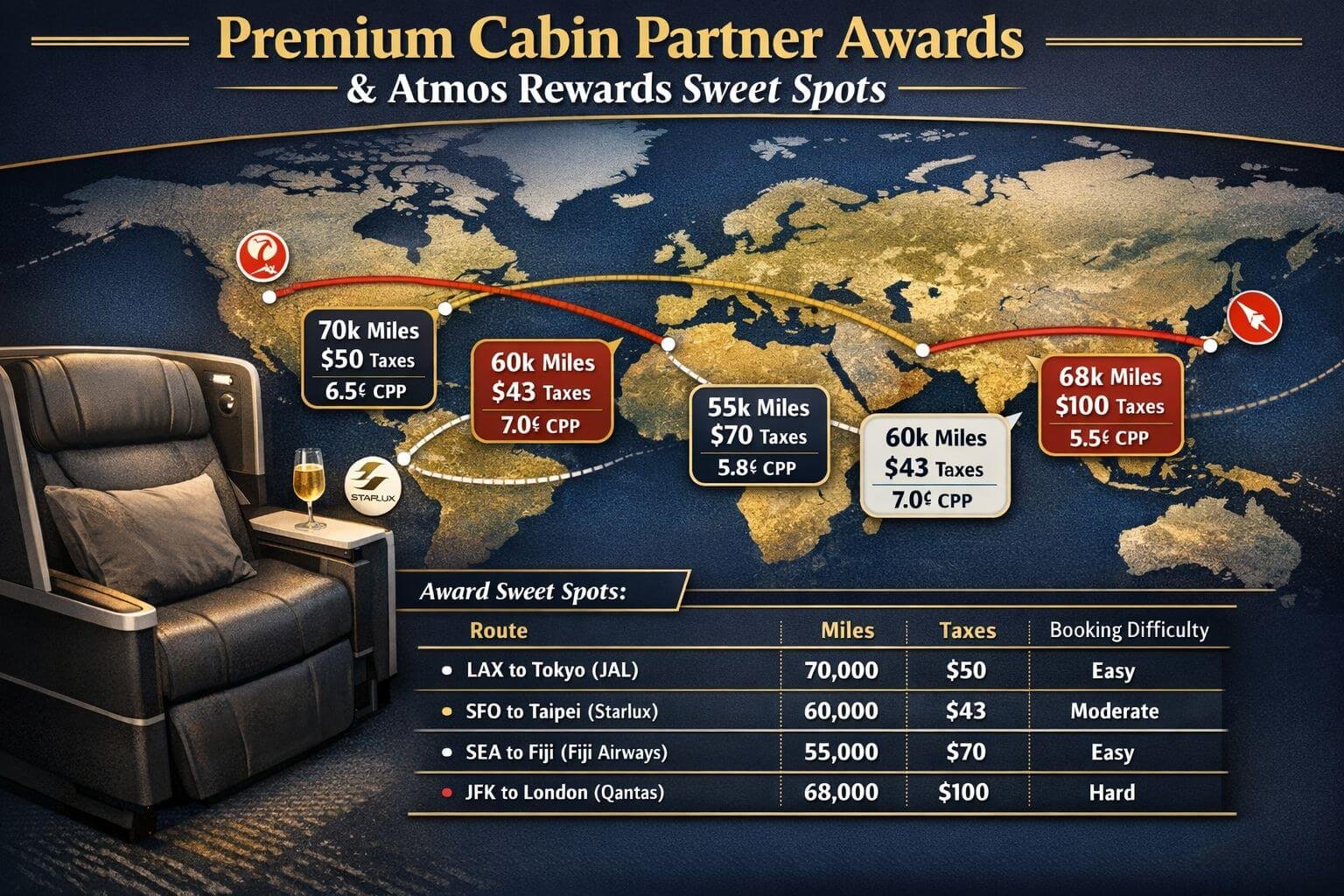
The best premium cabin Atmos Rewards sweet spots are Japan Airlines, Starlux, Fiji Airways, and selected Qantas awards. These are the redemptions that most often produce strong cents per point (CPP), especially in business or first class.
Sample premium cabin awards
Assumptions: CPP estimates use a realistic but variable cash fare check for comparable one-way tickets in 2026. Taxes are approximate and can vary by departure point and partner.
| Route and cabin | Miles | Taxes/fees | Transfer path | Rough CPP |
|---|---|---|---|---|
| Los Angeles to Tokyo on JAL business | 75,000 | ~$19 | Earn via Alaska/Hawaiian-linked balances | ~4.5 to 6.0 cpp |
| San Francisco to Tokyo on JAL first | 110,000 | ~$19 | Alaska/Hawaiian-linked balances | ~7.0+ cpp |
| Los Angeles to Taipei on Starlux business | 75,000 | ~$19-$50 | Alaska/Hawaiian-linked balances | ~4.0 to 5.5 cpp |
| Los Angeles to Nadi on Fiji Airways business | 75,000 | ~$50-$100 | Alaska/Hawaiian-linked balances | ~3.5 to 5.0 cpp |
| Dallas to Doha on Qatar business | 85,000 | often moderate | Alaska-linked partner award | ~3.0 to 4.5 cpp |
You may be interested



Why these stand out:
- JAL business and first remain flagship redemptions because taxes are low and cabin quality is high.
- Starlux business class is attractive for trips to Taiwan and onward to Asia, though routes and seat availability are limited.
- Fiji Airways can be a good option for South Pacific trips where cash fares are expensive.
- Qatar can be valuable, but booking friction and partner space can be inconsistent.
A partner award is only a sweet spot if the seat is actually bookable at a sane tax level.
Common mistake: Booking the first premium seat seen without comparing alternatives. A 75,000-mile business class award is not automatically a deal if Aeroplan, AAdvantage, or transfer-bonus options can do better.
Useful background:
- Best Airline Loyalty Programs: A Value Comparison Guide
- How to Book Business Class with Points: 2026 Guide
Which Atmos Rewards sweet spots are best for travel to Hawaii and for economy travel?
For practical bookings, Hawaii is the most useful part of the Atmos story. West Coast to Hawaii and inter-island flights are easier to book than many long-haul premium awards, and they can save real money on peak dates.
Best Hawaii and economy sweet spots
- West Coast to Hawaii from about 10,000 points one-way on select routes and partners.
- Inter-island Hawaii from about 4,500 to 6,500 points one-way, depending on route and timing.
- West Coast short-haul flights when cash fares are unusually high.
- Holiday or school-break economy awards, where fixed-ish point pricing outperforms dynamic programs.
Sample economy awards
| Route | Miles | Taxes/fees | Transfer path | Rough CPP |
|---|---|---|---|---|
| Seattle to Honolulu economy | 10,000 | ~$6 | Alaska/Hawaiian-linked balances | ~1.8 to 2.5 cpp |
| Portland to Maui economy | 10,000 | ~$6 | Alaska/Hawaiian-linked balances | ~1.7 to 2.3 cpp |
| Honolulu to Lihue economy | 6,500 | ~$6 | Alaska/Hawaiian-linked balances | ~1.5 to 2.2 cpp |
| Kahului to Honolulu first | 15,000 | ~$6 | Alaska/Hawaiian-linked balances | ~1.8 to 2.5 cpp |
These are not flashy redemptions, but they are often the best use of points for families and travelers who value low hassle over aspirational bookings.
Choose Hawaii sweet spots if:
- Travel dates are during school breaks or holiday periods
- Cash fares are elevated
- A premium cabin booking is unrealistic for the group size
- A simple nonstop has more value than chasing a higher CPP on paper
For broader transferable points context, compare options in Comparing Transfer Partners 2026: Chase vs Amex vs Citi vs Capital One and Best Use of 100,000 Points: Transfer Partner Value 2026.
Which Atmos Rewards sweet spots are hard to book in practice?
Some Atmos Rewards sweet spots are more famous than useful. Japan Airlines first, certain Qantas routes, and marquee Qatar business awards can be excellent deals, but many travelers will not find the space they need.
The main friction points:
- Limited saver award availability
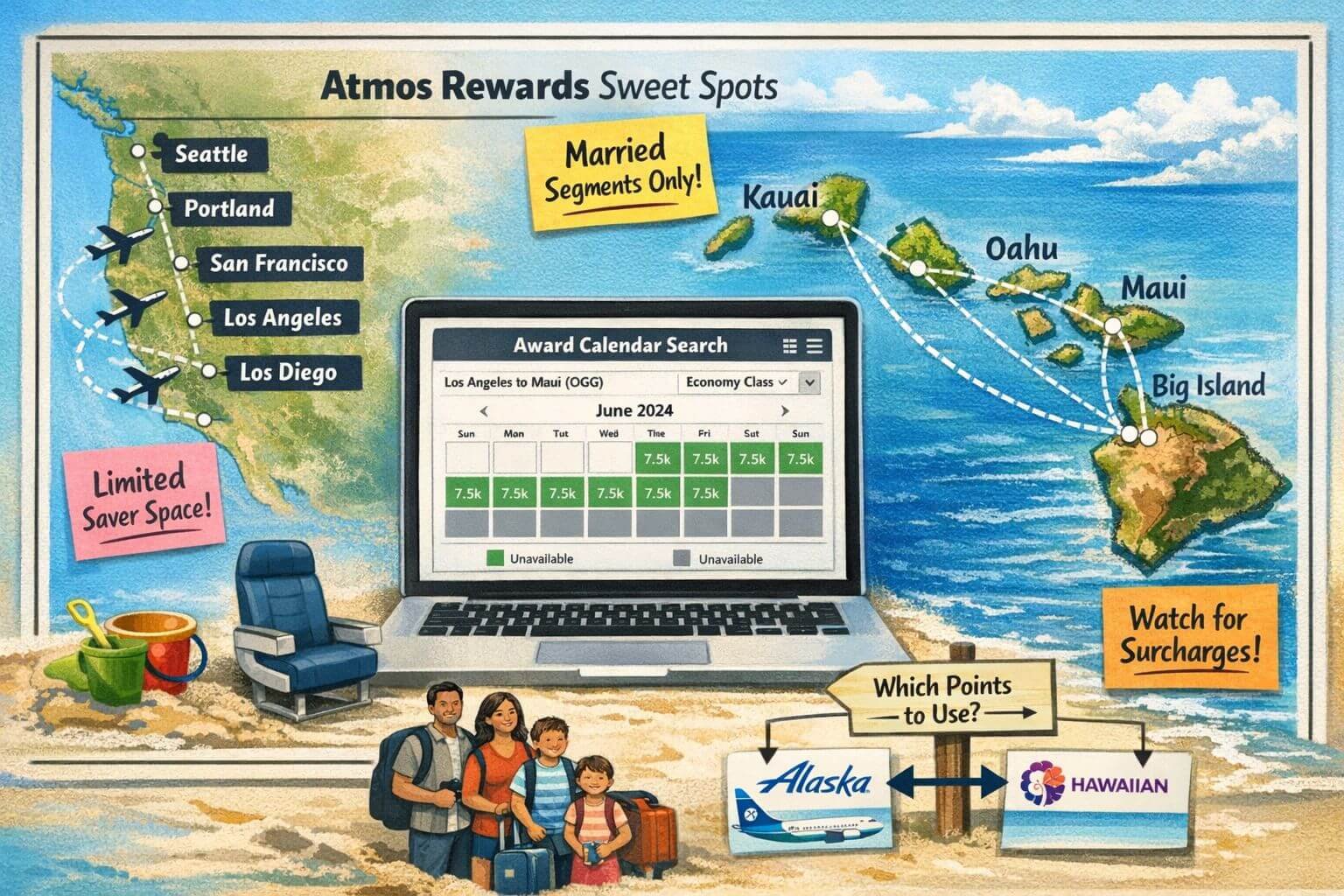
- Married segments, where partner seats only appear when booked with a longer connection
- Schedule release timing, especially for top premium products
- Mixed-cabin pricing, where one short segment in economy can still show as a premium award
- Fuel surcharges and fees on some partners, depending on the route
Good on paper, harder in practice:
- JAL first class for two passengers
- Qantas long-haul business from the U.S.
- Peak-season Hawaii at the lowest point levels
- Multi-city itineraries with stopovers that rely on rare partner inventory
Common mistake: Transferring bank points too early. Atmos-linked value is strongest when the award space is already visible. For search help, use Best Ways to Find Partner Award Space Fast (2026 Guide) and review Transfer Bonus Strategy: When to Transfer Points in 2026.
How should travelers choose the right Atmos Rewards redemption?
The right Atmos redemption depends on trip purpose, point source, and backup options. The best decision framework is to compare three things: price in points, out-of-pocket taxes, and odds of finding space.
Simple decision framework
Start with trip goal
- Asia premium cabin
- Hawaii family trip
- Simple domestic or short-haul booking
Check Atmos first if
- Partner award pricing is fixed or attractive
- Taxes are low
- You have found real saver-level space
Compare at least one alternative
- AAdvantage for oneworld
- Aeroplan for broader partner access
- Flying Blue or LifeMiles if transfer bonuses apply
Run the math
- Estimate cents per point (CPP) using the comparable cash fare
- See the 2026 guide to cents-per-point
Book only when the redemption fits the trip
- Nonstop economy to Hawaii may beat a harder business class award with poor timing
Best for:
- Travelers with specific partner targets
- Hawaii flyers based on the West Coast
- Intermediate and advanced users are comfortable searching partner space
Not for:
- Travelers who want instant transfer flexibility from every bank’s currency
- Anyone booking at the last minute without flexible dates
- Readers who prefer simple fixed-value travel portals
What are the biggest mistakes to avoid with Atmos Rewards sweet spots?
The most common mistakes are chasing old sweet spots, ignoring taxes, and overvaluing premium cabins with no real availability. Atmos rewards can be excellent, but only when the booking is practical.
Common pitfalls
- Assuming every famous Alaska redemption still works exactly the same
- Ignoring devaluation risk, especially after merger transitions
- Skipping cash comparisons on domestic and Hawaii routes
- Overlooking positioning flights needed to reach the long-haul gateway
- Forgetting cancellation rules and partner change fees
- Booking based on blogger screenshots instead of current searches
A common real-world scenario: a traveler sees a low-mileage premium award from Los Angeles but lives in Denver. Once a positioning flight, an overnight hotel, and limited backup options are added, the deal may no longer be the best use of points.
For more on transfer ecosystems, see Amex Transfer Partners Guide, Chase Transfer Partners Guide 2026, and Bilt Transfer Partners Guide.
Are Atmos Rewards worth the attention in 2026, or mostly branding hype?
Atmos Rewards is not just branding hype, but the upside is concentrated in a small set of partner awards and Hawaii use cases. The combined program has gained attention for innovation, new earning options, and integrated benefits, yet the real value still comes from selective redemptions rather than broad across-the-board bargains.
What has improved:
- Flexible earning structures and 2026 benefit enhancements.
- Continued partner access and preserved sweet spots in several key areas.
- Strong relevance for West Coast and Hawaii travelers.
What has not changed:
- Availability still determines value.
- Some 2025 chart changes reduced value on certain routes.
- Transferable points alternatives can beat Atmos on many routes.
FAQ
What are the best Atmos Rewards sweet spots in 2026?
The strongest practical options are West Coast to Hawaii, inter-island Hawaii flights, Japan Airlines business or first, Starlux business class, and selected Fiji or Qantas awards.
Are Alaska points and Hawaiian points basically the same now?
They are part of the broader Atmos Rewards structure, but booking logic and partner strengths still reflect the Alaska-Hawaiian integration process rather than a fully identical experience in every detail.
Is Hawaii the best use of Alaska/Hawaiian-linked points?
For many travelers, yes. Hawaii awards are easier to use than aspirational premium awards and can deliver solid value during expensive travel periods.
Are premium cabin Atmos Rewards sweet spots easy to book?
No. The best premium cabin awards often have limited space for savers, especially for two passengers or on peak dates.
Should travelers speculatively transfer Amex or Chase points for Atmos-style redemptions?
No. Transfer only when award availability is confirmed, and the taxes, routing, and backup options make sense.
Do Atmos partner awards have fuel surcharges?
Some partner awards can include meaningful surcharges and fees, so always check the total out-of-pocket cost before booking.
Is Atmos better than AAdvantage for Hawaii?
Often, yes, for fixed-value Hawaii sweet spots, especially when AAdvantage pricing is dynamic and expensive.
Is Atmos better than United for Hawaii?
Often yes on saver-style Hawaii pricing, because United frequently uses dynamic pricing that can run much higher.
What is a married segment in award travel?
A married segment means partner award space may only appear when two or more flight segments are booked together, not on the nonstop by itself.
Who should focus most on Atmos Rewards sweet spots?
West Coast flyers, Hawaii travelers, and experienced award bookers targeting specific oneworld-style partner awards should pay the most attention.
Related reading
- Alaska-Hawaiian Atmos Rewards: What the Merger Means
- Best Ways to Find Partner Award Space Fast (2026 Guide)
- Best Airline Loyalty Programs: A Value Comparison Guide
- Best Use of 100,000 Points: Transfer Partner Value 2026
- How to Book Business Class with Points: 2026 Guide
Conclusion
Atmos Rewards sweet spots are worth using in 2026, but only if the booking is practical. The best uses of Alaska and Hawaiian-linked points are still concentrated in a few areas: Hawaii flights with low taxes, Japan Airlines and Starlux premium cabins, and selected Fiji or Qantas partner awards where cash fares are high and partner space is real.
The best next step is simple: check live award availability before moving any transferable points, compare at least one alternative program, and favor redemptions that fit the trip without extra positioning or high surcharges. If the goal is Hawaii, start there. If the goal is Asia’s premium cabins, start with JAL and Starlux. If the award is hard to find, move on quickly rather than forcing a booking.




Content on Award Travel Hub is independently created by Award Travel Hub Editorial Desk and, where noted, reviewed by Award Travel Hub Review Desk. Some pages may contain affiliate links, but compensation does not determine our coverage, opinions, or methodology.