
United’s 2025 card refresh is now fully in effect, and the annual fee increases are hitting renewal statements across the board. The Explorer jumped to $150, the Quest climbed to $350, and the Club Infinite now commands $695. For United flyers who previously held these cards at lower price points, the question is no longer if the math changed—it’s which card, if any, still makes sense for your specific travel pattern.
This guide breaks down the best United credit cards in 2026 using a structured decision framework. Rather than ranking them generically, the goal is to match each card to the traveler profile where it actually delivers positive ROI. The comparison covers post-refresh fees, benefit buckets, PQP earnings for status chasers, and real break-even math—so the right answer becomes clear before renewal day.
Key Takeaways
- Explorer ($150/yr) remains the strongest value for leisure flyers taking 2–4 United roundtrips per year, primarily because of the free first checked bag benefit and statement credits that can offset most of the fee.
- Quest ($350/yr) targets semi-frequent flyers who value the $200 annual TravelBank credit and 1,000 bonus PQPs, but requires disciplined use of monthly credits to break even.
- Club Infinite ($695/yr) only pencils out for flyers who would otherwise buy United Club memberships ($750/yr) or fly 15+ segments annually, thanks to lounge access, 1,500 bonus PQPs, and the highest PQP earning cap.
- Product changes (upgrades/downgrades) do not trigger new welcome bonuses—a critical detail covered below.
- United miles earned on co-branded cards are locked into MileagePlus; pairing with transferable points programs (Chase, Amex, Capital One, Citi, Bilt) gives broader flexibility for premium cabin awards.
United Card Comparison Table: Post-Refresh Annual Fees & Core Benefits
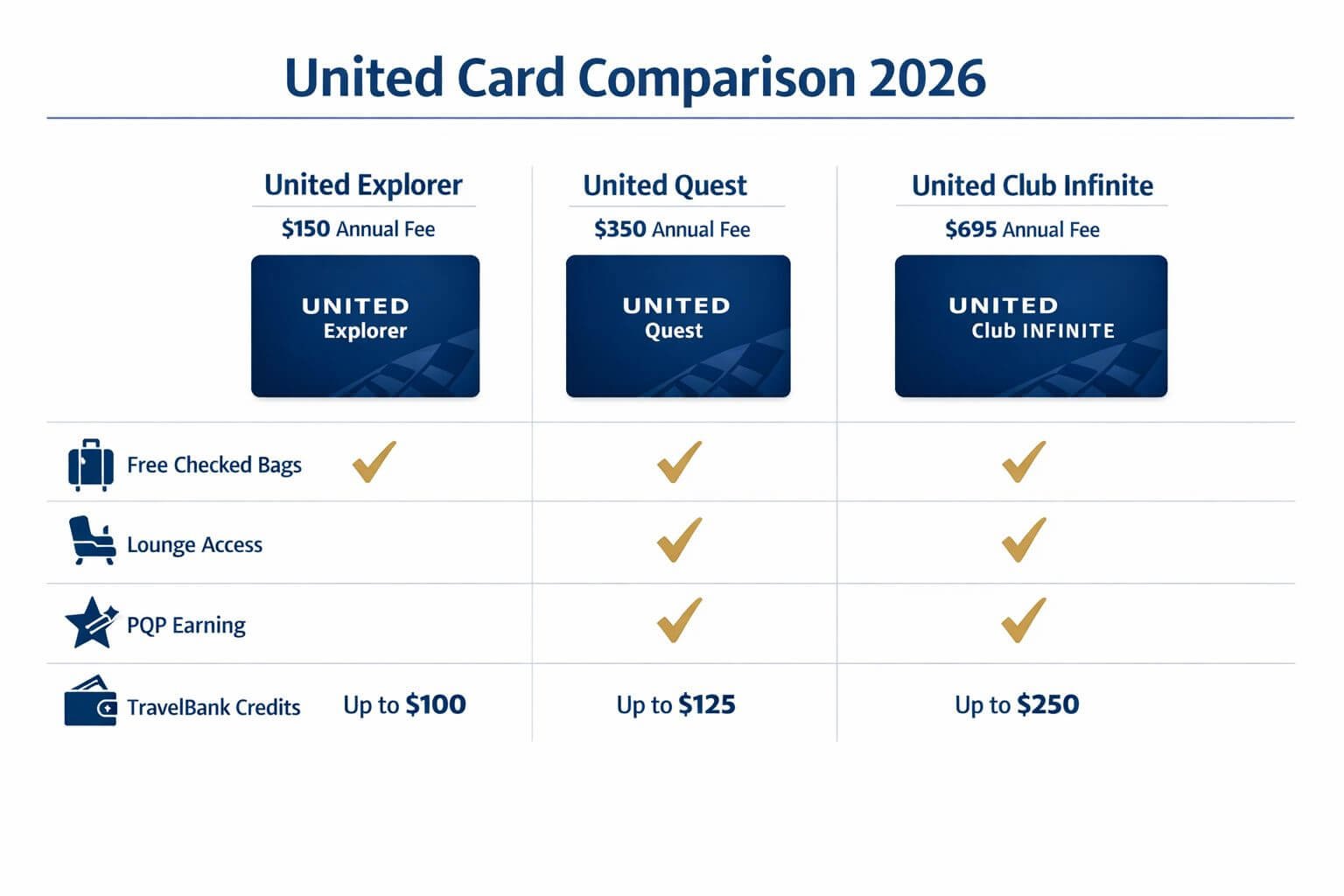
Before diving into the decision framework, here’s the updated side-by-side view of all three cards after the 2025/2026 refresh:
| Feature | Explorer | Quest | Club Infinite |
|---|---|---|---|
| Annual Fee | $0 first year, then $150 | $350 | $695 |
| Welcome Bonus (typical) | 60,000 miles | 70,000 miles | 90,000 miles |
| United Purchases | 2x miles | 3x miles | 4x miles |
| Dining | 2x miles | 2x miles | 2x miles |
| All Other Purchases | 1x mile | 1x mile | 2x miles |
| Free Checked Bags | 1st bag free (cardholder + companion on reservation) | 1st & 2nd bag free (cardholder + companion) | 1st & 2nd bag free (cardholder + companion) |
| TravelBank Annual Credit | — | $200 | — |
| United Club Lounge Access | ❌ (2 single-visit passes/yr) | ❌ (2 single-visit passes/yr) | ✅ Full membership |
| Instacart Credit | Up to $120/yr | Up to $120/yr | Up to $240/yr |
| Rideshare Credit | Up to $48/yr | Up to $48/yr | Up to $100/yr |
| JSX Credit | — | Up to $120/yr | Up to $240/yr |
| Bonus PQPs (annual) | — | 1,000 PQPs | 1,500 PQPs |
| PQP Earning via Spend | — | 1 PQP per $20 (up to 18,000) | 1 PQP per $15 (up to 28,000) |
| Global Entry/TSA PreCheck | ✅ | ✅ | ✅ |
| Trip Delay/Cancellation | Basic | Enhanced | Enhanced |
| Priority Boarding | ✅ | ✅ | ✅ |
| 25% Back on Inflight | ✅ | ✅ | ✅ |
💡 Note: The Instacart and JSX credits currently expire December 31, 2027. Factor this into multi-year value calculations—these perks may not renew.
What Changed in the 2025/2026 Refresh (and Why It Matters Now)
The annual fee increases weren’t the only changes. Understanding what shifted helps determine whether the new pricing still works:
Fee increases at a glance:
- Explorer: $95 → $150 (58% increase)
- Quest: $250 → $350 (40% increase)
- Club Infinite: $525 → $695 (32% increase)
What was added to justify the increases:
- PQP bonuses became a headline feature: Quest holders receive 1,000 PQPs automatically each January (if the card was open on December 31 of the prior year), and Club Infinite holders receive 1,500 PQPs.
- PQP earnings through spend expanded: Quest earns 1 PQP per $20 spent (capped at 18,000 PQPs), while Club Infinite earns 1 PQP per $15 (capped at 28,000 PQPs).
- Lifestyle credits (Instacart, rideshare, JSX) were introduced across all tiers.
- Earning rates improved slightly, with Club Infinite now earning 2x on all non-category spend (up from 1.5x).
What was reduced or nerfed:
- Club Infinite’s guest lounge access now requires $50,000 in annual spend to unlock “All Access” (unlimited guests). Without hitting that threshold, guest access is more limited than before.
- The effective value of lounge access decreased for cardholders who frequently bring non-cardholders as travel companions.
For a deeper look at whether premium annual fees pay off, use the Credit Card Annual Fee ROI Calculator to run your own numbers.
The Best United Credit Cards Decision Framework: 4 Factors That Matter
Rather than asking “which card is best,” the more useful question is: which card is best for how you actually fly? Here’s the decision system built around four variables.
Factor 1: Travel Frequency (United Segments Per Year)
This is the single biggest differentiator:
- 1–4 roundtrips/year → Explorer is almost always sufficient
- 5–10 roundtrips/year → Quest becomes competitive (especially with TravelBank credit and PQP earning)
- 11+ roundtrips/year → Club Infinite starts to justify itself through lounge access alone
You may be interested



Why it matters: The checked bag benefit—worth roughly $35–$70 per roundtrip depending on route—is available on all three cards. You don’t need to pay $695 for free bags. The incremental value of Quest and Club Infinite comes from credits, lounge access, and PQP earning that only compound with higher travel frequency.
Factor 2: Checked Bag Needs
| Scenario | Explorer | Quest / Club Infinite |
|---|---|---|
| Carry-on only traveler | Bag benefit has $0 value | Bag benefit has $0 value |
| 1 checked bag per flight | ✅ Covered | ✅ Covered |
| 2 checked bags per flight | ❌ 2nd bag not free | ✅ Both bags free |
If you routinely check two bags (family travel, ski trips, extended international trips), the Quest or Club Infinite saves an additional $35–$45 per segment on the second bag. Over 6 roundtrips, that’s $420–$540 in second-bag savings alone—which nearly covers the Quest’s $350 fee by itself.
Factor 3: Lounge Access Valuation
United Club membership costs $750/year if purchased separately. The Club Infinite card bundles it for $695 while adding miles earning, credits, and PQPs on top.
But lounge access is only valuable if you use it. A realistic valuation:
- 0–3 lounge visits/year: Worth roughly $0–$120. Not enough to justify Club Infinite.
- 4–10 visits/year: Worth $160–$400. Getting closer, but Quest may still win on net value.
- 11+ visits/year: Worth $440+. Combined with other benefits, Club Infinite becomes the clear pick.
⚠️ Common mistake: Valuing lounge access at the full $750 membership price when you’d never actually buy a standalone membership. Only count what you’d realistically pay or what alternative you’d use (Priority Pass, Amex Centurion, etc.).
If you already have lounge access through another card—like the Amex Platinum or a Priority Pass card—the Club Infinite’s lounge benefit has diminished marginal value. Factor in your full card portfolio.
Factor 4: MileagePlus Status Goals (PQP Strategy)
This is where the 2026 refresh added genuine differentiation. United Premier status requires PQPs:
| Status Level | PQP Requirement |
|---|---|
| Premier Silver | 4,000 PQPs |
| Premier Gold | 8,000 PQPs |
| Premier Platinum | 12,000 PQPs |
| Premier 1K | 24,000 PQPs |
How the cards help:
- Quest: 1,000 bonus PQPs + up to 18,000 via spend ($360,000 at $20/PQP). Realistically, most cardholders earn 2,000–5,000 PQPs from spend.
- Club Infinite: 1,500 bonus PQPs + up to 28,000 via spend ($420,000 at $15/PQP). The better earn rate ($15 vs $20) means the same $60,000 in annual spend yields 4,000 PQPs on Club Infinite vs 3,000 on Quest.
Rule of thumb: If you’re within 3,000–5,000 PQPs of your target status level from flying alone, the card PQP bonuses and spend-based earning can bridge the gap. If you need more than 10,000 PQPs from card spend, the math becomes unrealistic for most people.
For a broader look at how status-earning cards compare across airlines and hotels, see the guide on credit card and loyalty shortcuts to earn status.
Explorer vs Quest: The $200 Question
The Explorer-to-Quest upgrade is the most common decision point. Here’s how to think about it:
The Quest costs $200 more per year than the Explorer ($350 vs $150). To justify that gap, the Quest needs to deliver at least $200 in incremental value. Here’s what it offers beyond the Explorer:
| Incremental Quest Benefit | Estimated Annual Value |
|---|---|
| $200 TravelBank credit | $200 (if you fly United at least once) |
| 2nd free checked bag | $0–$540 (depends on usage) |
| 1,000 bonus PQPs | $0–$200 (only valuable if chasing status) |
| PQP earning via spend (up to 18,000) | Varies |
| 3x on United purchases (vs 2x) | ~$10–$50 more per year for most |
| JSX credit (up to $120/yr) | $0–$120 (only if you fly JSX) |
The TravelBank credit alone covers the fee difference. If you take at least one United flight per year (where you can apply the $200 TravelBank credit), the Quest effectively costs the same as the Explorer in out-of-pocket terms.
But there’s a catch: The TravelBank credit and some lifestyle credits require active management. The $200 appears as a lump credit, but Instacart and rideshare credits are doled out monthly. If you don’t use Instacart or rideshare services, those credits are worthless.
🎯 Bottom line: Upgrade from Explorer to Quest if you fly United 4+ times per year, would use the TravelBank credit, and either check two bags or are working toward Premier status. If you fly 1–3 times and only need one checked bag, the Explorer at $150 remains the better deal.
Club Infinite: When Does $695 Make Sense?
The Club Infinite is the premium tier, and it demands the most from cardholders to break even. Here’s the honest math:
Credits and benefits that offset the $695 fee:
| Benefit | Value |
|---|---|
| United Club membership (vs $750 standalone) | Up to $750 |
| Instacart credit | Up to $240 |
| Rideshare credit | Up to $100 |
| JSX credit | Up to $240 |
| 1,500 bonus PQPs | $0–$300 (status-dependent) |
| Global Entry/TSA PreCheck | $20–$25 (amortized) |
Maximum theoretical value: ~$1,655/year. But almost no one captures 100% of these credits. A realistic assessment:
- If you’d buy a United Club membership anyway: The card is immediately $55 cheaper than a standalone membership, and everything else is gravy. This is the clearest case for Club Infinite.
- If you wouldn’t buy a membership: You need to value the lounge visits you’d actually take, add the credits you’d actually use, and see if the total exceeds $695.
Guest access caveat: The nerfed guest policy means bringing companions into the lounge now requires $50,000 in annual card spend for full “All Access.” If you travel with a partner and don’t hit that threshold, budget for guest fees or factor in reduced lounge value.
The Club Infinite also requires a minimum $5,000 credit limit (Visa Infinite requirement), which is worth noting for applicants.
Worked Examples: 3 Traveler Profiles and Which Card Wins
Here’s where the framework meets reality. Three profiles, three different answers.
Profile A: “Weekend Getaway” – Leisure Traveler
| Detail | Value |
|---|---|
| United roundtrips/year | 3 |
| Checked bags per trip | 1 |
| Lounge visits/year | 0 |
| Annual United card spend | $8,000 |
| Chasing status? | No |
| Uses Instacart? | Yes (partially) |
Break-even analysis:
| Card | Fee | Bag Savings (3 RT × $70) | TravelBank | Usable Credits | Net Cost |
|---|---|---|---|---|---|
| Explorer | $150 | $210 | — | ~$80 (Instacart + rideshare) | –$140 (saves money) |
| Quest | $350 | $210 | $200 | ~$80 | –$140 |
| Club Infinite | $695 | $210 | — | ~$160 | +$325 (net loss) |
✅ Winner: Explorer. The Quest breaks even, too, but there’s no incremental benefit for this profile. The Explorer delivers the same net savings at a lower fee. Club Infinite is significantly negative.
Profile B: “Road Warrior Lite” – Semi-Frequent Business Traveler
| Detail | Value |
|---|---|
| United roundtrips/year | 7 |
| Checked bags per trip | 2 |
| Lounge visits/year | 6 |
| Annual United card spend | $25,000 |
| Chasing status? | Yes (targeting Gold – 8,000 PQPs) |
| Uses Instacart/JSX? | Instacart yes, JSX no |
Break-even analysis:
| Card | Fee | Bag Savings (7 RT × $140 for 2 bags) | TravelBank | PQP Value | Usable Credits | Lounge Value | Net |
|---|---|---|---|---|---|---|---|
| Explorer | $150 | $490 (1st bag only: $490) | — | $0 | ~$80 | $0 | –$420 |
| Quest | $350 | $980 (both bags) | $200 | 1,000 PQPs + 1,250 from spend = helpful | ~$80 | $0 | –$910 |
| Club Infinite | $695 | $980 | — | 1,500 PQPs + 1,667 from spend | ~$160 | ~$240 (6 visits) | –$685 |
✅ Winner: Quest. The second free checked bag is the game-changer here—saving $490 more than Explorer per year. The TravelBank credit further sweetens the deal. Club Infinite is close, but the lounge value at 6 visits doesn’t fully bridge the $345 fee gap over Quest.
Profile C: “Premier Chaser” – Ultra-Frequent United Flyer
| Detail | Value |
|---|---|
| United roundtrips/year | 14 |
| Checked bags per trip | 2 |
| Lounge visits/year | 20+ |
| Annual United card spend | $60,000 |
| Chasing status? | Yes (targeting Platinum – 12,000 PQPs) |
| Uses all credits? | Yes |
Break-even analysis:
| Card | Fee | Bag Savings | TravelBank | PQP Value | All Credits | Lounge Value | Net |
|---|---|---|---|---|---|---|---|
| Explorer | $150 | $980 | — | $0 | ~$120 | $0 | –$950 |
| Quest | $350 | $1,960 | $200 | 1,000 + 3,000 = 4,000 PQPs | ~$200 | $0 | –$2,010 |
| Club Infinite | $695 | $1,960 | — | 1,500 + 4,000 = 5,500 PQPs | ~$500 | $750+ | –$2,515 |
✅ Winner: Club Infinite. At this frequency, the lounge membership alone nearly covers the fee. The superior PQP earning (5,500 PQPs from bonus + spend vs 4,000 on Quest) is meaningful for Platinum status. The higher credits cap and 4x United earning rate compound the advantage.
📊 Want to run your own numbers? Use the break-even calculator at Award Travel Hub to plug in your specific travel pattern and credit usage.
Product Change vs. New Application: Critical Details

This section prevents a costly mistake. Many cardholders assume they can upgrade from Explorer to Quest (or Quest to Club Infinite) and receive a welcome bonus. That is not how it works.
Product Change (Upgrade/Downgrade)
- No new welcome bonus. A product change keeps your existing account and credit history, but it does not qualify you for a sign-up offer.
- No hard credit pull in most cases.
- Targeted upgrade offers do exist. In February 2026, Chase offered select cardholders 15,000 bonus miles or a $150 statement credit for upgrading to Explorer or Quest (with minimal spend requirements, such as $1,500 in 3 months). These are far less valuable than standard welcome bonuses.
- The annual fee changes immediately (prorated in some cases).
New Application
- Earns the full welcome bonus (60K–90K miles depending on card tier and current offer).
- Subject to Chase’s 5/24 rule: If you’ve opened 5+ new credit card accounts in the past 24 months, Chase will likely deny the application. Review the Chase 5/24 rule before applying.
- Opens a new account (affects the average age of accounts).
- May be subject to Chase’s “one Sapphire” or product family restrictions.
Recommendation Path
If you don’t currently hold a United card, apply for the card that matches your profile. The welcome bonus (60K–90K miles) is significant—worth $750–$1,200+ when redeemed for premium cabin awards on Star Alliance partners.
If you hold Explorer and want Quest: Apply for Quest as a new card (if under 5/24), earn the welcome bonus, then downgrade or cancel the Explorer after the first year.
If you hold Quest and want Club Infinite, same approach—new application beats a product change almost every time due to the 90,000-mile welcome bonus.
If you’re over 5/24: A product change may be your only option. Check for targeted upgrade offers in your Chase account before requesting a standard product change.
⚠️ Common pitfall: Accepting a targeted upgrade offer for 15,000 miles when you could earn 70,000–90,000 miles via a new application. Always check 5/24 eligibility first. For more on application timing, see the guide to credit card application rules.
How United Miles Fit Into a Broader Points Strategy
United co-branded cards earn MileagePlus miles directly—locked into United’s program. This is fine for United-loyal flyers, but it’s worth understanding the tradeoff.
Chase Ultimate Rewards points transfer 1:1 to United MileagePlus. This means:
- The Chase Sapphire Preferred ($95/yr) or Chase Sapphire Reserve ($550/yr) can fund your United miles balance through transfers while also giving you access to 10+ other airline and hotel transfer partners.
- If United devalues MileagePlus (a real devaluation risk with any single-airline currency), transferable points retain flexibility.
A practical pairing strategy:
- Use a United co-branded card for United-specific perks (bags, boarding, lounge, PQPs)
- Use a Chase Sapphire card for earning flexible points on non-United spend
- Transfer Chase points to United only when you find strong award availability on United or Star Alliance partners
This approach hedges against dynamic pricing changes in MileagePlus while still capturing the co-branded card’s travel benefits. For a full breakdown of how transfer partners work across all major programs, visit the credit card transfer partners guide.
For tips on finding the best redemptions with United miles, the guide on how to book Business Class with points covers Star Alliance sweet spots and search strategies.
Quick Decision Tree: Pick the Right United Card in Under 2 Minutes
Follow this path based on your answers:
Step 1: Do you fly United at least once per year?
- No → A United co-branded card likely isn’t worth it. Consider a transferable points card instead.
- Yes → Continue.
Step 2: How many United round-trip tickets per year?
- 1–3 → Explorer ($150). Free bags cover the fee. Done.
- 4–7 → Go to Step 3.
- 8+ → Go to Step 4.
Step 3: Do you check 2+ bags regularly OR are you chasing Premier Silver/Gold?
- No to both → Explorer is still sufficient.
- Yes to either → Quest ($350). The TravelBank credit offsets the fee gap, and PQP earning helps with status.
Step 4: Would you buy a United Club membership if the card didn’t exist?
- Yes → Club Infinite ($695). It’s cheaper than a standalone membership with better perks.
- No → Quest ($350) unless you fly 12+ roundtrips AND would use the lounge 10+ times, in which case Club Infinite edges ahead.
Step 5 (for all): Are you under Chase’s 5/24 rule?
- Yes → Apply as a new card for the full welcome bonus.
- No → Consider a product change or wait until you’re under 5/24.
Don’t Forget: “Year of Yes” Promotion (Register by March 15, 2026)
United is running a “Year of Yes” promotion in 2026 that awards bonus miles on travel booked with MileagePlus credit cards. Registration was required by March 15, 2026. If you missed the deadline, this won’t apply—but if you registered, ensure you’re using your United card for United purchases to capture the bonus.
This type of limited-time promotion is another reason to keep award travel tools and alerts active so you don’t miss registration windows.
Common Mistakes to Avoid
🚫 Overvaluing credits you won’t use. Instacart, JSX, and rideshare credits are only worth something if they replace spending you’d do anyway. Don’t count $240 in JSX credits if you’ve never flown JSX.
🚫 Upgrading via product change when you’re under 5/24. You’re leaving 55,000–75,000 miles on the table compared to a new application.
🚫 Keeping Club Infinite for lounge access you rarely use. If you visit United Clubs fewer than 6 times per year, the math rarely works. A Quest with occasional day passes may be cheaper.
🚫 Ignoring the broader portfolio. If you already hold a Chase Sapphire Reserve with Priority Pass lounge access, the Club Infinite’s lounge benefit has less marginal value. Evaluate cards in context, not isolation.
🚫 Assuming PQP earnings will get you to 1K status. Earning 24,000 PQPs through card spend alone would require $360,000 on Quest or $360,000 on Club Infinite (after the bonus). For most people, card PQPs supplement flying PQPs—they don’t replace them.
Conclusion: Choosing the Best United Credit Card for Your 2026 Travel
The best United credit cards in 2026 aren’t defined by which has the most impressive benefit sheet—they’re defined by which one matches how you actually travel. After the refresh and fee increases:
Explorer ($150) is the right card for the majority of United flyers. It covers the most universally valuable benefit (free checked bags) at the lowest cost, and lifestyle credits can offset most or all of the fee.
Quest ($350) earns its place for semi-frequent flyers (4–7+ roundtrips) who check two bags, want the $200 TravelBank credit, and are working toward Premier Silver or Gold status.
Club Infinite ($695) is a strong card for a narrow audience: ultra-frequent United flyers who would otherwise purchase a United Club membership and want maximum PQP earning power.
Next steps:
- Run your personal break-even math using the Award Travel Hub calculator with your actual travel frequency and credit usage.
- Check your 5/24 status before deciding between a new application and a product change.
- Review how United miles fit your broader strategy using the transfer partners guide—especially if you hold a Chase Sapphire or other transferable points card.
- Set a calendar reminder 30 days before your annual fee hits to reassess. Card math changes as travel patterns shift.
The right card is the one where the benefits you actually use exceed the fee you pay. Everything else is marketing.





Content on Award Travel Hub is independently created by Award Travel Hub Editorial Desk and, where noted, reviewed by Award Travel Hub Review Desk. Some pages may contain affiliate links, but compensation does not determine our coverage, opinions, or methodology.