
Imagine checking your airline account to book that dream business class redemption you’ve been planning—only to discover your balance is zero. Not because you used the miles, but because they expired without warning. It happens more often than you’d think, and in 2026, the expiration landscape is shifting again.
Do airline miles expire? The answer depends entirely on which program you’re using. While some U.S. carriers like Delta and Southwest never expire miles, others—including American Airlines and the newly policy-adjusted Air Canada Aeroplan—will zero out your balance after months of inactivity. Understanding these rules and knowing how to reset expiration clocks with minimal effort can protect thousands of dollars in travel value.
This guide breaks down expiration policies across major airline programs, identifies the quickest reset activities, and provides a practical playbook for extending miles at the lowest possible cost. Whether you’re sitting on a large balance or just starting to accumulate miles, these strategies will help you avoid losing value to expiration.
Key Takeaways
- Most North American carriers don’t expire miles, but American Airlines (24 months) and Air Canada Aeroplan (18 months starting November 2026) are major exceptions
- International programs typically expire between 12-36 months of inactivity, with 18 months being the most common threshold
- Any qualifying activity usually resets the entire expiration clock—earning just one mile can extend your balance for another full period
- Low-cost extension strategies include small shopping portal purchases ($1-2), dining program activity, or transferring minimal points from credit card programs
- Transferring bank points to airline programs can serve double duty: refreshing airline account activity while moving points to programs with better redemption value
Do Airline Miles Expire: The Fast Answer and Why It Varies
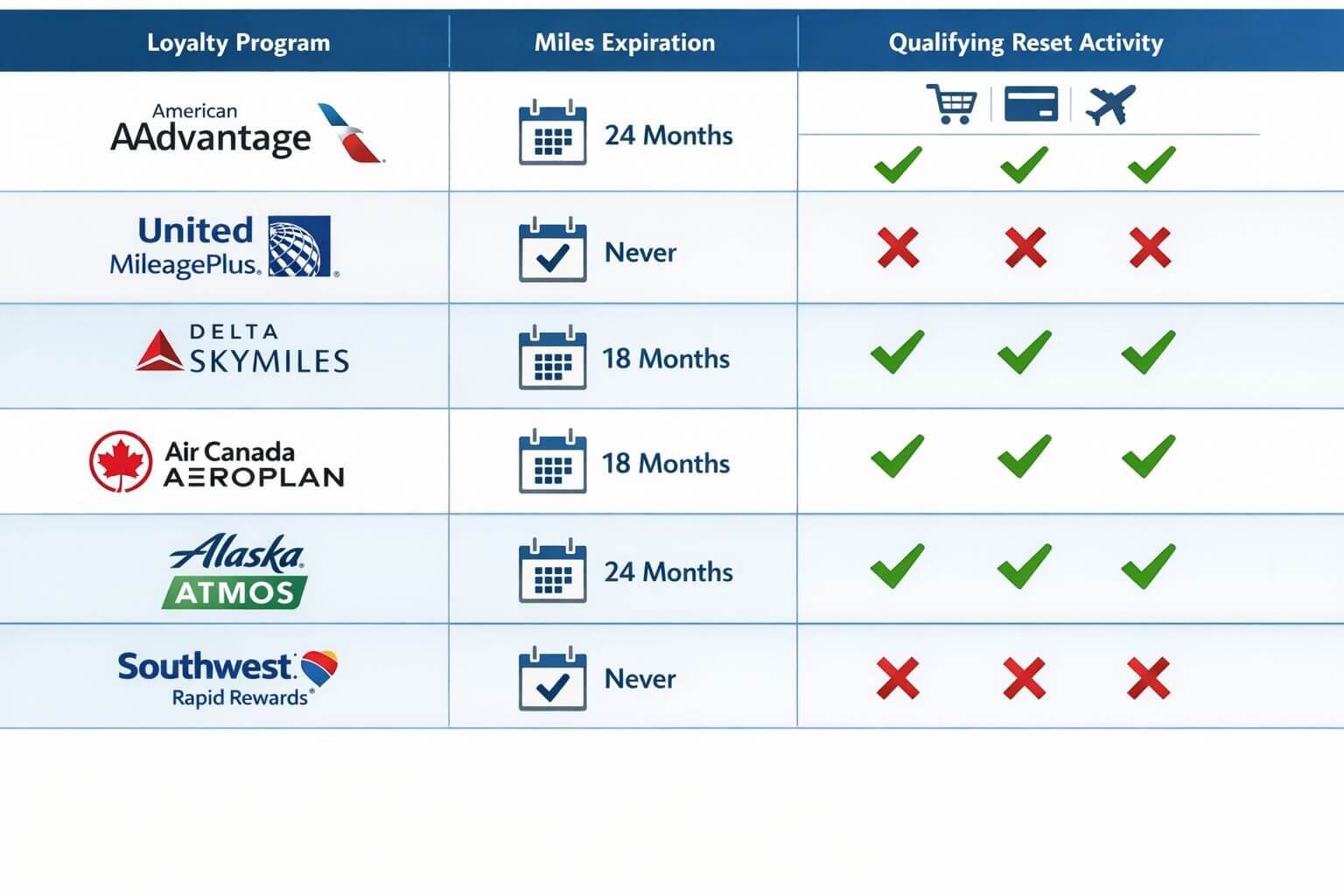
The short answer: it depends on the airline program. Unlike hotel points, which have largely moved toward no-expiration policies, airline loyalty programs maintain a wide range of expiration rules—from never expiring to as short as 12 months of inactivity.
The variation exists because airlines use different business models for their loyalty programs. Programs that generate significant revenue from co-branded credit cards and partners (like Delta SkyMiles) can afford to eliminate expiration, knowing cardholders provide ongoing value. Programs with less diversified revenue streams often maintain expiration policies to reduce liability and encourage active engagement.
Three categories of expiration policies:
- No expiration: Miles never expire regardless of activity (Delta, United, Southwest, Alaska, JetBlue, Hawaiian)
- Activity-based expiration: Miles expire after a set period of inactivity, but any qualifying activity resets the clock (American, Aeroplan, most international carriers)
- Absolute expiration: Miles expire on a fixed date regardless of activity, though this is rare (Emirates uses a 3-year absolute expiration for most members)
The key distinction: inactivity-based expiration is preventable. If you understand what counts as “activity” and take simple actions before the deadline, you can keep miles alive indefinitely.
Why Aeroplan’s 2026 Policy Change Matters
Air Canada’s Aeroplan made headlines by reinstating expiration after years of a no-expiration policy. Starting November 30, 2026, points will expire after 18 months of inactivity. More critically, any points that have already been inactive for 18+ months as of that date will immediately expire—there’s no grace period.
This shift brings Aeroplan in line with international norms (Cathay Pacific, Etihad, and Qantas all use 18-month windows), but it’s a wake-up call for North American travelers who’ve grown accustomed to permanent miles. If you hold Aeroplan points and haven’t had activity since mid-2025 or earlier, you need to take action before November 30, 2026.
For context on how different airline loyalty programs compare in value, expiration policies are just one factor—but they’re critical for protecting your accumulated balance.
Airline Miles Expiration Rules by Program
Below is a comprehensive comparison of expiration policies across major airline programs. This table shows the expiration window, what activities reset the clock, and the easiest low-cost actions to keep miles active.
North American Carriers
| Program | Expiration Window | Activities That Reset | Easiest Low-Cost Extension |
|---|---|---|---|
| Alaska ATMOS Rewards | Never expires | N/A | No action needed |
| American AAdvantage | 24 months of inactivity | Earning miles (flights, credit cards, shopping, dining), redeeming miles, buying/gifting miles | $0.01 AAdvantage eShopping purchase, dine at partner restaurant, transfer 1,000 Citi ThankYou points |
| Delta SkyMiles | Never expires | N/A | No action needed |
| JetBlue TrueBlue | Never expires | N/A | No action needed |
| Southwest Rapid Rewards | Never expires | N/A | No action needed |
| United MileagePlus | Never expires | N/A | No action needed |
| Air Canada Aeroplan | 18 months of inactivity (starting Nov 30, 2026) | Earning points, redeeming for travel/merchandise, transferring points in or out, donating to charity | Transfer 1,000 points from Amex/Chase/Capital One/Citi, make $1 purchase via Aeroplan eStore |
| Hawaiian Miles | Never expires | N/A | No action needed |
International Star Alliance Carriers
| Program | Expiration Window | Activities That Reset | Easiest Low-Cost Extension |
|---|---|---|---|
| ANA Mileage Club | 36 months from date earned | Earning or redeeming miles | Book award ticket, fly on Star Alliance partner |
| Avianca LifeMiles | 12 months of inactivity | Earning or redeeming miles | Transfer 1,000 points from Amex/Chase/Capital One/Citi, make small purchase via LifeMiles shopping portal |
| Singapore KrisFlyer | 36 months from date earned | Earning or redeeming miles | Fly Singapore Airlines or partner, transfer points from Amex/Chase/Capital One/Citi |
| Turkish Miles&Smiles | 36 months of inactivity | Earning or redeeming miles | Fly Turkish Airlines or Star Alliance partner; extension available for ~$20 per 1,000 miles |
International Oneworld Carriers
| Program | Expiration Window | Activities That Reset | Easiest Low-Cost Extension |
|---|---|---|---|
| British Airways Avios | 36 months of inactivity | Earning or redeeming Avios, collecting with partners | Transfer 1,000 points from Amex/Chase/Capital One/Citi, make purchase via BA shopping portal |
| Iberia Plus | 36 months of inactivity | Earning or redeeming Avios | Transfer points from Amex/Chase/Capital One/Citi, fly Iberia or Oneworld partner |
| Qatar Privilege Club | 36 months of inactivity | Earning or redeeming miles | Fly Qatar Airways or partner, transfer points from Citi ThankYou |
| Cathay Pacific Asia Miles | 18 months of inactivity | Earning or redeeming miles | Transfer points from Amex/Chase/Capital One/Citi, fly Cathay or partner |
International SkyTeam Carriers
| Program | Expiration Window | Activities That Reset | Easiest Low-Cost Extension |
|---|---|---|---|
| Air France/KLM Flying Blue | 24 months of inactivity | Earning or redeeming miles | Transfer points from Amex/Chase/Capital One/Citi, make purchase via Flying Blue shopping portal |
| Korean Air SKYPASS | 10 years from date earned | N/A (absolute expiration) | Cannot extend; must use before 10-year mark |
Middle East Carriers
| Program | Expiration Window | Activities That Reset | Easiest Low-Cost Extension |
|---|---|---|---|
| Emirates Skywards | 36 months from date earned (Platinum members exempt) | Flying Emirates or partners only | Fly Emirates or partner airline (shopping/dining don’t count) |
| Etihad Guest | 18 months of inactivity (policy changed June 2024) | Flying Etihad or partner airlines only | Fly Etihad or partner (other activities removed as of June 2024) |
Key Observations
Programs with no expiration give you maximum flexibility and eliminate the need for maintenance activity. This is one reason Delta SkyMiles and United MileagePlus remain popular despite dynamic pricing—you never worry about losing value to expiration.
The 18-month threshold is becoming the international standard. Aeroplan’s move to 18 months aligns it with Cathay Pacific, Etihad, Qantas, and Finnair. This suggests 18 months may become the new norm for programs that maintain expiration policies.
36-month windows offer the most breathing room for infrequent travelers. British Airways, Iberia, Qatar Airways, and ANA all provide three years between required activities. If you travel internationally once or twice per year, these programs naturally stay active.
Restrictive policies like Etihad’s (flying only, no shopping/dining resets) and programs with no extension options (Saudia, Starlux) require careful planning. If you can’t commit to flying the airline regularly, these programs carry a higher risk.
For a deeper look at how these programs stack up in terms of redemption value, see our comprehensive airline loyalty program comparison.
Activities That Usually Reset Expiration the Quickest
Understanding what counts as “activity” is essential for keeping miles alive with minimal effort. Most programs reset the expiration clock with any qualifying activity—meaning earning just one mile can extend your balance for another full period.
Universal Reset Activities (Work for Most Programs)
1. Earning miles through flying
Any revenue or award ticket on the airline or partner carriers typically resets expiration. This is the most universal activity—even restrictive programs like Etihad and Emirates only accept flying as a reset mechanism.
2. Credit card spending
Earning miles through a co-branded airline credit card counts as activity for that program. If you have an American Airlines credit card, any purchase that earns AAdvantage miles resets the 24-month clock.
3. Transferring points from bank programs
Transferring points from Amex Membership Rewards, Chase Ultimate Rewards, Capital One miles, Citi ThankYou, or Bilt Rewards to an airline program counts as earning activity. This is one of the most efficient extension methods because it serves dual purposes: protecting your airline balance while moving points to a program where you might get better value.
For details on which bank programs transfer to which airlines, see our complete credit card transfer partners guide.
4. Shopping portal purchases
Most airlines operate online shopping portals (AAdvantage eShopping, United MileagePlus Shopping, Aeroplan eStore, etc.). Making any purchase through these portals—even a $1 item—earns miles and resets expiration.
5. Dining program activity
Programs like AAdvantage Dining and United MileagePlus Dining award miles for eating at participating restaurants. Linking your credit card to a partner restaurant can reset the expiration for 18-36 months.
6. Redeeming miles
Using miles for any redemption—flights, hotels, car rentals, merchandise, gift cards—typically counts as activity. Even redeeming a small number of miles for a magazine subscription or gift card can reset the clock.
7. Buying, gifting, or transferring miles
Most programs allow you to purchase miles, gift them to another member, or transfer them within the program (if family pooling is available). While not cost-effective for purely extension purposes, these transactions do reset expiration.
Program-Specific Restrictions
Etihad Guest (as of June 2024) only accepts flying on Etihad or partner airlines as a qualifying activity. Shopping portals, dining, and other earning methods no longer reset expiration dates. This makes Etihad one of the most restrictive programs.
Emirates Skywards similarly only counts flying as activity, though Platinum members are completely exempt from expiration as long as they maintain status.
Korean Air SKYPASS uses absolute expiration (10 years from date earned) rather than activity-based expiration, so no activity can extend the timeline.
The Reset Mechanism: How It Works
When you complete a qualifying activity, the entire account balance gets a new expiration date. You don’t extend individual miles—the whole account resets.
Example: You have 50,000 American AAdvantage miles that have been idle since January 2024. In December 2025, you make a $1 purchase through the AAdvantage eShopping portal and earn 2 miles. On that day, all 50,002 miles now have a new expiration date of December 2027 (24 months from the activity).
This “all-or-nothing” reset is why even tiny activities are worthwhile. One dining transaction can protect a six-figure mile balance.
Low-Cost Ways to Extend Miles: The Cheap Extension Playbook
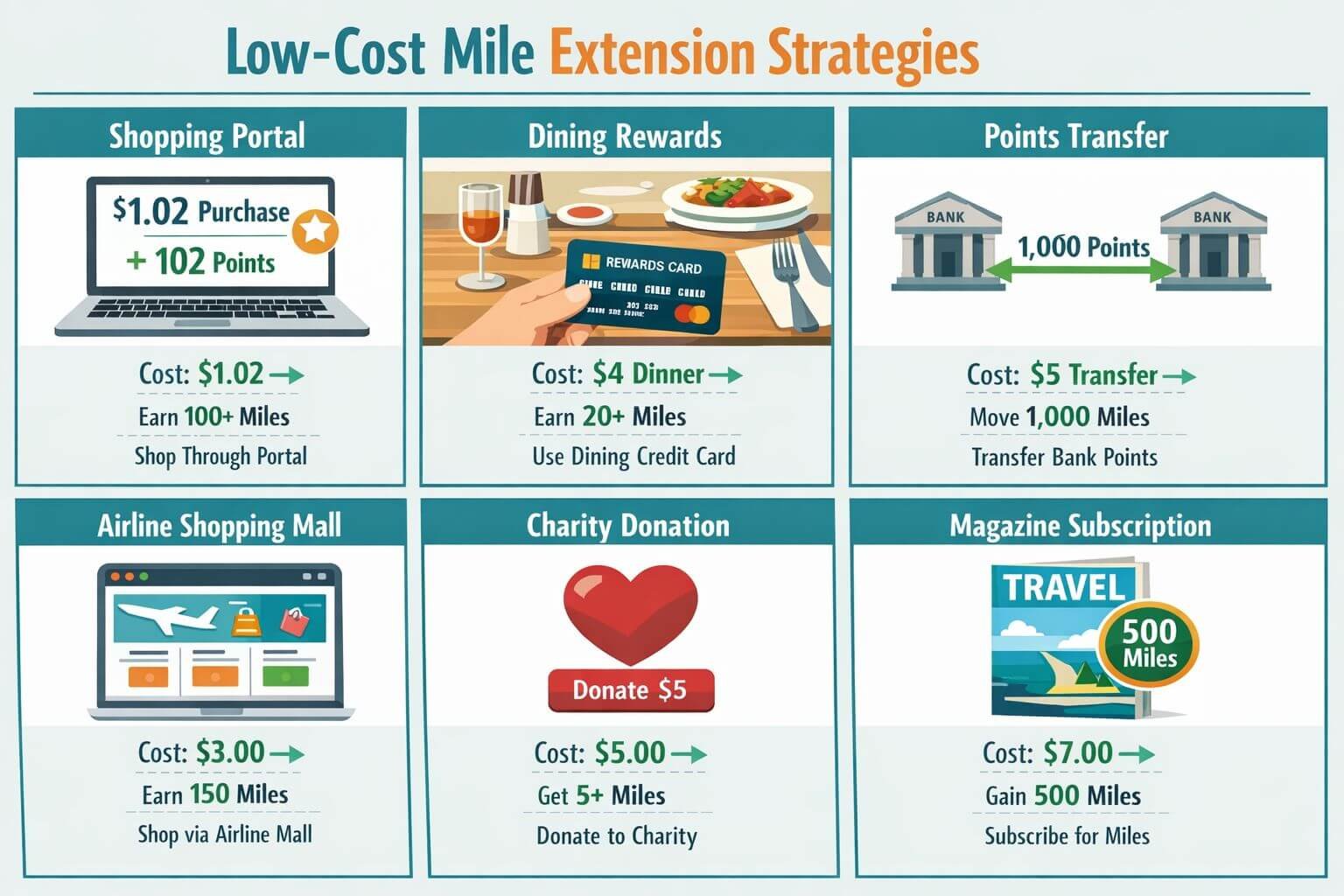
The goal is to reset expiration with the smallest possible investment of time and money. Here are eight proven strategies ranked by cost-effectiveness.
1. Shopping Portal Micro-Purchases ($0.50–$2)
How it works: Make the smallest possible purchase through your airline’s shopping portal. Many retailers offer items under $2, and the miles earned (even if it’s just 1-2) reset your entire account.
Best programs for this: American AAdvantage, Air Canada Aeroplan, United MileagePlus, British Airways, Flying Blue
Example: Buy a $0.99 Amazon gift card reload through AAdvantage eShopping. You’ll earn 1-2 miles and reset your 24-month expiration clock. Cost per extension: $0.99 for 24 months of protection.
Pro tip: Set a calendar reminder for 6 months before your expiration date. Make one micro-purchase, and you’re covered for another full cycle.
2. Dining Program Registration and Single Meal ($15–30)
How it works: Register your credit card with the airline’s dining program (AAdvantage Dining, MileagePlus Dining, etc.). Eat at any participating restaurant and the miles post within weeks, resetting expiration.
Best programs for this: American AAdvantage, United MileagePlus, Alaska Mileage Plan
Example: Link your card to AAdvantage Dining, spend $20 at a local partner restaurant. Earn 40 miles (2 miles per dollar) and reset your 24-month clock. Cost per extension: $20 for 24 months (but you were buying the meal anyway).
Pro tip: Dining programs often offer bonus miles for first purchase (500-1,000 miles). This is essentially a free extension with a meal you’d eat regardless.
3. Transfer 1,000 Bank Points ($10–15 value)
How it works: Transfer the minimum amount (usually 1,000 points) from a transferable points program to your airline account. This counts as earning activity and resets expiration.
Best programs for this: Any airline that accepts transfers from Amex, Chase, Capital One, Citi, or Bilt
Example: Transfer 1,000 Chase Ultimate Rewards points to Air Canada Aeroplan before the November 2026 deadline. This resets the 18-month clock. Cost per extension: $10-15 in points value for 18 months (assuming 1.0-1.5 cents per point baseline value).
When this makes sense: If you’re already planning to transfer points to that program eventually, or if the airline program offers better redemption value than your bank program. See our transfer bonus strategy guide for optimal timing.
When to skip it: If you value your bank points higher than the airline miles, don’t transfer just for extension. Use a cheaper method instead.
4. Magazine Subscription with Miles ($5–10)
How it works: Many airline programs offer magazine subscription options that cost a minimal number of miles (500-2,000). Redeeming these miles counts as activity and resets expiration.
Best programs for this: Programs with merchandise/magazine redemption options
Example: Redeem 1,500 AAdvantage miles for a 12-month magazine subscription. Cost per extension: 1,500 miles (roughly $15-22 in value depending on how you value AA miles).
Consideration: This actually depletes your balance, so only use this method if you genuinely want the subscription or if the miles are worth less than the cost of other extension methods.
5. Charity Donation Through Program ($10–25)
How it works: Some programs allow you to donate miles to charity partners. This counts as redemption activity and resets expiration.
Best programs for this: Air Canada Aeroplan, United MileagePlus, American AAdvantage
Example: Donate 1,000 Aeroplan points to a charity partner. Cost per extension: 1,000 points (roughly $15-20 in value).
Ethical consideration: If you’re donating anyway, this is a win-win. If you’re only donating to avoid expiration, cheaper methods exist.
6. Minimum Award Booking ($5.60+ in taxes/fees)
How it works: Book the cheapest possible award ticket—even if you don’t intend to fly it. The redemption resets expiration. You can often cancel for free or at a minimal fee.
Best programs for this: Programs with free award cancellation (United, JetBlue, Southwest)
Example: Book a 5,000-mile Southwest award for $5.60 in taxes. Cancel it immediately for free. Your Rapid Rewards points are returned an,d expiration is reset. Cost per extension: $0 (Southwest points don’t expire anyway, but this method works for programs that do).
Risk: Some programs charge cancellation fees or have restrictions on how quickly you can cancel. Always check cancellation policies first.
7. Buy Small Miles Package ($30–50)
How it works: Purchase the minimum miles package directly from the airline. This counts as earning activity.
Best programs for this: American AAdvantage, United MileagePlus, most programs that sell miles
Example: Buy 1,000 AAdvantage miles for $35 (including fees). This resets your 24-month clock. Cost per extension: $35 for 24 months.
When this makes sense: If you need those miles anyway for a redemption, or if you’re close to an award threshold. Otherwise, this is the most expensive extension method and should be a last resort.
8. Co-Branded Credit Card Annual Spending ($0 if you have the card)
How it works: If you already have a co-branded airline credit card, any purchase automatically resets the expiration. Even a $1 purchase counts.
Best programs for this: Any program with a co-branded card (American, United, Delta, Alaska, Southwest, JetBlue, etc.)
Example: Buy a $1 Amazon gift card, reload with your AAdvantage credit card. You earn 1 mile and reset the 24-month clock. Cost per extension: $0 (you’d use the card anyway).
Pro tip: If you’re on the fence about keeping a co-branded card, the automatic expiration protection can be a deciding factor—especially if you have a large mile balance and travel infrequently.
Cost-Per-Extension Comparison Table
| Extension Method | Typical Cost | Time Investment | Programs That Accept | Best Use Case |
|---|---|---|---|---|
| Shopping portal micro-purchase | $0.50–$2 | 5 minutes | Most programs with portals | Lowest cost, works for most programs |
| Dining program meal | $15–30 (meal cost) | 30 minutes | American, United, Alaska | You’re eating out anyway |
| Transfer 1,000 bank points | $10–15 value | 2 minutes | Programs accepting transfers | You plan to transfer eventually |
| Magazine subscription | 500–2,000 miles | 5 minutes | Programs with magazine options | You want the subscription |
| Charity donation | 1,000+ miles | 5 minutes | Aeroplan, United, American | You’re donating anyway |
| Minimum award booking | $5.60+ in fees | 10 minutes | Programs with free cancellation | Free if cancellation is free |
| Buy miles package | $30–50 | 5 minutes | Most programs | Last resort; only if you need the miles |
| Co-branded card purchase | $0 (if you have card) | 1 minute | Any program with co-branded card | Easiest if you already have the card |
Recommendation: For most travelers, the shopping portal micro-purchase offers the best cost-to-effort ratio. Set a reminder 6 months before expiration, spend $1-2, and you’re protected for another full cycle.
When Transferring Points to Extend Miles Makes Sense
Transferring points from bank programs (Amex, Chase, Capital One, Citi, Bilt) to airline programs serves two purposes: it resets the airline account’s expiration clock and moves points to programs that offer better redemption value.
Strategic Transfer Scenarios
Scenario 1: You’re already planning to book an award
If you know you’ll need miles in a specific program for an upcoming redemption, transferring in advance to reset expiration is a no-brainer. You were going to transfer anyway—doing it early protects your existing balance.
Example: You have 80,000 Avianca LifeMiles that have been idle for 10 months (2 months before expiration). You’re planning to book Star Alliance business class in 6 months. Transfer 1,000 Amex points now to reset the 12-month clock, then transfer the rest when you’re ready to book.
Scenario 2: The airline program offers better value than bank points
Some airline programs offer sweet spots that deliver higher value than keeping points in your bank program. If you’ve identified these opportunities, transferring to extend makes economic sense.
Example: You value Chase Ultimate Rewards at 1.5 cents per point (baseline portal redemption). But you know, Air Canada Aeroplan offers 2+ cents per point value on certain routes. Transferring 1,000 points to reset expiration is essentially moving $15 of value to a program where it might become $20+.
For detailed transfer partner strategies, see our guides for Capital One transfer partners and Avianca LifeMiles partners.
Scenario 3: Transfer bonus opportunities
When banks offer transfer bonuses (15-30% extra miles), transferring during the promotion resets expiration while getting bonus value. This is the ideal time to move points.
Example: Capital One offers a 15% bonus to Avianca LifeMiles. You transfer 1,000 Capital One miles, receive 1,150 LifeMiles, and reset your LifeMiles expiration. You’ve extended your account and gained 150 bonus miles.
For current transfer bonus opportunities, check our transfer bonus timing guide.
When NOT to Transfer Just for Extension
Don’t transfer if you value bank points higher: If you consistently get 2+ cents per point from Chase Ultimate Rewards through the travel portal, don’t transfer to an airline program just to avoid expiration. Use a cheaper extension method (shopping portal, dining) instead.
Don’t transfer to programs you’ll never use: If you’re not interested in the airline’s route network or partners, transferring points there—even to prevent expiration—doesn’t make sense. You’re just moving value from one place you won’t use it to another.
Don’t transfer during devaluations: If an airline program has just announced a devaluation or moved to dynamic pricing with poor value, don’t transfer there to extend the value. The extension cost (in points value) may exceed the value of the miles you’re protecting.
The Math: Is Transfer Extension Worth It?
Use this simple framework:
- Calculate the value of miles you’re protecting: Multiply your balance by your realistic cents-per-point value for that program
- Calculate the cost of transferring 1,000 points: Multiply 1,000 by your baseline value for bank points
- Compare: If the protected value exceeds the transfer cost, it’s worth it
Example calculation:
- You have 50,000 Avianca LifeMiles worth 1.4 cents each = $700 in value
- Transferring 1,000 Amex points (valued at 1.3 cents) = $13 cost
- You’re paying $13 to protect $700 = worthwhile extension
Counter-example:
- You have 10,000 Avianca LifeMiles worth 1.4 cents each = $140 in value
- Transferring 1,000 Amex points (valued at 1.3 cents) = $13 cost
- You’re paying $13 to protect $140, but you have no plans to use LifeMiles = not worth it; use a cheaper extension or let them expire
For value benchmarks across programs, see our points and miles valuation guide.
Transfer Extension Playbook
Step 1: Audit your airline accounts 3-6 months before expiration
Step 2: Identify which balances are worth protecting (high value, realistic redemption plans)
Step 3: Check for transfer bonuses to those programs
Step 4: Transfer minimum amounts (1,000-2,000 points) to reset expiration
Step 5: Set calendar reminders for the next expiration cycle
This systematic approach ensures you’re only protecting valuable balances and taking advantage of bonus opportunities when they arise.
Common Expiration Mistakes That Cause Lost Balances
Even experienced travelers make preventable mistakes that cost them miles. Here are the most common pitfalls and how to avoid them.
Mistake #1: Not Tracking Expiration Dates
The problem: You assume miles don’t expire, or you forget which programs have expiration policies.
The consequence: Miles expire without warning. Most programs send expiration notices 30-60 days before the deadline, but these emails often end up in spam or get overlooked.
The fix: Create a spreadsheet or use a note-taking app to track:
- Program name
- Current balance
- Last activity date
- Expiration date (if applicable)
- Required activity to reset
Set calendar reminders for 6 months and 1 month before expiration. This gives you time to take action without last-minute stress.
Mistake #2: Assuming All Miles Expire the Same Way
The problem: You think all programs work like American Airlines (24-month inactivity) or Delta (never expires).
The consequence: You treat a 12-month program (Avianca) the same as a 36-month program (British Airways) and miss the deadline.
The fix: Review the expiration table in this guide and note which of your programs have the shortest windows. Prioritize monitoring those accounts.
Mistake #3: Not Understanding What Counts as Activity
The problem: You assume only flying or credit card spending counts as activity.
The consequence: You miss easy extension opportunities through shopping portals, dining programs, or small transfers.
The fix: Review the “Activities That Reset Expiration” section for your specific programs. Most programs accept a wider range of activities than you realize.
Mistake #4: Waiting Until the Last Minute
The problem: You wait until 2 weeks before expiration to take action.
The consequence: Shopping portal purchases can take 4-8 weeks to post. Dining program miles can take 2-4 weeks to be credited. You run out of time and miles expire before the activity posts.
The fix: Take extension action at least 60-90 days before expiration. This provides a buffer against posting delays and gives you time to use backup methods if needed.
Mistake #5: Ignoring Aeroplan’s November 2026 Deadline
The problem: You assume Aeroplan will give a grace period or that only new inactivity counts.
The consequence: Air Canada has stated that points inactive for 18+ months as of November 30, 2026, will immediately expire—no grace period.
The fix: If you have Aeroplan points and haven’t had activity since May 2025 or earlier, take action before November 30, 2026. Transfer points, make a shopping portal purchase, or book an award.
Mistake #6: Letting Small Balances Expire Because They “Don’t Matter”
The problem: You have 5,000 miles in a program and decide it’s not worth the effort to extend.
The consequence: You lose $50-100 in value that could have been protected with a $1 purchase of a shopping portal.
The fix: If the balance is worth more than $20-30, protect it. The effort-to-value ratio is almost always favorable. Even small balances can be combined with transferred points for valuable redemptions.
Mistake #7: Not Reading Program Policy Updates
The problem: You set up an extension strategy years ago and assume nothing has changed.
The consequence: Programs modify policies (like Etihad did in June 2024, removing shopping/dining as qualifying activities). Your old extension method no longer works.
The fix: Check program policy pages annually, especially before relying on a specific extension method. Sign up for program newsletters and follow travel blogs that track policy changes.
For the latest program updates and devaluation warnings, see our airline program updates hub.
Mistake #8: Transferring Points to Programs You’ll Never Use
The problem: You transfer bank points to an airline program to “diversify” or because of a transfer bonus, without considering whether you’ll actually use those miles.
The consequence: You’ve moved points from a flexible program (where they don’t expire) to a program with expiration, creating a maintenance burden.
The fix: Only transfer to programs with specific redemption plans or where the route network aligns with your travel patterns. Don’t transfer just because of a bonus if you have no use for the miles.
Use ATH Calculators to Compare Extension Cost vs. Value
Before investing time or money in extending miles, calculate whether the effort is worth it. Award Travel Hub’s calculators help you determine the true value of your miles and whether extension makes economic sense.
The Extension ROI Framework
Step 1: Calculate your current mile value
Multiply your balance by the realistic cents-per-point value for that program. Use conservative estimates based on actual redemption opportunities, not theoretical maximums.
Example: You have 40,000 American AAdvantage miles. AA miles typically deliver 1.2-1.5 cents per mile on good redemptions. Use 1.3 cents as a middle estimate.
Value: 40,000 × $0.013 = $520
Step 2: Calculate extension cost
Determine the cheapest method to extend those miles and assign a dollar value.
Example: Shopping portal micro-purchase = $1.50
Extension cost: $1.50
Step 3: Calculate ROI
Divide protected value by extension cost.
Example: $520 ÷ $1.50 = 347× return
Any ROI above 10× is worth the effort. Anything above 100× is a no-brainer.
When Extension Doesn’t Make Sense
Scenario 1: Low balance with no redemption plan
You have 3,000 miles in a program you never use, worth roughly $30-40. Even a $1 extension might not be worth it if you have no realistic path to earning enough for a redemption.
Decision: Let them expire. The opportunity cost of tracking and maintaining the account exceeds the value.
Scenario 2: Program has been devalued significantly
The airline has moved to dynamic pricing and consistently prices awards 30-50% higher than competitors. Your miles are now worth 0.8 cents each instead of 1.4 cents.
Decision: Consider letting them expire or redeeming them for merchandise/gift cards before they expire, rather than extending indefinitely.
Scenario 3: You’re sitting on bank points with no expiration
You have 200,000 Chase Ultimate Rewards points (no expiration) and 15,000 Air France Flying Blue miles about to expire. You have no plans to fly Air France or SkyTeam partners.
Decision: Let the Flying Blue miles expire. Don’t transfer Chase points just to extend a balance you won’t use. Keep the flexibility of Chase points.
The Breakeven Analysis
Calculate the minimum balance worth protecting based on your extension method cost.
Formula: Minimum balance = Extension cost ÷ Cents per point value
Example: If your extension method costs $1.50 and the program delivers 1.3 cents per point:
Minimum balance = $1.50 ÷ $0.013 = 1,154 miles
Any balance above 1,154 miles is worth protecting with a $1.50 extension. Below that threshold, the math becomes marginal.
Tracking Extension Cost Over Time
If you’re extending the same balance repeatedly (every 18-24 months), calculate the cumulative cost.
Example: You extend 50,000 AAdvantage miles every 24 months with a $2 shopping portal purchase.
- Over 10 years: 5 extensions × $2 = $10 total cost
- Value protected: 50,000 × $0.013 = $650
- Net benefit: $640
Even with repeated extensions, the ROI remains overwhelmingly positive for any significant balance.
Expiration Strategy by Traveler Type
Different travel patterns require different extension approaches. Here’s how to tailor your strategy based on how you earn and use miles.
Casual Traveler (1-2 trips per year, small balances)
Profile: You earn miles primarily from credit card spending and occasional flights. Balances are typically under 50,000 miles per program.
Risk level: Medium—you may not fly often enough to naturally reset expiration through travel.
Strategy:
- Focus on programs with no expiration (Delta, United, Southwest, Alaska) for primary accumulation
- For programs with expiration, use shopping portal micro-purchases once per expiration cycle
- Set annual calendar reminders to check all accounts
- Don’t transfer bank points to airline programs unless you have a specific redemption planned
Extension budget: $5-10 per year across all programs
Frequent Business Traveler (10+ trips per year, large balances)
Profile: You fly regularly for work, often on the same airline or alliance. Balances can reach 200,000+ miles per program.
Risk level: Low—regular flying naturally resets expiration for most programs.
Strategy:
- Your primary programs will stay active through regular travel
- Monitor secondary programs (from occasional partner flights or credit card bonuses)
- Use co-branded credit cards for everyday spending to ensure automatic resets
- Consider consolidating to 2-3 primary programs rather than maintaining many small balances
Extension budget: $0-5 per year (most accounts reset naturally)
Points Enthusiast (Multiple credit cards, strategic transfers)
Profile: You earn transferable points from multiple bank programs and transfer strategically to airline partners. You may have balances in 10+ airline programs.
Risk level: High—managing multiple programs with different expiration policies requires organization.
Strategy:
- Keep most points in bank programs (no expiration) until ready to book
- Only maintain airline balances in programs with specific redemption plans
- Use small transfers (1,000-2,000 points) to extend valuable airline balances
- Let small, unused airline balances expire rather than creating a maintenance burden
- Focus extension efforts on programs with the best sweet spots for your travel patterns
Extension budget: $20-40 per year (primarily through strategic transfers)
Family Pooler (Combining miles from multiple accounts)
Profile: You pool or combine miles from family members to book larger awards. Multiple people contributing to the same program.
Risk level: Medium—multiple accounts require coordinated activity tracking.
Strategy:
- Choose programs with family pooling features (Alaska, JetBlue, British Airways)
- Assign one family member as “account manager” to track all expiration dates
- Use shared shopping portal purchases (one person’s activity can benefit the pool)
- Consider having each family member make one small activity per cycle to protect all accounts
Extension budget: $10-20 per year across all family accounts
For more on combining miles across family members, see our guide on family pooling strategies.
2026 Expiration Calendar: Key Dates to Watch
Mark these critical dates for major program changes and common expiration windows.
Immediate Action Required
November 30, 2026: Air Canada Aeroplan expiration policy takes effect
- Points inactive for 18+ months as of this date will immediately expire
- No grace period or warning
- If you haven’t had activity since May 2025 or earlier, take action now
Quarterly Expiration Checks
End of each quarter (March 31, June 30, September 30, December 31):
- Review all airline accounts for activity in the past 6 months
- Take extension action for any accounts approaching 12-18 month inactivity
- Check for new transfer bonuses that could provide efficient extension opportunities
Annual Review
December (before year-end):
- Comprehensive audit of all airline and hotel programs
- Calculate total value of balances across all programs
- Identify programs to consolidate or abandon
- Plan extension activities for the coming year
- Review any program policy changes announced during the year
For a complete year-end review checklist, see our end-of-year points and miles reset guide.
Program-Specific Monitoring
American Airlines (24-month window):
- Check activity every 12 months
- Extend at the 18-month mark to provide a buffer
Avianca LifeMiles (12-month window):
- Check activity every 6 months
- Extend at the 9-month mark (shortest window requires most frequent monitoring)
British Airways/Iberia/Qatar (36-month window):
- Check activity every 18 months
- Extend at the 30-month mark (longest window allows most flexibility)
Conclusion: Protect Your Miles with Minimal Effort
Do airline miles expire? For many programs, yes—but expiration is almost always preventable with simple, low-cost actions. The key is understanding your specific programs’ policies and taking proactive steps before deadlines arrive.
Your Action Plan
This week:
- Audit all airline loyalty accounts and note the last activity dates
- Calculate expiration dates for programs with activity-based policies
- Identify any accounts at immediate risk (within 60 days of expiration)
- Take extension action for at-risk accounts using the cheapest method available
This month: 5. Create a tracking spreadsheet with all programs, balances, and expiration dates 6. Set calendar reminders for 6 months before each expiration 7. Review the value of each balance and decide which are worth maintaining
Ongoing: 8. Check accounts quarterly for activity 9. Use shopping portal micro-purchases as your default extension method ($1-2 per cycle) 10. Transfer bank points strategically when you have specific redemption plans 11. Monitor program policy changes that might affect your extension strategy
The Bottom Line
For most travelers with balances above 10,000 miles, the cost of extension ($1-5 per program per cycle) is trivial compared to the value protected ($100-500+). The real cost is organizational—tracking multiple programs and remembering to take action.
Simplify by:
- Consolidating to 2-4 primary programs that align with your travel patterns
- Focusing on programs with no expiration (Delta, United, Southwest, Alaska) for primary accumulation
- Keeping most points in bank programs (Amex, Chase, Capital One) until ready to book
- Letting go of small balances in programs you’ll never use
The goal isn’t to maintain every mile in every program—it’s to protect valuable balances that align with your travel goals while minimizing maintenance overhead.
For more strategies on maximizing your points and miles, explore our guides on transfer partners, award booking timing, and alliance sweet spots.
Next steps: Review your accounts this week, take action on any at-risk balances, and set up a simple tracking system to prevent future losses. Your miles represent significant travel value—protect them with the minimal effort they deserve.

