
Last updated: April 6, 2026
If loyalty feels harder to justify in 2026, that instinct is correct. The best airline loyalty program 2026 depends less on brand habit and more on how each program handles partner awards, status earning, upgrade access, and whether transferable points can still turn into real trips without wasting value.
Key Takeaways
- Atmos is the best airline loyalty program of 2026 for many mixed travelers because it combines strong partner access, useful award pricing structure, and easier non-flight status earning.
- United is strongest for Star Alliance reach and upgrade usability, especially after allowing Premier benefits like complimentary upgrades and PlusPoints on award tickets booked with miles.
- AAdvantage remains very competitive for partner Premium Cabin awards and for travelers who can build Loyalty Points through flying and non-flying activity.
- There is no universal winner. Domestic utility, Premium Cabin goals, and status chasing lead to different answers.
- Travelers earning transferable points should care most about transfer access, partner airline value, and award availability, not just the airline they fly most.
- Dynamic pricing hurts predictability at United more than it does in classic award-chart-style partner redemptions.
- Atmos and AAdvantage both benefit from strong partner sweet spots, but AAdvantage still has edge cases where premium cabin awards can outperform United in travel rewards math.
- A common mistake is chasing elite status in the wrong program when a traveler’s real goal is actually premium cabin awards.
- For a broader framework, see ATH’s Best Airline Loyalty Programs: A Value Comparison Guide.
Quick Answer
For most intermediate U.S. travelers, Atmos is the best overall airline loyalty program in 2026, United is best for broad global network utility, and AAdvantage is best for targeted high-value partner redemptions. The right choice depends on whether the main goal is an easier status, better business class deals, or reliable domestic and alliance coverage.
What actually makes the best airline loyalty program 2026?
The best program in 2026 does four things well: it lets members earn with minimal friction, redeem at fair rates, access useful partners, and avoid loyalty traps such as limited availability or surprise pricing. Legacy reputation matters less than current rules.
For Award Travel Hub readers, these are the criteria that matter most:
Redemption value
- Can Miles still book partner airlines at reasonable levels?
- Are there real sweet spots for Business Class deals and First Class redemptions?
Status earning
- Can travelers earn elite credit from flying and non-flying activity?
- Are thresholds practical for normal spend?
Partner network
- Does the program give access to strong alliance partners and non-alliance partners?
- Is award availability searchable and bookable without calling?
Transferability
- Can Amex points, Chase points, Capital One miles, Citi points, or Bilt points feed the program directly or indirectly?
Pricing predictability
- Are there award charts, saver patterns, or at least useful price floors?
- Or is everything fully dynamic pricing?
Real-world utility
- Does the program work for domestic trips, positioning flights, and last-minute bookings?
Side-by-side scorecard
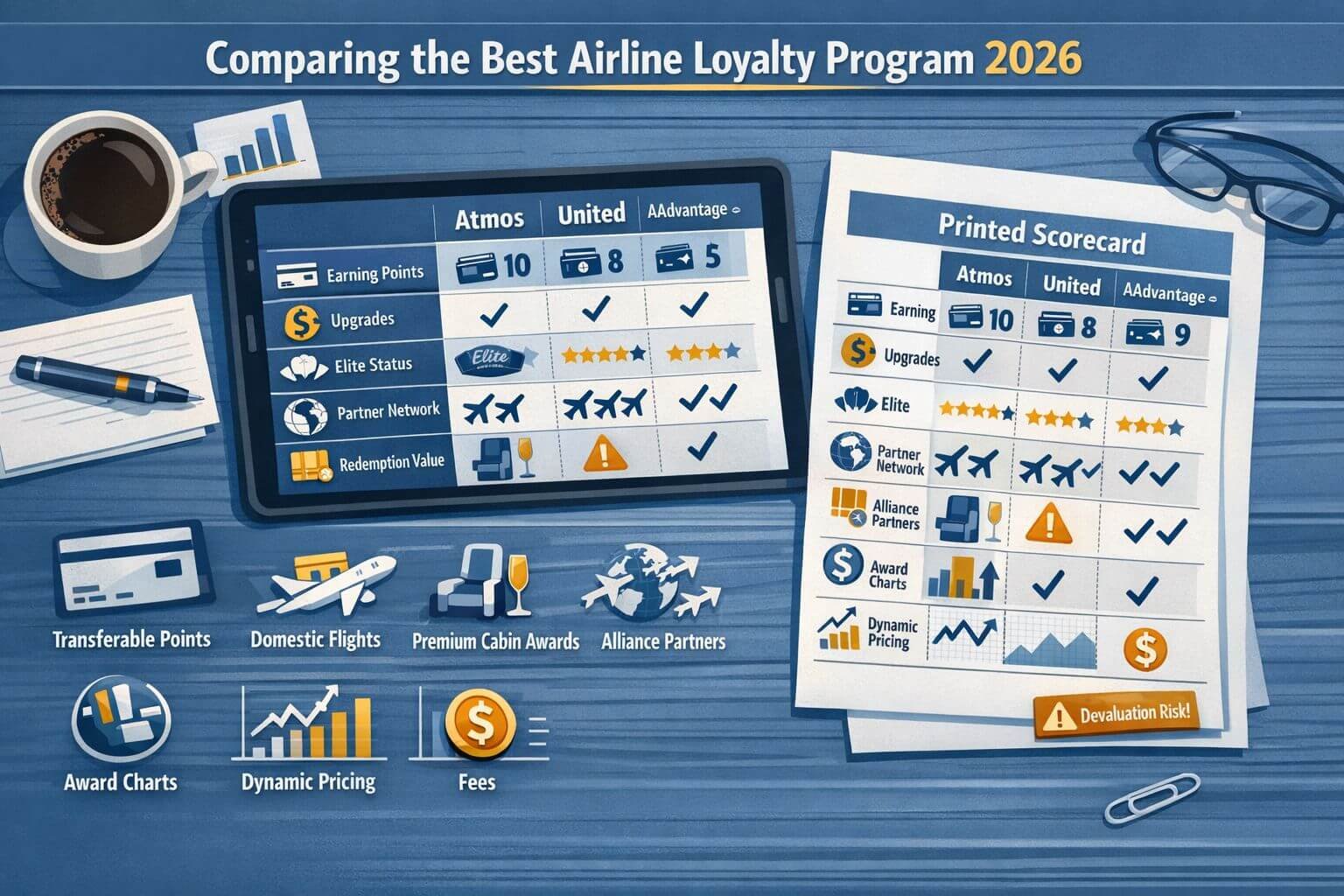
| Criteria | Atmos | United MileagePlus | American AAdvantage |
|---|---|---|---|
| Partner award value | Excellent | Good | Excellent |
| Domestic utility | Good | Excellent | Good |
| Status earning flexibility | Excellent | Good | Very good |
| Upgrade value | Good | Excellent | Good |
| Transferable points access | Moderate | Strong via Chase | Strong via Citi, Bilt ecosystem relevance |
| Pricing predictability | Better than United | Weakest due to dynamic pricing | Better on partners |
| Beginner friendliness | Very good | Excellent | Moderate |
| Devaluation risk | Moderate | High on dynamic awards | Moderate |
Decision rule:
- Choose Atmos if a traveler wants a balanced program with strong partner upside and easier status earning outside flights.
- Choose United if a traveler flies domestically often and wants the easiest broad-network program to actually use.
- Choose AAdvantage if a traveler is comfortable hunting partner awards for outsized value.
How do Atmos, United, and AAdvantage compare on earning and elite status?
For status-focused travelers, Atmos and AAdvantage are the most interesting in 2026, while United is more compelling for how status benefits now work on award tickets. The right pick depends on whether the traveler earns mostly from flights, credit cards, or partner activity.
Atmos
Atmos made the biggest practical move for many readers by expanding non-flight ways to earn status points. Alaska announced a 2026 partner earning that includes Lyft, CLEAR, shopping, and dining, with examples showing members can stack meaningful status progress without flying every week. Some coverage also highlighted that Silver status could be achieved through a substantial amount of partner-driven activity.
Why it matters:
- Better for travelers with mixed spending patterns
- More realistic for people near a hub but not on weekly business travel
- Potentially strong if the teased choice-based flight earning rolls out as announced later in 2026, including distance, spend, or segment options.
Best for:
- West Coast flyers
- Travelers who like earning status through lifestyle spend
- People who want loyalty without all earnings tied to butt-in-seat flying
Not for:
- Travelers needing a huge domestic route map every week
- For deeper program details, see ATH’s Alaska Atmos Rewards Guide 2026: Earn Status Without Flying and Atmos transfer partners guide.
United MileagePlus
United is not the easiest elite program, but it improved the value of elite status in 2026 by extending complimentary upgrades and PlusPoints use to award tickets for Premier members on eligible bookings. That change matters because members no longer face such a hard split between “cash ticket benefits” and “miles ticket benefits.”
Why it matters:
- Travelers redeeming miles do not give up as much upgrade upside
- Frequent domestic flyers can get more use from Premier benefits
- Star Alliance remains a major strength for network depth
Common mistake:
- Valuing United status based only on qualification thresholds, while ignoring the stronger on-trip value of benefits
For the United-specific transfer and partner strategy, see ATH’s United MileagePlus Transfer Partners Guide.
AAdvantage
AAdvantage remains one of the most status-accessible legacy U.S. programs because Loyalty Points can come from multiple channels. American also updated the Loyalty Point Rewards menu on March 1, 2026, including a 25% bonus at 60,000 Loyalty Points on select partners and new reward options at higher tiers. American also launched a limited “Ready, Set, Jet 2026” promotion to accelerate Loyalty Points through eligible flights.
Why it matters:
- Easier to stack progress through flying and partner activity
- Strong for travelers who naturally interact with AAdvantage Hotels, Dining, and other earning channels
- More structured than some fully flight-based programs
Edge case:
- AAdvantage loses appeal if a traveler often books basic economy fares, affected by reduced earning rules. ATH covered that in American Airlines Basic Economy: No Miles in 2026.
Which program has the best redemption value in 2026?
For pure redemption value, Atmos and AAdvantage are ahead of United for many Premium Cabin seekers. United still works well, but dynamic pricing makes “best use of points” math less predictable.
Atmos redemption value
Atmos earns high marks for preserving much of the Alaska-style appeal that travelers valued before the broader 2026 changes, and outside analysts have highlighted its innovation and strong all-around ecosystem. The combination of partner airlines and useful redemption paths makes Atmos attractive for travelers who want to maximize points without fully living inside one alliance.
What stands out:
- Strong partner angle
- Better chance at outsized value than a fully dynamic domestic program
- Good fit for premium cabin awards when partner space appears
United redemption value
United’s biggest strength is access, not always price. It remains one of the easiest ways to book across a large global network, especially for Star Alliance itineraries. But dynamic pricing means a saver-level business class deal may be great while another day’s exact same route prices poorly.
Choose United if:
- Simplicity matters more than squeezing every last cent per point (CPP)
- You want a broad domestic and international booking utility
- You value online booking convenience
AAdvantage redemption value
AAdvantage continues to matter because partner premium cabin awards can still be excellent when found. For intermediate travelers comfortable with award availability searches, AAdvantage can beat United on long-haul value.
Best use cases:
- Oneworld and select partner premium cabin awards
- Travelers who can be flexible on dates and departure cities
- Users who understand positioning flights and partner release patterns
For a broader transferable points strategy, ATH readers should also review Best Use of 100,000 Points: Transfer Partner Value 2026 and Best Ways to Find Partner Award Space Fast (2026 Guide).
If the goal is premium cabin awards, the best airline loyalty program 2026 is usually the one with bookable partner space, not the one with the nicest app.
Which program is best by traveler type?
The short answer: Atmos wins for balanced travelers, United wins for domestic road warriors, and AAdvantage wins for focused premium cabin planners.
Winner chart by traveler type
| Traveler type | Best program | Why |
|---|---|---|
| Domestic frequent flyer | United | Broad network, easier day-to-day utility, useful elite benefits on award tickets |
| Premium cabin seeker | AAdvantage | Strong partner award upside when space exists |
| Hybrid earner and status builder | Atmos | Strong mix of partner awards and non-flight status earning |
| Beginner points user | United | Easier booking flow and more forgiving learning curve |
| Advanced sweet-spot hunter | Atmos or AAdvantage | Better chance at outsized redemption value |

Sample traveler profiles
1. The domestic consultant
- Flies 2 to 4 times per month within the U.S.
- Wants upgrades, schedule options, and fewer booking headaches
- Uses Chase points often
Best fit: United
United’s domestic utility and broad route network matter more here than theoretical award sweet spots. The 2026 award-ticket upgrade change improves the value of using miles without giving up elite benefits.
2. The premium cabin planner
- Takes 2 international trips per year
- Flexible on dates and willing to reposition
- Tracks transfer bonuses and partner airlines
Best fit: AAdvantage
AAdvantage is still one of the better answers for Business Class deals if the traveler knows how to search and book partner awards. The learning curve is worth it when premium cabins are the priority.
3. The lifestyle-status earner
- Flies some paid trips but also spends heavily on travel-adjacent partners
- Wants one program that rewards both flying and everyday behavior
- May live on the West Coast or connect often through Alaska/Hawaiian markets
Best fit: Atmos
Atmos is the easiest recommendation for someone who values status, earning flexibility, and a broad loyalty ecosystem. Its 2026 partner earning expansion materially changes the math for non-road-warriors.
What are the biggest mistakes when choosing the best airline loyalty program 2026?
Most loyalty mistakes stem from choosing based on brand familiarity rather than actual booking patterns. A good program on paper can still be the wrong program for a specific traveler.
Common pitfalls:
- Chasing status before checking route maps
- Ignoring transfer access from Amex points, Chase points, Capital One miles, Citi points, or Bilt points
- Overvaluing dynamic-price miles balances without checking real redemption examples
- Skipping partner search tools, then assuming no award space exists
- Transferring too early before confirming seats
Quick checklist before committing:
- List top 5 routes likely in the next 12 months.
- Check alliance partners and nonstop options.
- Search three sample award bookings, domestic and international.
- Compare status earning from flights and partner activity.
- Only then decide where ongoing loyalty belongs.
Related reading:
- Airline Alliances 2026: Oneworld, SkyTeam, Star Alliance Guide
- Best Award Travel Tools and Alerts to Set Up for 2026 Bookings
- Award Travel Predictions for 2026: What Matters Most for Points Strategy Now
How should travelers decide between Atmos vs United vs AAdvantage?
Start with the traveler’s real goal, then work backward. Program choice should be based on use case, not loyalty marketing.
Simple decision framework
Choose Atmos if:
- Status earning from partners matters
- Partner sweet spots matter
- A balanced ecosystem matters more than the largest domestic map
Choose United if:
- Domestic utility comes first
- Star Alliance access matters
- The traveler wants easy online booking and strong operational network coverage
Choose AAdvantage if:
- Premium cabin awards are the main goal
- The traveler can be flexible and search often
- Loyalty Points are achievable through existing spend and travel patterns
Which airline loyalty strategy wins in 2026?
The winning strategy in 2026 is usually partial loyalty plus transferable points, not blind devotion to a single program. Travelers should keep one core airline program for status goals and use transferable currencies to maximize redemption opportunities elsewhere.
Practical approach:
- Pick one primary airline program for status and repeat travel
- Keep earning flexible bank points for backup
- Transfer only when award availability is confirmed
- Use partner programs when they offer better award charts or lower surcharges and fees
This is also why many readers should not force all spending into one airline card. A mixed strategy often beats pure airline loyalty, especially under dynamic pricing and ongoing devaluation risk.
For more on that approach, see Sweet-Spot Baskets: Combine Loyalty Programs for High-Value and ATH’s broader AAdvantage transfer partner guide.
FAQ
Is Atmos the best airline loyalty program 2026?
For many mixed travelers, yes. Atmos stands out in 2026 because it combines partner redemption strength with expanded non-flight status earning.
Is United or American better in 2026?
United is better for domestic network utility and easier day-to-day use. American is often better for high-value partner premium cabin redemptions.
Which airline miles are easiest to use?
United miles are often the easiest to use because of broad online booking access and a large route network, even if pricing is not always the best.
Which program is best for elite status in 2026?
Atmos and AAdvantage are strongest for flexible status earning. United is stronger for travelers who will actually use elite benefits often.
Which program is best for business class awards?
AAdvantage is often the best for Business Class awards when partner space is available. Atmos is also very competitive for partner-based premium cabin awards.
Should beginners choose United first?
Beginners often do well with United because the learning curve is lower. Intermediate travelers looking for better sweet spots may outgrow it.
Are transferable points better than airline miles in 2026?
Usually, yes. Transferable points reduce devaluation risk and allow travelers to compare options before moving points into a single program.
Should travelers transfer points speculatively?
No. Transfer only after confirming award availability, because transfers are usually one-way and program pricing can change.
Conclusion
The best airline loyalty program 2026 is not one universal winner. For most travelers, Atmos is the best all-around pick, United is the best practical choice for domestic-heavy flyers, and AAdvantage is the best targeted option for Premium Cabin value.
The most useful next step is simple: check the next three trips that are actually likely to happen in 2026. Compare each route across Atmos, United, and AAdvantage for cash fares, award pricing, partner options, and status earnings. Then commit loyalty where the math works, not where habit points.


Content on Award Travel Hub is independently created by Award Travel Hub Editorial Desk and, where noted, reviewed by Award Travel Hub Review Desk. Some pages may contain affiliate links, but compensation does not determine our coverage, opinions, or methodology.