
Last updated: April 29, 2026
Quick Answer: Hyatt’s new five-tier award chart (effective May 2026) can push Category 8 peak-night costs from 45,000 to 75,000 points — a 67% increase. The points calendar on Hyatt’s website and app lets you identify which specific dates fall at Lowest or Low tier pricing before you book. For high-demand 2026 travel (summer, Thanksgiving, Christmas/New Year’s), you should be searching now and booking immediately when you find favorable tier dates. Explorist, Globalist, and World of Hyatt credit cardholders gain a 13-month early-booking window later in 2026, giving them a meaningful edge on the most competitive dates.
Key Takeaways
- Hyatt’s award chart expanded from 3 tiers to 5 (Lowest, Low, Moderate, Upper, Top) in May 2026, with Top-tier nights at Category 8 costing up to 75,000 points.
- The points calendar shows tier pricing by date, so you can target Lowest and Low nights even during nominally “peak” travel periods.
- Category 8 properties now swing 40,000 points per night between Lowest (35,000) and Top (75,000) — comparable variance to Marriott Bonvoy’s dynamic pricing, despite Hyatt’s chart remaining published and fixed per property.
- Explorist/Globalist elites and World of Hyatt credit cardholders will receive a 13-month booking window (vs. 12 months for standard members), launching later in 2026.
- For summer 2026 and holiday travel, the practical booking window has already opened — delays increase the risk of landing on higher-tier dates or losing availability entirely.
- Chase Ultimate Rewards is the primary transfer partner for World of Hyatt points; Bilt Rewards also transfers to Hyatt at 1:1 and is worth considering for top-ups.
- Tier assignments per property are set at launch and change minimally mid-cycle, so the calendar you see today is a reliable planning tool.
- Pre-May bookings made under the old three-tier chart are honored at original rates — if you haven’t booked yet, this window has closed.
What the Hyatt Points Calendar Shows (and Why It Matters in 2026)
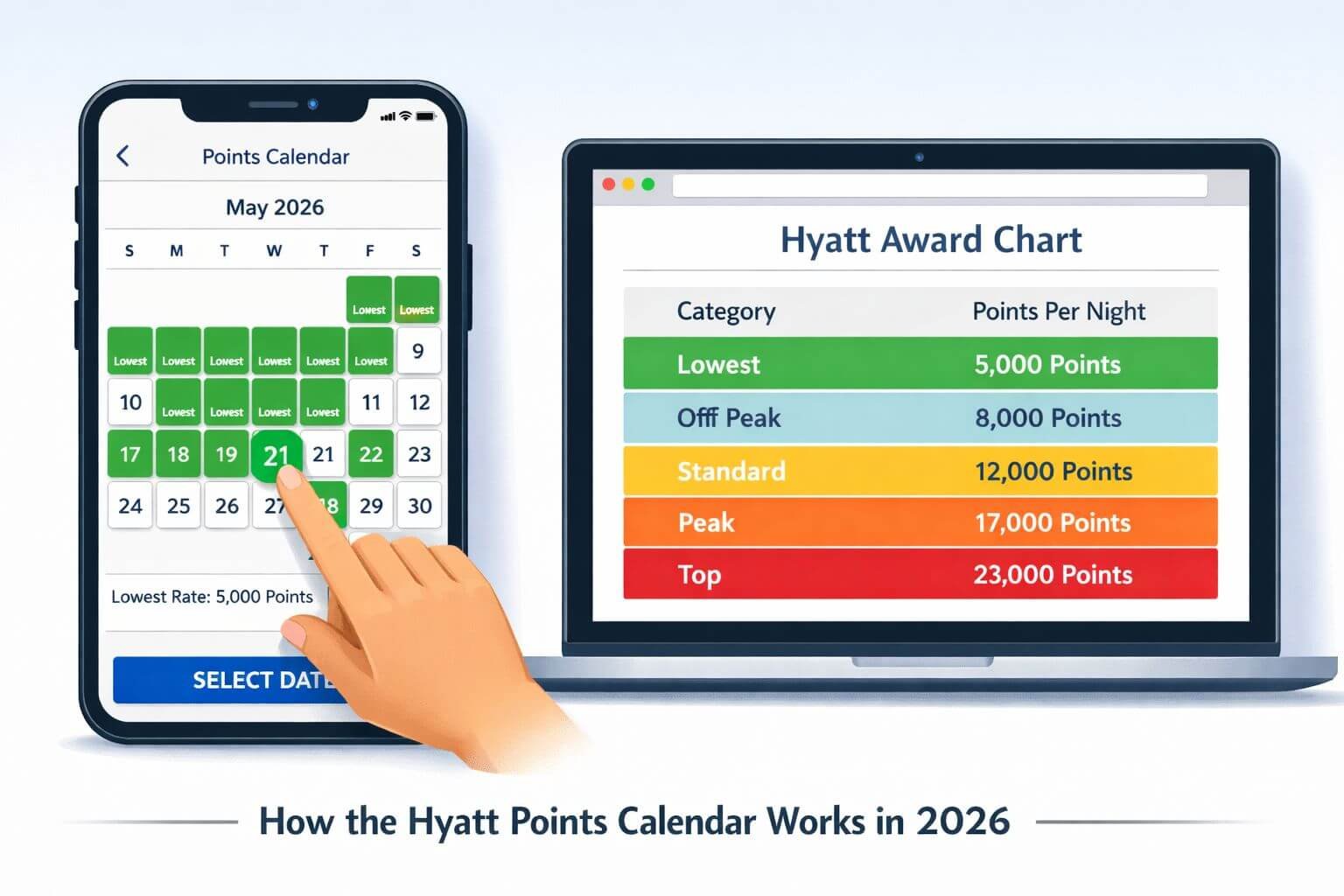
The points calendar is Hyatt’s built-in tool that displays the points cost per night for a specific property over a rolling 12-month window. Rather than showing a single flat rate, it reflects whichever of the five pricing tiers applies to each date — so two nights at the same resort in the same month can carry meaningfully different point costs.
This matters more in 2026 than it ever has before. Under the previous three-tier structure (Off-Peak, Standard, Peak), the spread at a Category 8 property was 35,000 to 45,000 points — a 10,000-point difference. Under the new five-tier chart, that same property spans 35,000 (Lowest) to 75,000 (Top) points per night — a 40,000-point gap. At a conservative Hyatt valuation of 1.7 cents per point (CPP), that’s a $680 swing per night on a single award booking. For a five-night stay, the difference between booking all Lowest nights versus all Top nights is 200,000 points — enough for several additional free nights at a mid-tier property.
For a deeper look at how the new tier structure was built and which categories moved, see the World of Hyatt Award Chart 2026 category increases and hidden deals guide and the Hyatt Award Chart Changes 2026 five-tier pricing guide.
The core use case: Before booking any Hyatt award stay in 2026, pull up the points calendar for your target property and scan 5–10 days around your preferred dates. A two-day shift in arrival date can save 20,000–40,000 points per night at Category 6–8 properties.
Common mistake: Searching only for your exact travel dates without checking adjacent nights. A Friday arrival during a holiday weekend may land on a Top-tier night, while a Thursday arrival at the same property could be Lowest or Low.
How to Use the Hyatt Points Calendar Step by Step
The calendar is accessible on both the Hyatt website and the World of Hyatt app. The process is straightforward, but a few navigation details are worth knowing.
On the Hyatt website (desktop):
- Go to hyatt.com and search for your target property by name or destination.
- Select “Use Points” as your rate type before running the search.
- On the property page, click “Check Availability” and choose “Points” as the payment method.
- The calendar view will display each date with its corresponding points cost. Dates with no availability show as unavailable; available dates show the per-night points rate.
- Hover over or click any date to see the full nightly breakdown, including whether the rate reflects Lowest, Low, Moderate, Upper, or Top tier.
- Toggle the calendar forward month by month to map out a full trip window.
You may be interested



On the World of Hyatt app (iOS/Android):
- Open the app and search for a property.
- Tap “Award” or “Points” under the rate filter.
- The calendar view appears by default in the booking flow — swipe left/right to navigate months.
- Tap individual dates to confirm the tier and total cost for a multi-night stay.
Practical tips:
- Search each property individually; the calendar is property-specific, not destination-wide.
- If you’re flexible on property, run searches across two or three comparable hotels in the same destination to compare tier distribution across your travel window.
- Screenshot or note the calendar for your top candidates — tier assignments are stable but availability can change as other members book.
- Use the best award travel tools and alerts for 2026 alongside the native calendar to set up availability notifications for high-demand properties.
Key 2026 Travel Seasons and When to Start Searching
For most peak 2026 travel periods, the booking window is already open. The table below outlines the major demand periods, the typical tier pressure you’ll face, and the recommended action date.
| Travel Period | Key Dates | Tier Pressure (Cat 6–8) | Recommended Search Start | Book By |
|---|---|---|---|---|
| Memorial Day Weekend | May 23–26 | Upper / Top | Now (open) | Immediately |
| Summer Peak (Hawaii, Europe) | June 20 – Aug 10 | Moderate to Top | Now (open) | May 2026 |
| Labor Day Weekend | Aug 29 – Sep 1 | Upper / Top | Now (open) | May–June 2026 |
| Thanksgiving Week | Nov 22–30 | Top at premium resorts | Now (open) | June–July 2026 |
| Christmas / New Year’s | Dec 20 – Jan 4 | Top at most Cat 6–8 | Now (open) | July–Aug 2026 |
Why these windows matter: Award inventory at popular Hyatt properties — Park Hyatt Maldives, Andaz Maui, Park Hyatt Paris-Vendôme — is finite. Top-tier pricing doesn’t just cost more points; it also signals that demand is high and standard rooms sell out faster. Waiting until September to book a Thanksgiving Hyatt stay at a Category 8 resort is a compounding risk: you face both higher tier pricing and reduced availability.
For holiday travel specifically, the holiday travel rebooking strategy using refundable points bookings is worth reading alongside this guide — it covers how to hold dates with a refundable booking while you finalize plans.
Real Examples: Lowest vs. Top Tier Pricing at Popular Properties
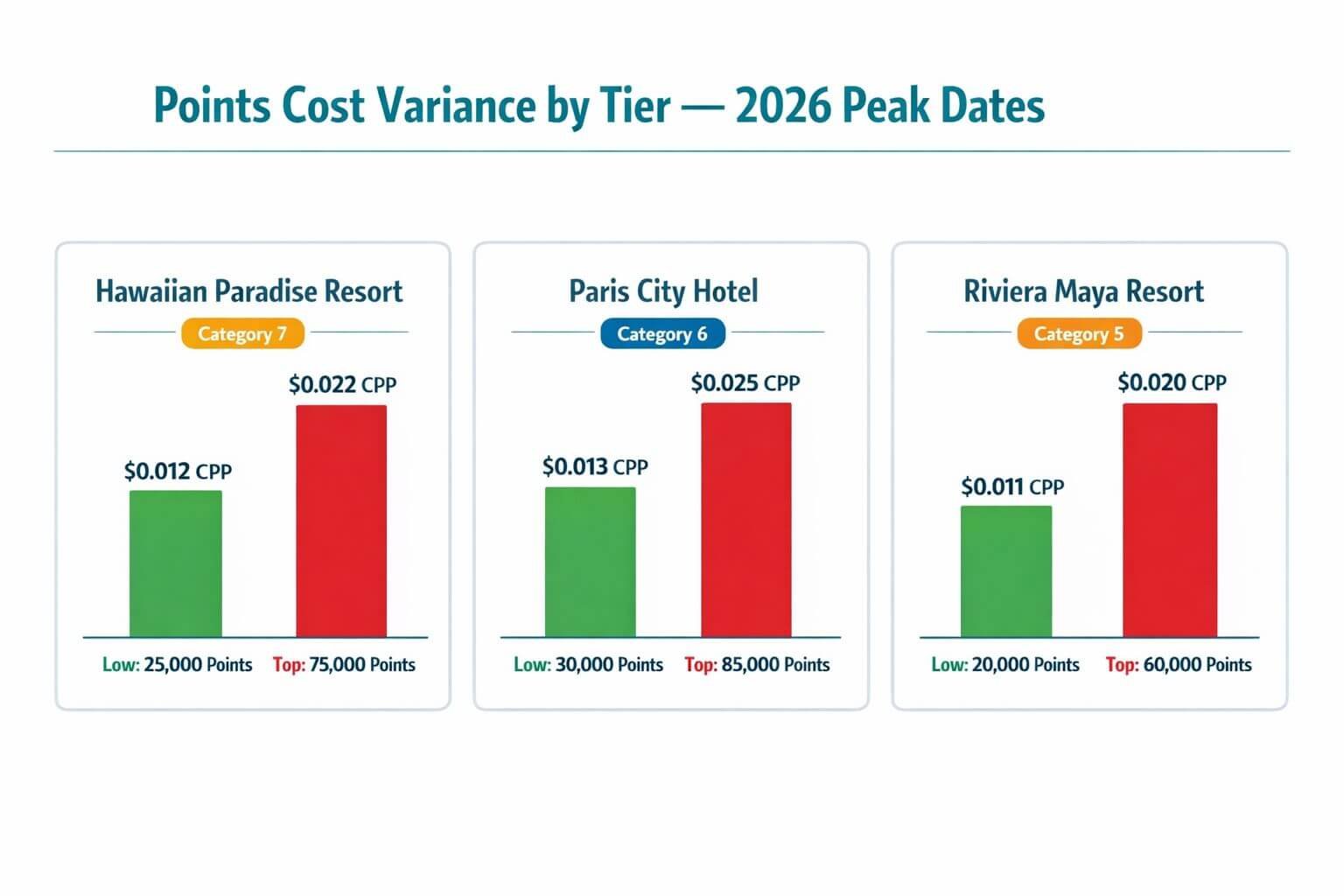
The following scenarios illustrate the practical stakes of the Hyatt points calendar early booking strategy 2026. All figures reflect the published 2026 five-tier chart. Assumptions: 5-night stays, single standard room, points sourced from Chase Ultimate Rewards transferred to World of Hyatt at 1:1.
Scenario 1: Andaz Maui at Wailea Resort (Category 6)
| Tier | Points/Night | 5-Night Total | Estimated Cash Value* |
|---|---|---|---|
| Lowest | 21,000 | 105,000 | ~$1,785 |
| Low | 25,000 | 125,000 | ~$2,125 |
| Moderate | 29,000 | 145,000 | ~$2,465 |
| Upper | 35,000 | 175,000 | ~$2,975 |
| Top | 40,000 | 200,000 | ~$3,400 |
*Estimated cash value based on 1.7 CPP. Cash rates at this property during peak summer regularly exceed $900/night, making even Top-tier redemptions strong value — but the 95,000-point savings between Lowest and Top is meaningful.
Scenario 2: Park Hyatt Paris-Vendôme (Category 8)
| Tier | Points/Night | 5-Night Total | Point Savings vs. Top |
|---|---|---|---|
| Lowest | 35,000 | 175,000 | 200,000 saved |
| Low | 45,000 | 225,000 | 150,000 saved |
| Moderate | 55,000 | 275,000 | 100,000 saved |
| Upper | 65,000 | 325,000 | 50,000 saved |
| Top | 75,000 | 375,000 | — |
For Paris in summer 2026, the points calendar often shows Lowest or Low pricing on weekday check-ins (Tuesday–Thursday), while Friday/Saturday nights spike to Upper or Top. A traveler who adjusts their arrival by two days and uses the calendar to identify the lowest-tier window saves 200,000 points on a five-night stay — equivalent to a free week at a Category 4 property.
Scenario 3: Hyatt Ziva Cancún (Category 5, All-Inclusive)
| Tier | Points/Night | 5-Night Total | Notes |
|---|---|---|---|
| Lowest | 15,000 | 75,000 | Shoulder weeks in Jan, May, Oct |
| Low | 20,000 | 100,000 | Most of June, early Sept |
| Moderate | 25,000 | 125,000 | July 4th week, spring break |
| Upper | 29,000 | 145,000 | Thanksgiving week |
| Top | 32,000 | 160,000 | Christmas/New Year’s |
For all-inclusive Mexico resorts, the spread is narrower than Category 8 city hotels, but the calendar still reveals meaningful savings. See the best all-inclusive Mexico resorts to book with points in 2026 for a full property comparison.
Decision rule: If the points calendar shows your target dates at Upper or Top tier, run the cash rate comparison. At Category 8, Top-tier redemptions (75,000 points/night) only clear 1.5+ CPP if the cash rate exceeds $1,125/night. Below that, you may be better served holding points for a lower-tier date or a different property.
For a full CPP framework, the 2026 guide to cents-per-point award travel math walks through the calculation in detail.
Using Elite and Cardholder Early Access to Beat the Crowds
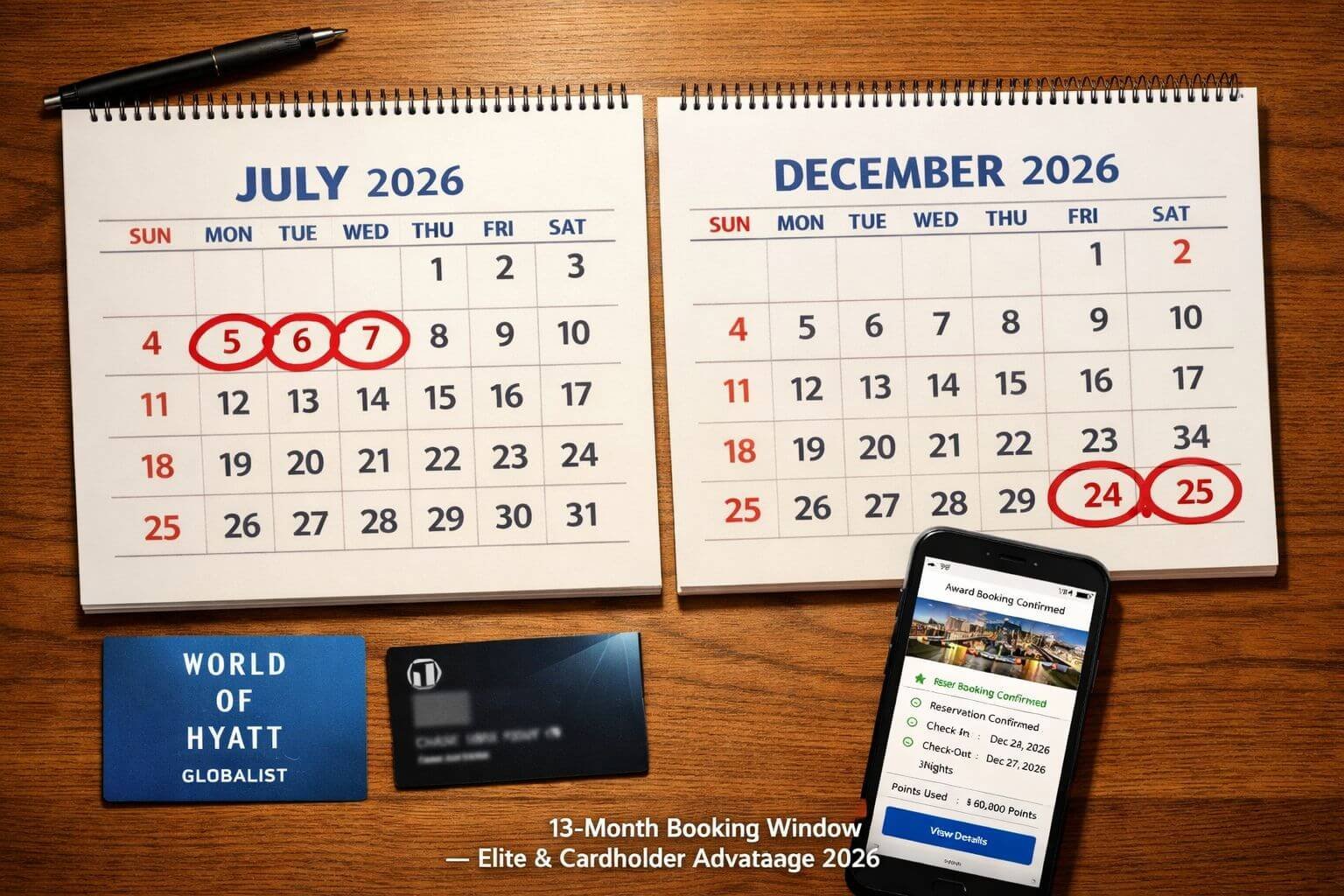
Hyatt’s 13-month booking window for Explorist and Globalist elites, as well as World of Hyatt credit cardholders, is one of the more concrete advantages in the program right now. Standard members book at 12 months; qualifying elites and cardholders get one additional month of lead time.
Who qualifies:
- World of Hyatt Globalist (top elite tier, 60 qualifying nights/year)
- World of Hyatt Explorist (mid elite tier, 30 qualifying nights/year)
- World of Hyatt credit cardholders (Chase-issued personal or business card)
Why it matters for 2026 peak dates: For a New Year’s Eve stay at a property like Park Hyatt Sydney or Alila Ventana Big Sur, the difference between booking at 13 months versus 12 months can be the difference between securing a standard room and finding nothing available. The 13-month window for December 31, 2026 opens in late November 2025 for qualifying members — most of that window has already passed, but the same advantage applies to any rolling peak date going forward into 2027.
If you’re not yet an elite or cardholder: The World of Hyatt personal card (Chase-issued) is the lowest-friction path to the 13-month window. It also earns 4x points on Hyatt stays and provides 5 qualifying night credits annually toward Discoverist status. For a broader look at maximizing Hyatt points across earning and redemption, the 15 strategies for luxury Hyatt hotels in 2026 covers the full picture.
Points sourcing for early bookings: The 13-month window is only useful if you have points ready to transfer. Chase Ultimate Rewards and Bilt Rewards both transfer to World of Hyatt at 1:1 with no fees. Transfers are instant in most cases. Do not transfer points speculatively — only transfer when you have a specific booking confirmed or a date/property locked in. For timing guidance on when to pull the trigger on a transfer, see the transfer bonus strategy guide for 2026.
Edge case: If you’re short on Hyatt points and a high-demand date is about to open, Hyatt’s planned digital points sharing (launching later in 2026) will make it easier to pool points between household members. Until that feature is live, coordinate transfers from individual Chase or Bilt accounts to each member’s Hyatt account separately.
An Annual “Look Ahead” Checklist for Hyatt Stays
A structured annual process prevents the most common mistake in Hyatt award booking: reactive searching after peak dates are already priced at Upper or Top tier.
Q1 (January–March): Set Your 2026 Travel Priorities
- Identify 2–3 target Hyatt stays for the year (property, approximate dates, travel party size)
- Check current category assignments against the Hyatt Award Chart 2026 survival guide
- Confirm your current points balance across Chase, Bilt, and World of Hyatt
- Note your elite status and whether you qualify for the 13-month booking window
Q2 (April–June): Active Search and Booking Phase
- Open the points calendar for each target property; map all dates in your travel window
- Identify the lowest-tier dates within ±5 days of your preferred travel dates
- Calculate CPP for your best available option (use the cents-per-point guide)
- Transfer points from Chase or Bilt only after confirming availability on your target dates
- Book immediately after transfer — do not wait
Q3 (July–September): Holiday Booking Phase
- Repeat the calendar search process for Thanksgiving and December/January travel
- Set award availability alerts for high-demand properties using third-party tools
- Book holiday stays as soon as availability opens; do not wait for “better” dates to appear
Q4 (October–December): Year-End Review
- Confirm all upcoming bookings; check for any category or tier changes
- Assess remaining points balance; avoid year-end expiration risks (see hotel points expiration rules)
- Begin planning 2027 aspirational stays; use 13-month window if eligible
- Review the end-of-year points and miles reset checklist to avoid leaving value on the table
Not for everyone: This level of advance planning is most valuable for Category 6–8 properties during genuine peak periods. For Category 1–4 properties or travel during shoulder seasons, the tier variance is smaller and the urgency is lower. If your target stay is a Category 3 city hotel on a Tuesday in October, the points calendar is still worth a quick check — but you don’t need to book six months in advance.
Conclusion: The Points Calendar Is Your 2026 Planning Baseline
Hyatt’s five-tier chart introduced real pricing complexity, but it also made the points calendar more valuable than ever. The tool shows exactly what each date costs before you commit — and in 2026, that information is worth tens of thousands of points per trip.
The practical summary:
- Pull the calendar first. Before transferring a single point, check the specific dates at your target property.
- Target Lowest and Low dates. Even a 2–3 day shift in travel dates can eliminate a full tier of cost.
- Use your booking window advantage. Explorist/Globalist elites and cardholders should use the 13-month window for any Category 6–8 peak stay.
- Transfer only on confirmed availability. Chase and Bilt transfers to Hyatt are instant, but points transferred are committed — don’t move them speculatively.
- Book holiday stays now. Thanksgiving and Christmas/New Year’s availability at premium Hyatt properties is already under pressure.
The Hyatt points calendar early booking strategy for 2026 is not complicated — but it requires acting ahead of demand rather than reacting to it. The readers who will get the most from the new chart are those who treat the calendar as a planning tool, not an afterthought.
Frequently Asked Questions
What is the Hyatt points calendar?
The points calendar is a date-by-date view within Hyatt’s booking interface that shows the points cost for each night at a specific property. It reflects whichever of the five pricing tiers (Lowest through Top) applies to each date, allowing members to identify the cheapest available nights before booking.
How many tiers does Hyatt’s 2026 award chart have?
Five: Lowest, Low, Moderate, Upper, and Top. This expanded from the previous three-tier structure (Off-Peak, Standard, Peak) effective May 2026. Each property has a base category (1–8), and the tier applied on any given night is determined by demand and the property’s calendar.
What is the maximum points cost for a Hyatt award night in 2026?
At Category 8 properties, Top-tier award nights cost 75,000 points. The Lowest tier at Category 8 is 35,000 points — a 40,000-point difference per night.
Who gets the 13-month early booking window at Hyatt?
World of Hyatt Explorist elites, Globalist elites, and World of Hyatt credit cardholders (Chase personal or business card) receive a 13-month advance booking window for award stays, versus 12 months for standard members.
Which transferable points currencies transfer to World of Hyatt?
Chase Ultimate Rewards and Bilt Rewards both transfer to World of Hyatt at 1:1 with no fees. Transfers from Chase are typically instant. No other major transferable currency (Amex, Capital One, Citi) currently transfers directly to Hyatt.
Should I transfer points before checking the calendar?
No. Always confirm award availability on your specific dates before initiating a transfer. Points transferred to World of Hyatt cannot be moved back to Chase or Bilt.
Are Hyatt tier assignments fixed for the year?
Tier assignments per property are set at launch and change minimally mid-cycle, unlike fully dynamic pricing programs. However, availability within a tier can decrease as other members book, so early action still matters.
Is it worth booking a Top-tier Hyatt night?
It depends on the cash rate. At Category 8, a Top-tier night costs 75,000 points. To achieve 1.7 CPP, the cash rate would need to exceed $1,275/night. Many Park Hyatt and Alila properties in peak season do reach or exceed this threshold — but always run the math before committing.
How does Hyatt’s pricing compare to Marriott Bonvoy in 2026?
Hyatt retains a published chart with predictable tier assignments, while Marriott uses fully dynamic pricing with no published ceiling. In practice, Hyatt’s Category 5–8 variance (up to 40,000 points/night) rivals Marriott’s swings, but Hyatt’s rates are at least visible in advance through the calendar tool.
What if I can’t find Lowest-tier availability on my target dates?
Consider: (1) shifting dates by 2–5 days using the calendar to find a lower tier; (2) checking comparable properties in the same destination; (3) evaluating whether the cash rate justifies a higher-tier redemption; or (4) booking cash and preserving points for a better-value redemption elsewhere.


Content on Award Travel Hub is independently created by Award Travel Hub Editorial Desk and, where noted, reviewed by Award Travel Hub Review Desk. Some pages may contain affiliate links, but compensation does not determine our coverage, opinions, or methodology.