Last updated: June 7, 2026
Quick Answer
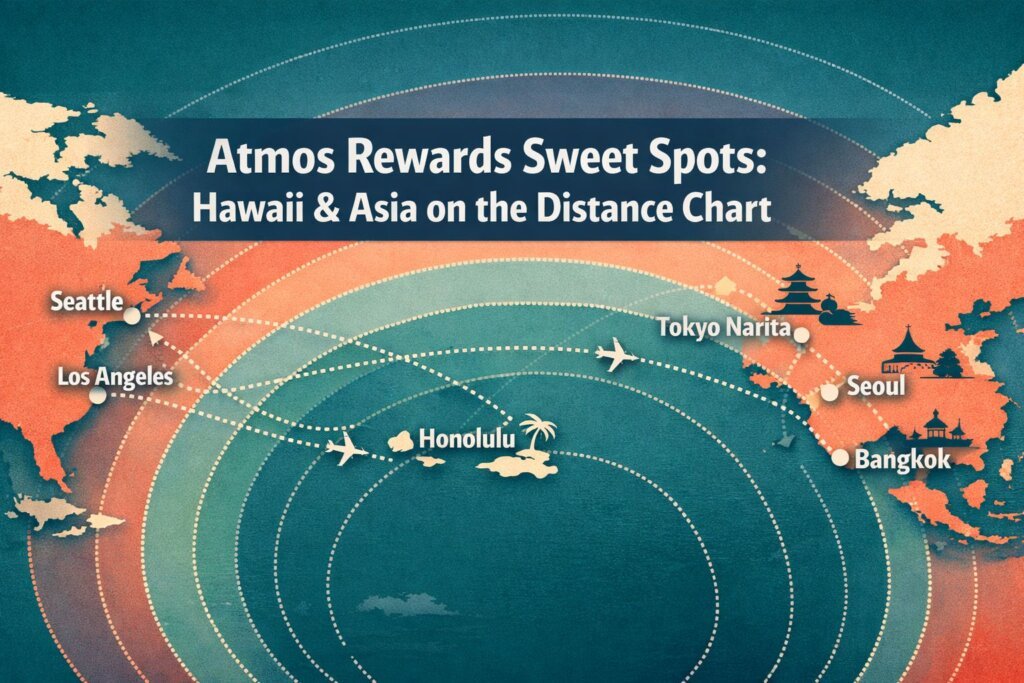
The Atmos Rewards award chart Hawaii Asia sweet spots live in three distance bands: West Coast–Hawaii economy from 12,500 points, Seattle–Tokyo on Japan Airlines Business from 60,000 points, and transpacific + intra-Asia stopovers from 85,000 points in Business. Because Atmos keeps a published distance-based chart with free stopovers on one-way awards, it often beats United’s dynamic pricing and American’s partner rates for the same seats. The catch: award space on JAL, STARLUX, and Hawaiian partners can be thin, so flexibility and early searching matter.
Key Takeaways
- West Coast–Hawaii economy: 12,500 points one-way is the baseline sweet spot on Alaska and Hawaiian metal.
- West Coast–Tokyo on JAL business: 60,000 points one-way, under the 5,000-mile band — one of the best transpacific business deals on any U.S.-accessible program.
- Transpacific + Asia stopover: 85,000 points one-way in business to cities like Bangkok, Hanoi, or Singapore via a free Tokyo stopover.
- Free stopover on one-ways: Atmos keeps the old Alaska-style stopover rule, which United and American don’t offer on standard awards.
- Point valuation: Independent valuations peg Atmos at roughly 1.2–1.6 cents per point (CPP), with premium-cabin Asia redemptions well above that.
- Partner availability is the gate: JAL, STARLUX, Hainan, and Hawaiian partner space drives every sweet spot. No space, no deal.
- Status earning in 2026: Members can choose distance, spend, or segment tracking, and award flights still count under the distance option.
How Do Atmos Rewards Distance Bands Work in 2026?
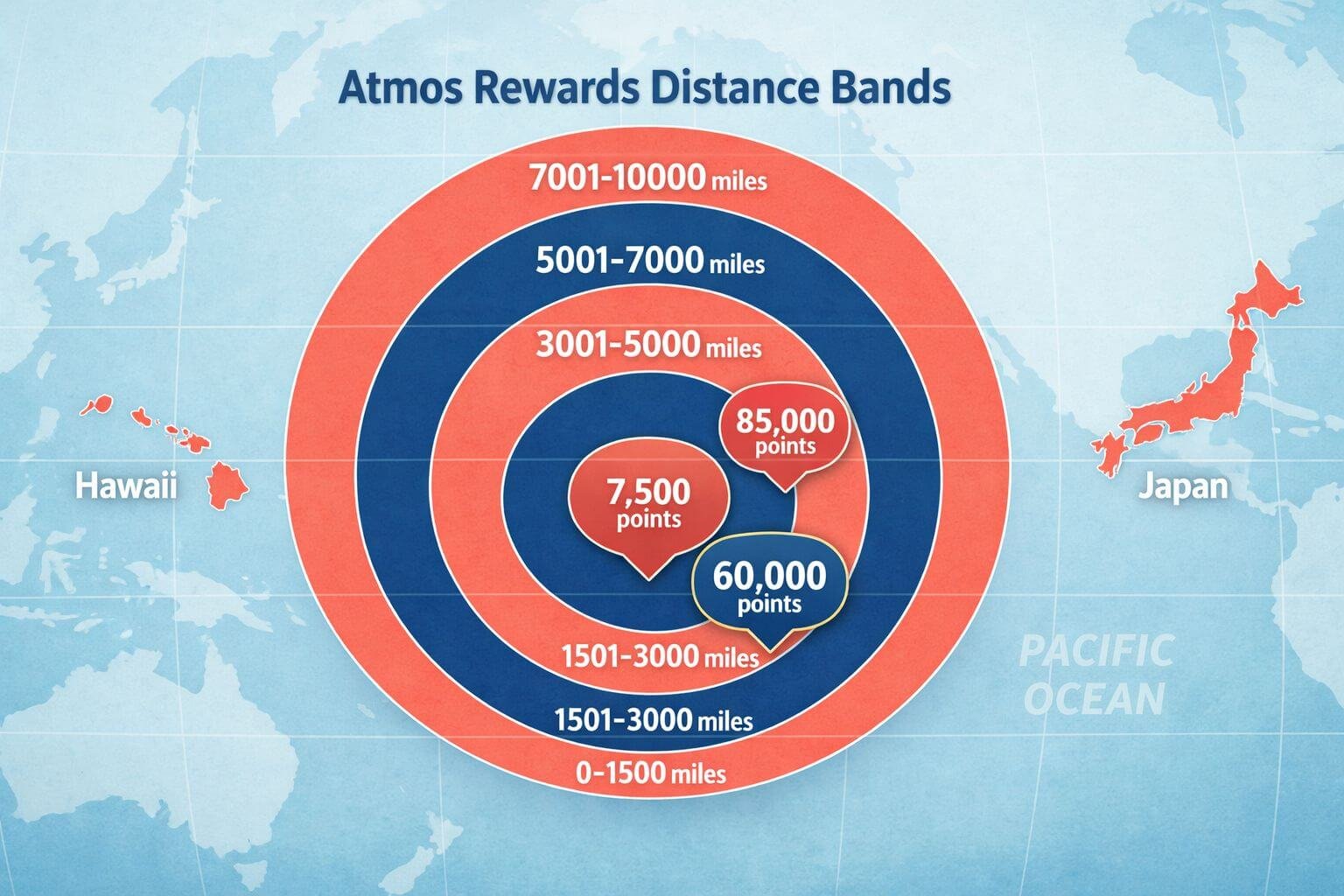
Atmos Rewards prices partner awards using fixed distance bands based on the flown miles of each one-way itinerary. That means the same price applies whether the cash fare is $600 or $6,000, as long as the routing fits the band and award space is available.
Key structural points:
- Per-partner chart. Each partner (JAL, Hawaiian, STARLUX, Qantas, Finnair, etc.) has its own chart. Don’t assume one chart applies across partners.
- One-way pricing. Prices are published one-way, so mixing cabins or partners on outbound vs. return is easy.
- Distance bands for Asia. The most useful APAC bands are 0–1,500, 1,501–3,000, 3,001–5,000, 5,001–7,000, and 7,001–10,000 miles.
- Free stopover on one-ways. You can add a stopover in a partner hub (like Tokyo) on a one-way award — a rule most U.S. programs killed years ago.
Define it: A distance band is a mileage range (e.g., 5,001–7,000 flown miles) that determines the award price, regardless of the cash fare. A stopover is a break in your journey of more than 24 hours between flights.
What Are the Rules for Atmos Partner Awards and Stopovers?
The rules that make or break a sweet spot: one-way pricing, free stopovers, mixed partners with limits, and award-earning status in 2026.
Practical rules to memorize:
- One stopover per one-way. Book two one-ways to effectively get two stopovers on a round trip.
- Partners usually can’t be mixed on the same award. A JAL + STARLUX itinerary on one ticket is typically not allowed; book separately.
- Taxes and surcharges vary. JAL passes moderate fuel surcharges on award tickets; Hawaiian and STARLUX are much lower. Budget $100–$300 per long-haul one-way.
- Award flights can earn status under the distance-based elite track in 2026.
- Changes and cancellations are generally permitted, but read the current terms before booking — see our award cancellation and change rules guide.
Common mistake: Assuming you can combine JAL and Cathay on one Atmos award. You usually can’t. Plan two separate one-ways instead.
For a broader primer on the program mechanics, see the Alaska Atmos Rewards guide for 2026.
What Are the Top Atmos Sweet Spots to Hawaii From U.S. Gateways?
The best Atmos Rewards redemptions to Hawaii start at 12,500 points one-way in economy from the West Coast and climb to roughly 40,000 points for first class. These prices are stable, with no blackout dates and strong availability on Alaska and Hawaiian metal post-merger.
Hawaii sweet spot table
| Route | Cabin | Atmos Points (one-way) | Typical Cash | Approx. CPP |
|---|---|---|---|---|
| SEA/PDX/SFO/LAX → HNL/OGG | Economy | 12,500 | $250–$450 | 2.0–3.6¢ |
| West Coast → HNL/OGG | First/Business | 40,000 | $700–$1,100 | 1.75–2.75¢ |
| East Coast → HNL (via West Coast) | Economy | 20,000–25,000 | $400–$700 | 1.8–2.8¢ |
| Inter-island (HNL–OGG/LIH/KOA) | Economy | 4,500–7,500 | $80–$180 | 1.5–2.4¢ |
You may be interested



CPP (cents per point) = cash price ÷ points × 100. Subtract taxes/fees from cash first for a cleaner number.
Best for: West Coast flyers with flexible dates. Not for: Summer peak weeks, when availability thins and cash fares to Hawaii occasionally dip below 1.5 CPP — at that point, just pay cash.
Pairing Hawaii with an Asia leg using the stopover rule is where Atmos quietly outshines competitors. More on that below.
What Are the Best Atmos Redemptions to Japan and Wider Asia?
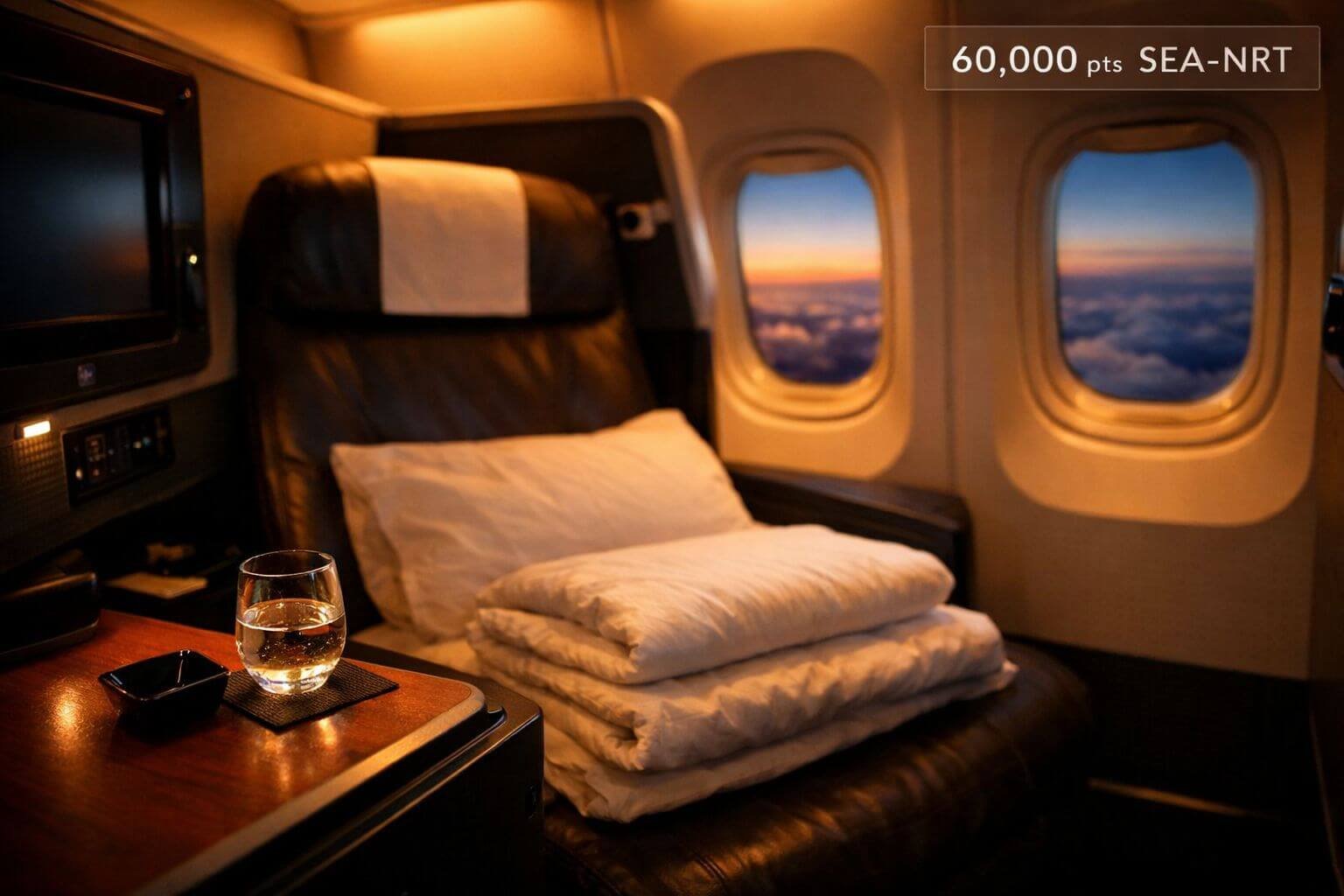
The headline sweet spot: Seattle or San Francisco to Tokyo in Japan Airlines business for 60,000 Atmos points one-way, under the 5,001-mile band. From the East Coast, the same partner prices around 75,000 points one-way.
Asia sweet spot table (partner awards, one-way)
| Route | Partner | Cabin | Atmos Points | Notes |
|---|---|---|---|---|
| SEA/SFO/LAX → HND/NRT | JAL | Business | 60,000 | 5,001–7,000 mi band |
| SEA → ICN | Hainan / partners | Business | 60,000–70,000 | Seasonal space |
| West Coast → TPE | STARLUX | Business | 65,000–75,000 | Newer partner, decent space |
| West Coast → BKK/HAN/SIN (via NRT stopover) | JAL | Business | 85,000 | 7,001–10,000 band, free stopover |
| Intra-Asia short hops (≤1,500 mi) | Various | Economy/Business | 7,500 / 15,000 | Great positioning value |
| EWR/JFK → HND/NRT | JAL | Business | 75,000 | East Coast premium |
Why the Tokyo stopover trick works
Book one award: LAX → NRT → BKK in JAL business. Atmos charges the 7,001–10,000 mile band (~85,000 points), and the free stopover lets you spend a week in Tokyo before continuing. Compared with Aeroplan’s ~87,500 points to Asia and higher surcharges, or United’s dynamic pricing that routinely pushes past 110,000 points for the same cabin, Atmos wins on both price and surcharges.
For a wider look at Japan options, cross-reference our points guide to flying to Japan in 2026.
When Does Atmos Beat Other Programs — and When Doesn’t It?
Atmos wins on transpacific predictability and stopovers; it loses when partner space is zero or when you need domestic U.S. coverage beyond Alaska’s network.
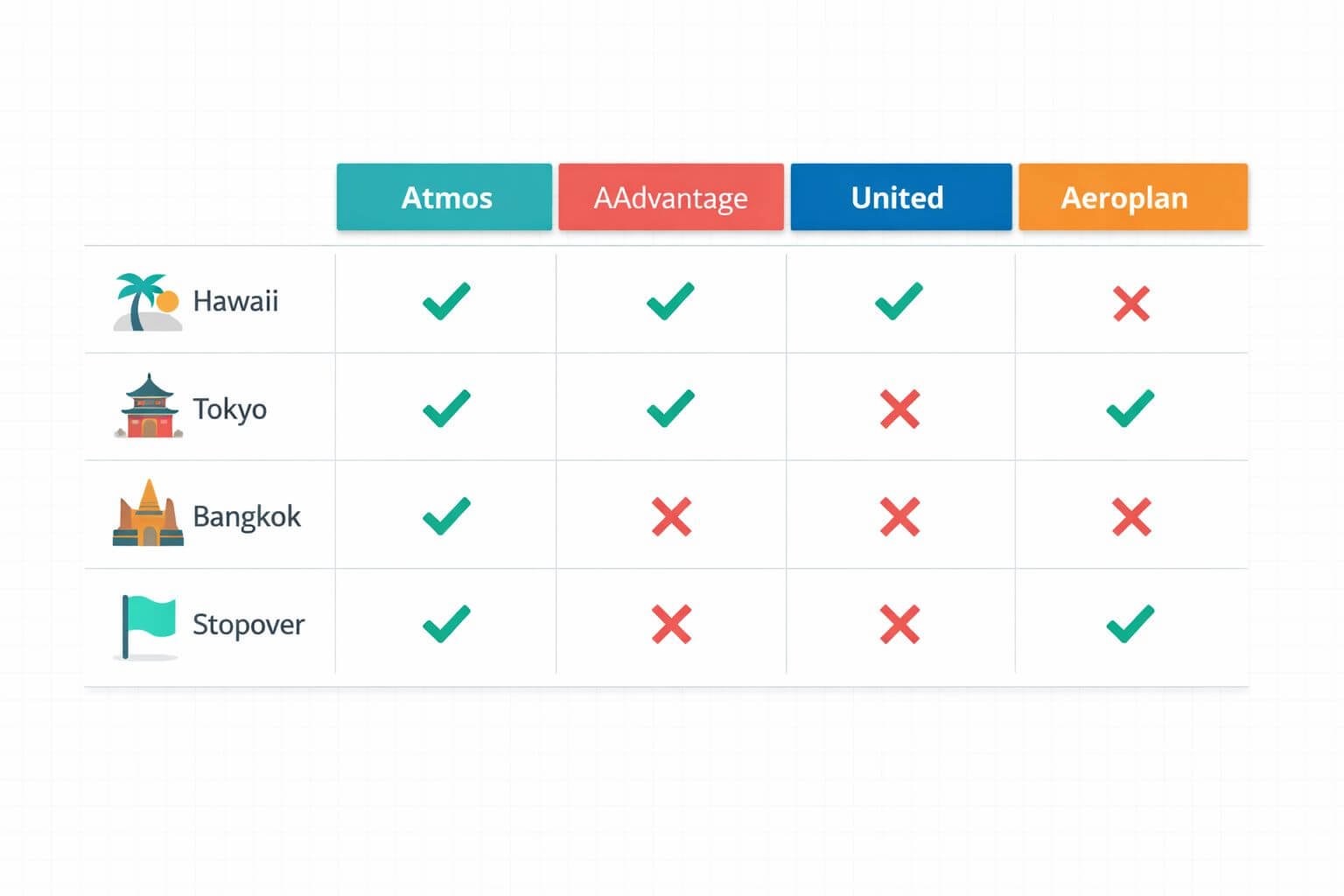
Head-to-head snapshot (business class to Tokyo, one-way, West Coast origin)
| Program | Points | Surcharges | Stopover allowed? |
|---|---|---|---|
| Atmos Rewards (JAL) | 60,000 | Moderate | Yes, free |
| American AAdvantage (JAL) | 60,000–75,000 | Low | No |
| Aeroplan (ANA/partners) | 75,000–87,500 | Higher on some carriers | Yes, paid $100 |
| United MileagePlus (ANA) | 88,000–120,000+ dynamic | Low | No |
Choose Atmos if: you want a published chart, a free stopover, and transferable points access via Bilt and (for many members) Amex after recent partnership updates. See our best transferable points programs 2026 for transfer mechanics.
Choose American if JAL space shows on AA but not Atmos (it happens), and you want lower surcharges.
Choose Aeroplan if you need ANA specifically or want a stopover and mixed-partner routing.
Choose United if: you’re deeply in the MileagePlus ecosystem and find a Saver-level award; otherwise, United’s dynamic pricing is rarely competitive for Asia business.
Not worth it: Using Atmos for domestic East Coast routes on American — the distance pricing there usually beats a straight cash fare only marginally.
What Do Real Atmos Booking Walkthroughs Look Like?
Three sample itineraries with point math, assumptions, and CPP. Prices reflect April 2026 chart snapshots.
Example 1: Family Hawaii trip, West Coast
- Itinerary: LAX → OGG and OGG → LAX, economy, 2 adults + 1 child.
- Points: 12,500 × 6 = 75,000 Atmos points round-trip for three.
- Cash comparison: ~$420 per person round-trip = $1,260.
- Taxes/fees on award: ~$22 total.
- Net CPP: ($1,260 − $22) ÷ 75,000 = 1.65 CPP — solid, and you preserved cash.
Example 2: Tokyo stopover + Bangkok honeymoon
- Outbound: SFO → NRT → BKK, JAL business, 85,000 points + ~$180 taxes.
- Return: BKK → NRT → SFO, JAL business, 85,000 points + ~$220 taxes.
- Stopover: 7 nights in Tokyo on the outbound — free.
- Cash comparison: JAL business round-trip often $6,500–$8,500.
- Total: 170,000 points + ~$400 taxes.
- Net CPP: ($7,000 − $400) ÷ 170,000 = ~3.9 CPP. Premium-cabin territory where Atmos shines.
Example 3: Intra-Asia positioning after a Japan trip
- Itinerary: TYO → TPE on a partner, economy, 7,500 points + ~$30.
- Cash comparison: $180–$260.
- Net CPP: ~2.7 CPP. Useful when you’re already in-region.
Assumption flag: Award space must be available at the partner-award level. Use tools like those in our best award search tools for beginners and partner award space guide before transferring points.
How Do You Future-Proof Your Atmos Strategy for 2027 and Beyond?
Keep points in transferable currencies until you have a specific booking target, watch for oneworld integration changes, and don’t speculatively hoard Atmos points above a 12-month booking horizon.
A simple framework:
- Earn flexibly. Prioritize transferable points programs and Bilt transfer partners so you can move points into Atmos when a specific award opens.
- Search first, transfer second. Confirm JAL or Hawaiian award space, hold if possible, then transfer.
- Book early for long-haul business. JAL opens ~355 days out and business space disappears fast.
- Use stopovers deliberately. One award, two destinations — don’t waste the rule on a 2-day layover you could’ve done for free anyway.
- Track devaluation risk. No major Atmos chart changes in March–April 2026, but oneworld integration could shift pricing. Keep balances moderate.
- Compare before you commit. Cross-check with our Atmos vs United loyalty comparison and transfer partner comparison.
FAQ
Is Atmos Rewards good for Hawaii? Yes. 12,500 points one-way in economy from the West Coast is one of the most reliable Hawaii award rates available, with no blackout dates.
What’s the cheapest way to fly business class to Japan on Atmos? West Coast to Tokyo on Japan Airlines for 60,000 points one-way, subject to JAL partner availability.
Can I add a stopover on an Atmos award? Yes. You get one free stopover per one-way award, which is ideal for pairing Tokyo with a second Asia city.
Do Atmos award flights earn elite status in 2026? They can, under the distance-based elite earning option announced for 2026.
How do fuel surcharges work on Atmos partner awards? They vary by partner. JAL passes moderate surcharges; Hawaiian and STARLUX pass very little. Budget $100–$300 per long-haul one-way.
Which credit cards transfer to Atmos Rewards? Bilt is the most widely cited transfer partner, and program partnerships continue to expand in 2026. Always confirm on the card issuer’s current partner list before transferring.
Is Atmos better than Aeroplan for Asia? Often, yes — Atmos typically prices West Coast–Tokyo business lower (60k vs. 75k+) and carries lower surcharges on JAL, though Aeroplan has broader partner mixing.
What’s the typical value of an Atmos point? Independent valuations put it at 1.2–1.6 CPP on average, with premium Asia redemptions often 3–4+ CPP.
Can I book round-trip with two stopovers? Effectively yes — book two one-ways, each with its own free stopover.
When should I not use Atmos points? When cash fares to Hawaii are under $300 round-trip or when partner award space is zero and your dates are fixed. Pay cash or use a different program.
Conclusion
Atmos Rewards keeps doing what most U.S. programs stopped doing: publishing a distance-based chart, honoring free stopovers, and pricing transpacific business class sensibly. For West Coast flyers targeting Hawaii and Asia, it’s arguably the most efficient airline currency in 2026 — if you can find partner space.
Next steps:
- Pick a target trip (Hawaii economy, Tokyo business, or a stopover combo).
- Search JAL and Hawaiian space using your preferred tool before transferring points.
- Compare against AA, Aeroplan, and United for the same dates.
- Transfer only what you need, book, then set a calendar reminder for the return leg.
For related strategy, read our Alaska Atmos Rewards guide, the fly to Japan with points guide, and the best transferable points programs for 2026.


Content on Award Travel Hub is independently created by Award Travel Hub Editorial Desk and, where noted, reviewed by Award Travel Hub Review Desk. Some pages may contain affiliate links, but compensation does not determine our coverage, opinions, or methodology.