

Last updated: April 1, 2026
Key Takeaways
- Economy round-trips to Japan cost roughly 60,000–80,000 miles per person through ANA or JAL partner programs; business class one-ways run 55,000–60,000 miles.
- Chase, Amex, and Capital One each offer direct transfer paths to ANA or JAL—pick one ecosystem and focus on it.
- Award space to Japan is tightest during cherry blossom season (late March–April) and Golden Week (late April–early May); January–February and late fall offer far better availability.
- Book 330–355 days in advance for premium cabin awards on popular departure dates.
- American AAdvantage (60,000 miles + ~$5 in taxes) and JAL Mileage Bank (55,000 miles one-way) are the two strongest beginner-friendly options for business class.
- Always search before you transfer—points moved to an airline program cannot be reversed.
- Fuel surcharges vary significantly by program; AAdvantage-to-JAL and Virgin Atlantic-to-ANA both avoid them.
Quick Answer
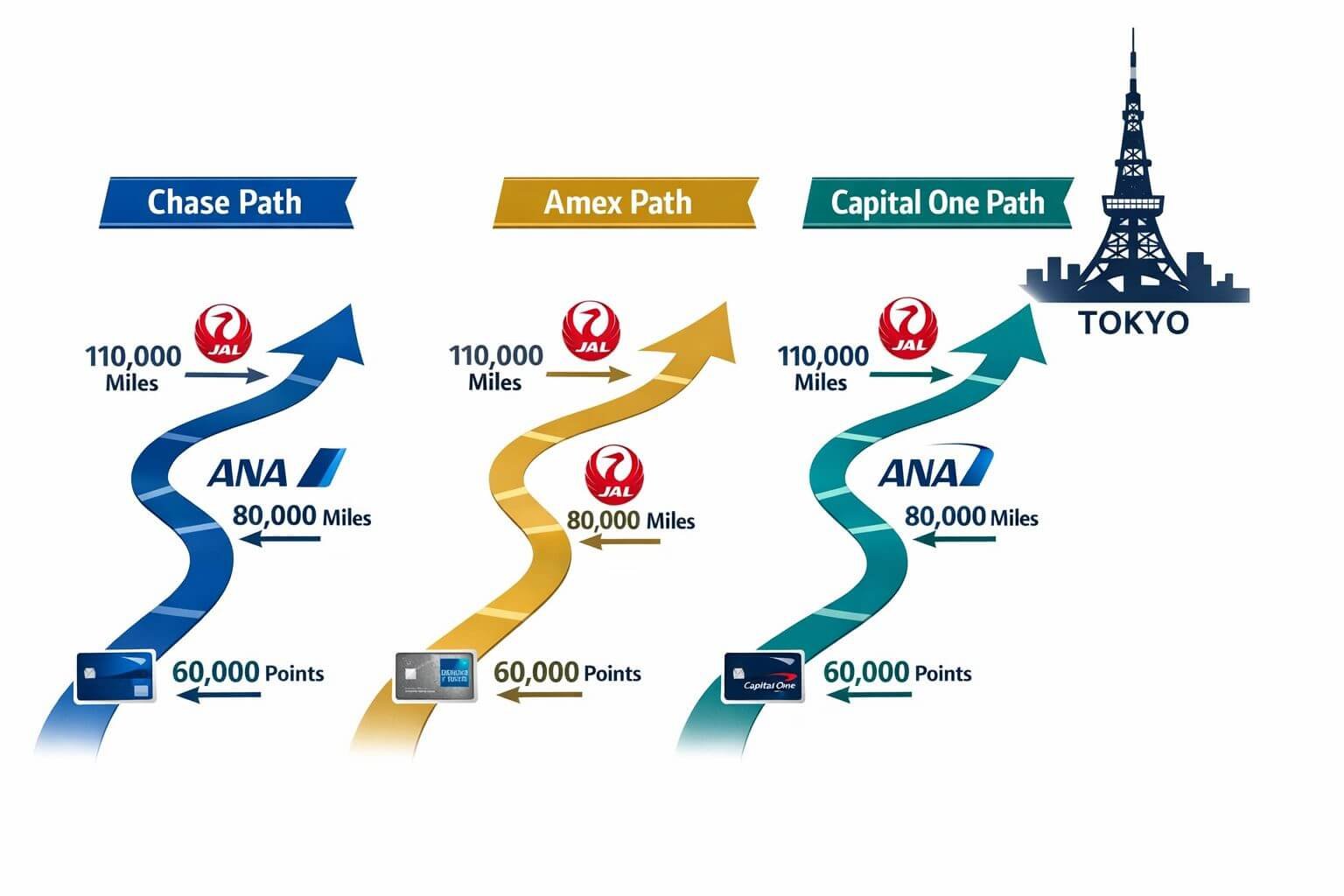
To use points to fly to Japan, transfer credit card points (Chase, Amex, or Capital One) to a partner airline like ANA or JAL, then book an award ticket directly through that airline’s website. Economy round-trips typically require 60,000–80,000 miles per person; Business Class one-ways start around 55,000–60,000 miles. The most beginner-friendly paths are Chase → United → ANA, Amex → ANA, or Amex/Citi/Capital One → JAL via American AAdvantage or directly.
Decide Your Japan Trip Basics Before You Pick a Points Strategy
Before choosing a program or transferring a single point, nail down three variables: your departure city, travel dates, and cabin preference. These three factors determine which program gives you the best shot at usable award space.
Departure city matters because nonstop Japan routes operate from a limited set of U.S. hubs. As of 2026, nonstop service to Tokyo (Narita/Haneda) or Osaka (Kansai) exists from New York (JFK), Los Angeles (LAX), San Francisco (SFO), Chicago (ORD), Dallas (DFW), Houston (IAH), Seattle (SEA), and Honolulu (HNL). If you’re not near one of these cities, you’ll need a positioning flight—a short domestic leg to reach your international departure point. Factor that into your points budget.
Travel dates are critical. Cherry blossom season (late March through mid-April) and Golden Week (late April through early May) are the hardest windows for award availability. If those dates are non-negotiable, start searching 330–355 days out and be prepared to be flexible on routing. January through February and late October through November offer noticeably better award space and are worth serious consideration if your schedule allows. For more on timing award searches around seasonal demand, see our guide on using points to book spring break travel cheaper.
Cabin preference sets your points target. Economy round-trip tickets are achievable for 60,000–80,000 miles per person. Premium economy runs 80,000–100,000 miles. Business class one-ways start around 55,000–60,000 miles through the best programs, and round-trips in business can reach 110,000–120,000 miles. First class is a separate conversation entirely.
Decision rule: If you have fewer than 100,000 transferable points across all programs and you’re traveling with a partner, focus on economy or premium economy first. Business class for two requires serious point accumulation—plan 6–12 months ahead.
Choose the Right Points Ecosystem for Your Japan Flights
The fastest way to learn how to use points to fly to Japan is to pick one transferable points ecosystem and understand its Japan-specific transfer partners. Spreading points across multiple programs without a plan leads to stranded balances that aren’t enough to book anything useful.
Here’s how the three main ecosystems connect to Japan:
| Ecosystem | Key Transfer Partners for Japan | Best Award Path |
|---|---|---|
| Chase Ultimate Rewards | United MileagePlus, British Airways Avios | Chase → United → ANA or JAL |
| Amex Membership Rewards | ANA Mileage Club, British Airways Avios | Amex → ANA direct |
| Capital One Miles | JAL Mileage Bank, Turkish Miles&Smiles, Avianca LifeMiles | Capital One → JAL direct |
| Citi ThankYou Points | Turkish Miles&Smiles, Avianca LifeMiles | Citi → Turkish → ANA |
| Bilt Points | JAL Mileage Bank, United MileagePlus | Bilt → JAL or United |
You may be interested



A note on American AAdvantage: AAdvantage miles aren’t earned directly through a major transferable points card ecosystem, but they’re bookable through Citi (ThankYou transfers ended; check current status) and earnable via the Citi AAdvantage card. AAdvantage remains one of the strongest programs for JAL business class awards—60,000 miles one-way with roughly $5 in taxes.
For a full breakdown of which banks connect to which airlines, see the comparing transfer partners guide for 2026.
Three Beginner Roadmaps: Chase, Amex, and Capital One Paths
Each path below assumes a solo traveler flying round-trip in economy or one-way in business class to Tokyo. Adjust point totals for two travelers.
The Chase Path
Best for: Beginners who want flexibility and already have or plan to open a Chase Sapphire Preferred or Reserve.
Chase Ultimate Rewards transfers to United MileagePlus at a 1:1 ratio. United’s Saver awards on ANA flights to Japan price at approximately 35,000 miles one-way in economy (70,000 round-trip) and 55,000–65,000 miles one-way in business class when Saver space is available. Dynamic pricing means United’s rates can be higher on popular dates, so off-peak travel is especially important here.
Step-by-step:
- Earn Chase points via the Sapphire Preferred or Reserve (see the Chase Sapphire Preferred 2026 guide for earning rates).
- Search ANA award space on united.com or Seats.aero before transferring.
- Once space is confirmed, transfer Chase points to United MileagePlus (transfers are instant).
- Book the ANA flight through united.com using your United miles.
Realistic point target: 70,000–80,000 Chase points for economy round-trip; 60,000–70,000 for one-way business (when Saver space exists).
Tradeoff: United’s dynamic pricing can push economy awards above 70,000 miles during peak periods. Always check the Saver vs. Everyday award pricing before transferring.
The Amex Path
Best for: Travelers targeting ANA directly or who hold the Amex Platinum or Gold card.
Amex Membership Rewards transfers to ANA Mileage Club at a 1:1 ratio. ANA’s own award chart prices U.S.-Japan business class at 88,000 miles round-trip (off-peak) or 110,000 miles (peak). Economy round-trip tickets run approximately 55,000 miles off-peak.
However, for many beginners, the stronger Amex play is transferring to Virgin Atlantic Flying Club, which prices ANA business class awards at 60,000 points one-way (120,000 round-trip) with no fuel surcharges. This requires a phone call to Virgin Atlantic to book, and ANA partner space must be confirmed first.
Step-by-step:
- Confirm ANA award availability on ana.com or Seats.aero.
- Transfer Amex points to Virgin Atlantic Flying Club (allow up to 24–48 hours, though often faster).
- Call Virgin Atlantic’s award line and book the ANA flight using Flying Club miles.
Realistic point target: 60,000 Amex points for one-way business class via Virgin Atlantic; 55,000 for economy round-trip via ANA direct.
Tradeoff: Virgin Atlantic bookings require a phone call and confirmed partner space. ANA’s own chart is simpler to book online, but costs more miles for business class.
The Capital One Path
Best for: Holders of the Venture X card who want a direct path to JAL.
Capital One miles transfer to JAL Mileage Bank at a 1:0.75 ratio normally, but Capital One ran a 30% transfer bonus to JAL through February 28, 2026, bringing the effective ratio close to 1:1. Check for future bonus windows—these have appeared multiple times and can significantly improve value. See the Capital One JAL transfer bonus guide for details on how these bonuses work.
JAL’s own award chart prices U.S.-Japan business class at 55,000 miles one-way from any U.S. coast—a fixed, distance-based rate that doesn’t fluctuate with demand. Economy round-trip tickets run approximately 40,000–50,000 JAL miles.
Step-by-step:
- Search JAL award space on jal.co.jp (English available) or Seats.aero.
- Transfer Capital One miles to JAL Mileage Bank (allow 1–3 business days).
- Book directly on JAL’s website using your JAL miles.
Realistic point target: ~74,000 Capital One miles for 55,000 JAL miles in business (at standard ratio); fewer during a transfer bonus.
Trade-off: The standard transfer ratio is less favorable than Chase’s or Amex’s. Waiting for a transfer bonus window significantly improves this path.
Sample Redemption Comparisons: Is the Upgrade Worth It?
Here’s how three redemption tiers compare against estimated 2026 cash fares for a New York–Tokyo round-trip (assumptions: off-peak fall travel, standard award pricing, no fuel surcharges):
| Cabin | Miles Required (per person) | Estimated Cash Fare | Implied CPP | Worth It? |
|---|---|---|---|---|
| Economy (round-trip) | 70,000 United miles | ~$1,100–$1,400 | ~1.6–2.0¢ | Yes, solid value |
| Premium Economy (round-trip) | 90,000 ANA miles | ~$2,200–$2,800 | ~2.4–3.1¢ | Yes, strong value |
| Business Class (one-way) | 60,000 AAdvantage miles | ~$3,500–$5,000 | ~5.8–8.3¢ | Excellent value |
For context on what these CPP figures mean, see the 2026 guide to cents-per-point math.
The upgrade to business class is almost always worth it when you can find Saver-level or fixed-chart award space. The gap between economy and business cash fares on transpacific routes is large enough that business class awards routinely deliver 5–8 cents per point—well above the 1–2 CPP you’d get from most cash-back alternatives.
When to Search, When to Book, and How to Use Alerts
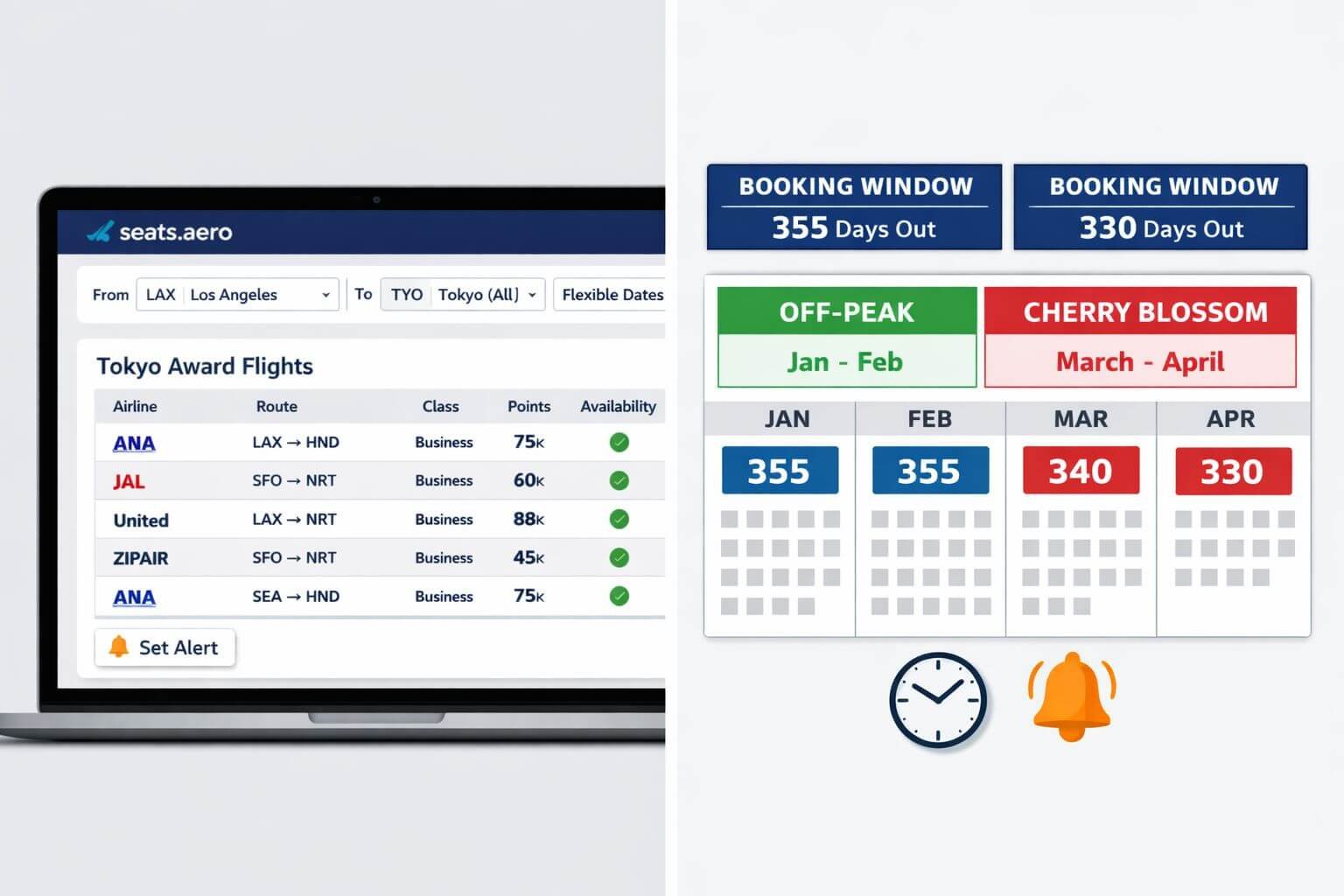
Award availability to Japan follows predictable patterns that beginners can use to their advantage.
When space opens: ANA and JAL typically release partner award space 330–355 days before departure. For a cherry blossom trip in late March 2027, that means searching in April or May 2026. Business class seats in particular tend to appear in small batches, sometimes at odd hours due to time zone differences with Japan.
Best months for availability: January and February are the easiest months to find award space to Japan. Late October and November are also strong. Avoid searching for Golden Week or cherry blossom peak without a 355-day head start.
Tools to use:
- Seats.aero — Searches partner award space across multiple programs simultaneously. Essential for finding ANA and JAL availability without logging into each airline separately.
- ExpertFlyer — Useful for setting availability alerts on specific routes and cabin classes. Paid subscription, but valuable for competitive dates.
- ANA.com and JAL.co.jp — Always verify directly on the airline’s website before transferring points.
For a full walkthrough of these tools, see the best award travel tools and alerts guide for 2026.
Common mistake: Transferring points before confirming award space. Transfers to airline programs are one-way and usually irreversible. Always find and hold (or at least confirm) the award seat before moving points.
Booking Walkthrough: From Zero to Confirmed Award Ticket
Here’s the complete process for a beginner booking a Japan award flight for the first time:
- Set your trip parameters — departure city, travel dates (with 2–3 weeks of flexibility), and cabin preference.
- Estimate your points need — use the tables above as a starting point.
- Check your current balances — log into your Chase, Amex, or Capital One account and note transferable points totals.
- Search award space first — use Seats.aero or the airline’s own website to find open seats on your dates.
- Identify the best program — match available space to a program you have points in (or can earn points in quickly).
- Transfer points — only after confirming space. Transfers are typically instant for Chase and Amex to most partners; for Capital One to JAL, it takes 1–3 business days.
- Book the award — complete the booking on the airline’s website or by phone (required for some partner bookings, such as Virgin Atlantic to ANA).
- Pay taxes and fees — most Japan awards carry minimal taxes ($5–$50 range through AAdvantage or Virgin Atlantic). Avoid programs that pass on fuel surcharges, which can reach $300–$600 per ticket.
For readers targeting lie-flat business class seats, the complete guide to booking business class with points in 2026 provides more in-depth cabin-specific strategies. Star Alliance travelers should also review the Star Alliance business class awards guide.
Common Mistakes Beginners Make (and How to Avoid Them)
Transferring points without confirmed space. This is the most costly error. Points moved to an airline are permanently removed from your flexible balance.
Ignoring fuel surcharges. Some programs (British Airways Avios on JAL, for example) pass through significant carrier-imposed fees. Always check the total cost at checkout, not just the miles required.
Booking during peak season without a 330+ day head start. Cherry blossom and Golden Week awards evaporate quickly. If you miss the opening window, consider winter travel alternatives with points or a shoulder-season trip.
Splitting points across too many programs. A beginner with 30,000 Chase points, 25,000 Amex points, and 20,000 Capital One miles has no usable balance in any single program. Consolidate before you plan a redemption.
Overlooking the JAL/JetBlue partnership change. JAL and JetBlue ended their partnership effective April 1, 2026. Award bookings that relied on cross-redemptions between these two programs are no longer possible for new bookings. Confirm current program rules before planning any strategy that involves this combination.
FAQ
How many points do I need to fly to Japan in economy? A round-trip economy award to Tokyo typically requires 60,000–80,000 miles per person, depending on the program and travel dates. United MileagePlus Saver awards on ANA price at roughly 35,000 miles each way; JAL’s own chart runs 40,000–50,000 miles round-trip for economy.
Can I use Chase points to fly to Japan? Yes. Chase Ultimate Rewards transfers to United MileagePlus at 1:1, and United books ANA and JAL partner awards. You can also transfer Chase points to British Airways Avios for JAL bookings, though fuel surcharges may apply.
What’s the cheapest business class award to Japan in miles? As of 2026, American AAdvantage prices JAL business class at 60,000 miles one-way with approximately $5 in taxes. JAL’s own Mileage Bank prices business class at 55,000 miles one-way from any U.S. coast. Virgin Atlantic Flying Club prices ANA business class at 60,000 points one-way with no fuel surcharges.
When should I start searching for Japan award space? Start 330–355 days before your target departure date, especially for premium cabin awards. For cherry blossom season (late March–April), that means beginning your search in April or May of the prior year.
Do I need to pay taxes on Japan award tickets? Yes, but the amount varies significantly by program. AAdvantage-to-JAL awards carry roughly $5 in taxes. Virgin Atlantic-to-ANA awards are similarly low. British Airways Avios bookings on partner airlines can carry $300–$600 in carrier-imposed surcharges. Always check the total fee at checkout.
Is it worth upgrading to business class using points for Japan? For most travelers, yes. Transpacific business class cash fares run $3,500–$7,000+ round-trip. Redeeming 55,000–60,000 miles for a one-way business class seat often delivers 5–8 cents per point in value—well above the typical 1–2 CPP threshold for a strong redemption.
Can two people fly to Japan business class together on points? Yes, but it requires 110,000–120,000 miles per couple for round-trip business class (or 110,000–120,000 for two one-ways). Finding two adjacent seats in business class on the same flight is harder than finding one; search early and consider splitting into two one-way awards if needed.
What happened to the JAL-JetBlue partnership? JAL and JetBlue ended their partnership on December 25, 2025. New award bookings using this combination were only possible through March 31, 2026. This path is no longer available for new bookings as of April 2026.
Should I wait for a transfer bonus before moving points? If you’re not under time pressure, yes. Capital One offered a 30% bonus to JAL in early 2026, and Bilt offered a 125% bonus to JAL in February 2026. These bonuses appear periodically and can meaningfully reduce the points required. Monitor the transfer bonus strategy guide for current offers.
What tools help find Japan award space? Seats.aero is the most useful starting point for beginners—it searches multiple programs simultaneously and shows availability for ANA and JAL partners. ExpertFlyer is better for setting alerts on specific routes. Always verify space directly on the airline’s website before transferring points.
Conclusion: Your Next Steps
Learning how to use points to fly to Japan doesn’t require mastering every airline program at once. Pick one ecosystem, identify your travel dates, and search before you transfer. That three-step discipline eliminates the most common beginner mistakes.
Your immediate action plan:
- Decide on departure city and target travel window (avoid cherry blossom peak unless you’re searching 330+ days out).
- Check your current transferable points balances (Chase, Amex, Capital One, Citi, or Bilt).
- Create a free Seats.aero account and search your target route and dates.
- Match available award space to a program you have points in.
- Transfer points only after you’ve confirmed open seats.
- Complete the booking and pay minimal taxes.
For travelers ready to go deeper, the complete Business Class booking guide and the Star Alliance award booking guide cover advanced strategies for lie-flat seats on ANA and JAL. If you’re still building your points balance, the Travel Hacking 101 beginner’s guide is the right starting point.
Japan is one of the best destinations in the world for points travel—fixed award charts, low surcharges on the right programs, and nonstop routes from major U.S. cities make it genuinely accessible. The planning work is front-loaded, but the payoff is a $4,000 business class seat for under 60,000 miles.


Content on Award Travel Hub is independently created by Award Travel Hub Editorial Desk and, where noted, reviewed by Award Travel Hub Review Desk. Some pages may contain affiliate links, but compensation does not determine our coverage, opinions, or methodology.