
Last updated: March 23, 2026
Key Takeaways
- Starting April 2, 2026, general MileagePlus members without a United co-branded credit card will earn only 3 miles per dollar on United flights, down from 5 — a 40% cut.
- Basic economy passengers without elite status or a United card will earn 0 miles beginning April 2, 2026.
- United cardholders without elite status will earn 6 miles per dollar on United flights, up from 5 — a meaningful improvement.
- Premier elites with a United card earn elevated rates by tier: Premier Silver cardholders earn 8 miles/dollar, Gold 9, Platinum 10, and 1K members earn 11 miles/dollar on United flights (estimates based on announced tier structure; confirm final rates at united.com).
- Starting February 1, 2026, all Premier elites can use MileagePlus Points and Complimentary Premier Upgrades (CPUs) on award tickets, not just revenue tickets — a significant policy expansion.
- Cardholders gain access to 10% off all award flights (15%+ for Premier elites) and discounted Saver Award pricing in Polaris business class, previously restricted to elites.
- MileagePlus Points upgrade pricing shifts to a dynamic model in 2027, introducing cost uncertainty for long-haul upgrades.
- Parents can now link children’s (under 18) MileagePlus accounts to share cardholder earning rates and award discounts, effective April 2, 2026.
- Delta SkyMiles and American AAdvantage already block basic economy miles earning; United’s change adds a cardholder bonus structure that competitors haven’t matched.
- The most important question for most readers: Does holding a United co-branded card now justify its annual fee under the new earning structure? For moderate United flyers, the math has shifted meaningfully in the card’s favor.
Quick Answer
The United MileagePlus 2026 changes divide members into two clear camps: cardholders (who earn more miles, get award discounts, and gain upgrade access on award tickets) and non-cardholders (who earn fewer miles and nothing at all in basic economy). If you fly United even occasionally and don’t hold a co-branded card, these changes make a strong case for getting one. If you already hold a United card and have Premier status, your earning power and upgrade flexibility just improved substantially.
What United Announced for MileagePlus in 2026 and 2027
United unveiled a broad MileagePlus overhaul on February 18–19, 2026, representing the most significant structural change to the program in several years. The core shift is straightforward: the program now explicitly rewards members who hold United co-branded Chase credit cards, and it penalizes those who don’t.
Two effective dates matter:
- February 1, 2026: Upgrade policy changes take effect (MileagePlus Points and CPUs on award tickets).
- April 2, 2026: New miles earning rates take effect for all flight purchases.
A third date — sometime in 2027 — is when MileagePlus Points upgrade pricing moves to a dynamic model, though United has not specified an exact date or pricing structure yet.
United’s stated rationale, per MileagePlus Managing Director Jill Doyle, is that cardholders provide ongoing, sustained value to the program through their everyday spending, and the new structure reflects that relationship. From a business perspective, the Chase co-brand partnership is one of United’s most significant revenue streams, and these changes are designed to deepen cardholder engagement and acquisition.
What this means for you: The United MileagePlus 2026 changes aren’t a devaluation for everyone. For cardholders, they’re an improvement. For non-cardholders, they’re a cut. The impact depends entirely on your current relationship with the program.
New Miles Earning Rules: Basic Economy, Elites, and Cardholders
The headline change: Non-cardholders earn fewer miles; cardholders earn more. Basic economy passengers without status or a card earn nothing.
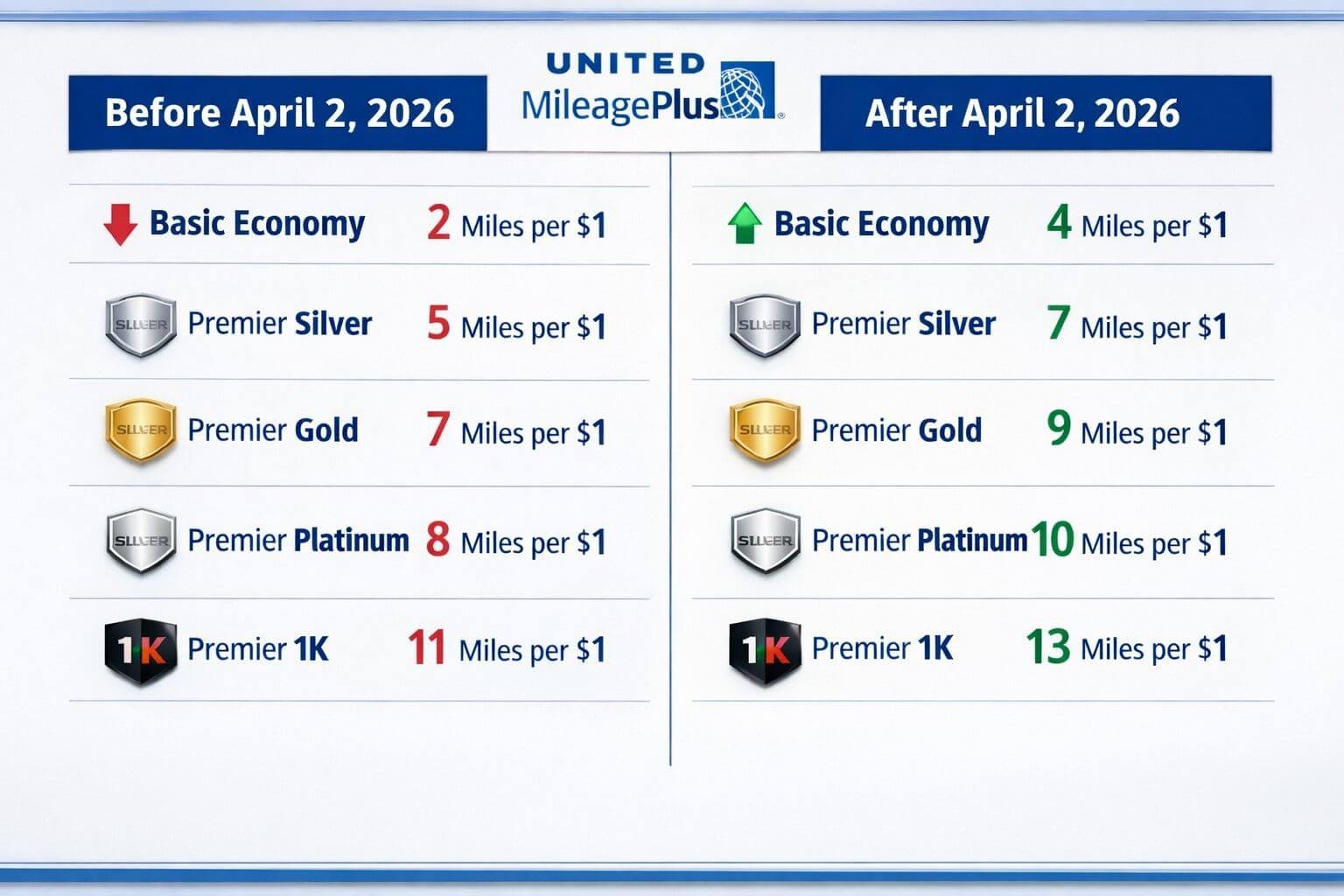
Here’s how the earning structure breaks down starting April 2, 2026:
Miles Per Dollar Earned on United Flights (Estimated Tier Structure)
| Member Type | Basic Economy | Standard Economy | Premium Cabin |
|---|---|---|---|
| General member, no card | 0 miles/$ | 3 miles/$ | 3 miles/$ |
| General member, United card | 3 miles/$ | 6 miles/$ | 6 miles/$ |
| Premier Silver, no card | 2 miles/$ | 5 miles/$ | 5 miles/$ |
| Premier Silver, United card | 5 miles/$ | 8 miles/$ | 8 miles/$ |
| Premier Gold, no card | 3 miles/$ | 6 miles/$ | 6 miles/$ |
| Premier Gold, United card | 6 miles/$ | 9 miles/$ | 9 miles/$ |
| Premier Platinum, no card | 4 miles/$ | 7 miles/$ | 7 miles/$ |
| Premier Platinum, United card | 7 miles/$ | 10 miles/$ | 10 miles/$ |
| Premier 1K, no card | 5 miles/$ | 8 miles/$ | 8 miles/$ |
| Premier 1K, United card | 8 miles/$ | 11 miles/$ | 11 miles/$ |
You may be interested



Note: These figures reflect the announced tier structure as reported at launch. Always verify current rates at united.com before booking, as United may adjust specific numbers.
Key observations from this table:
- The cardholder bonus appears to be a consistent +3 miles/dollar across all tiers and fare classes.
- Basic economy is now a zero-earning fare class for the majority of flyers — only elites earn anything there, and even they earn at reduced rates.
- A Premier Gold member without a card earns the same as a general cardholder (6 miles/dollar on standard economy). Holding a card essentially buys you one tier’s worth of earning power.
What Changed from Before
Previously, general MileagePlus members earned 5 miles per dollar on United flights regardless of card status. The new structure cuts that to 3 for non-cardholders and raises it to 6 for cardholders. That’s a 40% reduction for non-cardholders and a 20% increase for cardholders — from the same baseline.
For context: Delta SkyMiles and American AAdvantage both eliminated basic economy miles earning for non-elites in 2022–2023. United’s change aligns with that industry direction but adds an explicit cardholder bonus layer that neither competitor has matched at the same scale.
New Cardholder Perks: Award Discounts and Saver Access
Beyond earning rates, the United MileagePlus 2026 changes introduce two cardholder perks that meaningfully affect redemption value.
1. Award flight discounts:
- General cardholders receive 10% off all United award flights.
- Premier elites with a United card receive 15% or more off award flights (exact percentage varies by tier).
This discount applies to the miles price, not fees. On a 30,000-mile round-trip domestic award, a 10% discount saves 3,000 miles — roughly the equivalent of $30–$45 in award value depending on your cents per point (CPP) target. For frequent award bookers, this compounds meaningfully over a year.
2. Discounted Saver Award access in Polaris business class: Previously, Saver Award pricing in Polaris business class was accessible primarily to Premier elites. Starting April 2, 2026, United cardholders — regardless of elite status — gain access to discounted Saver Awards in premium cabins.
This is the more significant perk for intermediate award travelers. Polaris Business Class Saver Awards to Europe have historically priced around 70,000–80,000 miles one-way at standard rates. If cardholder Saver pricing brings that closer to 60,000–65,000 miles, the savings justify the card’s annual fee for even one or two premium cabin redemptions per year.
For a deeper look at whether the annual fee math works for your situation, the Credit Card Annual Fee ROI Calculator at Award Travel Hub can help you run the numbers against your actual travel patterns.
3. Family account linking: Parents can now link children’s MileagePlus accounts (under 18) to the primary cardholder’s account, allowing the child’s account to earn at cardholder rates and access award discounts. This is a genuine quality-of-life improvement for families who book United awards together.
Upgrades on Award Tickets: How MileagePlus Points and CPUs Now Work
Starting February 1, 2026, all Premier elites can use MileagePlus Points and Complimentary Premier Upgrades (CPUs) on award tickets. Previously, these upgraded instruments were restricted to revenue tickets.
This is a meaningful policy shift. Here’s what it means in practice:
Before February 1, 2026:
- Booked a United award ticket to London in economy? MileagePlus Points couldn’t touch it.
- You had to book a revenue ticket to be eligible for an upgrade to Polaris.
After February 1, 2026:
- Book that same award ticket to London in economy, and you can now request a MileagePlus Points upgrade or CPU to Polaris business class.
- The award ticket itself serves as the basis for upgrade eligibility, just like a revenue ticket.
For Premier elites who regularly book award tickets — particularly those using transferable points like Chase Ultimate Rewards transferred to MileagePlus — this change is significant. It means you can book a lower-cost economy award and still compete for an upgrade, rather than paying cash for a revenue ticket just to maintain upgrade eligibility.
The 2027 MileagePlus Points Dynamic Pricing Caveat
Here’s the risk to plan around: United has announced that MileagePlus Points upgrade pricing will shift to a dynamic model in 2027. Currently, MileagePlus Points costs are fixed by route distance. Under dynamic pricing, the MileagePlus Points required to upgrade a long-haul flight could increase substantially — similar to how dynamic award pricing has played out at other programs.
The practical implication: if you’re a Premier Platinum or 1K member sitting on a MileagePlus Points balance, using those points for upgrades in 2026 (while pricing is still fixed) may be more efficient than holding them for 2027. This is especially true for long-haul routes like EWR–LHR or SFO–NRT, where dynamic pricing is most likely to increase costs.
This mirrors a broader pattern in loyalty programs — the Award Travel Predictions for 2026 article covers how dynamic pricing is reshaping upgrade and award strategies across multiple programs.
Real Examples: Who Wins and Who Loses Under the New Rules
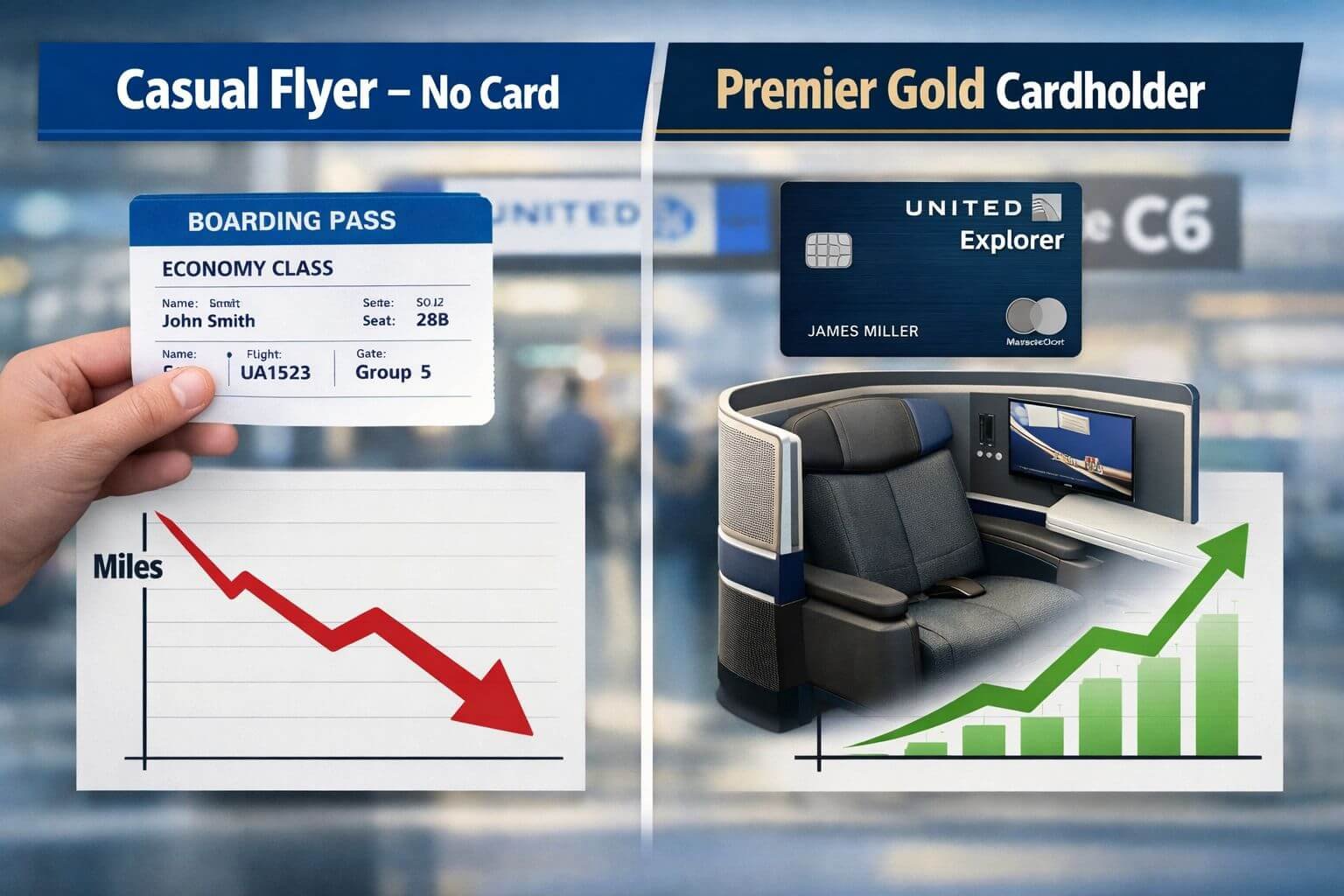
The United MileagePlus 2026 changes play out very differently depending on your traveler profile. Here are three concrete scenarios.
Scenario 1: Casual Flyer, No Card — EWR to SFO Round Trip
Profile: General MileagePlus member, no United credit card, books basic economy. Ticket price: $280 round trip.
| Before April 2, 2026 | After April 2, 2026 | |
|---|---|---|
| Miles earned | 1,400 miles (5x $280) | 0 miles |
| Miles value (at 1.4 CPP) | ~$19.60 | $0 |
| Annual fee paid | $0 | $0 |
Verdict: This traveler loses entirely. A $280 basic economy ticket that used to earn 1,400 miles now earns nothing. Over four such trips per year ($1,120 in spend), that’s 5,600 miles lost — worth roughly $78 at 1.4 CPP. At that volume, even a no-annual-fee United card (if available) or a mid-tier card like the United Explorer ($95/year) could recoup those miles and then some.
Scenario 2: Moderate Flyer, United Explorer Card — EWR to SFO Round Trip
Profile: General MileagePlus member, holds United Explorer card ($95/year), books standard economy. Ticket price: $380 round trip.
| Before April 2, 2026 | After April 2, 2026 | |
|---|---|---|
| Miles earned on flight | 1,900 miles (5x $380) | 2,280 miles (6x $380) |
| Miles value (at 1.4 CPP) | ~$26.60 | ~$31.92 |
| Award discount (10%) | None | Yes — saves miles on redemptions |
| Annual fee | $95 | $95 |
Verdict: This traveler earns modestly. The bigger win is the 10% award discount and Saver access in Polaris, which can deliver $100–$200+ in value on a single premium cabin redemption. For someone who books one transatlantic award per year, the card’s value proposition improved meaningfully under the new rules.
Scenario 3: Premier Gold Cardholder — EWR to LHR One Way
Profile: Premier Gold member, holds United Quest card ($250/year), books standard economy. Ticket price: $900 one way.
| Before April 2, 2026 | After April 2, 2026 | |
|---|---|---|
| Miles earned on flight | 4,500 miles (5x $900) | 8,100 miles (9x $900) |
| Miles value (at 1.4 CPP) | ~$63 | ~$113.40 |
| Upgrade eligibility on award tickets | No | Yes (MileagePlus Points/CPUs) |
| Award discount | None | 15%+ off award redemptions |
Verdict: This traveler wins substantially. The earning rate nearly doubles on a transatlantic ticket. Add the upgrade flexibility on award tickets and the elite-level award discount, and the Premier Gold cardholder profile is clearly the intended beneficiary of these changes. The Quest card’s $250 annual fee becomes easier to justify when a single transatlantic flight earns 8,100 miles instead of 4,500.
For a broader look at how these earning changes affect your overall points strategy, the 2026 Guide to Cents-Per-Point walks through how to calculate whether your miles are working hard enough.
How to Adjust Your United and Chase Card Strategy for 2026
The core decision framework: Do you fly United at least 2–4 times per year? If yes, the new earning structure makes holding a United co-branded card a straightforward financial decision. If no, the card’s value depends almost entirely on the sign-up bonus and non-flight perks.
Step-by-Step Card Strategy Review
Step 1: Assess your United flight frequency.
- Fewer than 2 United flights per year: A United card may not be worth the annual fee on earning alone. Focus on transferable points cards (Chase Sapphire Preferred, Amex Gold) that offer more flexibility.
- 2–6 United flights per year: The United Explorer ($95/year) likely pays for itself through the earning uplift and award discount.
- 6+ United flights per year or Premier status: The United Quest ($250/year) or United Club Infinite ($525/year) may deliver better value through higher earning rates, lounge access, and elite-qualifying benefits.
Step 2: Decide whether to keep, upgrade, or downgrade your current card. The r/churning and r/CreditCards communities have actively debated whether premium United cards like the Club Infinite remain worth their fees after these changes. The answer depends on your lounge usage and flight frequency. If you’re not flying United enough to use the United Club lounge access regularly, the earning improvements alone may not justify $525/year.
For a structured framework on this decision, see the Credit Card Downgrade Versus Cancel Decision Guide — it applies directly to the United card lineup.
Step 3: Reconsider basic economy bookings. If you’ve been booking basic economy to save money, the new zero-mile rule changes the math. On a $50 price difference between basic and standard economy, you’re now also forgoing miles worth $15–$30 (depending on your earning rate). For non-cardholders, the total cost of basic economy is higher than the ticket price suggests.
Step 4: Plan MileagePlus Points usage before 2027. If you hold Premier Platinum or 1K status and have MileagePlus Points, use them for long-haul upgrades in 2026 while pricing is still fixed. The shift to dynamic pricing in 2027 introduces real uncertainty about how many points a transatlantic upgrade will require.
Step 5: Consider transferable points for MileagePlus awards. Chase Ultimate Rewards transfers to United MileagePlus at a 1:1 ratio. With the new cardholder Saver Award access in Polaris, transferring Chase points to book a discounted Saver Award becomes more attractive than before. The Comparing Transfer Partners 2026 guide covers how Chase stacks up against Amex, Citi, and Capital One for this kind of move.
Common Mistakes to Avoid
- Assuming the earning changes are a universal devaluation. They’re not. Cardholders earn more. Only non-cardholders lose.
- Ignoring the award discount. The 10–15% off award flights is a real, recurring benefit — not a one-time promotion. Factor it into your annual fee calculation.
- Holding MileagePlus Points for 2027 without a plan. Dynamic pricing could make those points worth less on long-haul routes. Use them strategically in 2026.
- Booking basic economy without a card. You’re now paying for a ticket that earns nothing. Either get a card or book standard economy.
- Treating United MileagePlus as your only award program. United miles are most valuable for United metal flights and select Star Alliance partners. For broader premium cabin access, transferable points programs give you more options. The Book Star Alliance Business Class Awards guide covers how to use partner programs to access the same inventory that United elites compete for.
How Do These Changes Compare to Other Airline Programs?
United’s 2026 restructuring puts MileagePlus closer to Delta SkyMiles in philosophy — but with a more explicit cardholder reward structure.
| Program | Basic Economy Miles | Non-Elite, Non-Card Earning | Cardholder Bonus |
|---|---|---|---|
| United MileagePlus (post-April 2026) | 0 miles (no status/card) | 3 miles/$ | +3 miles/$ |
| Delta SkyMiles | 0 miles (no status) | ~5 miles/$ | Modest bonus |
| American AAdvantage | 0 miles (no status) | ~5 miles/$ | Modest bonus |
| Alaska Mileage Plan / Atmos | Varies | Generally higher for non-elites | Moderate bonus |
United’s cardholder bonus structure is more aggressive than Delta’s or American’s equivalent programs. The flip side is that non-cardholders are penalized more explicitly. Alaska’s Atmos program (still evolving) has generally been more generous to non-elites, which is worth considering if you have routing flexibility. The Best Airline Loyalty Programs comparison guide provides a fuller breakdown of where each program stands in 2026.
It’s also worth noting that United’s Excursionist Perk — a separate benefit that allowed free one-way awards within a region on multi-destination itineraries — ended earlier. For context on that change and its impact on multi-city award planning, see the United MileagePlus Excursionist Perk changes overview.
Is United MileagePlus Still Worth Using for Award Travel?
Yes — for the right traveler profile. The United MileagePlus 2026 changes don’t make the program worse for everyone; they make it significantly better for cardholders and worse for occasional, card-free flyers.
MileagePlus is still a strong program if:
- You hold a United co-branded Chase card.
- You fly United or Star Alliance partners at least 3–4 times per year.
- You want to book Polaris business class awards using transferable points (Chase, Citi) at Saver pricing.
- You’re a Premier elite who wants upgrade flexibility on award tickets.
MileagePlus is less compelling if:
- You fly United occasionally and don’t want a co-branded card.
- You primarily book basic economy to minimize costs.
- You prefer programs with more partner award availability (Aeroplan, Flying Blue) for international premium cabins.
For travelers who rely heavily on transferable points and want to maximize flexibility across multiple airlines, programs like Air Canada Aeroplan or Air France/KLM Flying Blue may offer better value on Star Alliance and SkyTeam metal, respectively. The Best Award Travel Tools and Alerts guide can help you search availability across multiple programs before committing to a transfer.
FAQ: United MileagePlus 2026 Changes
Q: When exactly do the new earning rates take effect? A: April 2, 2026. Tickets purchased before that date but flown after may be subject to the new rates — check United’s terms for the specific cutoff, as it typically applies to the flight date, not the purchase date.
Q: Do I earn zero miles on basic economy if I have Premier Silver status? A: No. Premier elites earn miles on basic economy even without a card, but at reduced rates (approximately 2 miles/dollar for Silver). Only general members without status or a card earn zero.
Q: Which United credit cards qualify for the cardholder earning bonus? A: All United co-branded Chase credit cards — including the United Explorer, United Quest, United Club Infinite, and the United Business cards — qualify. Confirm the full list on united.com, as the product lineup changes periodically.
Q: Can I use Chase Ultimate Rewards points to book United awards and still get the cardholder discount? A: Yes. The award discount applies to the redemption, not how you accumulated the miles. If you transfer Chase points to MileagePlus and book an award, you receive the cardholder discount as long as you hold a qualifying United card.
Q: What is the MileagePlus Points dynamic pricing change in 2027, and should I be worried? A: Starting sometime in 2027, United will price MileagePlus Points upgrades dynamically rather than at fixed rates by distance. This means long-haul upgrades could require significantly more MileagePlus Points than today. If you have MileagePlus Points, plan to use them for long-haul routes in 2026 while fixed pricing applies.
Q: Does the upgrade policy change (February 1, 2026) apply to all award tickets? A: It applies to United-operated award tickets booked through MileagePlus. Partner award tickets (e.g., flying Lufthansa on a United award) may have different rules. Verify eligibility at the time of booking.
Q: Is the 10% award discount a one-time benefit or ongoing? A: It’s an ongoing benefit for cardholders — not a promotion. Every award you book while holding a qualifying United card receives the discount.
Q: How does the family account linking work? A: Parents can link children’s MileagePlus accounts (under 18) to their own account starting April 2, 2026. The linked child’s account earns at the cardholder’s rate and receives the same award discounts. This does not pool miles — it aligns earning rates.
Q: Should I upgrade from the United Explorer to the United Quest under the new rules? A: If you fly United 6+ times per year and have or are pursuing Premier status, the Quest’s higher earnings on non-United purchases and additional travel credits may justify the jump from $95 to $250/year. Run the math using the Credit Card Annual Fee ROI Calculator with your actual spend patterns.
Q: Do the new cardholder perks apply to partner airline awards booked through United? A: The award discount (10–15%) appears to apply to United-marketed awards. Partner award availability and pricing rules are set by the partner program. Confirm specific terms with United before booking partner awards, expecting the discount.
Q: Is this a MileagePlus devaluation overall? A: For non-cardholders, yes — it’s a meaningful reduction. For cardholders, it’s an improvement. The program hasn’t changed its award chart structure or partner redemption rates, so the devaluation framing is most accurate for the earning side, not the redemption side.
Q: How do I know if I’m better off switching to a different airline loyalty program? A: If you don’t fly United regularly and don’t want a co-branded card, a transferable points strategy (Chase, Amex, Citi, Capital One, Bilt) gives you more flexibility than committing to MileagePlus. You can still transfer to United when it makes sense without being locked in.
Conclusion: What to Do Next
The United MileagePlus 2026 changes represent a clear strategic bet by United: reward the members who carry a co-branded Chase card, and reduce the program’s generosity toward those who don’t. For intermediate United flyers and cardholders, the practical implications are significant enough to warrant a real review of your card lineup and booking habits.
Here’s your action plan:
If you fly United 2+ times per year without a card: Evaluate the United Explorer or United Quest. The earning uplift and award discount will likely cover the annual fee within a few trips.
If you already hold a United card, confirm that your card qualifies for the new earning rates and award discounts. Log in to your MileagePlus account after April 2, 2026, to verify the rates are applying correctly.
If you have Premier status and MileagePlus Points: Plan your long-haul upgrade requests for 2026. Use MileagePlus Points on routes like EWR–LHR or SFO–NRT before dynamic pricing takes effect in 2027.
If you’re evaluating whether to keep a premium United card, use the Credit Card Downgrade Versus Cancel Decision Guide to assess whether the Club Infinite’s $525 fee makes sense given your actual lounge usage and flight frequency.
If you rely on transferable points for award travel, the Chase-to-United transfer remains one of the most useful pathways for Polaris business class Saver Awards, especially now that cardholders get discounted access. Keep Chase Ultimate Rewards as a primary currency if United is a regular redemption target.
If you’re reconsidering United entirely: The Best Airline Loyalty Programs comparison can help you assess whether Aeroplan, Flying Blue, or another Star Alliance-adjacent program serves your routes better without requiring a co-branded card commitment.
The United MileagePlus 2026 changes are not a reason to abandon the program — but they are a reason to be intentional about how you engage with it. Cardholders who adapt their strategy stand to earn meaningfully more miles and access better award pricing. Those who don’t adapt will simply earn less.
Related Reading:
- Book Star Alliance Business Class Awards: 2026 Complete Guide
- Comparing Transfer Partners 2026: Chase vs Amex vs Citi vs Capital One
- Award Travel Predictions for 2026: What Matters Most for Points Strategy Now
- 2026 Guide to Cents-Per-Point | Award Travel Math


Content on Award Travel Hub is independently created by Award Travel Hub Editorial Desk and, where noted, reviewed by Award Travel Hub Review Desk. Some pages may contain affiliate links, but compensation does not determine our coverage, opinions, or methodology.