

Every month, small business owners write checks, swipe cards, and pay invoices for software, advertising, shipping, and supplies. Most let those transactions disappear into accounting spreadsheets. A few route them through the right business travel rewards cards—and bank enough points to fly business class to Europe or enjoy a week in Hawaii twice a year —without touching their travel budget.
The difference isn’t luck or massive spending. It’s a simple system: identify where money already flows, match those expenses to high-earning business cards, centralize payments, and convert points through transfer partners instead of generic portals. This guide walks through that five-step framework, shows realistic point projections at three spend levels, and explains exactly when transfers beat portals—with two redemption examples that prove the math.
Key Takeaways
- Audit your expenses over the past 90 days to identify the top three categories your business consistently spends on—these become your high-earning targets.
- Pair 1–2 business cards that deliver 3x–4x points in those categories; even $3,000/month in focused spend yields 100,000+ points annually.
- Transfer partners consistently deliver 1.5–2× better value than travel portals for premium cabin flights, turning the same points into international business class instead of domestic economy.
- Employee card controls and expense tracking protect cash flow and tax compliance while accelerating points accumulation across your team.
- Set a monthly “points-to-trip” target (e.g., 8,300 points/month = 100,000/year = one business class redemption) to stay on track and avoid points sitting idle.
Business Travel Rewards: The Simple “Points-to-Trip” Math Model
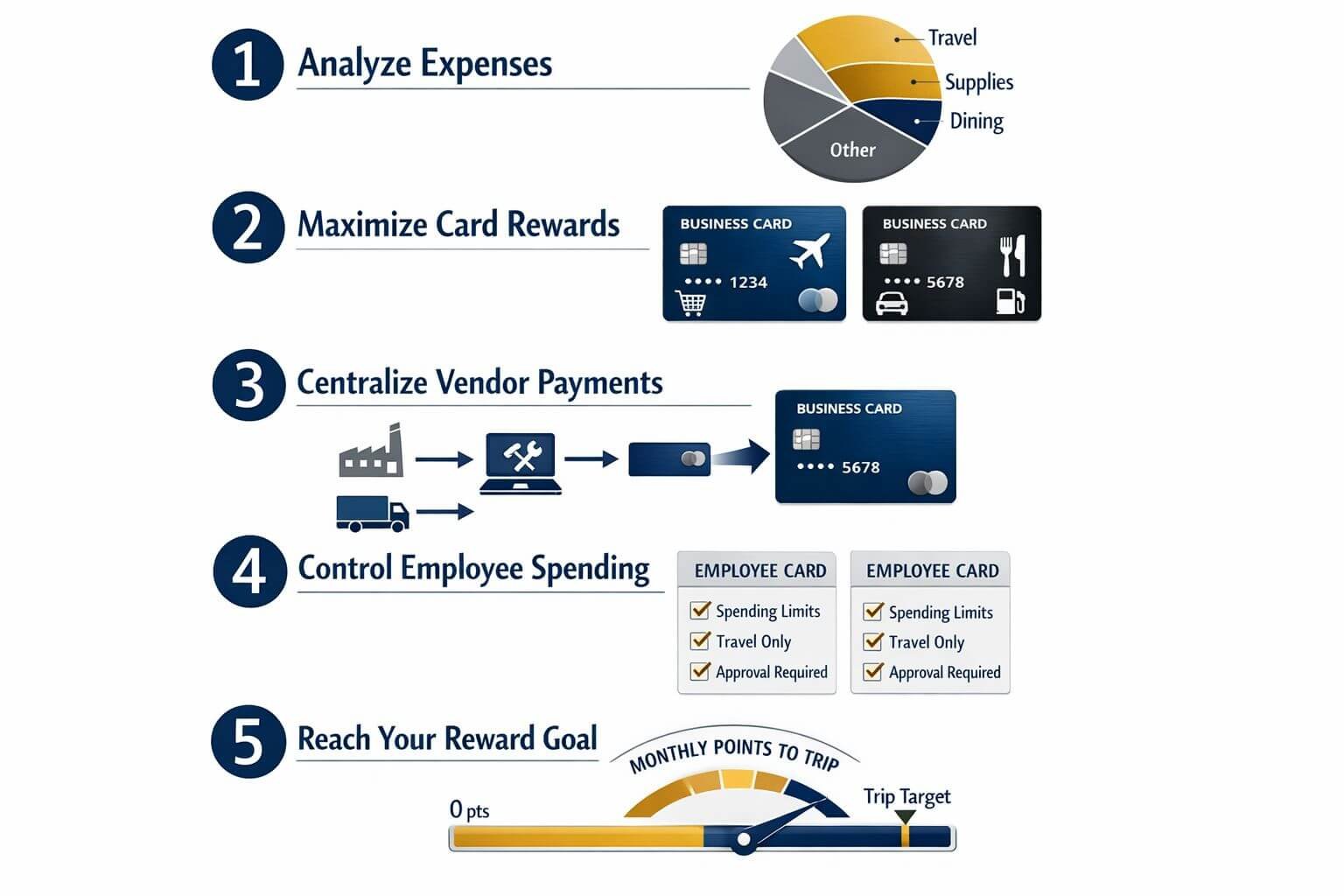
Most small business owners think travel rewards require six-figure ad budgets or constant travel. The reality: $36,000 in annual operating expenses routed through the right cards generates 100,000+ transferable points—enough for a roundtrip business class ticket to Europe or two domestic first-class awards.
The math is straightforward. Business cards from Chase, Amex, Capital One, Citi, and Bilt earn 1–4 points per dollar, depending on the category. Multiply your monthly spend by the earning rate, project 12 months, and you’ll see the trip potential immediately.
Monthly Spend Projection Table
| Monthly Spend | Primary Card | Bonus Category (4x) | Base Spend (1x) | Annual Points | Redemption Example |
|---|---|---|---|---|---|
| $3,000 | Amex Business Gold | $1,500 (advertising) | $1,500 | 90,000 | Roundtrip domestic first class (2 passengers) via transfer partners |
| $10,000 | Chase Sapphire Reserve for Business | $5,000 (flights/hotels) | $5,000 | 300,000 | Roundtrip business class to Europe + 1 week premium hotel stay |
| $25,000 | Amex Business Platinum + Business Gold | $12,000 (flights) + $8,000 (advertising) | $5,000 | 725,000 | Two international business class trips + domestic positioning flights |
Assumptions: 4x points on top spending category, 1x on everything else, no sign-up bonuses (those add 80,000–150,000 points in year one). Points valued at transfer-partner redemptions, not portal cash equivalents.
This table shows why category alignment matters more than total spend. A business spending $10,000/month earns 3× the points of one spending $3,000—but only if those dollars land in bonus categories. Route $5,000 through a 4x category and the rest through 1x base earn, and you’re looking at 300,000 points annually—enough for the kind of trip that costs $6,000+ out-of-pocket.
The model works because business expenses are predictable and recurring. Unlike personal spending, which fluctuates with lifestyle, most businesses pay the same vendors, run the same ads, and ship similar volumes month after month. That consistency turns ordinary operations into a reliable points engine.
For a deeper dive into maximizing category bonuses, see our guide on business credit card category bonuses.
How to Choose Business Cards Based on Your Top 3 Expense Categories
Start by auditing the last 90 days of business expenses. Export transactions from your accounting software or credit card portal, then group them into categories: advertising (Google Ads, Facebook, LinkedIn), software subscriptions (SaaS tools, hosting), shipping (FedEx, UPS, USPS), office supplies, telecom, travel, and dining.
You may be interested



Identify the top three categories by dollar volume. These are your bonus-category targets. Most small businesses cluster spending in 2–3 areas:
- Service businesses: Advertising, software, telecom
- E-commerce: Shipping, advertising, inventory (if coded as purchases)
- Consulting/freelance: Travel, dining, software
Once you know where money flows, match cards to those categories.
Card-to-Category Pairing Guide
For Advertising & Software (Digital Spend):
The Amex Business Gold Card earns 4x Membership Rewards points in two select categories where you spend the most each billing cycle, up to $150,000 in combined annual spend. Categories include advertising (search engines, social media), shipping, and select business services. After $150,000, earning drops to 1x.
For Flights & Hotels (Direct Bookings):
The Chase Sapphire Reserve for Business delivers 4x points on flights and hotels booked directly with airlines and properties, plus 8x points on Chase Travel purchases. It also earns 3x points on social media and search engine advertising (uncapped), making it a strong secondary card for digital marketers.
For Broad Flexibility:
The Capital One Spark Miles for Business earns 2x miles on every purchase, with no category restrictions. It’s ideal for businesses with diverse, unpredictable spending or those who want simplicity over optimization.
For Dining & Travel (Mixed Use):
The Chase Ink Business Preferred earns 3x points on travel, shipping, internet/cable/phone, and advertising (up to $150,000 in combined annual spend). It’s a strong all-around card for service businesses.
Decision Framework
- If 60%+ of spend lands in 1–2 categories: Choose a card with 3x–4x earning in those areas (Amex Business Gold, Chase Sapphire Reserve for Business).
- If spending is scattered across 5+ categories, use a flat 2x card (Capital One Spark Miles) to avoid tracking headaches.
- If you travel frequently for business, prioritize cards with trip protections, lounge access, and direct travel bonus categories (Chase Sapphire Reserve for Business, Amex Business Platinum).
Common mistake: Opening three cards at once to “cover everything.” Start with one or two cards that match your top categories, then add a third only after you’ve maximized the first two. Multiple cards dilute spending, delay sign-up bonus thresholds, and complicate expense tracking.
For side-by-side comparisons of top business cards, visit our credit card comparisons hub.
Centralize Vendor Payments and Subscriptions to Accelerate Earnings
Most businesses pay recurring vendors through ACH, checks, or PayPal—methods that earn zero points. Shifting those payments to a business card adds thousands of points annually without changing spending behavior.
High-Impact Payment Shifts
Software subscriptions (SaaS):
Update billing for tools such as Salesforce, HubSpot, Adobe Creative Cloud, Shopify, and QuickBooks to charge to your business card. A $500/month SaaS stack on a 4x card generates 24,000 points per year.
Advertising platforms:
Google Ads, Facebook Ads Manager, and LinkedIn Campaign Manager all accept credit cards. Route ad spend through a card earning 3x–4x in advertising categories. A $2,000/month ad budget yields 72,000–96,000 points annually.
Telecom and utilities:
Many internet, phone, and cloud hosting providers accept credit cards without processing fees. The Chase Ink Business Preferred earns 3x points on internet, cable, and phone services—turning a $300/month telecom bill into 10,800 points per year.
Shipping carriers:
FedEx, UPS, and USPS all allow credit card payments. E-commerce businesses spending $1,000/month on shipping earn 48,000 points annually with a 4x card.
Rent (via Bilt Rewards):
The Bilt Mastercard lets you pay rent with no transaction fees (up to 100,000 points per calendar year) and earn 1x Bilt points per dollar. Rent is often a business’s largest fixed expense; a $3,000/month lease adds 36,000 Bilt points annually, transferable 1:1 to partners like American, United, and Hyatt. Learn more in our Bilt transfer partners guide.
Vendor Payment Tactics
Ask about credit card acceptance:
Some vendors default to ACH but accept cards upon request. A quick email to accounts receivable can unlock thousands of points.
Use payment processors for reluctant vendors:
Services like Plastiq (2.85% fee) or Melio (variable fees) let you pay any vendor by credit card, even if they only accept checks or ACH. The fee often makes sense when:
- You’re working toward a sign-up bonus (e.g., spending $15,000 to earn 100,000 points worth $2,000+).
- The card earns 3x+ points in a bonus category, offsetting the fee with points value.
- You need to float cash flow for 30–45 days (effectively a low-cost short-term loan).
Set up autopay for recurring charges:
Once a vendor accepts your card, enable autopay to ensure you never miss points. Review statements monthly to catch billing errors or category miscodes.
Track category limits:
Cards like the Amex Business Gold cap bonus earning at $150,000 per year across select categories. Monitor spending quarterly to avoid surprises when bonuses drop to 1x.
Centralizing payments also simplifies expense tracking. Instead of reconciling dozens of ACH transfers, checks, and PayPal transactions, you’ll have a single monthly statement with categorized line items—saving hours during tax seasoFor strategies on turning everyday business expenses into travel rewards, see how to turn business expenses into travel rewards.
Add Employee Cards with Rules to Scale Points Safely
Employee cards multiply earning potential—but only if you set clear spending rules and monitor activity. Issuing cards without guardrails leads to personal purchases, overspending, and compliance headaches.
Employee Card Setup Checklist
1. Issue cards only to employees who travel or make regular business purchases.
Sales reps, account managers, and field staff are ideal candidates. Administrative roles that rarely incur expenses don’t need cards.
2. Set individual spending limits.
Most business card issuers let you assign per-card limits (e.g., $2,000/month per employee). Start conservative and adjust based on role and track record.
3. Require receipt uploads within 48 hours.
Use expense management software (Expensify, Divvy, Ramp) that integrates with your card issuer. Employees snap photos of receipts, categorize purchases, and submit for approval—all before the statement closes.
4. Define approved categories.
Spell out what’s reimbursable: client meals, travel (flights, hotels, rental cars), office supplies, and approved software. Explicitly prohibit personal purchases, cash advances, and non-business entertainment.
5. Review employee card statements weekly.
Catch errors, fraud, or policy violations early. Most issuers provide real-time alerts for large or unusual transactions.
6. Consolidate points to the primary cardholder.
All points earned on employee cards flow to the business owner’s account (the primary cardholder). Employees don’t accrue personal points, eliminating conflicts of interest.
Earning Example with Employee Cards
Scenario: A consulting firm with three employees issues cards to two account managers who travel monthly.
- Owner’s card: $8,000/month (advertising, software, travel)
- Employee 1: $2,000/month (client dinners, flights)
- Employee 2: $1,500/month (hotels, ground transport)
- Total monthly spend: $11,500
- Annual points (assuming 2x average earning rate): 276,000 points
Without employee cards, the owner would earn only 192,000 points on $8,000/month. Employee cards add 84,000 points annually—enough for a roundtrip business class ticket to Asia.
Common Pitfalls
Mixing personal and business expenses:
Employees sometimes use business cards for personal purchases, planning to reimburse later. This creates tax complications (personal expenses aren’t deductible) and muddies expense reports. Enforce a zero-tolerance policy and conduct spot audits.
Ignoring cash flow impact:
Employee cards increase your monthly balance. If your business operates on thin margins, ensure you can pay the full statement balance on time. Carrying a balance erases points value through interest charges.
Failing to track category spend across all cards:
If your primary card has a $150,000 annual cap on bonus categories, employee card spend counts toward that limit. Monitor the combined spend quarterly to optimize category allocation.
For more on maximizing rewards with business credit cards, see Maximize Travel Rewards with Business Credit Cards.
Set a Monthly “Points-to-Trip” Target and Track Progress
Most business owners accumulate points passively, then scramble to find availability when they want to travel. Flipping that approach—setting a trip goal first, then reverse-engineering the monthly points target—keeps earning intentional points and prevents points from expiring or losing value to devaluation.
Step-by-Step Target-Setting
1. Pick one domestic and one international trip for the next 12 months.
Examples:
- Domestic: Roundtrip first class from New York to Los Angeles (2 passengers) = 50,000 points total (25,000 per person via American AAdvantage or Alaska Mileage Plan)
- International: Roundtrip Business Class from the U.S. to Europe (1 passenger) = 100,000–120,000 points (via Air France/KLM Flying Blue, Virgin Atlantic, or Aeroplan)
2. Add a 20% buffer for availability constraints.
Award space fluctuates. Budget 60,000 points for the domestic trip and 140,000 for the international trip to account for peak dates or partner surcharges.
3. Calculate the annual target: 200,000 points.
Divide by 12 months: 16,700 points per month.
4. Map monthly spend to hit the target.
If your primary card earns 2x points on average, you need $8,350 in monthly spend. If 40% lands in a 4x category and 60% earns 1x, the math adjusts:
- 40% × $8,350 = $3,340 at 4x = 13,360 points
- 60% × $8,350 = $5,010 at 1x = 5,010 points
- Total: 18,370 points/month (exceeds target by 10%, creating a cushion)
5. Track progress in a simple spreadsheet or app.
Log monthly points earned, cumulative total, and distance to goal. Tools like AwardWallet aggregate balances across programs, showing real-time progress.
Adjust Tactics Mid-Year
If you’re falling short of the target by Q2, consider:
- Prepaying annual subscriptions (if vendors offer discounts for upfront payment).
- Timing large purchases (new equipment, inventory) to land in bonus categories.
- Leveraging transfer bonuses (15–30% bonus points when transferring to select partners—see our transfer bonuses guide for current offers).
If you’re ahead of target, don’t inflate spending to “use” points. Bank the surplus for a future trip or transfer to a partner program during a bonus promotion.
Use our points value calculators to model different redemption scenarios and calculate break-even thresholds for annual fees.
Transfer Partners vs. Portals: When Each Wins (With 2 Redemption Examples)
Chase, Amex, Capital One, Citi, and Bilt all offer two redemption paths: travel portals (book any flight or hotel through the issuer’s site) and transfer partners (move points 1:1 to airline and hotel loyalty programs). Portals are convenient; transfers unlock premium cabins and outsized value.
When Travel Portals Win
Best for:
- Domestic economy flights with flexible dates: Portal prices often match or beat cash fares, and you avoid transfer delays.
- Last-minute bookings: No need to search for award availability or wait for transfers to post.
- Hotel stays with no loyalty program sweet spots: generic chain hotels or independent properties where points transfers don’t apply.
Portal redemption rates:
- Chase Sapphire Reserve for Business: 1.5 cents per point (cpp) through Chase Travel
- Amex Business Platinum: 1.0 cpp through Amex Travel (1.35 cpp on flights if you have the Amex Platinum personal card)
- Capital One Venture X: 1.0 cpp through Capital One Travel (2.0 cpp on hotels and rental cars)
Example: A $400 roundtrip economy ticket from Chicago to Denver costs 26,700 Chase points at 1.5 cpp—reasonable value if you’re not interested in premium cabins and want a simple booking process.
When Transfer Partners Win
Best for:
- International business or first class: Portal prices for premium cabins are prohibitively expensive (often 3–5× economy), but partner awards offer fixed pricing.
- Peak travel dates: Award charts (where they still exist) provide predictable costs, while portal prices surge during holidays.
- Stopovers and open-jaws: Many partner programs allow free stopovers or multi-city routings that portals can’t match.
Transfer partner value:
Transferring to airline partners typically yields 1.5–3.0 cpp for business class and 3.0–6.0 cpp for first class—twice or triple the portal rate.
Redemption Example 1: Domestic First Class (Transfer Partner Wins)
Route: San Francisco (SFO) to New York (JFK), roundtrip, 2 passengers
Cash price: $1,200/person = $2,400 total
Portal option (Chase Sapphire Reserve for Business at 1.5 cpp):
$2,400 ÷ $0.015 = 160,000 Chase points
Transfer partner option (American AAdvantage via British Airways Avios):
British Airways prices domestic first class at 25,000 Avios per roundtrip (off-peak) or 32,500 Avios (peak). For 2 passengers: 50,000–65,000 Avios + ~$11 in taxes per person.
Chase transfers 1:1 to British Airways, so 50,000 Chase points cover both tickets at off-peak rates.
Value comparison:
- Portal: 160,000 points = 1.5 cpp
- Transfer partner: 50,000 points = 4.8 cpp ($2,400 ÷ 50,000)
Winner: Transfer partners save 110,000 points—enough for another domestic trip or a hotel stay.
Redemption Example 2: International Business Class (Transfer Partner Wins by a Wider Margin)
Route: New York (JFK) to Paris (CDG), roundtrip, 1 passenger
Cash price: $5,500 (business class)
Portal option (Chase Sapphire Reserve for Business at 1.5 cpp):
$5,500 ÷ $0.015 = 367,000 Chase points
Transfer partner option (Air France/KLM Flying Blue):
Flying Blue prices JFK–CDG business class at 53,000–70,000 miles one-way (dynamic pricing), or 106,000–140,000 miles roundtrip + ~$150–$400 in fuel surcharges.
Chase transfers 1:1 to Flying Blue. Assume 120,000 Chase points + $250 in surcharges.
Value comparison:
- Portal: 367,000 points = 1.5 cpp
- Transfer partner: 120,000 points + $250 cash = 4.4 cpp ($5,500 ÷ 120,000)
Winner: Transfer partners save 247,000 points—nearly enough for a second business class ticket.
Decision Framework
Use this simple rule:
- If the cash price is under $600 (domestic economy): Check the portal first; transfers may not justify the effort.
- If the cash price is $1,500+ (premium cabin or international): Search transfer partners first; portal redemptions rarely compete.
- If you’re booking 6+ months out: Transfer partners offer better availability and fixed pricing (where award charts still exist).
- If you’re booking within 2 weeks, Portals provide more last-minute inventory and no transfer delays.
For a comprehensive list of transfer partners and their sweet spots, visit our transfer partners hub.
Controls and Pitfalls: Employee Cards, Cash Flow, and Tax/Expense Tracking
A well-designed business travel rewards strategy accelerates earning—but it also introduces risks if you don’t manage controls, cash flow, and compliance.
Employee Card Controls (Revisited with Risk Mitigation)
Spending alerts:
Set up real-time SMS or email alerts for transactions over $500. Catch unauthorized purchases or fraud within minutes, not weeks.
Monthly reconciliation:
Compare employee card statements against submitted expense reports. Flag discrepancies (missing receipts, unapproved categories, duplicate charges) and address them before the month-end close.
Annual policy review:
Update your employee card policy annually to reflect new vendors, spending limits, and IRS rules. Require employees to sign an acknowledgment confirming they’ve read and understood the policy.
Cash Flow Pitfalls
Overextending to hit sign-up bonuses:
Cards like the Chase Sapphire Reserve for Business require $20,000 in spend within 3 months to earn the 150,000-point bonus. If your natural spend is $5,000/month, don’t manufacture $15,000 in unnecessary purchases. The bonus is worth ~$3,000 in travel value, but overspending on unneeded inventory or services costs more.
Carrying a balance:
Business card APRs range from 18–24%. Carrying a $10,000 balance for one month costs $150–$200 in interest, erasing the value of 10,000–13,000 points. Always pay the full statement balance by the due date.
Ignoring payment due dates:
Late payments trigger fees ($25–$40), damage your business credit score, and may result in the forfeiture of points earned that cycle. Set up autopay for at least the minimum payment, then manually pay the full balance a few days before the due date.
Tax and Expense Tracking
Separate business and personal expenses rigorously:
The IRS requires clear documentation that business card charges are legitimate business expenses. Mixing personal purchases (even small ones like coffee or groceries) creates audit risk and disallows deductions.
Categorize expenses correctly:
Use accounting software (QuickBooks, Xero, FreshBooks) to tag each transaction with the correct expense category (advertising, travel, meals, supplies). This simplifies Schedule C (sole proprietors) or corporate tax filings and ensures you claim all eligible deductions.
Track points as taxable income (in rare cases):
The IRS generally treats credit card rewards as rebates (non-taxable), not income—unless you earn points without spending (e.g., sign-up bonuses with no minimum spend requirement, or referral bonuses). Consult a CPA if you earn $10,000+ in annual points value to confirm reporting requirements.
Retain receipts for 7 years:
The IRS can audit returns up to 6 years back (7 years for substantial underreporting). Store digital copies of receipts, statements, and expense reports in a secure cloud folder.
Common Mistakes to Avoid
❌ Opening too many cards at once: Each application triggers a hard inquiry, temporarily lowering your credit score. Space applications 3–6 months apart.
❌ Ignoring annual fees: A $695 card makes sense only if the points earned + perks used exceed the fee. Calculate ROI annually.
❌ Transferring points without a booking plan: Transfers are usually irreversible. Search for award availability first, confirm the redemption, then transfer points.
❌ Letting points expire: Transferable points (Chase, Amex, Capital One, Citi, Bilt) don’t expire as long as your account is open and in good standing, but partner program miles often do (12–36 months of inactivity). Set calendar reminders to review balances quarterly.
For a detailed look at best practices for travel reward programs, see the best travel reward programs for business travelers.
Real-World Case Study: $10k/Month Spend = 2 Premium Trips
Business profile: Digital marketing agency, $10,000 average monthly spend
Top 3 expense categories:
- Advertising (Google Ads, Facebook): $4,000/month
- Software (project management, design tools): $2,500/month
- Travel (client meetings, conferences): $2,000/month
- Miscellaneous (office supplies, telecom): $1,500/month
Card strategy:
- Primary card: Amex Business Gold (4x on advertising and software, up to $150,000/year combined)
- Secondary card: Chase Sapphire Reserve for Business (4x on travel, 3x on advertising)
Monthly earning breakdown:
- Advertising: $4,000 × 4x (Amex Business Gold) = 16,000 Membership Rewards
- Software: $2,500 × 4x (Amex Business Gold) = 10,000 Membership Rewards
- Travel: $2,000 × 4x (Chase Sapphire Reserve for Business) = 8,000 Chase points
- Miscellaneous: $1,500 × 1x (either card) = 1,500 points
- Monthly total: 35,500 points (26,000 Amex + 9,500 Chase)
- Annual total: 426,000 points (312,000 Amex + 114,000 Chase)
Sign-up bonuses (year one):
- Amex Business Gold: 100,000 points (after $15,000 spend in 3 months)
- Chase Sapphire Reserve for Business: 150,000 points (after $20,000 spend in 3 months)
- Year-one total: 676,000 points
Trip 1: Roundtrip Business Class to Europe (Summer)
Route: New York (JFK) to London (LHR), 1 passenger
Partner program: Virgin Atlantic Flying Blue (transfer from Amex or Chase)
Award cost: 50,000 Virgin Atlantic points one-way (off-peak) = 100,000 points roundtrip + ~$200 in taxes
Cash equivalent: $4,500
Points value: 4.5 cpp
Trip 2: Roundtrip Business Class to Tokyo (Fall)
Route: San Francisco (SFO) to Tokyo (NRT), 1 passenger
Partner program: ANA Mileage Club (transfer from Amex)
Award cost: 85,000 ANA miles roundtrip (low season) + ~$120 in taxes
Cash equivalent: $5,800
Points value: 6.8 cpp
Total points used: 185,000 (100,000 Virgin Atlantic + 85,000 ANA)
Remaining balance (year one): 491,000 points (enough for 2–3 more trips or hotel stays)
Key Tactics Used
✅ Category alignment: 65% of spend landed in 4x categories, maximizing earn rate.
✅ Sign-up bonus timing: Hit both minimum spend requirements within 3 months by prepaying annual software licenses and consolidating ad spend.
✅ Transfer partner selection: Choose Virgin Atlantic and ANA for their fixed award charts and low surcharges (avoiding British Airways’ $500+ fuel surcharges on transatlantic flights).
✅ Advance booking: Searched award availability 10–11 months out, securing saver-level awards before peak summer and fall demand.
This case study demonstrates how $10,000/month in ordinary business expenses generates enough points for two international business class trips—worth $10,000+ in cash—without any manufactured spending or risky tactics.
For more strategies on award travel planning, see the award travel trends 2026.
Step-by-Step Implementation Checklist
Use this checklist to launch your business travel rewards strategy in the next 30 days.
Week 1: Audit and Analyze
- Export the last 90 days of business expenses from accounting software or bank statements
- Categorize transactions (advertising, software, travel, shipping, supplies, etc.)
- Identify the top 3 categories by dollar volume
- Calculate average monthly spend per category
- Estimate annual points potential using the projection table (Section 1)
Week 2: Choose and Apply for Cards
- Compare business cards that match your top 3 categories (use credit card comparisons)
- Check current sign-up bonus offers (100,000–150,000 points are common in 2026)
- Apply for 1–2 cards (space applications 1–2 weeks apart if applying for multiple)
- Note minimum spend requirements and deadlines (typically 3 months)
- Set calendar reminders for spending tracking and due dates
Week 3: Centralize Payments
- Update billing for software subscriptions to the new business card
- Switch advertising platforms (Google, Facebook) to a new card
- Contact vendors (shipping, telecom) to add card on file
- Set up autopay for recurring charges
- Enable real-time transaction alerts via SMS or email
Week 4: Set Goals and Track
- Pick 1 domestic and 1 international trip goal for the next 12 months
- Calculate points needed (add 20% buffer)
- Divide by 12 to get the monthly target
- Create tracking spreadsheet or use AwardWallet
- Schedule monthly review (last Friday of each month) to compare actual vs. target
Ongoing (Monthly)
- Review statements for miscategorized charges
- Reconcile employee card expenses (if applicable)
- Check transfer bonus offers (15–30% bonuses appear 4–6 times per year)
- Search award availability for upcoming trips (book 6–11 months out for best selection)
- Adjust strategy if falling short of the monthly target
Advanced Tactics: Transfer Bonuses, Positioning Flights, and Stopovers
Once the basic system is running, these advanced moves squeeze additional value from your points.
Transfer Bonuses
Amex, Chase, Capital One, and Citi periodically offer 15–30% bonus points when transferring to select partners. A 30% bonus turns 100,000 points into 130,000—often enough to upgrade from economy to business class or add a positioning flight.
How to use transfer bonuses:
- Set up alerts: Subscribe to email alerts from your card issuer or follow blogs that track bonuses.
- Search availability first: Confirm award space exists before transferring. Bonuses are time-limited (typically 2–4 weeks), but transfers are irreversible.
- Transfer only what you need: If a flight costs 60,000 miles and you have a 20% bonus, transfer 50,000 points (which become 60,000 after the bonus).
- Stack with partner promotions: Some airlines run their own transfer bonuses or award sales simultaneously. Combining both can yield 40–50% total savings.
For current transfer bonus offers, check our transfer bonuses hub.
Positioning Flights
Positioning flights are short hops from your home airport to a hub with better award availability or lower point costs. They’re common in award travel strategy when direct routes are unavailable or expensive.
Example:
You live in Austin (AUS) and want to fly business class to Paris. Direct AUS–CDG flights don’t exist, and connecting through Dallas (DFW) costs 140,000 points. Instead:
- Book a separate economy ticket from AUS to JFK for $150 cash.
- Book JFK–CDG business class for 60,000 points (off-peak on a partner with better availability).
- Total cost: 60,000 points + $150 (vs. 140,000 points).
When positioning makes sense:
- Your home airport is a small regional hub with limited international service.
- Award availability is wide open from major gateways (JFK, LAX, SFO, ORD, IAH).
- The cash cost of the positioning flight is less than the points saved (typically $100–$300).
Risks:
- Tight connections: Book positioning flights the day before long-haul departures to avoid misconnects.
- Separate tickets: If the positioning flight is delayed, the airline won’t reprotect you on the award ticket. Build in a buffer.
Stopovers and Open-Jaws
Some partner programs allow free stopovers (24+ hour layovers) or open-jaw routings (flying into one city, out of another) at no extra cost.
Example (ANA Mileage Club):
Book a roundtrip business class award from Los Angeles to Tokyo with a free stopover in Seoul. Spend 3 days in Seoul, continue to Tokyo for a week, then return to Los Angeles—all for 85,000 ANA miles (the same cost as a direct LAX–NRT roundtrip).
Programs with generous stopover rules:
- ANA Mileage Club: One free stopover on roundtrip awards
- Singapore KrisFlyer: One stopover allowed on most awards
- Air Canada Aeroplan: Up to two stopovers on multi-segment awards (fees apply)
When to use stopovers:
- You want to visit two destinations for the price of one award.
- Award availability is better via a stopover city than direct.
- You’re maximizing time off (e.g., combining a business trip with vacation).
For more on booking multi-city awards, see how to book business class with points.
When This Strategy Isn’t Worth It
Not every business should pursue a business travel rewards strategy. Here are scenarios where the juice isn’t worth the squeeze:
Low monthly spend (under $2,000):
If your business spends less than $2,000/month, you’ll earn ~24,000 points annually (assuming 1x earning rate)—barely enough for a domestic economy ticket. The time spent managing cards, tracking expenses, and searching for awards outweighs the return. Stick with a simple cash-back card.
Inconsistent cash flow:
If you can’t reliably pay the full statement balance each month, interest charges will erase the points value. Business credit cards aren’t a financing tool; they’re an earning tool for businesses with stable cash flow.
No travel plans:
Points lose value if they sit idle for years. Devaluation risk is real: airlines and hotels periodically increase award prices or eliminate sweet spots. If you don’t plan to travel within 18–24 months, cash-back cards deliver more immediate, tangible value.
Complex tax situations:
Sole proprietors with straightforward expenses can easily manage card tracking. Multi-member LLCs, S-corporations, or businesses with complex cost allocation may find that the added bookkeeping burden outweighs the points value. Consult your CPA.
Preference for simplicity:
Some business owners value simplicity over optimization. If you’d rather not track categories, monitor transfer bonuses, or search award availability, a flat-rate cash-back card (1.5–2% back on everything) is a perfectly reasonable choice.
Conclusion: Turn Operating Expenses Into Real Trips in 2026
The difference between business owners who fly business class twice a year and those who don’t isn’t spending more—it’s routing existing expenses through the right cards and redeeming strategically. A $10,000/month business earns 300,000+ points annually, enough for two international premium cabin trips worth $10,000+ in cash value.
The five-step system is straightforward:
- Audit your spending over the past 90 days to identify the top spending categories.
- Choose 1–2 business cards that deliver 3x–4x points in those areas.
- Centralize vendor payments to capture every eligible dollar.
- Add employee cards with clear rules to scale earnings safely.
- Set a monthly points-to-trip target and track progress toward specific redemptions.
Transfer partners consistently deliver 1.5–2× better value than travel portals for premium cabins. A business class ticket to Europe that costs $5,500 in cash requires only 100,000–120,000 points via partners, but 367,000 points through a portal. That difference funds another trip.
Avoid common pitfalls: don’t overextend to hit bonuses, never carry a balance, rigorously separate business and personal expenses, and transfer points only after confirming award availability.
Next Steps
- Export your last 90 days of expenses and identify your top 3 categories this week.
- Compare business cards using our credit card comparisons hub to find the best match.
- Search award availability for your target trip using tools like ExpertFlyer, Seats.aero, or airline websites (book 6–11 months out for best selection).
- Check current transfer bonuses at our transfer bonuses page before moving points.
- Use our calculators at Award Travel Hub Calculators to model ROI and break-even scenarios for annual fees.
The strategy works because business expenses are predictable, recurring, and often concentrated in high-earning categories. Route them intentionally, redeem strategically, and you’ll turn ordinary operations into extraordinary travel—without touching your budget.


Content on Award Travel Hub is independently created by Award Travel Hub Editorial Desk and, where noted, reviewed by Award Travel Hub Review Desk. Some pages may contain affiliate links, but compensation does not determine our coverage, opinions, or methodology.