
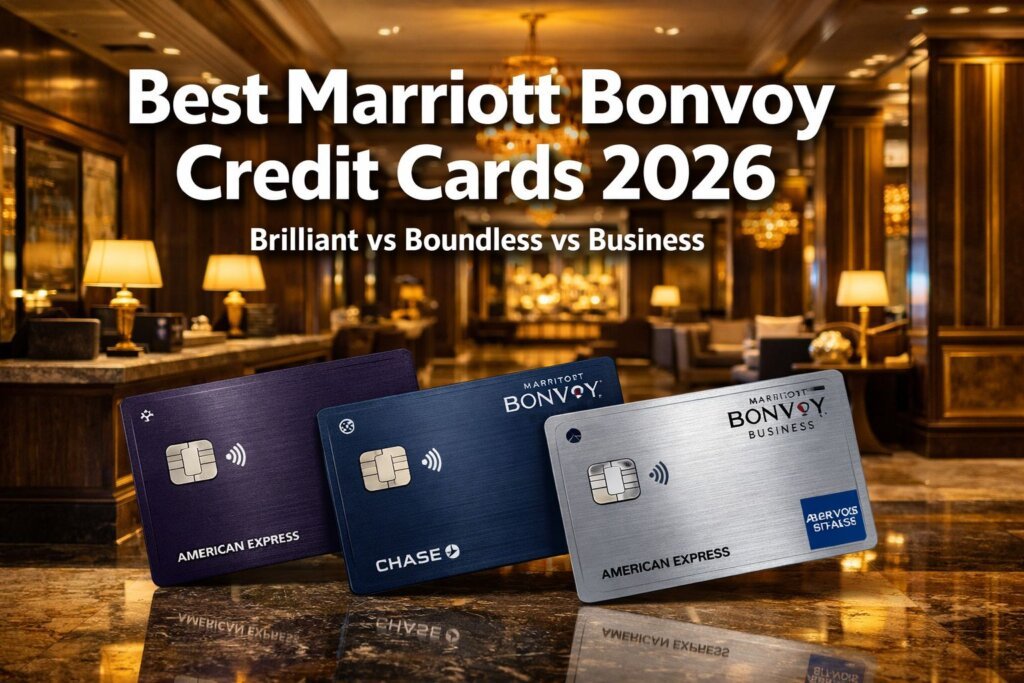
Marriott Bonvoy has the largest hotel footprint in the world — over 8,800 properties across 30+ brands. That scale makes its co-branded credit cards genuinely useful, but it also means choosing the wrong card can cost hundreds of dollars per year in missed value. The best Marriott Bonvoy credit cards in 2026 each serve a different traveler profile, and the gap between them is wider than most comparison articles suggest.
The Bonvoy Brilliant (from American Express, $650 annual fee), the Bonvoy Boundless (from Chase, $95 annual fee), and the Bonvoy Business (from American Express, $125 annual fee) all offer free night certificates, elite night credits, and Marriott-specific earning rates. But the annual fee math, the certificate ceilings, and the status benefits differ dramatically. A casual Marriott guest picking the Brilliant could waste $500+ per year. A frequent luxury traveler settling for the Boundless could leave thousands of dollars in value on the table.
This guide breaks down exactly which card fits which traveler — with real numbers, net-cost analysis, and a decision framework at the end.
Key Takeaways
- The Boundless ($95/year) is the best value for most Marriott travelers — its 35,000-point free night certificate alone can cover the annual fee, and the 2026 welcome offer of 5 Free Night Awards (up to 50,000 points each) is historically strong.
- The Brilliant ($650/year) only makes sense if you actively use its credits — the $300 dining credit ($25/month), $100 luxury property credit, and 85,000-point free night certificate can deliver $800+ in value, but only with deliberate planning.
- Free night certificates can be topped off with up to 15,000 Bonvoy points — turning a 35K certificate into a 50K redemption or an 85K certificate into a 100K redemption, which unlocks significantly better properties.
- Holding two Marriott cards (one personal + the Business) stacks elite night credits — potentially reaching Platinum Elite status faster without extra hotel stays.
- Marriott’s shift toward dynamic pricing increases devaluation risk — making free night certificates and status benefits more important than raw point earning rates. For details on recent changes, see our Marriott Bonvoy points devaluation analysis.
Three-Way Winner Table: Brilliant vs Boundless vs Business at a Glance
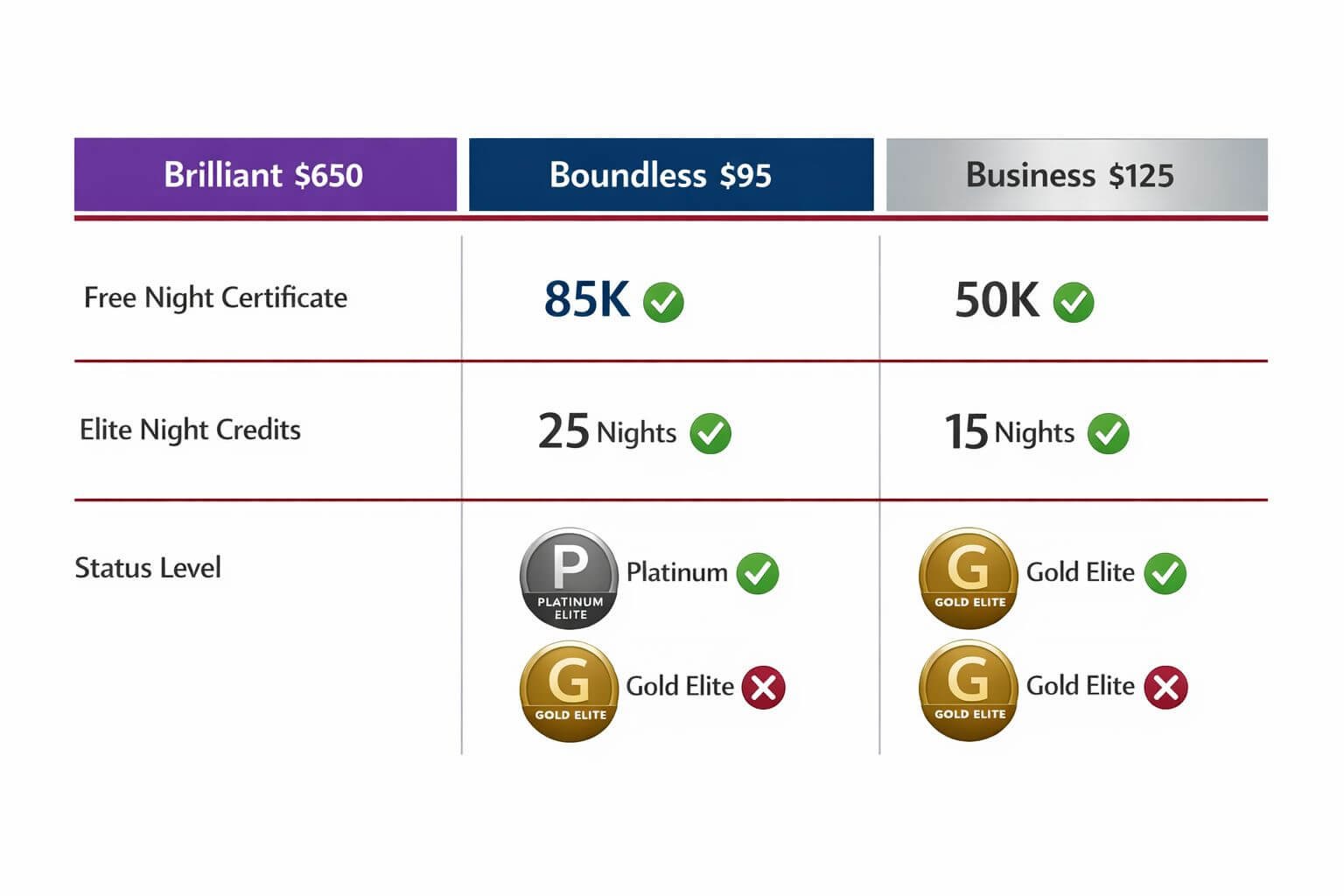
Before diving into details, here is the side-by-side comparison that matters most:
| Feature | Bonvoy Brilliant (Amex) | Bonvoy Boundless (Chase) | Bonvoy Business (Amex) |
|---|---|---|---|
| Annual Fee | $650 | $95 | $125 |
| Free Night Certificate | Up to 85,000 points | Up to 35,000 points | Up to 50,000 points |
| Certificate + Top-Up | Up to 100,000 points | Up to 50,000 points | Up to 65,000 points |
| Elite Status | Platinum Elite | Gold Elite | Gold Elite |
| Elite Night Credits | 25/year | 15/year | 15/year |
| Marriott Earning Rate | 6x | 6x | 6x |
| Dining Earning | 3x | 2x (non-Marriott) | 4x at U.S. restaurants |
| Key Credits | $300 dining ($25/mo), $100 luxury property | $100 airline credit (2026 only) | None |
| Priority Pass | Select | N/A | N/A |
| Best For | Frequent luxury Marriott travelers | Most Marriott travelers | Business spenders pairing with a personal card |
Quick rule of thumb: If you stay at Marriott 10+ nights per year and use the dining/luxury credits, the Brilliant wins. If you stay 2–10 nights per year, the Boundless is almost certainly the better pick. The Business card is a complement, not a standalone choice for most.
Annual Fee Math: $650 vs $95 (and What You Must Redeem to Break Even)
Bonvoy Boundless: The Easiest Fee to Justify
At $95 per year, the Boundless needs to deliver just $95 in value to break even. The annual free night certificate (up to 35,000 points) does this easily. Even a modest Courtyard or Fairfield Inn stay typically runs $120–$180 per night, meaning the certificate alone returns 1.3x–1.9x the annual fee.
2026 bonus: Chase added a $100 airfare statement credit for 2026 — $50 after $250+ in direct airline purchases January–June, and another $50 July–December. This is available to both new and existing cardholders, making the Boundless effectively free in 2026 if you use both the certificate and the airline credit.
Net cost in 2026: $95 fee – $100 airline credit = -$5 (before even counting the free night certificate).
Bonvoy Brilliant: Premium Fee, Premium Offsets
The $650 fee looks steep, but the Brilliant stacks multiple credits:
| Credit/Benefit | Annual Value | Notes |
|---|---|---|
| Free Night Certificate (85K) | ~$400–$700 | Depends on property and dates |
| Dining Credit | Up to $300 | $25/month; use-it-or-lose-it |
| Luxury Property Credit | Up to $100 | Only at Ritz-Carlton, St. Regis, EDITION, etc. |
| Priority Pass Select | ~$100–$300 | Depends on usage |
| Platinum Elite Status | ~$200+ | Suite upgrades, breakfast, late checkout |
You may be interested



Realistic net cost: If you use the dining credit ($300) monthly, the luxury credit ($100), and the free night certificate ($400+ value), the total offsets reach $800+, offsetting a $650 fee. That is a positive return — but it requires consistent monthly effort on the dining credit and at least one luxury Marriott stay per year.
Common mistake: Many cardholders forget the $25/month dining credit in low-travel months. Missing even 3–4 months costs $75–$100 in unrealized value. Set a calendar reminder or use a tool to track card perks.
Bonvoy Business: Moderate Fee, Moderate Return
At $125 per year, the Business card’s 50,000-point free night certificate typically covers the fee with room to spare. The card lacks the Brilliant’s credits but earns 4x at U.S. restaurants, U.S. gas stations, wireless telephone services, and U.S. shipping — categories useful for actual business spending.
Net cost: $125 fee – free night certificate value (~$200–$350) = negative net cost for most holders.
Use our certificate value vs. annual fee calculator to model your specific scenario based on the properties you actually book.
Free Night Certificates by Card: 35K vs 50K vs 85K (Plus the Top-Up Strategy)
Free night certificates are the single biggest reason to hold a Marriott co-branded card. Here is how each card’s certificate works—and the top-up strategy that dramatically expands its usefulness.
Certificate Ceilings Explained
Each card issues one free night certificate per cardmember year (on your account anniversary), redeemable at properties costing up to the certificate’s point ceiling:
- Boundless: Up to 35,000 points
- Business: Up to 50,000 points
- Brilliant: Up to 85,000 points
The 15,000-Point Top-Up: Why It Matters
Marriott allows cardholders to add up to 15,000 Bonvoy points to any free night certificate. This raises the effective ceiling:
| Card | Base Certificate | + Top-Up | Effective Ceiling |
|---|---|---|---|
| Boundless | 35,000 | +15,000 | 50,000 points |
| Business | 50,000 | +15,000 | 65,000 points |
| Brilliant | 85,000 | +15,000 | 100,000 points |
What this unlocks in practice:
- 35K → 50K (Boundless): Moves from limited-service hotels (Courtyard, Fairfield) to solid full-service options like Marriott Hotels, Sheraton, and some Westin properties on off-peak dates. A 50,000-point night at a Westin resort can easily be worth $250–$400.
- 50K → 65K (Business): Opens up more Westin, W Hotels, and select Autograph Collection properties. Good mid-range sweet spot.
- 85K → 100K (Brilliant): Reaches into Ritz-Carlton, St. Regis, and EDITION properties on standard or off-peak dates. A single night at the St. Regis Maldives or Ritz-Carlton Kyoto at 100,000 points can represent $800–$1,500+ in cash value.
Important: The top-up uses points from your Bonvoy account, not from the credit card. You need to have those 15,000 points available. Also, with Marriott’s ongoing shift toward dynamic pricing, the point cost for specific properties fluctuates. Check current rates before assuming your certificate will cover a target hotel.
Best Strategy for Certificate Holders
- Identify your target property before your anniversary date.
- Check the current point cost on Marriott.com for your preferred dates.
- Decide whether to top up — only add points if the property costs more than your base certificate.
- Book as soon as the certificate posts to your account (typically 6–8 weeks after your anniversary).
- Watch for off-peak pricing — the same property might cost 35K on a Tuesday and 50K on a Saturday.
Elite Nights and Status: What Each Card Really Helps You Earn
Status Tiers by Card
| Card | Automatic Status | Elite Night Credits/Year |
|---|---|---|
| Brilliant | Platinum Elite | 25 |
| Boundless | Gold Elite | 15 |
| Business | Gold Elite | 15 |
Platinum Elite (earned at 50 nights or via the Brilliant card) is the tier where Marriott benefits become genuinely valuable: suite upgrades (when available), complimentary breakfast at select brands, 4 PM late checkout, 50% bonus points on stays, and access to the lounge at applicable properties.
Gold Elite (earned after 25 nights or with the Boundless/Business cards) provides 2 PM late checkout, enhanced room upgrades (excluding suites), and a 25% bonus on points earned from stays. Useful, but not transformative.
Stacking Elite Night Credits Across Cards
Here is where holding two Marriott cards becomes strategic. Elite night credits from multiple cards stack:
- Brilliant (25) + Business (15) = 40 elite night credits — only 10 actual hotel nights away from Platinum Elite (50 nights total).
- Boundless (15) + Business (15) = 30 elite night credits — still need 20 actual nights for Platinum, but a meaningful head start.
For travelers who stay 10–20 nights per year at Marriott, the Brilliant + Business combination can push them to Platinum without changing behavior. This is one of the most effective credit card shortcuts to hotel elite status available in 2026.
Note: Marriott’s Spring 2026 promotion (launched February 10, 2026) offers 2,500 bonus points per stay plus bonus Elite Night Credits upon registration. This applies to all three card products and can further accelerate status qualification.
Earning Rates: Where Each Card Fits in a Points Strategy
Side-by-Side Earning Rates
| Spend Category | Brilliant | Boundless | Business |
|---|---|---|---|
| Marriott purchases | 6x | 6x | 6x |
| Dining | 3x | 2x | 4x (U.S.) |
| Groceries | 2x | 2x | 4x (U.S.) |
| Gas | 2x | 2x | 4x (U.S.) |
| Wireless/Shipping | 2x | 2x | 4x (U.S.) |
| All other purchases | 2x | 2x | 2x |
The Honest Assessment
Marriott Bonvoy points are worth roughly 0.7–0.9 cents per point (CPP) on average, though specific redemptions can push above 1.0 CPP at premium properties. This means:
- 6x at Marriott = ~4.2–5.4% return (solid)
- 2x on everything else = ~1.4–1.8% return (mediocre)
- 4x on Business card categories = ~2.8–3.6% return (decent for a hotel card)
The bottom line: None of these cards should be a primary everyday spending card. Transferable points programs — earning Amex points, Chase points, Capital One miles, Citi points, or Bilt points — offer greater flexibility and typically offer a higher CPP on non-hotel spending.
The best use of these cards is for Marriott-specific purchases (6x) and for holding the annual benefits (free night certificates, elite status, credits). For everything else, a card that earns transferable points will work better. See our guide on whether points or cash back wins in 2026 for a broader framework.
A Note on Transferable Points → Marriott
Both Chase Ultimate Rewards and Amex Membership Rewards transfer to Marriott Bonvoy at a 1:1 ratio. However, this is generally a poor transfer because Bonvoy points are worth less per point than Chase or Amex points used through other partners. Transfer to Marriott only when you need a small top-up for a specific redemption — never as a default strategy.
The Bonvoy Business Card: Who It’s For and How It Complements a Personal Card

The Marriott Bonvoy Business American Express Card occupies a specific niche. It is not the best standalone Marriott card for most travelers, but it is an excellent second card in a Marriott strategy.
Current Welcome Offer (2026)
As of January 2026, the Business card offers 3 Free Night Awards (up to 50,000 points each) after $6,000 in spend within 6 months. That is up to 150,000 points in free night value — a strong offer, though the Boundless’ 5x50K offer requires less spend ($3,000 in 3 months).
Who Should Consider the Business Card
- Business owners or self-employed individuals who can direct shipping, wireless, gas, and restaurant spend to the card for 4x earning.
- Travelers who already hold the Brilliant or Boundless and want to stack an additional 15 elite night credits and a second free night certificate (50K ceiling).
- Anyone not subject to Chase’s 5/24 rule — the Business card is issued by Amex and does not count toward 5/24, making it accessible even when the Boundless is not.
For more on business credit card eligibility and how to qualify, see our dedicated guide.
Pairing Strategies
| Combination | Total Elite Night Credits | Total Free Night Certificates | Best For |
|---|---|---|---|
| Brilliant + Business | 40 | 2 (85K + 50K) | Frequent Marriott travelers chasing Platinum |
| Boundless + Business | 30 | 2 (35K + 50K) | Moderate travelers wanting two certificates |
| All three | 55 | 3 | Rarely justified; high total fees ($870+) |
Amex limitation: You can hold both the Brilliant and Business simultaneously (one personal, one business). However, Amex’s once-per-lifetime welcome bonus rule means you cannot earn a welcome bonus on a card you have previously held. Plan your application order carefully. Our guide on credit card application rules covers the details.
When Holding Two Marriott Cards Makes Sense (and When It Doesn’t)
It Makes Sense When:
- You stay at Marriott 15+ nights per year and want Platinum status with fewer actual stays
- You travel to destinations where Marriott is the dominant hotel brand (many international markets)
- You value two free night certificates — one for a mid-range stay and one for a luxury property
- You have business expenses that benefit from 4x categories on the Business card
It Doesn’t Make Sense When:
- You stay at Marriott fewer than 5 nights per year — one card (likely the Boundless) is sufficient
- You prefer hotel flexibility — transferable points programs let you book Marriott, Hyatt, Hilton, and others
- You are already paying high annual fees on other premium cards (Amex Platinum, Chase Sapphire Reserve) and the marginal value of a second Marriott card is low
- You are under Chase’s 5/24 limit and need those application slots for higher-value cards
Before adding a second card, run the numbers using our annual fee ROI calculator to confirm the math works for your spending pattern.
Which Marriott Card Should You Get? Decision Framework by Traveler Type
Use this decision tree to find the best Marriott Bonvoy credit card for your situation:
The Occasional Marriott Guest (2–5 Nights/Year)
→ Get the Boundless ($95)
The free night certificate covers the fee. The 2026 $100 airline credit makes it essentially free this year. Gold Elite status provides modest upgrades and late checkout. The current welcome offer (5 Free Night Awards up to 50K each) is the strongest entry point.
Not worth it: The Brilliant — you will not use enough credits to justify $650.
The Regular Marriott Traveler (10–25 Nights/Year)
→ Get the Brilliant ($650) if you will use the credits. Otherwise, Boundless + Business.
If you dine out regularly ($25+/month is easy) and stay at luxury Marriott brands at least once per year, the Brilliant’s credits stack to exceed the fee. Platinum Elite status is the real differentiator — suite upgrades and breakfast add hundreds of dollars in value per trip.
If you do not dine out consistently or stay at luxury brands, the Boundless + Business pairing gives you two free night certificates and 30 elite night credits for $220 total in annual fees.
The Business Traveler
→ Get the Business ($125) as a complement to either personal card.
The 4x categories on wireless, shipping, gas, and restaurants align with common business expenses. The 50K free n ight certificate is a strong annual return. Stack it with the Boundless or Brilliant for additional elite night credits.
For a broader look at how business cards fit into an award travel strategy, see our guide on maximizing travel rewards with business credit cards.
The Points Maximizer (Transferable Points First)
→ Hold the Boundless ($95) as your only Marriott card. Focus spending on transferable points cards.
Marriott cards should not be your primary tool for earning rewards. Use Amex points, Chase points, Capital One miles, Citi points, or Bilt points for everyday spending, and keep the Boundless purely for its annual free night certificate and 6x earning on Marriott stays.
This approach preserves flexibility. Transferable points can be used across multiple hotel and airline transfer partners, protecting against Marriott-specific devaluation risk.
The “Should I Downgrade?” Holder
If you currently hold the Brilliant plan and are not using your credits, consider downgrading or canceling before your next annual fee is due . The Boundless is available as a downgrade path within Chase (note: the Brilliant is Amex, so you cannot downgrade across issuers — you would cancel the Brilliant and apply for the Boundless separately).
Common Mistakes to Avoid
- Choosing the Brilliant for status alone. Platinum Elite is valuable, but not $650 valuable if you ignore the dining and luxury credits. Do the full net-cost math.
- Forgetting the $25/month dining credit structure. The Brilliant’s $300 dining credit is not a lump sum — it is $25 per month. Unused months do not roll over.
- Not topping up certificates. Leaving 15,000 points of top-up value unused means booking a worse property than necessary. Always check if a small top-up unlocks a meaningfully better hotel.
- Using Marriott cards for non-Marriott spending. At 2x on general purchases (~1.4–1.8 CPP), these cards underperform transferable points cards that earn 2x–5x in flexible currencies.
- Ignoring the Boundless’ 2026 airline credit. This is a limited-time benefit. Set reminders to make qualifying airline purchases in both halves of the year.
- Applying for the Boundless when over 5/24. The Boundless is a Chase card subject to the 5/24 rule. If you have opened 5 or more new credit cards in the past 24 months, you will likely be denied. The Business card (Amex) is not subject to 5/24.
Conclusion: Your Next Steps
The best Marriott Bonvoy credit cards in 2026 depend entirely on how often you stay at Marriott and whether you will actively use card credits.
For most readers, The Boundless at $95 is the clear winner. It’s a free night certificate, 15 elite night credits, and the 2026 airline credit offer strong value with minimal effort. The current 5 Free Night Awards welcome offer makes this the best time to apply.
For frequent luxury Marriott travelers: The Brilliant at $650 delivers more total value — but only with disciplined monthly use of the dining credit and at least one luxury property stay per year.
For business owners: The Business card at $125 is the best complement to either personal card, adding a second free night certificate and 15 more elite night credits.
Here is what to do next:
- Run the math for your specific situation using our certificate value and annual fee calculators.
- Check your 5/24 count before applying for the Boundless (Chase).
- Register for Marriott’s Spring 2026 promotion to earn bonus points and elite night credits on upcoming stays.
- Review your broader card strategy — if you are not yet earning transferable points through a primary card, that should come first. A Marriott card complements a transferable points strategy, not a replacement for it.
- Monitor for devaluation risk — Marriott’s dynamic pricing means point costs can shift. Stay informed with our Marriott Bonvoy devaluation tracker.
The right Marriott card, held for the right reasons, can deliver hundreds of dollars in annual value. The wrong one is an expensive mistake. Use the framework above to make an informed choice.


Content on Award Travel Hub is independently created by Award Travel Hub Editorial Desk and, where noted, reviewed by Award Travel Hub Review Desk. Some pages may contain affiliate links, but compensation does not determine our coverage, opinions, or methodology.