

The Chase Sapphire Preferred has held its position as the go-to starter travel rewards card for over a decade—but 2026 brings significant changes that make understanding this card more important than ever. With new bonus eligibility rules that went into effect in January 2026, a competitive 75,000-point welcome offer, and access to Chase’s powerful transfer partner network, the Chase Sapphire Preferred 2026 presents both opportunities and strategic considerations for travelers building their points portfolio.
For beginners entering the world of transferable points, the Sapphire Preferred offers a rare combination: a manageable $95 annual fee, straightforward earning categories, and the ability to transfer points 1:1 to premium airline and hotel partners. That last feature transforms this card from a simple travel rewards card into a gateway for booking Business Class flights and luxury hotel stays at a fraction of retail prices.
This guide walks through exactly how the Chase Sapphire Preferred 2026 works—from maximizing the welcome bonus to executing your first transfer partner redemption—with the decision frameworks and real-world examples needed to determine if this card fits your travel goals.
Key Takeaways
- 75,000-point welcome bonus (after $5,000 spend in 3 months) equals $937.50 in Chase Travel portal value or significantly more through strategic transfer partner redemptions
- New 2026 bonus rules allow one bonus per Sapphire product based on lifetime eligibility, replacing the previous 48-month window
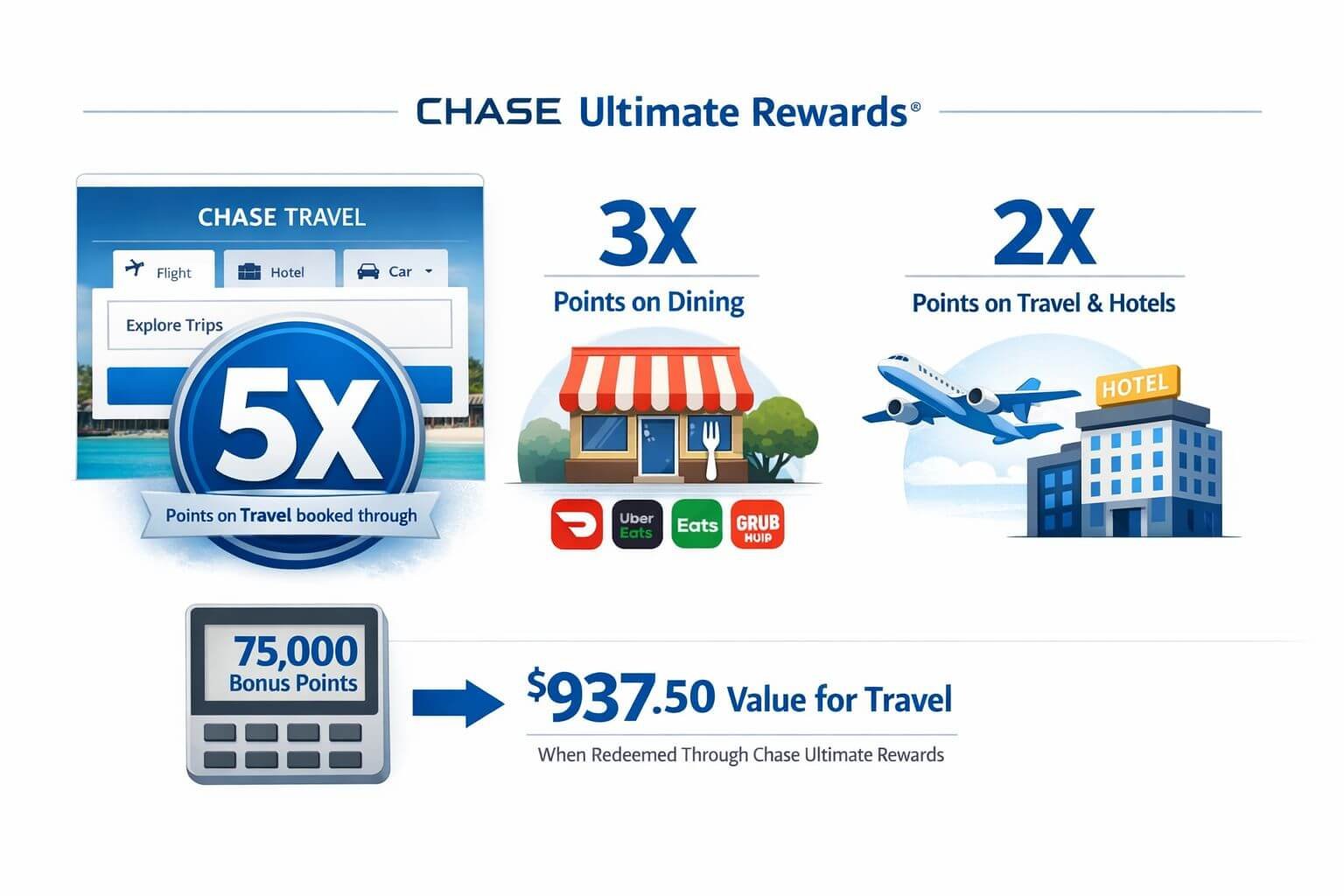
- Earning structure delivers 5x points on Chase Travel purchases, 3x on dining, and 2x on other travel—competitive rates for a $95 annual fee card
- 1.25 cents per point portal redemption provides a guaranteed baseline value, while transfer partners offer 1.5-2+ cpp for premium cabin awards
- Best for beginners who want to transfer partner access without Reserve’s $795 annual fee, especially those under Chase’s 5/24 rule
What Makes the Chase Sapphire Preferred 2026 Different
The Chase Sapphire Preferred occupies a specific position in the transferable points ecosystem: it’s the most accessible card that unlocks Chase Ultimate Rewards transfer partners. While cards like the Chase Freedom Unlimited earn Ultimate Rewards points, only premium cards (Sapphire Preferred, Sapphire Reserve, and Ink Business Preferred) can transfer those points to airline and hotel partners.
The core value proposition: Pay a $95 annual fee to gain transfer partner access and enhanced earning rates on travel and dining—the two largest discretionary spending categories for most households.
For 2026, Chase has maintained the card’s fundamental structure while adjusting bonus eligibility rules that affect how cardholders can accumulate welcome bonuses across the Sapphire family. Understanding these changes matters for long-term strategy, particularly if considering an eventual upgrade to the Sapphire Reserve.
The 2026 Bonus Eligibility Changes Explained
In January 2026, Chase implemented new rules that fundamentally changed how Sapphire bonuses work. Previously, cardholders faced a 48-month waiting period between earning bonuses on the same card. The new structure eliminates repeat bonuses entirely while allowing greater flexibility across the Sapphire product line.
Current rules (effective January 22, 2026):
- One welcome bonus per Sapphire card product, lifetime
- Can hold multiple Sapphire cards simultaneously
- Can earn a bonus on Sapphire Reserve even while holding Sapphire Preferred (and vice versa), provided you haven’t previously earned a bonus on that specific card
You may be interested



What this means practically: If you’ve never held a Sapphire card, you can earn the Preferred bonus now and the Reserve bonus later (or simultaneously). But you can’t earn the Preferred bonus again – it’s a one-time opportunity per product.
Chase has also added intentionally vague language to applications stating bonuses “may not be available” to those who hold other Sapphire cards, though reports indicate bonuses still post when eligibility requirements are met. This ambiguity creates uncertainty, requiring careful tracking of your bonus history.
Chase Sapphire Preferred 2026 Welcome Bonus Strategy
The current welcome offer—75,000 points after $5,000 spend in the first three months—represents one of the most valuable starter card bonuses available in 2026. The minimum spend requirement is higher than some competing cards, but it remains achievable for most households through normal spending.
Calculating the Real Value
At the guaranteed 1.25 cents per point redemption rate through Chase Travel, 75,000 points equals $937.50 in travel value. This calculation provides the baseline—your worst-case scenario for redemption value.
Through transfer partners, the same 75,000 points can deliver significantly higher value:
Example redemption scenarios:
- 75,000 points → 75,000 World of Hyatt points = 5 nights at Category 4 hotels (valued at $200-300/night = $1,000-1,500 in hotel stays)
- 75,000 points → 75,000 United MileagePlus miles = Round-trip business class to Europe on partner airlines (valued at $3,000-5,000 retail)
- 60,000 points → 60,000 Southwest Rapid Rewards points = Multiple domestic round-trips or one long-haul domestic flight (valued at $900-1,200)
These examples assume standard award pricing and availability—actual value varies based on routing, dates, and program dynamics. The key insight: transfer partners typically deliver 1.5-2+ cents per point value for premium cabin awards, doubling or tripling portal redemption value.
For a detailed framework on calculating redemption value, see our guide to cents-per-point calculations.
Meeting the Minimum Spend Requirement
$5,000 in three months breaks down to approximately $1,667 per month—manageable for most households through regular expenses:
Strategic approaches:
- Front-load large purchases: Annual insurance premiums, property taxes (if accepting credit cards), estimated tax payments
- Shift everyday spending: Groceries, gas, utilities, subscriptions to the new card during the three-month window
- Leverage bonus categories: Concentrate dining and travel spending to earn both welcome bonus progress and category bonuses simultaneously
- Avoid manufactured spending: Chase monitors for suspicious activity; stick to organic spending patterns
The $5,000 threshold is designed to be achievable without lifestyle changes for the target demographic—households spending $20,000+ annually on credit cards. If this threshold feels aggressive, consider starting with a card offering lower minimum spend requirements.
Earning Chase Ultimate Rewards Points: Category Breakdown
The Chase Sapphire Preferred 2026 earning structure focuses on travel and dining—categories that represent both high spending volume and strong alignment with the card’s redemption options.
Primary Earning Categories
| Category | Earning Rate | Annual Value Example |
|---|---|---|
| Chase Travel Portal | 5x points | $10,000 spend = 50,000 points ($625 value) |
| Dining (restaurants, delivery, takeout) | 3x points | $8,000 spend = 24,000 points ($300 value) |
| Other travel (airlines, hotels, transit) | 2x points | $5,000 spend = 10,000 points ($125 value) |
| All other purchases | 1x point | $15,000 spend = 15,000 points ($187.50 value) |
Total example annual earnings: 99,000 points = $1,237.50 baseline value through portal (before accounting for transfer partner optimization)
Understanding the 5x Chase Travel Category
The 5x earning rate applies exclusively to travel booked through Chase’s Ultimate Rewards portal—not direct bookings with airlines or hotels. This creates a strategic tension: portal bookings earn the maximum points but don’t accrue airline or hotel loyalty program points.
When 5x Chase Travel makes sense:
- Domestic economy flights where loyalty program value is minimal
- Hotel stays at properties outside major loyalty programs
- Car rentals and vacation packages
- Situations where 5x earning (effective 6.25% return) exceeds loyalty program earning rates
When to book direct instead:
- Premium cabin flights where you want elite upgrades and miles
- Hotel stays where elite status provides meaningful benefits (room upgrades, late checkout, breakfast)
- Situations requiring flexible cancellation policies that portal bookings don’t offer
The Chase Travel portal uses Expedia’s booking engine, which means inventory and pricing generally match what you’d find when booking directly—but customer service and changes are routed through Chase rather than the airline or hotel.
The 3x Dining Category: Broader Than Expected
Chase defines “dining” expansively to include:
- Restaurants (full-service and fast food)
- Bars and cafes
- Food delivery services (DoorDash, Uber Eats, Grubhub)
- Takeout and drive-through purchases
This category typically represents $500-800 monthly spending for households that regularly eat out or order delivery—translating to 18,000-28,800 points annually at 3x earning. For many cardholders, dining becomes the highest-earning category by volume.
Common dining miscodes to watch:
- Grocery store prepared food sections (code as grocery, earn 1x)
- Convenience store food purchases (code as gas/convenience, earn 1x)
- Warehouse club food courts (code as wholesale, earn 1x)
If dining represents significant spending, consider pairing the Sapphire Preferred with the Chase Freedom Unlimited (1.5x on all purchases) or Freedom Flex (5x on quarterly rotating categories) to maximize earning across all spending categories. These cards earn Ultimate Rewards points that can be combined and transferred through your Sapphire Preferred account.
Limited-Time Promotional Categories
Chase periodically adds temporary bonus categories to maintain competitiveness:
Active through 2027:
- 5x points on Lyft rides (through September 30, 2027)
- 5x points on Peloton equipment purchases over $150 (through December 31, 2027)
These promotional categories provide tactical opportunities but shouldn’t drive card selection—they’re temporary enhancements rather than core value propositions.
Redeeming Chase Ultimate Rewards: Portal vs Transfer Partners
Chase Ultimate Rewards offers two fundamentally different redemption paths, each with distinct value propositions and use cases. Understanding when to use each method determines whether you extract 1.25 cents per point or 2+ cents per point from your balance.
Chase Travel Portal: The Guaranteed Floor
Sapphire Preferred cardholders redeem points through the Chase Travel portal at 1.25 cents per point for travel purchases. This rate applies to:
- Flights
- Hotels
- Car rentals
- Cruises
- Vacation packages
- Activities and experiences
The math: 50,000 points = $625 in travel bookings through the portal.
Advantages of portal redemptions:
- Guaranteed value with no award availability concerns
- Simple booking process (similar to Expedia)
- No need to learn partner program award charts
- Immediate redemption without transfer delays
- Option to book one-way awards without round-trip requirements
Disadvantages of portal redemptions:
- Lower cents-per-point value than optimized transfer partner redemptions
- No loyalty program credit (no miles, points, or elite qualifying activity)
- Limited flexibility for changes and cancellations
- No access to partner award inventory is available for cash booking
- Pricing follows cash rates, which spike during peak periods
The portal works best for domestic economy flights, car rentals, and situations where simplicity outweighs optimization. It establishes your baseline value—any redemption delivering less than 1.25 cpp represents a poor use of points.
Transfer Partners: Where Premium Value Lives
The Sapphire Preferred unlocks Chase’s network of 14 airline and hotel transfer partners, enabling 1:1 point transfers that often deliver 1.5-3+ cents per point value for premium cabin awards and luxury hotel stays.
Chase Ultimate Rewards transfer partners (2026):
Transfer Partners
Transfer ratios and transfer times can change. Please verify details with the issuer before transferring points.
Transfers are instant for most partners (appearing within minutes) and irreversible—once transferred, points cannot return to your Chase account. This permanence requires research before transferring to ensure the award you want is actually available.
For a comprehensive breakdown of each transfer partner’s sweet spots and booking procedures, see our Chase Transfer Partners Guide 2026.
Transfer Partner Strategy: When to Transfer vs Hold
Transfer points when:
- You’ve confirmed award availability for your specific route and dates
- The redemption delivers 1.5+ cents per point value
- You’re booking within the partner’s cancellation window (to preserve flexibility)
- A limited-time transfer bonus increases the value proposition
Hold points in Chase when:
- You’re still researching options or haven’t confirmed availability
- Cash prices are unusually low (making portal redemptions competitive)
- You’re waiting for a transfer bonus to the partner you need
- You’re uncertain about travel plans and want maximum flexibility
Chase Ultimate Rewards points don’t expire as long as your account remains open and in good standing—there’s no penalty for holding points until you identify the optimal redemption. This flexibility represents a key advantage over earning directly in airline programs subject to devaluation risk.
Step-by-Step: Your First Transfer Partner Redemption
Walking through a concrete example demonstrates how transfer partner redemptions work in practice. This scenario uses World of Hyatt—one of Chase’s most valuable transfer partners and an ideal starting point for beginners.
Example: 75,000 Chase Points → 5 Nights at Hyatt Category 4 Hotels
The scenario: You want to book a five-night stay in a major city, and you’ve identified a Hyatt property that meets your needs.
Step 1: Research award availability
- Visit World of Hyatt’s website and search for your destination and dates
- Filter for Category 4 properties (15,000 points per night standard rate)
- Confirm availability for your exact dates
- Note the cash price for comparison (typically $200-300/night)
Step 2: Calculate the value
- Award cost: 75,000 Hyatt points (5 nights × 15,000 points)
- Cash alternative: $1,250 (5 nights × $250 average)
- Cents per point value: $1,250 ÷ 75,000 = 1.67 cpp
- Conclusion: Exceeds 1.25 cpp portal baseline—transfer makes sense
Step 3: Execute the transfer
- Log into Chase Ultimate Rewards
- Navigate to “Transfer to Travel Partners”
- Select World of Hyatt
- Enter 75,000 points
- Confirm transfer (irreversible)
- Points appear in the Hyatt account within minutes
Step 4: Book the award
- Log into World of Hyatt account
- Search for the same property and dates
- Select “Use Points” option
- Complete booking with 75,000 points
- Receive confirmation email
Step 5: Manage the reservation
- Link reservation to the World of Hyatt app for mobile check-in
- Note cancellation policy (typically free cancellation until check-in)
- Earn elite qualifying nights if you have Hyatt status
- Prepare to pay any resort fees or incidental charges at checkout
Total time investment: 15-20 minutes for research and booking, assuming you’ve already identified your destination.
This process applies similarly across other transfer partners, though there may be variations in award availability tools and booking interfaces. The fundamental workflow remains consistent: research → calculate value → transfer → book.
For more advanced transfer partner strategies, including how to maximize transfer bonuses and avoid common booking mistakes, see our comprehensive guide to comparing transfer partners.
Chase Sapphire Preferred vs Reserve vs Freedom: Decision Framework
Chase offers three primary Ultimate Rewards-earning cards with different value propositions. Choosing the right starting point—and understanding potential upgrade paths—requires analyzing annual fees against benefits and earning rates.
Complete Comparison Table
| Feature | Sapphire Preferred | Sapphire Reserve | Freedom Unlimited |
|---|---|---|---|
| Annual Fee | $95 | $795 | $0 |
| Welcome Bonus | 75,000 points after $5,000 spend | 75,000 points after $4,000 spend | 20,000 points after $500 spend |
| Portal Redemption Rate | 1.25 cpp | 1.5 cpp | 1.0 cpp (1.25-1.5 cpp when transferred to Sapphire card) |
| Transfer Partners | ✅ Full access | ✅ Full access | ❌ No direct access (must transfer to Sapphire) |
| Chase Travel Earning | 5x points | 10x points | 1.5x points |
| Dining Earning | 3x points | 10x points | 3x points |
| Other Travel Earning | 2x points | 5x points | 1.5x points |
| All Other Purchases | 1x point | 1x point | 1.5x points |
| Annual Travel Credit | None | $300 | None |
| Priority Pass Lounge Access | None | ✅ Unlimited visits | None |
| TSA PreCheck/Global Entry Credit | None | $120 every 4 years | None |
| Primary Rental Car Insurance | ✅ Yes | ✅ Yes | ❌ Secondary only |
| Trip Cancellation Insurance | Up to $10,000/trip | Up to $10,000/trip | None |
| DoorDash Benefits | $0 | $120 annual credit + complimentary DashPass | $0 |
| Lyft Benefits | $0 | $120 annual credit + Lyft Pink | $0 |
When the Sapphire Preferred Makes Sense
Best for:
- Travelers spending $10,000-25,000 annually on travel and dining
- Beginners wanting to transfer partner access without premium annual fees
- Those under Chase’s 5/24 rule who want to preserve application slots
- Cardholders who travel 1-3 times per year and won’t fully utilize Reserve credits
- Households where $795 annual fee represents a significant commitment
Annual fee breakeven calculation:
- $95 annual fee ÷ 0.0125 (portal redemption value) = 7,600 points needed to break even
- With 3x dining earning, $2,533 annual dining spend covers the annual fee
- With 2x travel earnings, $3,800 annual travel spend covers the annual fee
Real-world profile: A household spending $6,000 annually on dining and $4,000 on travel earns 26,000 points (worth $325 through portal)—covering the annual fee with $230 net value remaining.
When to Choose Sapphire Reserve Instead
The Reserve’s $795 annual fee initially appears prohibitive, but the card delivers a $300 annual travel credit (usable on any travel purchase), effectively reducing the net cost to $250.
Reserve makes sense when:
- You’ll use Priority Pass lounge access (4+ airport visits annually = $120+ value)
- The 10x dining and travel earning through Chase Travel significantly exceeds Preferred’s rates
- You value 1.5 cpp portal redemptions (50% higher than Preferred’s 1.25 cpp)
- Annual travel credits, DoorDash, and Lyft benefits offset the higher fee
- You want premium travel protections and benefits
Annual fee breakeven with credits:
- $795 annual fee – $300 travel credit = $495 net cost
- Additional $240 in DoorDash and Lyft credits
- Plus other credits
- Priority Pass access and other benefits provide surplus value
For a detailed analysis of whether the Reserve’s benefits justify the annual fee increase, see our complete Reserve fee vs value breakdown.
The Freedom Unlimited Role: Earning Without Annual Fees
The Freedom Unlimited earns 1.5x points on all purchases with no annual fee—making it the optimal card for non-bonused spending categories once you have a Sapphire card to enable transfers.
Optimal Chase card strategy:
- Start with Sapphire Preferred to unlock transfer partners and earn a welcome bonus
- Add Freedom Unlimited 3-6 months later for 1.5x earnings on non-bonused categories
- Consider Freedom Flex for 5x rotating quarterly categories (requires activation)
- Pool all points in the Sapphire Preferred account for transfers and enhanced redemptions
This multi-card approach maximizes earnings across all spending categories while maintaining just one annual fee. Points earned on Freedom cards transfer instantly to your Sapphire account, where they gain transfer partner access and enhanced portal redemption rates.
Upgrade Path: Preferred to Reserve
Chase allows product changes on Sapphire cards after 12 months of holding the current card. This creates a strategic option: start with Preferred to earn the welcome bonus, then upgrade to Reserve if your travel patterns justify the higher annual fee.
Upgrade considerations:
- No new welcome bonus when upgrading (you already earned the Preferred bonus)
- Points balance transfers automatically
- Can downgrade back to Preferred later if Reserve benefits aren’t utilized
- Annual fee prorates based on upgrade timing
When to upgrade:
- Travel frequency increases to 4+ trips annually
- You start booking more premium cabin awards (where the 1.5 cpp portal rate matters)
- Lounge access becomes valuable as travel patterns change
- You want to maximize earning rates on dining and travel
When to stay with Preferred:
- Current benefits meet your needs
- The $795 annual fee feels excessive relative to the benefits used
- You primarily redeem through transfer partners (where portal rate differences don’t matter)
- You hold other cards providing similar Reserve benefits
The flexibility to upgrade or downgrade without reapplying makes the Sapphire family adaptable to changing travel patterns—you’re not locked into the initial card choice.
Maximizing Your Chase Sapphire Preferred 2026: Tactical Strategies
Beyond basic earning and redemption mechanics, several tactical approaches increase the value extracted from your Sapphire Preferred card.
Combining with Other Chase Cards
Chase’s Ultimate Rewards ecosystem rewards holding multiple cards within the family. Points earned across all Chase Ultimate Rewards cards pool into a single account, where the highest-tier card determines redemption options.
Optimal card combination:
- Sapphire Preferred: Transfer partner access and enhanced portal redemptions
- Freedom Unlimited: 1.5x on all non-bonused spending
- Freedom Flex: 5x on rotating quarterly categories (gas, grocery, Amazon, etc.)
- Ink Business Preferred: 3x on business spending categories (if you have a business)
Example earning optimization:
- Dining and travel → Sapphire Preferred (3x and 2x)
- Quarterly 5x categories → Freedom Flex (5x)
- Everything else → Freedom Unlimited (1.5x)
- Business expenses → Ink Business Preferred (3x on shipping, internet, advertising)
This approach requires managing multiple cards, but can increase overall earning rates by 50-100% compared to using a single card for all spending.
Timing Transfers Around Transfer Bonuses
Chase periodically offers transfer bonuses to specific partners—typically 20-30% bonus points when transferring during promotional windows. These bonuses can transform marginal redemptions into excellent value.
Recent transfer bonus examples:
- 30% bonus to British Airways Avios (75,000 Chase points → 97,500 Avios)
- 20% bonus to Air France-KLM Flying Blue
- 20% bonus to Air Canada Aeroplan
Transfer bonus strategy:
- Monitor Chase’s transfer partner page for active promotions
- Plan aspirational trips around bonus periods when possible
- Don’t transfer speculatively—only when you’ve confirmed award availability
- Calculate whether the bonus makes a previously marginal redemption worthwhile
For current transfer bonuses and strategies to maximize them, see our transfer bonus timing guide.
Leveraging Travel Protections
The Sapphire Preferred includes several travel insurance benefits that provide value beyond points earning:
Trip cancellation/interruption insurance:
- Up to $10,000 per trip coverage
- Reimburses prepaid, non-refundable expenses if the trip is canceled for covered reasons
- Requires purchasing a trip with Sapphire Preferred or redeeming points through Chase
Baggage delay insurance:
- Up to $100 per day for essential purchases if baggage is delayed 6+ hours
- Covers toiletries, clothing, and other necessities
Primary rental car insurance:
- Covers damage or theft of rental vehicles in most countries
- Primary coverage means it pays before your personal auto insurance
- Declines the rental company’s collision damage waiver, saving $15-30 per day
Trip delay reimbursement:
- Up to $500 per ticket for meals and lodging if the trip is delayed 6+ hours or requires an overnight stay
- Applies to delays caused by weather, mechanical breakdown, or other covered reasons
These protections deliver tangible value but require understanding coverage terms and filing claims properly. Keep receipts and documentation for any incidents requiring insurance claims.
Avoiding Common Mistakes
Mistake #1: Transferring before confirming availability. Transfer points only after searching partner award inventory and confirming the specific flights or hotels you want are bookable. Transfers are irreversible—speculative transfers can strand points in programs with limited award availability.
Mistake #2: Redeeming for non-travel purchases Chase allows redeeming points for cash back, gift cards, and merchandise at 1 cent per point—25% less than portal travel redemptions and 50-70% less than optimized transfer partner redemptions. These options exist as last resorts, not primary redemption strategies.
Mistake #3: Ignoring the 5/24 rule. Chase’s 5/24 rule automatically denies applications from anyone who has opened 5+ credit cards (from any issuer) in the past 24 months. If you’re at 4/24, the Sapphire Preferred represents one of your last two Chase application opportunities—use it strategically.
For a complete explanation of 5/24 and its impact on application strategy, see our Chase 5/24 rule guide.
Mistake #4: Paying an annual fee without using the benefits. If you’re not earning enough points to offset the $95 annual fee through bonus categories, or you’re not redeeming points for travel, the Sapphire Preferred doesn’t make sense. Downgrade to Freedom Unlimited to maintain your points balance without paying annual fees.
Mistake #5: Booking refundable awards without understanding cancellation policies. Partner award cancellation policies vary significantly. Some (like United and Southwest) allow free cancellations with points redepositing, while others (like Air France-KLM) charge redeposit fees. Research cancellation terms before booking, especially for tentative plans.
Is the Chase Sapphire Preferred 2026 Worth It?
The value proposition depends entirely on your spending patterns, travel frequency, and willingness to engage with transfer partner programs.
The card delivers clear value when:
- Annual spending on dining exceeds $3,000 (earning 9,000+ points worth $112.50+ at portal rates)
- You’ll redeem points through transfer partners for premium cabin awards (delivering 1.5-2+ cpp)
- You’re building a transferable points portfolio and want Chase as one of your earning currencies
- The $95 annual fee represents an acceptable cost for transfer partner access
- You’re under 5/24 and can qualify for the welcome bonus
The card doesn’t make sense when:
- You rarely travel and won’t redeem points for travel purchases
- Annual dining and travel spending totals less than $5,000 (insufficient earnings to justify annual fee)
- You prefer cash back simplicity over points optimization
- You’re over 5/24 and can’t qualify for the welcome bonus
- You already hold the Sapphire Reserve (which provides all Preferred benefits plus more)
Alternative considerations:
- Capital One Venture X: $395 annual fee, but includes $300 travel credit, Priority Pass, and 2x earning on all purchases
- Chase Freedom Unlimited: No annual fee, 1.5x on all purchases, but no transfer partner access
- Amex Gold: $325 annual fee, 4x dining and grocery, but Amex transfer partners differ from Chase
For a detailed comparison of how Chase Ultimate Rewards stacks up against competing transfer point currencies, see our comprehensive transfer partner comparison.
Real-World Value Calculation
Consider a household with these annual spending patterns:
- Dining: $8,000 (3x = 24,000 points)
- Travel: $5,000 (2x = 10,000 points)
- Other purchases: $15,000 (1x = 15,000 points)
- Total annual earnings: 49,000 points
Portal redemption value: 49,000 × $0.0125 = $612.50 Net value after annual fee: $612.50 – $95 = $517.50
Transfer partner redemption value (assuming 1.8 cpp average): 49,000 × $0.018 = $882 Net value after annual fee: $882 – $95 = $787
This example demonstrates how transfer partner redemptions increase net value by 50%+ compared to portal redemptions—but only if you’re willing to invest time learning partner programs and searching for award availability.
Beyond the Basics: Building Your Chase Ultimate Rewards Strategy
The Sapphire Preferred functions best as part of a broader Chase Ultimate Rewards strategy rather than as a standalone card. Understanding how to integrate it with other Chase products and when to leverage transfer bonuses maximizes long-term value.
The Chase Trifecta Strategy
Advanced Chase users implement a “trifecta” approach combining three cards to optimize earnings across all spending categories:
Card #1: Sapphire Preferred ($95 annual fee)
- Enables transfer partner access for all pooled points
- Earns 3x dining, 2x travel, 5x Chase Travel
Card #2: Freedom Unlimited (no annual fee)
- Earns 1.5x on all purchases
- Covers non-bonused categories at a higher rate than Sapphire’s 1x
Card #3: Freedom Flex (no annual fee)
- Earns 5x on rotating quarterly categories (requires activation)
- Covers gas, grocery, Amazon, and other high-spend categories during bonus quarters
Combined annual earnings example:
- $8,000 dining → Sapphire Preferred (24,000 points)
- $5,000 travel → Sapphire Preferred (10,000 points)
- $12,000 quarterly 5x categories → Freedom Flex (60,000 points)
- $20,000 other purchases → Freedom Unlimited (30,000 points)
- Total: 124,000 points (worth $1,550 at portal rates or $2,200+ through transfer partners)
This approach requires managing three cards and tracking category earning, but increases total points earning by approximately 40% compared to using only the Sapphire Preferred. The total annual fee remains just $95—the Sapphire Preferred unlocks transfer access for all points earned across the portfolio.
Integrating Business Cards
If you have a business (including sole proprietorships and side businesses), Chase’s Ink business cards add another earning dimension:
Ink Business Preferred ($95 annual fee)
- 3x on the first $150,000 annually in combined purchases from shipping, internet, cable, phone services, and advertising on social media and search engines
- 3x on travel
- Includes transfer partner access (independent of personal Sapphire cards)
Ink Business Unlimited (no annual fee)
- 1.5x on all purchases
- No earning cap
Ink Business Cash (no annual fee)
- 5x on first $25,000 annually in combined purchases at office supply stores and on internet, cable, and phone services
- 2x on the first $25,000 annually at gas stations and restaurants
Business cards don’t count toward 5/24 status, allowing you to accumulate additional Ultimate Rewards earning cards beyond the five-card limit. Points earned on business cards transfer to personal Sapphire cards (and vice versa), creating a unified points balance.
Planning Award Travel for 2026
The Sapphire Preferred’s transfer partners enable booking premium cabin international flights that would cost $3,000-8,000 in cash for a fraction of that in points. Planning these aspirational trips requires understanding partner award charts and availability patterns.
Key planning principles:
Book 11-12 months in advance for international premium cabins: Most airlines release award space 330-365 days before departure. Popular routes and peak dates fill quickly—waiting until 6 months out often means no availability.
Search multiple partner programs for the same flight: A United-operated flight might have award availability through United MileagePlus, Air Canada Aeroplan, or Singapore KrisFlyer—often at different point costs. Chase’s multiple airline transfer partners provide flexibility to find the best redemption rate.
Understand married segment logic: Some airlines price awards differently for one-way versus round-trip bookings, or require booking specific routing combinations. Research partner-specific booking rules before transferring points.
Factor in surcharges and fees: British Airways and Virgin Atlantic pass through significant fuel surcharges on partner flights. A “free” business class ticket might cost $400-800 in taxes and fees—still valuable, but not truly free.
For detailed guidance on searching for award availability and booking international premium cabin flights, see our complete guide to planning 2026 aspirational trips.
Monitoring Devaluation Risk
Transfer partners periodically devalue their award charts, increasing the points required for specific redemptions. Chase Ultimate Rewards points themselves don’t devalue—they always transfer 1:1 to partners—but the value received at the partner level can decrease.
Recent devaluation examples:
- World of Hyatt increased Category 4 hotels from 15,000 to 16,000 points (6.7% devaluation)
- Air Canada Aeroplan moved to dynamic pricing on some routes
- United MileagePlus eliminated award charts entirely in favor of dynamic pricing
Devaluation mitigation strategies:
- Hold points in Chase until ready to book (Chase points are more stable than airline miles)
- Book aspirational trips when you identify good value, rather than waiting indefinitely
- Diversify across multiple transfer partners to avoid concentration risk
- Monitor program announcements for advance notice of changes
The flexibility to transfer Chase points to 14 different partners provides protection against any single program’s devaluation—if one partner becomes less valuable, you can shift strategy to another partner.
Next Steps: Getting Started with Chase Sapphire Preferred 2026
If the analysis above suggests the Sapphire Preferred fits your spending patterns and travel goals, the application process is straightforward—but timing and preparation matter.
Pre-Application Checklist
✓ Verify 5/24 status: Count how many credit cards (from any issuer) you’ve opened in the past 24 months. If you’re at 5 or more, Chase will automatically deny the application. If you’re at 4/24, consider whether Sapphire Preferred represents the best use of one of your final two Chase slots.
✓ Check credit score requirements: Chase typically approves Sapphire Preferred applications for credit scores of 720+. Scores in the 680-720 range may approve with high income and low credit utilization, but approval odds decrease.
✓ Confirm bonus eligibility: Review your Chase card history to verify you haven’t previously earned a Sapphire Preferred welcome bonus. Under the new 2026 rules, you can only earn each Sapphire product bonus once, lifetime.
✓ Plan minimum spend strategy: Ensure you can organically spend $5,000 in three months without lifestyle changes or manufactured spending. Front-loading large purchases (insurance premiums, property taxes) can help reach the threshold quickly.
✓ Consider application timing: If you’re planning to apply for multiple Chase cards, space applications 2-3 months apart to avoid triggering velocity concerns. Apply for the Sapphire Preferred first if it’s your highest priority.
Application Process
- Visit Chase’s website or apply through a referral link (referral links provide the same welcome bonus while giving an existing cardholder bonus points)
- Complete the application with accurate income and housing information
- Expect an instant decision or a 7-10 day message (7-10 day message often indicates approval pending verification)
- Call reconsideration line if denied (Chase reconsideration: 1-888-270-2127) to discuss denial reasons
- Receive the card within 7-10 business days if approved
First 90 Days: Maximizing the Welcome Bonus
Week 1-2:
- Activate the card and set up online account access
- Add a card to your mobile wallet for everyday use
- Set up automatic payment to avoid missing due dates
- Review and understand bonus categories
Month 1:
- Shift all dining and travel purchases to Sapphire Preferred
- Front-load any large planned purchases
- Track progress toward $5,000 minimum spend
- Familiarize yourself with the Chase Ultimate Rewards portal
Month 2-3:
- Continue concentrating on spending on the new card
- Verify minimum spend progress through the online account
- Research transfer partners to prepare for bonus posting
- Identify potential redemptions for the 75,000-point bonus
After bonus posts:
- Decide whether to redeem through the portal or transfer to partners
- If transferring, confirm award availability before executing the transfer
- Book your first award redemption
- Evaluate whether to add Freedom Unlimited or Freedom Flex to maximize earnings
Long-Term Management
Annual review (before annual fee posts):
- Calculate total points earned over the past year
- Assess whether the earnings justified the $95 annual fee
- Evaluate whether spending patterns suggest upgrading to Reserve
- Consider downgrading to Freedom Unlimited if benefits aren’t utilized
Ongoing optimization:
- Monitor transfer bonus promotions quarterly
- Search for award availability 11-12 months before planned trips
- Combine points from multiple Chase cards for larger redemptions
- Stay informed about partner program changes and devaluations
For additional strategies on building a comprehensive travel rewards strategy beyond a single card, see our beginner’s guide to travel hacking.
Conclusion
The Chase Sapphire Preferred 2026 remains the most accessible entry point to transferable points and premium award travel. For a $95 annual fee, the card delivers competitive earning rates on dining and travel, guaranteed 1.25 cents per point baseline value through the Chase Travel portal, and—most importantly—access to Chase’s network of 14 transfer partners that enable booking business class flights and luxury hotel stays at 1.5-2+ cents per point value.
The 2026 bonus eligibility changes create a one-time opportunity: you can earn the 75,000-point welcome bonus once per Sapphire product, lifetime. This makes the decision to apply more consequential—you won’t have another chance to earn this bonus on the Sapphire Preferred in the future.
The card makes sense for:
- Beginners wanting to transfer partner access without Reserve’s $795 annual fee
- Households spending $10,000+ annually on dining and travel
- Travelers willing to learn partner programs to maximize redemption value
- Those under Chase’s 5/24 rule who can qualify for the welcome bonus
Start elsewhere if:
- Annual spending on bonus categories totals less than $5,000
- You prefer cash back simplicity over points optimization
- You’re over 5/24 and can’t earn the welcome bonus
- You already hold the Sapphire Reserve
For those who fit the target profile, the Sapphire Preferred provides the foundation for a comprehensive Chase Ultimate Rewards earning strategy—one that can scale from a single card earning 50,000 points annually to a multi-card portfolio generating 150,000+ points per year. The key is starting with clear goals, understanding the earning and redemption mechanics, and committing to learning one or two transfer partners well enough to extract premium value.
Immediate next steps:
- Review the pre-application checklist above to confirm eligibility
- Calculate your expected annual earnings based on spending patterns
- Research 2-3 transfer partners aligned with your travel goals (start with World of Hyatt and United MileagePlus)
- Apply for the card if the analysis supports it
- Execute the 90-day plan to earn the welcome bonus
- Book your first transfer partner redemption within 6 months to validate the strategy
The Chase Sapphire Preferred 2026 won’t revolutionize your finances or make international travel free—but it provides the tools to reduce travel costs by 40-60% while accessing premium experiences that would otherwise cost thousands of dollars. For travelers willing to invest modest time learning the system, that value proposition remains compelling.


Content on Award Travel Hub is independently created by Award Travel Hub Editorial Desk and, where noted, reviewed by Award Travel Hub Review Desk. Some pages may contain affiliate links, but compensation does not determine our coverage, opinions, or methodology.