
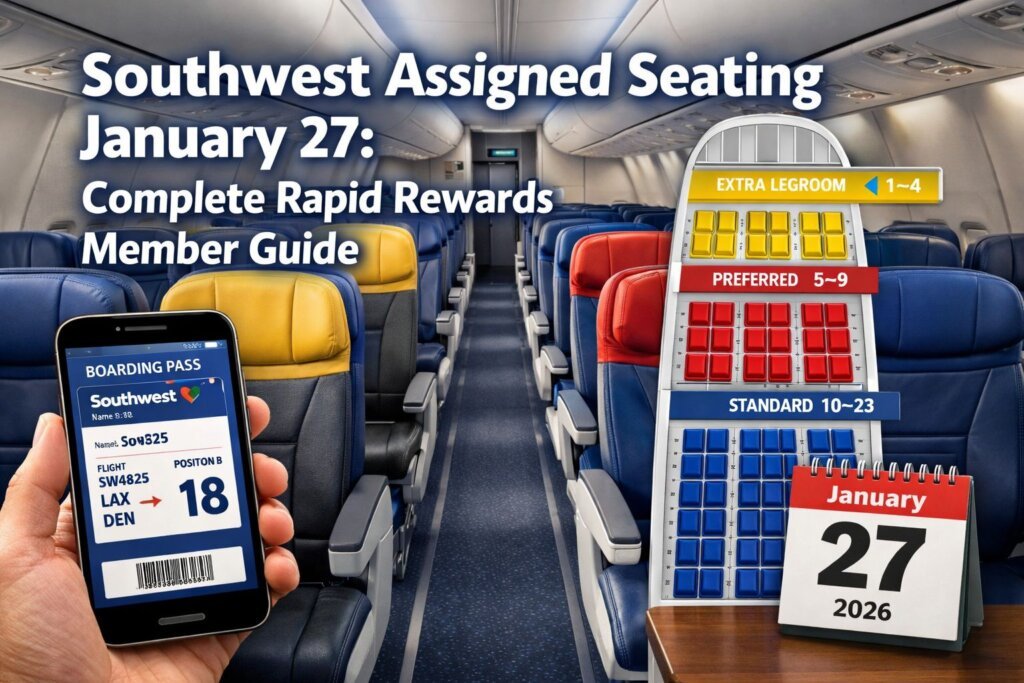
After 53 years of controlled chaos—the legendary cattle-call boarding, the sprint down the jetway, the passive-aggressive middle-seat standoffs – Southwest Airlines is finally saying goodbye to open seating. On January 27, 2026, the airline beloved for its quirky traditions transforms into something entirely different. For millions of Rapid Rewards members who’ve mastered the art of snagging an aisle seat with A-List status, this shift raises urgent questions: What happens to your elite benefits? How do the new boarding groups work? And most importantly, will you still get that coveted exit row?
The Southwest assigned seating January 2026 rollout represents the most significant operational change in Southwest’s history. Whether you’re an A-List Preferred member who’s flown 100+ segments annually or a casual traveler trying to understand what “Preferred seating” actually means, this complete guide breaks down everything you need to know about the new system—from seat types and boarding groups to exactly what perks your Rapid Rewards status still delivers.
Key Takeaways
- Southwest eliminates open seating on January 27, 2026, after 53 years, introducing three seat types: Extra Legroom, Preferred (front cabin), and Standard
- New boarding Groups 1-8 replace the A/B/C position system, with elite members and fare types determining your group assignment
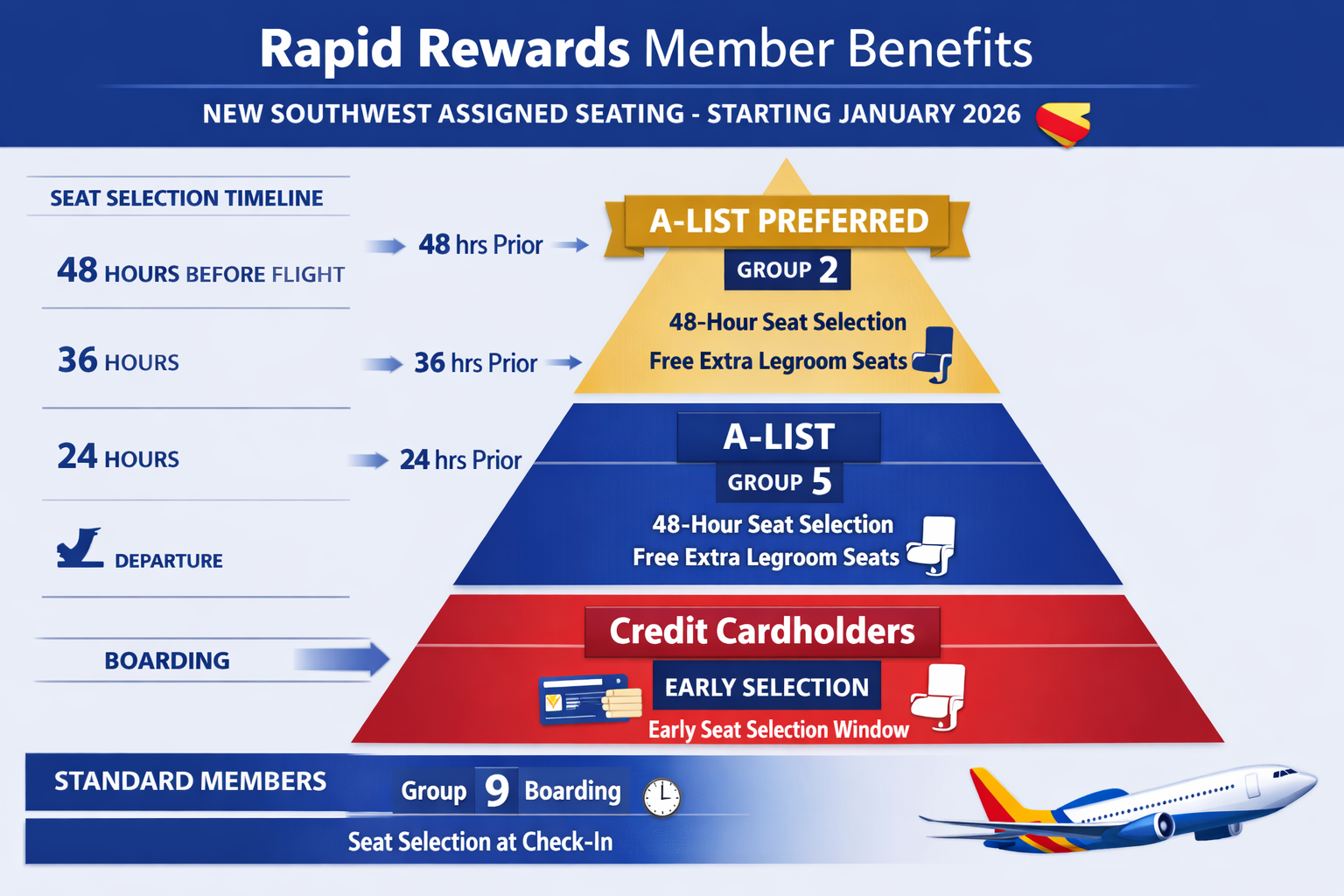
- A-List Preferred members board in Group 2 and select seats (including Extra Legroom for free) 48 hours before departure
- Fare type determines seat selection timing: Choice Extra/Preferred get selection at booking; Basic fares receive assignments at check-in
- Early Bird Check-In is eliminated under the new assigned seating model, fundamentally changing pre-flight strategy
Southwest’s Historic Shift: Open Seating Ends After 53 Years
Southwest Airlines built its reputation on being different. While competitors charged baggage fees and crammed passengers into assigned seats, Southwest let you sit wherever you wanted—if you could get there first. That freedom defined the Southwest experience for generations of travelers who memorized check-in times and perfected their boarding position strategies.
But customer preferences shifted. Southwest’s internal research revealed that 80% of passengers preferred assigned seating, with families particularly frustrated by the inability to guarantee sitting together. The airline industry evolved, and Southwest recognized that its signature feature had become a pain point rather than a perk.
The southwest assigned seating January 2026 implementation marks the end of an era. Starting January 27, every Southwest flight will feature assigned seats, joining every other major U.S. carrier in abandoning the free-for-all approach. For longtime Southwest loyalists, it’s bittersweet—the loss of a quirky tradition in exchange for guaranteed seat certainty.
Why Southwest Made the Change
Southwest didn’t make this decision lightly. The airline conducted extensive passenger surveys, analyzed booking patterns, and studied revenue optimization models. Three key factors drove the transformation:
Customer demand: Families traveling with young children consistently ranked guaranteed adjacent seating as their top priority. Business travelers wanted predictability without gaming check-in times.
You may be interested



Revenue potential: Assigned seating allows Southwest to monetize premium seat locations, similar to competitors who charge $15-$80 for extra legroom or forward cabin positions. Industry analysts estimate this could generate $1.5-2 billion in annual ancillary revenue.
Competitive positioning: As the last major U.S. carrier with open seating, Southwest struggled to attract corporate travelers whose companies preferred the seat assignment certainty offered by Delta, United, and American.
The transition affects everything from mobile app functionality to gate agent procedures, representing a complete operational overhaul across Southwest’s 121-destination network.
New Seat Types: Extra Legroom, Preferred, and Standard Explained
Understanding the Southwest assigned seating January 2026 system starts with knowing the three distinct seat categories. Unlike the old system, where all seats were technically equal (just harder to access for later boarding positions), the new structure creates clear hierarchies with different pricing and availability rules.
🪑 Extra Legroom Seats
These premium seats offer 5-7 additional inches of legroom compared to standard seats, located primarily in exit rows and the aircraft’s first few rows. Think of them as Southwest’s version of Economy Plus or Main Cabin Extra.
Key characteristics:
- Approximately 60-80 seats per aircraft (varies by plane configuration)
- Positioned at emergency exits, bulkhead rows, and rows 1-2
- Available for purchase at booking or through Rapid Rewards elite benefits
- Pricing ranges from $30-$80 per segment, depending on route length and demand
- A-List Preferred and A-List members can select these free of charge starting 48 hours before departure
Extra Legroom seats provide the most tangible upgrade for taller passengers, those on long flights, or anyone who values personal space. They’re comparable to premium economy offerings on other carriers but priced more affordably.
✈️ Preferred Seats
Preferred seating occupies the front third of the cabin—typically rows 3-10 on most Boeing 737 configurations. These don’t offer extra legroom but provide faster deplaning and closer proximity to the forward lavatory.
Key characteristics:
- Approximately 60-90 seats per aircraft
- Same legroom as Standard seats (31-32 inches)
- Available with Choice Extra and Preferred fare purchases at booking
- Can be purchased separately for $15-$40 per segment
- Faster exit upon landing (3-5 minutes quicker than the rear cabin)
- Popular with business travelers on tight connections
The value proposition here is time and convenience rather than physical comfort. If you’ve ever sat in row 28 watching everyone ahead of you slowly deplane while your connection boards in 20 minutes, you understand the appeal.
🎫 Standard Seats
These comprise the majority of the aircraft—roughly rows 11-35 depending on the plane. Standard seats represent the baseline experience with no premium charges.
Key characteristics:
- Approximately 100-120 seats per aircraft
- Standard 31-32 inch seat pitch
- Free seat selection for Choice Extra and Preferred fares at booking
- Assigned automatically at check-in for Basic fare passengers
- Middle seats in this section typically last to fill
- Window and aisle seats are still desirable despite the rear location
Standard doesn’t mean bad—Southwest’s seats remain comfortable with generous width compared to ultra-low-cost carriers. You’re simply trading location convenience for cost savings.
Seat Type Comparison Table
| Seat Type | Legroom | Location | Typical Cost | Elite Member Access |
|---|---|---|---|---|
| Extra Legroom | 36-38 inches | Exit rows, rows 1-2 | $30-$80 | Free for A-List/A-List Preferred (48hr window) |
| Preferred | 31-32 inches | Rows 3-10 (front cabin) | $15-$40 | Included with Choice Extra/Preferred fares |
| Standard | 31-32 inches | Rows 11-35 (mid/rear) | Included | All fare types |
Understanding these distinctions helps you make informed decisions when booking or selecting seats under the new system. Maximizing your credit card rewards can help offset the cost of premium seats if you’re purchasing them regularly.
Boarding Groups 1-8: How the New System Replaces A/B/C
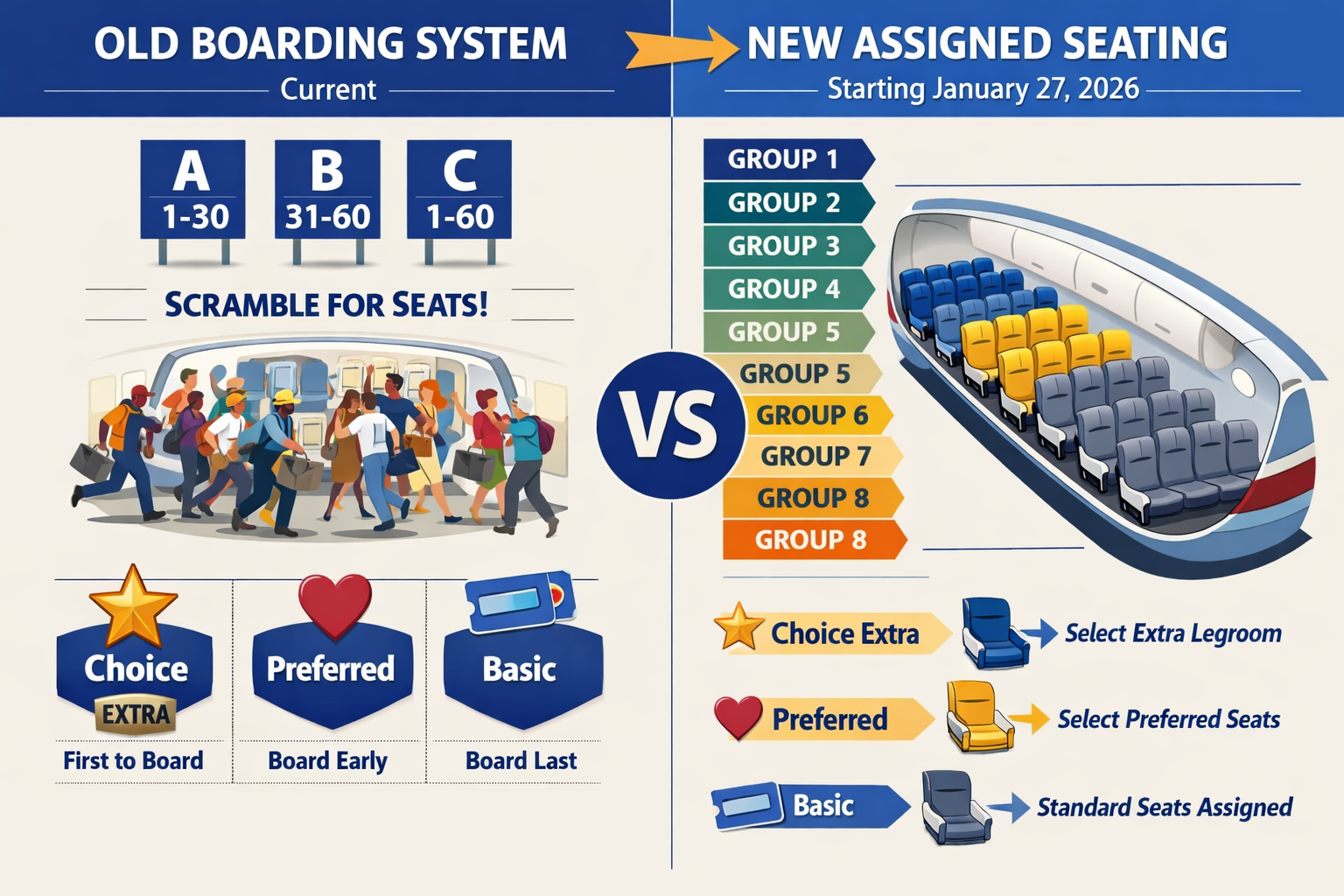
The iconic A1-C60 boarding positions that defined Southwest for decades disappear on January 27, 2026. In their place: a straightforward boarding group system numbered 1 through 8, assigned based on fare type, elite status, and credit card benefits.
This represents a fundamental philosophical shift. The old system rewarded those who checked in exactly 24 hours before departure (or paid for Early Bird). The new system rewards those who pay for premium fares or maintain elite status—aligning Southwest with industry-standard practices.
The New Boarding Group Hierarchy
Group 1: Passengers requiring assistance, families with children under 6 (limited pre-boarding), and top-tier elite members on specific fare types
Group 2: A-List Preferred members (Southwest’s highest published elite tier)
Group 3: A-List members (mid-tier elite status)
Group 4: Choice Extra fare passengers without elite status
Group 5: Preferred fare passengers and Southwest credit cardholders
Group 6: Standard Wanna Get Away Plus fare passengers
Group 7: Basic Wanna Get Away fare passengers
Group 8: Standby passengers and non-revenue travelers
What This Means for Your Boarding Experience
Unlike the old system, where your boarding position determined everything, your seat is already assigned when you board. The group number primarily affects:
- Overhead bin access: Earlier groups secure bin space before it fills
- Cabin settling time: Lower group numbers mean more time to organize before departure
- Perceived status: Similar to how Zone 1 boarding feels more premium on other carriers
The psychological shift is significant. Previously, an A15 boarding position felt like a victory—you’d beaten 90% of passengers to check-in. Now, boarding in Group 5 as a standard fare passenger is simply… standard. There’s no gaming the system, no setting 6:00 AM alarms for check-in.
Old System vs. New System Comparison
| Aspect | Old Open Seating (Pre-Jan 27, 2026) | New Assigned Seating (Post-Jan 27, 2026) |
|---|---|---|
| Seat Selection | First-come-first-served at boarding | Assigned at booking or check-in |
| Boarding Method | A1-A60, B1-B60, C1-C60 positions | Groups 1-8 |
| Check-in Strategy | Critical—exactly 24 hours before flight | Less critical—seat already assigned |
| Early Bird | $15-$25 for automatic check-in | Eliminated (no longer needed) |
| Elite Benefits | Earlier boarding position | Specific group + free premium seat selection |
| Family Seating | Hope for the kindness of strangers | Guaranteed adjacent seats (when booked together) |
| Predictability | Variable—depends on others’ choices | Guaranteed—know your seat at booking |
For Rapid Rewards members who’ve built entire travel strategies around the old system, this requires a complete mental reset.
Seat Selection by Fare: What Choice Extra, Preferred, and Basic Get
The southwest assigned seating January 2026 system ties seat selection privileges directly to your fare type. This represents Southwest’s move toward the unbundled pricing model that dominates the industry—pay more, get more choices.
Choice Extra Fare: Maximum Flexibility
Choice Extra sits at the top of Southwest’s leisure fare hierarchy (below full-fare Business Select). Passengers booking this fare type receive:
✅ Seat selection at booking, including Extra Legroom and Preferred seats
✅ Same-day flight changes without additional fees
✅ Same-day standby for earlier flights
✅ Transferable flight credits if you cancel
✅ Bonus Rapid Rewards points (10 points per dollar vs. 6 for basic fares)
When to book Choice Extra: Long flights where Extra Legroom justifies the premium, tight connections requiring forward cabin seating, or trips where schedule flexibility matters. The fare typically costs $40-$120 more than the Basic one-way fare, but includes perks that would cost $30-$80 if purchased separately.
Preferred Fare: Front Cabin Access
The new Preferred fare category (replacing the previous Wanna Get Away Plus tier) offers middle-ground benefits:
✅ Seat selection at booking, including Preferred seats (front cabin)
✅ Same-day standby for earlier flights
✅ Transferable flight credits
✅ Standard Rapid Rewards earning (8 points per dollar)
❌ Cannot select Extra Legroom at booking (must wait for 48-hour window or pay separately)
When to book Preferred: Business trips with potential schedule changes, routes where front cabin deplaning saves connection time, or when you want seat certainty without paying for maximum legroom.
Basic Fare (Wanna Get Away): Seat Assignment at Check-In
Southwest’s lowest published fare now comes with significant restrictions under assigned seating:
❌ No seat selection at booking—seats assigned automatically at check-in (24 hours before departure)
❌ Non-transferable credits if you cancel
❌ No same-day changes or standby
❌ Restricted to Standard seats only—no access to Extra Legroom or Preferred
✅ Still includes 2 free checked bags (Southwest’s signature benefit remains)
Seat assignment reality: Basic fare passengers receive whatever Standard seats remain after everyone else selects. On popular routes, this often means middle seats in the rear cabin. Families booking Basic together may not receive adjacent seats if the flight is heavily booked.
When to book Basic: Flexible travel where exact seat location doesn’t matter, solo travelers indifferent to window/aisle/middle, or price-sensitive trips where saving $30-$60 outweighs seat preference.
Fare Type Seat Selection Summary
| Fare Type | Seat Selection Timing | Available Seat Types | Typical Premium vs Basic |
|---|---|---|---|
| Choice Extra | At booking | All (Extra Legroom, Preferred, Standard) | +$40-$120 |
| Preferred | At booking | Preferred + Standard (Extra Legroom at 48hr or fee) | +$20-$60 |
| Basic (Wanna Get Away) | At check-in (24hr) | Standard only | Base price |
Understanding these distinctions helps you calculate the true value of fare upgrades. Sometimes paying $35 more for a Preferred fare makes sense when the alternative is a $30 separate Preferred seat fee plus restricted change policies.
Rapid Rewards Member Benefits: A-List Preferred and A-List Changes
For the 12+ million active Rapid Rewards members, the Southwest assigned seating January 2026 transition fundamentally reshapes elite benefits. The old system’s primary perk—early boarding positions—becomes less relevant when seats are pre-assigned. Southwest responded by enhancing elite members’ seat selection privileges.
A-List Preferred Benefits (Top Tier)
Earning A-List Preferred requires 50 one-way qualifying flights or 70,000 tier qualifying points in a calendar year. Starting January 27, 2026, members receive:
🏆 Group 2 boarding (second-highest priority after assistance/families)
🏆 Free Extra Legroom seat selection starting 48 hours before departure
🏆 Preferred seat selection at booking on any fare type
🏆 100% Rapid Rewards points bonus on all flights
🏆 Priority security/boarding lanes at select airports
🏆 Free same-day standby and confirmed changes
The game-changer: Free Extra Legroom access 48 hours out means A-List Preferred members can book the cheapest Basic fare and still snag exit row seats two days before departure—potentially saving $30-$80 per flight while getting the best seats.
Strategic approach: Book Basic fares for maximum flexibility. Set a 48-hour reminder to select your preferred Extra Legroom seat. You’ve now combined rock-bottom pricing with premium seating—the best of both worlds.
A-List Benefits (Mid-Tier)
A-List status requires 25 one-way qualifying flights or 35,000 tier qualifying points annually. Benefits include:
✈️ Group 3 boarding (third-highest priority)
✈️ Free Extra Legroom seat selection starting 48 hours before departure
✈️ 25% Rapid Rewards points bonus on flights
✈️ Priority security/boarding lanes at select airports
✈️ Free same-day standby
Key difference from A-List Preferred: You board one group later (Group 3 vs. Group 2) and earn fewer bonus points, but you still get the valuable free Extra Legroom selection at 48 hours. For most frequent travelers, this represents the sweet spot of benefits-to-effort ratio.
What Happened to Early Bird Check-In?
Southwest officially eliminated Early Bird Check-In with the rollout of assigned seating. The product—which automatically checked you in and assigned a boarding position—becomes obsolete when seats are pre-assigned.
Previously, Early Bird cost $15-$25 per person, per flight, and guaranteed an A or B boarding position. Frequent travelers who flew Southwest 2-4 times monthly spent $360-$1,200 annually on this feature.
The math shift: That same money now goes toward:
- Occasional Preferred seat upgrades ($15-$40 each)
- Choice Extra fare premiums for important trips
- Saving for credit card annual fees that provide seating benefits
For budget-conscious frequent flyers, this actually represents potential savings—you’re no longer paying $15-$25 per flight for boarding priority that only mattered under the old system.
Elite Status Comparison: Old vs. New Benefits
| Benefit | Old System (A-List Preferred) | New System (A-List Preferred) |
|---|---|---|
| Primary Perk | Priority boarding (A1-A15 typical) | Free Extra Legroom at 48hr + Group 2 |
| Seat Selection | First pick of open seats | Pre-select the best seats before others |
| Family Boarding | Board after A, hope for seats together | Guaranteed adjacent seats when booked together |
| Value per Flight | ~$15-$25 (Early Bird equivalent) | $30-$80 (Extra Legroom value) |
| Predictability | Variable based on flight load | Guaranteed—locked in at selection |
The new system arguably provides more tangible value to elite members. Instead of a better boarding position that might not yield your preferred seat on full flights, you’re guaranteed the specific Extra Legroom seat you selected 48 hours out.
Credit Cardholder Perks Under the New Assigned Seating System
Southwest’s co-branded credit cards from Chase have always offered valuable benefits, but the Southwest assigned seating January 2026 changes elevate their importance. If you fly Southwest 4+ times a year, the right card can save you hundreds on seat selection fees.
Southwest Rapid Rewards Priority Card Benefits
The premium Priority card ($149 annual fee) now includes:
💳 Early seat selection window (exact timing varies—typically 36 hours before departure)
💳 4 upgraded boardings per year (Group 1-2 boarding regardless of fare)
💳 7,500 anniversary bonus points (covers ~$100 in flights)
💳 25% back on in-flight purchases
💳 No foreign transaction fees
Value calculation: If you purchase Preferred seats 8 times a year at an average of $25 each, that’s $200 in fees. The early selection window often lets you grab those seats free before they’re released to general passengers, effectively paying for the annual fee.
Southwest Rapid Rewards Performance Business Card
Designed for business travelers, the Performance Business card ($199 annual fee) offers:
💼 Early seat selection window for all passengers on the reservation
💼 4 upgraded boardings per year
💼 9,000 anniversary bonus points
💼 $75 Southwest annual travel credit
💼 25% inflight purchase rebate
Business traveler advantage: The early selection window applies to all travelers on your booking, making this valuable when paying for colleagues or family members.
Southwest Rapid Rewards Plus Card (Entry-Level)
The no-annual-fee Plus card ($69 annual fee after first year) provides:
🎫 Early seat selection window (more limited than Priority/Performance)
🎫 3,000 anniversary bonus points
🎫 25% back on in-flight purchases
Best for: Occasional Southwest travelers (4-8 flights per year) who want a seating advantage without premium card fees.
Maximizing Credit Card Benefits
Strategic travelers combine card benefits with elite status:
Example scenario: You’re A-List Preferred with the Priority card. You book a Basic fare ($89), use your elite status to select Extra Legroom free at 48 hours ($60 value saved), and your Priority card gives you early access to grab your preferred exit row before other A-List Preferred members. Total cost: $89 for what would have been a $149+ experience.
For travelers building their credit card strategy, Southwest cards now compete directly with premium travel cards from other airlines. The combination of 2 free checked bags plus valuable seating benefits creates compelling value, especially for families.
Those working through the Chase 5/24 rule should consider whether a Southwest card slot makes sense given the enhanced seating perks under the new system.
Family Seating Strategy and Common Questions
One of the most anxiety-inducing aspects of Southwest’s old open seating system was family travel. Parents with young children faced the impossible choice: pay for Early Bird for the whole family ($60-$100+ per flight) or hope strangers would give up their aisle seats so you could sit with your 4-year-old.
The southwest assigned seating January 2026 system solves this—mostly.
Guaranteed Adjacent Seating (With Conditions)
Southwest now guarantees families with children under 14 will receive adjacent seats when booked on the same reservation. Key requirements:
✅ All family members on one confirmation number
✅ Booked at least 7 days before departure
✅ Children under 14 in the reservation
How it works: When you book, Southwest’s system automatically assigns adjacent seats for your party. If you’re booking Basic fares (assigned at check-in), the system still prioritizes keeping families together within available Standard seats.
Pre-Boarding for Families
Southwest maintains family pre-boarding for children under 6 years old. This allows:
- Boarding before Group 1
- Time to settle children, stow bags, and install car seats
- Access to overhead bins before they fill
Important change: Under the old system, family boarding happened after the A group, allowing families to grab any remaining good seats. Now, your seats are pre-assigned, so family pre-boarding simply provides extra settling time rather than a seat selection advantage.
Booking Strategies for Families
Strategy 1: Book Choice Extra or Preferred fares
Guarantees seat selection at booking, letting you choose specific rows (window for kids to look out, aisle for easy bathroom access). The $40-$80 per person premium often feels worth it for stress-free family travel.
Strategy 2: Book Basic but far in advance
If booking 3+ months out, Basic fares often still have good Standard seat availability at the 24-hour check-in window. Set a reminder to check in exactly 24 hours before to maximize selection.
Strategy 3: Mix fare types strategically
Book Choice Extra for parents (guaranteeing good seats) and Basic for older children (who can handle middle seats). Select seats at booking to keep the family clustered, with kids in the middle between parents in the aisles.
Common Family Seating Questions
Q: What if we book separate reservations?
A: Southwest cannot guarantee adjacent seating across different confirmation numbers. Always book families together on one reservation.
Q: Can we change seats after the initial assignment?
A: Yes, you can modify seat selections anytime before check-in (24 hours out) based on availability and your fare type’s privileges.
Q: What happens if the flight is completely full?
A: Southwest’s system prioritizes keeping families with children under 14 together, even if it means moving other passengers. Gate agents have tools to facilitate this.
Q: Do lap infants (under 2) get seats?
A: No, lap infants don’t receive seat assignments. The adult holding them gets a standard seat assignment based on fare type.
Navigating Your First Flight Under the New System
The transition to southwest assigned seating january 2026 requires adjusting long-held habits. Here’s what changes in your typical Southwest travel experience:
Booking Process
Old way: Book the cheapest fare, set an alarm for a 24-hour check-in, and hope for a good boarding position
New way: Consider fare type carefully—it determines your seat selection timing and options
Action steps:
- Compare total trip cost, including seat fee,s across fare types
- Decide if the specific seat location matters for this trip
- Book Choice Extra/Preferred if you want seat control at booking
- Book Basic if you’re indifferent and want the lowest price
Check-In Process
Old way: Check in exactly 24 hours before to get the best boarding position
New way: Check in anytime in the 24-hour window (your seat is already assigned)
What still matters: Checking in confirms your presence and prints your boarding pass showing your assigned group and seat number. But there’s no advantage to checking in at the 24-hour mark rather than 12 hours earlier.
Exception: Basic fare passengers receive seat assignments at check-in, so earlier check-in (closer to the 24-hour mark) may yield better Standard seat selection.
Airport Experience
Old way: Line up by boarding position, rush to find seats
New way: Board with your group, walk directly to your pre-assigned seat
Overhead bin strategy: Earlier boarding groups (1-3) have first access to bins. If you’re in Groups 6-8, consider checking bags to avoid bin scarcity—Southwest still offers 2 free checked bags, a major advantage over competitors.
Managing Expectations
The biggest mental shift: you’re no longer competing with other passengers for seats. Your seat is guaranteed from the moment you select it. This reduces pre-flight stress but eliminates the “game” aspect some travelers enjoyed.
For those who loved the strategy of the old system, channel that energy into maximizing Rapid Rewards earning or optimizing credit card rewards to fund more travel.
What This Means for Award Travel and Points Strategy
For points and miles enthusiasts, the Southwest assigned seating changes for January 2026 affect award booking strategy and Rapid Rewards value calculations.
Award Ticket Seat Selection
Good news: Rapid Rewards award tickets receive the same seat selection privileges as paid tickets of the same fare type.
How it works:
- Book award travel using points
- Southwest assigns a fare class equivalent (typically Wanna Get Away)
- You receive a seat assignment at check-in unless you have elite status
- A-List/A-List Preferred members can select Extra Legroom free at 48 hours, even on award tickets
Strategic implication: Elite status becomes more valuable for award travelers. Previously, award tickets and paid tickets boarded identically based on check-in time. Now, elite members get superior seats on award bookings without paying cash upgrades.
Points Value Calculation Changes
Southwest Rapid Rewards points maintain their straightforward valuation (roughly 1.3-1.5 cents per point), but the new system adds complexity:
Example comparison:
Scenario 1: Book Basic fare award ticket (10,000 points)
- Receive a standard seat at check-in
- Might get a middle seat in the rear cabin
- Value: ~$130 (10,000 × 1.3cpp)
Scenario 2: Book Choice Extra award ticket (14,000 points)
- Select an Extra Legroom seat at booking
- Guaranteed preferred location
- Value: ~$182 (14,000 × 1.3cpp) + $60 seat value = $242 effective value
For travelers who value seat location, spending extra points for higher fare class awards now provides tangible seating benefits beyond just flexibility.
Companion Pass Implications
Southwest’s famous Companion Pass—allowing a designated companion to fly free on all your flights—works identically under assigned seating with one enhancement:
Old system: You and your companion boarded with the same position, but competed for adjacent seats
New system: Book together on one reservation, receive adjacent seat assignments automatically
This makes Companion Pass even more valuable for couples. You’re guaranteed to sit together without paying extra or hoping for seat availability.
For strategies on earning Companion Pass through credit card sign-up bonuses, the new seating system adds another layer of value to this already exceptional benefit.
Transfer Partner Considerations
Southwest isn’t a transfer partner for major bank points programs like Chase Ultimate Rewards, Amex Membership Rewards, or Citi ThankYou Points. You earn Rapid Rewards points directly through:
- Southwest credit cards
- Flying Southwest
- Shopping portals
- Dining programs
- Hotel partners
However, Chase Ultimate Rewards points can be transferred to Southwest at a 1:1 ratio if you hold the right Chase cards, making them valuable for topping off your account before booking Choice Extra awards with better seat selection.
Common Mistakes to Avoid
As millions of travelers adapt to the new system, certain pitfalls keep emerging:
❌ Mistake 1: Booking Separate Reservations for Families
The problem: Southwest can’t guarantee adjacent seats across different confirmation numbers, even for families with young children.
The fix: Always book all family members on one reservation. If you’ve already made separate bookings, call Southwest to link them before the flight.
❌ Mistake 2: Assuming Basic Fares Work Like Before
The problem: Under open seating, Basic fares (Wanna Get Away) and higher fares boarded identically if you checked in at the same time. Now, Basic fares receive seat assignments last and can’t select premium locations.
The fix: Evaluate whether saving $30-$50 on a Basic fare is worth potentially getting a middle seat in row 32. For important trips, the Preferred fare upgrade often justifies the cost.
❌ Mistake 3: Not Using Elite Status Benefits
The problem: A-List and A-List Preferred members booking Choice Extra fares and paying for Extra Legroom seats they could get free at 48 hours.
The fix: Book Basic fares when you have elite status, then select Extra Legroom free at the 48-hour window. You’ve saved both the fare difference AND the seat fee.
❌ Mistake 4: Ignoring Credit Card Benefits
The problem: Paying $25-$40 per flight for Preferred seats when a Southwest credit card provides early selection access.
The fix: Calculate annual seat fees versus the card annual fee. If you fly Southwest 6+ times yearly, a Southwest credit card likely pays for itself through seating benefits alone.
❌ Mistake 5: Checking In Late for Basic Fares
The problem: Basic fare passengers receive seat assignments at check-in. Checking in 2 hours before departure often means only middle seats remain.
The fix: Set a 24-hour reminder to check in at exactly the time the window opens. Those few hours can mean the difference between 14A and 28B.
Preparing for January 27, 2026, and Beyond
The southwest assigned seating January 2026 implementation is now active. Here’s your action plan:
Immediate Actions (This Week)
✅ Review upcoming Southwest reservations: Check if you have flights booked. Your confirmation will now show assigned seats or indicate when you can select them.
✅ Evaluate your elite status: If you’re close to A-List or A-List Preferred qualification, consider whether completing qualifying flights before year-end makes sense given enhanced seat benefits.
✅ Assess credit card strategy: Compare Southwest card benefits against your annual flight frequency. The early seat selection window has become significantly more valuable.
Medium-Term Strategy (Next 3 Months)
✅ Test the new system: Book a flight and experience the seat selection process firsthand. This helps you understand timing windows and available inventory.
✅ Adjust booking habits: Develop your personal framework for when Basic fares make sense versus when Preferred/Choice Extra justify their premiums.
✅ Update family travel approach: If you regularly travel with children, establish your new booking routine to ensure adjacent seating.
Long-Term Optimization
✅ Track seat fee spending: Monitor how much you’re paying for seat upgrades over 6-12 months. This data informs whether pursuing elite status or paying credit card annual fees makes financial sense.
✅ Reevaluate airline loyalty: Southwest’s assigned seating removes one of its key differentiators. Compare total travel costs (including seat fees) against competitors to ensure Southwest still offers the best value for your routes.
✅ Maximize Rapid Rewards earning: With seat selection now tied to elite status, accelerating your path to A-List through strategic credit card use and bonus opportunities provides tangible per-flight value.
Conclusion
The southwest assigned seating January 2026 transformation represents the most significant change in Southwest Airlines’ history. After 53 years of open seating, the airline joins the rest of the industry in offering predictable, assigned seats—fundamentally altering the Southwest travel experience.
For Rapid Rewards members, the news is largely positive. Elite status benefits now include valuable free Extra Legroom seat selection rather than just earlier boarding. Families receive guaranteed adjacent seating. The stress of check-in timing disappears, replaced by the certainty of knowing your exact seat at the time of booking.
But the change requires strategic adaptation. Understanding the three seat types, eight boarding groups, and fare-based selection windows helps you maximize value. A-List and A-List Preferred status provide more tangible benefits than ever before. Southwest credit cards offer meaningful seat advantages that can save hundreds of dollars annually.
The quirky charm of Southwest’s boarding scramble is gone, but what replaces it is arguably more consumer-friendly: guaranteed seat certainty, family-friendly policies, and transparent pricing. Whether you’re a road warrior pursuing elite status or a family taking an annual vacation, the new system rewards planning and strategic fare selection.
Your next steps: Review your upcoming Southwest flights, evaluate whether your current booking strategy needs adjustment, and consider whether pursuing elite status or a Southwest credit card makes sense given your travel frequency. The January 27, 2026, transition is here—those who understand the new rules will find better seats, save money, and enjoy a more predictable Southwest experience.
For more strategies on maximizing airline loyalty programs and optimizing your award travel, explore our comprehensive guides on navigating the evolving landscape of points and miles travel.





Content on Award Travel Hub is independently created by Award Travel Hub Editorial Desk and, where noted, reviewed by Award Travel Hub Review Desk. Some pages may contain affiliate links, but compensation does not determine our coverage, opinions, or methodology.