
Updated Points Valuations for January 2026: Your Complete Guide to Points and Miles Valuations 2026

When a single airline mile can be worth anywhere from 0.5 cents to over 3 cents, depending on how it’s redeemed, understanding current valuations becomes critical for maximizing points. January 2026 brings significant shifts across major loyalty programs—some improving, others declining—that directly impact your redemption strategy and which credit cards deserve space in your wallet.
The latest points and miles valuations 2026 data reveal notable changes across airline and hotel programs, with several transferable currencies adjusting their baseline worth. These monthly updates matter because they reflect real-world redemption opportunities, award chart modifications, and the ongoing impact of dynamic pricing across loyalty programs.
Key Takeaways
- Chase Ultimate Rewards maintains its position as the highest-valued transferable currency at 1.7 cents per point, while American Express Membership Rewards holds steady at 1.5 cents per point
- Airline miles show diverging trends: United MileagePlus increased to 1.3 cents per mile, while Delta SkyMiles dropped to 1.1 cents per mile due to continued award pricing volatility
- Hotel points remain stable with World of Hyatt leading at 1.7 cents per point, though Marriott Bonvoy saw a slight decrease to 0.7 cents per point
- Transfer bonuses create temporary value spikes that can push effective valuations 30-50% higher when strategically timed
- Redemption sweet spots continue shifting as programs adjust award charts, making monthly valuation tracking essential for optimal booking strategy
Understanding Points and Miles Valuations 2026: Methodology for Accurate Calculations
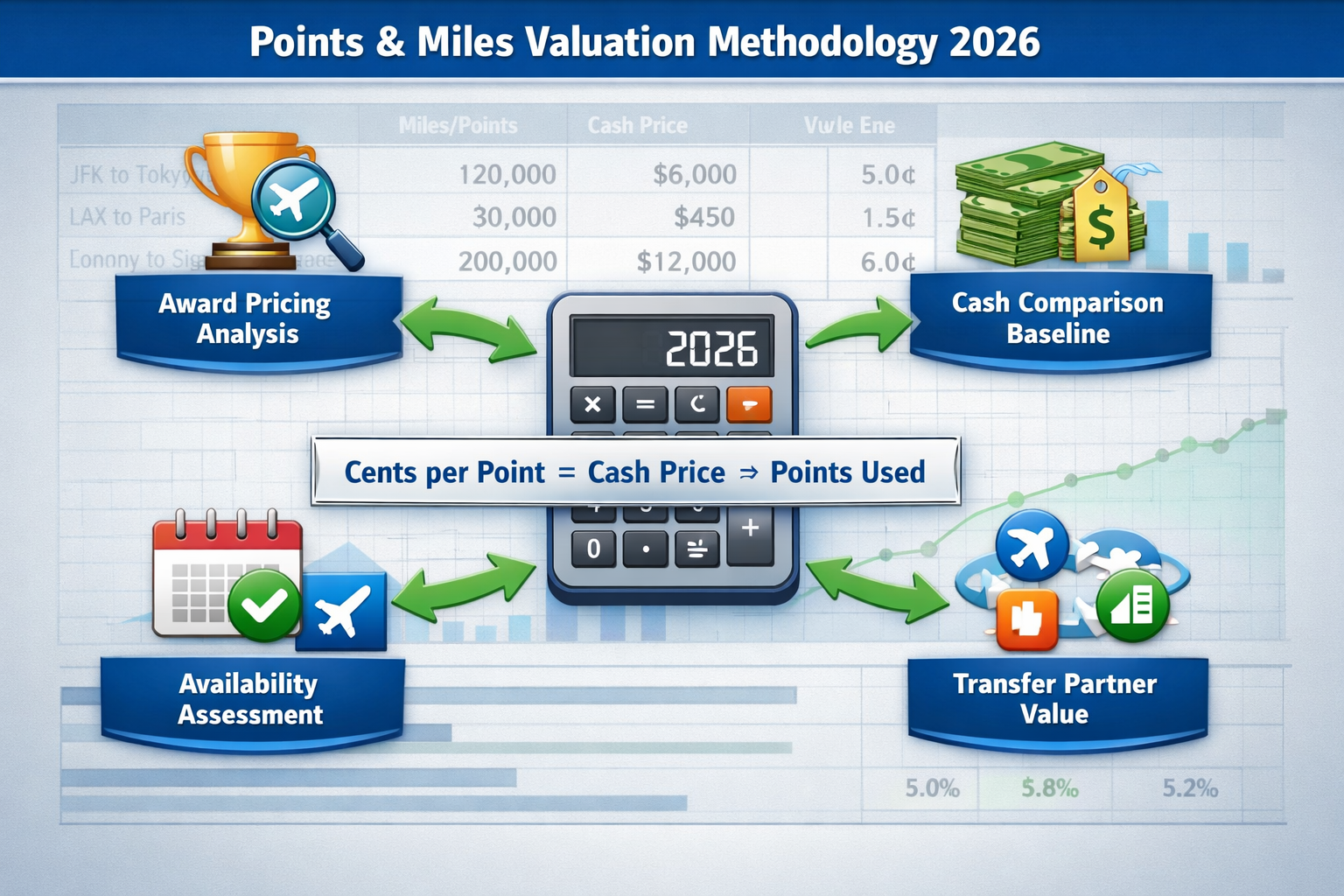
Valuation methodology determines whether published numbers reflect realistic redemption scenarios or theoretical maximums. The most reliable approach combines multiple data points rather than relying on single exceptional redemptions.
The Three-Pillar Valuation Framework
Award pricing analysis forms the foundation. This involves surveying hundreds of actual award bookings across economy, premium economy, business, and first class on both domestic and international routes. The analysis captures what points are actually required for real bookings, not aspirational sweet spots with zero availability.
Cash price comparison establishes the baseline. Each award redemption gets compared to the cash price for the identical flight or hotel stay on the same dates. This reveals the cents per point (CPP) value: divide the cash price by points required. For example, a $1,200 business class ticket costing 60,000 points yields 2.0 CPP ($1,200 ÷ 60,000 = $0.02).
Availability weighting adjusts for real-world constraints. A program offering theoretical 3.0 CPP redemptions that are never bookable is subject to downward adjustments. Programs with consistent award availability at good values score higher, even if their absolute ceiling is lower.
Why Monthly Updates Matter
Loyalty programs don’t announce devaluations with press releases. Award charts change quietly. Dynamic pricing algorithms adjust constantly. Transfer bonuses appear and disappear. Monthly valuations capture these shifts before they significantly impact your strategy.
Consider a traveler who earned 200,000 Chase Ultimate Rewards points in 2025. If they planned to transfer to a partner that devalued by 15% in January 2026, that represents a real loss of 30,000 points in purchasing power, equivalent to missing out on a domestic round-trip ticket.
Key Changes in January 2026 Points Valuations
January 2026 brought measurable shifts across major programs, with winners and losers emerging from ongoing industry trends.
Transferable Points Currencies
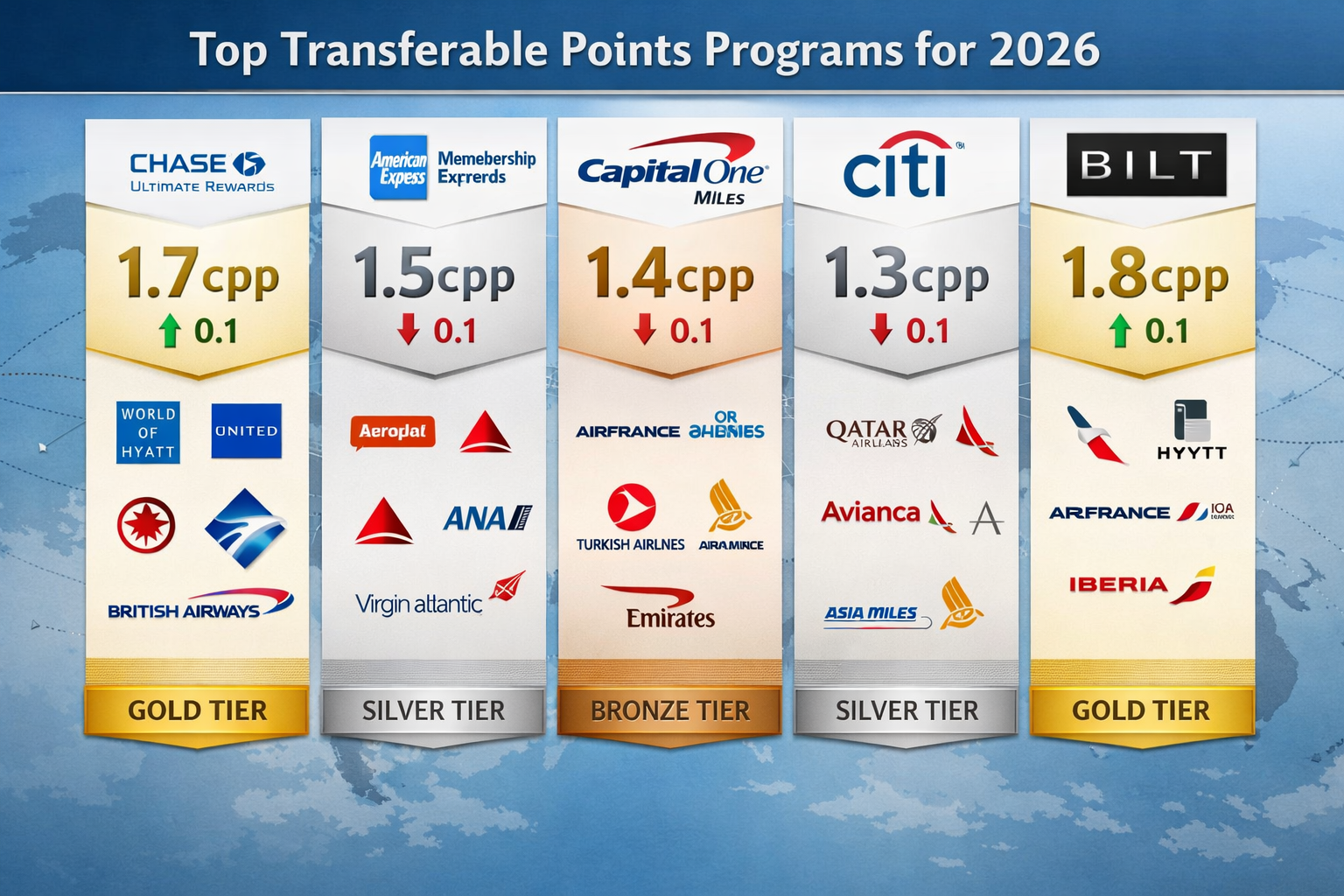
Chase Ultimate Rewards maintained its 1.7 cents per point valuation, unchanged from December 2025. The stability reflects consistent value across transfer partners, particularly Hyatt (for hotels) and United (for flights). The program benefits from strong sweet spots that remain bookable, including Hyatt Category 1-4 properties and United Saver awards on partner airlines.
American Express Membership Rewards held at 1.5 cents per point. While lower than Chase, Amex offers more transfer partners (21 versus Chase’s 14), providing flexibility when specific routes or properties show poor availability. The valuation accounts for periodic transfer bonuses, which increase value by 25-50% for strategic transfers.
Capital One Miles increased slightly to 1.4 cents per mile, up from 1.35 cents in December 2025. The improvement reflects new transfer partnerships added in late 2025 and competitive transfer ratios. Capital One’s ability to book through its travel portal at 1.0 CPP creates a valuable floor that prevents catastrophic value loss.
Citi ThankYou Points remained at 1.3 cents per point. The program continues offering solid value through transfer partners like Turkish Airlines and Singapore Airlines, though limited earning opportunities outside specific credit cards constrain its appeal.
Bilt Rewards debuted in monthly valuations at 1.2 cents per point. As the newest major transferable currency, Bilt’s valuation reflects conservative estimates given limited historical data. The program’s unique rent-earning mechanism creates acquisition opportunities unavailable elsewhere, but redemption patterns remain less established than legacy programs.
Notable Airline Program Shifts
United MileagePlus increased to 1.3 cents per mile from 1.25 cents, driven by improved award availability on partner airlines and the continuation of Excursionist Perk benefits that allow free one-way segments on multi-city awards. United’s dynamic pricing creates volatility, but saver-level awards remain consistently bookable on many routes.
Delta SkyMiles decreased to 1.1 cents per mile from 1.15 cents. The decline continues a multi-year trend reflecting aggressive dynamic pricing that frequently prices awards at or above cash equivalent. Delta’s elimination of award charts means redemption values fluctuate significantly based on demand, reducing predictability.
American AAdvantage held steady at 1.2 cents per mile. The program benefits from off-peak pricing on select routes and valuable partner redemptions, particularly on Qatar Airways and Japan Airlines for premium cabin travel. However, web special awards appear less frequently than in previous years.
Hotel Program Adjustments
World of Hyatt maintained its industry-leading 1.7 cents per point valuation. The program’s fixed award chart, reasonable point requirements for premium properties, and generous redemption policies (including free cancellation and no close-in booking fees) preserve exceptional value. Category 1-4 properties regularly deliver 2.0+ CPP, while even top-tier properties often exceed 1.5 CPP.
Marriott Bonvoy dropped to 0.7 cents per point from 0.72 cents, reflecting continued category increases and the dilutive effect of the program’s massive footprint. While Marriott offers the most properties globally, redemption value has steadily declined as award pricing increases faster than cash rates.
Hilton Honors remained at 0.5 cents per point. Hilton’s lower valuation reflects its higher point requirements for award stays, though the program’s frequent promotions and easy credit card earning opportunities offset this. Strategic redemptions at premium properties can still achieve 0.7-0.8 CPP.
IHG One Rewards held at 0.5 cents per point. The program’s value concentrates in specific sweet spots—particularly PointBreaks promotions and select luxury properties—while standard redemptions often underperform.
Top Valued Airline Miles: Where Your Miles Go Furthest
Airline mile valuations vary dramatically based on route networks, partner access, and award pricing philosophy. Understanding which programs offer the best value helps inform both earning and redemption strategies.
Premium Tier: 1.3+ Cents Per Mile
United MileagePlus (1.3 CPP) leads domestic programs through strong Star Alliance partnerships and the valuable Excursionist Perk. A real-world example: Los Angeles to Tokyo in business class costs 80,000 miles one-way on saver awards. Cash prices for this route typically range from $3,000-$4,500, yielding 3.75-5.6 CPP—well above the baseline valuation.
The program’s strength lies in partner redemptions. Booking ANA or Singapore Airlines flights through United often provides better availability than booking directly with those programs. However, United’s dynamic pricing means popular routes during peak travel periods can spike to 150,000+ miles for the same redemption, dropping value below 2.0 CPP.
Best use strategy: Book long-haul international business or first class on partner airlines during off-peak periods. Avoid domestic flights where dynamic pricing frequently exceeds reasonable value.
Mid-Tier: 1.0-1.3 Cents Per Mile
American AAdvantage (1.2 CPP) offers solid value through oneworld partnerships, particularly Qatar Airways Qsuites and Japan Airlines business class. Off-peak pricing to Europe (22,500 miles each way in economy) and South America creates accessible sweet spots for moderate point balances.
The program’s web specials—reduced-price awards on select routes—occasionally deliver exceptional value, though they require flexibility and quick action. A December 2025 web special offered Los Angeles to London in premium economy for 25,000 miles one-way, compared to $1,200 cash prices (4.8 CPP).
Common mistake: Redeeming for domestic economy flights, which frequently require 12,500-30,000 miles for routes with $150-250 cash prices (0.8-2.0 CPP). These redemptions underperform the baseline valuation.
Delta SkyMiles (1.1 CPP) presents challenges due to complete dynamic pricing. Award costs fluctuate daily based on demand, cash prices, and Delta’s revenue management algorithms. The lack of an award chart means no guaranteed pricing for any route.
However, Delta occasionally prices awards below expected values, particularly on less-popular routes or during low-demand periods. A January 2026 search showed Atlanta to Amsterdam in business class for 95,000 miles one-way, compared to $2,800 cash prices (2.95 CPP)—but the same route during summer peaks required 250,000 miles for $3,500 tickets (1.4 CPP).
Best use strategy: Search multiple date ranges, remain flexible, and book when pricing appears reasonable. Avoid assuming any route offers predictable redemption rates.
Specialized High-Value Programs
Singapore KrisFlyer (not independently valued but accessible through multiple transfer partners) offers exceptional redemptions in the premium cabin. Singapore’s Suites and business class products are among aviation’s finest, and award availability often exceeds that of U.S. carriers.
New York to Singapore in Suites class costs 231,000 miles round-trip, compared to $20,000+ cash prices—delivering 8.6+ CPP when available. Even business class (105,000 miles one-way) against $5,000-7,000 cash prices yields 4.8-6.7 CPP.
Turkish Miles&Smiles (accessible via Citi and Capital One transfers) offers Star Alliance redemptions at rates often 30-40% below United’s. Business Class to Europe costs 45,000 miles one-way versus United’s 77,000 miles—a significant savings for identical flights.
Leading Hotel Points Programs: Maximizing Accommodation Value
Hotel points often deliver more consistent value than airline miles due to fixed award charts and transparent pricing. However, program differences create significant valuation gaps.
Premium Tier: 1.5+ Cents Per Point
World of Hyatt (1.7 CPP) dominates hotel valuations through favorable award pricing and premium properties. The program’s Category 1-8 structure creates predictable costs: Category 4 properties (15,000 points standard nights) frequently include excellent hotels with cash rates of $250+ per night, yielding 1.67+ CPP.
A real-world booking scenario: Park Hyatt New York in January 2026 costs 30,000 points per night (Category 7) versus $650+ cash rates—delivering 2.17 CPP. Even accounting for periodic sales or discounts, redemptions consistently exceed 1.5 CPP at mid-tier and premium properties.
Strategic advantage: Hyatt’s free night certificates (earned from credit cards or elite status) provide outsized value at top-tier properties. A Category 1-4 free night certificate can book properties valued at $300+, delivering 2.0+ CPP with no point cost.
Common mistakes to avoid:
- Redeeming at Category 1-2 properties where cash rates are low ($80-120) and points deliver only 0.8-1.2 CPP
- Booking during low season when discounted cash rates reduce redemption value
- Ignoring Hyatt’s Points + Cash option, which sometimes offers better value than full point redemptions
Mid-Tier: 0.7-1.0 Cents Per Point
Marriott Bonvoy (0.7 CPP) offers extensive property access but declining per-point value. The program’s recent category increases mean properties that cost 35,000 points in 2024 now require 40,000-50,000 points for identical stays.
However, Marriott’s fifth-night-free benefit on award stays creates value opportunities. Booking five nights at a Category 5 property (50,000 points per night) costs 200,000 points instead of 250,000—effectively reducing the per-night cost to 40,000 points. If cash rates are $400/night, this delivers 1.0 CPP versus 0.8 CPP for shorter stays.
Best use strategy: Focus on longer stays (5+ nights) at premium properties where the fifth-night-free benefit maximizes value. Avoid standard redemptions at mid-tier properties where cash rates often make paid stays more economical.
IHG One Rewards (0.5 CPP) prioritizes value in specific redemption opportunities over consistent baseline returns. The program’s PointBreaks promotions (discontinued in some markets but continuing in others) offer select properties at 5,000-15,000 points per night—often delivering 2.0+ CPP when properties normally cost $100-200 cash.
Standard redemptions frequently underperform, with mid-tier properties requiring 30,000-50,000 points for $150-200 cash rates (0.3-0.67 CPP). The program is best suited to opportunistic redemptions rather than a primary focus on earnings.
Budget-Friendly Options
Hilton Honors (0.5 CPP) requires higher point balances (standard rooms typically cost 40,000-95,000 points) but offers accessible earning through credit cards and promotions. The program’s value emerges through strategic redemptions at premium properties and during high-demand periods.
A Hampton Inn might cost 40,000 points versus a $200 cash rate (0.5 CPP), while a Conrad property could require 95,000 points versus $650 cash rates (0.68 CPP). The program rewards patience and selective redemptions.
Transferable Points Analysis: The Foundation of Flexible Rewards Strategy
Transferable points currencies offer the flexibility that single-program miles cannot match. Understanding how these programs compare helps optimize earning strategy and credit card selection.
Chase Ultimate Rewards: The Gold Standard at 1.7 CPP
Chase’s valuation leadership stems from three factors: premium transfer partners (Hyatt, United, Southwest), consistent transfer ratios (typically 1:1), and the ability to pool points across personal and business cards.
Transfer partner value distribution:
- Hyatt transfers regularly deliver 1.8-2.5 CPP for hotel redemptions
- United transfers average 1.3-1.8 CPP for international business class
- Southwest transfers provide 1.3-1.5 CPP with no blackout dates
- Virgin Atlantic transfers occasionally spike to 3.0+ CPP for specific routes (like Upper Class to Tokyo)
Decision framework: Transfer to Hyatt for hotel stays at Category 4+ properties. Transfer to United for Star Alliance international business class. Transfer to Southwest for domestic positioning flights or when award availability with other programs is poor. Hold points in Chase until ready to book—transfers are instant, and keeping points in Chase preserves flexibility.
Risk consideration: Chase can close accounts or restrict transfers if it detects manufactured spending or policy violations. Maintain legitimate spending patterns and follow the terms of service.
American Express Membership Rewards: Breadth Over Depth at 1.5 CPP
Amex’s 21 transfer partners create opportunities unavailable through Chase, though average redemption value runs slightly lower. The program excels for travelers willing to research optimal partners for specific routes.
Strategic transfer opportunities:
- ANA for Star Alliance redemptions (often better availability than United)
- Virgin Atlantic for Delta flights (sometimes cheaper than transferring to Delta directly)
- Air France/KLM Flying Blue for Promo Rewards (monthly discounted awards)
- Avianca LifeMiles for last-minute bookings without close-in fees
Real-world comparison: New York to Paris in business class costs 77,000 United miles (via Chase transfer) or 50,000 Flying Blue miles during Promo Rewards (via Amex transfer). If Flying Blue offers the promotion, Amex delivers 35% better value—but only if you catch the limited-time offer.
Transfer bonus impact: Amex frequently offers 20-30% transfer bonuses to specific partners. A 30% bonus to Virgin Atlantic effectively increases valuation from 1.5 CPP to 1.95 CPP for those redemptions. Strategic timing around these bonuses significantly impacts overall value.
Capital One Miles: The Rising Challenger at 1.4 CPP
Capital One’s improving valuation reflects aggressive partnership expansion and competitive transfer ratios. The program’s unique 1:1 transfers to most partners (while some competitors use 1:0.75 or 1:0.8 ratios) preserve point value.
Distinctive advantages:
- Transfer to Turkish Miles&Smiles for discounted Star Alliance awards
- Transfer to Wyndham at 1:1 (versus 1:0.8 at other programs) for budget hotel stays
- Book directly through the Capital One Travel portal at 1.0 CPP as a value floor
- No foreign transaction fees on earning cards
Best for: Travelers who want transferable points flexibility but don’t qualify for Chase cards (due to 5/24 rule) or prefer Capital One’s earning structure. Also valuable for those who occasionally need to book non-award travel through the portal without losing all value.
Citi ThankYou Points: The Specialist at 1.3 CPP
Citi’s smaller partner network (16 airlines, no hotels) limits flexibility, but specific partnerships deliver exceptional value. The program works best as a complement to Chase or Amex rather than a primary currency.
Sweet spot redemptions:
- Turkish Miles&Smiles for discounted Star Alliance awards
- Singapore KrisFlyer for premium cabin Asia travel
- Virgin Atlantic for Delta and Air France/KLM redemptions
- Avianca LifeMiles for Central/South America travel
Limitation: Fewer earning opportunities outside Citi Premier and Prestige cards. The program suits travelers who can maximize these specific partnerships rather than those wanting broad optionality.
Bilt Rewards: The Newcomer at 1.2 CPP
Bilt’s unique rent-earning proposition (earn points on rent payments without transaction fees) creates acquisition opportunities worth trillions of points annually across U.S. renters. However, redemption value remains under observation as usage patterns develop.
Current valuation drivers:
- 1:1 transfers to Hyatt, United, American, and Alaska
- Rent payments earn 1x points on amounts up to $50,000 annually
- No transaction fees (unlike competitors charging 2-3%)
Conservative approach recommended: Treat Bilt as a bonus earning opportunity rather than a primary strategy until redemption patterns mature. The 1.2 CPP valuation reflects limited historical data – actual value may prove higher or lower as the program ages.
Redemption Sweet Spots: Where to Find Outsized Value in 2026
Sweet spots are redemptions in which point costs significantly undervalue the cash equivalent. These opportunities require specific routing, timing, or program knowledge but deliver 3.0+ CPP when executed correctly.
Airline Sweet Spots Still Available
ANA Round-the-World Awards (bookable with Virgin Atlantic points transferred from Amex, Chase, Citi, or Capital One): 120,000 miles in business class for up to 8 segments circling the globe. Cash equivalent often exceeds $15,000 for comparable routing, delivering 12.5+ CPP. Requires Star Alliance availability and careful routing within program rules.
Avianca LifeMiles Central America (transferable from Amex, Citi, Capital One): 20,000 miles round-trip in economy from U.S. to Central America, often matching routes with $400-600 cash prices (2.0-3.0 CPP). No fuel surcharges on most partners.
Air France/KLM Flying Blue Promo Rewards: Monthly discounted awards offering 25-50% reductions on select routes. January 2026 promos included U.S. to Europe business class for 50,000 miles one-way (versus standard 110,000 miles), delivering 3.0+ CPP against $1,500+ cash prices.
Alaska Airlines Partner Awards: 55,000 miles for business class to Asia on Japan Airlines or Cathay Pacific (one-way), compared to $3,000-5,000 cash prices (5.5-9.1 CPP). Availability has tightened but remains superior to most U.S. programs.
Hotel Sweet Spots Delivering Premium Value
Hyatt Category 1-4 Free Night Certificates: Earned through credit card anniversary bonuses or promotional offers, these certificates book stays at properties valued at $150-400 for zero points. Effective value is infinite, but compared to the point cost (8,000-15,000 points) yields 1.9-5.0 CPP equivalent.
Marriott Peak/Off-Peak Arbitrage: Properties with wide seasonal pricing variation create opportunities. A resort costing 50,000 points year-round might have $800 peak season rates (1.6 CPP) versus $300 off-peak rates (0.6 CPP). Redeeming during peak periods maximizes value.
IHG PointBreaks: When available, these promotions offer properties at 5,000-15,000 points, typically requiring 30,000-50,000 points. A $180/night property at 10,000 points delivers 1.8 CPP versus 0.6 CPP at standard pricing.
Hilton Premium Properties During Events: Redeeming 95,000 points at a Conrad during high-demand events (conferences, festivals, holidays) when cash rates spike to $800-1,200 delivers 0.84-1.26 CPP—significantly above the 0.5 CPP baseline.
Common Mistakes That Destroy Value
❌ Redeeming for economy domestic flights: Most programs charge 12,500-25,000 miles for flights with $150-300 cash prices, yielding 0.6-2.4 CPP. This often underperforms baseline valuations and wastes points that would be better used for premium cabins.
❌ Booking hotels during sales: Redeeming 40,000 points for a hotel running a 40% off sale destroys value. The cash rate might be $150 (down from $250), yielding only 0.375 CPP versus 0.625 CPP at the regular rate.
❌ Ignoring fuel surcharges: Some programs (e.g., British Airways, Lufthansa) assess $400-800 in carrier-imposed surcharges on award tickets. A “free” business class flight costing 100,000 miles plus $600 in fees against a $2,000 cash price delivers only 1.4 CPP—and requires $600 cash outlay.
❌ Transferring before confirming availability: Points transfers are typically irreversible. Always search for award availability before transferring. A traveler who transferred 100,000 points to an airline only to find no availability has locked value into a program with limited options.
Strategic Approaches Based on Current Points and Miles Valuations 2026
Valuations inform multiple strategic decisions: which credit cards to carry, where to focus earning, when to transfer, and how to redeem. Different traveler profiles require different approaches.
For Premium Cabin International Travelers
Earning priority: Focus on Chase Ultimate Rewards and Amex Membership Rewards through premium cards (Sapphire Reserve, Platinum Card). These currencies offer the best transfer partners for business and First Class redemptions.
Redemption strategy: Target long-haul international business class where redemptions regularly deliver 3.0-6.0 CPP. Book 6-12 months in advance when saver-level award availability is strongest. Use transfer bonuses to reduce point costs by 25-30%.
Card portfolio example:
- Chase Sapphire Reserve (3x dining/travel earning)
- Amex Platinum (5x flights booked directly)
- Amex Gold (4x dining/groceries)
- Category-specific cards for 5x earning in other categories
Annual value target: With $50,000 annual spending strategically allocated, earn 150,000-200,000 transferable points. Redeem for 2-3 international business class tickets annually (180,000-240,000 points at 3.0+ CPP = $5,400-7,200 value).
For Frequent Domestic Travelers
Earning priority: Consider Southwest Rapid Rewards (via Chase transfers) or Alaska Mileage Plan for West Coast travel. These programs offer better domestic redemption value than legacy carriers.
Redemption strategy: Southwest’s revenue-based pricing delivers consistent 1.3-1.5 CPP with no blackout dates. Alaska’s fixed award chart offers predictable pricing, particularly on West Coast routes.
Card portfolio example:
- Chase Sapphire Preferred (2x travel/dining, transfers to Southwest)
- Southwest credit cards for Companion Pass (if flying with a partner)
- Category-specific cards for maximum earning
Value consideration: Domestic economy redemptions often deliver lower CPP (1.0-2.0) than international premium cabins. Ensure redemptions exceed 1.3 CPP to beat baseline valuations, or consider cash-back cards if travel patterns don’t support premium redemptions.
For Hotel-Focused Travelers
Earning priority: Chase Ultimate Rewards for Hyatt transfers, or direct earnings with Hyatt credit cards. Hyatt’s 1.7 CPP valuation significantly exceeds competitors.
Redemption strategy: Focus on Category 4-6 properties where point requirements (15,000-25,000 per night) match hotels with $250-450 cash rates. Use free night certificates at top-tier properties for maximum value.
Card portfolio example:
- Chase Sapphire Reserve or Preferred (for flexible points)
- World of Hyatt Credit Card (for free night certificate and category bonuses)
- Amex Gold or other cards for non-travel spending
Annual value target: With 100,000 Hyatt points, book 4-6 nights at premium properties (1.7-2.2 CPP = $1,700-2,200 value) versus equivalent Marriott redemptions delivering $700-1,000 value for similar point costs.
For Flexible/Opportunistic Travelers
Earning priority: Maintain balances across multiple transferable currencies (Chase, Amex, Capital One) to capitalize on transfer bonuses and varying award availability.
Redemption strategy: Monitor transfer bonuses, Promo Rewards, and flash sales. Book when opportunities arise rather than planning specific trips. Maintain point balances in transferable currencies until ready to book.
Card portfolio example:
- One premium card from each ecosystem (Chase, Amex, Capital One)
- Category-specific cards for maximum earning
- Business cards were applicable for additional point earning
Risk management: Diversification across currencies mitigates the risk of single-program devaluations. If one program devalues 20%, only a portion of total points are affected.
Devaluation Risk and Protection Strategies
Points and miles lose value over time through award chart increases, dynamic pricing expansion, and partner changes. Understanding and mitigating devaluation risk preserves long-term value.
Historical Devaluation Patterns
Major programs are devalued every 18-36 months, on average. Recent examples include:
- United MileagePlus (2024): Eliminated award charts, moved to dynamic pricing
- Marriott Bonvoy (2022, 2024): Multiple category increases affecting thousands of properties
- Delta SkyMiles (2015): Eliminated award charts entirely, pioneered full dynamic pricing
These changes typically reduce the value of affected redemptions by 15-30%. A route requiring 70,000 miles might increase to 90,000 miles—effectively a 22% devaluation.
Protection Strategies
Maintain points in transferable currencies: Keep points in Chase, Amex, Capital One, or Citi until ready to book. These currencies offer multiple redemption paths. If one partner devalues, transfer to another.
Book travel when ready: Don’t speculatively transfer points. Award availability can be held in points that remain transferable currencies, then transferred immediately before booking.
Diversify across programs: Maintain balances in 2-3 transferable currencies rather than concentrating in one program. This limits exposure to any single devaluation.
Use points regularly: Points that sit unused for years undergo multiple devaluation cycles. Redeem within 12-24 months of earning when practical.
Monitor program announcements: Devaluations are sometimes announced 30-90 days in advance. Book immediately when devaluations are announced to lock in current pricing.
Consider cash-back alternatives: If redemption values consistently fall below 1.5 CPP, cash-back cards earning 2% might deliver better returns. A 2% cash-back card on $50,000 spending yields $1,000 guaranteed value versus 50,000 points worth $500-750 at 1.0-1.5 CPP.
Practical Next Steps: Implementing Your 2026 Points Strategy
Understanding valuations means nothing without action. These concrete steps translate knowledge into results.
Immediate Actions (This Week)
- Audit current point balances: Log into all loyalty accounts and transferable point programs. Document total points in each currency.
- Calculate current portfolio value: Multiply each balance by its January 2026 valuation (e.g., 100,000 Chase points × $0.017 = $1,700 value). This establishes your baseline.
- Identify expiring points: Check for points expiring within 6-12 months. Prioritize using or extending these balances.
- Review credit card portfolio: Confirm you’re carrying cards that earn currencies aligned with your travel patterns. If you’re earning Delta miles but valuations show 1.1 CPP while Hyatt delivers 1.7 CPP, consider shifting strategy.
Short-Term Actions (This Month)
- Search award availability for planned trips: Before transferring any points, confirm awards are bookable at reasonable rates. Use airline and hotel search tools to verify availability.
- Monitor transfer bonuses: Subscribe to newsletters tracking transfer promotions (Award Travel Hub, other points resources). Transfer bonuses can increase effective value by 25-50%.
- Book high-value redemptions: If you have upcoming travel and points sufficient for redemptions exceeding 2.0 CPP, book now to lock in current pricing.
- Optimize earning categories: Adjust which cards you use for different purchases to maximize points in the highest-valued currencies.
Long-Term Actions (Next 3-6 Months)
- Develop redemption plan: Outline desired trips for the next 12-24 months. Calculate point requirements using current award pricing. This creates earning targets.
- Adjust your credit card strategy: Apply for cards that earn currencies aligned with your redemption goals. If targeting Hyatt stays, prioritize Chase cards. If focusing on diverse airline options, consider Amex.
- Build point balances strategically: Aim for redemption-sized balances (60,000-100,000 points for international business class, 40,000-75,000 for hotel stays) rather than spreading earning too thin.
- Track monthly valuation changes: Review updated valuations each month to identify trends. A program declining from 1.3 to 1.1 CPP over three months signals accelerating devaluation—use those points sooner.
- Document redemptions: Track actual CPP achieved on your bookings. This personal data reveals whether programs deliver advertised value for your specific travel patterns.
Conclusion
The January 2026 points and miles valuations reveal a loyalty landscape where strategic knowledge creates measurable financial advantage. With Chase Ultimate Rewards maintaining premium value at 1.7 cents per point, World of Hyatt leading hotel programs at identical valuations, and airline miles ranging from 1.1 to 1.3 cents per mile, the spread between optimal and suboptimal redemptions can exceed 100%.
A traveler redeeming 200,000 points at 1.2 CPP receives $2,400 in travel value. The same points redeemed strategically at 2.5 CPP deliver $5,000 in value—a $2,600 difference from identical point balances. This gap represents the return on understanding current valuations, identifying sweet spots, and executing redemptions aligned with program strengths.
The most valuable action: maintain points in transferable currencies until ready to book, focus redemptions on premium cabins and high-value properties where CPP regularly exceeds 2.0, and monitor monthly valuation updates to catch devaluations before they erode your balances.
Points and miles retain significant value in 2026, but only for travelers who treat redemptions as strategic decisions rather than aspirational wishes. The math doesn’t lie—and neither do monthly valuations tracking real-world redemption opportunities.
Start with your current balances, identify your highest-value currency, check award availability for your next planned trip, and book when the numbers make sense. The difference between theoretical knowledge and booked travel is execution.
References
[1] The Points Guy – Monthly Valuations (January 2026): https://thepointsguy.com/loyalty-programs/monthly-valuations