

Transfer Bonuses: When to Transfer Points (and When to Wait) – A Strategic Decision Framework
Last week, a reader transferred 50,000 Chase points to United during a 30% transfer bonus—only to find the business class award seat they wanted had disappeared. Another passed on a 70% IHG bonus because they “wanted to keep options open,” then paid 40% more points three months later for the same hotel. A third jumped on a 25% British Airways transfer bonus without checking fuel surcharges, turning a “great deal” into a $1,200 surprise. These aren’t unusual scenarios. They’re the predictable result of making transfer decisions without a clear transfer bonus strategy.
Transfer bonuses promise more miles or points for the same transfer, but they also create pressure to act fast—often before confirming whether the bonus actually improves the deal. This guide provides a practical framework to evaluate when a transfer bonus is worth taking and when waiting preserves more value.
Key Takeaways
- Transfer bonuses are permanent and irreversible—once points move to a partner program, they cannot be returned, making pre-transfer verification essential
- A transfer bonus only adds value when combined with confirmed award availability and better redemption rates than alternative options
- The six-question decision framework helps evaluate whether to transfer now or wait: availability confirmation, redemption value comparison, surcharge assessment, devaluation risk, flexibility cost, and portal alternative analysis
- Strategic timing matters more than bonus size—a 15% bonus with a confirmed sweet spot redemption often beats a 70% bonus without a specific use case
- Common mistakes include transferring without availability checks, ignoring fuel surcharges, and overvaluing hotel point bonuses that still require more points than a portal booking would cost
What a Transfer Bonus Actually Changes
A transfer bonus increases the number of points or miles received when transferring from a flexible points currency (Chase Ultimate Rewards, Amex Membership Rewards, Capital One miles, Citi ThankYou Points, or Bilt Rewards) to an airline or hotel partner program.
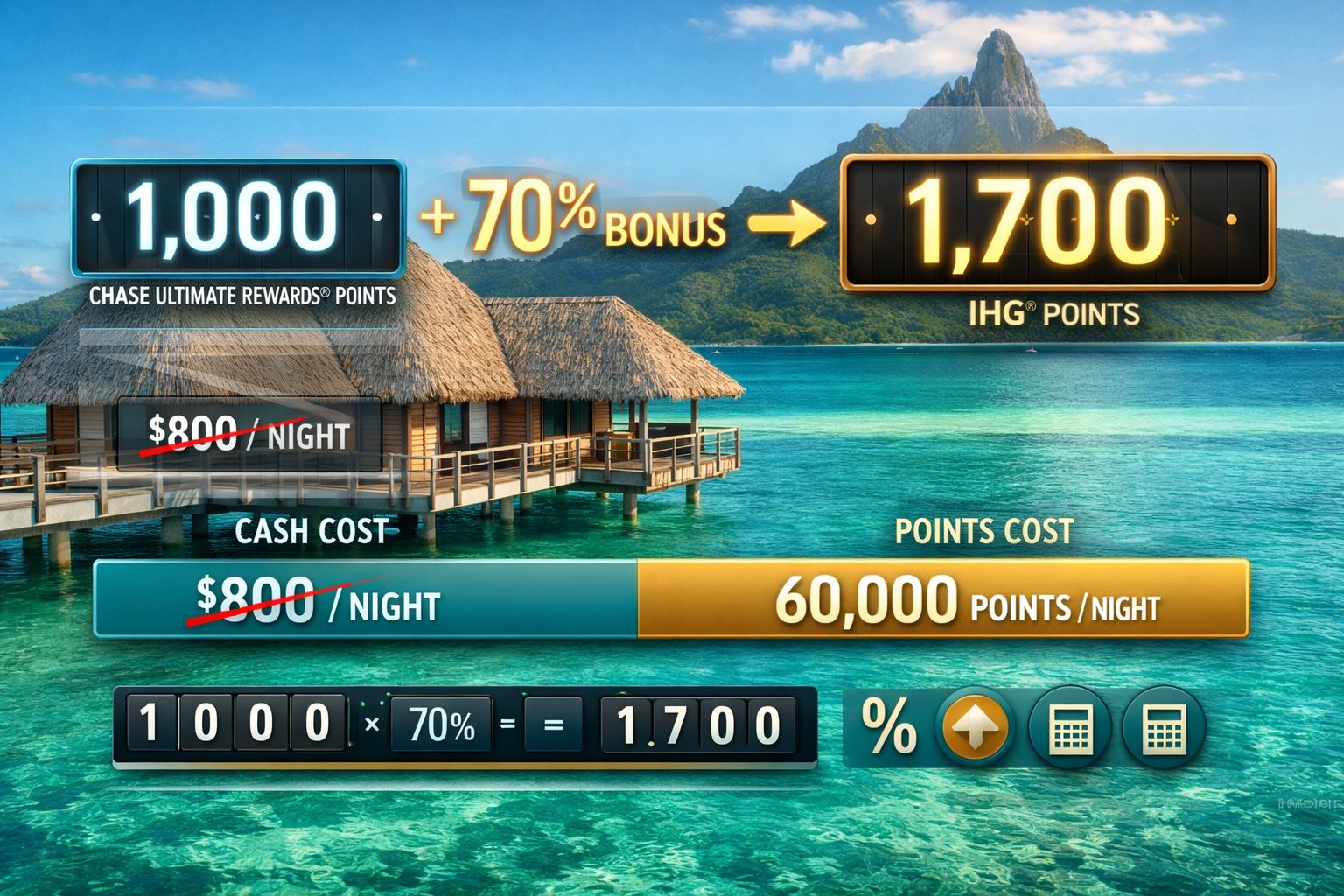
The math is straightforward: A 70% transfer bonus means 1,000 transferable points become 1,700 partner miles instead of the standard 1:1 ratio of 1,000 miles. A 15% bonus converts 1,000 points to 1,150 miles.
Simple Example: IHG Transfer Bonus
Assumptions: You want to book five nights at the InterContinental Bora Bora Resort & Thalasso Spa, a Category 7 property requiring 60,000 IHG One Rewards points per night during standard dates. Cash rates average $850 per night.
Without transfer bonus:
- Points needed: 60,000 IHG points
- Chase Ultimate Rewards required: 60,000 points (1:1 transfer)
- Effective value: $850 ÷ 60,000 = 1.42 cents per point (CPP)
With 70% transfer bonus (like the Chase promotion ending January 15, 2026):
- Points needed: 60,000 IHG points
- Chase Ultimate Rewards required: 60,000 ÷ 1.7 = 35,295 points
- Effective value: $850 ÷ 35,295 = 2.41 CPP
The bonus effectively increases redemption value by 70% if you were already planning this specific redemption. But if you transfer those 35,295 Chase points without a confirmed booking, you’ve locked them into IHG’s program—losing the flexibility to use them for flights, other hotel chains, or future transfer bonuses to different partners.
What changes: The bonus reduces the number of transferable points needed for a specific, confirmed redemption. It does not change award availability, surcharges, program rules, or whether the redemption is the best use of points in the first place.
What doesn’t change: Award charts, blackout dates, dynamic pricing, fuel surcharges, transfer processing times (1-3 days for most programs), or the irreversibility of the transfer.
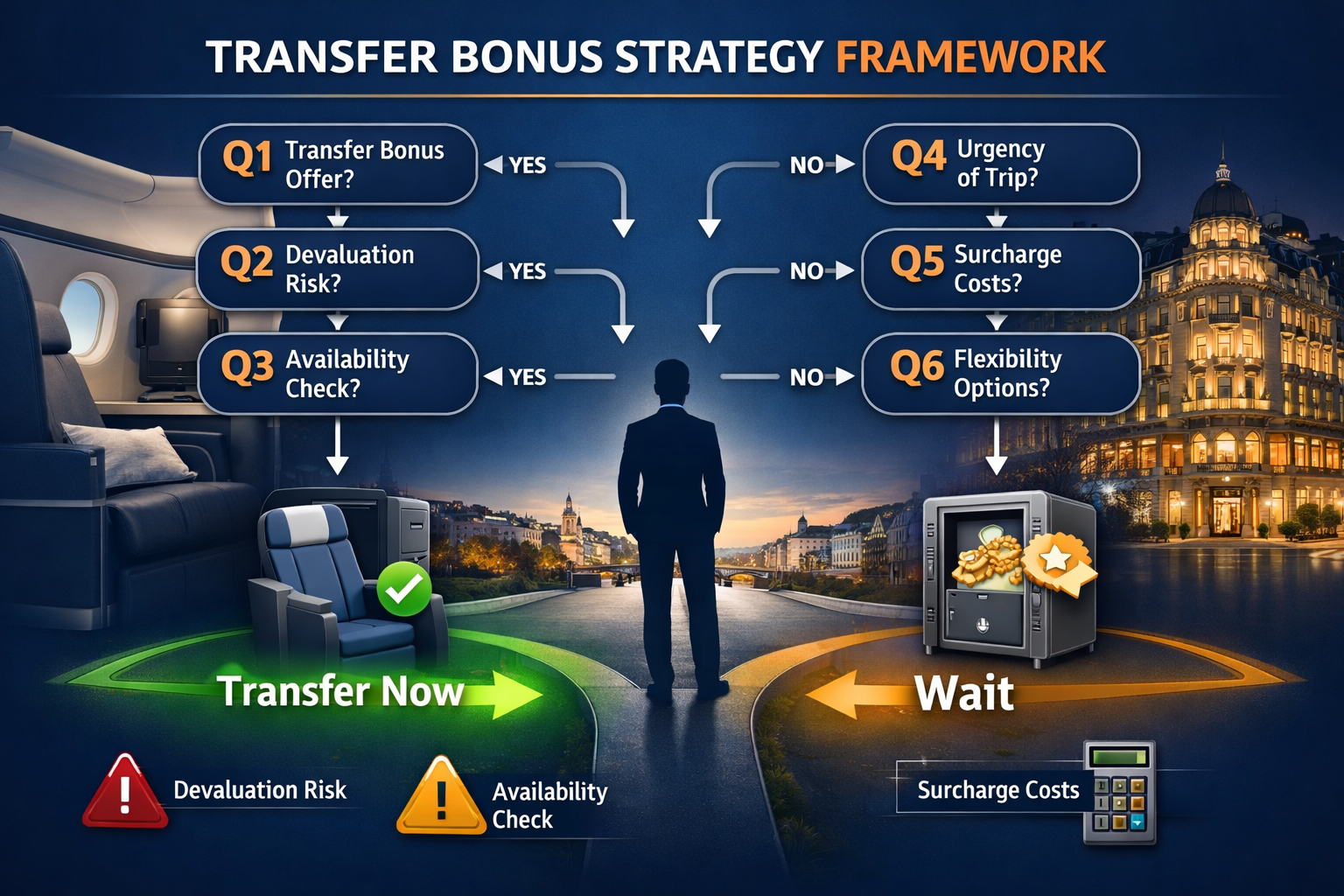
The 6-Question Transfer Bonus Strategy Framework
Use these six questions in order. If the answer to any question is “no” or “unfavorable,” reconsider the transfer.
Q1: Have You Confirmed Award Availability for Your Specific Dates and Route?
Why it matters: Transfer bonuses create urgency, but points transferred without confirmed availability become stranded in a program you may not use optimally.
How to check:
- Search the partner airline or hotel website directly (not aggregators)
- Verify award space shows as “available” or “standard award” pricing
- Screenshot or note the exact availability before transferring
- For flights: check multiple dates within a 3-day window in case space disappears
- For hotels: verify the point category and any restrictions (resort fees, blackout dates)
Common mistake: Assuming availability exists because you saw it mentioned in a blog post or saw cash availability. Award space and cash availability are completely separate inventories.
Decision point: If availability isn’t confirmed, do not transfer. Wait until you can see the exact award you want to book.
Q2: Does the Transfer Bonus Actually Improve Your Redemption Value?
Calculate the effective cents per point (CPP) value with and without the bonus, then compare to baseline values for your points currency.
Baseline values (approximate):
- Chase Ultimate Rewards: 1.5 CPP via portal (Sapphire Reserve), 1.25 CPP (Sapphire Preferred)
- Amex Membership Rewards: 1.1 CPP via portal (Platinum/Gold)
- Capital One miles: 1.0 CPP via portal
- Citi ThankYou Points: 1.25 CPP via portal (Premier)
- Bilt Rewards: 1.25 CPP via portal
Formula:
(Cash price of award ÷ Points required with bonus) = Effective CPP
Example: United business class to Europe
- Cash price: $3,500
- Award cost: 77,000 United miles (standard)
- With 30% transfer bonus: 77,000 ÷ 1.3 = 59,231 Chase points needed
- Effective value: $3,500 ÷ 59,231 = 5.91 CPP ✅
Compare to booking the same flight through the Chase travel portal:
- Portal cost: $3,500 ÷ 0.015 = 233,333 Chase points
- Effective value: 1.5 CPP
The transfer bonus redemption is clearly superior (5.91 CPP vs. 1.5 CPP).
Decision point: If the transfer bonus redemption delivers at least 1.5x your baseline portal value, it’s worth considering. If it’s close to or below portal value, skip the transfer and book through the portal to preserve flexibility.
Q3: What Are the Total Out-of-Pocket Costs (Surcharges, Fees, Taxes)?
Award tickets are rarely free. Some partner programs impose substantial fuel surcharges and carrier-imposed fees that can exceed $500-1,000 per ticket, dramatically reducing the value of a transfer bonus.
High-surcharge programs to watch:
- British Airways Avios: $400-800+ in surcharges on transatlantic flights operated by British Airways
- Air France/KLM Flying Blue: $300-600 on long-haul awards
- Lufthansa via Aeroplan or United: €300-700 on Lufthansa-operated flights
- Virgin Atlantic: $300-500 on Virgin-operated transatlantic
Lower-surcharge alternatives:
- Avianca LifeMiles: Minimal surcharges on Star Alliance partners (often $50-150)
- Air Canada Aeroplan: Reasonable fees on most Star Alliance routes ($100-300)
- United MileagePlus: No fuel surcharges on United-operated flights
Example comparison:
- British Airways: 26,000 Avios + $650 in surcharges (off-peak economy to Europe)
- Avianca LifeMiles: 63,000 miles + $120 in fees (business class to Europe)
Even with a 25% British Airways transfer bonus (reducing the Avios needed to 20,800), the $650 surcharge makes the Avianca redemption more cost-effective.
Decision point: Calculate total out-of-pocket costs before transferring. If surcharges exceed $300-400 per ticket, evaluate whether a different transfer partner offers better all-in value.
Q4: What Is the Devaluation Risk of Waiting?
Airline and hotel programs regularly devalue their award charts, sometimes with little notice. Transfer bonuses can hedge against devaluation if you have a near-term redemption planned.
Devaluation indicators:
- Dynamic pricing adoption: Programs moving away from fixed award charts (Delta, Flying Blue, Hilton, Marriott) can increase award costs at any time
- Merger/acquisition activity: Program changes often follow airline mergers or loyalty program sales
- Advance notice: Some programs (United, American) announce devaluations 30-90 days in advance; others do not
Recent examples:
- Avianca LifeMiles increased business class awards to Europe from 63,000 to 87,000 miles in 2024[1]
- IHG introduced dynamic pricing for top-tier properties in 2022, making some redemptions 50%+ more expensive
Risk assessment:
- High risk: Programs with dynamic pricing and no advance notice (Delta SkyMiles, Flying Blue)
- Medium risk: Programs with fixed charts but history of devaluations (United, American)
- Lower risk: Programs with recent devaluations (less likely to change again soon)
Decision point: If a program is likely to devalue within 6-12 months and you have a confirmed redemption, the transfer bonus provides insurance against future increases. If devaluation risk is low or you lack a specific redemption, preserve flexibility by waiting.
Q5: What Flexibility Are You Giving Up?
Transferable points are valuable precisely because they offer optionality. Once transferred, points are locked into a single program with specific redemption rules, blackout dates, and award charts.
Flexibility costs:
- Program bankruptcy or changes: Points in a single airline program are at risk if the airline restructures (rare but possible)
- Award availability fluctuations: If your travel dates change, transferred points may not offer availability when you need it
- Better future bonuses: A 30% bonus today may be followed by a 50% bonus in three months to a different partner
- Opportunity cost: Points transferred to IHG can’t be used for a future flight redemption if your plans change
When flexibility matters most:
- Travel plans are tentative or more than 6 months away
- You don’t have a specific redemption in mind
- You’re building a points balance for future undefined travel
- Multiple family members have different travel preferences
When flexibility matters less:
- You have confirmed award availability and are ready to book
- The redemption is a known “sweet spot” with consistent availability
- You’re booking within the next 30-60 days
- The transfer bonus significantly improves value (50%+ bonus)
Decision point: If your travel plans are firm and the redemption is confirmed, the flexibility cost is minimal. If plans are uncertain or more than 6 months out, wait and preserve optionality.
Q6: Is Booking Through Your Credit Card Portal a Better Option?
Premium travel credit cards offer portal redemption bonuses that sometimes rival or exceed transfer partner value—without the irreversibility or surcharge risk.
Portal redemption rates:
- Chase Sapphire Reserve: 1.5 CPP
- Chase Sapphire Preferred: 1.25 CPP
- Amex Platinum/Gold: 1.0 CPP (1.25 CPP on flights via Amex Travel)
- Capital One Venture X: 1.0 CPP (1.25 CPP on Capital One Travel)
- Citi Premier: 1.25 CPP
When the portal wins:
- Cash fares are discounted (sales, error fares)
- Transfer partner surcharges are high
- Award availability is poor but cash seats are available
- You value refundability and flexibility (portal bookings often offer better cancellation terms)
Example:
- Economy flight to Europe: $450 cash fare
- Chase Sapphire Reserve portal: $450 ÷ 0.015 = 30,000 points
- British Airways award: 26,000 Avios + $400 surcharges
- Portal is better: 30,000 points vs. 26,000 Avios + $400 cash
Decision point: Before transferring, price the same trip through your card’s travel portal. If the portal cost is within 20-30% of the transfer redemption and avoids high surcharges, book through the portal to preserve flexibility.
Transfer Now vs. Wait: Decision Triggers
| Transfer Now If: | Wait If: |
|---|---|
| ✅ Award availability is confirmed for your exact dates | ⏸ Availability is uncertain or you’re “just looking” |
| ✅ Redemption value exceeds 1.5x your portal baseline | ⏸ Redemption value is close to portal value |
| ✅ Surcharges are under $200-300 per ticket | ⏸ Surcharges exceed $400-500 per ticket |
| ✅ You’re booking within 30-60 days | ⏸ Travel is 6+ months away |
| ✅ Program devaluation is imminent or likely | ⏸ Program recently devalued or has stable award chart |
| ✅ Transfer bonus is 50%+ and redemption is a sweet spot | ⏸ Bonus is under 25% and redemption is marginal |
| ✅ You’ve compared portal pricing and transfer wins | ⏸ Portal pricing is competitive or better |
| ✅ You’re ready to book immediately after transfer | ⏸ You’re “stockpiling” points for undefined future use |
Key principle: Transfer bonuses reward execution, not speculation. Transfer when you have a confirmed plan that delivers clear value. Wait when uncertainty, flexibility, or alternative options provide better outcomes.
3 Real-World Transfer Bonus Strategy Case Studies (Europe Focus)
Case Study 1: Economy to Europe – When the Bonus Doesn’t Help
Scenario: Round-trip economy from New York to London in September 2026.
Assumptions:
- Cash fare: $550 (typical off-peak pricing)
- British Airways off-peak award: 26,000 Avios + $350 in surcharges
- Current transfer bonus: 25% from Amex to British Airways (26,000 Avios requires 20,800 Amex points)
Analysis:
- Transfer option: 20,800 Amex points + $350 cash = total cost
- Portal option (Amex Platinum): $550 ÷ 0.011 = 50,000 points (or 43,750 points at 1.25 CPP for flights)
- Effective value of transfer: $550 ÷ 20,800 = 2.64 CPP (looks good)
- But: $350 surcharge reduces net value to $200 ÷ 20,800 = 0.96 CPP
Better alternative: Use Avianca LifeMiles (15% transfer bonus from Capital One, ending February 11, 2026)
- Award cost: 30,000 LifeMiles + $120 fees
- With 15% bonus: 30,000 ÷ 1.15 = 26,087 Capital One miles
- Effective value: ($550 – $120) ÷ 26,087 = 1.65 CPP
Decision: Transfer to Avianca LifeMiles (better value, lower fees) or book through portal if you value flexibility. Skip the British Airways bonus despite the higher percentage—surcharges kill the value.
Case Study 2: Business Class to Europe – When the Bonus Shines
Scenario: Round-trip business class from Chicago to Frankfurt in May 2026.
Assumptions:
- Cash fare: $4,200
- Lufthansa business class via United: 77,000 United miles + $250 fees
- Lufthansa business class via Avianca LifeMiles: 87,000 miles + $180 fees (post-devaluation pricing)
- Current transfer bonus: 15% from Capital One to Avianca (ending February 11, 2026)
Analysis:
- United option (no bonus): 77,000 Chase points + $250
- Avianca with 15% bonus: 87,000 ÷ 1.15 = 75,652 Capital One miles + $180
- Portal option (Chase Sapphire Reserve): $4,200 ÷ 0.015 = 280,000 points
Effective values:
- United: ($4,200 – $250) ÷ 77,000 = 5.13 CPP
- Avianca with bonus: ($4,200 – $180) ÷ 75,652 = 5.31 CPP
- Portal: 1.5 CPP
Decision: Transfer to Avianca LifeMiles with the 15% bonus (best value, lower fees than United). The bonus provides meaningful savings (75,652 miles vs. 87,000 without bonus) and delivers 3.5x portal value. Transfer now if availability is confirmed.
Common mistake to avoid: Don’t assume United is always better because it’s a 1:1 transfer. Run the math with bonuses and fees included.
Case Study 3: Luxury Hotel Stay – When 70% Isn’t Enough
Scenario: Five nights at InterContinental Bordeaux – Le Grand Hotel (France) in July 2026.
Assumptions:
- Cash rate: $420/night = $2,100 total
- IHG points required: 50,000 points/night = 250,000 total (Category 6 property)
- Current transfer bonus: 70% from Chase to IHG (ending January 15, 2026)
- Alternative: Book through Chase portal at 1.5 CPP
Analysis:
- IHG with 70% bonus: 250,000 ÷ 1.7 = 147,059 Chase points
- Portal option: $2,100 ÷ 0.015 = 140,000 Chase points
- Effective value of IHG redemption: $2,100 ÷ 147,059 = 1.43 CPP
Decision: Book through the Chase portal (140,000 points vs. 147,059 points). The 70% transfer bonus sounds impressive but doesn’t overcome IHG’s inflated award pricing for this property. Portal booking also preserves flexibility for cancellations and avoids locking points into IHG.
Key insight: Hotel transfer bonuses often look attractive but require careful comparison to portal rates. High award chart categories (6-7) frequently cost more points than portal bookings, even with substantial bonuses.
Exception: If the property were in a remote location (like Bora Bora) where cash rates are $800+/night but IHG category remains 6-7, the transfer bonus would deliver significantly better value.
Transfer Bonus Strategy Checklist & Rules of Thumb
Pre-Transfer Checklist
Use this checklist before initiating any transfer during a bonus promotion:
- Confirmed availability: Award space verified on partner website for exact dates
- Screenshot saved: Availability documented in case space disappears
- Surcharges calculated: Total out-of-pocket fees identified and acceptable
- Portal comparison completed: Transfer redemption delivers at least 1.5x portal value
- Transfer amount calculated: Exact points needed with bonus factored in (round up to avoid shortfalls)
- Transfer timing confirmed: Sufficient time for 1-3 day processing before award space might disappear
- Backup plan identified: Alternative redemption or portal booking if transfer fails or space vanishes
- Account details verified: Transfer to correct frequent flyer/hotel account (transfers are irreversible)
Rules of Thumb for Transfer Bonus Strategy
✅ Transfer bonuses worth taking:
- 50%+ bonuses to programs with confirmed sweet spot redemptions (e.g., 70% Chase to IHG for expensive resort stays)
- 25%+ bonuses that reduce surcharge-heavy redemptions to competitive levels
- Any bonus when booking premium cabin international flights at 4+ CPP effective value
- Bonuses to programs with imminent devaluation risk when you have confirmed availability
⏸ Transfer bonuses to approach cautiously:
- Hotel bonuses under 50% (often don’t overcome inflated award charts vs. portal pricing)
- Airline bonuses to programs with high fuel surcharges (British Airways, Air France/KLM)
- Bonuses for economy domestic flights (portal usually competitive or better)
- Any bonus when availability is uncertain or travel is 6+ months away
❌ Transfer bonuses to skip:
- Bonuses when portal pricing is within 20% of transfer redemption
- Any bonus without confirmed award availability
- Bonuses to programs you don’t have immediate redemption plans for
- Bonuses that “expire soon” creating artificial urgency without a confirmed use case
General benchmarks:
- Excellent value: 3+ CPP (business/first class international, luxury hotels in expensive markets)
- Good value: 1.8-3 CPP (premium economy long-haul, upscale hotels)
- Marginal value: 1.2-1.8 CPP (economy international, mid-tier hotels)
- Poor value: Under 1.2 CPP (usually better to book through portal or use cash)
Timing strategy:
- Transfer 2-3 days before you plan to book (allows processing time)
- Book awards within 24-48 hours of the transfer being completed
- Avoid transferring on weekends (processing may be delayed until Monday)
- Set calendar reminders for bonus end dates to avoid last-minute pressure
Frequently Asked Questions
Can I transfer points back if I change my mind?
No. Transfers from Chase, Amex, Capital One, Citi, and Bilt to airline and hotel partners are permanent and irreversible. Once points leave your transferable currency account, they cannot be returned—even if you don’t use them or the program devalues. This is why confirming availability before transferring is critical to any transfer bonus strategy.
How long do transfer bonuses typically last?
Most transfer bonuses run 30-90 days, though some are shorter (7-14 days) or longer (quarterly promotions). Chase, Amex, and Capital One typically announce bonuses with specific end dates. Do not assume a bonus will be extended—treat the published end date as final when planning transfers.
Do transfer bonuses apply to all cardholders or just targeted offers?
Both exist. Many transfer bonuses are available to all cardholders of a particular program (e.g., all Chase Ultimate Rewards cardholders can access a Chase-to-IHG bonus). Some bonuses are targeted to specific accounts based on spending patterns or account history. Check your account’s transfer page or promotional emails to confirm eligibility before planning a redemption.
Should I transfer the maximum amount during a bonus to “stockpile” miles?
Generally no. Transferring points without a specific redemption plan exposes you to devaluation risk, program changes, and loss of flexibility. The exception: if you have multiple confirmed redemptions planned within 6-12 months with the same partner and the program has announced an imminent devaluation, transferring enough for all planned bookings can make sense. Otherwise, transfer only what you need for confirmed bookings.
What happens if award space disappears during the 1-3 day transfer processing period?
You’re stuck. Points will complete the transfer to the partner program even if availability vanishes. This is why booking high-demand routes or limited-availability awards during transfer bonuses carries risk. Mitigation strategies: Transfer during periods of wide availability, have backup award options identified, or book through the portal if space is extremely limited.
Are hotel transfer bonuses usually better than airline bonuses?
Not necessarily. Hotel transfer bonuses often feature higher percentages (50-100%) but hotel programs typically have inflated award charts that require comparison to portal pricing. A 70% hotel bonus may still cost more points than booking through your card’s portal, while a 15% airline bonus to a program with good sweet spots can deliver 4-5 CPP value. Always run the math comparing transfer redemption to portal pricing before assuming a higher bonus percentage means better value.
Conclusion: If You Only Remember 3 Things…
Transfer bonuses create urgency, but the best transfer bonus strategy prioritizes confirmed value over promotional percentages.
1. Never transfer without confirmed award availability. The highest bonus in the world doesn’t help if the award seat or hotel room isn’t actually available when you’re ready to book. Search partner programs directly, verify space, and screenshot availability before initiating transfers. Points transferred speculatively often deliver less value than keeping them flexible.
2. Run the complete math: points required, surcharges, and portal comparison. A 70% bonus sounds better than 15%, but effective value depends on total out-of-pocket costs and alternative redemption options. Calculate cents per point including all fees, then compare to booking the same trip through your credit card’s travel portal. Transfer only when the redemption delivers at least 1.5x your portal baseline value.
3. Flexibility has value—preserve it unless the transfer delivers clear, immediate benefit. Transferable points offer optionality across dozens of airline and hotel partners. Once transferred, they’re locked into a single program’s rules, award charts, and devaluation risks. Transfer when you have a confirmed booking that maximizes value. Wait when travel plans are uncertain, redemption value is marginal, or better opportunities may emerge.
The next time a transfer bonus hits your inbox, resist the urge to transfer immediately. Use the six-question framework, run the numbers, confirm availability, and transfer only when all factors align. That discipline—not chasing every bonus—is what separates strategic points users from those who wonder why their balances never seem to stretch as far as expected.

