

Last updated: April 10, 2026
Key Takeaways
- Lounge access rules tightened across all three major premium cards in early 2026, with Capital One Venture X cutting free guest access, Amex adding same-flight requirements, and Chase holding relatively steady on Sapphire Reserve.
- The Venture X effective annual fee is still near $0 after credits and anniversary miles, making it the easiest to justify even with reduced lounge benefits.
- Amex Platinum’s $895 fee requires heavy use of niche credits (airline incidentals, Uber, digital entertainment) to break even; lounge access alone no longer makes the card worthwhile.
- Chase Sapphire Reserve is the most stable option for 2-guest lounge access via Priority Pass, with no major policy changes as of early 2026.
- Frequent business travelers (10+ trips/year) still get clear value from premium cards. Infrequent leisure travelers (1–2 trips) often don’t.
- Families of 3–4 now face $45–$90 in guest fees per lounge visit on Venture X, which changes the math significantly compared to 2025.
- Downgrading isn’t always the right move; lost trip delay insurance, rental car coverage, and transfer partner access can cost more than the annual fee difference.
- The real value of premium cards in 2026 is access to transferable points and travel protections, not lounge perks.
Quick Answer
Are premium travel cards worth it in 2026? For most intermediate travelers taking 3+ trips per year, yes, but the justification has shifted away from lounge access and toward transferable points, travel credits, and insurance benefits. The lounge cutbacks across Amex Platinum, Capital One Venture X, and Chase Sapphire Reserve mean the break-even math now depends more on how effectively you use statement credits and points transfer partners. Solo frequent travelers still benefit the most; families and infrequent travelers should run the numbers before renewal.
What Really Changed for Premium Travel Cards in 2026?
Three significant policy shifts reshaped the premium card landscape in early 2026, and understanding the specifics matters more than the headlines.
Capital One Venture X (effective February 1, 2026):
- Complimentary guest access to Capital One Lounges, Capital One Landings, and Priority Pass lounges was eliminated
- Adult guests now cost $45 each per visit
- Authorized users require a $125 annual fee (up to 4) for their own lounge access
- Cardholders who spend $75,000+ annually on the card retain free guest access
- Children under 2 remain free
For a detailed breakdown, see our Venture X lounge changes guide.
American Express Platinum (effective July 8, 2026):
- Centurion Lounge guests must now be on the same flight as the cardholder
- Layover access is limited to 5 hours before departure at U.S. and select international locations (LHR, HND)
- Existing guest fee structure remains: free guests require $75,000+ in annual spend, otherwise $50 per guest
- These rules target the practice of using Centurion Lounges as general day-use spaces
For the full picture on Amex Platinum’s current benefit stack, read our Amex Platinum benefits 2026 analysis.
Chase Sapphire Reserve (no major changes as of February 2026):
- Still offers 2 free Priority Pass guests per visit ($27 per additional guest)
- No same-flight or spend threshold requirements announced
- The annual fee increased to $795 (from $550 pre-2025), with the $300 travel credit unchanged
Chase Ritz-Carlton Card (effective January 15, 2026):
- Unlimited Priority Pass guests eliminated; now capped at 2 free ($27 extras)
- Authorized users require a $125 annual fee for lounge access
The pattern is clear: issuers are responding to lounge overcrowding by restricting guest access and adding spend thresholds. This directly affects families and travelers who previously shared a single card’s benefits across a group.
For a broader context on how these changes fit into the year’s trends, see our award travel predictions for 2026.
Side-by-Side Comparison: Amex Platinum vs. Venture X vs. Sapphire Reserve in 2026
Here’s where the three major premium cards stand after the 2026 changes. This table focuses on the factors that most affect break-even math.
| Feature | Amex Platinum | Capital One Venture X | Chase Sapphire Reserve |
|---|---|---|---|
| Annual fee | $895 | $395 | $795 |
| Travel credit | $200 airline incidental + $200 hotel (FHR/HC) | $300 travel credit (any travel) | $300 travel credit (any travel) |
| Effective fee after credits | ~$495 (if you fully use both credits) | ~$0 (after $300 credit + 10K anniversary miles at ~1.0 cpp) | ~$495 |
| Lounge network | Centurion, Priority Pass, Delta Sky Club (with Delta flights), Lufthansa, Plaza Premium | Capital One Lounges, Priority Pass | Priority Pass, Chase Sapphire Lounges (limited locations) |
| Free lounge guests | 0 (unless $75K spend) | 0 (unless $75K spend) | 2 per visit |
| Guest fee | $50/guest (Centurion) | $45/guest (Capital One Lounges) | $27/guest (Priority Pass, after 2 free) |
| Points earn rate (travel) | 5x flights booked via Amex Travel | 10x on hotels/rental cars via portal, 5x flights via portal, 2x all else | 3x travel, 3x dining, 10x via Chase portal on hotels/car |
| Transfer partners | 20+ airline/hotel | 15+ airline/hotel | 14+ airline/hotel |
| Trip delay insurance | $200/6 hrs | $100/6 hrs | $100/6 hrs |
| Rental car CDW | Secondary | Primary | Primary |
Key takeaway from this comparison: The Venture X has the lowest effective cost, but now the weakest guest lounge access. The Amex Platinum has the broadest lounge network but the highest fee and most restrictive guest rules. The Sapphire Reserve sits in the middle with the most stable guest policy.
For help calculating whether your specific spending pattern justifies any of these fees, try our annual fee ROI calculator.
Break-Even Math: Are Premium Travel Cards Worth It in 2026 for Your Travel Pattern?
Generic benefit lists don’t answer the real question. Here’s the travel rewards math for three common traveler profiles, using realistic assumptions.
Assumptions for all scenarios:
- Points valued at 1.0 cpp for Venture X miles, 1.5 cpp for Amex points (via transfer partners), 1.5 cpp for Chase points (via transfer partners). See our cents-per-point guide for methodology.
- All statement credits are fully used.
- Lounge visits are valued at $40 per person (comparable to day-pass pricing at most Priority Pass locations).
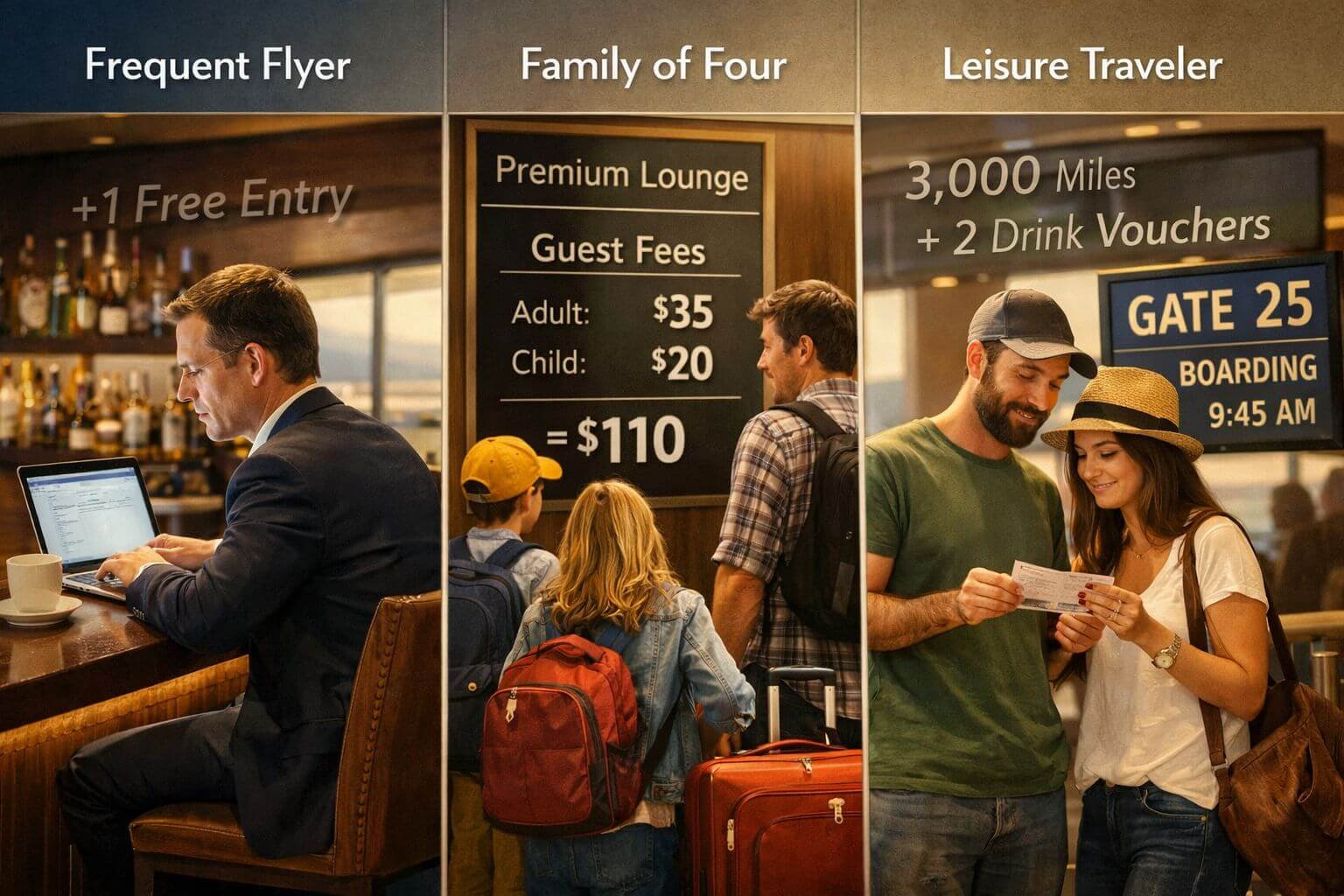
Archetype 1: Infrequent Leisure Traveler (1–2 trips/year, solo or couple)
| Value Source | Amex Platinum | Venture X | Sapphire Reserve |
|---|---|---|---|
| Travel credits used | $400 | $300 | $300 |
| Lounge visits (4 visits, solo) | $160 | $160 | $160 |
| Anniversary miles/points | — | $100 (10K miles) | — |
| Trip delay insurance value (est.) | $50 | $50 | $50 |
| Total value | $610 | $610 | $510 |
| Annual fee | $895 | $395 | $795 |
| Net value | -$285 | +$215 | -$285 |
Verdict: Only the Venture X breaks even for infrequent travelers. Amex Platinum and Sapphire Reserve require additional credit usage (Uber, Saks, entertainment) or high-value points redemptions to justify themselves. If you’re in this category, consider whether a no-annual-fee card with travel perks would serve you better.
Archetype 2: Family of Four, 3 Trips Per Year
This is where the 2026 lounge changes hit hardest.
| Value Source | Amex Platinum | Venture X | Sapphire Reserve |
|---|---|---|---|
| Travel credits used | $400 | $300 | $300 |
| Lounge visits (6 visits, 4 people) | $240 (cardholder only; guests cost $300 total at $50 each) | $240 (cardholder only; guests cost $270 at $45 each × 3 guests × 2 visits needing all 4) | $240 (cardholder + 2 free guests; 1 extra guest = $162 total at $27 × 6) |
| Net lounge value after guest fees | -$60 | -$30 | +$78 |
| Anniversary miles | — | $100 | — |
| Trip delay (family, est.) | $100 | $100 | $100 |
| Total value | $440 | $470 | $478 |
| Annual fee | $895 | $395 | $795 |
| Net value | -$455 | +$75 | -$317 |
Verdict: For families, the Sapphire Reserve’s 2 free guests make it the best lounge option, but the high fee still makes it hard to break even on lounge access alone. The Venture X barely stays positive. The Amex Platinum is the hardest to justify for family lounge use.
Common mistake: Counting lounge access at full retail value ($60–$80 per visit) when you wouldn’t actually pay for a day pass. Be honest about what you’d spend without the card.
Archetype 3: Frequent Business Traveler (10+ trips/year, solo)
| Value Source | Amex Platinum | Venture X | Sapphire Reserve |
|---|---|---|---|
| Travel credits used | $400 | $300 | $300 |
| Lounge visits (20 visits, solo) | $800 | $800 | $800 |
| Anniversary miles | — | $100 | — |
| Trip delay insurance (est. 2 claims) | $400 | $200 | $200 |
| Rental car CDW savings (est.) | $150 | $150 | $150 |
| Total value | $1,750 | $1,550 | $1,450 |
| Annual fee | $895 | $395 | $795 |
| Net value | +$855 | +$1,155 | +$655 |
Verdict: All three cards deliver strong value for frequent solo travelers. The Venture X wins on net value because of its low effective fee. The Amex Platinum wins on lounge network breadth (Centurion + Lufthansa + Delta Sky Club access). For frequent flyers focused on booking business class with points, the transfer partner networks matter more than lounge access.
When It Makes Sense to Downgrade or Cancel Your Premium Card
Downgrade if:
- You’re in Archetype 1 (infrequent traveler), holding an Amex Platinum or Sapphire Reserve
- You can’t fully use the statement credits each year
- You primarily valued the card for lounge guest access, which is now restricted
- You want to keep the points transfer partner access (downgrading within the same issuer preserves your points)
Keep if:
- You travel 3+ times per year solo and actively use lounges
- You regularly book premium cabin awards through transfer partners and need the earn rates
- You rely on the trip delay insurance, rental car CDW, or other protections (these are often worth $200–$500/year for frequent travelers)
- You’re using the card’s portal bonuses (10x on hotels through Chase or Capital One portals)
Cancel only if:
- You have no other card with the same issuer to transfer points to
- You’ve confirmed you won’t lose points or transfer partner access
- The opportunity cost of the annual fee exceeds all benefits, including protections you’d need to buy separately
For a step-by-step walkthrough of the downgrade process, see our credit card downgrade vs. cancel decision guide.
Edge case: If you hold both an Amex Platinum and a Sapphire Reserve, the overlap in Priority Pass access means you’re paying twice for similar lounge coverage. Consider keeping one premium card and downgrading the other to a mid-tier option that preserves your points ecosystem.
Smarter Alternatives if Premium Cards No Longer Fit
If the break-even math doesn’t work for your travel pattern, here are practical alternatives that preserve most of the value.
Within the same ecosystem (downgrade path):
- Amex Platinum → Amex Gold ($325/year): Keep Amex points and transfer to partners. Lose lounge access but gain 4x dining and groceries. Strong for families with high food spending.
- Sapphire Reserve → Sapphire Preferred ($95/year): Keep Chase points and transfer partners. Lose Priority Pass but keep trip cancellation insurance and 3x dining/2x travel.
- Venture X → VentureOne ($0/year): Keep Capital One miles. Lose lounge access and portal bonuses but maintain the ability to transfer miles to partners.
Multi-card strategy (best for intermediate users): Pair a mid-tier card with a no-fee card from a different ecosystem to maintain access to multiple transfer partner networks. For example:
- Chase Sapphire Preferred (Chase points + 14 transfer partners) + Bilt Mastercard ($0/year, Bilt points + unique partners like Hyatt and Turkish Airlines)
- This combination costs $95/year total and gives access to 25+ airline and hotel transfer partners
For a broader look at how transferable points compare to cash back in 2026, read our points vs. cash back strategy comparison.
What you lose by downgrading (don’t overlook these):
- Trip delay insurance: Premium cards typically cover $100–$200 per 6-hour delay. A single weather delay can pay for months of annual fees.
- Primary rental car CDW: Sapphire Reserve and Venture X offer primary coverage, saving $15–$30/day on rental car insurance. Our rental car insurance guide breaks this down.
- Global Entry/TSA PreCheck credit: Most premium cards reimburse the $100 fee every 4–5 years. Some mid-tier cards do too, but check before downgrading.
- Higher earn rates on travel: Dropping from 5x to 2x on flights means earning significantly fewer points per dollar on your biggest travel purchases.
Decision Framework: Should You Keep Your Premium Travel Card in 2026?
Use this quick framework to decide:
- Calculate your effective annual fee (fee minus credits you actually use, not credits you could theoretically use).
- Count your annual lounge visits and multiply by $40 for solo value. Subtract any guest fees you’d now pay.
- Estimate insurance value based on your actual travel frequency (trip delay, baggage, rental car).
- Add the value of points earned above what a mid-tier card would earn on your typical spending.
- Compare the total value to the effective fee. If the gap is less than $100 in either direction, factor in convenience and peace of mind.
Choose to keep if the total value exceeds the effective fee by $100+. Choose to downgrade if the effective fee exceeds the total value by $100+. It’s a toss-up if the difference is under $100; lean toward keeping if you value the insurance protections.
FAQ
Q: Is the Capital One Venture X still worth it after the February 2026 lounge changes? Yes, for most solo travelers. The effective annual fee is still near $0 after the $300 travel credit and 10,000 anniversary miles. The lounge changes primarily hurt families and travelers who relied on free guest access. See our full Venture X benefits breakdown.
Q: Should I cancel my Amex Platinum in 2026? Don’t cancel without first checking whether a downgrade to the Amex Gold preserves your points balance and transfer partner access. The Platinum is hardest to justify for travelers taking fewer than 4 trips per year who don’t fully use the airline’s incidental, Uber, and hotel credits.
Q: Which premium card has the best lounge guest policy in 2026? Chase Sapphire Reserve: 2 free Priority Pass guests per visit, no spend threshold. This makes it the strongest option for couples and small families who want lounge access without per-guest fees.
Q: Can I still access Delta Sky Clubs with the Amex Platinum? Yes, when flying Delta. The Amex Platinum provides Delta Sky Club access on same-day Delta flights. Guest policies follow Delta’s own rules, which are separate from Centurion Lounge policies.
Q: What’s the best mid-tier alternative to a premium travel card? The Chase Sapphire Preferred ($95/year) offers the best balance of transfer partner access, travel protections, and low cost. Pair it with the Bilt Mastercard ($0/year) for expanded partner coverage.
Q: Do I lose my points if I downgrade my premium card? Generally, no, as long as you downgrade to another card within the same issuer’s ecosystem. Amex points stay with any Amex Membership Rewards card, Chase points stay with any Sapphire or Freedom card, and Capital One miles stay with any Capital One card.
Q: Are Chase Sapphire Lounges a real alternative to Centurion Lounges? They’re expanding but still limited to a handful of locations. Check our Chase Sapphire Lounge locations guide for current availability. They’re a nice bonus at airports where they exist, but not a reason to choose the Sapphire Reserve over other cards.
Q: Is it worth paying $45 per guest at Capital One Lounges? Only if you’d otherwise pay for a comparable day pass or restaurant meal at the airport. At $45 per adult guest, a family of four pays $135 per visit in addition to the cardholder’s free entry. For families visiting lounges 3+ times per year, the authorized user fee ($125/year for unlimited access) may be more cost-effective.
Q: What’s the biggest risk of keeping a premium card I barely use? Opportunity cost. The $500–$895 annual fee could fund a signup bonus on a new mid-tier card worth $750+ in points, or simply stay in your pocket. Run the break-even math honestly before each renewal.
Q: How do devaluation risks affect this decision? Points devaluation is real but affects all cards equally. The key question isn’t whether points will lose value (they will, gradually, due to dynamic pricing trends) but whether you’re earning enough points at premium card rates to offset the higher fee. If you’re not actively booking premium cabin awards through transfer partners, the higher earn rates on premium cards may not matter.
Conclusion
The question of whether premium travel cards are worth it in 2026 comes down to honest math, not brand loyalty. Lounge access, once the headline benefit that justified $400–$895 annual fees, has been meaningfully restricted across all three major premium cards. Capital One Venture X cut free guests entirely, Amex Platinum added same-flight requirements for Centurion Lounges, and only Chase Sapphire Reserve held steady with 2 free Priority Pass guests.
For frequent solo travelers, premium cards still deliver strong value through lounge access, insurance protections, and higher point-earning rates. For families and infrequent travelers, the math has shifted: the lounge benefit alone rarely covers the fee gap between premium and mid-tier cards.
Next steps:
- Run your personal break-even calculation using the framework above or our annual fee ROI calculator.
- If you decide to downgrade, do it before your next annual fee posts (most issuers refund within 30 days of the fee posting).
- If you’re keeping your card, make sure to activate all available credits and use transfer partners for premium cabin bookings rather than portal redemptions.
- Set a calendar reminder to re-evaluate at your next renewal; lounge policies and annual fees will likely shift again before 2027.
The cards aren’t dead. But the era of justifying a premium annual fee primarily through lounge access is over.


Content on Award Travel Hub is independently created by Award Travel Hub Editorial Desk and, where noted, reviewed by Award Travel Hub Review Desk. Some pages may contain affiliate links, but compensation does not determine our coverage, opinions, or methodology.