
You’ve found the perfect business class award seat to Europe—50,000 points, lie-flat seat, the works. There’s just one problem: it only departs from New York, and you live in Columbus. Your home airport wants 90,000 points for the same route, or worse, shows zero availability. This is the exact moment when understanding positioning flights transforms from travel trivia into a skill that saves you tens of thousands of points.
A positioning flight is a separately booked short-haul flight that gets you from your home airport to a major gateway hub where better award availability and pricing are available. It’s the tactical move that unlocks sweet spots invisible to direct searches, bypasses married-segment pricing logic, and gives you access to the Premium Cabin awards that make transferable points worth collecting in the first place.
But booking positioning flights incorrectly can turn your dream trip into a nightmare. Miss your connection on separate tickets, and the airline has zero obligation to rebook you—your international award seat simply departs without you, and your points vanish. This guide provides the step-by-step workflow, buffer time decision rules, and break-even math you need to position safely and profitably in 2026.
Key Takeaways
- Positioning flights are separately-booked short-haul tickets to major gateway airports that unlock better award availability and pricing than direct searches from your home airport
- Always book the long-haul award first, then arrange positioning—never commit to a gateway city before securing your core international flight
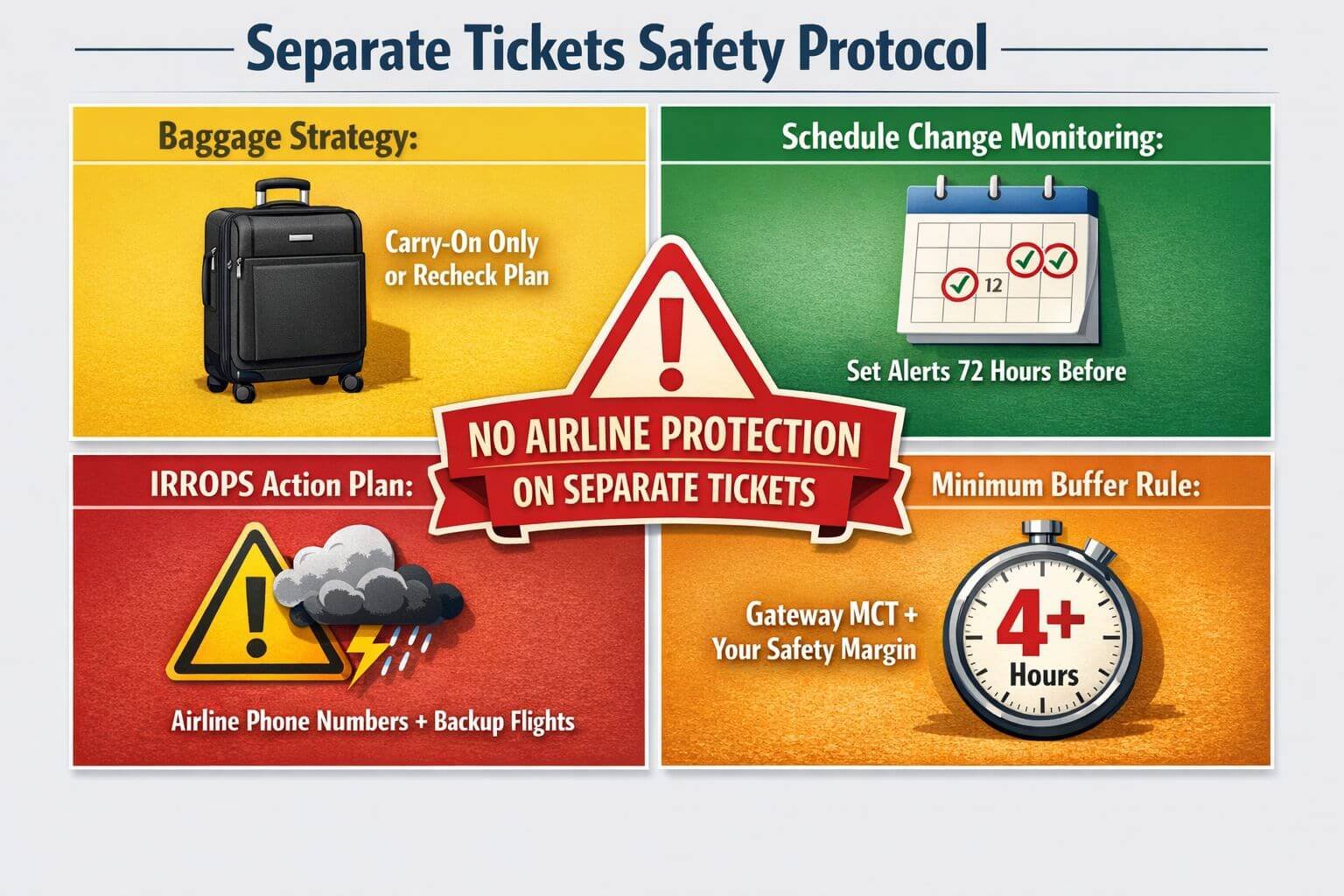
- Use a minimum 4-hour buffer for same-day connections (or fly in the night before for high-stakes trips) since separate tickets provide zero airline protection
- Run break-even math before committing: calculate total cash spent (positioning ticket + hotel if overnight) against points saved, targeting minimum 1.5 cents per point value
- Only use flexible or refundable positioning tickets to protect against schedule changes on your main award booking
What Is a Positioning Flight and Why Do Travelers Use It
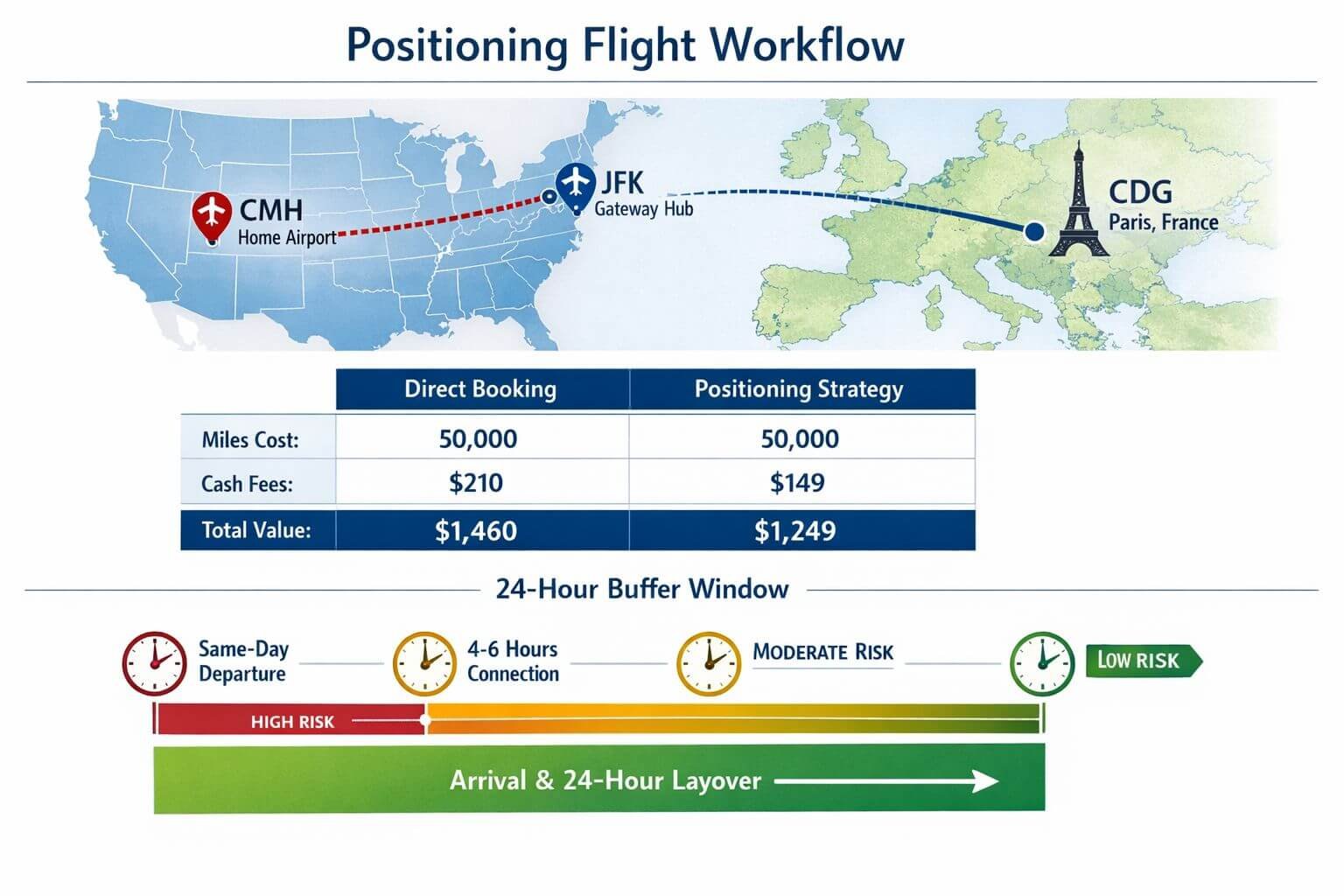
A positioning flight is a short-haul flight purchased separately to travel from your home airport to a major international gateway where long-haul award flights are available. Unlike a standard connection booked as part of one itinerary, positioning flights are booked on separate tickets—typically cash tickets or low-cost awards—that have no contractual relationship with your main international flight.
The core purpose: bypass married-segment logic and access better award inventory at major hubs like New York (JFK), Los Angeles (LAX), Chicago (ORD), or Boston (BOS).
Why Positioning Flights Matter for Award Travel
Airlines use sophisticated inventory management systems that treat multi-city searches differently than point-to-point searches. When you search Columbus (CMH) to Paris (CDG), the airline’s system may:
- Show zero award availability despite having seats on the JFK-CDG segment
- Apply dynamic pricing that inflates the point cost by 40-80% compared to gateway departures
- Force you onto specific routing that avoids their most valuable partner inventory
Example: A Flying Blue search from Columbus to Paris shows 50,000 miles plus $210 in taxes. The exact same dates from New York to Paris cost 50,000 miles plus $149—identical miles but $61 less in fees. Add a $89 positioning flight CMH-JFK, and you’ve saved money while maintaining schedule control.
The math gets more compelling when award availability disappears entirely from your home airport. If you need four business class seats to Europe for your family, your regional airport may show zero availability while JFK shows consistent inventory across multiple dates.
When Positioning Flights Unlock Hidden Value
Positioning flights become essential in three specific scenarios:
1. Sweet spot access: Programs like British Airways Avios offer exceptional redemption rates (13,000 points to Hawaii or Ireland) but only from specific gateway cities on the West or East Coast. If you live in the Midwest, positioning becomes the only way to access these sweet spots.
2. Partner airline inventory: Virgin Atlantic frequently releases substantial award space from Boston and Washington Dulles to London, but shows limited or zero availability from connecting cities. The partner airline (Delta) may not make that inventory visible to searches originating from your home airport.
3. Premium cabin availability: Long-haul business and first class awards are already scarce. When you need multiple seats or specific dates, major hubs offer 3-5x more inventory than spoke airports. Positioning expands your search universe from one airport to potentially 4-6 major gateways within a reasonable positioning distance.
Understanding how to book business class with points provides the foundation for identifying when positioning makes strategic sense versus when direct routing suffices.
How to Find the Best Gateway City for Your Award Flight (Step-by-Step)
Finding the optimal gateway city requires working backward from award availability, not forward from your home airport. This inverted search process ensures you’re positioning toward real inventory, not theoretical routing.
Step 1: Identify Your Target Destination and Rough Travel Window
Start with your end goal:
- Final destination (e.g., Paris, Tokyo, Sydney)
- Approximate travel dates (±3 days flexibility if possible)
- Cabin preference (economy, premium economy, business, first)
- Number of passengers
Do not search from your home airport yet. You’re gathering intelligence on where inventory actually exists.
Step 2: Search Award Availability from Major Gateway Hubs
Run parallel searches from 4-6 major hubs to your destination using the same dates. Focus on these primary North American gateways:
East Coast: JFK (New York), EWR (Newark), BOS (Boston), IAD (Washington), MIA (Miami)
West Coast: LAX (Los Angeles), SFO (San Francisco), SEA (Seattle)
Central: ORD (Chicago), DFW (Dallas), IAH (Houston)
Use airline-specific search tools rather than generic flight search engines:
- Air Canada Aeroplan for Star Alliance inventory (United, Lufthansa, ANA, Singapore)
- British Airways Executive Club for oneworld inventory (American, Qantas, Japan Airlines)
- Air France-KLM Flying Blue for SkyTeam inventory (Delta, Virgin Atlantic, Korean Air)
Record which gateways show availability for your dates. You’re building a shortlist of viable positioning targets.
Step 3: Compare Award Pricing and Fees Across Gateways
Not all gateway cities offer equal value. Compare:
- Points required: Some gateways trigger lower award pricing due to distance-based or zone-based charts
- Taxes and fees: European destinations from Boston may carry $400+ in fuel surcharges, while the same route from other gateways costs $150
- Schedule quality: A 10-hour layover in your gateway city may require an overnight hotel, changing your break-even calculation
Create a simple comparison table:
| Gateway | Points | Cash Fees | Departure Time | Arrival Time |
|---|---|---|---|---|
| JFK | 50,000 | $149 | 10:00 PM | 11:30 AM+1 |
| BOS | 50,000 | $387 | 9:15 PM | 10:45 AM+1 |
| IAD | 50,000 | $156 | 11:30 PM | 1:00 PM+1 |
The BOS option charges $238 more in fees for identical point cost and similar schedule—eliminating it from consideration unless it offers significant positioning convenience.
Step 4: Calculate Positioning Cost and Complexity
For each viable gateway, estimate positioning logistics:
Cash positioning cost: Search Google Flights or Southwest for your home airport to each gateway. Look for:
- Direct flights (preferred for schedule reliability)
- Departure times that provide your target buffer (see buffer rules section below)
- Flexible or refundable fare options (critical for separate ticket protection)
Positioning time investment: Calculate total travel time including:
- Home to home airport (driving/parking)
- Positioning flight duration
- Gateway airport navigation time
- Buffer window before international departure
Overnight requirements: If your buffer rule requires flying in the night before (recommended for high-value trips), add:
- Gateway city hotel cost ($100-200)
- Airport hotel transportation
- Meals and incidentals
Step 5: Run the Break-Even Calculation
Your positioning strategy only makes sense if total cost (cash + points) delivers better value than direct booking from home.
Formula:
<code>Direct booking value = (Points required × Your CPP threshold) + Cash fees
Positioning value = (Points required × Your CPP threshold) + Cash fees + Positioning cost + Hotel (if overnight)
Net savings = Direct booking value - Positioning value
</code>
Example:
- Direct CMH-CDG: 90,000 points + $210 fees = (90,000 × $0.015) + $210 = $1,560 total value
- Positioning via JFK: 50,000 points + $149 fees + $89 positioning + $150 hotel = (50,000 × $0.015) + $149 + $89 + $150 = $1,138 total value
- Net savings: $422 (27% reduction)
If your break-even shows less than $200 savings for a domestic positioning flight, or less than $400 for international positioning, reconsider whether the added complexity and risk justify the savings.
The cents-per-point guide provides current valuation benchmarks for major transferable point currencies to inform your break-even calculations.
Step 6: Verify Positioning Flight Frequency and Reliability
Before committing to a gateway, confirm positioning route characteristics:
- Flight frequency: Minimum 3-4 daily flights from your home airport (provides backup options if delays occur)
- Airline reliability: Check DOT on-time performance data; avoid carriers with consistent delay patterns on your positioning route
- Weather considerations: Winter positioning to Northeast hubs carries higher cancellation risk than Sun Belt gateways
A gateway that saves $300 but requires positioning on a route with 40% on-time performance introduces unacceptable risk to your international award.
How to Book a Positioning Flight on Separate Tickets (Safe Workflow)
The booking sequence matters enormously. Reversing these steps can leave you with worthless positioning tickets when your desired award disappears, or worse, committed to an international flight you can’t safely reach.
Booking Sequence: Always Long-Haul First
Rule: Secure the long-haul award flight first (the “hard” flight), then arrange the positioning leg.
Rationale: Long-haul international award availability is typically more constrained than domestic positioning flights. If you book positioning first and the international award disappears during your search, you’ve purchased a ticket to a gateway city with no onward travel.
Exception: If you’re using a highly competitive route with extremely limited availability (e.g., ANA first class to Tokyo, Singapore Suites), you may need to book immediately when space appears, then arrange positioning within hours. In this scenario, only proceed if you can reach the gateway via multiple positioning options or can absorb the cost of a last-minute positioning ticket.
Step-by-Step Booking Workflow
1. Lock the international award
- Search and confirm award availability on your target long-haul flight
- Verify points required, cash fees, and cancellation policy before transferring points
- Check the program’s award cancellation and change rules
- Transfer points from your credit card transfer partners only after confirming availability
- Complete the award booking and save your confirmation number
2. Identify your required positioning arrival time
Calculate backward from your international departure:
- International departure time: 10:00 PM
- Recommended arrival buffer: 4+ hours (see buffer rules section)
- Target positioning arrival: 6:00 PM or earlier
- Add 30-60 minutes for domestic flight delays
- Safe positioning arrival window: 5:00-5:30 PM
3. Search positioning flights with flexible fare options
Search your home airport to gateway using:
- Southwest Airlines: No change fees, points bookable, cancel for full credit (best option for domestic positioning)
- Alaska Airlines: Flexible main cabin fares allow changes for fare difference only
- United/American/Delta: Book refundable economy if using cash, or use miles for free cancellation
Avoid: Basic economy fares (no changes allowed) or ultra-low-cost carriers with poor operational reliability (Spirit, Frontier) for high-stakes positioning.
4. Book positioning with protection features
Select a positioning flight that provides:
- ✅ Arrival 4+ hours before international departure (or overnight)
- ✅ Changeable or refundable fare
- ✅ Direct routing (no connections on your positioning flight)
- ✅ Backup flight options (3+ later flights same day if your buffer allows)
5. Set up monitoring and alerts
After booking both tickets:
- Add both flights to TripIt or similar itinerary tracker
- Set ExpertFlyer alerts for schedule changes on both flights
- Save airline phone numbers in your phone (both carriers)
- Screenshot both confirmation numbers and email to yourself
- Calendar reminder 72 hours before departure to verify both flights
Special Case: Booking Partners on Same PNR
Advanced strategy: If you’re booking through a program that allows multi-carrier awards (e.g., United booking United domestic + Lufthansa international), you can book both segments on one reservation.
Advantage: The airlines have contractual obligations to rebook you if the first segment causes a misconnect. You’re protected by standard connection rules.
Disadvantage: Award search tools typically show less availability when searching multi-city itineraries. You’re constrained to routing the system offers, which often excludes the best partner inventory.
When to use this method:
- You’re booking well in advance (9-11 months out) when multi-city inventory is more available
- The routing offered matches your preferred schedule
- You’re risk-averse and value protection over optimal pricing
For most intermediate award travelers, separate tickets with proper buffer provide better inventory access while maintaining acceptable risk levels when protocols are followed correctly.
Buffer Time Rules: Same-Day vs Overnight Positioning Strategies
Buffer time is your insurance policy against the chaos of air travel. Since separate tickets provide zero airline protection, your buffer must absorb delays, cancellations, gate changes, and terminal navigation while still getting you to your international flight.
The Minimum Buffer Formula
Base rule: Minimum 4-hour buffer between positioning arrival and international departure for same-day connections.
Why 4 hours:
- Typical domestic delay: 45-90 minutes
- Deplaning and terminal navigation: 15-30 minutes
- Security re-check (if changing terminals): 20-40 minutes
- Gate-to-gate walk in major hubs: 10-25 minutes
- Cushion for unexpected issues: 60-90 minutes
This formula assumes:
- Both flights in same airport (not EWR positioning for JFK departure)
- Carry-on baggage only (no checked bag recheck)
- No terminal changes requiring airside exit
- Normal operational conditions (not holiday peak or severe weather)
When to Upgrade to Overnight Positioning
Mandatory overnight scenarios:
High-value awards: If your international award represents $5,000+ in cash value (business/first class to Asia, South Pacific, etc.), the cost of a $150 hotel is 3% insurance. Always fly in the night before.
Weather-sensitive periods: November-March positioning to Northeast or Midwest hubs; June-November positioning to Florida or Gulf Coast hubs during hurricane season.
Limited backup options: If your positioning route has only 2-3 daily flights, overnight positioning eliminates same-day risk entirely.
Tight international connections: If your international flight has a connection in Europe or Asia, missing the first segment can cascade into 24-48 hour delays. Overnight positioning prevents this domino effect.
Peak travel periods: Holiday weeks, spring break, major events in your gateway city—operational reliability drops 20-30% during these windows.
Same-Day Positioning Decision Tree
Use this framework to evaluate same-day positioning risk:
Green light (acceptable risk):
- ✅ 6+ hour buffer
- ✅ 4+ backup positioning flights available same day
- ✅ Direct positioning flight (no connections)
- ✅ Reliable carrier with 80%+ on-time performance on route
- ✅ Off-peak travel dates
- ✅ Carry-on baggage only
- ✅ Same terminal/airport for both flights
Yellow light (elevated risk—proceed with caution):
- ⚠️ 4-6 hour buffer
- ⚠️ 2-3 backup flights available
- ⚠️ Shoulder season travel
- ⚠️ Terminal change required
- ⚠️ One checked bag (must recheck)
Red light (high risk—strongly consider overnight):
- 🚫 Less than 4-hour buffer
- 🚫 Only 1-2 daily positioning flights
- 🚫 Connection required on positioning flight
- 🚫 Peak holiday period
- 🚫 Winter travel to/from weather-sensitive hubs
- 🚫 Different airports (EWR→JFK, OAK→SFO)
- 🚫 Award value exceeds $3,000
Buffer Time by Gateway Airport
Different hubs require different buffers due to size, layout, and operational complexity:
Compact hubs (standard 4-hour buffer):
- BOS (Boston Logan): Single terminal for most international flights
- SEA (Seattle): Efficient layout, reliable operations
- SAN (San Diego): Small, easy navigation
Large hubs (5-hour minimum buffer):
- JFK (New York): Multiple terminals, frequent inter-terminal transfers
- LAX (Los Angeles): Sprawling layout, terminal transfers require bus
- ORD (Chicago): Weather delays common, large facility
Complex hubs (6-hour minimum or overnight strongly recommended):
- EWR (Newark): Chronic delays, poor operational reliability
- MIA (Miami): Customs/immigration congestion, terminal layout issues
- DFW (Dallas): Size + summer weather delays
Overnight Positioning Cost-Benefit Analysis
Typical overnight positioning costs:
- Airport hotel: $100-180
- Ground transportation: $20-40 (hotel shuttle often free)
- Dinner: $25-50
- Total: $145-270
Value received:
- Elimination of missed connection risk: $5,000-15,000 (value of lost award)
- Stress reduction: Immeasurable
- Flexibility to handle positioning delays: Full 24-hour buffer
- Opportunity to explore gateway city: Bonus value
Break-even threshold: If your international award values above $2,000 (roughly 100,000 points at 2 cents per point), overnight positioning provides positive expected value even if it only reduces miss-connection probability from 5% to 0.5%.
The secrets to booking award flights include understanding when to add buffer as insurance versus when same-day connections provide acceptable risk-reward ratios.
Break-Even Math: When Positioning Is Worth It (CPP + Cash Costs)
Not every positioning opportunity makes financial sense. Running proper break-even math prevents you from adding complexity and risk to save $50—or missing opportunities to save thousands.
The Complete Cost Equation
Total positioning cost = Positioning flight + Hotel (if overnight) + Ground transportation + Meals + Parking differential + Time value
Total positioning benefit = Points saved × Your CPP threshold + Cash fees saved + Schedule improvement value
Net value = Total benefit – Total cost
Positioning makes sense when net value exceeds your complexity threshold (typically $200-300 minimum for domestic positioning, $400-500 for international positioning).
Cents Per Point (CPP) Thresholds by Program
Your break-even calculation depends on how you value the points you’re saving:
Conservative valuations (use for break-even):
- Chase Ultimate Rewards: $0.015 per point
- Amex Membership Rewards: $0.015 per point
- Capital One miles: $0.015 per point
- Citi ThankYou Points: $0.014 per point
- Bilt Rewards: $0.015 per point
Actual redemption values (use for opportunity cost):
- Premium cabin international: $0.02-0.05 per point
- Domestic economy: $0.01-0.015 per point
- Hotel transfers: $0.005-0.015 per point
Use conservative valuations for break-even to avoid justifying marginal positioning decisions. The points value calculator provides current benchmarks across programs.
Example 1: Domestic Positioning to International Gateway (Positive Case)
Scenario: Family of three traveling from Nashville (BNA) to London (LHR)
Direct booking option:
- BNA-LHR via Delta/Virgin Atlantic: 50,000 SkyMiles per person × 3 = 150,000 miles
- Cash fees: $320 per person × 3 = $960
- Schedule: Overnight connection in JFK (8-hour layover)
Positioning option:
- BNA-JFK positioning: $129 per person × 3 = $387 (Southwest, refundable)
- JFK-LHR Virgin Atlantic award: 30,000 points per person × 3 = 90,000 points (transferred from Chase)
- Cash fees: $280 per person × 3 = $840
- Hotel near JFK (overnight positioning): $165
- Schedule: Direct JFK-LHR flight, preferred departure time
Break-even calculation:
Direct option value:
- Points: 150,000 SkyMiles × $0.012 (Delta valuation) = $1,800
- Cash: $960
- Total: $2,760
Positioning option value:
- Points: 90,000 Chase points × $0.015 = $1,350
- Cash: $840 + $387 + $165 = $1,392
- Total: $2,742
Net savings: $18
Additional factors:
- ✅ Better schedule (no 8-hour overnight layover)
- ✅ Preferred departure time
- ✅ Southwest positioning provides flexibility (free cancellation)
- ⚠️ Added complexity (two separate bookings)
Decision: Marginal financial savings, but schedule improvement and flexibility justify positioning for this scenario. The elimination of an 8-hour overnight connection with three people (including potential children) adds significant quality-of-life value beyond the $18 break-even.
Example 2: Small Airport to Major Hub (Strong Positive Case)
Scenario: Solo traveler from Boise (BOI) to Tokyo (NRT) in business class
Direct booking option:
- BOI-NRT via United: 90,000 miles (dynamic pricing)
- Cash fees: $78
- Schedule: Two connections (Denver + San Francisco), 18-hour total travel time
Positioning option:
- BOI-SFO positioning: $156 (Alaska, main cabin refundable)
- SFO-NRT via ANA (booked through Virgin Atlantic): 55,000 points
- Cash fees: $48
- Overnight hotel near SFO: $145
- Schedule: Direct SFO-NRT, 11-hour flight
Break-even calculation:
Direct option value:
- Points: 90,000 United miles × $0.015 = $1,350
- Cash: $78
- Total: $1,428
Positioning option value:
- Points: 55,000 Virgin Atlantic points × $0.015 = $825
- Cash: $48 + $156 + $145 = $349
- Total: $1,174
Net savings: $254 (18% reduction)
Additional factors:
- ✅ Direct flight vs two connections (7 hours saved)
- ✅ ANA business class superior to United product
- ✅ 35,000 points saved (enough for future domestic award)
- ✅ Eliminates connection risk in Denver (winter weather)
Decision: Strong positioning case. Significant point savings, schedule improvement, and product upgrade justify added complexity.
When Positioning Doesn’t Make Sense
Red flags that positioning is wrong choice:
Minimal savings: Net value below $150 for domestic positioning or $300 for international positioning doesn’t justify complexity and risk.
Poor positioning reliability: If your positioning route has operational issues (chronic delays, weather sensitivity), the risk premium erases financial savings.
Limited backup options: Positioning routes with only 1-2 daily flights create unacceptable missed-connection risk unless you overnight.
Short positioning flights available on main ticket: If the airline offers the exact routing you want (including the gateway) on one ticket for only 5,000-10,000 more points, pay the premium for protection.
Peak travel periods: Holiday positioning adds 30-50% to positioning costs (higher fares, expensive hotels) while simultaneously increasing operational risk.
Example of poor positioning decision:
- Direct: 70,000 points + $125 fees = $1,175 total value
- Positioning: 60,000 points + $95 fees + $110 positioning + $180 hotel = $1,285 total value
- Net cost: -$110 (you’re paying more to add complexity)
Break-Even Sensitivity Analysis
Your break-even changes significantly based on variable assumptions:
Hotel cost impact:
- $100 hotel: Break-even requires 6,700 points saved (at $0.015 CPP)
- $150 hotel: Break-even requires 10,000 points saved
- $200 hotel: Break-even requires 13,300 points saved
Positioning flight cost impact:
- $75 positioning: Break-even requires 5,000 points saved
- $150 positioning: Break-even requires 10,000 points saved
- $250 positioning: Break-even requires 16,700 points saved
Points valuation impact (saving 40,000 points):
- At $0.012 CPP: $480 value
- At $0.015 CPP: $600 value
- At $0.020 CPP: $800 value
Run sensitivity analysis on your specific scenario before committing. If your break-even depends on achieving 2+ cents per point value, but you’re booking economy, you’re using optimistic assumptions that may not hold.
Separate Tickets Checklist: Bags, Schedule Changes, IRROPS Plan
Separate tickets eliminate the safety net of airline protection. This checklist provides the protocols that prevent positioning failures.
Pre-Booking Checklist
Before you click “purchase” on either ticket:
✅ Verify both flights are changeable or refundable
- Positioning flight: Refundable fare or airline with free changes (Southwest, Alaska main cabin)
- International award: Program allows free cancellation or changes (most programs do, but verify)
✅ Confirm gateway airport matches exactly
- Not EWR positioning for JFK departure
- Not IAD positioning for DCA departure
- Not OAK positioning for SFO departure
✅ Calculate true buffer time
- Account for time zone changes
- Account for daylight saving time transitions (March/November)
- Verify you’re using arrival time, not departure time, for buffer calculation
✅ Check terminal information
- Identify which terminals both flights use
- Verify whether terminal change requires security re-check
- Map walking distance between gates (use airport maps)
✅ Verify positioning flight frequency
- Count number of backup flights same day
- Identify last flight that still provides minimum buffer
- Screenshot backup flight numbers and times
Baggage Strategy for Separate Tickets
Rule: Carry-on only is strongly preferred for positioning flights.
Why: Checked bags on separate tickets must be:
- Collected at positioning destination
- Re-checked with international airline
- Timed to allow baggage claim + re-check within your buffer
This process adds 45-60 minutes to your minimum buffer requirement and introduces multiple failure points (delayed bag, long re-check line, baggage system issues).
If you must check bags:
Option 1: Check only on international flight
- Carry-on for positioning flight
- Check bags at gateway airport for international flight
- Requires arriving at international check-in counter 3 hours before departure (standard international requirement)
- Reduces your effective buffer by 1 hour
Option 2: Ship bags ahead
- Use LugLess, ShipSticks, or similar service
- Ship bags to gateway city hotel 2-3 days before departure
- Pick up bags at hotel before heading to airport
- Cost: $50-100 per bag, but eliminates baggage risk entirely
Option 3: Accept extended buffer
- Add 60 minutes to minimum buffer time (5 hours instead of 4)
- Plan for baggage claim + re-check time
- Have backup plan if bags are delayed (ship to destination, file claim)
Schedule Change Monitoring Protocol
Airlines change schedules constantly. On separate tickets, you’re responsible for monitoring both flights and ensuring they still connect properly.
72-hour pre-departure check:
- Log into both airline accounts
- Verify flight times haven’t changed
- Verify flight numbers haven’t changed (airlines sometimes swap aircraft/routes)
- Check weather forecast for both airports
- Verify buffer still meets minimum threshold
30-day pre-departure check:
- Set ExpertFlyer or similar alert for schedule changes
- Review both flights for any timing adjustments
- If positioning flight time changes, verify buffer still adequate
- If international flight time changes, adjust positioning flight if needed
When schedule changes break your buffer:
Scenario: Your international departure moves from 10:00 PM to 6:00 PM, and your positioning flight now arrives at 4:30 PM (only 90-minute buffer).
Action plan:
- Immediately search for earlier positioning flights
- If using Southwest or other free-change carrier, modify positioning booking
- If using paid ticket, call airline and explain situation—many will waive change fees for schedule-change scenarios even on non-refundable tickets
- If no earlier positioning flights exist, consider overnight positioning
- Last resort: Cancel and rebook international award if positioning becomes impossible
IRROPS (Irregular Operations) Action Plan
IRROPS = Irregular Operations (delays, cancellations, weather events, mechanical issues)
When your positioning flight encounters IRROPS, you have zero airline protection for your international flight. Your action plan must be immediate and decisive.
Delay scenario (positioning flight delayed but not cancelled):
If delay still preserves minimum buffer:
- Monitor flight status continuously
- Have backup positioning flights identified and ready to book
- Position yourself near gate agent for immediate rebooking if needed
If delay breaks minimum buffer:
- Immediately approach gate agent and explain situation
- Request rebooking to earlier flight (even if it requires fee—pay it)
- If no earlier flights, request standby on next flight
- Simultaneously search for alternative positioning routes (different airline, different airport)
- Call international airline and explain situation—they may allow one-time courtesy change even on award ticket
Cancellation scenario (positioning flight cancelled):
Immediate actions (first 5 minutes):
- Open airline app and attempt self-rebooking to next available flight
- Call airline phone number (already saved in phone) while attempting app rebooking
- Approach gate agent for in-person rebooking
- Search alternative airlines for same-day positioning flights
If same-day positioning impossible:
- Book last-minute positioning flight for next day (yes, expensive—but cheaper than losing international award)
- Call international airline immediately and request one-time courtesy change to next day
- Many programs allow one free change; use it now
- If program charges change fee, pay it—still cheaper than rebooking entire trip
If international airline won’t accommodate change:
- Accept loss of positioning cost
- Rebook international award for next available date
- File complaint with positioning airline for refund (success rate low, but worth attempting)
- Consider travel insurance claim if you purchased coverage
Day-of-Travel Checklist
Morning of positioning flight:
- Check positioning flight status (on-time, delayed, cancelled)
- Check international flight status (verify no schedule changes)
- Check weather at both airports
- Verify you have confirmation numbers for both flights (screenshot or print)
- Verify you have airline phone numbers saved
- Verify you have backup flight numbers identified
- Charge phone fully (you may need it for rebooking)
- Bring portable charger
At positioning airport:
- Check in online exactly 24 hours before departure (Southwest) or as early as allowed
- Arrive at positioning airport 90 minutes before departure (allows buffer for security)
- Monitor flight status at gate
- Identify gate agent location for immediate access if needed
Upon arrival at gateway:
- Verify international flight still on time
- Navigate to international terminal/gate area
- Verify gate assignment (may change from original)
- If checking bags, proceed immediately to check-in counter
- If time permits, get food/water airside near international gate
If positioning flight delayed in air:
- Use in-flight WiFi to monitor international flight status
- Calculate new arrival time and verify buffer still adequate
- If buffer compromised, use WiFi to search backup positioning flights
- Text/email travel companion with status update
This level of preparation separates successful positioning from missed connections. The best ways to prevent points bookings from falling apart provides additional protocols for high-risk travel periods.
Two Real-World Examples: Domestic + International Positioning Flight Builds
Theory becomes actionable through specific examples. These scenarios show the complete workflow from search through booking.
Example 1: Domestic Positioning for Transatlantic Business Class
Traveler profile: Intermediate award traveler in Columbus, Ohio (CMH) planning summer trip to Barcelona
Objective: Book business class to Barcelona for two passengers using Chase Ultimate Rewards points
Step 1: Identify gateway cities with award availability
Search Air France-KLM Flying Blue from major gateways to Barcelona (BCN) for June 15-30 window:
- JFK-BCN: 50,000 Flying Blue miles, $149 fees, 7:00 PM departure, availability on June 18, 22, 25
- BOS-BCN: 50,000 Flying Blue miles, $387 fees, 8:30 PM departure, availability on June 20, 24
- IAD-BCN: 50,000 Flying Blue miles, $156 fees, 10:30 PM departure, availability on June 19, 26
- ORD-BCN: No availability any dates searched
Step 2: Compare direct booking from home airport
Search CMH-BCN:
- CMH-BCN via JFK: 70,000 Flying Blue miles, $189 fees, includes 4-hour layover in JFK
- Availability limited to June 23 only
Step 3: Calculate initial break-even
Direct option: 70,000 points × 2 passengers = 140,000 points + $378 fees = $2,478 total value (at $0.015 CPP)
JFK positioning option: 50,000 points × 2 passengers = 100,000 points + $298 fees = $1,798 value
Potential savings: $680 (27% reduction)
Step 4: Price positioning flights CMH-JFK
Search Southwest (refundable, no change fees):
- June 18: CMH-JFK departing 11:00 AM, arriving 1:30 PM, $156 per person = $312 total
- Backup flights: 1:15 PM (arrives 3:45 PM), 4:30 PM (arrives 7:00 PM)
Buffer calculation:
- Positioning arrival: 1:30 PM
- International departure: 7:00 PM
- Buffer: 5.5 hours ✅ (exceeds 4-hour minimum)
- Terminal: Both flights in Terminal 1 at JFK (no terminal change required)
Step 5: Evaluate overnight positioning alternative
Overnight option:
- Fly CMH-JFK on June 17 (day before)
- Hotel near JFK: $165 (Hampton Inn with free airport shuttle)
- Dinner and breakfast: ~$60
- Additional cost: $225
Overnight benefits:
- Eliminates same-day connection risk entirely
- 24-hour buffer provides complete protection
- Opportunity to explore New York (added value)
Decision: Same-day positioning provides adequate buffer (5.5 hours) with three backup flights available. Overnight adds $225 cost for marginal risk reduction. Proceed with same-day positioning.
Step 6: Final break-even with positioning cost
Positioning option total cost:
- Points: 100,000 Chase Ultimate Rewards = $1,500 value
- Fees: $298
- Positioning: $312
- Total: $2,110
Net savings vs direct: $2,478 – $2,110 = $368 saved (15% reduction)
Additional benefits:
- Direct JFK-BCN flight (vs connection through JFK on direct option)
- Flexible positioning (Southwest allows free changes)
- More date options (3 dates vs 1 date for direct)
Step 7: Execute booking
- Transfer points: Transfer 100,000 Chase Ultimate Rewards to Air France-KLM Flying Blue (instant transfer)
- Book international award: Book JFK-BCN on June 18 for two passengers, 50,000 points each, $149.50 fees each
- Confirm booking: Receive confirmation number AF8472XX
- Book positioning: Book Southwest CMH-JFK June 18, 11:00 AM departure, $156 per person
- Set alerts: Configure ExpertFlyer alerts for both flights
- Calendar reminders: Set 30-day and 72-hour pre-departure checks
Step 8: Identify backup plan
- Primary positioning: Southwest 11:00 AM (arrives 1:30 PM)
- Backup 1: Southwest 1:15 PM (arrives 3:45 PM, maintains 3.25-hour buffer)
- Backup 2: Southwest 4:30 PM (arrives 7:00 PM, only 0-hour buffer—not viable)
- Backup 3: American 2:45 PM (arrives 5:15 PM, maintains 1.75-hour buffer—below minimum)
Conclusion: Two viable backup options exist if primary positioning flight encounters issues.
Example 2: International Positioning for Asia Premium Cabin
Traveler profile: Advanced award traveler in Austin, Texas (AUS) planning trip to Bangkok in business class
Objective: Book business class to Bangkok using Amex Membership Rewards points, willing to position internationally for optimal value
Step 1: Identify best redemption programs for US-Bangkok
Research shows:
- ANA (via Virgin Atlantic): 95,000 points roundtrip business class, low fees, excellent availability from West Coast
- Singapore KrisFlyer: 92,000 points roundtrip, high fees ($400+), limited availability
- United: 160,000+ points (dynamic pricing), variable availability
Decision: Target ANA via Virgin Atlantic for best value.
Step 2: Search ANA award availability
ANA releases space to partners 355 days out. Search from major West Coast gateways:
- LAX-NRT-BKK: 95,000 Virgin Atlantic points roundtrip, $120 fees, good availability
- SFO-NRT-BKK: 95,000 Virgin Atlantic points roundtrip, $120 fees, limited availability
- SEA-NRT-BKK: 95,000 Virgin Atlantic points roundtrip, $120 fees, moderate availability
Step 3: Compare to direct booking from Austin
Search AUS-BKK:
- United dynamic pricing: 180,000 points roundtrip, $85 fees
- No ANA availability from Austin (must connect through gateway)
Step 4: Calculate positioning options
Option A: Domestic positioning to LAX
- AUS-LAX positioning: $220 roundtrip (Southwest)
- LAX hotel (overnight positioning): $175
- Total positioning cost: $395
Option B: International positioning to Tokyo
- AUS-NRT direct: Available on ANA for 88,000 Virgin Atlantic points one-way, $60 fees
- Continue NRT-BKK: Included in roundtrip award (95,000 points total)
- Additional points cost: 88,000 points outbound + 50,000 points return = 138,000 points (vs 95,000 for LAX positioning)
- Points premium: 43,000 points = $645 value (at $0.015 CPP)
Option C: Positioning to Vancouver (YVR)
- AUS-YVR positioning: $380 roundtrip (Alaska)
- YVR-NRT-BKK: 95,000 Virgin Atlantic points, $85 fees
- YVR hotel (overnight): $140
- Total positioning cost: $520
Step 5: Break-even analysis
Direct booking (United):
- 180,000 United miles = $2,700 value
- Fees: $85
- Total: $2,785
LAX positioning option:
- 95,000 Virgin Atlantic points = $1,425 value
- Fees: $120
- Positioning: $395
- Total: $1,940
- Savings: $845 (30% reduction)
Tokyo positioning option:
- 138,000 Virgin Atlantic points = $2,070 value
- Fees: $120
- Positioning: $0 (using points)
- Total: $2,190
- Savings: $595 (21% reduction)
Vancouver positioning option:
- 95,000 Virgin Atlantic points = $1,425 value
- Fees: $85
- Positioning: $520
- Total: $2,030
- Savings: $755 (27% reduction)
Step 6: Evaluate product and schedule differences
LAX routing:
- ANA business class “The Room” on 777-300ER (LAX-NRT)
- Schedule: Overnight flight, arrives Tokyo morning, 4-hour connection to Bangkok
- Product quality: ⭐⭐⭐⭐⭐ (best business class product)
Tokyo positioning:
- ANA business class on 787 (AUS-NRT)
- Direct AUS-NRT saves positioning day
- Same NRT-BKK connection
- Product quality: ⭐⭐⭐⭐ (excellent but not “The Room”)
Vancouver positioning:
- ANA business class on 787 (YVR-NRT)
- Requires international positioning complexity
- Product quality: ⭐⭐⭐⭐
Step 7: Decision framework
Factors favoring LAX positioning:
- Best product (The Room)
- Lowest points cost
- Domestic positioning (simpler)
- Strong savings ($845)
Factors favoring Tokyo positioning:
- Saves full positioning day
- No hotel night required
- Direct flight from Austin
- Still strong savings ($595)
Decision: LAX positioning offers best value-to-complexity ratio. The $250 additional savings vs Tokyo positioning, combined with superior product, justifies the added positioning day.
Step 8: Execute booking with buffer strategy
Outbound:
- Book AUS-LAX on Southwest: Depart March 15, 3:00 PM, arrive 4:30 PM
- Book LAX hotel near airport: March 15 night
- Book LAX-NRT-BKK on ANA: Depart March 16, 11:40 AM
- Buffer: Overnight ✅ (eliminates all connection risk)
Return:
- Book BKK-NRT-LAX on ANA: Arrive LAX March 30, 5:00 PM
- Book LAX-AUS on Southwest: Depart March 31, 10:00 AM
- Book LAX hotel near airport: March 30 night
- Buffer: Overnight ✅
Total positioning cost:
- Southwest roundtrip: $220
- Hotels (2 nights): $350
- Total: $570
Adjusted break-even:
- Points: 95,000 = $1,425
- Fees: $120
- Positioning: $570
- Total: $2,115
- Savings vs direct: $670 (24% reduction)
Step 9: Risk mitigation checklist
- ✅ Overnight positioning eliminates same-day connection risk
- ✅ Southwest positioning allows free changes/cancellations
- ✅ Virgin Atlantic allows free award changes (up to 361 days before departure)
- ✅ Multiple daily Southwest flights AUS-LAX provide backup options
- ✅ LAX-NRT flight has daily frequency (can rebook if needed)
Conclusion: This positioning strategy saves $670 while providing access to superior product and eliminating connection risk through overnight positioning. The added complexity of two positioning days is justified by substantial savings and product upgrade.
Common Mistakes to Avoid When Booking Positioning Flights
Learning from others’ errors saves you thousands in lost awards and positioning costs.
Mistake 1: Booking Positioning Before Securing Award
Error: Purchasing positioning flights before confirming the international award is available and booked.
Consequence: Award disappears during search, leaving you with positioning tickets to a gateway with no onward travel.
Solution: Always book long-haul award first, then arrange positioning within 24 hours. The only exception is highly competitive awards (ANA first class, Singapore Suites) where you must book immediately when space appears—and only if multiple positioning options exist.
Mistake 2: Using Non-Refundable Positioning Tickets
Error: Booking basic economy or ultra-low-cost carrier positioning flights to save $30-50.
Consequence: When international award schedule changes, you can’t adjust positioning flight without losing entire ticket cost.
Solution: Always use refundable fares or airlines with free changes (Southwest, Alaska main cabin). The $50 premium for flexibility is insurance against $200+ positioning ticket loss.
Mistake 3: Insufficient Buffer Time
Error: Booking 2-3 hour buffers to “maximize time efficiency.”
Consequence: Normal flight delays cause missed connections, resulting in lost international award and stranded positioning.
Solution: Minimum 4-hour buffer for same-day connections, overnight for high-value awards. Your buffer must absorb typical delays while still meeting minimum connection time.
Mistake 4: Ignoring Backup Flight Availability
Error: Positioning on routes with only 1-2 daily flights.
Consequence: When positioning flight cancels, no same-day alternative exists, forcing expensive last-minute rebooking or missed international flight.
Solution: Only position on routes with 3+ daily flights, or use overnight positioning to eliminate same-day dependency.
Mistake 5: Checking Bags on Separate Tickets
Error: Checking bags on positioning flight, assuming they’ll transfer to international flight.
Consequence: Must claim bags, exit security, re-check bags, re-clear security—adding 60-90 minutes to connection time and introducing multiple failure points.
Solution: Carry-on only for positioning flights. If bags required, add 60 minutes to minimum buffer or ship bags ahead to gateway hotel.
Mistake 6: Different Gateway Airports
Error: Positioning to Newark (EWR) for international flight departing JFK, or Oakland (OAK) for SFO departure.
Consequence: Inter-airport transfer requires ground transportation (30-60 minutes), eliminates backup options, and dramatically increases missed connection risk.
Solution: Verify exact airport codes match. If positioning to New York area, confirm whether your international flight uses JFK, EWR, or LGA and position to that specific airport.
Mistake 7: Neglecting Schedule Change Monitoring
Error: Booking both tickets and assuming schedules remain constant until departure.
Consequence: Airline changes international departure time from 10:00 PM to 6:00 PM, and you discover at airport that your 4:00 PM positioning arrival now provides zero buffer.
Solution: Set ExpertFlyer or airline app alerts for both flights. Check both bookings at 30 days and 72 hours before departure. Adjust positioning immediately if schedule changes break buffer.
Mistake 8: Positioning During High-Risk Periods
Error: Same-day positioning during Thanksgiving week, Christmas, or major weather season.
Consequence: Operational delays increase 30-50% during peak periods, dramatically raising missed connection probability.
Solution: Mandatory overnight positioning for holiday travel or weather-sensitive periods (winter to Northeast, summer hurricane season to Gulf Coast/Florida).
Mistake 9: Optimistic Break-Even Assumptions
Error: Justifying marginal positioning decisions using 2.5+ cents per point valuations.
Consequence: Actual value received is lower than projected, resulting in net loss after positioning costs.
Solution: Use conservative valuations ($0.015 CPP for transferable points) in break-even calculations. Require minimum $200 net savings for domestic positioning, $400 for international positioning.
Mistake 10: No IRROPS Action Plan
Error: Arriving at airport without backup flight numbers, airline phone numbers, or contingency plan.
Consequence: When positioning flight delays or cancels, panic and poor decisions lead to missed international flight.
Solution: Create written action plan before departure including backup flight numbers, airline phone numbers, alternative positioning routes, and decision tree for delay scenarios.
Conclusion: Your Next Steps for Safe Positioning Flight Strategy
Positioning flights transform award travel from “take what’s available from your home airport” to “access the best redemptions globally.” The strategy unlocks sweet spots, saves thousands of points, and provides access to premium cabin inventory that would otherwise remain invisible.
But positioning only works when executed with proper risk management. The difference between successful positioning and missed connections comes down to following systematic protocols: minimum 4-hour buffers (or overnight for high-value trips), refundable positioning tickets, backup flight identification, and continuous schedule monitoring.
Your positioning flight implementation checklist:
- Master the search sequence: Find gateway availability first, then calculate positioning logistics—never reverse this order
- Run honest break-even math: Use conservative point valuations and require minimum $200 net savings to justify added complexity
- Book long-haul first: Secure your international award before purchasing positioning tickets (unless ultra-competitive award requires immediate booking)
- Apply buffer rules: 4+ hours same-day minimum, overnight for awards valuing $3,000+, mandatory overnight for holiday/weather-sensitive periods
- Use flexible positioning tickets: Southwest, Alaska main cabin, or refundable fares only—basic economy is false economy
- Create IRROPS plan: Identify backup flights, save airline phone numbers, know your action plan before departure day
Decision framework for your next award booking:
- Strong positioning candidates: Major hub awards with 30,000+ point savings, premium cabin redemptions, routes with limited home airport availability
- Marginal positioning candidates: Awards saving less than $200 net, routes requiring complex positioning (multiple connections, international positioning), peak travel periods
- Skip positioning: Awards with minimal savings, positioning routes with poor reliability, situations where direct booking offers acceptable value
The credit card transfer partners guide helps you identify which programs offer the best positioning opportunities before you commit to a gateway city.
Advanced positioning strategies to explore next:
- Unbundled itineraries: Split roundtrips into two one-ways through different gateways for optimal routing (see unbundled award tickets guide)
- Stopover positioning: Use award flight stopovers to explore gateway cities while positioning
- Alliance-based positioning: Leverage Star Alliance, Oneworld, and SkyTeam partner networks for maximum flexibility
Positioning flights represent the intersection of award travel math and practical logistics. Master both dimensions, and you’ll access redemptions that most travelers never see—while maintaining the risk management that protects your hard-earned points.
Start with conservative positioning decisions: domestic gateways, overnight buffers, strong net savings. As you build experience and confidence, you’ll develop intuition for when positioning makes sense and when direct booking provides better value.
Your next award search should include parallel gateway searches. You may discover that the “unavailable” award from your home airport is sitting there waiting at JFK—just one positioning flight away.

