Marriott Bonvoy members woke up to unwelcome news in early 2026: another round of award chart adjustments that effectively reduced the purchasing power of their hard-earned points. This latest Marriott Bonvoy points devaluation continues a pattern that has frustrated loyal members for years, with properties across multiple categories seeing significant increases in point requirements.
For travelers who’ve been stockpiling Bonvoy points or regularly transfer from credit card programs like Amex, Chase, or Capital One, understanding these changes isn’t optional—it’s essential for protecting the value of your points portfolio and making informed booking decisions going forward.
Key Takeaways
- Category increases affected 15-20% of properties globally, with the most significant changes hitting popular leisure destinations and premium brands like Ritz-Carlton and St. Regis
- Off-peak and standard award pricing increased by 10,000-15,000 points for many Category 6-8 properties, while peak pricing saw jumps of 20,000+ points per night
- The effective value per point dropped approximately 0.3-0.5 cents for affected properties, making some redemptions less competitive than paying cash or using other hotel programs
- Strategic booking windows and transfer partner optimization remain critical for maximizing remaining value in the Bonvoy program
- Alternative hotel programs and flexible point strategies deserve renewed consideration for travelers focused on premium redemptions
Understanding the 2026 Marriott Bonvoy Points Devaluation
The 2026 Marriott Bonvoy points devaluation represents the latest adjustment to award pricing across Marriott’s portfolio of 8,000+ properties worldwide. Unlike previous years, where Marriott announced sweeping category changes annually, this devaluation followed a more targeted approach—focusing on high-demand properties that were previously considered sweet spots for point redemptions.
Marriott framed these changes as part of their “dynamic pricing optimization,” but the practical impact is straightforward: members now need more points to book the same hotels they could have reserved for less just months earlier.
What Actually Changed
The devaluation affected properties across several dimensions:
Category Recategorizations: Approximately 1,200 properties moved up one or two award categories, automatically increasing their point requirements across all three pricing tiers (off-peak, standard, peak).
Within-Category Price Increases: Even properties that maintained their category designation saw point requirements increase by 5,000-15,000 points per night, particularly during high-demand periods.
Peak Pricing Expansion: Marriott expanded the number of dates classified as “peak” at popular properties, meaning travelers face higher point costs more frequently throughout the year.
Fifth Night Free Limitations: While the fifth night free benefit on award stays remains intact, the increased base pricing means the absolute point savings decrease in value.
This approach differs from the wholesale devaluations seen in previous years. Rather than announcing changes months in advance, Marriott implemented adjustments with minimal notice, catching many members mid-planning for 2026 travel.
Why This Devaluation Matters for Your Strategy
The 2026 changes fundamentally alter the value proposition for certain redemption patterns. Properties that previously offered 1.0+ cents per point value now deliver closer to 0.5-0.7 cents per point—a significant erosion that impacts whether transferring points from flexible programs makes sense.
For travelers who’ve built strategies around specific Bonvoy sweet spots, this devaluation forces a recalibration. The best ways to use flexible points for summer 2025 award travel now require updated analysis that accounts for Marriott’s diminished value in many markets.
Affected Properties and Award Chart Changes
The 2026 Marriott Bonvoy points devaluation didn’t impact all properties equally. Understanding which hotels saw the most significant changes helps prioritize where to use points before further erosions—and where to avoid wasting them on poor-value redemptions.
Properties Hit Hardest by Devaluation
Luxury Beach Resorts: Caribbean and Maldives properties experienced some of the steepest increases. The St. Regis Maldives Vommuli Resort jumped from Category 7 to Category 8, increasing standard award nights from 70,000 to 100,000 points—a 43% increase.
European City Center Hotels: Popular properties in London, Paris, and Rome saw category increases or within-category price hikes. The Rome Marriott Park Hotel moved from Category 5 to Category 6, while maintaining similar cash rates.
Ski Resort Properties: Winter destination properties like the Ritz-Carlton Bachelor Gulch saw peak pricing expand to cover nearly the entire ski season, with peak rates increasing from 85,000 to 100,000 points per night.
All-Inclusive Resorts: Several all-inclusive properties in Mexico and the Caribbean moved up categories, making them significantly more expensive on points while cash rates remained relatively stable.
Geographic Patterns in the Devaluation
Certain regions experienced disproportionate impacts:
- Asia-Pacific: 22% of properties saw category increases, particularly in beach destinations (Bali, Phuket, Fiji)
- Caribbean: 18% of properties affected, with luxury resorts seeing the largest point requirement jumps
- Europe: 15% of properties impacted, concentrated in capital cities and the Mediterranean coast
- North America: 12% of properties changed, primarily ski resorts and urban luxury hotels
Interestingly, business-focused properties in secondary markets remained largely unchanged, suggesting Marriott targeted leisure-driven redemptions where demand elasticity supports higher point pricing.
Category-Specific Changes
Here’s how each award category was affected:
Categories 1-3: Minimal changes. These properties remain relatively stable for value-conscious redemptions, though availability during peak periods tightened.
Category 4: Modest increases. Several properties moved to Category 5, but within-category pricing remained mostly unchanged.
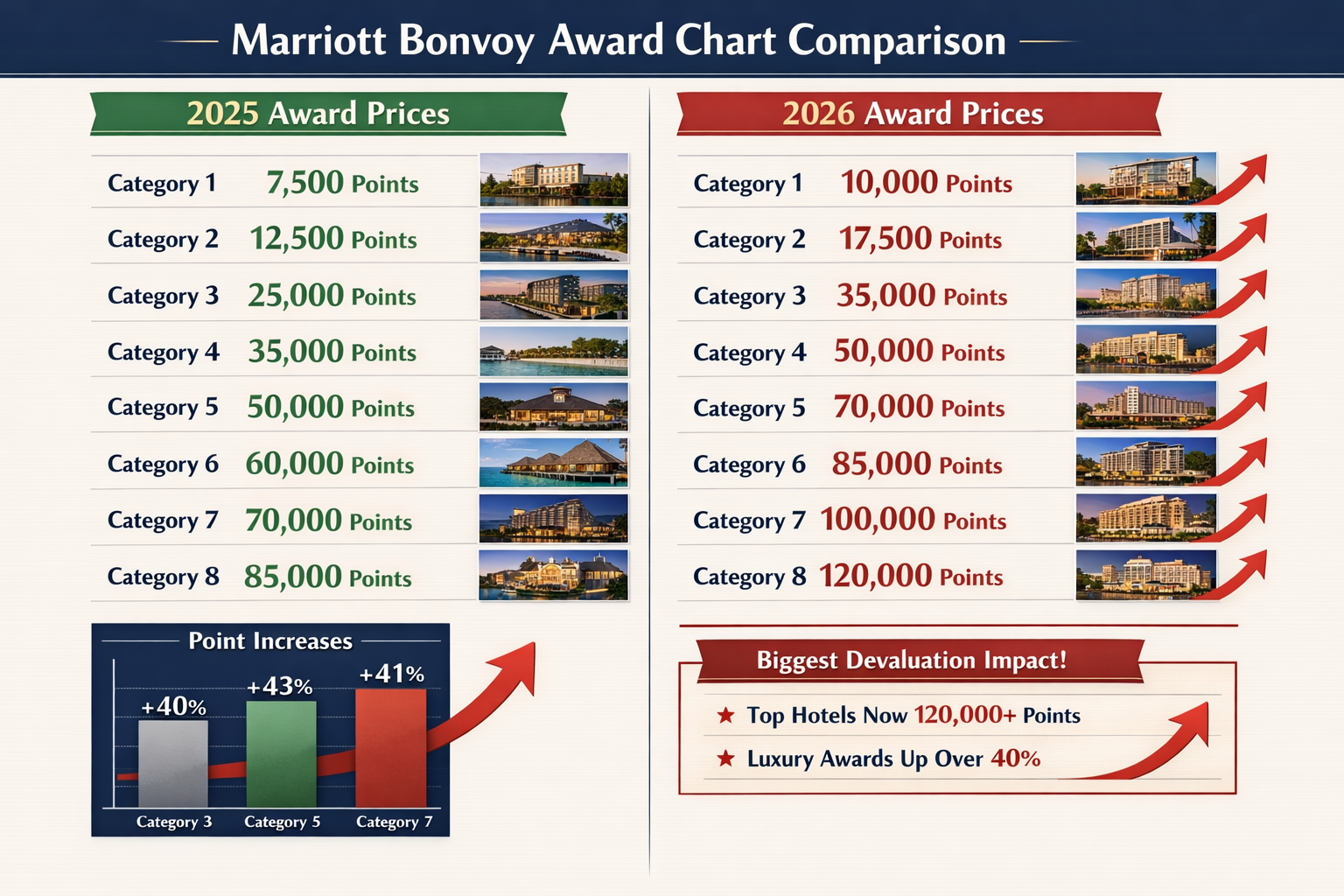
Category 5: Moderate impact. Standard pricing at many properties increased from 35,000 to 40,000 points, while peak pricing jumped from 50,000 to 60,000 points.
Category 6: Significant changes. Standard awards increased from 50,000 to 60,000 points at numerous properties, with peak pricing reaching 80,000-85,000 points.
Category 7: Heavy devaluation. Standard pricing rose from 60,000 to 70,000 points, and peak pricing increased from 85,000 to 95,000+ points at many properties.
Category 8: The most severe impact. Standard awards jumped from 85,000 to 100,000 points, while peak pricing now reaches 120,000-150,000 points at ultra-luxury properties.
For travelers tracking hotel loyalty free nights in 2025, these changes mean free night certificates from credit cards (typically capped at 50,000 points) now exclude an even larger portion of desirable properties.
Before and After Award Price Comparison
Concrete examples illustrate the real-world impact of the Marriott Bonvoy points devaluation better than category descriptions alone. The following comparisons show actual properties and the point increases members now face.
Detailed Property Comparisons
| Property | Location | 2025 Category | 2026 Category | Off-Peak (Before) | Off-Peak (After) | Standard (Before) | Standard (After) | Peak (Before) | Peak (After) | % Increase (Standard) |
|---|---|---|---|---|---|---|---|---|---|---|
| St. Regis Maldives Vommuli | Maldives | 7 | 8 | 60,000 | 85,000 | 70,000 | 100,000 | 85,000 | 120,000 | +43% |
| Ritz-Carlton Bachelor Gulch | Colorado | 7 | 7 | 60,000 | 60,000 | 70,000 | 85,000 | 85,000 | 100,000 | +21% |
| W Bali Seminyak | Indonesia | 6 | 7 | 50,000 | 60,000 | 60,000 | 70,000 | 80,000 | 85,000 | +17% |
| Rome Marriott Park Hotel | Italy | 5 | 6 | 35,000 | 50,000 | 40,000 | 60,000 | 50,000 | 80,000 | +50% |
| JW Marriott Cancun Resort | Mexico | 6 | 6 | 50,000 | 60,000 | 60,000 | 70,000 | 80,000 | 90,000 | +17% |
| The Ritz-Carlton New York Central Park | New York | 8 | 8 | 85,000 | 100,000 | 100,000 | 120,000 | 120,000 | 150,000 | +20% |
| Sheraton Maui Resort & Spa | Hawaii | 6 | 7 | 50,000 | 60,000 | 60,000 | 70,000 | 80,000 | 85,000 | +17% |
| Le Méridien Bora Bora | French Polynesia | 7 | 8 | 60,000 | 85,000 | 70,000 | 100,000 | 85,000 | 120,000 | +43% |
Value Per Point Analysis
The devaluation’s impact becomes clearer when calculating cents per point (CPP)—the metric that determines whether using points makes sense versus paying cash.
Example: St. Regis Maldives Vommuli Resort
- 2025 Redemption: 70,000 points for a standard night typically priced at $800 = 1.14 CPP
- 2026 Redemption: 100,000 points for the same night at $800 = 0.80 CPP
- Value Loss: 30% reduction in redemption value
Example: Rome Marriott Park Hotel
- 2025 Redemption: 40,000 points for a standard night typically priced at $250 = 0.63 CPP
- 2026 Redemption: 60,000 points for the same night at $250 = 0.42 CPP
- Value Loss: 33% reduction in redemption value
These calculations reveal a critical insight: the devaluation hit hardest at properties where Bonvoy points previously offered strong value. Properties that already delivered mediocre value (0.4-0.5 CPP) saw smaller percentage decreases.
Real-World Booking Scenarios
Scenario 1: Five-Night Maldives Honeymoon
- 2025 Cost: 280,000 points (70,000 × 4 nights paid + 1 free fifth night)
- 2026 Cost: 400,000 points (100,000 × 4 nights paid + 1 free fifth night)
- Additional Points Required: 120,000 points (+43%)
For context, 120,000 additional points represents the entire welcome bonus from a premium credit card. Couples who planned this redemption now need to accumulate significantly more points or reconsider their strategy.
Scenario 2: Week-Long European City Tour
Booking five nights across Rome, Paris, and London:
- 2025 Cost: Approximately 200,000-240,000 points
- 2026 Cost: Approximately 280,000-320,000 points
- Additional Points Required: 80,000 points (+33%)
The increased cost pushes this redemption pattern beyond what many travelers can earn from a single credit card bonus, requiring either multiple card applications or longer accumulation periods.
Scenario 3: Ski Week in Colorado
Seven nights at the Ritz-Carlton Bachelor Gulch during peak season:
- 2025 Cost: 510,000 points (85,000 × 6 nights + 1 free)
- 2026 Cost: 600,000 points (100,000 × 6 nights + 1 free)
- Additional Points Required: 90,000 points (+18%)
This scenario highlights how peak pricing expansion compounds the base devaluation, creating a double impact on high-season redemptions.
For travelers comparing hotel programs, understanding these value shifts is essential. The best hotel points redemptions for Christmas week, when cash rates are inflated, now require recalculating whether Marriott still competes with Hyatt, Hilton, or IHG for specific properties.
Impact on Redemption Value and Strategy
The 2026 Marriott Bonvoy points devaluation creates ripple effects beyond individual booking costs. It fundamentally alters the strategic calculus for earning, transferring, and redeeming points across the broader travel rewards ecosystem.
How Devaluation Affects Transfer Decisions
Marriott Bonvoy is a transfer partner for all five major transferable point programs: Amex Membership Rewards, Chase Ultimate Rewards, Capital One Miles, Citi ThankYou Points, and Bilt Rewards. The devaluation changes the math on whether transferring makes sense.
Transfer Ratios and Effective Value
Most programs transfer to Marriott at a 1:1 ratio, though Amex offers a 2:3 ratio (20,000 Amex points = 30,000 Bonvoy points). With the devaluation reducing effective value from 0.8-1.0 CPP to 0.5-0.7 CPP at many properties, transferring flexible points to Bonvoy now competes poorly against alternative uses.
Comparison Example:
- 100,000 Chase Ultimate Rewards transferred to Marriott = 100,000 Bonvoy points = ~$500-700 in hotel value (post-devaluation)
- 100,000 Chase Ultimate Rewards transferred to Hyatt = 100,000 World of Hyatt points = ~$1,000-1,500 in hotel value
- 100,000 Chase Ultimate Rewards used for travel through the Chase portal = $1,250-1,500 in value (with Sapphire Reserve 1.5x multiplier)
The devaluation makes Marriott transfers less competitive unless you’re targeting specific properties where Bonvoy still delivers acceptable value or you need to top off an existing balance for an imminent booking.
Opportunity Cost Considerations
Every point transferred to Marriott represents a decision not to transfer elsewhere. With award travel predictions for 2026, what matters most for points strategy now is highlighting increasing devaluation risk across programs; maintaining flexibility matters more than ever.
Decision Framework:
✅ Consider transferring to Marriott when:
- You’ve identified a specific property offering 0.7+ CPP value
- You’re booking within 30 days and need to lock in availability
- You’re using a free night certificate and need to top off points for a higher category
- Transfer bonuses increase the effective value (rare for Marriott)
❌ Avoid transferring to Marriott when:
- You’re speculatively accumulating points without a specific booking
- Alternative programs (Hyatt, IHG) offer better value for your target destination
- Cash rates are reasonable, and you’d get better value using points for flights
- You’re within 5/24 for Chase and might want to save transfers for future needs
Impact on Credit Card Strategy
The devaluation affects which credit cards deliver the best value for hotel-focused travelers.
Marriott Bonvoy Credit Cards: The value proposition of co-branded Marriott cards (Bonvoy Boundless, Bonvoy Brilliant) weakened with this devaluation. While these cards offer free night certificates and elite status, the diminished point value makes them less competitive against flexible point-earning cards.
Flexible Point Cards: Cards like the Chase Sapphire Preferred, Amex Gold, and Capital One Venture X retain their value by preserving optionality. You can still transfer to Marriott when it makes sense, but you’re not locked into a devaluing program.
For travelers evaluating their wallet strategy, the devaluation reinforces the advantage of best credit card combos for free 2025 travel that emphasize flexible points over program-specific currencies.
Calculating Your Personal Impact
To assess how the devaluation affects your specific situation, work through this framework:
Step 1: Identify properties you’ve booked or planned to book with Bonvoy points
Step 2: Calculate the old vs. new point requirements using the award chart
Step 3: Determine the cash price for those same stays
Step 4: Calculate CPP for both old and new point costs
Step 5: Compare against alternative redemption options (other hotel programs, flights, cash bookings)
Example Calculation:
You planned a 5-night stay at W Bali Seminyak:
- Old cost: 240,000 points (60,000 × 4 + 1 free)
- New cost: 280,000 points (70,000 × 4 + 1 free)
- Cash price: $2,100 for 5 nights
- Old CPP: $2,100 ÷ 240,000 = 0.88 CPP
- New CPP: $2,100 ÷ 280,000 = 0.75 CPP
- Alternative: Transfer 160,000 Chase points to Hyatt for a similar property = ~1.3 CPP
This analysis reveals whether absorbing the devaluation makes sense or if you should pivot to a different program or property.
Strategies for Maximizing Bonvoy Points Post-Devaluation
Despite the 2026 devaluation, Marriott Bonvoy points retain value when deployed strategically. The key is adapting your approach to focus on redemption patterns that still deliver acceptable returns.
Immediate Actions to Protect Value
Book Known Travel Now: If you have confirmed travel plans to affected properties, book immediately with points. Award pricing can increase further, and locking in current rates protects against future devaluations.
Use Points for Peak Pricing: The fifth night free benefit creates the most value during peak periods when cash rates spike. A property charging $600/night in cash but 100,000 points delivers 1.2 CPP when you factor in the free fifth night ($3,000 cash value ÷ 400,000 points for 5 nights).
Target Category 5-6 Properties: These mid-tier properties often deliver the best value post-devaluation, offering quality accommodations without the premium pricing of luxury brands. Many excellent properties remain in these categories with reasonable point requirements.
Leverage PointSavers: Marriott occasionally offers PointSavers promotions, reducing award costs by 20-30% at select properties. Monitor these offers and book opportunistically when your target destinations appear.
Long-Term Strategic Adjustments
Diversify Hotel Point Portfolios: Rather than concentrating points in Bonvoy, maintain balances across multiple programs. Hyatt, IHG, and Hilton each offer distinct advantages for different redemption patterns.
Prioritize Flexible Points: Focus credit card spending on flexible point programs (Amex, Chase, Capital One, Citi, Bilt) rather than Marriott co-branded cards. This preserves optionality as programs evolve.
Monitor Transfer Bonuses: While rare for Marriott, transfer bonuses to other hotel programs appear periodically. A 30% transfer bonus to Hyatt or IHG can dramatically improve value versus a straight Marriott transfer.
Optimize Elite Status Separately: If you value Marriott elite status, earn it through credit card benefits or status matches rather than concentrating all hotel spending with Marriott. This separates status benefits from the point accumulation strategy.
Category-Specific Optimization Tactics
For Luxury Properties (Categories 7-8):
- Only redeem during peak pricing when cash rates exceed $500/night
- Use points + cash options if they offer better value than straight award bookings
- Consider cash bookings with the best credit cards for travel insurance in 2025 for expensive stays where insurance matters
For Mid-Tier Properties (Categories 4-6):
- These offer the best post-devaluation value, often delivering 0.7-0.9 CPP
- Ideal for longer stays, where the fifth night free creates meaningful savings
- Consider for business travel or city-based trips where luxury amenities matter less
For Budget Properties (Categories 1-3):
- Generall,y poor value for points; cash rates often make more sense
- Reserve for situations where you need to burn expiring points
- Better to save points for higher-value redemptions
Advanced Redemption Techniques
Points + Cash Bookings: Marriott allows combining points and cash for award stays. In some cases, paying $50-100 plus fewer points delivers better overall value than a full award booking, particularly when point requirements increased significantly.
Fifth Night Free Optimization: Structure stays in 5-night increments whenever possible. The free fifth night provides 20% savings, partially offsetting the devaluation impact.
Category Timing: Some properties change categories seasonally. Research whether your target property moves to a lower category during shoulder season, allowing you to book the same hotel for fewer points.
Geographic Arbitrage: Focus redemptions on regions where the devaluation had less impact. Properties in Asia (outside beach resorts), Eastern Europe, and secondary U.S. markets often still deliver reasonable value.
Common Mistakes to Avoid
❌ Transferring speculatively: Don’t transfer points to Marriott unless you have a specific booking in mind. The devaluation trend suggests holding flexible points until needed.
❌ Ignoring cash rates: Always compare point redemptions against cash prices. Sometimes paying cash and saving points for higher-value redemptions makes more sense.
❌ Booking off-peak when cash is cheap: Off-peak award pricing often coincides with low cash rates, creating poor value. Save points for peak periods when cash rates spike.
❌ Overlooking alternative programs: Marriott’s massive footprint creates loyalty inertia, but Hyatt, IHG, and independent hotels sometimes offer better value for specific destinations.
❌ Neglecting award availability: Devaluation compounds when award availability is limited. Properties that restrict award inventory force you into peak pricing more often, multiplying the impact.
For travelers managing points across multiple programs, understanding the best ways to prevent points bookings from falling apart during holiday travel chaos becomes increasingly important as you diversify beyond Marriott.
Expert Analysis: What’s Next for Bonvoy?
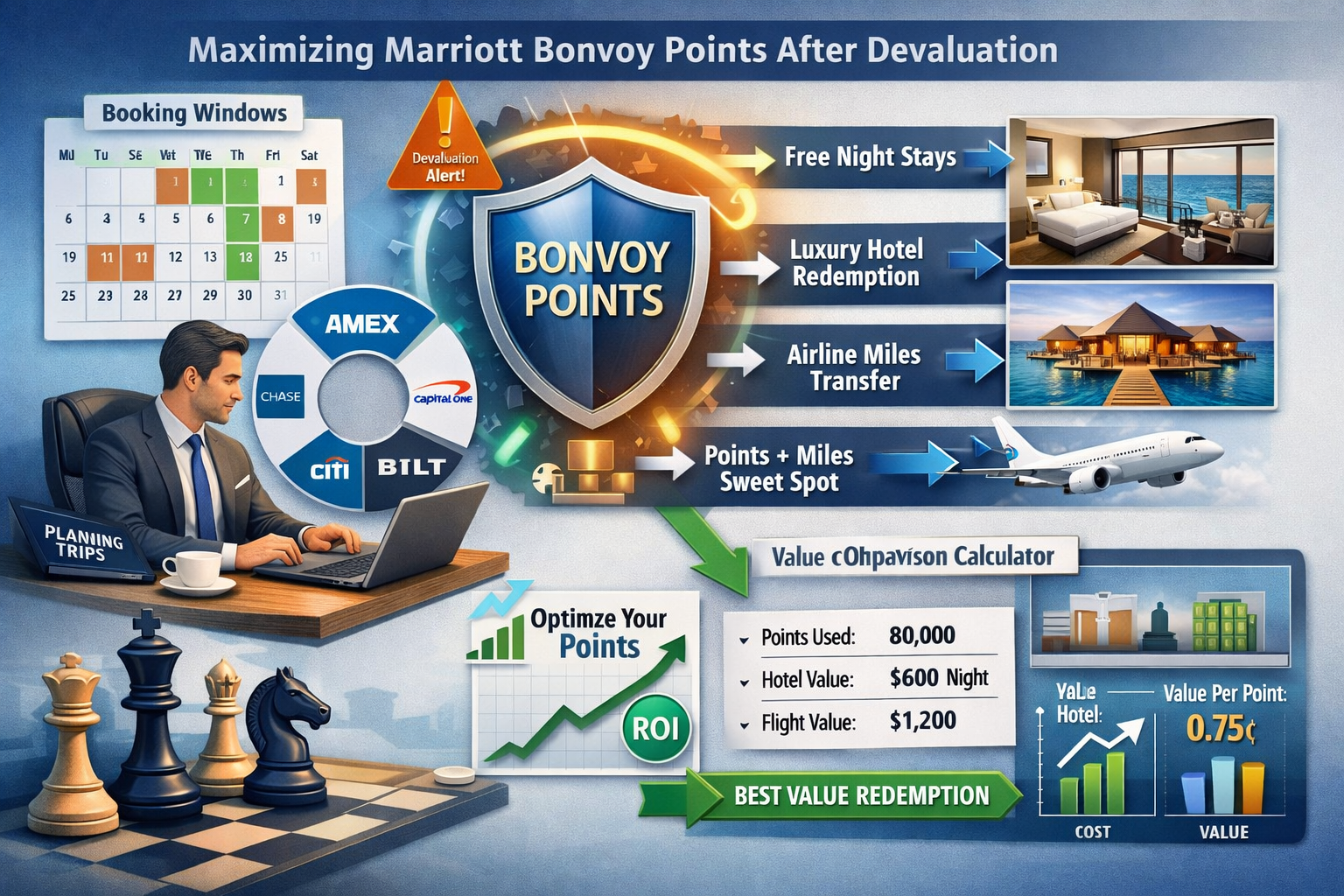
The 2026 Marriott Bonvoy points devaluation fits a broader pattern of loyalty program erosion across the travel industry. Understanding the forces driving these changes helps predict future developments and adjust strategy accordingly.
Why Hotel Programs Keep Devaluing
Revenue Management Optimization: Hotels increasingly use sophisticated algorithms that treat award inventory like cash inventory, adjusting pricing based on demand. This creates a structural bias toward higher point requirements as properties recognize they can extract more points without losing bookings.
Inflation and Operating Costs: Rising labor and property costs, along with inflationary pressures, are forcing hotels to increase revenue per room. Since loyalty programs represent a liability on balance sheets, reducing point value helps offset these pressures.
Competitive Dynamics: As airlines aggressively devalue their programs, hotels face less competitive pressure to maintain value. Travelers who might have used points for flights are now redirected to hotels, increasing demand and enabling devaluation.
Program Maturation: Marriott Bonvoy has 164+ million members. As membership grows, the program shifts from acquisition mode (offering generous value to attract members) to extraction mode (reducing costs while maintaining engagement).
Predicting Future Changes
Based on historical patterns and industry trends, expect:
Continued Category Inflation: Properties will gradually migrate upward through categories, with popular destinations seeing the most aggressive moves. Budget for 5-10% annual point requirement increases at desirable properties.
Peak Pricing Expansion: Marriott will likely expand peak pricing windows, classifying more dates as peak periods. This hidden devaluation increases point costs without changing published award charts.
Dynamic Pricing Adoption: The industry trend points toward fully dynamic award pricing (like airlines use), where point costs fluctuate daily based on demand. Marriott has tested this at select properties and may expand it.
Reduced Transfer Partner Value: As Marriott devalues, credit card companies may reduce transfer ratios or eliminate Marriott as a partner. Amex’s 2:3 transfer ratio already reflects Marriott’s diminished value.
Elite Benefit Erosion: Expect gradual reductions in elite benefits—reduced suite upgrades, tighter lounge access, or increased spending requirements for status. This pattern mirrors airline programs.
How This Compares to Other Hotel Programs
Hyatt World of Hyatt: Currently the strongest value among major hotel programs, with more stable award pricing and better redemption value (often 1.5-2.0 CPP). Smaller footprint limits options but maintains quality.
Hilton Honors: Already uses dynamic pricing at many properties, making direct comparisons difficult. Point values typically range from 0.4 to 0.6 CPP, similar to post-devaluation Marriott but with more properties.
IHG One Rewards: Highly variable value (0.3-0.8 CPP) with frequent promotions. Less predictable than Marriott but occasionally offers exceptional value at specific properties.
Independent Hotel Programs: Smaller chains like Hyatt and boutique programs often deliver better value because they prioritize member satisfaction over shareholder returns. Worth exploring for travelers tired of mega-chain devaluations.
Industry-Wide Implications
The Marriott devaluation signals broader trends affecting all travel loyalty programs:
Transferable Points Become More Valuable: As individual programs devalue, the flexibility of Amex, Chase, Capital One, Citi, and Bilt points increases in value. Optionality provides protection against the erosion of any single program.
Status Matters Less: When award pricing increases dramatically, elite status benefits (upgrades, bonus points) provide less incremental value. The math shifts toward choosing properties based on cash price or alternative programs rather than chasing status.
Cash Bookings Gain Appeal: For many travelers, the complexity and diminishing value of points programs make simple cash back cards more attractive. A 2% cash-back card that delivers $400 on a $20,000 annual spend may beat points strategies that require constant optimization.
Niche Programs Offer Opportunities: Smaller loyalty programs and boutique hotel collections often deliver better value because they compete for members rather than extract value from existing bases. Exploring beyond the major chains can uncover better redemptions.
For travelers tracking these dynamics, resources like airline and hotel status matches the ultimate 2025 guide, help navigate the shifting landscape, and identify programs offering better current value.
What Marriott Could Do (But Probably Won’t)
Transparent Value Guarantees: Marriott could commit to minimum value floors (e.g., 0.7 CPP) or limit annual devaluation to a published percentage. This would rebuild member trust but reduce the flexibility for revenue optimization.
Enhanced Transfer Ratios: Offering periodic transfer bonuses (e.g., 30% bonus when transferring from Amex) would make Bonvoy more competitive. However, this costs Marriott real revenue and seems unlikely.
Improved Elite Benefits: Strengthening elite perks could offset point devaluation by making status more valuable. But industry trends point in the opposite direction.
Award Availability Guarantees: Committing to minimum award availability at standard pricing would address a major pain point. Airlines like Southwest do this successfully, but most hotel programs resist.
The reality: Marriott’s incentives align with gradual value extraction rather than member-friendly policies. Expect continued devaluation with occasional tactical promotions to manage member dissatisfaction.
Common Questions About the 2026 Devaluation
When did the 2026 Marriott Bonvoy points devaluation take effect?
The primary changes implemented in March 2026 included properties moving to new categories and updated award pricing. Unlike previous years, where Marriott announced changes months in advance, this devaluation had minimal advance notice—approximately 4-6 weeks before implementation.
Can I cancel existing bookings and rebook if prices are decreased?
Yes, Marriott allows free cancellation and rebooking for award reservations up to 24-48 hours before check-in (depending on property policy). However, the 2026 devaluation increased prices across the board, so rebooking would cost more points, not fewer. If you booked before the devaluation, keep that reservation locked in.
Do free night certificates from credit cards work at devalued properties?
Free night certificates remain subject to their point value caps. Most Marriott credit cards offer certificates valid up to 50,000 points (Bonvoy Boundless) or 85,000 points (Bonvoy Brilliant). The devaluation reduced the properties these certificates access, as more hotels now require 60,000+ points per night.
Should I transfer points to Marriott now or wait?
Transfer only when you have a specific booking ready. The devaluation trend suggests waiting preserves optionality—you can always transfer later if a good redemption appears, but you can’t un-transfer if Marriott devalues further. Maintain points in flexible programs (Amex, Chase, Capital One, Citi, Bilt) until needed.
How does this affect Marriott Bonvoy credit card value?
The devaluation weakens the value proposition of co-branded Marriott cards. The welcome bonuses now buy fewer nights, and ongoing earning rates deliver less value per dollar spent. However, the free night certificates and elite status benefits retain value if you frequently stay at Marriott properties. For most travelers, flexible point cards offer better long-term value.
Will Marriott devalue again in 2027?
Highly likely. Marriott has devalued award pricing nearly every year since the SPG merger in 2018. Budget for 5-10% annual erosion in point value when planning a long-term points strategy. This pattern makes holding large Bonvoy balances risky unless you have specific redemptions planned.
What’s the best alternative to Marriott for hotel points?
Hyatt World of Hyatt currently offers the best value among major hotel programs, with award pricing that delivers 1.5-2.0 CPP at many properties and a more stable award chart. The smaller footprint (1,000+ properties vs. Marriott’s 8,000+) limits options, but quality exceeds quantity for value-focused travelers.
IHG One Rewards provides good value at select properties, particularly when promotions are active. Hilton Honors offers extensive coverage but value varies widely.
For comprehensive comparisons, check the best hotel loyalty free nights in 2025 to evaluate which programs align with your travel patterns.
Can I get better value using points for other redemptions?
Often, yes. Consider these alternatives:
- Transfer to airline partners: Premium cabin flights often deliver 1.5-3.0+ CPP value, significantly better than post-devaluation Marriott hotels
- Use Chase/Amex travel portals: With premium cards, portal bookings deliver 1.25-1.5 CPP with more flexibility than hotel transfers
- Book Hyatt instead: If your destination has Hyatt properties, transferring there typically provides better value
- Pay cash and save points: When cash rates are reasonable, preserving points for future higher-value redemptions often makes more sense
Use the calculators at Award Travel Hub to compare the value of different redemption options before committing your points.
How can I track future devaluations?
Monitor Marriott’s official announcements: Marriott typically announces category changes 4-6 weeks before implementation, though they’ve reduced advance notice in recent years.
Follow travel rewards blogs: Sites like Award Travel Hub track devaluations and provide analysis of impacts.
Join online communities: Reddit’s r/awardtravel and FlyerTalk forums often surface devaluation news quickly.
Set up award alerts: Tools that monitor award availability can alert you to pricing changes at specific properties you’re tracking.
Review annually: Each January, review your points portfolio and assess whether your strategy needs adjustment based on the previous year’s changes.
Conclusion: Adapting Your Strategy for Maximum Value
The 2026 Marriott Bonvoy points devaluation reinforces a fundamental truth about travel loyalty programs: they consistently trend toward reduced value over time. While this latest round of changes stings for members who’ve accumulated large balances or built strategies around specific Bonvoy sweet spots, it’s not a reason to abandon hotel points entirely—just a signal to adapt your approach.
Key Strategic Takeaways
Maintain Flexibility: The clearest lesson from this devaluation is the value of optionality. Keeping points in transferable currencies (Amex, Chase, Capital One, Citi, Bilt) rather than speculatively transferring to Marriott provides protection against future erosion. Transfer only when you have a specific booking ready and the value justifies it.
Diversify Hotel Loyalty: Don’t concentrate all hotel stays and points in a single program. Earning and redeeming across Marriott, Hyatt, IHG, and Hilton creates options when one program devalues. This approach requires more management but delivers better long-term value.
Book Strategically: Focus Marriott redemptions on situations where they still deliver acceptable value: peak pricing periods when cash rates spike, Category 5-6 properties offering 0.7+ CPP, and five-night stays that maximize the free night benefit. For other situations, consider alternatives.
Monitor and Adjust: Set a calendar reminder to review your points strategy quarterly. Devaluations happen gradually, and small adjustments—shifting spending to different cards, transferring to different programs, or booking trips earlier—compound into significant value preservation over time.
Immediate Next Steps
This Week:
- Review any upcoming Marriott bookings and confirm they’re still locked in at pre-devaluation rates
- Calculate CPP for planned redemptions using current award pricing
- Compare against alternative programs or cash bookings to verify you’re getting acceptable value
This Month:
- Audit your credit card portfolio and ensure you’re optimizing for flexible points rather than Marriott-specific earning
- Research Hyatt, IHG, or other alternative programs for your typical travel destinations
- Set up award availability alerts for properties you want to book in the next 6-12 months
This Year:
- Diversify your hotel points across at least 2-3 programs to reduce devaluation risk
- Book any high-value Marriott redemptions you’ve been planning before further devaluations
- Evaluate whether Marriott co-branded credit cards still justify their annual fees based on your actual redemption patterns
The Bigger Picture
Hotel loyalty programs exist to drive behavior that benefits the hotel company, not to maximize value for members. Understanding this reality helps set appropriate expectations and build strategies that work within these constraints.
The most successful points strategies focus on:
- Earning flexible currencies that preserve options
- Booking opportunistically when value appears rather than forcing redemptions
- Staying informed about program changes and adjusting quickly
- Maintaining realistic expectations about long-term value erosion
The 2026 Marriott Bonvoy points devaluation isn’t the end of hotel points value—it’s a reminder that passive strategies fail in a dynamic environment. Active management, strategic flexibility, and willingness to adapt separate travelers who consistently extract value from those who watch their points erode.
For travelers ready to optimize beyond Marriott, exploring the best award travel tools and alerts to set up for 2026 bookings provides the infrastructure to identify and capture value across multiple programs as opportunities appear.
The devaluation changes the game, but it doesn’t end it. Adapt, diversify, and stay strategic—your points can still deliver exceptional value when deployed thoughtfully.