When a business traveler books five consecutive nights at a Marriott property, they pay for only four nights—automatically. This Fifth Night free benefit guarantees a 20% discount on every extended-stay redemption, making Marriott Bonvoy one of the most practical hotel loyalty programs for frequent travelers who know how to maximize its structure. Unlike competitors with fixed award charts, Bonvoy operates on dynamic pricing across 8,000+ properties spanning 30 brands, from budget Fairfield Inns to luxury St. Regis resorts.
The program’s value proposition differs fundamentally from boutique-focused competitors like Hyatt. While Marriott Bonvoy delivers a lower cents-per-point redemption value—typically 0.7-0.9¢ compared to Hyatt’s 1.5-2¢ – its massive footprint creates availability where other programs simply have none. For travelers who prioritize consistent elite benefits and geographic coverage over maximum point value, Bonvoy’s breadth compensates for its redemption inefficiency.
Key Takeaways
- Fifth night free benefit creates an automatic 20% discount on all five-night award stays, making extended redemptions significantly more valuable than short stays
- Elite status earning rates range from 10 points per dollar (base) to 15x for Ambassador members, with status requirements starting at just 10 nights for Silver
- Dynamic pricing replaced traditional award charts, with nightly rates spanning 5,000-100,000+ points depending on property category and demand
- Average redemption value hovers around 0.7-0.9 cents per point—substantially lower than Hyatt, but offset by 8,000+ property availability worldwide
- Three co-branded credit cards offer different free night certificates (up to 50,000 points), creating strategic opportunities for annual fee optimization
Earning Structure and Elite Status Requirements: Silver Through Ambassador
Marriott Bonvoy’s earning framework operates on a base rate of 10 points per dollar spent on eligible room rates and incidentals. This baseline applies to all members, regardless of status tier. The program awards points based on the actual amount paid, excluding taxes and fees—a standard structure across major hotel loyalty programs.
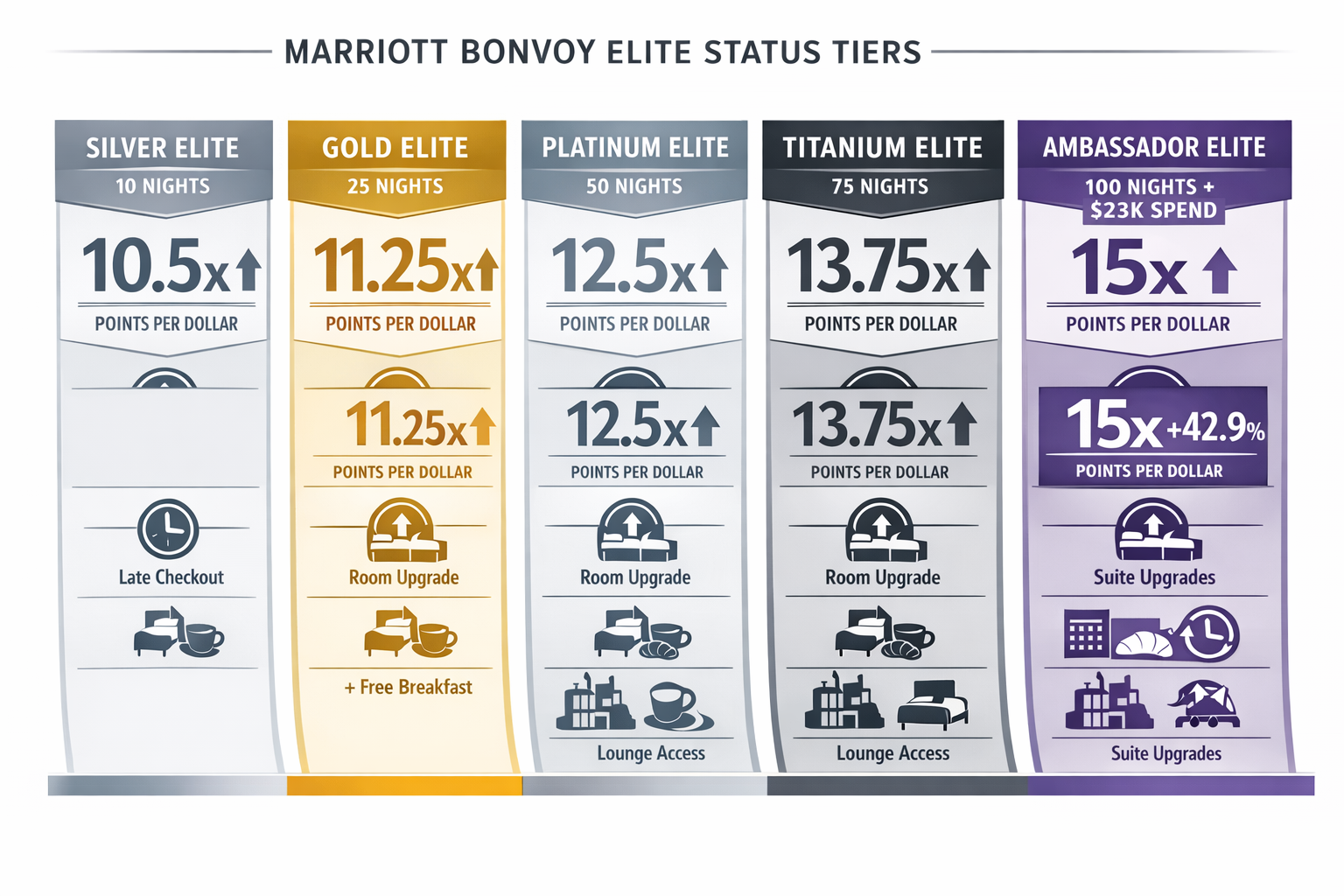
Elite status multiplies this base earning rate through percentage bonuses applied to every qualifying stay:
- Silver Elite (10 nights): 10.5x points per dollar (5% bonus)
- Gold Elite (25 nights): 11.25x points per dollar (12.5% bonus)
- Platinum Elite (50 nights): 12.5x points per dollar (25% bonus)
- Titanium Elite (75 nights): 13.75x points per dollar (37.5% bonus)
- Ambassador Elite (100 nights + $23,000 spend): 15x points per dollar (50% bonus)
The qualification structure counts nights, not stays. A single three-night reservation contributes three qualifying nights toward status, making weekend trips equally valuable as weekday business travel for status progression. This differs from programs that count stays, where longer trips provide no additional status benefit beyond the single stay credit.
Status Qualification Mechanics
Marriott offers multiple pathways to elite status beyond traditional stays:
Credit card shortcuts provide instant status through co-branded cards. The Marriott Bonvoy Brilliant American Express Card ($650 annual fee) grants automatic Platinum Elite status, bypassing the 50-night requirement entirely. This creates a decision framework: travelers who would otherwise fall short of 50 nights but value Platinum benefits may find the annual fee worthwhile compared to manufactured spending or unnecessary stays.
Rollover nights carry forward from year to year when members exceed their current tier threshold. Earn 60 nights in a calendar year, and those 10 excess nights beyond Platinum qualification roll into the following year’s status calculation. This mechanism helps maintain status during lighter travel years.
Elite Night Credits can be purchased or earned through promotional offers. Marriott periodically runs promotions offering bonus elite night credits for completing specific stay patterns—stay twice per month for three consecutive months, earn 15 bonus nights toward status.
The Ambassador tier requires both 100 qualifying nights and $23,000 in eligible spending at Marriott properties within the calendar year. This dual requirement creates a natural filter: only high-spend business travelers or those with manufacturing stays will reach this tier organically. The spending threshold resets annually, requiring sustained investment to maintain Ambassador benefits year over year.
Status Benefits Breakdown: What You Get at Each Tier in 2026
Elite status benefits in Marriott Bonvoy follow a graduated structure, with meaningful improvements at Gold and Platinum tiers. Understanding which benefits matter for your travel patterns determines whether pursuing a higher status makes practical sense.
Silver Elite (10 Nights)
Silver delivers minimal tangible value:
- Late checkout until 2:00 PM (subject to availability)
- 5% points bonus on eligible spending
- Priority late checkout (requested but not guaranteed)
Silver functions primarily as an entry tier. The late checkout benefit depends entirely on hotel occupancy—high-demand properties frequently deny the request. The 5% earning bonus adds marginal value: spending $1,000 on a stay earns 50 additional points, worth approximately $0.35-$0.45 at standard redemption values.
Best for: Travelers who stay 10-24 nights annually and want minimal perks without significant effort.
Gold Elite (25 Nights)
Gold represents the first tier with consistently useful benefits:
- Room upgrades at check-in (standard to enhanced room, subject to availability)
- 12.5% points bonus on eligible spending
- Late checkout until 2:00 PM
- Lounge access at participating properties (limited to select brands)
The room upgrade benefit typically means better views, higher floors, or slightly larger rooms—not suite upgrades. Properties with executive lounges may grant Gold members access, but this varies by brand and location. European properties are more likely to offer lounge access than U.S. hotels.
Gold status can be achieved with the Marriott Bonvoy Boundless Credit Card, which offers a path to automatic Gold status through spending thresholds. This creates an alternative to earning through staying alone.
Best for: Leisure travelers who stay 25-49 nights annually and value room upgrades over breakfast benefits.
Platinum Elite (50 Nights)
Platinum delivers the most significant benefit jump:
- Enhanced room upgrades, including suites (subject to availability)
- Lounge access or breakfast benefit at participating properties
- 25% points bonus on eligible spending
- Late checkout until 4:00 PM
- Your24 flexibility (choose check-in time, guaranteed 24-hour stay)
The breakfast benefit applies at most full-service Marriott properties worldwide, covering continental or full breakfast for the Platinum member and one guest. This benefit alone can save $20-$40 per day at properties with expensive breakfast offerings.
Suite upgrades occur more frequently at Platinum than Gold, particularly at properties with larger suite inventory. Business-oriented hotels (Marriott, Sheraton, Westin) upgrade more reliably than resort properties, where suites command a significant premium.
Your24 allows Platinum members to select their check-in time and receive a guaranteed 24-hour stay. Check-in at 3:00 PM, check-out at 3:00 PM the following day—useful for late arrivals or early departures.
The Marriott Bonvoy Brilliant American Express Card grants automatic Platinum status, creating a shortcut for travelers who won’t organically reach 50 nights. At a $650 annual fee, the card includes a free night certificate (up to 85,000 points) and a $300 annual Marriott credit, effectively reducing the fee to $350 for the status benefit alone.
Best for: Frequent business travelers who stay 50-74 nights annually or those who value breakfast benefits and suite upgrade opportunities enough to justify the Brilliant card’s annual fee.
Titanium Elite (75 Nights)
Titanium adds incremental improvements over Platinum:
- 48-hour room upgrade guarantee (enhanced rooms confirmed 48 hours before arrival)
- 37.5% points bonus on eligible spending
- Your24 flexibility (same as Platinum)
- All Platinum benefits
The 48-hour upgrade guarantee provides more certainty than Platinum’s at-check-in upgrades, but still doesn’t guarantee suite upgrades—only enhanced rooms. The points bonus improvement from 25% to 37.5% adds value for high spenders: a $2,000 stay earns 250 additional points compared to Platinum, worth roughly $1.75-$2.25.
Best for: Business travelers who naturally accumulate 75-99 nights through work travel and appreciate confirmed upgrades over at-check-in uncertainty.
Ambassador Elite (100 Nights + $23,000 Spend)
Ambassador represents Bonvoy’s top tier:
- Your24 flexibility with enhanced recognition
- 50% points bonus on eligible spending
- Confirmed suite upgrades on redemption stays (select properties)
- Ambassador service (dedicated support line)
- All Titanium benefits
The confirmed suite upgrades on award stays distinguish Ambassador from lower tiers, where upgrades on points bookings rarely occur. This benefit applies only at participating properties and requires a 5-day advance booking.
The $23,000 annual spending requirement creates a high barrier. At an average room rate of $200 per night, reaching Ambassador requires approximately 115 paid nights—15 more than the minimum required nights alone. This dual threshold ensures only heavy business travelers or those with corporate rates reach this tier organically.
Best for: Road warriors with 100+ annual nights and corporate travel budgets, or travelers with manufacturing status through mattress runs who value the enhanced recognition and confirmed upgrades.
Status Benefit Comparison Table
| Benefit | Silver | Gold | Platinum | Titanium | Ambassador |
|---|---|---|---|---|---|
| Points Bonus | 5% | 12.5% | 25% | 37.5% | 50% |
| Room Upgrades | — | Enhanced | Enhanced + Suites | 48hr Confirmed | Confirmed Suites |
| Breakfast/Lounge | — | Limited | Yes | Yes | Yes |
| Late Checkout | 2 PM | 2 PM | 4 PM | 4 PM | 4 PM |
| Your24 | — | — | Yes | Yes | Yes |
Understanding hotel status benefits and how to maximize them helps travelers determine which tier provides the best return on effort.
Dynamic Pricing and Property Categories: How Much Nights Actually Cost
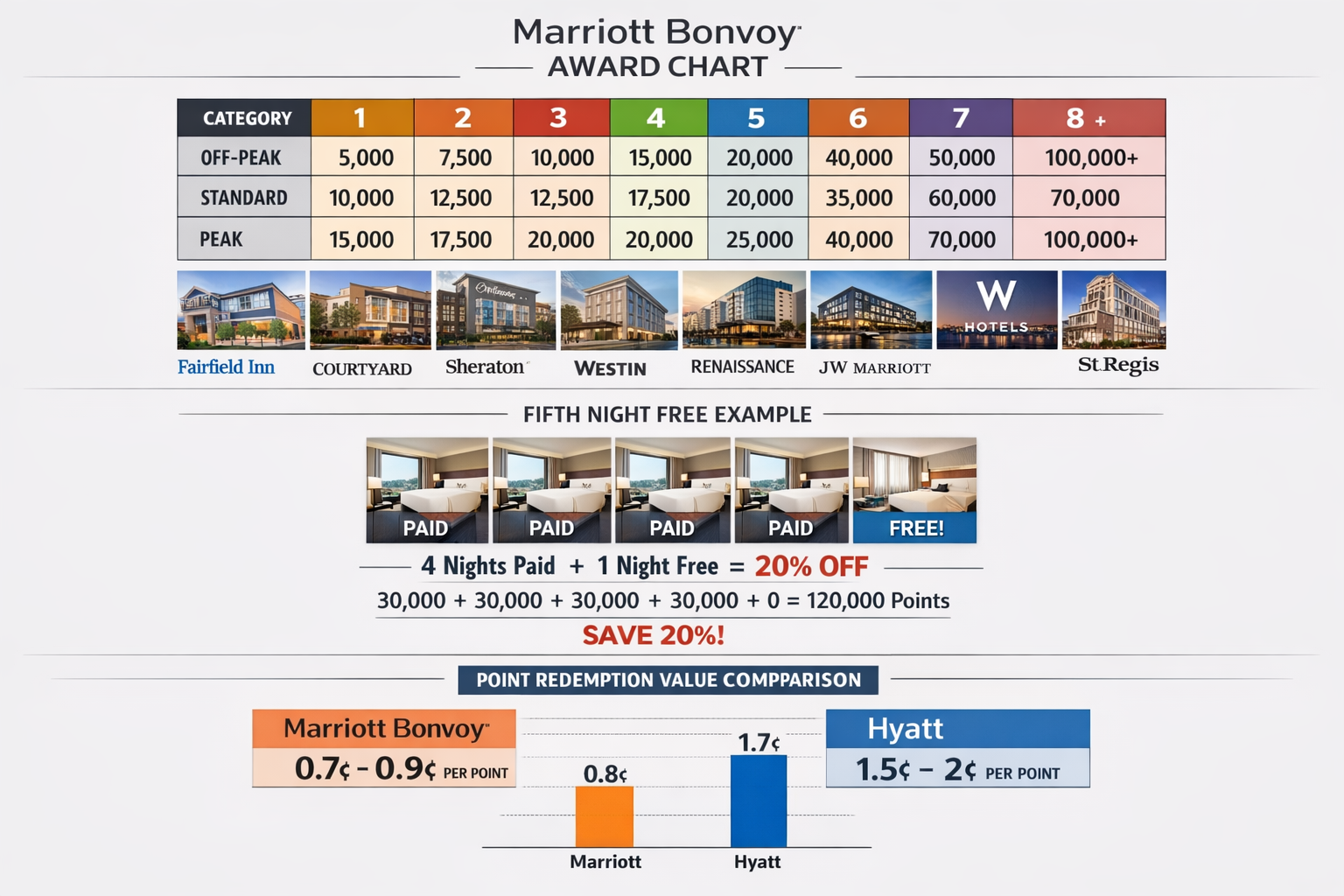
Marriott eliminated its traditional award chart in March 2022, replacing fixed-price redemptions with dynamic pricing that fluctuates based on demand, seasonality, and cash rates. While properties still carry category designations (1-8), these categories now represent pricing ranges rather than fixed costs.
Current Category Pricing Ranges (2026)
The eight categories establish baseline pricing windows:
- Category 1: 5,000-10,000 points per night
- Category 2: 10,000-20,000 points per night
- Category 3: 15,000-30,000 points per night
- Category 4: 20,000-40,000 points per night
- Category 5: 30,000-50,000 points per night
- Category 6: 40,000-60,000 points per night
- Category 7: 50,000-70,000 points per night
- Category 8: 70,000-100,000+ points per night
These ranges represent off-peak to peak pricing. A Category 4 property might cost 20,000 points on a Tuesday in February (off-peak) but 40,000 points on a Saturday in July (peak). The same room could be priced at 30,000 points on a Thursday in April (standard pricing).
Peak, Off-Peak, and Standard Pricing
Marriott’s dynamic model adjusts pricing within category ranges based on:
Demand patterns: Weekend rates at resort properties typically reach peak pricing, while business hotels in city centers often show the opposite pattern, with lower weekend rates.
Seasonal fluctuations: Beach resorts in the Caribbean charge peak rates from December through April, dropping to off-peak rates from May through November. Ski resorts follow inverse patterns.
Cash rate correlation: Award pricing generally tracks cash rates. When a property’s cash rate doubles due to local events or high demand, award rates increase proportionally within the category range.
Event-driven surges: Properties near major conferences, sporting events, or festivals frequently hit peak pricing regardless of season. A Category 3 property near the Super Bowl might price at 30,000 points when it typically costs 15,000-20,000 points.
Practical Redemption Value Analysis
The shift to dynamic pricing creates significant variation in value. Calculating cents per point (CPP) for specific redemptions determines whether using points makes sense compared to paying cash:
CPP Formula: (Cash Rate – Taxes/Fees) ÷ Points Required = Cents Per Point
Example 1 – Poor Value:
- Property: Category 4 Courtyard (off-peak)
- Cash rate: $120 per night
- Award rate: 20,000 points
- CPP: $120 ÷ 20,000 = 0.6 cents per point
Example 2 – Good Value:
- Property: Category 7 St. Regis (peak demand)
- Cash rate: $850 per night
- Award rate: 70,000 points
- CPP: $850 ÷ 70,000 = 1.2 cents per point
Example 3 – Excellent Value:
- Property: Category 5 resort (off-peak season)
- Cash rate: $450 per night
- Award rate: 30,000 points (low end of range)
- CPP: $450 ÷ 30,000 = 1.5 cents per point
The average Bonvoy redemption delivers approximately 0.7-0.9 cents per point. Redemptions below 0.6 CPP rarely make sense unless points are expiring or no alternative redemption options exist. Values above 1.2 CPP represent strong uses of Bonvoy points.
Category Changes and Devaluation Risk
Marriott adjusts property categories annually, typically in March. Properties can move up or down categories based on average cash rates, renovations, or market repositioning. These category changes represent devaluation risk—a Category 4 property you’ve targeted might be downgraded to Category 5, increasing award costs by 10,000-20,000 points per night.
2024-2025 Category Changes affected approximately 15% of Bonvoy properties, with roughly 60% of changes representing category increases (devaluations) and 40% decreases. Popular resort destinations saw disproportionate increases, while older business hotels in secondary markets experienced more category decreases.
Mitigation strategy: Book award stays immediately when finding good value, as Marriott honors the price at booking time, even if categories change before the stay date. The program allows free cancellation up to 24-48 hours before check-in (varies by property), reducing the risk of booking speculatively.
Finding Category Information
Marriott doesn’t prominently display category designations in search results. To identify a property’s category:
- Search the property on Marriott.com
- Select dates and view award pricing
- Compare the pricing range to the category bands above
- Cross-reference with historical data if available
Third-party tools and community-maintained spreadsheets track category changes, but Marriott’s official app and website remain the authoritative source for current pricing.
Understanding the mechanics of dynamic pricing helps travelers identify when Bonvoy points deliver acceptable value and when paying cash or using alternative programs makes more sense. For tools to calculate redemption values across programs, refer to the points and miles calculators available for comparing options.
The Fifth Night Free Benefit: Adding 20% Value to All Redemptions
The Fifth Night Free benefit is Marriott Bonvoy’s most valuable redemption feature. When booking five or more consecutive nights at a single property using points, Bonvoy automatically discounts the total by one night—effectively creating a 20% reduction on the entire stay.
How Fifth Night Free Works
The mechanism operates automatically without requiring special codes or manual requests:
- Search for five or more consecutive nights at any Bonvoy property
- Select award redemption (points booking)
- The system calculates: (Nightly Rate × 4) = Total Points Required
- The fifth night costs zero points
Example Calculation:
- Property: Category 5 resort
- Nightly award rate: 40,000 points
- Standard 5-night cost: 200,000 points (40,000 × 5)
- Actual cost with fifth night free: 160,000 points (40,000 × 4)
- Savings: 40,000 points (20%)
This benefit applies to all award stays of five or more nights, regardless of property category, elite status, or redemption value. A Category 1 property charging 5,000 points per night costs only 20,000 points for five nights instead of 25,000 points.
Maximizing Fifth Night Free Value
The benefit’s value scales with nightly award rates. Higher category properties create larger absolute savings:
Category 3 Property (20,000 points per night):
- 5 nights: 80,000 points (saves 20,000)
- 10 nights: 160,000 points (saves 40,000)
Category 7 Property (70,000 points per night):
- 5 nights: 280,000 points (saves 70,000)
- 10 nights: 560,000 points (saves 140,000)
The percentage discount remains constant at 20%, but the absolute point savings increase with property category. This creates a strategic framework: prioritize using Bonvoy points for extended stays at higher-category properties where the Fifth Night Free benefit delivers maximum absolute value.
Extended Stays: 10+ Nights
The benefit applies to the total stay, not just the first five nights. Book 10 consecutive nights, and the system charges for only eight nights (two free nights). Book 15 nights, pay for 12 (three free nights).
Calculation for 10 nights:
- Nightly rate: 50,000 points
- Standard cost: 500,000 points (50,000 × 10)
- Actual cost: 400,000 points (50,000 × 8)
- Effective nightly rate: 40,000 points
This creates an effective 20% discount on all nights in the reservation, making extended stays significantly more efficient than multiple short bookings.
Common Mistakes and Limitations
Mistake 1: Booking multiple 4-night stays instead of one 8-night stay
Booking two separate 4-night reservations at the same property costs 20% more than a single 8-night reservation:
- Two 4-night stays: 32 nights’ worth of points (4 × 8)
- One 8-night stay: 6.4 nights’ worth of points (8 × 0.8)
Mistake 2: Changing properties mid-stay
The Fifth Night Free benefit requires all nights at the same property. Booking three nights at Property A and two nights at Property B—even if both are Marriott brands—doesn’t trigger the benefit. Each reservation must be five or more consecutive nights at a single location.
Mistake 3: Mixing cash and points
The benefit applies only to full award stays. Booking with a combination of cash and points (Cash + Points rate) doesn’t qualify for fifth night free. The reservation must be entirely on points.
Limitation: Dynamic pricing still applies
Fifth Night Free doesn’t protect against dynamic pricing fluctuations. If a property prices at 30,000 points for four nights and 50,000 points for the fifth night due to weekend demand, the system charges:
(30,000 × 3) + 50,000 = 140,000 points for four paid nights
The “free” night would have been the highest-priced night in the stay, but you still pay for four nights at their respective rates. The benefit removes the most expensive night from the calculation, but doesn’t create uniform nightly pricing.
Strategic Booking Approach
To maximize Fifth Night Free value:
- Target 5-night minimum stays when using Bonvoy points for any redemption
- Prioritize higher-category properties (6-8) where absolute savings are largest
- Book extended stays as single reservations rather than multiple short bookings
- Compare 4-night vs 5-night pricing to determine if adding a night improves overall value
- Use Fifth Night Free for expensive peak periods where cash rates are inflated
For travelers who typically book 3-4-night stays, extending to 5 nights purely to capture the Fifth Night Free benefit may not make sense if it requires extra vacation time or unnecessary travel. The benefit delivers maximum value when it aligns with natural travel patterns requiring 5+ consecutive nights at a destination.
The fifth night free benefit distinguishes Bonvoy from competitors like Hyatt (which offers fourth night free on select properties) and Hilton (which offers fifth night free only for elite members). This universal application across all properties and member levels makes extended Bonvoy redemptions more valuable than short stays, creating a clear decision framework for when to use Marriott points versus alternative programs.
Marriott’s 8,000+ Property Footprint: Breadth vs Depth Tradeoff
Marriott Bonvoy operates the largest hotel loyalty program by property count, with 8,000+ participating properties across 139 countries. This massive footprint spans 30 distinct brands, from economy-focused Fairfield Inn to ultra-luxury Ritz-Carlton Reserve properties.
Brand Portfolio and Category Distribution
Marriott’s brand architecture covers every price tier and travel segment:
Luxury Tier (Categories 6-8):
- The Ritz-Carlton
- St. Regis
- The Luxury Collection
- W Hotels
- EDITION
- JW Marriott
Premium Tier (Categories 4-6):
- Marriott Hotels
- Sheraton
- Westin
- Renaissance
- Le Méridien
- Autograph Collection
Select Service (Categories 2-4):
- Courtyard
- Four Points
- Aloft
- AC Hotels
- Moxy
Extended Stay (Categories 1-3):
- Residence Inn
- TownePlace Suites
- Element
Economy (Categories 1-2):
- Fairfield Inn & Suites
- SpringHill Suites
This brand diversity creates geographic coverage unmatched by boutique-focused programs. Need a hotel in a secondary market or suburban location? Marriott likely has a Courtyard, Fairfield, or Residence Inn available. Competitors like Hyatt offer superior redemption value but operate fewer than 1,300 properties globally—roughly one-sixth of Marriott’s footprint.
The Breadth vs Value Tradeoff
Marriott’s size creates a fundamental tradeoff that defines the program’s value proposition:
Breadth advantage: Properties are located in areas where competitors have no presence. Business travelers visiting corporate offices in suburban markets, families on road trips through secondary cities, and travelers exploring less-touristy destinations find Marriott options when Hyatt, IHG, or Hilton offer nothing.
Value disadvantage: Average redemption value hovers around 0.7-0.9 cents per point, compared to Hyatt’s 1.5-2 cents per point. This 50-100% value gap means Bonvoy points buy roughly half as many hotel nights as Hyatt points do at equivalent properties.
Practical implication: Travelers who prioritize availability and consistency over maximum point value find Bonvoy’s breadth valuable. Those who plan trips around hotel availability and target specific aspirational properties typically find better value in Hyatt’s smaller but higher-value portfolio.
Geographic Strengths and Weaknesses
Marriott’s footprint shows distinct geographic patterns:
Strong presence:
- United States (3,000+ properties, especially in suburban and secondary markets)
- Europe (1,200+ properties, concentrated in major cities and resort areas)
- Asia-Pacific (1,500+ properties, strong in China, India, and Southeast Asia)
- Caribbean and Latin America (600+ properties, resort-heavy)
Weaker presence:
- Africa (limited outside major cities and safari lodges)
- Middle East (concentrated in the UAE and Saudi Arabia)
- Remote or adventure travel destinations (limited compared to cash-only boutique hotels)
For travelers focused on major cities and established resort destinations, Marriott’s coverage is comprehensive. For those seeking unique properties in off-the-beaten-path locations, the program’s scale doesn’t necessarily translate to relevant options.
Category Distribution Reality
While Marriott operates 8,000+ properties, category distribution skews heavily toward mid-tier options:
- Categories 1-3: ~40% of properties (economy and select service)
- Categories 4-5: ~35% of properties (premium full-service)
- Categories 6-7: ~20% of properties (luxury)
- Category 8: ~5% of properties (ultra-luxury and peak resort)
This distribution means that while Marriott offers luxury options, the majority of available properties fall into the Courtyard/Fairfield/Residence Inn category—functional business hotels rather than aspirational destinations. Travelers seeking consistently high-end redemptions will find fewer relevant options than the total number of properties suggests.
Award Availability Patterns
Large footprint doesn’t guarantee award availability. Marriott’s size creates different availability dynamics than smaller programs:
Positive factors:
- More total rooms means more award inventory in absolute terms
- Multiple properties in major cities provide backup options
- Lesser-known brands (Moxy, AC Hotels) often show better availability than flagship Marriott properties
Negative factors:
- Popular properties (St. Regis Maldives, Ritz-Carlton Kyoto) show limited award space despite high category pricing
- Dynamic pricing means available dates might be priced at peak rates, reducing value
- No advance award calendar—availability appears only when Marriott chooses to release it
Unlike airline programs with published award calendars, Marriott controls award availability property by property, day by day. A Category 7 resort might show zero award availability for an entire month, even though cash rooms are available—the property simply hasn’t released award inventory.
Comparing Footprint to Competitors
| Program | Properties | Countries | Average CPP | Footprint Strategy |
|---|---|---|---|---|
| Marriott Bonvoy | 8,000+ | 139 | 0.7-0.9¢ | Maximum breadth, all segments |
| Hilton Honors | 7,000+ | 123 | 0.5-0.7¢ | Broad coverage, lower value |
| World of Hyatt | 1,300+ | 70+ | 1.5-2.0¢ | Selective, high-value properties |
| IHG One Rewards | 6,000+ | 100+ | 0.5-0.8¢ | Broad coverage, variable quality |
Marriott and Hilton compete on breadth; Hyatt competes on value per point. IHG falls between these strategies with broad coverage but inconsistent property quality.
Strategic Implications for Points Earners
The footprint vs value tradeoff creates a decision framework for which transferable points to convert to Bonvoy:
Scenarios favoring Bonvoy transfers:
- Need hotels in secondary markets where Hyatt has no presence
- Planning extended stays where Fifth Night Free creates 20% value boost
- Targeting specific Marriott brands (Ritz-Carlton, St. Regis) unavailable in other programs
- Require consistent availability across multiple cities on a road trip
Scenarios favoring alternative programs:
- Targeting major cities where Hyatt properties exist
- Prioritizing maximum value per point over breadth
- Booking short stays (1-3 nights) where Fifth Night Free doesn’t apply
- Seeking boutique or unique properties over chain consistency
For travelers who value maximizing points across multiple hotel programs, understanding these tradeoffs prevents suboptimal transfers.
Marriott’s 8,000+ properties create optionality and consistency—valuable attributes for frequent travelers who prioritize availability over maximum redemption value. The program’s breadth makes it a practical complement to higher-value programs like Hyatt, covering geographic gaps while reserving Hyatt points for aspirational redemptions where the value gap matters most.
Credit Card Strategy: Three Cards and Free Night Certificates
Marriott offers three co-branded credit cards through Chase and American Express, each providing different combinations of annual free night certificates, elite status, and earning structures. Understanding which card (or combination) delivers optimal value requires matching benefits to your spending patterns and redemption goals.
The Three Marriott Bonvoy Credit Cards
Marriott Bonvoy Boundless® Credit Card (Chase)
- Annual fee: $95
- Welcome bonus: 75,000 points (after $3,000 spend in 3 months, offers vary)
- Earning: 6x points at participating Marriott properties, 3x on dining and grocery (up to $6,000 annually, then 2x), 2x on all other purchases
- Annual free night: Up to 35,000 points (anniversary)
- Elite status: None (pathway to Silver through spending)
- Additional benefits: 15 elite night credits annually
Marriott Bonvoy Brilliant® American Express® Card
- Annual fee: $650
- Welcome bonus: 95,000 points (after $6,000 spend in 6 months, offers vary)
- Earning: 6x points at participating Marriott properties, 3x on dining and flights, 1x on all other purchases
- Annual free night: Up to 85,000 points (anniversary)
- Elite status: Automatic Platinum Elite
- Additional benefits: $300 annual Marriott statement credit, 25 elite night credits annually, Priority Pass lounge access
Marriott Bonvoy Business® American Express® Card
- Annual fee: $125
- Welcome bonus: 100,000 points (after $5,000 spend in 3 months, offers vary)
- Earning: 6x points at participating Marriott properties, 4x on dining, gas, wireless, and U.S. shipping, 2x on all other purchases
- Annual free night: Up to 35,000 points (anniversary)
- Elite status: None (pathway to Silver through spending)
- Additional benefits: 15 elite night credits annually
Free Night Certificate Value Analysis
The annual free night certificates represent the primary value proposition for keeping these cards long-term. Each certificate entitles the holder to one free night at a property priced at or below the certificate’s point cap.
35,000-point certificate (Boundless and Business):
- Covers: Most Category 1-4 properties during off-peak and standard pricing
- Typical redemptions: Courtyard, Fairfield Inn, Residence Inn, Four Points
- Cash value equivalent: $150-$300 per night (varies by location)
- Effective annual fee: $95-$125 minus $150-$300 value = positive return if used strategically
85,000-point certificate (Brilliant):
- Covers: Category 1-5 properties during off-peak, many Category 6 during off-peak
- Typical redemptions: Full-service Marriott, Westin, Sheraton, some luxury properties
- Cash value equivalent: $250-$500 per night
- Effective annual fee: $650 minus $300 credit minus $250-$500 certificate value = $0-$150 net cost for Platinum status
Strategic certificate usage:
- Target properties at the certificate cap: Using a 35,000-point certificate for a 35,000-point property maximizes value; using it for a 20,000-point property wastes 15,000 points of potential value.
- Book high cash rate properties: Certificates deliver the best value when cash rates are high relative to award pricing. A property charging $400 cash but 35,000 points creates 1.14 CPP value from the certificate.
- Combine with fifth night free: Certificates cannot be combined with points for a single stay, but can be used for one night of a multi-night stay (pay for nights 1-4 with points, use certificate for night 5).
- Plan around expiration: Certificates expire one year from issuance. Book a stay within the validity window, even if the actual stay date is later—Marriott honors the certificate for stays booked before expiration.
Multi-Card Strategy
Holding multiple Marriott cards simultaneously can make sense for specific scenarios:
Boundless + Business ($220 combined annual fees):
- Two 35,000-point certificates annually
- 30 elite night credits (helps reach Gold or Platinum)
- Combined welcome bonuses: 175,000+ points
- Best for: Travelers who can use two free nights annually at mid-tier properties and want to accelerate status qualification
Brilliant + Business ($775 combined annual fee):
- Automatic Platinum Elite (bypasses 50-night requirement)
- One 85,000-point certificate and one 35,000-point certificate annually
- 40 elite night credits (max Elite night capped by Marriott)
- $300 annual Marriott credit (effectively reduces fee to $350)
- Priority Pass lounge access
- Best for: Travelers who stay 10+ nights annually and value Platinum benefits (breakfast, suite upgrades) but won’t reach 50 nights organically
Chase 5/24 Consideration
The Marriott Bonvoy Boundless card counts toward Chase’s 5/24 rule, which limits approval for Chase cards if you’ve opened five or more cards (from any issuer) in the past 24 months. This creates a strategic decision point:
- Apply for Boundless before other Chase cards if Marriott is a priority
- Consider a Business Card (American Express) instead, which doesn’t impact 5/24
- Evaluate whether the Boundless welcome bonus justifies using a 5/24 slot
For travelers focused on building a comprehensive credit card strategy for travel rewards, understanding how Marriott cards fit into the broader portfolio prevents suboptimal application timing.
Annual Fee Decision Framework
Determining which card(s) to keep long-term requires comparing annual fees to tangible benefits:
Keep Boundless/Business if:
- You’ll use the 35,000-point certificate (value: $150-$300)
- Annual fee ($95-$125) is less than the certificate redemption value
- You’re close to the status threshold and need the 15 elite night credits
Keep Brilliant if:
- You stay 20-49 nights annually and value Platinum benefits without organic qualification
- You’ll use the $300 Marriott credit (easy with regular stays)
- You’ll use the 85,000-point certificate (value: $300-$800)
- Net cost ($650 – $300 – certificate value) is worth automatic Platinum status
Cancel if:
- You won’t use the free night certificate before expiration
- You reach elite status organically and don’t need the automatic benefit
- Annual fee exceeds the value you’ll extract from benefits
Many travelers follow a one-year churn strategy: apply for the card, earn the welcome bonus, use the first-year free night certificate, then cancel before the second annual fee posts. This approach maximizes signup value while minimizing long-term costs, though it requires waiting 24 months between applications for the same card.
Realistic Value Assessment: When Bonvoy Makes Sense vs Competitors
Marriott Bonvoy occupies a specific niche in the hotel loyalty ecosystem: maximum breadth at moderate value. Understanding when to use Bonvoy points versus alternative programs requires an honest assessment of the program’s strengths and limitations.
Average Redemption Value: The 0.7-0.9¢ Reality
Bonvoy points consistently deliver 0.7-0.9 cents per point in redemption value across most properties and dates. This average reflects:
Lower-value redemptions (0.5-0.7 CPP):
- Category 1-3 properties during off-peak periods
- Business hotels in secondary markets
- Properties with inflated award pricing relative to cash rates
- Weekend rates at city center business hotels
Average-value redemptions (0.7-0.9 CPP):
- Category 4-5 properties during standard pricing
- Most Courtyard, Residence Inn, and Fairfield properties
- Mid-tier Marriott and Sheraton properties
- Typical business travel scenarios
Higher-value redemptions (1.0-1.5 CPP):
- Category 6-8 properties during off-peak periods
- Luxury properties (St. Regis, Ritz-Carlton) when cash rates are high
- Resort properties during shoulder season
- Properties with low award pricing relative to inflated cash rates
Exceptional-value redemptions (1.5+ CPP):
- Ultra-luxury properties during peak demand (rare)
- Properties with award pricing glitches (temporary)
- Last-minute bookings when cash rates surge but award rates remain stable
The 0.7-0.9¢ average means 100,000 Bonvoy points buy roughly $700-$900 in hotel value—enough for 2-3 nights at mid-tier properties or one night at a luxury resort.
Compared to World of Hyatt
The most direct competitor for transferable points users is World of Hyatt, which offers dramatically different value characteristics:
| Metric | Marriott Bonvoy | World of Hyatt |
|---|---|---|
| Average CPP | 0.7-0.9¢ | 1.5-2.0¢ |
| Properties | 8,000+ | 1,300+ |
| Geographic coverage | Excellent | Good (major cities) |
| Award chart | Dynamic pricing | Category-based (more predictable) |
| Free night benefit | Fifth night free (all members) | Fourth night free (Globalist only) |
| Elite status value | Moderate (breakfast, upgrades) | High (suite upgrades, club access) |
When to choose Hyatt over Bonvoy:
- Property exists in your target destination
- Booking 1-4 night stays (where Bonvoy’s fifth night free doesn’t apply)
- Maximizing point value is a priority over convenience
- Targeting aspirational luxury properties (Park Hyatt, Andaz)
When to choose Bonvoy over Hyatt:
- No Hyatt property in the target destination
- Booking 5+ night stays (fifth night free adds 20% value)
- Need consistent availability across multiple cities
- Prefer Marriott brands (Ritz-Carlton, St. Regis) over Hyatt equivalents
Practical example:
Scenario: 5-night stay in Kyoto
Hyatt option: Park Hyatt Kyoto
- Cash rate: $600/night = $3,000 total
- Award rate: 30,000 points/night = 150,000 points total
- CPP: 2.0¢
- Fifth night: Not free (unless Globalist status)
Marriott option: The Ritz-Carlton Kyoto
- Cash rate: $700/night = $3,500 total
- Award rate: 70,000 points/night standard, 280,000 for 5 nights (fifth free)
- CPP: $3,500 ÷ 280,000 = 1.25¢
- Fifth night: Free (all members)
In this scenario, Hyatt delivers better raw value (2.0¢ vs 1.25¢), but Marriott’s fifth night free narrows the gap. The decision depends on whether you value the Park Hyatt property enough to spend 150,000 Hyatt points or prefer the Ritz-Carlton and have sufficient Bonvoy points for the higher cost.
Transfer Partners and Airline Conversions
Bonvoy points transfer to 40+ airline partners at a ratio of 3:1 (60,000 Bonvoy points = 20,000 airline miles). When transferring 60,000+ points at once, Bonvoy adds a 5,000-mile bonus, improving the ratio to approximately 3:1.25.
Standard transfer: 60,000 Bonvoy → 20,000 airline miles + 5,000 bonus = 25,000 airline miles
This creates an alternative use for Bonvoy points beyond hotel stays, particularly when:
- Hotel redemption value is poor (below 0.6 CPP)
- You need to top off an airline account for a specific award
- Airline miles offer better redemption opportunities than hotels
Key transfer partners include:
- United MileagePlus
- American AAdvantage
- Alaska Mileage Plan
- Singapore KrisFlyer
- British Airways Executive Club
Transfer value analysis:
If 60,000 Bonvoy points transfer to 25,000 airline miles, and those miles book a business class flight worth $3,000, the effective value is:
$3,000 ÷ 60,000 Bonvoy points = 5.0 cents per Bonvoy point
This dramatically exceeds typical hotel redemption value, making airline transfers worthwhile when specific award availability exists. However, this requires:
- Specific award space is available in the airline program
- Sufficient additional miles to complete the booking
- Transfer time (typically 24-48 hours)
For detailed information on Bonvoy’s airline transfer partners and sweet spots, reference the complete transfer partner guide.
When Bonvoy Makes Sense for Transferable Points Holders
Travelers earning Chase, Amex, Citi, Capital One, or Bilt points face a decision: transfer to Bonvoy or to an alternative hotel program?
Transfer to Bonvoy when:
- No Hyatt property exists in target destination
- Booking 5+ consecutive nights (fifth night free creates 20% boost)
- Targeting specific Marriott brands unavailable elsewhere
- Need immediate availability and Marriott shows space
- Transferring to airlines for high-value awards (using Bonvoy as intermediary)
Avoid transferring to Bonvoy when:
- Hyatt property exists and offers better value
- Booking 1-4 night stays (no fifth night benefit)
- Award pricing shows poor value (below 0.6 CPP)
- Cash rates are reasonable and points are better saved
Common mistake: Transferring speculatively to Bonvoy without specific redemption in mind. Unlike flexible points, Bonvoy points have limited alternative uses beyond Marriott hotels and airline transfers. Transfer only when you have a specific booking planned.
Points Advance: Booking Without Sufficient Points
Marriott offers Points Advance, which allows members to book award stays up to 12 months before they have sufficient points. The system holds the reservation while you accumulate points, requiring a full point balance at least 14 days before check-in.
Use cases:
- Securing award space at popular properties before points post from the credit card signup bonus
- Locking in current pricing before potential category increases
- Booking far in advance while planning points earning strategy
Risks:
- Must accumulate points by the 14-day deadline or lose the reservation
- No price protection if award costs increase (rare, but possible)
- Creates commitment to earning specific point totals on a timeline
Points Advance works best for travelers with predictable points earning (regular stays, credit card spending) who want to secure specific properties before award availability disappears.
The Verdict: Bonvoy’s Role in a Points Strategy
Marriott Bonvoy functions best as a complementary program rather than a primary focus for transferable points earners:
Primary use cases:
- Geographic gaps where preferred programs have no properties
- Extended stays leveraging Fifth Night Free
- Specific Marriott brands (Ritz-Carlton, St. Regis) when those properties offer unique value
- Airline transfer opportunities when specific award space exists
Not ideal for:
- Maximizing point value on short stays
- Aspirational luxury redemptions (Hyatt typically delivers better value)
- Speculative transfers without a specific redemption plan
For travelers building a comprehensive strategy across multiple programs, Bonvoy points work best when earned through:
- Direct stays at Marriott properties (especially when targeting elite status)
- Credit card signup bonuses (100,000-point bonuses create meaningful redemption opportunities)
- Strategic transfers for specific high-value redemptions (5+ night stays, airline conversions)
Avoid accumulating large Bonvoy balances without redemption plans, as the program’s moderate value means points sitting idle represent opportunity cost compared to keeping points in flexible currencies (Chase, Amex, Citi), where they maintain transfer optionality.
Conclusion
Marriott Bonvoy rewards travelers who understand its specific value proposition: unmatched geographic coverage and the Fifth Night Free benefit, balanced against moderate redemption value compared to boutique-focused competitors. The program works best for extended stays at mid to high category properties where the automatic 20% discount creates meaningful savings, and for travelers who need consistent hotel availability across secondary markets where alternatives don’t exist.
Elite status delivers tangible value starting at Platinum (50 nights or Brilliant card), where breakfast benefits and suite upgrade opportunities create daily savings that compound across frequent stays. The three co-branded credit cards offer different value equations—from the $95 Boundless with its 35,000-point certificate to the $650 Brilliant with automatic Platinum status—requiring honest assessment of your stay patterns and status goals to determine optimal card strategy.
The program’s shift to dynamic pricing means redemption value varies significantly by property, date, and demand. Successful Bonvoy users calculate cents per point for specific redemptions, target properties at the high end of category ranges where absolute value is greatest, and structure bookings in five-night increments whenever possible. For transferable points holders, Bonvoy serves as a complementary option, filling geographic gaps in Hyatt’s smaller footprint, rather than a primary transfer destination for all hotel stays.
Next steps for maximizing Marriott Bonvoy:
- Calculate your natural stay pattern: Do you typically book 1-3 night stays (where Bonvoy’s value is weakest) or 5+ night trips (where Fifth Night Free creates 20% boost)?
- Evaluate status pathways: Compare the cost of reaching Platinum organically (50 nights) versus the $350 net annual fee for automatic status via the Brilliant card
- Audit current point balances: If holding Bonvoy points without specific redemption plans, consider whether airline transfers or immediate hotel bookings make more sense than letting points sit idle
- Set award alerts: Use Marriott’s app to monitor pricing for target properties, booking when rates hit the low end of category ranges
- Review annual fee cards: Before anniversary dates, confirm you’ll use free night certificates and extract value exceeding annual fees
For travelers building comprehensive points strategies across multiple programs, reference the best hotel loyalty programs comparison to understand how Bonvoy fits into a diversified portfolio. Calculate redemption values using points and miles calculators before transferring from flexible currencies, ensuring Marriott offers better value than alternatives for your specific booking.
Marriott Bonvoy delivers practical value for travelers who align their redemption strategy with the program’s strengths—breadth, consistency, and the Fifth Night Free benefit—while acknowledging its limitations in per-point value compared to smaller, more selective programs. Success requires aligning your travel patterns with the program’s sweet spots rather than forcing redemptions when alternatives offer superior value.


Content on Award Travel Hub is independently created by Award Travel Hub Editorial Desk and, where noted, reviewed by Award Travel Hub Review Desk. Some pages may contain affiliate links, but compensation does not determine our coverage, opinions, or methodology.