
Last updated: April 4, 2026
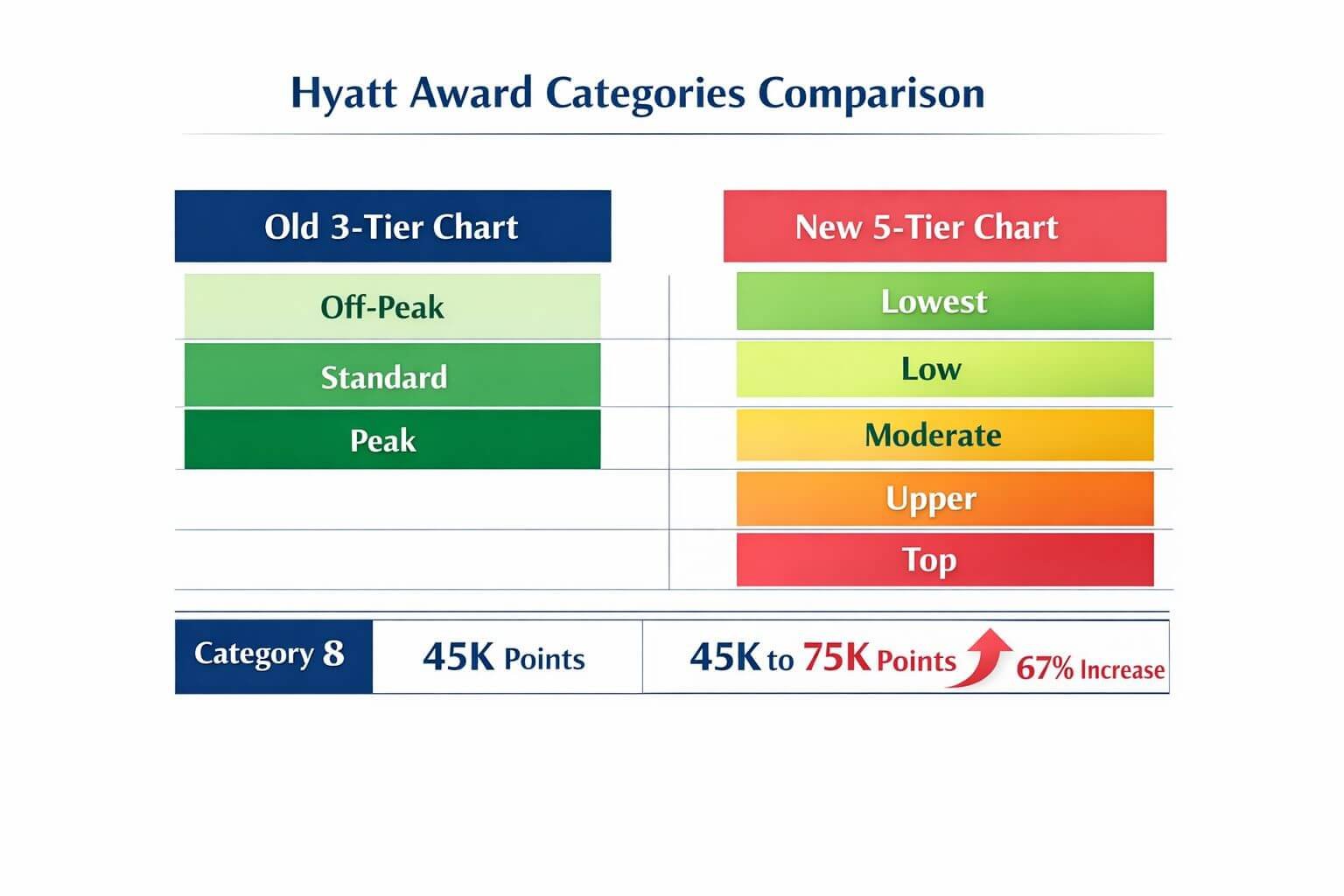
World of Hyatt’s new 5-tier award chart launches in May 2026, and it represents the biggest devaluation in the program’s history. Category 8 properties can now cost up to 75,000 points per night at the “Top” tier—a 67% jump from the current peak rate of 45,000 points. But the headline numbers don’t tell the full story. Some categories barely move at the “Moderate” level, and Hyatt’s phased rollout means the worst pricing won’t hit every property immediately. This guide breaks down exactly what changes, what it will cost you, and what to do before and after May 2026.
Key Takeaways
- Category 8 “Top” nights jump to 75,000 points (from 45,000 peak), a 67% increase—the steepest hike in the new Hyatt award chart 2026
- The chart expands from 3 tiers to 5: Lowest, Low, Moderate, Upper, and Top replace Off-Peak, Standard, and Peak
- Average mid-tier increases run 20–37%, but Upper and Top tiers push well beyond that for high-demand dates
- Reservations booked before May 2026 are grandfathered at current rates—book now to lock in old pricing
- Hyatt says Upper/Top pricing will be “limited” in 2026, with broader rollout in future years—but that timeline is vague
- Seven properties already shifted categories as of February 24, 2026, including Grand Hyatt Grand Cayman (Cat 6 → Cat 8)
- Hyatt still publishes a fixed chart, unlike Marriott and Hilton’s uncapped dynamic pricing—there’s a ceiling, even if it’s higher
- Explorist and Globalist members get 1-month early award access starting May 2026, a meaningful new perk
Quick Answer
The Hyatt award chart 2026 changes are a real devaluation, but they’re not uniform. If you target “Lowest” and “Moderate” tier nights, your points still deliver strong value at most properties. The pain concentrates at the top: luxury Category 7–8 stays during peak demand can now cost 40–67% more. Your best moves right now are to book pre-May trips at old rates, stockpile points in transferable currencies rather than Hyatt balances, and run CPP math before every redemption going forward.
How Hyatt’s New Award Chart Actually Changes in May 2026
The old system had three pricing levels per category: Off-Peak, Standard, and Peak. The new system replaces those with five: Lowest, Low, Moderate, Upper, and Top. That expansion creates over 40 distinct price points across Categories 1–8 plus all-inclusive tiers A–F.
Here’s what the shift looks like for standard room categories:
| Category | Old Off-Peak | Old Standard | Old Peak | New Lowest | New Moderate | New Top |
|---|---|---|---|---|---|---|
| 1 | 3,500 | 5,000 | 6,500 | 3,500 | 5,000 | 7,500 |
| 4 | 8,000 | 12,000 | 15,000 | 8,000 | 14,000 | 23,000 |
| 5 | 12,000 | 17,000 | 23,000 | 12,000 | 20,000 | 35,000 |
| 7 | 20,000 | 25,000 | 35,000 | 20,000 | 30,000 | 55,000 |
| 8 | 25,000 | 30,000 | 45,000 | 25,000 | 40,000 | 75,000 |
All-inclusive Category F “Top” can reach 85,000 points for double occupancy.
The “Lowest” tier matches old off-peak pricing in most categories. “Moderate” sits roughly 20–37% above old standard rates. The real damage is at “Upper” and “Top,” where Category 5 peak jumps 52% (to 35,000), and Category 7 peak jumps 57% (to 55,000).
For a deeper breakdown of every category change, see our full guide to Hyatt’s new 5-tier pricing.
Important context: Hyatt says Upper and Top pricing will apply to a “limited” number of nights in 2026, with broader use phased in over future years. Frequent Miler’s Greg Diamond has argued that 40,000-point swings within a single category effectively mimic dynamic pricing despite the published chart. The practical question isn’t whether the chart exists—it’s how often you’ll actually see “Lowest” vs. “Top.”
Calculate Your Real Cents-Per-Point Under the New 5-Tier Pricing
The only way to know whether an award booking makes sense is to run the CPP math. Under the old chart, Hyatt points consistently delivered 1.8–2.5 cents per point at standard and peak rates. The new tiers change that math significantly at the high end.
Here are three real-world examples using estimated cash rates for May–August 2026:
Park Hyatt Kyoto (Category 8)
- Estimated cash rate (summer 2026): $900/night
- Moderate tier: 40,000 points → 2.25 CPP
- Top tier: 75,000 points → 1.20 CPP
At “Moderate,” this is still an excellent redemption. At “Top,” you’re below the 1.5 CPP threshold, where most readers should consider paying cash instead.
Andaz Costa Rica Resort (Category 7)
- Estimated cash rate (summer 2026): $550/night
- Moderate tier: 30,000 points → 1.83 CPP
- Top tier: 55,000 points → 1.00 CPP
The “Top” tier here is a clear walk-away. At 1.0 CPP, your Chase points or Bilt points are better spent elsewhere.
Grand Hyatt Grand Cayman (Category 8, opening 2026)
- Estimated cash rate (summer 2026): $700/night
- Moderate tier: 40,000 points → 1.75 CPP
- Top tier: 75,000 points → 0.93 CPP
This property jumped from Category 6 to Category 8 before it even opened. At “Top” pricing, the CPP collapses below 1.0—pay cash or look at alternatives.
The dollar impact is real. For a 3-night Category 8 stay at “Top” vs. old peak pricing, you’d need an extra 90,000 points (225,000 vs. 135,000). At 1.8 CPP, that’s roughly $540 in additional point value burned compared to the old chart.
For a full refresher on how to run these calculations, see our guide to cents-per-point math.
Decision rule: If a Hyatt award prices at “Upper” or “Top” and your CPP drops below 1.5, compare the cash rate against your credit card’s effective return. A Chase Sapphire Reserve at 1.5x on travel portal bookings may beat a weak Hyatt redemption.
What to Book Before May 2026 to Lock In Old Hyatt Award Rates
Reservations made before the May 2026 switchover are grandfathered at current pricing. This is the single most valuable thing you can do right now.
Priority booking checklist:
- Summer 2026 peak trips: Book Category 5–8 properties now at old peak rates. A Cat 8 stay booked today at 45,000/night saves 30,000 points per night vs. potential “Top” pricing.
- Holiday travel (Thanksgiving, Christmas, New Year’s): These dates are most likely to fall into the “Upper” or “Top” tiers post-May. Lock them in now.
- All-inclusive resorts (Categories A–F): Double-occupancy “Top” rates can hit 85,000 points. Book at current rates if your dates are firm.
- Properties that just recategorized: Grand Hyatt Grand Cayman (now Cat 8), Hyatt Centric Malta (now Cat 3), and five others shifted on February 24. These are already more expensive even under the old tier system.
Common mistake: Booking speculative trips you won’t take just to “lock in” rates. Hyatt’s cancellation policies still apply, and tying up points in bookings you’ll cancel wastes flexibility. Only book trips you’re at least 80% likely to take.
For broader strategies on getting ahead of devaluation risk, our 2026 award travel trends guide covers the macro picture.
When Hyatt Awards Still Beat Cash (and When to Walk Away)
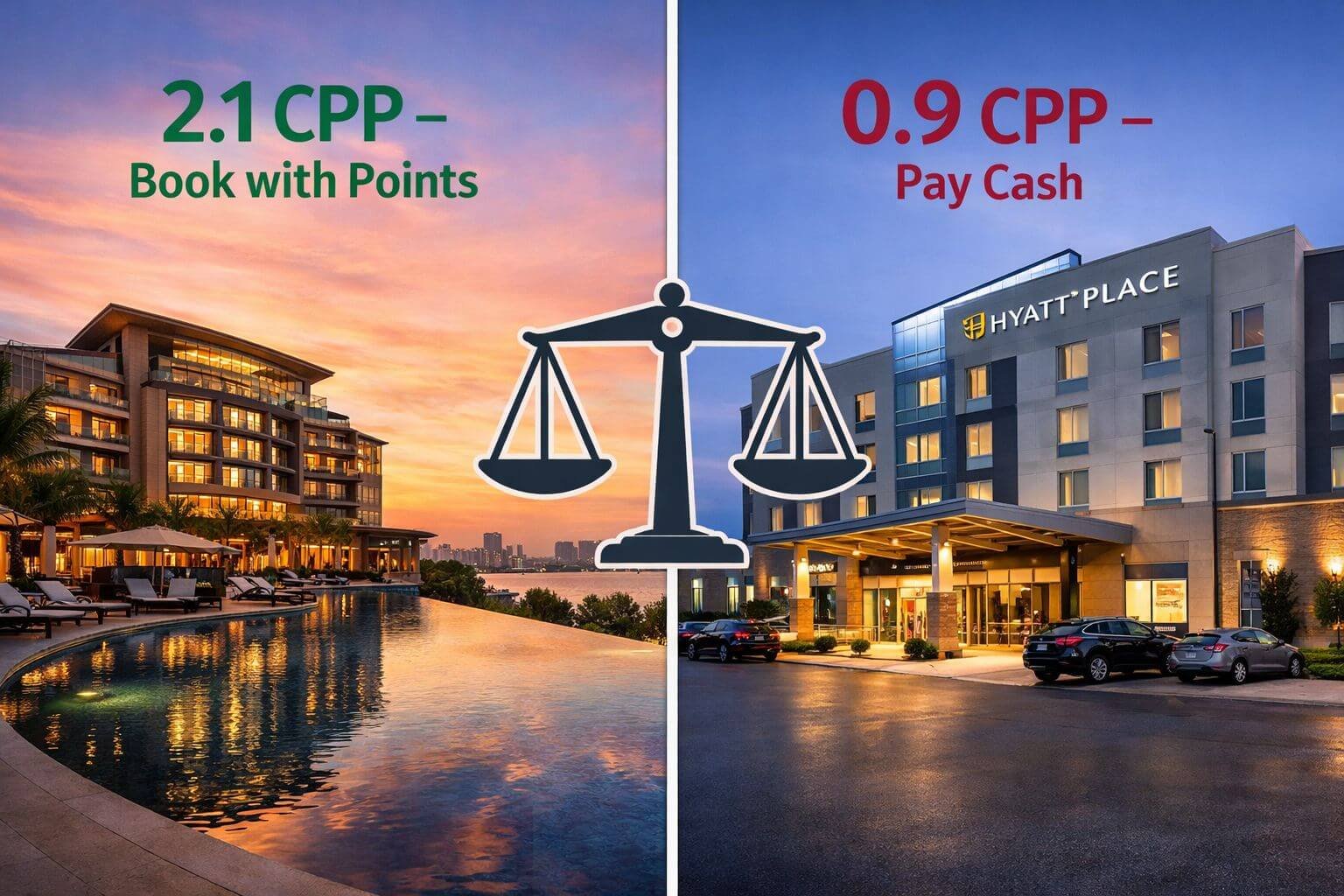
Not every redemption gets worse. Here’s a framework:
Still strong value (book with points):
- Category 1–4 properties at “Lowest” through “Moderate” tiers—pricing barely moves, and CPP often exceeds 2.0
- Category 5–6 at “Lowest” or “Low” during shoulder season
- Any property where cash rates spike (events, holidays) but award tier stays at “Moderate”—the fixed chart protects you here
Marginal (run the math first):
- Category 5–7 at “Upper” tier—CPP typically lands between 1.3–1.8, depending on cash rates
- All-inclusive properties where the cash rate includes meals and drinks (the effective CPP may be higher than it looks)
Walk away (pay cash or switch programs):
- Category 7–8 at “Top” tier where cash rates are under $700/night
- Any redemption below 1.5 CPP when you have transferable points that could go to airline partners instead
- Properties where you’d get a meaningful cash discount through corporate rates, AAA, or Hyatt Privé
Best for: Travelers who mix points and cash strategically, not those who insist on always using points. Not for: Readers who treat every Hyatt stay as an automatic award booking—that approach no longer works across the board.
How to Adjust Your Hyatt Earning Strategy Across Cards and Stays
The devaluation changes how aggressively you should funnel points into World of Hyatt specifically.
Keep transferable points flexible. Chase Ultimate Rewards remain Hyatt’s only major transfer partner at 1:1, and that transfer is still among the best uses of Chase points. But don’t transfer speculatively. Hold points in Chase, and transfer only when you have a confirmed award booking at a favorable tier.
The same logic applies to Bilt points (which also transfer 1:1 to Hyatt). Capital One miles, Amex points, and Citi points don’t transfer to Hyatt directly, so if you’re diversifying away from Hyatt, those currencies give you access to other hotel and airline partners that may offer better value on specific trips.
Earning adjustments to consider:
- Globalist status still matters. Suite upgrades, free breakfast, and the confirmed suite upgrade benefit offset higher award costs. The new 1-month early award access for Explorist/Globalist is also meaningful for snagging “Lowest” and “Low” tier nights before they’re gone.
- Chase Sapphire cards remain the primary feeder. The Chase Sapphire Preferred earns 2x on travel and dining, and the Reserve earns 3x on travel—both transfer 1:1 to Hyatt.
- Don’t over-earn Hyatt-specific points. The World of Hyatt credit card earns bonus points on Hyatt spending, but those points are locked into the Hyatt ecosystem. With devaluation risk rising, keeping more of your earnings in flexible currencies is prudent.
For a broader look at how to maximize Hyatt points across earning channels, see our dedicated guide.
Backup Plans: When to Pivot From Hyatt to Other Hotel Programs
Hyatt’s devaluation doesn’t happen in a vacuum. Here’s how it compares:
| Program | Pricing Model | Cap on Award Nights? | Typical CPP Range |
|---|---|---|---|
| World of Hyatt (post-May 2026) | 5-tier fixed chart | Yes (75K Cat 8 Top) | 1.0–2.5 |
| Marriott Bonvoy | Fully dynamic | No cap | 0.6–1.2 |
| Hilton Honors | Fully dynamic | No cap | 0.4–0.8 |
| IHG One Rewards | Dynamic with soft ranges | No firm cap | 0.5–1.0 |
Even after the devaluation, Hyatt’s fixed chart with a published ceiling is structurally better than Marriott’s or Hilton’s uncapped dynamic pricing. Milesopedia still rates Hyatt points at roughly 2.4¢ CAD (about 1.7¢ USD), compared with Marriott’s 0.9¢ CAD.
When to pivot:
- If your target Hyatt property prices at “Top” and a comparable Marriott or Hilton property is available at a lower effective CPP
- If you’re sitting on Amex or Capital One points that don’t transfer to Hyatt—use them for Marriott or airline partners instead
- If you’re booking Category 1–3 properties where the cash rate is under $150/night, at that price, cash is almost always simpler
When to stay with Hyatt:
- Luxury properties (Park Hyatt, Andaz) at “Lowest” through “Moderate” tiers still deliver outsized value
- Globalist perks (suite upgrades, breakfast, late checkout) add hundreds of dollars in value that don’t show up in CPP calculations
- The fixed chart protects you when cash rates spike—dynamic programs can’t offer that guarantee
Action Plan Checklist for Hyatt Loyalists in 2026
Use this step-by-step framework based on your situation:
Before May 2026:
- Book any confirmed summer/fall 2026 Hyatt trips at current award rates
- Check whether your target properties shifted categories on February 24
- Transfer Chase or Bilt points to Hyatt only for specific, confirmed bookings—don’t speculatively transfer
After May 2026 launches:
- Run CPP math on every Hyatt award booking using the new tier that appears at checkout
- Use the 1.5 CPP threshold as your floor—below that, compare cash rates and credit card portal options
- If you hold Explorist or Globalist status, use 1-month early access to grab “Lowest” and “Low” tier nights
- Monitor which properties and dates Hyatt assigns to “Upper” and “Top” tiers—patterns will emerge by late summer 2026
Ongoing strategy:
- Keep the majority of your earning in transferable points (Chase, Bilt) rather than Hyatt-locked currencies
- Watch for transfer bonuses from Chase to Hyatt—a 20–30% bonus can offset the new higher rates
- Reassess Globalist status value annually—if you’re not getting suite upgrades or breakfast, the status may not justify the qualifying nights
- Track Hyatt’s phased rollout of Upper/Top pricing; the 2026 chart is the floor, not the ceiling, of future changes
Conclusion
The Hyatt award chart 2026 changes are real and meaningful—especially at the top end, where Category 7–8 “Top” tier pricing represents a 57–67% increase. But this isn’t a reason to panic or abandon the program. Hyatt still offers a published chart with fixed ceilings, which is structurally better than those provided by Marriott and Hilton. The key is adapting your booking strategy: lock in pre-May rates where possible, hold transferable points in Chase or Bilt until you have a specific booking, and run CPP math before every redemption.
The travelers who get hurt most are those who book on autopilot. The ones who come out ahead will be those who treat each booking as a decision—points vs. cash, Hyatt vs. alternatives, “Moderate” vs. “Top.” That’s always been the core of smart award travel, and it matters more now than ever.
Next steps:
- Read our full breakdown of Hyatt’s new 5-tier award chart for the complete category-by-category analysis
- Review current points valuations to benchmark your CPP targets
- Check our World of Hyatt transfer partners guide for the latest on earning and transferring to Hyatt
FAQ
How much more will Category 8 Hyatt awards cost in 2026? Category 8 “Top” tier nights will cost 75,000 points, up from 45,000 at the old peak rate—a 67% increase. The “Moderate” tier sits at 40,000 points, a 33% increase over the old standard rate of 30,000.
Are existing Hyatt award bookings affected by the May 2026 changes? No. Reservations booked before the May 2026 switchover are grandfathered at the old rates. This applies to both standard and peak bookings already confirmed.
Is Hyatt moving to dynamic pricing like Marriott? Not exactly. Hyatt is expanding to 5 fixed tiers with published point thresholds, so there’s still a ceiling on what any night can cost. Marriott and Hilton use uncapped dynamic pricing with no published maximums. However, critics argue the wide spread between “Lowest” and “Top” (e.g., 25,000–75,000 for Cat 8) functions similarly to dynamic pricing in practice.
Should I burn all my Hyatt points before May 2026? Only if you have specific trips that make sense. Burning points on trips you don’t actually want just to avoid devaluation is a common mistake. Focus on booking confirmed travel at current rates and holding the rest in flexible currencies, such as Chase Ultimate Rewards.
Which transfer partners send points to Hyatt? Chase Ultimate Rewards and Bilt Rewards both transfer to World of Hyatt at a 1:1 ratio. Amex Membership Rewards, Capital One miles, and Citi ThankYou points do not transfer directly to Hyatt.
Will Hyatt’s “Lowest” tier actually be available, or is it just marketing? Hyatt has said Upper and Top pricing will be “limited” in 2026. How often “Lowest” appears will depend on the property and season. Explorist and Globalist members get 1-month early access to award inventory, which should help secure lower tiers.
Is Hyatt still the best hotel loyalty program after this devaluation? For most transferable-points users, yes—but with a narrower margin. Even post-devaluation, Hyatt points deliver roughly 1.7 cents per point on average, compared to about 0.7 for Marriott and 0.5 for Hilton. The gap has shrunk, but it hasn’t closed.
How do all-inclusive Hyatt resorts change under the new chart? All-inclusive Categories A–F follow the same 5-tier expansion. Category F “Top” for double occupancy can reach 85,000 points per night. Run CPP carefully here—all-inclusive cash rates include food and drinks, which can make the effective CPP higher than it first appears.
What’s the best CPP threshold for deciding points vs. cash at Hyatt? Use 1.5 CPP as your floor. Below that, compare the cash rate against what your credit card earns on travel purchases. A Chase Sapphire Reserve effectively gets 1.5 CPP through the travel portal, so any Hyatt redemption below that threshold means you’re better off paying cash.


Content on Award Travel Hub is independently created by Award Travel Hub Editorial Desk and, where noted, reviewed by Award Travel Hub Review Desk. Some pages may contain affiliate links, but compensation does not determine our coverage, opinions, or methodology.