

Award availability isn’t what it used to be. Airlines have cut capacity, shifted to dynamic pricing, and reserved fewer seats for partner awards. Yet thousands of travelers will still fly business class to Tokyo, safari in Tanzania, or watch the Australian Open from Melbourne—all using points. The difference between those who succeed and those who give up? A structured planning framework that starts early, builds in flexibility, and prioritizes the hardest-to-book segments first.
Learning how to plan 2026 aspirational trips with points requires a shift from spontaneous booking to strategic campaign planning. The travelers securing premium cabin awards to bucket-list destinations aren’t getting lucky—they’re working backward from departure dates, monitoring multiple programs, and building layered backup plans. This guide provides the decision framework and timeline to make it happen.
Key Takeaways
- Start 9-18 months ahead: Award calendars open 11-12 months out for most programs; competitive routes fill within hours of release
- Lock long-haul premium cabins first: Secure the hardest segment (intercontinental business/first class) before adding positioning flights or hotels
- Build three-tier backup plans: Primary route, alternative partner, and mixed-cabin options ensure you don’t lose momentum when availability shifts
- Use flexible points strategically: Chase, Amex, Capital One, Citi, and Bilt points provide access to 15+ airline programs—leverage transfer bonuses and sweet spots
- Layer the trip in phases: Core award flights first, then positioning segments, hotels, and ground arrangements as dates firm up
Why Aspirational Award Trips Are Harder – But Still Possible in 2026
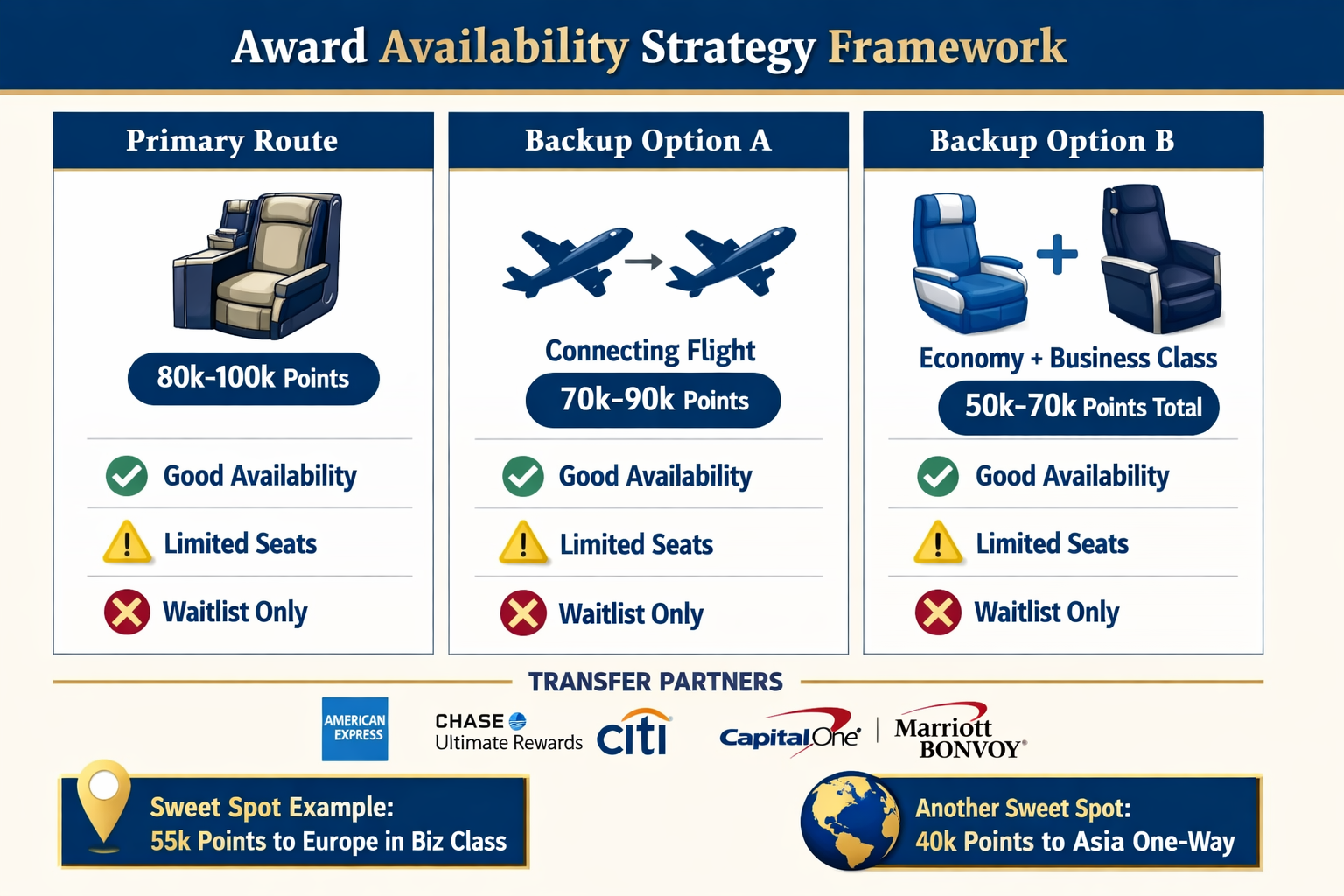
Award availability has contracted across the board. Airlines reduced international capacity during the pandemic and haven’t fully restored premium cabin inventory. Programs like Delta SkyMiles and United MileagePlus shifted to dynamic pricing, making predictable sweet spots harder to find. Partner award space—the backbone of flexible points strategies—has become scarcer as airlines prioritize their own members.
What changed in 2024-2026:
- Fewer saver-level seats: Airlines release 2-4 business class awards per flight instead of 6-8
- Dynamic pricing expansion: More programs tie award costs to cash fares, eliminating fixed charts
- Partner space restrictions: Airlines like Qantas, JAL, and Lufthansa reduced partner availability on premium routes
- Shorter booking windows: Some programs cut advance booking from 360 to 330 days
- Increased competition: More travelers hold flexible points and know how to use them
Despite these headwinds, aspirational trips remain achievable. The key is treating award booking as a months-long campaign rather than a single search session. Travelers who monitor award calendars, set alerts, and maintain backup options consistently find space that casual searchers miss.
The advantage of flexible points in 2026:
Transferable currencies (Chase Ultimate Rewards, Amex Membership Rewards, Capital One miles, Citi ThankYou Points, Bilt Rewards) provide access to 15+ airline programs. When one program shows no availability, another often does. A Tokyo trip might use ANA miles, Virgin Atlantic points, or Air Canada Aeroplan, depending on which partner releases space first. This optionality is the foundation of successful aspirational award planning.
Understanding award travel predictions for 2026 helps set realistic expectations about availability patterns and program changes.
Defining Your Dream Trip and Must-Have vs. Nice-to-Have Elements
Aspirational trips fail when travelers insist on perfection: specific dates, nonstop routing, particular airlines, and luxury hotels—all booked with points. Award availability rarely aligns with every preference. Successful planning starts by separating non-negotiable elements from flexible ones.
The Must-Have / Nice-to-Have Framework
Must-Have Elements (non-negotiable):
- Destination: The primary location (e.g., Tanzania for safari, Japan for cherry blossoms)
- Rough timeframe: Season or event window (e.g., Australian Open in January, Serengeti migration July-October)
- Cabin class on longest segment: Business class for 10+ hour flights if comfort is essential
- Companion requirements: Solo vs. two passengers vs. family (availability multiplies difficulty)
Nice-to-Have Elements (flexible):
- Specific dates within the travel window
- Nonstop vs. one-stop routing
- Preferred airline or alliance
- Premium economy vs. business on shorter segments
- Exact hotel properties vs. general location
Example: African Safari Trip
Must-Have:
- Destination: Tanzania (Serengeti/Ngorongoro)
- Timeframe: July-September 2026 (dry season, migration)
- Business class from the U.S. East Coast on the transatlantic segment
- Two passengers
Nice-to-Have:
- Exact departure week (any time July-August works)
- Nonstop JFK-Johannesburg vs. connecting through Europe/Middle East
- Qatar vs. Ethiopian vs. Kenya Airways
- Premium economy vs. business on JNB-JRO positioning segment
- Specific safari lodge (several excellent options available)
This framework immediately expands options. Instead of searching for two Qatar Qsuites seats JFK-DOH-JNB on specific July dates (likely unavailable), the search becomes: any Star Alliance or Oneworld partner, any U.S. gateway, any connection point, any week in July-August. Availability increases exponentially.
Realistic Point Requirements for Aspirational Trips
Before building a plan, confirm point balances align with trip costs. Aspirational awards typically require:
| Trip Type | Point Range (per person) | Example Routes |
|---|---|---|
| Asia Business Class | 80,000-120,000 | U.S. to Tokyo/Seoul/Bangkok via ANA, Singapore, JAL |
| Africa Business Class | 100,000-150,000 | U.S. to Johannesburg/Nairobi via Ethiopian, Qatar, Turkish |
| Australia/New Zealand Business | 90,000-140,000 | U.S. to Sydney/Auckland via ANA, Air Canada, United |
| South Pacific Premium | 100,000-180,000 | U.S. to Fiji/Tahiti via Flying Blue, Virgin Atlantic |
| Europe First Class | 80,000-110,000 | U.S. to Europe via ANA (Lufthansa/Swiss first) |
Add 30-50% for peak season, last-minute booking, or programs with high surcharges. Budget additional points for positioning flights (10,000-25,000 per segment) and hotels if using points (15,000-50,000 per night at aspirational properties).
Common mistake: Underestimating total point needs. A couple booking business class to Tanzania might assume 200,000 points total (100k each for the long-haul award). Reality: 220,000 for transatlantic segments + 40,000 for positioning flights + 100,000 for safari lodge stays = 360,000 points. Build a complete budget before committing to dates.
How to Plan 2026 Aspirational Trips with Points: Locking in Long-Haul Premium Cabins First
The core principle: secure the scarcest, highest-value segment first, then build around it. For aspirational trips, that’s the intercontinental business or first class flight. Once locked, everything else—positioning flights, hotels, tours—becomes easier to arrange.
Why Long-Haul Comes First
Premium cabin award space on competitive routes (U.S. to Asia, Africa, South Pacific) appears sporadically and disappears quickly. Waiting to “finalize dates” before searching means missing available seats. The correct sequence:
- Find available long-haul premium cabin space within your travel window
- Lock those dates (hold or book immediately)
- Build positioning flights to/from the gateway city
- Add hotels and ground arrangements around confirmed flight dates
This approach feels backward—committing to flights before hotels—but reflects the award availability reality. Premium cabin seats to Johannesburg might appear only twice in a three-month window. Safari lodges have far more availability and can be booked 2-6 months out.
The 11-Month Search Window
Most airline programs open award calendars 11-12 months before departure:
- ANA Mileage Club: 355 days
- Air Canada Aeroplan: 355 days
- United MileagePlus: 337 days
- American AAdvantage: 331 days
- Alaska Mileage Plan: 330 days
- Singapore KrisFlyer: 355 days
For travel in July 2026, award space opens in August 2025. Set calendar reminders for the exact date (e.g., August 1, 2025, for July 1, 2026 travel) and search the moment calendars open. Competitive routes—especially partner space on JAL, ANA, Singapore, or Qatar—fill within 24-48 hours.
Step-by-step: Booking Japan Business Class for April 2026 Cherry Blossom Season
Scenario: Two passengers, U.S. West Coast to Tokyo, early April 2026, business class
Step 1 (May 2025): Set alerts for April 1-15, 2026 award space opening in May 2025. Monitor ANA, JAL (via Alaska or British Airways), and Air Canada Aeroplan (for ANA space).
Step 2 (May 1, 2025): ANA calendar opens for April 1, 2026. Search ANA.co.jp for two business class seats LAX-NRT or SFO-NRT. ANA releases partner space reliably but cherry blossom season is competitive.
Step 3: Find availability April 8, 2026 (not April 3 preferred date, but within window). ANA round-trip business: 88,000 miles per person via Virgin Atlantic Flying Club (transferred from Amex, Chase, Citi, Capital One, or Bilt).
Step 4: Transfer 176,000 points to Virgin Atlantic immediately. Book both tickets. Total out-of-pocket: ~$150 in taxes per person.
Step 5 (May-July 2025): Monitor for April 3 space opening due to cancellations. Set ExpertFlyer alerts. If space appears, rebook (Virgin Atlantic allows changes).
Step 6 (June-August 2025): Book positioning flights if needed (e.g., home city to LAX), hotels in Tokyo, and any domestic Japan segments.
This sequence locks the hardest piece (trans-Pacific business class during peak season) first, then layers easier elements around it.
Using Multiple Programs and Transfer Partners
Flexible points shine when one program shows no space, but another does. For the same Tokyo trip:
- Primary search: ANA space via Virgin Atlantic (88k miles)
- Backup option A: JAL space via Alaska Mileage Plan (60k miles, but Alaska miles harder to earn)
- Backup option B: United Polaris via United MileagePlus (80k-110k miles, dynamic pricing)
- Backup option C: Air Canada via Aeroplan (90k points, books ANA and other Star Alliance)
Check all options simultaneously. If ANA shows nothing but JAL has space, transfer Chase points to British Airways Avios (books JAL) or buy Alaska miles during a bonus promotion.
For detailed guidance on which transfer partners access specific sweet spots, reference the Transfer Partners Cheat Sheet.
Using Partner Programs, Alerts, and Tools to Find Hidden Availability
Award space exists in three tiers: widely visible, program-specific, and hidden. Casual searchers see only tier one. Successful aspirational trip planners access all three through partner programs, alerts, and specialized tools.
Partner Program Strategy
Airlines release different inventory to their own members vs. partners. Example: Lufthansa releases generous first class space to its own Miles & More members but minimal space to United or Air Canada. Conversely, ANA releases excellent business class space to Virgin Atlantic and Air Canada but limited space to United.
Key partner relationships for aspirational routes:
| Airline with Space | Book Using | Sweet Spot |
|---|---|---|
| ANA (Star Alliance) | Virgin Atlantic, Air Canada Aeroplan | U.S.-Japan business: 88k-90k miles |
| JAL (Oneworld) | Alaska Mileage Plan, British Airways | U.S.-Japan business: 60k-80k miles |
| Singapore Airlines | KrisFlyer (own program), Avianca LifeMiles | U.S.-Asia business: 90k-110k miles |
| Qatar Airways | Avios (BA/Qatar/Iberia), Alaska | U.S.-Middle East/Africa business: 70k-85k miles |
| Etihad Airways | Etihad Guest (own program) | U.S.-Middle East/Asia business: 100k-115k miles |
| Turkish Airlines | Miles&Smiles (own program), Aeroplan | U.S.-Africa via Istanbul: 90k-100k miles |
Search the same route across multiple programs. A flight showing no space on United.com might appear on ANA.co.jp or aircanada.com (both book Star Alliance partners).
Award Search Tools and Alerts
Manual searching across 10+ airline websites is impractical. Specialized tools aggregate availability:
Award search platforms:
- ExpertFlyer: Sets alerts for specific routes/dates when space opens (subscription required)
- AwardFares: Real-time search across Star Alliance, Oneworld, and SkyTeam programs
- Seats.aero: Monitors premium cabin space on major routes, sends alerts
- Point.me: Searches 100+ programs simultaneously (premium subscription)
How to use alerts effectively:
- Set broad date ranges: Instead of April 3 only, alert for April 1-15
- Monitor multiple programs: Alert for both ANA and United space on the same route
- Check daily during opening windows: When calendars open 11 months out, space appears and disappears hourly
- Act within hours: When alerts trigger, book immediately or risk losing space
Example alert setup for Australia trip:
Goal: Business class to Sydney, January 2026 (Australian Open)
- Alert 1: ExpertFlyer for ANA space LAX-SYD, January 10-20, 2026, business class, 2 passengers
- Alert 2: Seats.aero for United Polaris LAX-SYD, same dates
- Alert 3: AwardFares for Air Canada Aeroplan space SFO-SYD (alternative gateway)
When any alert triggers, evaluate immediately. If it’s a viable date within the window, book. Don’t wait for “perfect” dates—award availability rarely aligns exactly with preferences.
For a comprehensive comparison of search tools, see the award search tools showdown.
Hidden Availability: Waitlists and Last-Minute Openings
Airlines release additional space in waves:
- T-14 days: Many carriers release unsold inventory two weeks before departure
- T-7 days: Another wave as airlines finalize loads
- T-3 days: Last-minute space, often business class upgrades from economy awards
Waitlists (offered by Air Canada, Qantas, and others) can clear weeks or days before departure. If primary dates show no space, book backup dates and waitlist for preferred dates. Monitor daily as departure approaches.
Risk assessment: Last-minute strategies work for flexible travelers without firm hotel bookings or time-off constraints. For trips requiring lodge reservations or event tickets (safari camps, Australian Open), book available space early rather than gambling on last-minute openings.
When Economy, Premium Economy, or Mixed Cabins Make Sense
Not every segment requires business class. Strategic use of economy or premium economy—especially on shorter flights or less competitive routes—conserves points and increases availability while maintaining overall trip quality.
The Decision Framework: Cabin Class by Segment
Book business/first class when:
- Flight duration exceeds 8-10 hours (transatlantic, transpacific, U.S.-Africa)
- Overnight departure requires sleep for next-day activities
- Award cost is reasonable (80k-120k miles), and availability exists
- Cash fare difference exceeds $2,000-$3,000 per person
Consider premium economy when:
- Flight duration is 6-9 hours (U.S. West Coast to Hawaii, East Coast to Western Europe)
- Business class costs 2x+ premium economy (e.g., 140k vs. 60k miles)
- Traveling with children (premium economy provides more space than economy, without the Business Class cost)
- Business class shows no availability, but premium economy does
Economy makes sense when:
- Flight duration under 5 hours (regional positioning, intra-Asia, intra-Europe)
- Award cost in business is prohibitive (150k+ miles)
- Cash fare is low enough to pay out-of-pocket (<$300)
- Availability in premium cabins is zero
Mixed-Cabin Strategy Example: African Safari
Route: New York to Serengeti (Seronera Airstrip)
Segment 1 (JFK-JNB, 15 hours): Business Class essential
- Ethiopian Airlines via Addis Ababa: 90,000 miles per person (transferred to Aeroplan)
- Overnight flight; arrive refreshed for safari
- Cash equivalent: $4,500
Segment 2 (JNB-JRO, 4 hours): Economy acceptable
- Kenya Airways or Ethiopian: 12,500 miles (Aeroplan) or $250 cash
- Short daytime flight; business class adds minimal value
- Conserves 15,000-20,000 miles per person
Segment 3 (JRO-Seronera, 45 minutes): Regional flight (fixed cost)
- Coastal Aviation or Regional Air: $200 cash (no award option)
- Small aircraft; no cabin classes
Total per person: 102,500 miles + $450 cash vs. 120,000+ miles if booking business on all segments
The mixed-cabin approach saves 35,000 miles per couple while maintaining comfort where it matters (the long-haul overnight segment). Those saved miles fund another trip or reduce earning requirements.
Calculating Value: When to Pay Cash Instead
Use cents per point (CPP) calculations to determine if award redemption beats paying cash:
Formula: (Cash fare – award taxes/fees) ÷ miles required = CPP
Example: Business class LAX-Tokyo
- Cash fare: $3,500
- Award cost: 88,000 miles + $150 fees
- CPP: ($3,500 – $150) ÷ 88,000 = 3.8 cents per point
If your points are worth 1.5-2 cents per point on average (typical for flexible points), 3.8 CPP is an excellent value. Book the award.
Counterexample: Premium economy LAX-Tokyo
- Cash fare: $1,200
- Award cost: 60,000 miles + $150 fees
- CPP: ($1,200 – $150) ÷ 60,000 = 1.75 cents per point
At 1.75 CPP, the award provides marginal value. Consider paying cash if:
- Cash fare drops further (sales, mistake fares)
- You need to conserve miles for business class segments
- The route has excellent business class availability, worth saving miles for
For detailed value calculations, use the Award Travel Hub calculators when weighing economy vs. premium cabins.
How to Layer Hotels, Tours, and Backup Flights on Top of Your Core Awards
Once long-haul flights are locked, layer remaining trip elements in priority order. This phased approach prevents overcommitting before core awards are confirmed and allows flexibility if flight dates shift.
Phase 1: Core Long-Haul Awards (9-12 months out)
Action items:
- Search for award space the day calendars open
- Book or hold primary long-haul segments
- Transfer points immediately to secure space
- Set alerts for preferred dates if booking backup dates
Example: For the July 2026 safari, book a transatlantic business class in August 2025 when space opens.
Phase 2: Positioning Flights (6-9 months out)
Once international flights are confirmed, add domestic or regional positioning segments.
Positioning flight categories:
- Home city to international gateway: If you live in a non-hub city, book flights to the departure airport (e.g., Nashville to JFK for JFK-JNB flight)
- International gateway to final destination: Regional flights within destination country (e.g., Johannesburg to Kilimanjaro for Tanzania safari)
- Return positioning: Reverse of the above
Booking strategies:
- Use points: Book with same airline program if routing allows (e.g., United MileagePlus for domestic + international segments)
- Pay cash: Domestic flights often cost 12,500-25,000 miles but $150-$300 cash; conserve miles if cash is reasonable
- Separate tickets: Book positioning on separate reservations to avoid missed connection issues if international flight delays
Common mistake: Booking positioning flights before international flights are confirmed. If the long-haul award falls through or dates change, positioning flights become useless. Always lock core awards first.
For travelers with premium credit cards offering lounge access, positioning through hub airports provides lounge benefits during connections.
Phase 3: Hotels and Accommodations (4-6 months out)
With flights confirmed, book hotels. Aspirational trips often combine award hotels with cash properties, depending on value.
Hotel booking decision tree:
Use points when:
- Award rates offer 1+ cent per point value
- Cash rates are inflated (peak season, major events)
- Hotel is aspirational property (Park Hyatt Tokyo, Aman resorts)
- You have excess hotel points from credit card bonuses
Pay cash when:
- Award rates require 50,000+ points per night but cash is $300-$400
- Hotel offers better cash benefits (breakfast, upgrades) than award stays
- Points are better saved for future trips
- Boutique properties don’t participate in points programs
Example: Tokyo hotel strategy
10-night stay during cherry blossom season
- Nights 1-3: Park Hyatt Tokyo (60,000 World of Hyatt points per night) – iconic property, good value at 1.5+ CPP
- Nights 4-7: Cash hotel in Shibuya ($150/night) – conserves points, good location
- Nights 8-10: Hyatt Regency Tokyo (15,000 points per night) – lower-tier property, excellent point value
Total: 225,000 Hyatt points + $600 cash vs. 600,000 points for all nights at Park Hyatt
Mixed strategies maximize value. Splurge with points at aspirational properties where cash rates are prohibitive; pay cash at mid-tier hotels where point value is poor.
Phase 4: Tours, Experiences, and Ground Arrangements (2-4 months out)
Book safari lodges, tour operators, and activities once flights and base hotels are confirmed.
Safari lodge example:
- Many Tanzania safari camps require deposits 90-120 days before arrival
- Book after confirming JFK-JNB-JRO flights (Phase 1-2)
- Some lodges accept points (Marriott Bonvoy in South Africa) but most are cash
Activity booking:
- Event tickets (Australian Open, Rugby World Cup): Buy as soon as available, often 6-12 months ahead
- Tours and guides: Book 2-3 months out for popular destinations
- Restaurant reservations: 1-3 months for high-end dining (e.g., Tokyo Michelin restaurants)
Building Backup Flight Options
Even with confirmed awards, maintain backup plans. Airlines cancel flights, reduce schedules, or eliminate routes. Award tickets on partner airlines can’t always be rebooked easily if disruptions occur.
Three-tier backup framework:
Tier 1 (Primary): Confirmed award booking
- Example: ANA business LAX-NRT via Virgin Atlantic, April 8, 2026
Tier 2 (Alternative partner): Different airline, same route, similar dates
- Example: JAL business LAX-NRT via Alaska Mileage Plan, April 9-10, 2026
- Set alert; book if primary cancels
Tier 3 (Mixed cabin or cash): Last-resort option if awards disappear
- Example: United Polaris or premium economy LAX-NRT, or cash fare if under $1,500
- Don’t book unless needed, but identify as fallback
This layered approach ensures trip continuity even if award space evaporates or airlines make schedule changes.
For strategies on preventing award bookings from falling apart during irregular operations, see best ways to prevent points bookings from falling apart.
A Sample 12-Month Planning Timeline for a 2026 Bucket List Trip
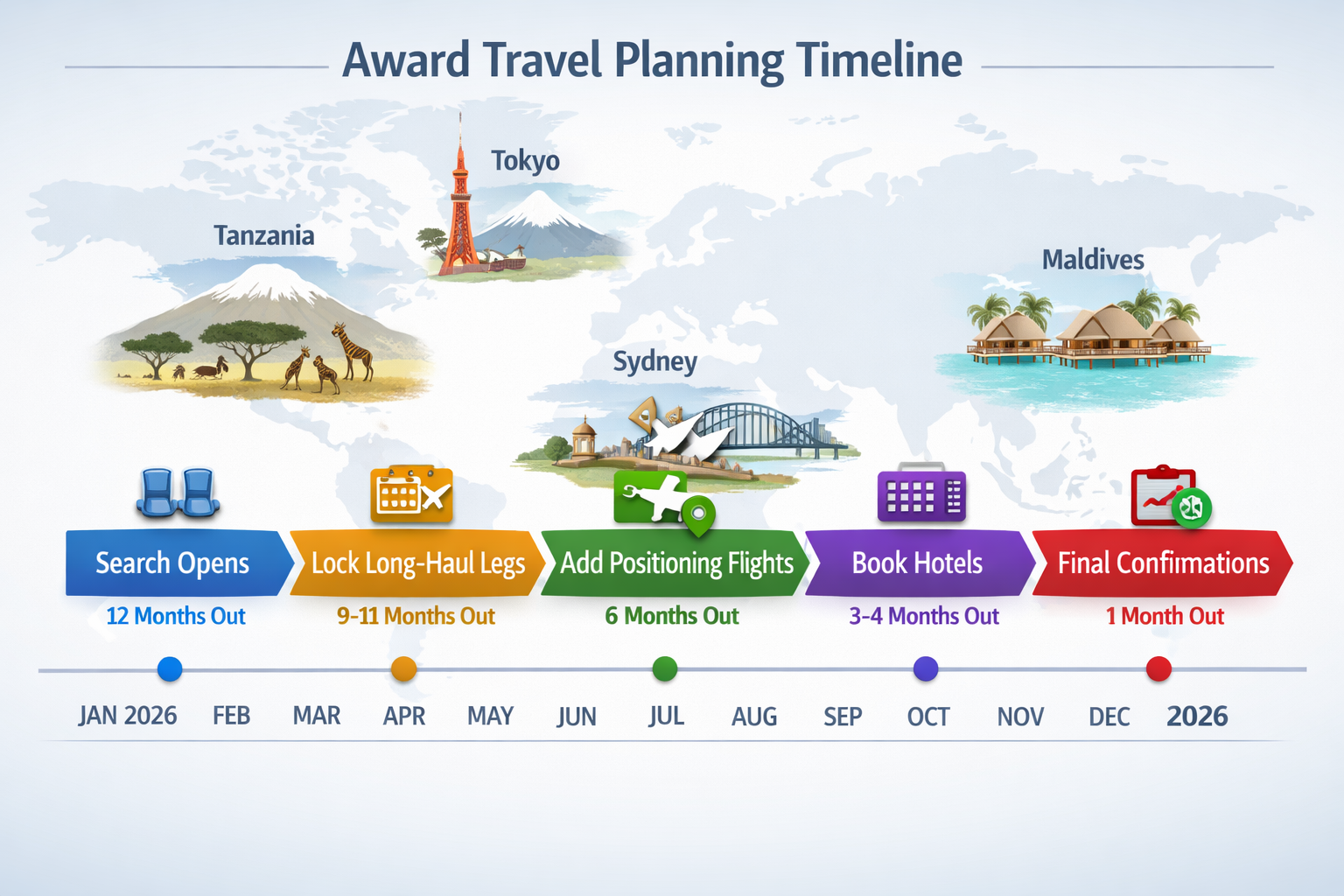
Here’s a month-by-month framework for planning an aspirational award trip, using a September 2026 African Safari as the example.
September 2025 (12 months out)
Goal: Define trip parameters and start monitoring award space
Action items:
- ✅ Decide on destination (Tanzania: Serengeti + Ngorongoro Crater)
- ✅ Set travel window (September 10-25, 2026 – dry season, post-peak pricing)
- ✅ Identify must-have elements (business class transatlantic, two passengers, safari lodge)
- ✅ Calculate point budget (200k miles for flights + 100k for hotels = 300k total)
- ✅ Review current point balances across Chase, Amex, Capital One, Citi, and Bilt
- ✅ Set ExpertFlyer alerts for September 2026 award space on Ethiopian, Qatar, Kenya Airways, South African Airways
Time investment: 3-4 hours (research, alerts setup)
October 2025 (11 months out)
Goal: Book core long-haul business class awards
Action items:
- ✅ Award calendars open for September 2026 travel
- ✅ Search Ethiopian Airlines JFK-ADD-JNB (Star Alliance, bookable via Aeroplan, Avianca LifeMiles)
- ✅ Find availability September 12, 2026 (not preferred Sept 10, but acceptable)
- ✅ Transfer 180,000 Chase points to Air Canada Aeroplan (90k miles per person, business class)
- ✅ Book JFK-JNB outbound immediately
- ✅ Search return JNB-JFK for September 23-25 window
- ✅ Book return September 24 via same program
Time investment: 5-6 hours (searching, transferring points, booking)
Status: Core flights locked ✅
November 2025 (10 months out)
Goal: Add positioning flights and finalize routing
Action items:
- ✅ Book JNB-JRO positioning flight (Johannesburg to Kilimanjaro)
- ✅ Use Aeroplan for short-haul (12,500 miles per person) or pay cash ($250 each)
- ✅ Decision: Pay cash to conserve miles (total $500 for the couple)
- ✅ Book return JRO-JNB positioning flight (September 23)
- ✅ If home city isn’t NYC, book domestic flights to/from JFK
Time investment: 2-3 hours
Status: All flights confirmed ✅
December 2025 (9 months out)
Goal: Research and shortlist safari lodges
Action items:
- ✅ Identify 3-4 safari camps in Serengeti and Ngorongoro
- ✅ Compare pricing, availability, and included activities
- ✅ Check if any accept Marriott/Hilton/Hyatt points (most don’t; budget cash)
- ✅ Contact lodges for availability September 14-22, 2026
- ✅ Request quotes and deposit requirements
Time investment: 4-5 hours (research, email inquiries)
January 2026 (8 months out)
Goal: Book safari lodges
Action items:
- ✅ Select 2 lodges: 4 nights in Serengeti, 2 nights at Ngorongoro Crater
- ✅ Pay deposits (typically 50% due at booking, 50% due 60 days before arrival)
- ✅ Confirm included activities (game drives, meals, park fees)
- ✅ Book regional flight JRO-Seronera Airstrip (small aircraft to safari camp)
Time investment: 2-3 hours
Status: Ground arrangements confirmed ✅
February-March 2026 (7-6 months out)
Goal: Book hotels for Johannesburg layover (if needed)
Action items:
- ✅ Decide if overnight in Johannesburg is needed (depends on connection times)
- ✅ If yes, book a hotel near the airport using Marriott/Hilton/Hyatt points or cash
- ✅ Example: Marriott Johannesburg (35,000 Bonvoy points or $180 cash)
Time investment: 1 hour
April 2026 (5 months out)
Goal: Finalize trip details and logistics
Action items:
- ✅ Apply for Tanzania visa (e-visa available online)
- ✅ Confirm yellow fever vaccination requirements (needed if transiting certain countries)
- ✅ Book travel insurance covering medical, trip cancellation, evacuation
- ✅ Notify credit card companies of travel dates
- ✅ Confirm all award tickets are still ticketed (check airline websites)
Time investment: 2-3 hours
May-June 2026 (4-3 months out)
Goal: Monitor for award changes and prepare for trip
Action items:
- ✅ Set alerts for schedule changes on Ethiopian Airlines flights
- ✅ Pay final balance to safari lodges (due 60 days before arrival)
- ✅ Book any additional activities (hot air balloon safari, cultural tours)
- ✅ Purchase safari gear if needed (binoculars, camera equipment)
Time investment: 2 hours
July-August 2026 (2-1 months out)
Goal: Final confirmations and preparation
Action items:
- ✅ Reconfirm all award flights 2 weeks before departure
- ✅ Check in online 24 hours before each flight
- ✅ Request seat assignments (if not already assigned)
- ✅ Download offline maps and travel documents
- ✅ Confirm safari lodge pickup arrangements from JRO airport
Time investment: 2-3 hours
September 2026
Trip executed ✅
Total planning time: ~30-35 hours spread over 12 months
Common Mistakes to Avoid When You Plan 2026 Aspirational Trips with Points
Even experienced award travelers make predictable errors when planning complex trips. Avoid these pitfalls:
❌ Mistake 1: Waiting for “Perfect” Dates
The error: Refusing to book until all preferences align (exact dates, nonstop routing, preferred airline).
Why it fails: Award space on competitive routes appears sporadically. Waiting for perfection means missing available space entirely.
Solution: Book a good-enough space within your travel window, then monitor for preferred dates. Most programs allow free changes or cancellations (Air Canada, United, Alaska). Lock space when it appears; optimize later.
❌ Mistake 2: Transferring Points Before Confirming Space
The error: Transferring Chase/Amex/Capital One points to airline programs before verifying award availability.
Why it fails: Once transferred, points are trapped in that program. If space disappears or you find a better option in another program, points can’t be moved back.
Solution: Search award space first, confirm availability, then transfer points immediately before booking. Transfers usually process within minutes to hours.
Exception: Air Canada Aeroplan and some programs allow holding awards for 24-48 hours before transferring points. Use holds when available.
❌ Mistake 3: Ignoring Fuel Surcharges
The error: Booking awards without checking taxes and fees, especially on British Airways, Lufthansa, or Air France.
Why it fails: Some programs pass along carrier-imposed surcharges (fuel surcharges) that can exceed $500-$1,000 per person on long-haul business class. A “free” award becomes a $2,000 out-of-pocket expense.
Solution: Check the total cost before booking. Programs with low surcharges include United, Avianca LifeMiles, and ANA. Avoid British Airways for long-haul unless the route has low fees.
For detailed guidance, see airline fuel surcharges on award tickets.
❌ Mistake 4: Booking Hotels Before Flights
The error: Reserving non-refundable hotels before confirming award flights.
Why it fails: If award flights aren’t available or dates change, hotel reservations become useless. Cancellation fees or lost deposits add up.
Solution: Book refundable hotels or wait until flights are confirmed. Most hotels allow free cancellation 24-72 hours before arrival.
❌ Mistake 5: Single-Program Tunnel Vision
The error: Searching only one airline program (e.g., United MileagePlus) and giving up when no space appears.
Why it fails: The same flight might show availability in Air Canada Aeroplan, Avianca LifeMiles, or ANA Mileage Club. Different programs see different inventory.
Solution: Search the same route across 3-5 partner programs. Use tools like Point.me or AwardFares to compare availability simultaneously.
❌ Mistake 6: Neglecting Backup Plans
The error: Booking a single award option with no alternatives if space disappears or flights cancel.
Why it fails: Airlines reduce schedules, eliminate routes, or cancel flights with minimal notice. Award tickets on partner airlines can be difficult to rebook.
Solution: Maintain Tier 2 and Tier 3 backup options (see earlier section). Set alerts for alternative routes and dates. Know which cash fares are acceptable if all award options fail.
Advanced Strategies: Stopovers, Open-Jaws, and Multi-City Awards
Once comfortable with basic award booking, advanced routing techniques unlock additional value and flexibility.
Stopovers: Add a Second City for Minimal Points
Some programs allow stopovers—extended layovers of 24+ hours in a connecting city—for free or at minimal points cost.
Programs with stopover benefits:
- Air Canada Aeroplan: One free stopover on international round-trips (e.g., NYC-Tokyo-Bangkok-NYC with multi-day Tokyo stop)
- ANA Mileage Club: One stopover on round-trips (e.g., LAX-Tokyo-Singapore-LAX with Tokyo stopover)
- Alaska Mileage Plan: One stopover on international awards (limited partners)
Example: Tanzania safari with Dubai stopover
Route: JFK-Dubai (stopover 3 nights)-Johannesburg-JRO
Program: Emirates via Alaska Mileage Plan or Japan Airlines via Alaska (if routing through Doha)
Cost: Same as direct routing (90k-100k miles) but includes 3 nights in Dubai
Stopovers effectively create two trips for the cost of one award. Use them to visit aspirational cities (Tokyo, Dubai, Singapore) en route to primary destinations.
For detailed stopover strategies, see Aeroplan stopovers: add a city for 5,000 points.
Open-Jaw Routing: Fly Into One City, Out of Another
Open-jaw tickets allow different origin/destination cities on outbound and return segments.
Example: Japan multi-city trip
Routing: LAX-Tokyo (outbound), Osaka-LAX (return)
Program: ANA via Virgin Atlantic (88k miles, same as round-trip)
Benefit: No backtracking; explore Tokyo, travel overland to Kyoto/Osaka, fly home from Osaka
Open-jaws work well for:
- Multi-country trips (fly into Paris, out of Rome)
- Safaris (fly into Nairobi, out of Johannesburg)
- Regional exploration (fly into Bangkok, out of Singapore)
Most programs price open-jaws the same as round-trips if total distance is similar.
Multi-City Awards: Complex Itineraries on One Ticket
Programs like United, Air Canada, and ANA allow booking complex multi-city itineraries as single awards.
Example: Australia + New Zealand trip
Routing: LAX-Sydney (5 nights), Sydney-Auckland (4 nights), Auckland-LAX
Program: Air Canada Aeroplan (90k-110k miles business class)
Benefit: Visit two countries on one award; no separate tickets needed
Multi-city awards require careful routing to avoid excess mileage surcharges, but they simplify complex trips and often cost less than separate one-ways.
Conclusion: Your Action Plan to Secure 2026 Aspirational Awards
Award availability for bucket-list trips is tighter than ever, but strategic planning overcomes scarcity. The travelers who succeed in 2026 will be those who start early, build flexible backup plans, and prioritize the hardest-to-book segments first.
Your next steps:
- Define your 2026 trip now (destination, timeframe, must-haves vs. nice-to-haves)
- Calculate total point requirements (flights, hotels, positioning segments)
- Set calendar reminders for award space opening 11-12 months before travel
- Configure award alerts across multiple programs for your target routes
- Review flexible point balances and plan any needed credit card applications
- Lock long-haul premium cabins first when space opens, then layer remaining elements
- Build three-tier backup plans (primary route, alternative partner, mixed cabin/cash)
- Monitor bookings monthly for schedule changes or improved availability
The difference between dreaming about business class to Tokyo or a Serengeti safari and actually going is a structured planning framework executed over 9-18 months. Award space exists for those willing to search strategically, act quickly, and maintain flexibility around non-essential preferences.
Start planning your aspirational trip for 2026 today. The award calendar is already open for late 2025 travel, and 2026 space begins appearing in the coming months. By the time most travelers start searching, the best space will already be gone—claimed by readers who followed this framework.
For ongoing updates on award availability patterns, program changes, and booking strategies, bookmark Award Travel Hub and set alerts for your target routes. The tools, transfer partners, and decision frameworks outlined here provide everything needed to plan 2026 aspirational trips with points successfully—even when award space is tighter than ever.