
Last month, a reader emailed after spending three hours searching for business class awards from New York to Tokyo—only to discover they’d been looking at the wrong program’s availability calendar the entire time. They’d found phantom space on United’s website, transferred 160,000 Chase points, then learned the seats were never actually bookable. That frustrating experience cost them both time and opportunity.
Learning to book Star Alliance business class awards efficiently requires understanding which programs show accurate availability, how redemption rates differ across partners, and which search strategies actually work in 2026. Star Alliance’s 26 member airlines create the world’s largest award booking network, but that size introduces complexity. The same business class seat from San Francisco to Frankfurt might cost 77,000 miles through United, 63,000 through Avianca LifeMiles, or 85,000 through Aeroplan—and only two of those programs will show you the seat exists.
This guide provides the decision framework and step-by-step instructions for booking Star Alliance business class efficiently with transferable points from Chase, Amex, Capital One, Citi, and Bilt.
Key Takeaways
- Four primary programs access Star Alliance awards: United MileagePlus, Avianca LifeMiles, Air Canada Aeroplan, and Turkish Miles&Smiles. Each shows different availability and charge different rates for identical flights
- Search strategies matter more than loyalty: The most efficient approach involves searching on United’s calendar (most accurate availability), then comparing redemption rates across programs before transferring points
- Phantom availability wastes time and points: Always verify space through multiple sources and understand phone booking requirements before initiating credit card point transfers
- Redemption sweet spots can save 30-50% of points: Knowing which program prices which route most favorably turns a 150,000-point redemption into an 80,000-point booking
- Transfer partner strategy determines success: Understanding which credit card programs transfer to which Star Alliance partners prevents getting stuck with points in the wrong currency
Understanding Star Alliance Award Booking Programs and Rules
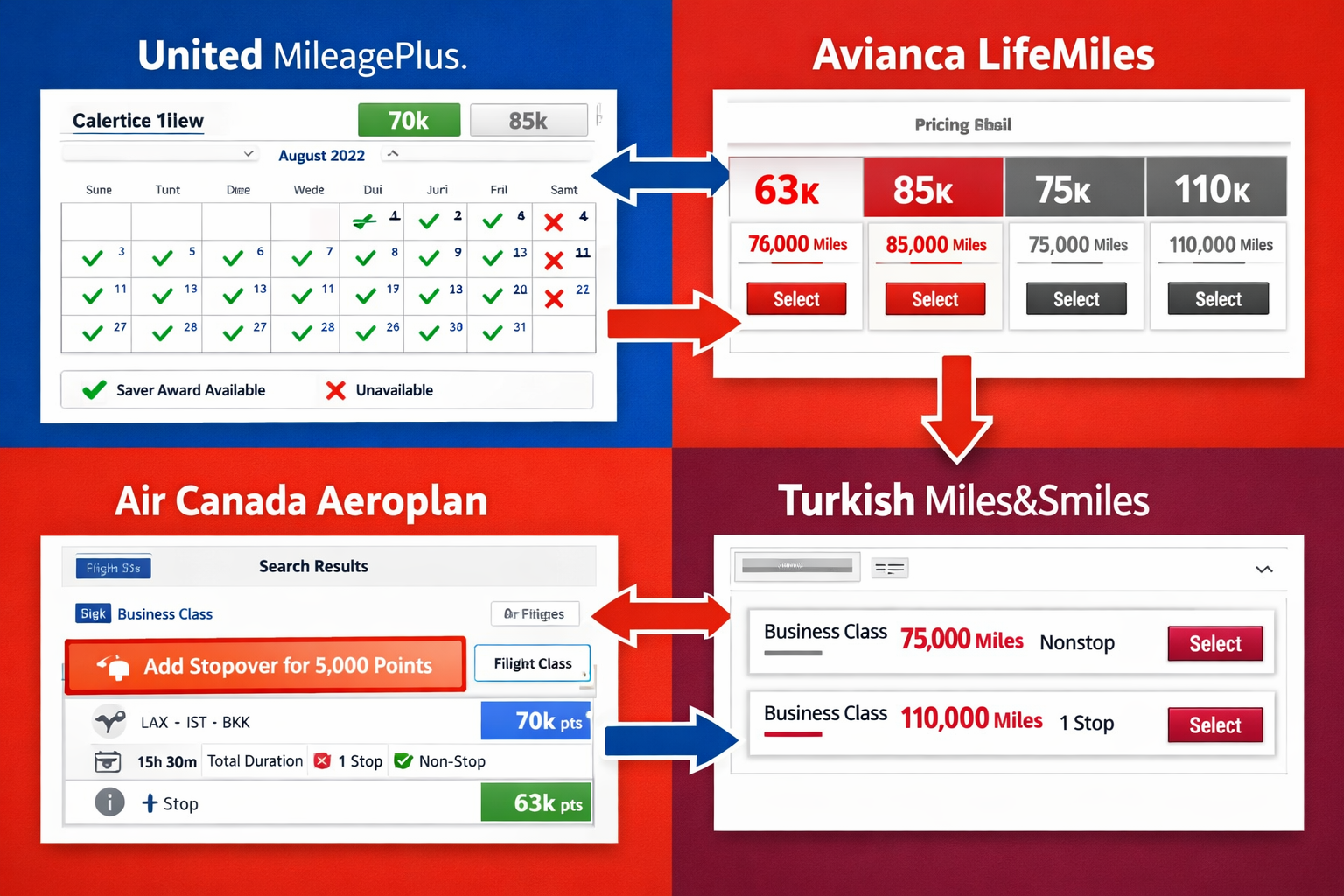
Star Alliance operates as a marketing alliance, not a unified booking system. Each of the 26 member airlines maintains independent award charts, search tools, and booking rules. This fragmentation creates both opportunity and complexity when you want to book Star Alliance Business Class awards.
The Four Primary Booking Programs
United MileagePlus serves as the baseline program for U.S.-based travelers. United shows the most comprehensive Star Alliance availability and operates the most reliable search calendar. However, United’s dynamic pricing means redemption rates fluctuate with demand, often making it the most expensive option on popular routes.
United accepts transfers from Chase Ultimate Rewards, Bilt Rewards, and Marriott Bonvoy. Transfer times are instant from Chase and Bilt, making United useful for last-minute bookings despite higher costs.
Avianca LifeMiles maintains fixed award charts and often prices Star Alliance Business Class 15-30% below United’s rates. LifeMiles excels on transatlantic routes (63,000 miles one-way in Business Class) and doesn’t apply fuel surcharges on most Star Alliance partners.
The tradeoff: LifeMiles’ search engine frequently misses available space that appears on United’s calendar. Most award bookings require a call to Avianca’s phone center, where wait times can exceed 90 minutes. LifeMiles accepts transfers from Amex Membership Rewards, Capital One, Citi ThankYou, and Bilt.
Air Canada Aeroplan introduced distance-based dynamic pricing in 2020, but still offers competitive rates on many routes. Aeroplan’s unique advantage is the stopover policy—you can add a second city to your itinerary for just 5,000 additional points, turning a simple Business Class award into a two-destination trip. Learn more about Aeroplan stopovers.
Aeroplan accepts transfers from Amex, Capital One, Chase, and Bilt. The program charges carrier-imposed surcharges on Lufthansa, Swiss, and Austrian flights, which can add $300-600 to Business Class awards.
Turkish Miles&Smiles offers the lowest redemption rates for certain Star Alliance routes—sometimes 40% below United’s pricing. The program uses a fixed award chart based on distance and doesn’t pass through most fuel surcharges.
The significant limitation: Turkish Airlines’ website only displays Turkish Airlines flights. Booking partner awards requires a call, and phone agents sometimes struggle to find available space. Turkish accepts transfers from Capital One and Citi ThankYou, though transfers can take 3-5 days.
Award Chart Structures in 2026
Understanding how each program prices awards helps identify sweet spots before searching.
| Route Example | United | Avianca | Aeroplan | Turkish |
|---|---|---|---|---|
| US-Europe (one-way) | 77,000+ | 63,000 | 70,000-90,000 | 57,500 |
| US-Asia (one-way) | 90,000+ | 87,000 | 90,000-110,000 | 67,500 |
| Europe-Asia (one-way) | 90,000+ | 78,000 | 75,000-100,000 | 62,500 |
| Within Europe | 30,000+ | 30,000 | 25,000-45,000 | 22,500 |
Note: The United prices shown are typical saver-level awards; United’s dynamic pricing can increase during peak demand.
Common Booking Rules Across Programs
Mixed-cabin awards (combining business and economy on different segments) price at the higher cabin level on most programs. If your itinerary includes one Business Class segment and one economy segment, you’ll pay the full Business Class rate for the entire journey.
Stopover policies vary significantly. Aeroplan allows one stopover for 5,000 points. United permits one stopover on roundtrip international awards for $0-100, depending on routing. Avianca and Turkish generally don’t allow stopovers on award tickets.
Change and cancellation fees have become more favorable since 2020. United charges $0 to redeposit miles on awards booked with miles (no close-in fee). Avianca charges $75 – $150, depending on timing. Aeroplan charges CAD $0-75. Turkish charges $50-100. All programs require paying any difference in miles if rebooking to a more expensive award.
Waitlist functionality exists only on United and Aeroplan. Other programs require confirmed space at the time of booking.
Where to Search for Business Class Award Availability
The most common mistake when learning to book Star Alliance business class is searching in the wrong place. Each program’s search tool shows different inventory, and some tools are more reliable than others.
The Optimal Search Strategy
Start with United’s website even if you plan to book through another program. United’s search calendar displays the most comprehensive Star Alliance availability and updates more frequently than partner sites. The calendar view shows an entire month at a glance, making it easy to identify which dates have Business Class space.
Log in to united.com, select “Book with miles,” enter your route, and click the calendar icon. Green dots indicate saver-level availability. Click specific dates to see which flights have Business Class space.
United’s search is most reliable for:
- United-operated flights (obviously)
- Lufthansa Group airlines (Lufthansa, Swiss, Austrian, Brussels Airlines)
- ANA (All Nippon Airways)
- Singapore Airlines
- Air Canada
- Scandinavian Airlines (SAS)
Cross-reference with Aeroplan’s search for additional confirmation, especially on Air Canada, Lufthansa Group, and European routes. Aeroplan sometimes shows space that United doesn’t, particularly on Air Canada’s flights.
Log into aeroplan.com, search your route, and filter results to show only Business Class. Aeroplan’s search is more reliable than Avianca’s but less comprehensive than United’s.
Avoid relying solely on Avianca’s search engine. LifeMiles’ website frequently fails to display available space that appears on United and Aeroplan. Use Avianca’s search as a final confirmation before calling to book, not as your primary search tool.
Turkish Airlines’ website only shows Turkish Airlines flights. You cannot search partner availability online. If you plan to book through Turkish Miles&Smiles, you must search on United or Aeroplan first, then call Turkish to confirm availability and book.
Using Third-Party Search Tools
Several paid services aggregate award availability across multiple programs, saving time when searching complex routes.
Seats.aero ($12/month) searches United, Aeroplan, Avianca, and other programs simultaneously. The tool excels at finding Business Class availability on specific date ranges and sends alerts when space opens. Seats.aero is particularly useful for monitoring multiple departure dates or alternative routings.
Point.me ($12-30/month depending on tier) searches across programs and calculates the best redemption value based on your points balances. The tool factors in transfer bonuses and shows cents-per-point (CPP) values for each option.
Award search tools like these work best for travelers booking multiple trips per year. For occasional award bookings, United’s free search calendar provides sufficient functionality. Compare current award search tools for detailed feature breakdowns.
Understanding Phantom Availability
Phantom availability occurs when a program’s search shows award space that doesn’t actually exist or cannot be booked. This happens most frequently with:
- Lufthansa Group flights on United’s website: United often displays Lufthansa Business Class space that Lufthansa hasn’t released to partners. When you try to book, the space disappears, or you have to call United, where phone agents confirm the seats aren’t actually available.
- Close-in availability (within 14 days): Some airlines release last-minute space that can take hours to propagate across partner systems. What appears available on United’s website might not be bookable through Avianca for 12-24 hours.
- Mixed-carrier itineraries: When searching multi-segment trips, search engines sometimes combine segments that can’t actually be booked together on a single ticket.
How to avoid phantom availability issues:
- Search on multiple platforms (United and Aeroplan minimum)
- For Lufthansa Group flights, verify availability on Aeroplan or by calling the booking program
- Screenshot your search results showing availability before transferring points
- For high-value redemptions, call the program to confirm space before transferring points
Comparing Redemption Rates Across United, Avianca, and Aeroplan
The same Business Class seat can cost dramatically different amounts depending on which program you use to book. Understanding these differences turns theoretical knowledge into practical savings.
Real-World Redemption Comparisons
New York (JFK) to Frankfurt (FRA) on Lufthansa Business Class:
- United MileagePlus: 77,000-110,000 miles one-way (dynamic pricing)
- Avianca LifeMiles: 63,000 miles one-way (fixed chart)
- Aeroplan: 70,000-85,000 points one-way (dynamic, plus ~$350 in Lufthansa surcharges)
- Turkish Miles&Smiles: 57,500 miles one-way (fixed chart, minimal surcharges)
Winner: Turkish at 57,500 miles, but requires phone booking and a 3-5 day transfer time from Capital One or Citi. Second place: Avianca at 63,000 miles with instant Amex transfers.
San Francisco (SFO) to Tokyo (NRT) on ANA Business Class:
- United: 90,000-120,000 miles one-way
- Avianca: 87,000 miles one-way
- Aeroplan: 90,000-100,000 points one-way
- Turkish: 67,500 miles one-way
Winner: Turkish at 67,500 miles. Second place: Avianca at 87,000 miles.
Los Angeles (LAX) to Sydney (SYD) via Tokyo on ANA Business Class:
- United: 110,000-140,000 miles one-way
- Avianca: 87,000 miles one-way (prices based on origin to first connection only)
- Aeroplan: 100,000-120,000 points one-way
- Turkish: 67,500 miles one-way (prices based on distance bands)
Winner: Turkish at 67,500 miles. Second place: Avianca at 87,000 miles.
When Each Program Offers the Best Value
Use United MileagePlus when:
- Booking last-minute awards (instant Chase transfers)
- Flying United-operated flights (best availability on their own metal)
- Booking complex itineraries with multiple stopovers
- Award space is limited, and United shows availabilitythat others don’t
Use Avianca LifeMiles when:
- Booking transatlantic Business Class (63,000 miles is a sweet spot)
- Flying routes without significant fuel surcharges
- You have Amex points and need instant transfers
- You’re willing to call for booking (most awards require phone booking)
Use Air Canada Aeroplan when:
- You want to add a stopover (extra city for 5,000 points)
- Booking Air Canada-operated flights (best availability)
- Flying within North America or to Europe on non-Lufthansa carriers
- You value flexible cancellation (CAD $0 for cancellations 24+ hours before departure)
Use Turkish Miles&Smiles when:
- Booking long-haul Business Class (best rates for distance-based pricing)
- You have time for 3-5 day transfers from Capital One or Citi
- You’re comfortable with phone bookings
- The route doesn’t involve complex connections
Calculating Cents Per Point (CPP) Value
Understanding redemption value helps determine whether to use points or pay cash. Calculate CPP by dividing the cash ticket price by the number of points required.
Example: A San Francisco to Frankfurt Business Class ticket costs $4,200 cash or 63,000 Avianca miles plus $89 in taxes.
- Cash price after taxes: $4,200
- Award price: 63,000 miles + $89
- Net value: $4,200 – $89 = $4,111
- CPP: $4,111 ÷ 63,000 = 6.5 cents per point
Good CPP values for Business Class awards:
- 4+ cents per point: Good value, generally worth booking
- 5-7 cents per point: Excellent value, strong redemption
- 8+ cents per point: Outstanding value, rare but possible
When to pay cash instead: If the CPP falls below 2 cents, consider whether the cash price is reasonable. Sometimes sale fares offer better value than award bookings, especially for domestic or short-haul Business Class.
For travelers holding premium travel credit cards with annual travel credits, factor those credits into your cash vs. points calculation.
Step-by-Step: Searching and Booking on Each Platform
Knowing where to search is only half the process. Actually completing bookings requires understanding each platform’s specific workflow and quirks.
How to Book Star Alliance Business Class Through United MileagePlus
Step 1: Search for Award Availability
- Log into united.com
- Select “Book with miles” toggle
- Enter origin, destination, and dates
- Click the calendar icon to view monthly availability
- Look for green dots indicating saver-level awards
- Select a date and review flight options
- Filter results to show only Business Class
Step 2: Evaluate Pricing and Routing
United displays the total miles required for each option. For multi-segment itineraries, click “Flight details” to see the routing and connection times.
Check whether the price shown is “Everyday” or “Saver” level. Saver awards represent better value. Everyday awards can cost 2-3x saver rates during peak periods.
Step 3: Add to Cart and Review Taxes
Click “Select” on your preferred flight, then proceed to the passenger information page. United displays the total cost, including taxes and fees, before final confirmation.
Typical taxes for international Business Class:
- US to Europe: $80-150 (or $350-600 on Lufthansa/Swiss/Austrian)
- US to Asia: $90-180
- Within North America: $30-80
Step 4: Complete Booking
If you have sufficient MileagePlus miles, complete the booking online. The confirmation appears immediately.
If you need to transfer points from Chase or Bilt:
- Log into your Chase Ultimate Rewards or Bilt account
- Select “Transfer to partners.”
- Choose United MileagePlus
- Enter the exact number of miles needed
- Confirm transfer (instant, appears within 5 minutes)
- Return to United’s website and complete booking
United phone booking: Call 1-800-864-8331 if online booking fails or you need to book complex routing. Phone agents can access some inventory not shown online, though wait times can exceed 60 minutes during peak hours.
How to Book Star Alliance Business Class Through Avianca LifeMiles
Step 1: Search on United’s Website First
Don’t start with Avianca’s search engine. Find your desired flights on United’s calendar, note the exact flight numbers, dates, and times, then verify availability on Avianca.
Step 2: Search on Avianca’s Website
- Log into lifemiles.com
- Enter your route and dates
- Select “Business” class
- Click “Search flights.”
- Review results—Avianca often shows fewer options than United
Step 3: Verify Award Pricing
If Avianca’s search displays your desired flights, note the miles required. Avianca’s fixed award chart means pricing won’t change based on demand.
Check the taxes and fees shown. Avianca doesn’t pass through fuel surcharges on most Star Alliance partners, keeping out-of-pocket costs low ($80-150 for most international Business Class awards).
Step 4: Attempt Online Booking
Avianca’s website allows online booking for simple routes (one-way or roundtrip on the same carrier). For mixed-carrier itineraries or complex routing, the website typically shows an error requiring phone booking.
If online booking works:
- Select your flights
- Enter passenger information
- Choose “Pay with miles.”
- Complete booking
Step 5: Phone Booking (Most Common)
For most Star Alliance awards, you’ll need to call Avianca:
- Call 1-866-919-0081 (US number, English-speaking agents)
- Wait times: 30-120 minutes, typical
- Have your flight details ready (flight numbers, dates, times)
- Confirm the agent sees availability before transferring points
- Provide your LifeMiles account number
- Wait while the agent tickets the reservation (can take 20-30 minutes)
Before calling, transfer points from Amex, Capital One, Citi, or Bilt:
- Amex: Instant (appears within 5 minutes)
- Capital One: Instant
- Citi: 24-48 hours
- Bilt: Instant
Pro tip: Call early morning EST (8-9 AM) for the shortest wait times. Avoid evenings and weekends when call volume peaks.
How to Book Star Alliance Business Class Through Air Canada Aeroplan
Step 1: Search for Awards
- Log into aeroplan.com
- Enter route and dates
- Select “Use points” and choose Business Class
- Click “Search flights.”
- Review results—Aeroplan shows dynamic pricing for each option
Step 2: Evaluate Pricing and Surcharges
Aeroplan displays the total points required plus taxes and fees. Pay attention to carrier-imposed surcharges:
- High surcharges: Lufthansa, Swiss, Austrian, Brussels Airlines ($300-600)
- Low surcharges: United, Air Canada, ANA, Singapore Airlines ($80-180)
- Moderate surcharges: Turkish, LOT Polish, TAP Portugal ($150-300)
If surcharges are high, compare the total out-of-pocket cost against booking through Avianca or Turkish, which don’t pass through most surcharges.
Step 3: Consider Adding a Stopover
Aeroplan’s stopover feature lets you add a second city for 5,000 points. For example, if flying from New York to Bangkok, you could stopover in Tokyo for 3 days, then continue to Bangkok—all on one award ticket.
To add a stopover:
- Use the multi-city search tool
- Enter your origin to stopover city (leg 1)
- Enter stopover city to final destination (leg 2)
- Select dates with at least 24 hours between flights
- Aeroplan prices the itinerary as one award plus 5,000 points
Step 4: Complete Booking Online
Aeroplan’s website handles most Star Alliance bookings online:
- Select your flights
- Enter passenger details
- Review total points and fees
- Confirm booking
The confirmation appears immediately. Aeroplan emails ticket numbers within 24 hours.
Transfer points before booking:
- Amex: Instant
- Capital One: Instant
- Chase: Instant
- Bilt: Instant
Aeroplan phone booking: Call 1-800-361-5373 if online booking fails or you need to book a complex routing. Phone agents can access inventory not shown online and help troubleshoot booking issues.
How to Book Star Alliance Business Class Through Turkish Miles&Smiles
Step 1: Search on United or Aeroplan
Turkish Airlines’ website only displays Turkish Airlines flights. To book partner awards, search availability on United’s website first, noting exact flight details.
Step 2: Create a Miles&Smiles Account
Register at turkishairlines.com/en-us/miles-and-smiles if you don’t have an account. Account approval is immediate.
Step 3: Transfer Points
Transfer points from Capital One or Citi ThankYou before calling:
- Capital One: 3-5 days typical
- Citi: 24-48 hours typical
Important: Turkish transfer times are slower than other programs. Plan accordingly and transfer points well before your desired booking date.
Step 4: Call Turkish to Book
- Call 1-800-874-8875 (US number)
- Wait times: 20-60 minutes, typical
- Provide your flight details (numbers, dates, times)
- The agent will search availability in their system
- Confirm pricing before proceeding
- Provide Miles&Smiles account number
- Agent tickets the reservation (15-30 minutes)
Turkish phone agent tips:
- Be specific about flight numbers—don’t just say “any flight to Europe.”
- If the first agent can’t find space, politely hang up and call back (different agents have varying skill levels)
- Request confirmation via email after booking
- Verify ticket numbers are issued within 24 hours
Common Turkish booking challenges:
- Agents sometimes struggle to find partner availability
- System can be slow to display search results
- Mixed-carrier itineraries may require supervisor approval
- Changes and cancellations must be done by phone ($50-100 fee)
Overcoming Common Booking Challenges and Phantom Availability
Even experienced travelers encounter obstacles when booking Star Alliance Business Class. Understanding common issues and their solutions prevents wasted time and points.
Phantom Availability on Lufthansa Group Flights
The problem: United’s website frequently displays Lufthansa, Swiss, and Austrian Business Class awards that can’t actually be booked. When you attempt to complete the booking, you receive an error message or the space disappears.
Why it happens: Lufthansa releases limited partner award space and restricts how far in advance partners can book. United’s search engine sometimes shows flights before Lufthansa has actually released them to partners.
The solution:
- Cross-reference Lufthansa availability on Aeroplan’s website
- If space shows on both United and Aeroplan, it’s likely real
- For high-value bookings, call United to confirm before transferring points
- Consider booking through Avianca or Turkish, which sometimes have access to different Lufthansa inventory
Alternative approach: Book non-Lufthansa Star Alliance carriers for European routes. United, Air Canada, SAS, LOT Polish, and TAP Portugal all fly transatlantic routes with more reliable award availability.
Close-In Availability Sync Issues
The problem: Award space released within 14 days of departure doesn’t always sync across all partner systems immediately. You might see availability on United but not on Avianca or Aeroplan.
Why it happens: Airlines batch-update partner availability every 12-24 hours. Last-minute releases take time to propagate across systems.
The solution:
- For bookings within 14 days, use United if you have Chase or Bilt points (instant transfers)
- If using Avianca, wait 24 hours after seeing space on United, then search again
- Call the booking program to confirm availability before transferring points
- Screenshot your United search showing availability as documentation
Mixed-Carrier Itinerary Booking Failures
The problem: Online booking engines fail when combining flights from multiple Star Alliance carriers, especially when routing is complex.
Why it happens: Each airline’s inventory system has different rules about which connections are allowed, minimum connection times, and routing restrictions. The online booking engine can’t always process these combinations.
The solution:
- Simplify your routing—direct flights or single-carrier connections book more reliably
- Call to book complex itineraries (phone agents have override capabilities)
- Book each segment separately if necessary (though this uses more points)
- Use Aeroplan for complex routing—their phone agents are most experienced with multi-carrier bookings
Award Space Disappearing During Booking
The problem: You find perfect award availability, start the booking process, and the space vanishes before you complete the transaction.
Why it happens: Multiple people search for the same flights simultaneously. Award inventory updates in real-time, so someone else might book the last seat while you’re entering passenger information.
The solution:
- Complete bookings quickly once you find space—don’t leave the booking page
- Have passenger information ready before starting the booking process
- For group bookings (2+ passengers), search and book immediately when space appears
- If space disappears, search nearby dates—airlines often release multiple days at once
Fuel Surcharge Surprises
The problem: You find a great award redemption rate, then discover $400- $600 in fuel surcharges at checkout.
Why it happens: Some airlines (Lufthansa Group, British Airways, Air France) charge carrier-imposed surcharges that programs pass through to award bookings. These aren’t traditional taxes—they’re airline fees.
The solution:
- Check total out-of-pocket costs before transferring points
- Book through Avianca or Turkish to avoid most surcharges
- Choose carriers with low surcharges (United, Air Canada, ANA, Singapore Airlines)
- Learn which airlines charge high fuel surcharges and how to avoid them
Phone Booking Wait Times
The problem: You need to call to complete a booking, but wait times exceed 90 minutes.
Why it happens: Airlines reduced call center staffing post-pandemic, even as award bookings increased. Peak times (evenings, weekends, Mondays) have the longest waits.
The solution:
- Call early morning EST (8-9 AM) for the shortest waits
- Use callback features when available (United and Aeroplan offer this)
- Try calling on Tuesday-Thursday for lower volume
- Have all information ready to minimize call duration
- Consider paying for premium phone lines (United Premier members get dedicated lines)
Transfer Partner Strategy: Which Credit Card Points to Use
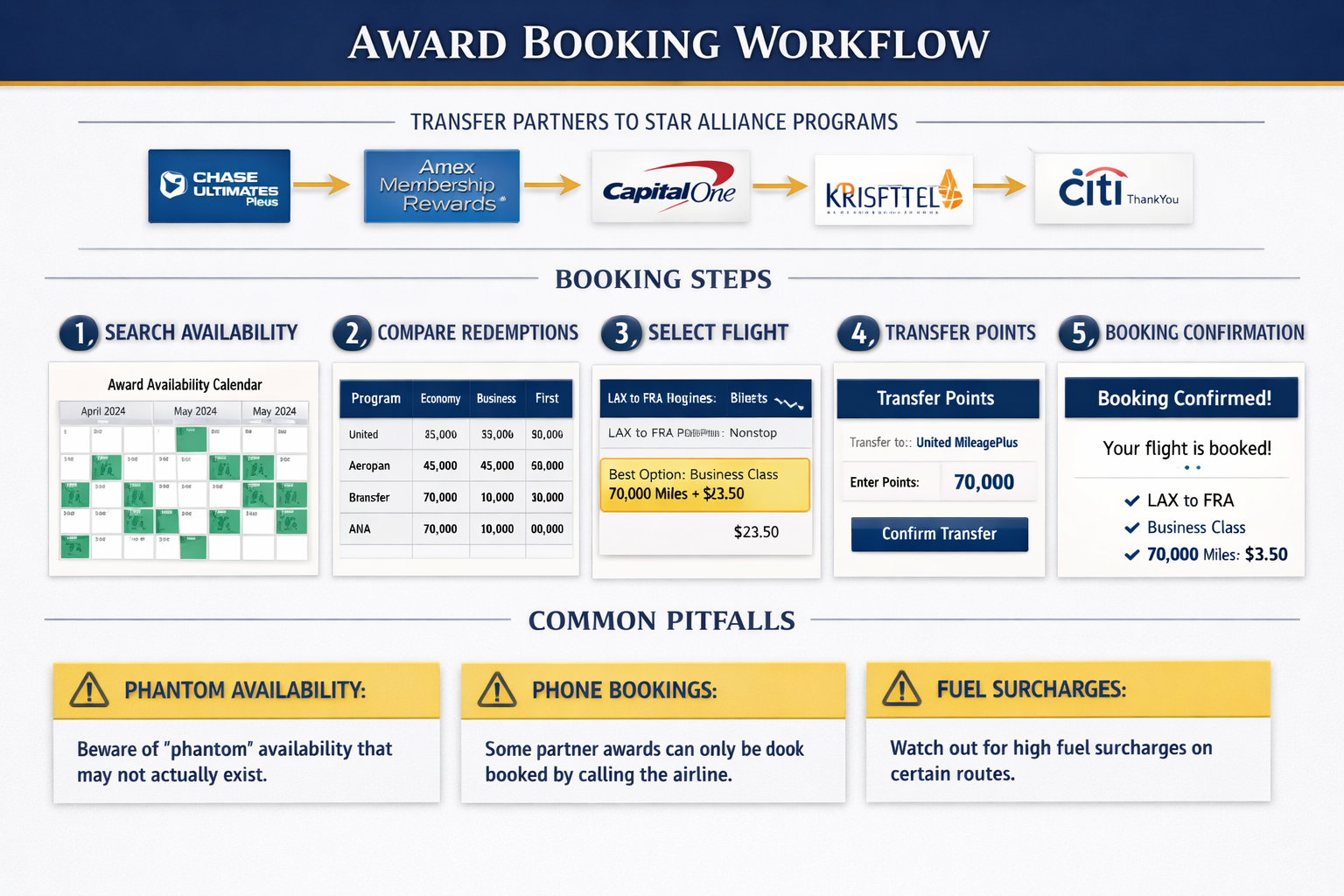
The transferable points you hold determine which Star Alliance programs you can access. Strategic decisions about which points to transfer—and when—maximize your booking flexibility and value.
Credit Card Transfer Partner Matrix
Understanding which credit cards transfer to which programs prevents getting stuck with points in the wrong currency.
Chase Ultimate Rewards transfers to:
- ✅ United MileagePlus (instant)
- ✅ Air Canada Aeroplan (instant)
- ❌ Avianca LifeMiles (not a partner)
- ❌ Turkish Miles&Smiles (not a partner)
Best for: United and Aeroplan bookings, last-minute awards requiring instant transfers.
Amex Membership Rewards transfers to:
- ❌ United MileagePlus (not a partner)
- ✅ Air Canada Aeroplan (instant)
- ✅ Avianca LifeMiles (instant)
- ❌ Turkish Miles&Smiles (not a partner)
Best for: Avianca and Aeroplan bookings, especially transatlantic Business Class through LifeMiles.
Capital One Miles transfers to:
- ❌ United MileagePlus (not a partner)
- ✅ Air Canada Aeroplan (instant)
- ✅ Avianca LifeMiles (instant)
- ✅ Turkish Miles&Smiles (3-5 days)
Best for: Maximum flexibility across programs, Turkish bookings for long-haul sweet spots.
Citi ThankYou Points transfers to:
- ❌ United MileagePlus (not a partner)
- ❌ Air Canada Aeroplan (not a partner)
- ✅ Avianca LifeMiles (24-48 hours)
- ✅ Turkish Miles&Smiles (24-48 hours)
Best for: Avianca and Turkish bookings, especially if you have time for 1-2 day transfer windows.
Bilt Rewards transfers to:
- ✅ United MileagePlus (instant)
- ✅ Air Canada Aeroplan (instant)
- ✅ Avianca LifeMiles (instant)
- ❌ Turkish Miles&Smiles (not a partner)
Best for: Maximum flexibility for instant transfers across three major programs.
See the complete credit card transfer partners guide for current transfer ratios and bonus opportunities.
When to Transfer Points vs. Hold Flexible Currency
Transfer immediately when:
- You’ve confirmed award availability and are ready to book
- Award space is limited and might disappear
- You’re booking within 14 days and need instant transfers
- A transfer bonus is ending soon (15-30% bonuses are common)
Hold points in flexible currency when:
- You’re still searching for availability
- Your travel dates are flexible
- You want to compare programs before committing
- You might need points for a different redemption
The risk of speculative transfers: Points transferred to airline programs cannot be returned or transferred to other programs. If you transfer 100,000 Chase points to United, then find better availability through Avianca, those United miles are stuck. Always confirm availability before transferring.
Leveraging Transfer Bonuses
Credit card programs periodically offer transfer bonuses (typically 15-30% extra miles when transferring to specific partners). These bonuses can significantly improve redemption value.
Example: A 30% transfer bonus to Avianca LifeMiles means 100,000 Amex points become 130,000 LifeMiles. If aBusiness Class award costs 87,000 miles, you only need to transfer 67,000 Amex points (67,000 × 1.3 = 87,100 miles).
Current 2026 transfer bonus patterns:
- Amex offers rotating bonuses every 2-3 months
- Chase offers bonuses less frequently (2-3 times per year)
- Capital One rarely offers bonuses, but has strong base transfer ratios
- Citi offers occasional bonuses (3-4 times per year)
Transfer bonus strategy:
- Monitor transfer bonus opportunities regularly
- Have specific redemptions in mind before transferring during bonuses
- Don’t transfer speculatively just because a bonus exists
- Calculate whether the bonus actually saves points on your specific route
Multi-Card Strategy for Maximum Flexibility
Holding points across multiple transferable currencies provides maximum booking flexibility. If you can’t book through one program, you have alternatives.
Recommended portfolio for Star Alliance bookings:
- Primary: Chase Ultimate Rewards or Amex Membership Rewards (200,000+ points)
- Secondary: Capital One Miles (100,000+ points for Turkish access)
- Tertiary: Citi ThankYou or Bilt (50,000+ points as backup)
This combination gives you access to all four major Star Alliance booking programs, with instant transfer capability to at least two of them.
For travelers building their points portfolio, focus on credit cards that offer strong international travel benefits and flexible transfer options.
Advanced Tips for Complex Multi-City Star Alliance Itineraries
Once you’ve mastered basic award bookings, complex multi-city itineraries unlock even more value from Star Alliance awards. These advanced strategies require more planning but can turn a simple trip into a multi-destination journey.
Maximizing Aeroplan’s Stopover Feature
Aeroplan allows one stopover on one-way awards for just 5,000 additional points. This feature works on both North American and international itineraries.
Example itinerary: New York to Bangkok with Tokyo stopover
- Leg 1: JFK to NRT (Tokyo) on ANA – 3-day stopover
- Leg 2: NRT to BKK (Bangkok) on Thai Airways
- Total cost: 90,000 Aeroplan points + 5,000 stopover fee = 95,000 points
Without the stopover, you’d need to book two separate one-way awards (90,000 points each, for a total of 180,000). The stopover saves 85,000 points.
Stopover routing rules:
- Stopover must be on the way to your destination (no backtracking)
- Minimum 24 hours, maximum 45 days at the stopover city
- Only one stopover per one-way award
- Stopover city must be a Star Alliance hub
Best stopover cities for Business Class awards:
- Europe to Asia: Istanbul (Turkish), Frankfurt (Lufthansa), Zurich (Swiss)
- US to Asia: Tokyo (ANA), Seoul (Asiana), Taipei (EVA Air)
- US to Europe: Reykjavik (Icelandair – not Star Alliance but useful), London (not recommended due to high taxes)
Open-Jaw Routing Strategies
Open-jaw awards let you fly into one city and return from another, with no award ticket needed for the surface segment between cities.
Example: Fly from San Francisco to Rome, travel overland to Paris, and return from Paris to San Francisco—all on one award booking.
Most Star Alliance programs allow open-jaws at no additional cost. The program prices are based on the total distance flown, not the surface segment.
Best uses for open-jaw awards:
- European trips (fly into one city, train to another, fly home)
- Multi-country Asia itineraries (fly into Tokyo, travel to Seoul, fly home from Seoul)
- South American routes (fly into Buenos Aires, travel to Santiago, fly home from Santiago)
Booking open-jaws:
- Use the multi-city search tool on United, Aeroplan, or Avianca
- Enter origin to destination A (inbound)
- Enter destination B to origin (return)
- Leave the middle segment blank
- Program prices as one roundtrip award
Positioning Flights for Better Availability
Sometimes the best award availability doesn’t originate from your home airport. Positioning flights—short domestic segments to reach better international departure points—can unlock space that doesn’t exist from your local airport.
Example: You live in Denver but want to fly to Frankfurt in Business Class. Denver-Frankfurt has limited Star Alliance Business Class availability, but San Francisco-Frankfurt has abundant space.
Strategy: Book a separate positioning flight from Denver to San Francisco (cash or separate award), then book your Star Alliance Business Class award from San Francisco.
Best positioning airports for Star Alliance:
- West Coast to Asia: San Francisco, Los Angeles, Seattle
- East Coast to Europe: New York (JFK/EWR), Washington DC (IAD), Chicago (ORD)
- Europe to Asia: Frankfurt, Zurich, Istanbul, Munich
Positioning flight considerations:
- Book positioning flights with sufficient connection time (4+ hours recommended)
- Use the same airline alliance when possible for through-checking bags
- Consider overnight positioning to avoid tight connections
- Factor positioning costs into the total trip value
Mixed-Cabin Bookings for Points Savings
When Business Class isn’t available for your entire journey, mixing business and economy on different segments can still provide value—though you’ll pay the business class rate for the entire ticket.
When mixed-cabin makes sense:
- Long-haul segment in business, short connection in economy (e.g., San Francisco-Tokyo Business Class, Tokyo-Bangkok economy)
- Outbound in business, return in economy (if return availability is limited)
- Business Class on overnight flights, economy on daytime segments
When to avoid mixed-cabin:
- If the economy segment is long-haul (defeats the purpose)
- If you’re paying full Business Class rates for mostly economy flying
- If you can wait for full Business Class availability
Using Award Calendars to Find Sweet Spot Dates
Star Alliance airlines release award space in predictable patterns. Understanding these patterns helps you find availability when others can’t.
General release patterns:
- United: 337 days in advance (11 months)
- Lufthansa Group: 360 days in advance, but partner access is often restricted until 14 days before departure
- ANA: 355 days in advance
- Air Canada: 355 days in advance
- Singapore Airlines: 355 days in advance
Best times to search:
- Immediately when the calendar opens (set alerts)
- 14-21 days before departure (last-minute releases)
- Off-peak seasons (January-March, September-November for most routes)
- Midweek departures (Tuesday-Thursday typically have better availability)
Calendar search strategy:
- Search the entire month using United’s calendar view
- Identify which dates have any Business Class availability
- Note patterns (e.g., Mondays and Fridays might be blocked, but Wednesdays are open)
- Adjust your travel dates to match availability patterns
For travelers planning 2026 trips now, review award travel predictions for 2026 to understand which programs are likely to offer the best value.
Booking Partner Awards on United’s Website
United’s website allows booking most Star Alliance partners online, but some carriers require phone booking. Understanding which partners book online saves time.
Book online through United:
- Air Canada
- Lufthansa Group (when space is available)
- ANA (most routes)
- Singapore Airlines (most routes)
- SAS
- Copa Airlines
Require phone booking:
- Asiana Airlines
- EVA Air (some routes)
- Thai Airways (some routes)
- TAP Portugal (most routes)
Phone booking tips for United:
- Call 1-800-864-8331
- Tell the agent you found award space online (provide flight details)
- Ask them to verify availability before placing on hold
- Confirm total miles and fees before ticketing
- Request email confirmation with ticket numbers
Conclusion: Your Action Plan to Book Star Alliance Business Class
Learning to book Star Alliance Business Class efficiently requires understanding multiple programs, search strategies, and booking procedures. The complexity creates opportunity—travelers who master these systems consistently book premium cabin awards for 30-50% fewer points than those who don’t.
Your immediate next steps:
- Audit your points balances: Review your Chase, Amex, Capital One, Citi, and Bilt accounts. Determine which Star Alliance programs you can access based on your current points portfolio.
- Start searching availability: Even if you’re not ready to book, practice searching on United’s website. Familiarize yourself with the calendar view, understand how to filter for Business Class, and note which routes have consistent availability.
- Create accounts with multiple programs: Set up United MileagePlus, Avianca LifeMiles, Air Canada Aeroplan, and Turkish Miles&Smiles accounts now. Having accounts ready prevents delays when you find award space.
- Monitor transfer bonuses: Sign up for alerts about transfer bonuses from your credit card programs. A 30% bonus can turn a good redemption into an exceptional one.
- Plan your first redemption: Choose a specific route and date range. Search availability across multiple programs. Compare redemption rates. Calculate cents-per-point value. This practical exercise cements the concepts better than reading alone.
Common mistakes to avoid as you start booking:
- Transferring points before confirming availability
- Searching only on Avianca’s website (use United first)
- Ignoring fuel surcharges when comparing programs
- Booking at non-saver rates without comparing alternatives
- Waiting too long when you find good availability (space disappears)
The best use of this guide: Bookmark it and return to the relevant sections when you’re ready to book specific routes. The step-by-step instructions for each program serve as checklists during actual bookings.
Star Alliance Business Class awards are among the best uses of transferable points. A single business class flight to Europe or Asia can deliver 5-7 cents per point value—far exceeding the value of cash-back cards or statement credits. The time invested in learning these systems pays dividends across multiple trips.
The travelers who succeed at booking Star Alliance Business Class share one trait: they start searching and practicing before they need to book. They understand that award availability is dynamic, programs change their rules, and the best redemptions require flexibility and knowledge.
Start searching today. The next time Business Class award space opens on your dream route, you’ll know exactly which program to use, how many points to transfer, and how to complete the booking before someone else claims those seats.

